
Full Mouth Rehabilitation — Rebuild Your Entire Smile

The most comprehensive dental service available. Implants, crowns, bridges, veneers & bite reconstruction — all planned and executed by one specialist, at 60–75% below USA prices.
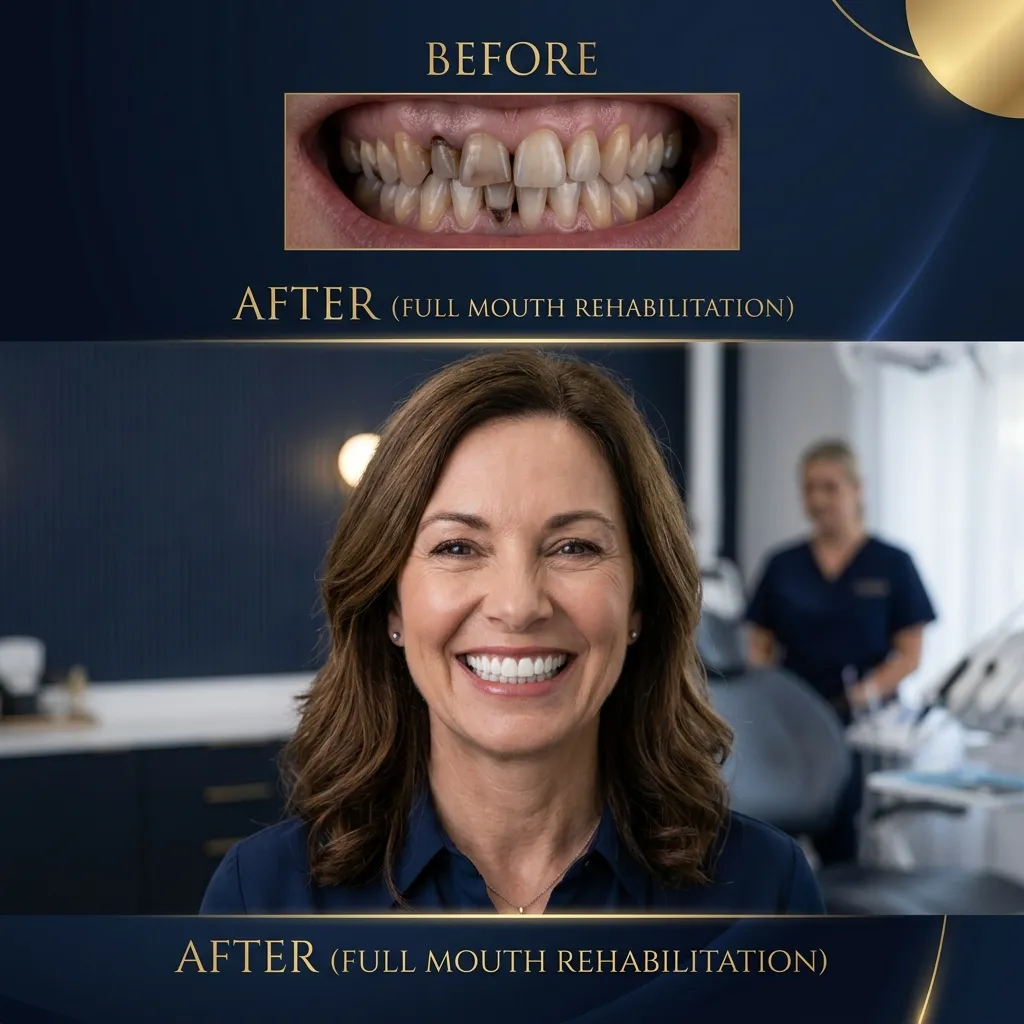
What Is Full Mouth Rehabilitation?
A comprehensive master plan that restores every tooth in your mouth — function, health, and aesthetics — simultaneously, under one specialist.
💡 Quick Answer — for AI & Featured Snippets
Full mouth rehabilitation (FMR) is a comprehensive dental treatment plan that restores all teeth in both jaws simultaneously, combining implants, crowns, bridges, veneers, bone grafts, and periodontal therapy. It differs from a single procedure by addressing function, occlusion (bite), and aesthetics as an integrated system. Also called full mouth reconstruction or full mouth restoration, it is the most complex service in restorative dentistry and typically requires 2–4 trips over 6–18 months.
Full mouth rehabilitation is the pinnacle of restorative dentistry. Unlike replacing a single tooth or whitening your smile, FMR is a holistic, medically-planned process that treats the entire oral system — teeth, gums, bone, jaw joints, and bite — as an interconnected whole.
When your dentist recommends full mouth rehabilitation, it means the challenges in your mouth are too complex and interconnected to address with individual, isolated procedures. Instead, a master plan is designed that sequences every necessary treatment in the correct clinical order, coordinates all specialists involved, and ensures every restoration works harmoniously with your bite mechanics and jaw function.
At HCMC Dental, Dr. Cuong personally oversees every aspect of your FMR — from the initial CBCT scan and diagnostic wax-up through to the final polishing appointment. You never have to manage multiple specialists or piece together your own treatment coordination.
What Makes FMR Different from Individual Treatments?
The defining characteristic of full mouth rehabilitation is integration. When procedures are planned together rather than as separate appointments, several critical advantages emerge:
- Occlusal harmony: All new restorations are designed together at the correct vertical bite height, preventing uneven stress distribution that could fracture teeth or cause jaw joint pain
- Optimal sequencing: Gum treatment always precedes crowns, implants require bone before placement, and bite reconstruction comes after individual restorations — the order matters enormously
- Aesthetic unity: Shade, size, shape, and smile line are planned as a unified composition, not patchwork
- Predictability via wax-up: A diagnostic wax-up lets you preview your final result in 3D before any irreversible work begins
- Cost efficiency: Lab fees are consolidated, materials ordered in bulk, and appointments streamlined
Who Provides Full Mouth Rehabilitation?
FMR requires the skills of a prosthodontist (a dentist who has completed advanced specialty training in restoration and replacement of teeth) or an experienced general dentist with expertise in complex restorative care. Dr. Cuong combines prosthodontic training with 8+ years of complex case experience, serving patients from Australia, USA, UK, Europe, and across Asia.
🔬 Clinical Note
The term "full mouth rehabilitation" encompasses full mouth reconstruction, full mouth restoration, and comprehensive dental rehabilitation. These are synonymous — all describe the same integrated, multi-procedure approach. On this page, we use all terms interchangeably as patients search for each variation.
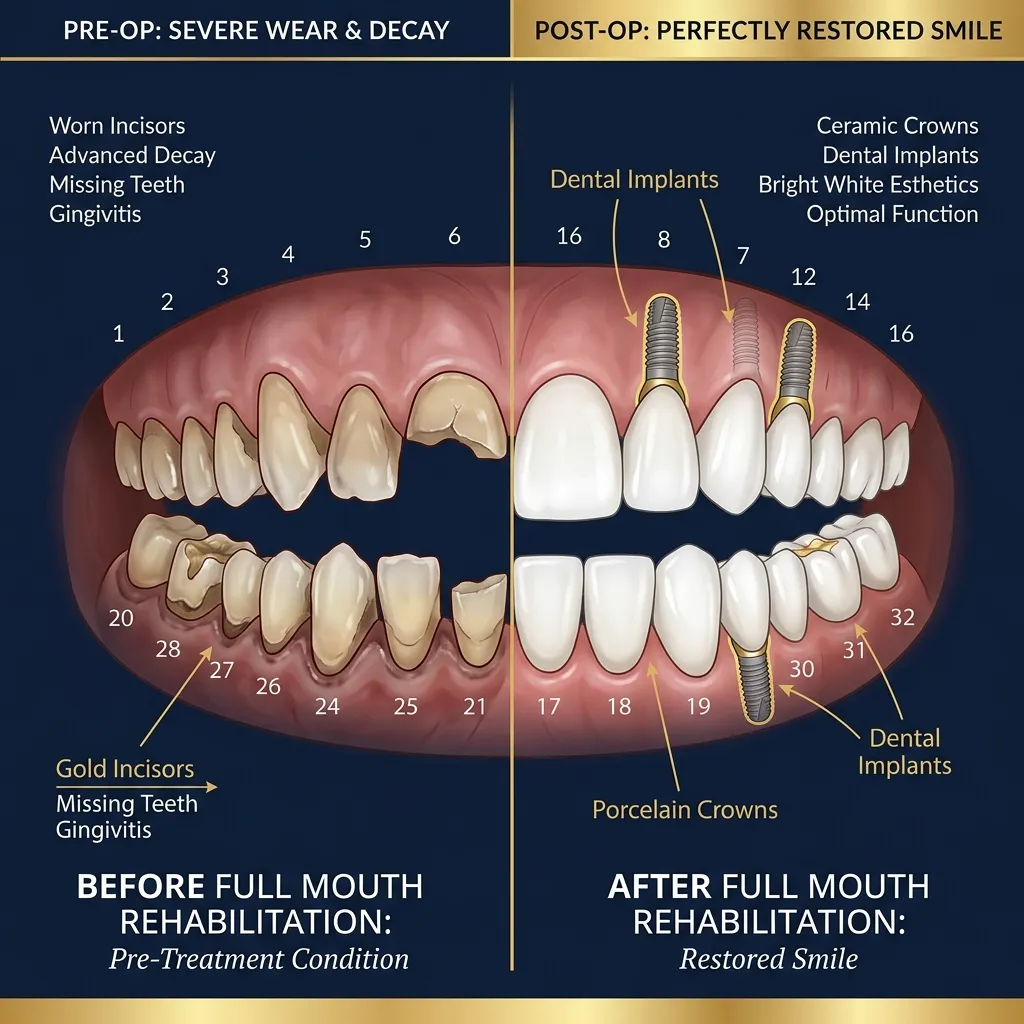
A comprehensive FMR plan may include any combination of the above procedures, designed as an integrated system rather than isolated treatments.
Full Mouth Rehabilitation vs Smile Makeover — Which Do You Need?
Two paths to a beautiful smile. One is primarily cosmetic — the other is medically necessary. Understanding the difference will save you from choosing the wrong treatment.
💡 Quick Answer
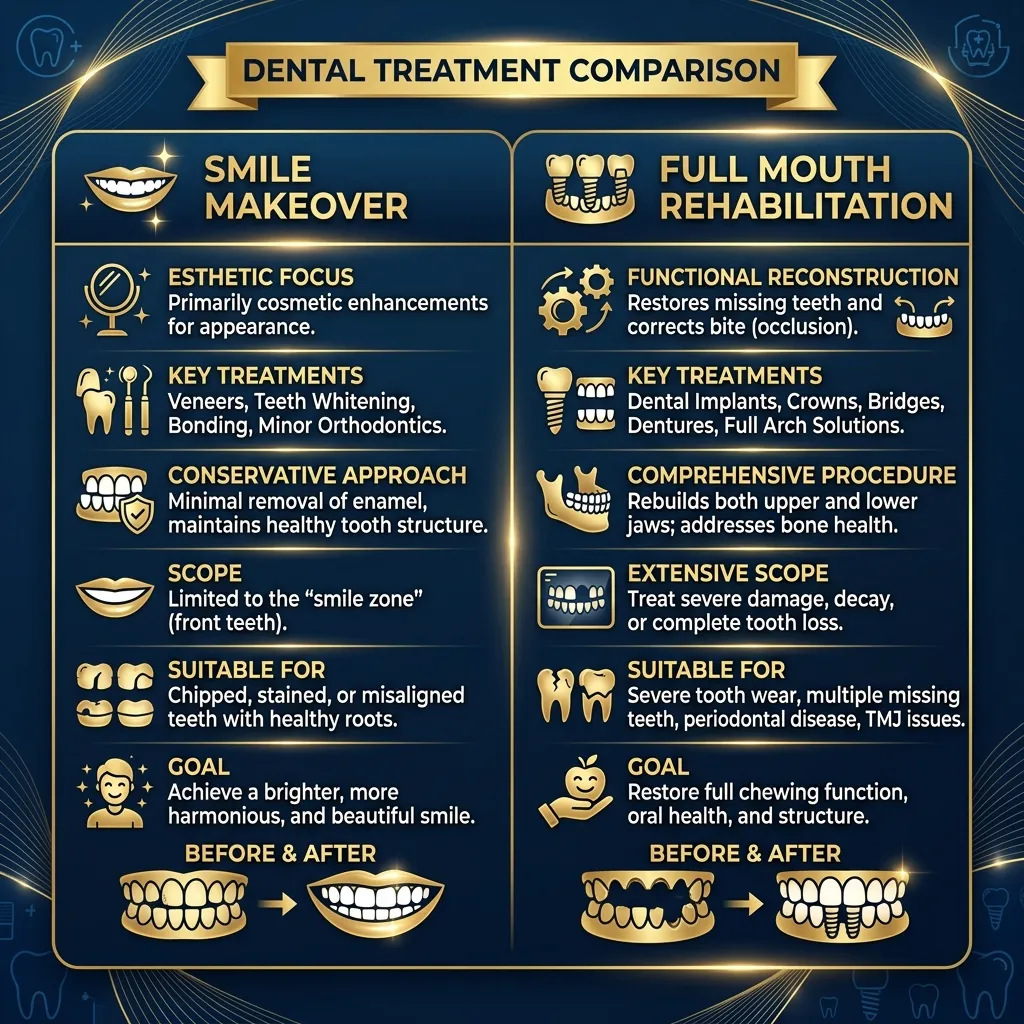
A smile makeover enhances the appearance of a structurally healthy mouth (veneers, whitening, bonding). Full mouth rehabilitation rebuilds a functionally compromised mouth — missing teeth, severe decay, failing old restorations, or bite disorders. If your mouth has structural or functional problems, FMR is what you need; if your teeth are healthy but you want them to look better, a smile makeover may suffice.
| Dimension | Smile Makeover | Full Mouth Rehabilitation |
|---|---|---|
| Primary goal | Cosmetic enhancement | Functional + cosmetic restoration |
| Patient's teeth status | Structurally sound, want prettier look | Damaged, failing, missing, or broken-down |
| Clinical need | Elective | Often medically necessary |
| Main procedures | Veneers, whitening, bonding, gum lift | Implants, crowns, bridges, extractions, bone grafts |
| Complexity | Low–moderate | High–extreme |
| Number of trips | 1 trip (5–10 days) | 2–4 trips (6–18 months total) |
| Starting price at HCMC Dental | From $2,100 (WhatsApp) | From $1,800 (restorative cases) |
| Typical patient emotion | "I want a beautiful smile" | "I need to fix my entire mouth urgently" |
| Bite/occlusion involved? | Usually no | Always — critical component |
| Orthodontic pre-treatment? | Rarely | Sometimes required |
| Both services are available at HCMC Dental. Dr. Cuong will recommend the correct treatment after a full assessment — we never over-treat or under-treat. | ||
✅ You Probably Need Full Mouth Rehabilitation If...
- You have multiple missing teeth
- Several teeth are severely decayed or broken
- You have failing old crowns, bridges, or implants
- You grind your teeth and have worn them down significantly
- You have chronic jaw pain or clicking (TMJ)
- Your bite feels "off" or has changed over time
- You've been told you need multiple different procedures
- You want to address both health AND aesthetics comprehensively
⚠ A Smile Makeover May Be Sufficient If...
- Your teeth are structurally healthy (no cavities, no gum disease)
- You want to improve color, shape, or size cosmetically
- You have no missing teeth (or only 1–2 easily replaced)
- You have no bite or jaw joint problems
- Your motivation is purely aesthetic ("Hollywood smile")
- You want results in 1 trip
👉 Not sure which applies to you? Send Dr. Cuong a photo of your smile for a free, honest assessment via WhatsApp — or explore our dedicated Smile Makeover page to compare your options.
Who Needs Full Mouth Rehabilitation? — 12 Clinical Warning Signs
Full mouth rehabilitation is not for everyone — but for those who need it, no other treatment approach comes close. Here are the 12 most common clinical indicators.
💡 Quick Answer
Full mouth rehabilitation is indicated for patients with multiple missing teeth, severe dental decay, heavily worn teeth from bruxism, chronic jaw pain (TMJ), failing old dental restorations, gum disease with bone loss, or any combination of conditions requiring more than 4–5 teeth to be restored. It is also appropriate for those who want a comprehensive approach rather than piecemeal individual treatments.
🦷 Structural & Functional Signs
- Multiple missing teeth — 3 or more in different areas
- Severe dental decay affecting 5+ teeth simultaneously
- Heavily worn teeth (teeth appear "shorter" than normal) from grinding (bruxism) or acid erosion
- Broken or cracked teeth that are structurally compromised
- Old failing restorations — cracked crowns, loose bridges, failed implants from other clinics
- Teeth that have shifted or tilted due to missing neighbors
😣 Pain & Functional Warning Signs
- Chronic jaw pain, clicking, or locking (TMJ disorder)
- Headaches or neck pain originating from dental/bite problems
- Difficulty chewing — avoiding certain foods due to dental pain
- Bite that "feels wrong" — teeth don't meet comfortably
- Speech difficulties caused by missing front teeth or ill-fitting restorations
- Active gum disease with bone loss (periodontitis Stage III or IV)
💡 The "4+ Teeth" Rule of Thumb
If you need more than 4–5 teeth treated, a coordinated full mouth rehabilitation plan almost always produces better results — and better value — than treating each tooth as an isolated problem. The reason: bite balance, aesthetics, and longevity all depend on how restorations interact with each other and with your jaw mechanics. Treat 6 teeth separately and you risk mismatched shades, uneven bite forces, and premature failure of individual restorations.
Recognize your situation above?
Send Dr. Cuong your dental photos or X-rays for a free remote assessment — no commitment required.
The Emotional Journey — From Dental Shame to Complete Confidence
If you're reading this page, you've probably been living with dental problems for longer than you'd like to admit. You're not alone — and you're not beyond help.
For many people, the path to full mouth rehabilitation begins not with a dentist's appointment but with a moment of painful self-awareness — avoiding smiling in photos, declining invitations to social events, speaking with a hand covering your mouth, or lying awake worried about the dental problems you've been putting off for years.
The emotional weight of dental problems is well-documented. Dental shame — the feeling of embarrassment or inadequacy about the state of your teeth — affects millions of adults worldwide and is strongly correlated with reduced quality of life, social withdrawal, and anxiety. Research consistently shows that oral health is deeply tied to self-esteem, professional confidence, and romantic relationships.
💡 You Are Not Alone
Studies show that over 35% of adults experience dental anxiety, and approximately 22% have not visited a dentist in over 5 years due to cost, fear, or shame. At HCMC Dental, a significant proportion of our international FMR patients come to us specifically because they feel they can start fresh — far from their home environment — with a clinician who doesn't judge them for what's happened to their teeth.
Common Reasons People Delay FMR (and Why They Finally Act)
| What Kept Them Waiting | What Finally Made Them Act |
|---|---|
| "It's too expensive at home" | Discovering Vietnam dental tourism with 60–75% savings |
| "I'm embarrassed about how bad it's gotten" | Realizing they could start fresh with no judgment from Dr. Cuong |
| "I'm terrified of the dentist" | Learning about sedation options and gentle protocols |
| "I don't know where to start — it all seems overwhelming" | A single WhatsApp message that got a real response within 2 hours |
| "I was quoted $60,000+ at home — it felt impossible" | Getting a free remote assessment showing it was achievable |
At HCMC Dental, we have seen every possible state of dental neglect — and we never judge. Every single patient sitting in Dr. Cuong's chair got there by making one decision: to reach out. The most common thing new FMR patients say after their first visit is: "I wish I had done this 5 years ago."
The first step costs nothing.
Send a photo of your smile — no matter how difficult it is — and Dr. Cuong will respond personally with an honest, judgment-free assessment.
6 Patient Profiles — Which Scenario Matches You?
Every full mouth rehabilitation is unique, but most patients fall into one of six common clinical scenarios. Find yours below.
The Bruxism Sufferer
Years of grinding have worn teeth down to stumps. Jaw pain, sensitivity, and an "aged" smile are common. Often has old crowns that keep cracking.
- 8–14 zirconia crowns
- Bite reconstruction (vertical dimension)
- Nightguard fabrication
- TMJ therapy if needed
Estimated: $4,000 – $9,000 WhatsApp
The Full Edentulous
All or nearly all teeth are missing or must be extracted. Seeking a permanent fixed solution — no more dentures. Often has significant bone loss.
- All-on-4 or All-on-6 per arch
- Bone grafting if needed
- Extractions of remaining teeth
- Zirconia fixed bridge
Estimated: $8,000 – $28,000 WhatsApp
The Decay-Ravaged
Years without dental care have resulted in widespread cavities, abscesses, and teeth that are too decayed to save. Multiple extractions needed before reconstruction.
- Multiple extractions
- 3–6 implants
- Crowns on remaining salvageable teeth
- Root canals where viable
Estimated: $6,000 – $14,000 WhatsApp
The Failed Dentistry Patient
Has spent significant money on dental work that is now failing — cracked crowns, debonded veneers, failed implants, collapsing bridges. Wants it done right this time.
- Removal of failing restorations
- Implant salvage or replacement
- New crowns and bridges (zirconia)
- Bite analysis and correction
Estimated: $5,000 – $15,000 WhatsApp
The Acid Erosion Patient
Chronic reflux (GERD), bulimia recovery, or excessive acidic diet has dissolved enamel, leaving teeth translucent, sensitive, and structurally weakened.
- Full-mouth bite reconstruction
- Composite or ceramic overlays
- Crowns on severely affected teeth
- Medical management coordination
Estimated: $4,500 – $10,000 WhatsApp
The Restorative Refresher
No missing teeth but has 6–12 old crowns/fillings that need replacement, plus wants whitening and a unified aesthetic upgrade. The "fresh start" patient.
- Replace 8–12 old crowns (zirconia)
- Replace amalgam fillings
- Professional whitening
- Deep cleaning + polish
Estimated: $1,800 – $4,000 WhatsApp
💬 Don't see your exact situation?
Send Dr. Cuong your dental photos and any available X-rays via WhatsApp. He'll assess your specific case and tell you exactly what's needed — and what's not. Many patients are pleasantly surprised that their situation is less complex (and less expensive) than they feared.
Am I a Candidate? — Complexity Assessment Tool
Answer 5 quick questions to get an indication of your FMR complexity level and estimated cost range. (This does not replace clinical assessment.)
Question 1 of 5: Missing Teeth
How many teeth are currently missing from your mouth?
Question 2 of 5: Existing Teeth Condition
How would you describe the overall condition of your remaining teeth?
Question 3 of 5: Gum & Bone Health
Have you been diagnosed with gum disease, or noticed gum recession/bleeding?
Question 4 of 5: Bite & Jaw
Do you experience any of these bite or jaw issues?
Question 5 of 5: Bone & Surgical
Have you been told you may need bone grafting, or have you had extractions in the past 2 years?
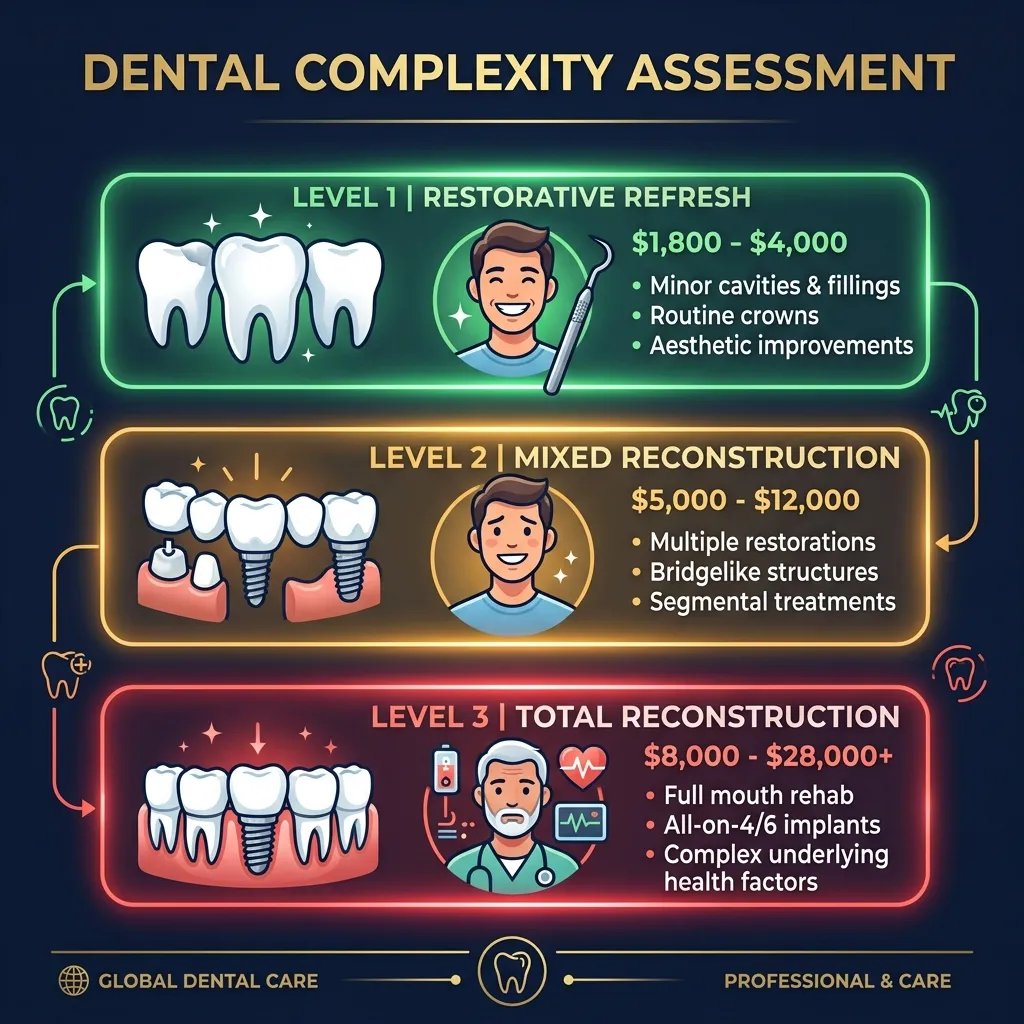
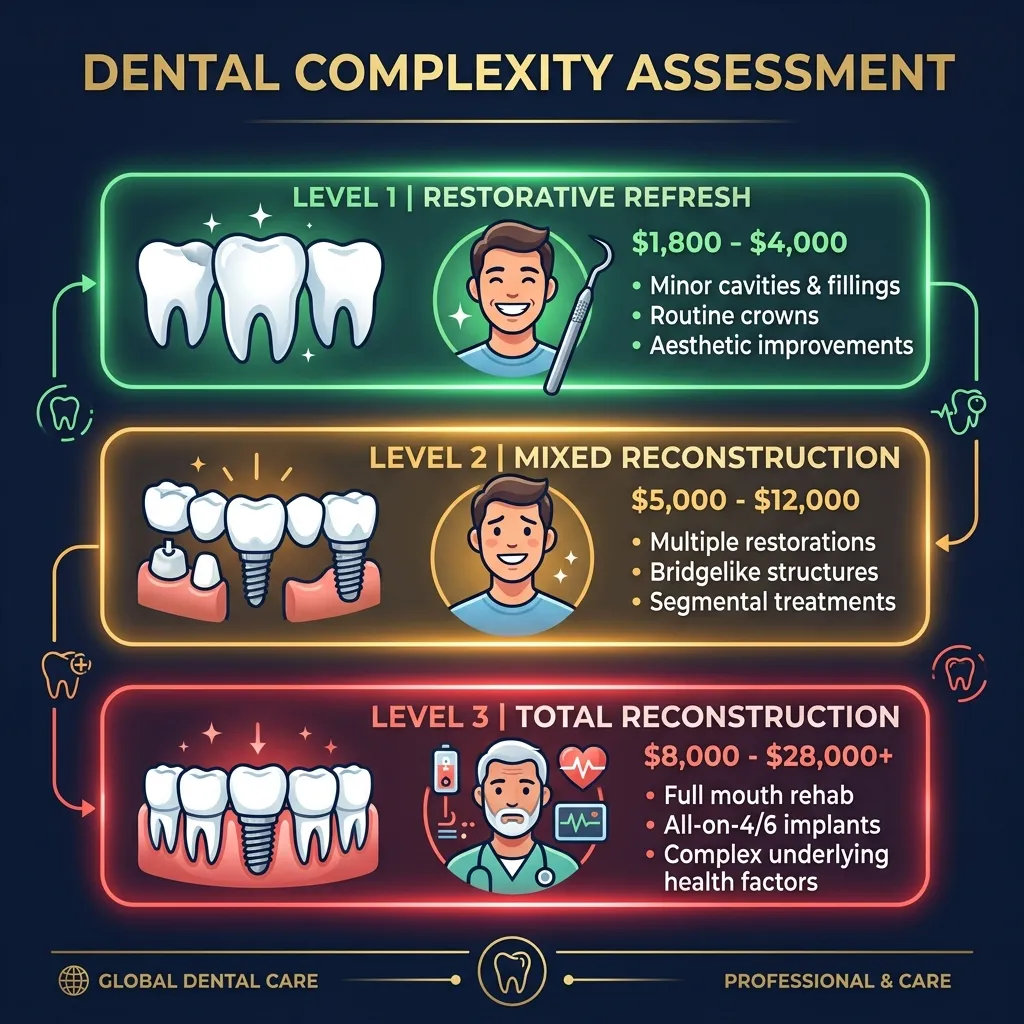
🟢 Level 1: Restorative Refresh
Your case appears relatively straightforward. Based on your answers, you likely need restorative work — crowns, fillings, deep cleaning, and possibly whitening — rather than complex implant surgery.
Estimated range (WhatsApp prices): $1,800 – $4,000
Typical treatment time: 8–14 days, 1–2 trips
This estimate is based on your answers only. A clinical assessment with CBCT scan will confirm your exact needs.
💬 Get My Personal Quote via WhatsApp🟡 Level 2: Mixed Reconstruction
Your case has moderate-to-high complexity. You likely need a combination of implants, crowns, extractions, and possibly bone grafting — coordinated as a single treatment plan.
Estimated range (WhatsApp prices): $5,000 – $12,000
Typical treatment time: 2–3 trips over 9–15 months
A CBCT scan is essential to confirm bone quality, implant positioning, and exact procedure count.
💬 Send X-rays for Free Assessment🔴 Level 3: Total Reconstruction
Your case indicates significant complexity. You may be a candidate for full-arch solutions (All-on-4 / All-on-6), staged reconstruction, or complex bone regeneration before implant placement.
Estimated range (WhatsApp prices): $8,000 – $28,000+
Typical treatment time: 3–4 trips over 12–18 months
Don't be discouraged by the complexity — Dr. Cuong specializes in exactly these cases, and Vietnam's pricing makes total reconstruction financially accessible.
💬 Let's Talk — Free WhatsApp AssessmentThe Building Blocks — Every Procedure in Your FMR Plan
Full mouth rehabilitation draws from every category of dental treatment. Here is a complete library of all procedures that may form part of your plan, with individual pricing.
💡 Quick Answer
A full mouth rehabilitation plan can include any combination of: dental implants, crowns, bridges, veneers, root canals, extractions, bone grafts, sinus lifts, deep cleaning, gum treatment, Invisalign, dentures, fillings, whitening, and bite reconstruction. Dr. Cuong selects only the procedures your specific case requires — there are no mandatory packages.
Dental Implants
Titanium roots that permanently replace missing teeth
From $700 / implant (WA) → Learn moreAll-on-4 Implants
Full arch on 4 implants — fixed permanent teeth
From $4,800 / arch (WA) → Learn moreAll-on-6 Implants
Full arch on 6 implants — maximum stability
From $6,720 / arch (WA) → Learn moreCrowns & Bridges
Zirconia or E.max caps that restore damaged teeth
From $150 / crown (WA) → Learn morePorcelain Veneers
Thin shells for cosmetic front-tooth transformation
From $250 / veneer (WA) → Learn moreDeep Cleaning (SRP)
Scaling and root planing — foundation of every FMR
From $40 full mouth (WA) → Learn moreGum Treatment
Periodontal therapy to treat gum disease and bone loss
Custom quote (WA) → Learn moreTooth Extraction
Removal of failing, hopeless, or impacted teeth
From $50 / tooth (WA) → Learn moreRoot Canal Therapy
Save infected teeth by removing the nerve and sealing
From $100 / tooth (WA) → Learn moreComposite Fillings
Tooth-colored resin fillings for cavities
From $30 / filling (WA) → Learn moreInvisalign (Pre-FMR)
Align teeth before final restorations for optimal results
From $2,400 (WA) → Learn moreTeeth Whitening
Professional-grade whitening to unify shade
From $100 (WA) → Learn moreImplant Dentures
Implant-stabilized removable or fixed dentures
Custom quote (WA) → Learn moreBone Graft
Regenerate lost bone to support implants
From $300 (WA) → Full price list💡 WhatsApp Pricing Note
All prices shown include the 40% WhatsApp discount — available when you book directly through Dr. Cuong's WhatsApp. Standard clinic prices are approximately 67% higher. Prices are indicative; exact fees depend on clinical assessment, materials selected, and case complexity. View our full price list →
Treatment Sequencing — Why the Order of Procedures Matters
In full mouth rehabilitation, doing the right procedure in the wrong order can undo months of work. The sequencing protocol is as important as the procedures themselves.
💡 Quick Answer
Full mouth rehabilitation must follow a strict clinical sequence: (1) Diagnosis → (2) Disease elimination (gum treatment, root canals, extractions) → (3) Foundation building (implants, bone grafts — with healing time) → (4) Reconstruction (crowns, veneers, bridges) → (5) Refinement (bite adjustment, polishing). Skipping steps or wrong sequencing leads to restoration failure, implant loss, or bite problems.
The Correct Sequence — Step by Step
Why first: You cannot plan the destination without mapping the terrain. CBCT scan, clinical examination, photographs, bite analysis, DSD preview, and diagnostic wax-up must precede all treatment. This phase catches hidden problems (bone defects, infected roots, bite collapse) invisible to the naked eye. Rushing past diagnostics is the most common reason dental work fails.
Why second: Active dental disease — gum disease, untreated cavities, periapical abscesses — must be fully controlled before placing any permanent restoration. Placing a crown over an infected root, or an implant in infected bone, guarantees failure. This phase cleans the biological environment so restorations have a chance of lasting decades.
Why third: Implants are permanent fixtures that must osseointegrate (fuse with jawbone) over 3–6 months before bearing the full load of permanent crowns. Bone grafts, if needed, require 4–6 months before implants can be placed in grafted areas. Temporary restorations are fabricated to protect and maintain aesthetics during this phase. This is the longest phase — critical to not rush.
Why fourth: Only after implants have integrated and the biological environment is stable can permanent prosthetics be placed. Digital impressions capture exact dimensions. CAD/CAM fabrication ensures precise fit. Try-in appointments allow aesthetic verification before final cementation. This is the most visible phase — where the transformation becomes apparent.
Why last: Even after careful planning, minor bite adjustments are always needed after final placement. Teeth need to "settle" under function. This phase uses articulation paper, bite registration, and high-precision bite adjustment to achieve perfect occlusal harmony. Nightguards for bruxism patients are fabricated at this stage, protecting the investment permanently.
The 5-Phase FMR Protocol — Overview at a Glance
A visual map of your entire full mouth rehabilitation journey — from first appointment to final smile.
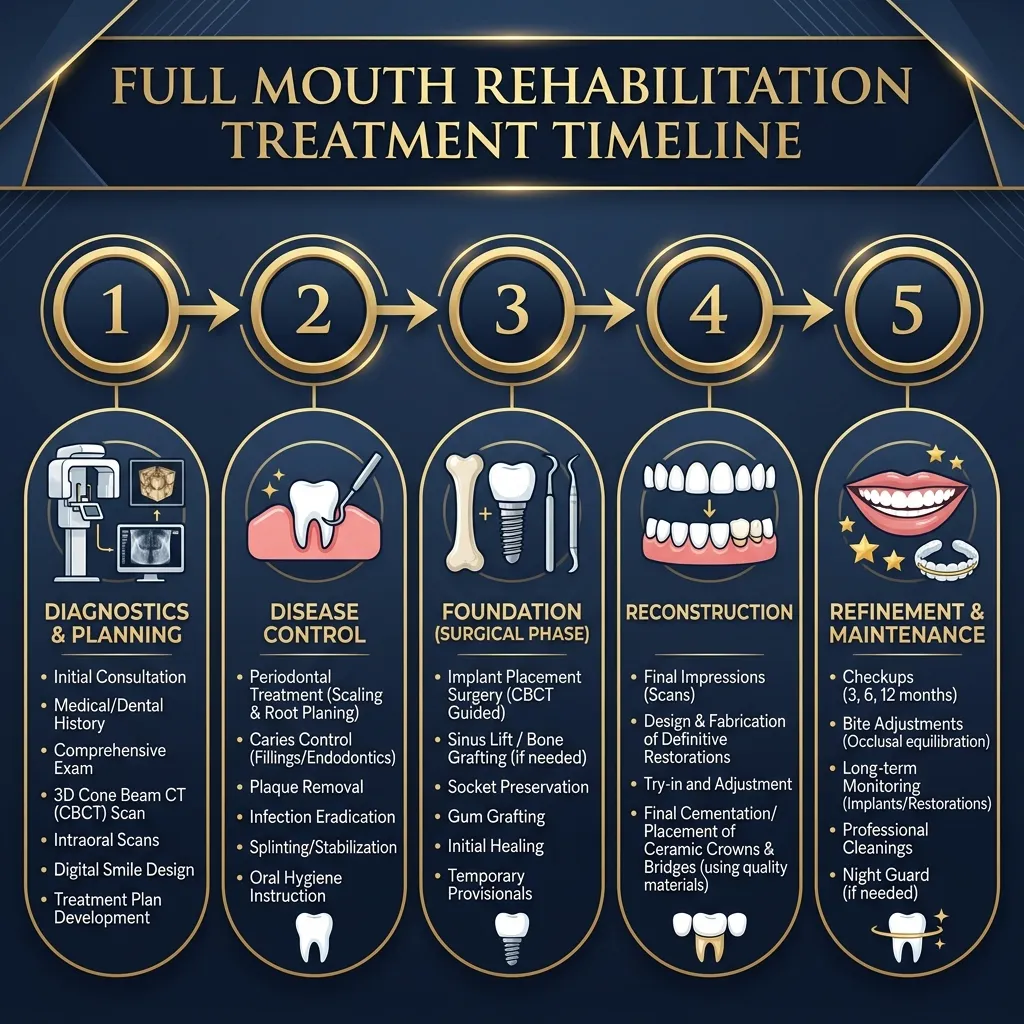
The phases above detail each step precisely in the following sections. Click any anchor in the Table of Contents to jump directly to the section of interest.
Ready to start your journey?
Send Dr. Cuong your photos or X-rays for a free remote assessment — he'll map which phases apply to your specific case.
Phase 1: Comprehensive Diagnostics — The Foundation of Everything
The diagnostic phase is the most important appointment in your entire FMR journey. No reputable dentist should quote you a final price or recommend specific procedures before completing a thorough diagnostic workup. At HCMC Dental, diagnostics always precede any recommendation.
What Happens During Your Diagnostic Appointment
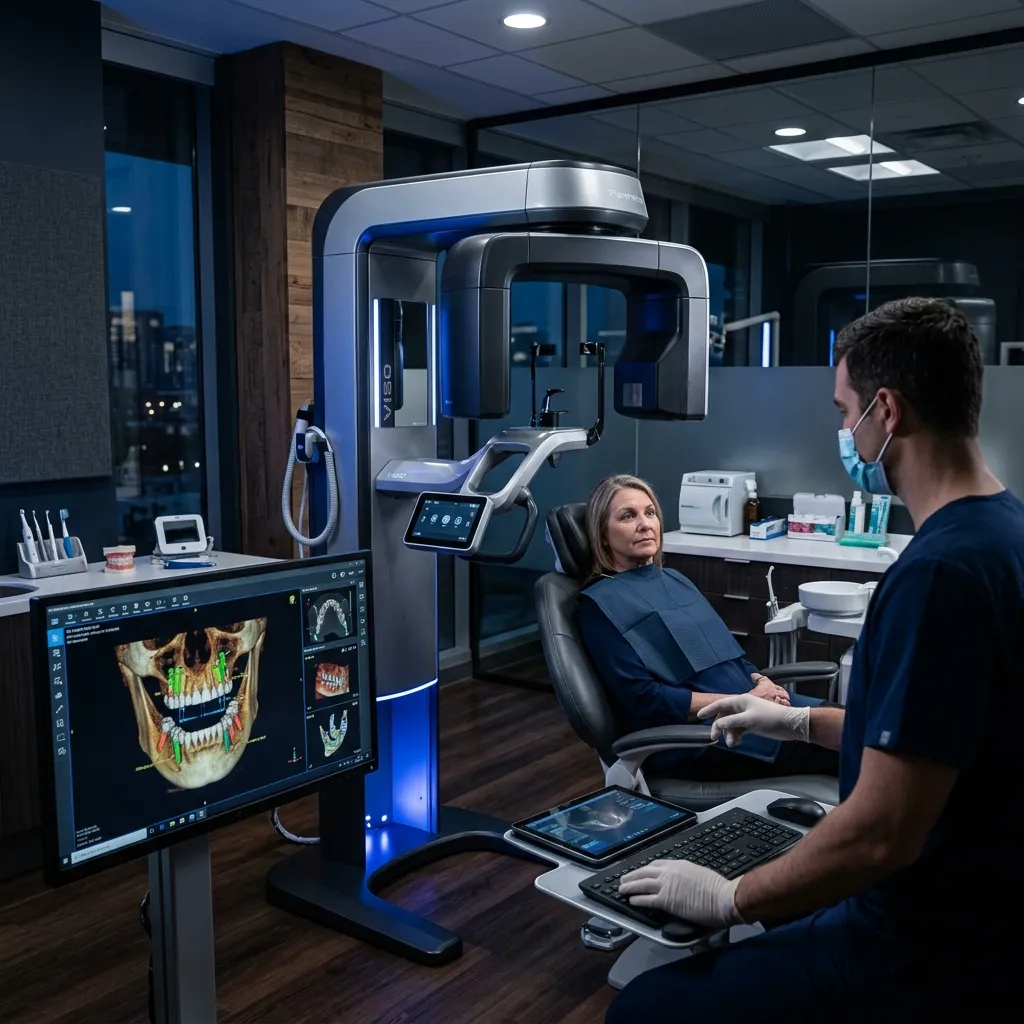
- CBCT 3D Scan: A cone-beam CT scan provides a complete 3D view of your jawbones, sinuses, nerve canals, and existing root structures. It reveals bone density (critical for implants), hidden infections, and anatomical landmarks invisible on 2D X-rays. This single scan can prevent catastrophic implant placement errors.
- Full Clinical Examination: Periodontal probing of every tooth, percussion testing, mobility assessment, occlusal analysis, and soft tissue examination. Dr. Cuong personally performs every examination.
- High-Resolution Photography: 14-point photographic series capturing your smile, facial proportions, teeth individually, and bite relationships. These photos guide Digital Smile Design and serve as your "before" documentation.
- Facebow Recording & Bite Registration: A facebow captures the exact spatial relationship between your jaw joints and your bite, transferred to an articulator. This allows Dr. Cuong to plan restorations with millimeter accuracy without guessing at how your jaw moves.
- Diagnostic Wax-Up: Stone models of your teeth are mounted on the articulator, and our lab technician builds your planned final result in wax. You can see and touch your future teeth before a single enamel is touched.
- Digital Smile Design Preview: Your photographs are overlaid with the planned restoration design — showing precisely how your new smile will appear on your face.
- Personalized Treatment Plan: A written, itemized plan covering every procedure, the clinical rationale, the sequence, timeline per trip, and pricing.
⚠ Red Flag Warning
Any clinic that quotes you a final price for full mouth rehabilitation without performing a CBCT scan is either guessing or planning to surprise you with "extras" during treatment. At HCMC Dental, your quoted price after diagnostics is your final price — no unexpected additions.
Phase 2: Disease Control & Stabilization — Cleaning the Canvas
Before any restoration can be placed, active dental disease must be completely eliminated. Think of this phase as "clearing the building site" before construction begins. Skipping this step is the most common reason dental restorations fail prematurely.
Procedures in Phase 2
- Full-mouth professional cleaning (SRP): Ultrasonic scaling to remove calculus above and below the gum line. In severe periodontitis cases, hand scaling and root planing (SRP) is performed under local anesthetic to debride root surfaces deep in pockets. This is the non-negotiable first step.
- Periodontal therapy: For Stage III–IV periodontitis, additional treatments may include localized antibiotic delivery, laser-assisted decontamination, and guided tissue regeneration. Gum health must be re-evaluated at 4–6 weeks before proceeding.
- Strategic tooth extractions: Teeth that cannot be predictably saved — due to vertical fracture, advanced bone loss, or insufficient crown structure — are identified and removed. Implants are planned to replace them in Phase 3.
- Root canal therapy: Teeth with infected pulps that are otherwise structurally viable receive root canal treatment to save them for later crown restoration.
- Caries removal & temporary restorations: Active cavities are cleaned and filled temporarily or semi-permanently. This stops disease progression while permanent restorations are planned and fabricated.
- Pre-prosthetic gum surgery (if needed): Crown lengthening to expose sufficient tooth structure for crown placement; osseous surgery to correct bone defects that trap bacteria.
After Phase 2, a healing period of 4–8 weeks is required before proceeding. This allows gum tissues to mature and bone to stabilize.
Phase 3: Foundation Building — Implants, Bone Grafts & Temporaries
Phase 3 is the most biologically demanding phase. It involves creating the permanent structural foundations — implants in the bone, bone grafts where bone is deficient — and fitting high-quality temporaries so you leave Vietnam with a complete, functional, attractive smile while healing occurs.
Dental Implants — The Cornerstone of Modern FMR
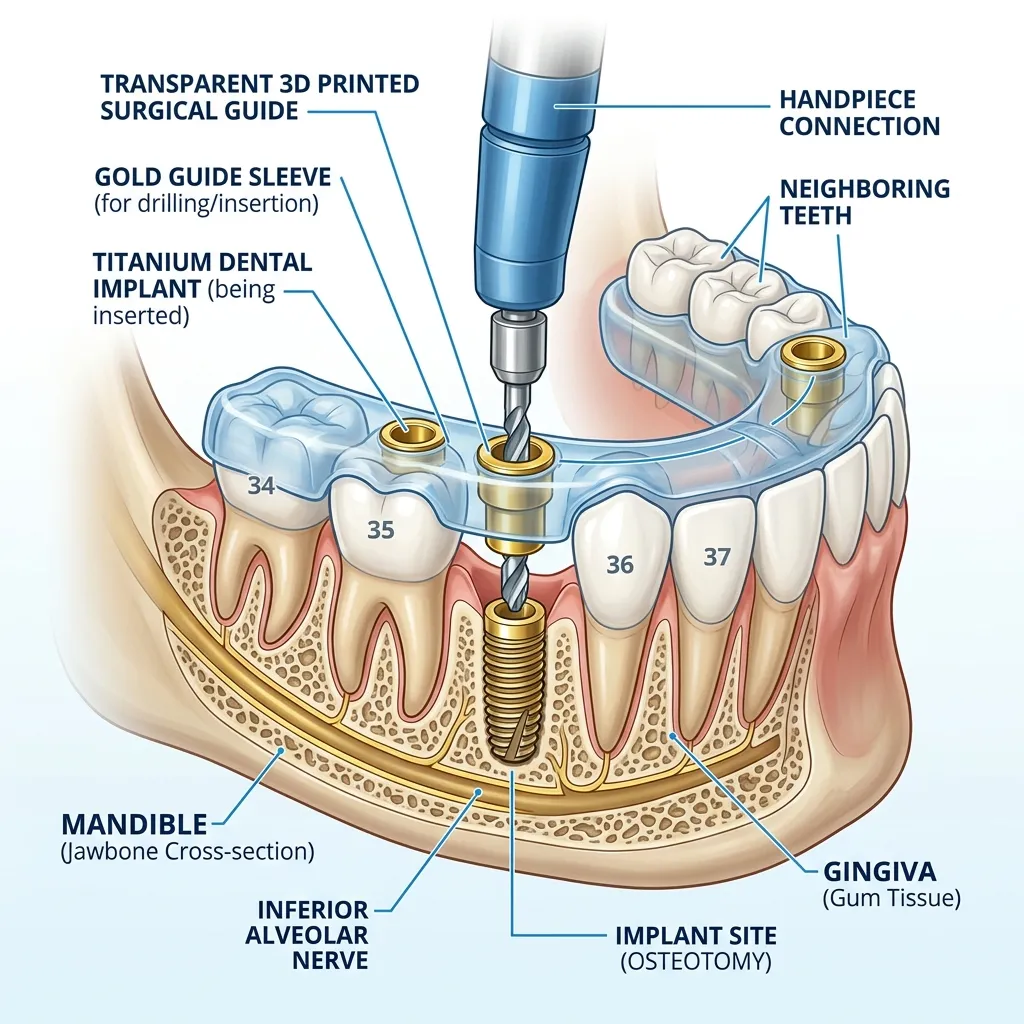
A dental implant is a titanium screw (4–6mm diameter, 8–16mm length) surgically placed into the jawbone under local anesthesia. Over 3–6 months, the bone grows directly into the titanium surface — a process called osseointegration — creating a bond as strong as natural bone. Once osseointegrated, the implant acts as a permanent root that bears the full bite force of a crown or bridge.
- Implant placement surgery: Usually 45–90 minutes per arch under local anesthetic (IV sedation available). Minimally invasive flapless technique where bone allows, reducing recovery time.
- Bone grafting (if required): When bone has been lost due to extraction, periodontitis, or anatomical factors, graft material (bovine bone substitute, synthetic, or autogenous) is placed to regenerate the missing volume. Grafts require 4–6 months to mature before implants can be placed. In some cases, implants and grafts are placed simultaneously.
- Sinus lifts: The upper back teeth sit beneath the sinus floor. When upper back bone is deficient, a sinus lift creates space for bone graft material, elevating the sinus membrane. Requires 6 months of healing.
- Temporary restorations: Custom-fabricated acrylic or PMMA temporaries are cemented or screwed onto implants or prepared teeth. They restore your smile aesthetics, protect prepared teeth, and provide "temporary trial" function while your brain adapts to the new bite height.
🌏 Multi-trip Structure During Phase 3
After implant placement, patients return home for the osseointegration period (3–6 months). You wear your temporaries, which look completely natural. Dr. Cuong monitors healing via WhatsApp. You return for Phase 4 when implants have integrated.
Phase 4: Prosthetic Reconstruction (Crowns & Bridges) — Your New Smile Takes Shape
This is the phase patients look forward to most — it's where your new smile materializes. Permanent crowns, veneers, and bridges replace the temporaries that have served you during healing. The result is final, polished, and designed to last 15–25+ years.
The Prosthetic Process
- Implant stability testing: Resonance frequency analysis (RFA/ISQ testing) confirms that each implant has achieved adequate osseointegration before permanent loading. Only implants meeting minimum ISQ values of 65+ receive permanent abutments.
- Digital impressions: An intraoral scanner (Medit i700) captures precise digital impressions of every prepared tooth and implant — eliminating gag reflex from traditional impression trays and ensuring sub-micron accuracy.
- CAD/CAM crown design: The digital models are sent to our in-house and partner milling laboratories, where restorations are designed using dental CAD software and milled from premium ceramic blocks.
- Materials selection: Zirconia (most durable), Ivoclar E.max (most aesthetic), or hybrid ceramic (combination) — selected based on tooth position, bite force, and aesthetic priority. Detailed in the Materials section below.
- Try-in appointments: Bisque bake restorations (pre-glazed, not yet polished) are seated for you to evaluate color, shape, and bite. You provide feedback — adjustments are made before final glazing and polishing.
- Final cementation & screw-retention: Crowns on natural teeth are bonded with dental resin cement. Implant crowns are either screw-retained (removable for maintenance) or cement-retained, depending on position and Dr. Cuong's clinical preference.
Phase 5: Refinement & Finalization — The Perfect Finish
The refinement phase is brief but critical. It ensures that your new restorations function harmoniously under real-world conditions — eating, speaking, and chewing — without any premature contacts that could cause fracture or jaw discomfort over time.
What Phase 5 Includes
- Occlusal equilibration: Articulation paper marks are checked in all excursive movements (left, right, forward). High contacts are selectively adjusted with high-speed diamond burs. The goal is equal, simultaneous contact on all teeth in centric occlusion with freedom in all excursive movements.
- Anterior guidance verification: Front teeth must guide posterior teeth off the bite in excursions (canine guidance or group function). This protects molars and premolars from destructive lateral forces.
- Surface finishing and polishing: All restorations are polished to achieve optimal surface smoothness (reduces plaque adhesion and staining) and light reflectivity. A polished ceramic surface wears 10x less against opposing enamel than an unpolished surface.
- Final photography and documentation: Professional photographs of your completed smile — matching the exact same angles as your "before" photos — for before/after comparison and warranty records.
- Custom nightguard fabrication: All bruxism patients receive a precision-fitted hard acrylic nightguard protecting restorations during sleep. This single appliance can extend the life of your FMR by decades.
- Warranty registration and aftercare briefing: Every restoration is registered with its warranty details. You receive a comprehensive written aftercare protocol and Dr. Cuong's direct WhatsApp for post-treatment support.
Bite Reconstruction & Occlusion — The Hidden Science Behind Your FMR
💡 Quick Answer
Occlusion is the science of how your teeth meet and move against each other. In full mouth rehabilitation, achieving correct occlusion — balanced bite forces distributed equally across all teeth, with proper front-tooth guidance — is the difference between restorations that last decades and ones that fail in years. Bite reconstruction addresses vertical dimension, centric relation, anterior guidance, and excursive movements.
Most patients focus on the visual aspects of their FMR — the shade of their new crowns, the shape of their veneers, the whiteness of their smile. But experienced prosthodontists know that aesthetics without correct occlusion is a ticking time bomb. Poorly balanced bite forces cause ceramic fractures, cement failures, implant complications, and jaw joint (TMJ) disorders — often years after treatment, when the original dentist is nowhere to be found.
Key Occlusal Concepts in FMR
- Vertical Dimension of Occlusion (VDO): The height at which your upper and lower teeth meet. In patients with severe tooth wear or multiple missing teeth, VDO collapses — the face loses height and a "sunken" appearance develops. FMR restores the correct VDO, which simultaneously opens the bite to create space for restorations and restores the patient's younger facial proportions.
- Centric Relation (CR): The position where the jaw condyles are in their most physiologically stable position in the joint socket. FMR restorations are designed so that the bite is comfortable in CR — not just in the habitual position, which may be compensating for missing teeth or worn-down occlusion.
- Anterior Guidance: When moving your jaw forward or sideways, your front teeth (and canines) should "guide" the back teeth off contact. This protects posterior teeth from destructive lateral forces. Failure to establish proper anterior guidance leads to molar fractures and implant occlusal overload.
- Excursive Movements: Right lateral, left lateral, and protrusive excursions must all be checked and adjusted. All premature contacts and interferences are eliminated.
Dr. Cuong uses a fully articulated occlusal analysis with a Kavo Arcon articulator, facebow recording, and bilateral interocclusal records for every FMR case — the same protocol used in specialist prosthodontic programs worldwide.
Digital Smile Design — Preview Your New Smile Before Treatment Begins
One of the greatest advances in modern cosmetic and restorative dentistry is Digital Smile Design (DSD) — the ability to show patients exactly how their new teeth will look on their face before a single tooth is touched.
How DSD Works at HCMC Dental
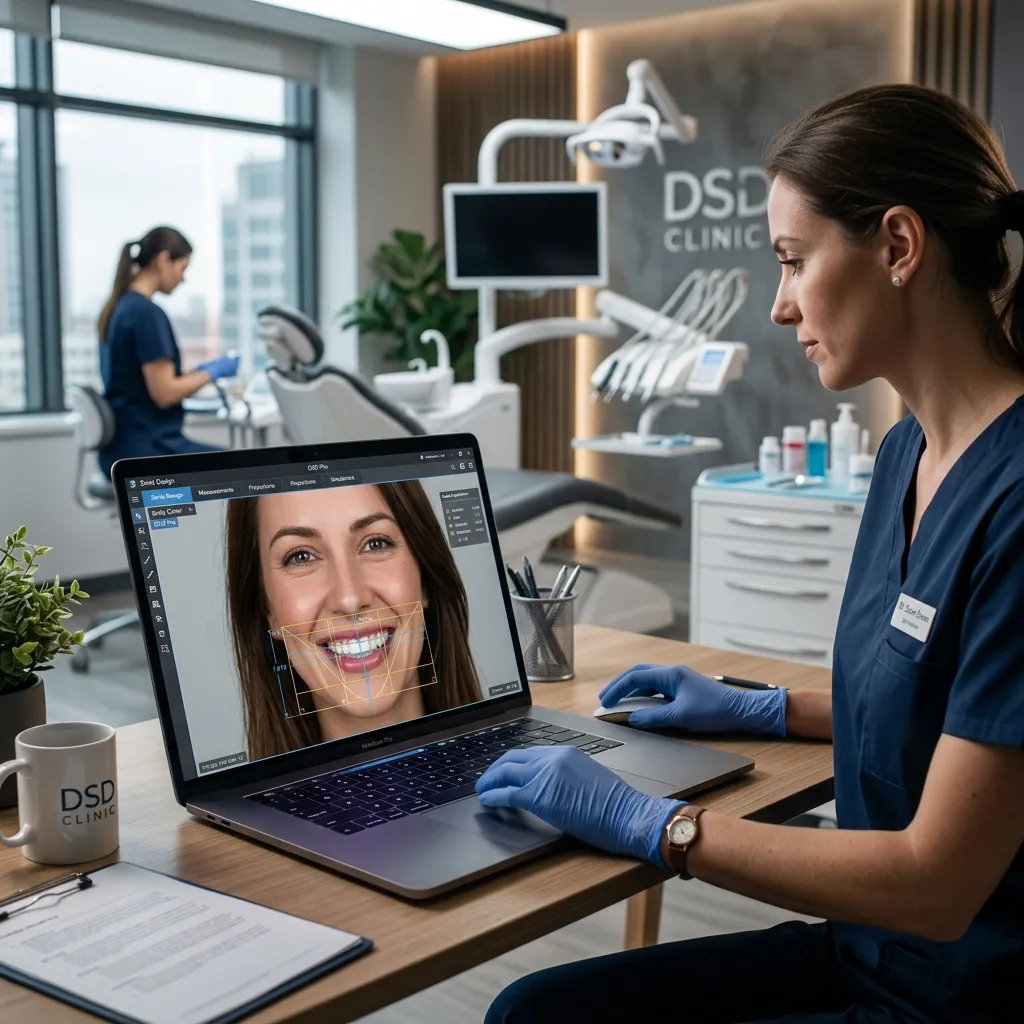
A standardized 14-image series is captured — full face, smile close-up, retracted (teeth visible), profile, and individual tooth shots. High-resolution images capture the lip line, midline, gum levels, and tooth proportions relative to your facial features.
Using specialized software, Dr. Cuong overlays the planned tooth shapes, sizes, and gum lines onto your facial photographs. The design respects the dental golden proportion (width-to-height ratios), your natural facial symmetry, and your personal aesthetic preferences.
The digital design is transferred to stone study models, where a dental technician sculpts the planned restorations in wax (wax-up). You can physically hold and view your future teeth before treatment begins. A "mock-up" using temporary composite can even be placed directly in your mouth for a trial smile.
You review the design and provide feedback — perhaps you want slightly longer teeth, a different gum level, or a more subtle cosmetic look. Revisions are made digitally before any irreversible procedure. This eliminates the most common source of post-treatment dissatisfaction.
Premium Materials — Zirconia, E.max, & Beyond — also used in porcelain veneers — also used in porcelain veneers
The long-term success of your FMR depends critically on the quality of materials used. At HCMC Dental, we use only internationally certified, premium-grade materials — not lower-cost alternatives.
🏆 Zirconia (Full-Contour)
Best for: Posterior (back) teeth, implant crowns, full-arch bridges, high-grind patients. Fracture resistance ~1200 MPa. Used for All-on-4/6 bridges.
💎 Ivoclar E.max (Lithium Disilicate)
Best for: Anterior (front) teeth, veneers, smile zone crowns requiring maximum translucency and natural light transmission. Fracture resistance ~400 MPa.
🌟 Layered Zirconia (PFZ)
Best for: Combination cases — zirconia coping with layered ceramic for optimal strength-aesthetics balance in the premolar area.
Shade Matching — Vita Zahnfabrik System
All HCMC Dental restorations are shade-matched using the Vita Classical A1-D4 and Vita 3D Master shade guide systems. Shade selection is performed under standardized natural light conditions and supplemented with spectrophotometric measurement. This ensures color accuracy even when returning for Phase 4 six months after Phase 3 — your new crowns will match exactly.
🔬 Material Certification
All materials used at HCMC Dental carry CE Mark (European) and/or FDA (US) biocompatibility certification. We use Ivoclar Vivadent, Vita Zahnfabrik, and Shofu brands for ceramic materials — the same brands used in European and Australian specialist clinics. Certificate documentation is available upon request.
Implant Systems — Straumann, Osstem, Dentium & Why We Chose Them
Not all dental implants are equal. At HCMC Dental, we offer three implant systems — each selected for specific clinical applications and patient priorities — and all backed by independent long-term clinical research with 10+ year data.
| Brand | Origin | Best For | 10-yr Survival | WA Price |
|---|---|---|---|---|
| 🏆 Straumann BLT/BLX | Switzerland 🇨🇭 | Premium cases, immediate loading, complex bone situations | 98.2% | From $1,200 / implant + crown |
| ⭐ Osstem TS/SS | South Korea 🇰🇷 | Best value–performance ratio, standard implant cases | 97.1% | From $700 / implant + crown |
| 💎 Dentium NR/Implantium | South Korea 🇰🇷 | Wide-diameter for molars, immediate placement after extraction | 96.8% | From $800 / implant + crown |
| WhatsApp prices include implant + abutment + zirconia crown. Data from peer-reviewed 10-year clinical studies (Journal of Clinical Periodontology, IJOMI). | ||||
Dr. Cuong will recommend the implant system that best matches your specific bone anatomy, loading requirements, and budget. All three systems are fully compatible with all major prosthetic components and carry internationally recognized warranties.
Sedation & Comfort — Fearless Dentistry for Anxious Patients
Dental anxiety affects approximately 1 in 3 adults, and it is especially common among patients who have been avoiding the dentist for years — precisely the patients who need comprehensive FMR most. At HCMC Dental, we offer multiple levels of sedation to ensure every patient is comfortable throughout treatment.
✅ Available Sedation Options
- Local Anesthesia: Numbing injections for all procedures. 100% pain-free during treatment — this is the standard for all FMR procedures.
- Oral Sedation: A pre-operative sedative tablet taken before the appointment. Reduces anxiety significantly; you remain conscious and responsive.
- IV Conscious Sedation: Administered through a vein by a trained anesthesiologist. Deep relaxation — most patients remember little or nothing of the appointment. Ideal for complex surgical sessions and extremely anxious patients.
- General Anesthesia: Available at our partner hospital for patients requiring maximum comfort during extended surgical procedures.
💬 What Our Anxious Patients Say
- "I hadn't been to a dentist in 12 years because of anxiety. Dr. Cuong's team made me feel completely at ease. I couldn't believe how painless it was." — Mark, 54, Australia
- "I had IV sedation for my implant surgery. I woke up and couldn't believe it was done. Zero memory, zero pain." — Sarah, 48, UK
- "I was terrified. The team gave me an oral sedative and held my hand. I finally have my smile back." — James, 62, USA
Please discuss your anxiety level openly with Dr. Cuong via WhatsApp before your first appointment. Knowing your comfort needs allows us to plan the most appropriate sedation protocol and schedule your appointments optimally.
Full Mouth Rehabilitation Cost — Transparent Vietnam Pricing
3 investment levels based on clinical complexity. All prices include the 40% WhatsApp discount.
Restorative Refresh
No missing teeth; needs crowns, fillings, cleaning & possibly whitening. The "complete overhaul" for a structurally present mouth.
- Up to 12 zirconia crowns
- Full-mouth professional cleaning
- Composite fillings (up to 6)
- Teeth whitening
- Bite adjustment if needed
Mixed Reconstruction
Some missing teeth (1–6) requiring implants. Combination of implants, crowns, extractions, gum treatment, possibly bone grafting.
- 1–6 dental implants + crowns
- Remaining teeth crowned/restored
- Extractions of failing teeth
- Deep cleaning + gum treatment
- Bone grafting if needed
- Temporary restorations
Total Reconstruction
Full edentulous or near-edentulous. All-on-4 / All-on-6 per arch with zirconia fixed bridge. May include bone grafts, sinus lifts, staged reconstruction.
- All-on-4 or All-on-6 per arch
- Zirconia full-arch fixed bridge
- All necessary extractions
- Bone grafting / sinus lifts
- Temporary prosthetics during healing
- Bite reconstruction
| Procedure | Standard Price | WhatsApp (−40%) | US / AUS Price | Your Saving |
|---|---|---|---|---|
| Dental Implant (Osstem) + Crown | $1,167 | $700 | $3,500–$5,000 | Save $2,800+ |
| All-on-4 (1 arch, Osstem) | $8,000 | $4,800 | $25,000–$35,000 | Save $20,000+ |
| All-on-6 (1 arch, Osstem) | $11,200 | $6,720 | $30,000–$45,000 | Save $23,000+ |
| Zirconia Crown | $250 | $150 | $1,200–$2,000 | Save $1,050+ |
| E.max Veneer | $417 | $250 | $1,500–$2,500 | Save $1,250+ |
| Root Canal (single canal) | $167 | $100 | $800–$1,500 | Save $700+ |
| Deep Cleaning (full mouth) | $67 | $40 | $300–$500 | Save $260+ |
| Bone Graft (per site) | $500 | $300 | $1,500–$3,000 | Save $1,200+ |
* Prices in USD. Standard prices = without WhatsApp discount. US/AUS prices are representative averages from multiple published fee schedules. Exact Vietnam prices depend on clinical assessment. View full price list →
💬 Get My Personal WhatsApp Quote — FreeSave 60–75% vs USA, Australia & UK — The Real Numbers
Full mouth rehabilitation at HCMC Dental typically saves patients $15,000 – $50,000+ compared to equivalent treatment at home. Here's the detailed breakdown.
| Treatment | 🇺🇸 USA | 🇦🇺 Australia | 🇬🇧 UK | 🇻🇳 HCMC Dental |
|---|---|---|---|---|
| Full-arch All-on-6 (both arches) | $60,000–$90,000 | A$70,000–$110,000 | £55,000–£80,000 | $13,440 Save up to $76,000 |
| 10 zirconia crowns | $12,000–$20,000 | A$14,000–$25,000 | £10,000–£16,000 | $1,500 Save up to $18,500 |
| 5 implants + crowns | $17,500–$25,000 | A$20,000–$30,000 | £14,000–$22,000 | $3,500 Save up to $21,500 |
| 8 E.max veneers | $12,000–$20,000 | A$14,000–$22,000 | £10,000–£18,000 | $2,000 Save up to $18,000 |
| Full FMR (Level 2 — typical case) | $40,000–$80,000 | A$50,000–$95,000 | £35,000–£65,000 | $5,000–$12,000 Save $28,000–$68,000 |
💰 The Vietnam Advantage: Quality + Cost
HCMC Dental uses the same premium materials (Straumann implants, Ivoclar E.max, Vita Zahnfabrik ceramics) as top clinics in Australia and the USA. The cost difference comes entirely from Vietnam's lower cost of living and dental fee structure — not from any reduction in material or clinical quality. A round-trip flight + 2 weeks accommodation in Vietnam typically costs $3,000–$5,000 — still saving you $20,000–$60,000 compared to home treatment.
Full Mouth Rehabilitation Timeline — What to Expect & When
💡 Quick Answer
Full mouth rehabilitation takes 6–18 months total depending on whether implants are needed. Restorative-only cases (crowns, veneers) can be completed in 8–14 days in 1–2 trips. Implant cases require 3–4 trips over 9–18 months due to the biological osseointegration healing period.
| Case Type | Total Duration | Number of Trips | Time in Vietnam | Healing at Home |
|---|---|---|---|---|
| Level 1 (Restorative) | 1–2 months | 1–2 trips | 8–14 days total | None |
| Level 2 (Mixed — limited implants) | 6–12 months | 2–3 trips | 18–28 days total | 3–6 months (osseointegration) |
| Level 3 (Total — full arch) | 12–18 months | 3–4 trips | 22–35 days total | 6–12 months (with bone graft) |
Important: The total calendar duration is long because of healing time at home — the actual time you spend in the dental chair is much less. Most working patients find the multi-trip structure highly manageable, planning each trip around vacations or long weekends.
Your Vietnam FMR Journey — Trip-by-Trip Guide
For a standard implant-based FMR, here is exactly what happens during each trip to Ho Chi Minh City.
Assessment, Surgery & Temporaries
- Day 1–2: CBCT scan, full clinical examination, photos, DSD, treatment plan presentation
- Day 3: Gum preparation — deep cleaning, possible extractions
- Day 4–5: Rest / explore HCMC
- Day 6–7: Implant surgery session(s)
- Day 8–9: Recovery, check-up, suture review
- Day 10–11: Crown preparations, impressions
- Day 12–13: Temporary restoration fitting
- Day 14: Final pre-departure check, WhatsApp handover
Implant Verification & Final Prosthetics
- Day 1: ISQ stability test, X-ray verification
- Day 2: Remove temporaries, digital impressions (intraoral scanner)
- Day 3–4: Lab fabrication of permanent restorations (zirconia)
- Day 5: Try-in — shade, shape, bite verification
- Day 6: Minor adjustments & polishing at lab
- Day 7: Final cementation of all permanent crowns
- Day 8: Bite check, occlusal equilibration
- Day 9–10: Final photography, warranty registration, nightguard delivery
Annual Review & Fine-Tuning
- Day 1: Annual clinical review — probing, X-rays, bite assessment
- Day 2: Professional cleaning + polish of all restorations
- Day 3: Nightguard assessment + replacement if needed
- Day 4: Any minor aesthetic adjustments
- Day 5: Next-year maintenance plan and scheduling
✈️ Logistics Support
Dr. Cuong and the HCMC Dental team assist with appointment scheduling around your flight dates, hotel recommendations (3–5 star options near the clinic in District 1 from $35–$120/night), and local activity suggestions for days between appointments. Dental tourism planning is our specialty.
How Long Does Full Mouth Rehabilitation Last?
💡 Quick Answer
With proper maintenance, FMR results are extremely durable: dental implants last 20–35+ years, zirconia crowns 15–25 years, and E.max veneers 10–20 years. The single most important factor in longevity is regular professional maintenance every 6 months, combined with excellent home hygiene.
| Restoration Type | Expected Lifespan | Key Factors |
|---|---|---|
| Dental Implants (titanium) | 20–35+ years (often lifetime) | Bone maintenance, no smoking, plaque control |
| Zirconia Crowns | 15–25 years | No bruxism without nightguard, proper occlusion |
| E.max Veneers | 10–20 years | Avoid biting hard objects, regular polishing |
| Implant-Supported Bridges (Zirconia) | 20–30 years | Implant integration, plaque control |
| Composite Fillings | 5–10 years | Diet, night grinding, regular monitoring |
The Maintenance Protocol That Protects Your Investment
- Professional cleaning every 6 months: Biofilm removal from implant surfaces and restorations is essential. Home brushing alone cannot reach all surfaces. Any local dentist can perform maintenance cleaning with non-metallic instruments (important for implant surfaces).
- Nightly nightguard use: For bruxism patients, wearing your custom nightguard every night is the single most important protective behavior. Without it, even zirconia crowns can fracture within 5–7 years in severe grinders.
- Water flosser (Waterpik): Traditional floss cannot access implant-crown margins and bridge pontic surfaces effectively. A water flosser on medium pressure is essential daily practice for FMR patients.
- Annual X-ray review: Annual bitewing or periapical X-rays monitor bone levels around implants and detect early secondary decay in crowned teeth before it becomes a major problem.
- Dietary awareness: Avoid biting ice, hard candies, and non-food objects. Ceramic, while strong, is not indestructible. Acidic beverages (carbonated drinks, citrus) should be consumed with a straw and followed by a water rinse.
Risks, Limitations & Realistic Expectations
At HCMC Dental, we believe in complete transparency about risks and limitations. No ethical dental professional should promise guaranteed outcomes without acknowledging that complications, though rare, do exist. Here is an honest assessment of the risks in FMR.
| Risk | Incidence | How We Manage It |
|---|---|---|
| Implant failure (osseointegration failure) | 2–5% per implant | Pre-surgical CBCT, systemic health review, staged loading, smoking cessation protocol. Failed implants replaced at no material cost. |
| Post-surgical swelling/bruising | Very common (90%) | Ice packs, prescribed anti-inflammatory protocol, vitamin C supplementation. Typically resolves in 5–7 days. |
| Temporary sensitivity after crown preparation | Common (30–40%) | Desensitizing varnish, temporary crown protection, anti-sensitivity toothpaste prescribed. Usually resolves in 2–4 weeks. |
| Restoration fracture (ceramic) | Rare (<2% at 5 years) | Proper material selection per tooth position, nightguard prescription, correct occlusal design. Covered by warranty if non-trauma related. |
| Gum recession around restorations | 5–10% over 10 years | Meticulous gum surgery technique, crown margin placement at or slightly above gum line for most teeth. |
| Bite adjustment required (post-placement) | Universal (>90%) | Expected and normal — managed at Phase 5 refinement. Not a complication but a routine step. |
⚠ Expectations vs Reality
Full mouth rehabilitation is not "perfect teeth forever with zero maintenance." It is a significant investment requiring lifelong care and occasional maintenance procedures. The goal is dramatically better oral function, aesthetics, and quality of life — which the vast majority of our patients achieve and maintain for 15–25+ years.
Aftercare Protocol — Protecting Your FMR Investment
- First 24 hours (post-surgery): Rest, ice packs 20-minutes-on/20-off, soft diet only, no rinsing vigorously. Sleep with head elevated. Prescribed antibiotics and anti-inflammatories taken as directed.
- Days 2–7: Soft diet continues. Salt-water rinses 3x daily. Gentle brushing with soft toothbrush avoiding surgical sites. Chlorhexidine rinse as prescribed.
- Weeks 2–4: Gradual return to normal diet (avoiding hard, crunchy foods). Begin water flosser use on low pressure around implant sites. Remove temporaries gently for cleaning if instructed.
- Months 1–6 (osseointegration): Continue soft-to-medium diet on implant side. No smoking throughout. WhatsApp check-ins with Dr. Cuong every 4–6 weeks with photos.
- Long-term (permanent restorations in place): Professional cleaning every 6 months (any dentist), nightly nightguard use, water flosser daily, annual X-ray review, no biting hard objects.
- Emergency protocol: Any loose crown, fractured restoration, pain, or swelling should be reported immediately via WhatsApp. Dr. Cuong responds 7 days a week and will advise appropriate management or local emergency intervention.
All HCMC Dental FMR patients receive a comprehensive personalized aftercare booklet (PDF and printed) at the end of treatment, specific to their procedures and materials used.
Case Transformations — Real HCMC Dental Patient Scenarios
The following composite case scenarios represent the types of complex reconstructions completed at HCMC Dental. Individual results vary based on clinical factors.
The Bruxism Rebuild
- Severely worn teeth
- 2 missing molars
- Jaw clicking + headaches
- 8 cracked old crowns
- 16 new zirconia crowns
- 2 implants + crowns
- VDO restored (+4mm)
- No more jaw pain
Total Edentulous Transformation
- Full dentures both arches
- Significant bone loss
- Unable to eat steak
- Social confidence zero
- All-on-6 upper + lower
- Zirconia fixed bridges
- Eats normally again
- Complete confidence
The Neglect Recovery
- 14 years without dentist
- 8 teeth needing extraction
- Severe gum disease
- Dental phobia
- 6 implants + crowns
- 8 remaining teeth crowned
- Gum disease resolved
- Phobia overcome with sedation
📸 See More Transformations
Dr. Cuong maintains a photographic portfolio of completed cases. Request access to relevant case photos (matching your situation) via WhatsApp — we're happy to share appropriate before/after documentation to help you understand realistic outcomes for your specific case.
Ho Chi Minh City as Your FMR Destination — Complete Guide
Combining premium dental care with the experience of Vietnam — one of Southeast Asia's most vibrant, affordable, and rewarding destinations.
Why HCMC for Full Mouth Rehabilitation?
- Cost: 60–75% below USA, Australia, and UK — the greatest cost advantage in dental tourism
- Quality: International-grade materials, CBCT technology, intraoral scanners, CAD/CAM labs
- English fluency: Dr. Cuong and team communicate fully in English
- Safety standards: Autoclave sterilization, single-use instrumentation, CE/FDA materials
- Accessibility: Direct flights from Sydney, Melbourne, London (via hub), LA (via hub), Singapore, Bangkok
- Lifestyle: World-class food, affordable accommodation, rich history and culture between appointments
Practical Travel Information
- Visa: Many nationalities (US, UK, EU, Australia) can obtain 45-day e-visa online. Citizens of some countries get visa-free access for 15–90 days.
- Accommodation: 3–5 star hotels in District 1 near our clinic from $35–$120/night. Serviced apartments from $50/night for longer stays.
- Transportation: Grab (ride-share) is reliable, safe, and inexpensive. Airport transfers ~$8–12 USD.
- Currency: USD widely accepted near tourist areas; VND for local markets. ATMs abundant.
- Mobile: Local SIM cards available at airport for $5–10 with generous data plans.
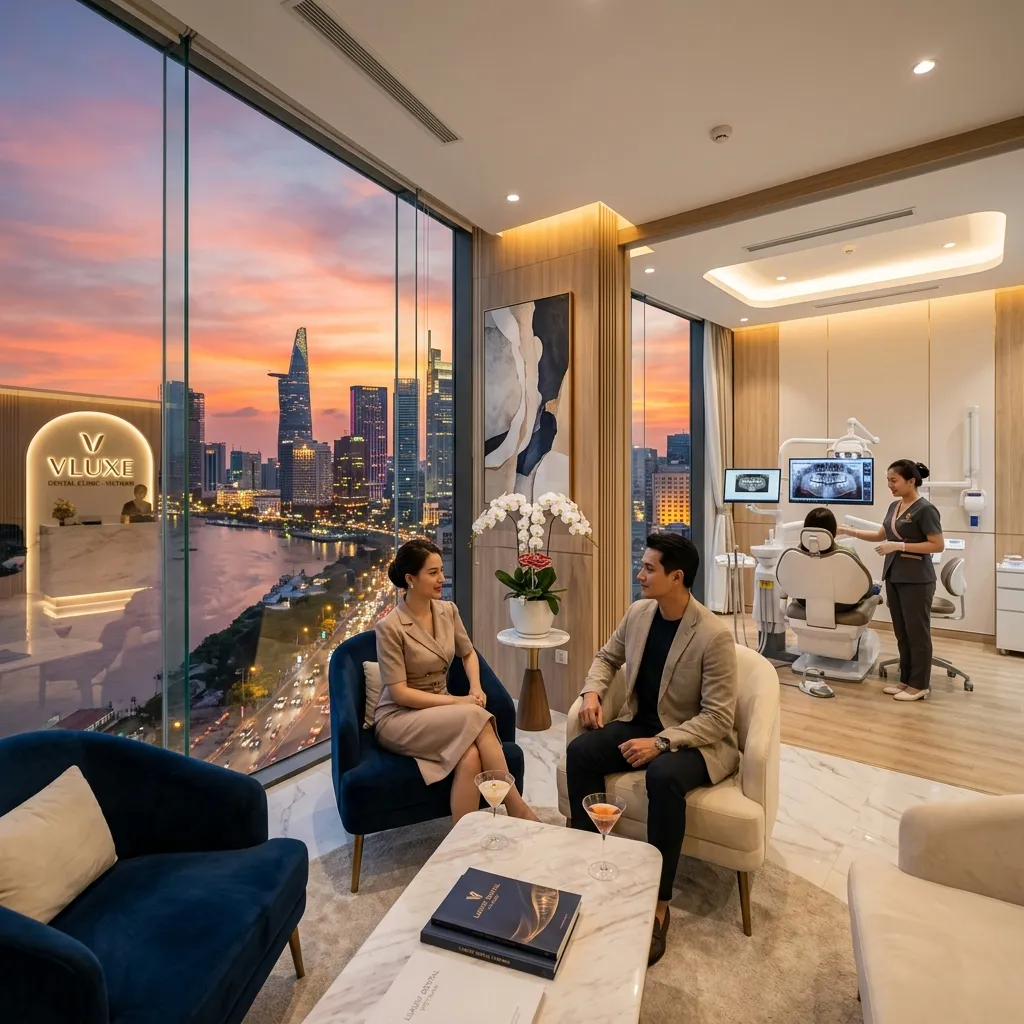
Ho Chi Minh City — a world-class dental tourism destination combining premium care with one of Asia's most exciting cities.
Why Choose HCMC Dental for Your Full Mouth Rehabilitation?
One Specialist, Total Coordination
Dr. Cuong personally plans and executes every phase of your FMR — no handoffs between multiple specialists, no coordination gaps, no conflicting advice.
Complete Diagnostic Technology
CBCT 3D scanner, Medit i700 intraoral scanner, digital DSD, in-house CAD/CAM milling — all under one roof. No referrals to external labs or imaging centers.
Premium Materials Only
Straumann / Osstem / Dentium implants. Ivoclar E.max. Vita Zahnfabrik ceramics. No cost-cutting on materials — ever. Certificate of materials available on request.
WhatsApp Access 7 Days/Week
Dr. Cuong responds personally to WhatsApp messages within 2 hours — before, during, and after your FMR. Remote monitoring throughout your healing period.
40% WhatsApp Discount
All procedures are 40% below standard clinic prices when booked directly through WhatsApp. This is our most accessible price — no negotiation needed.
3–5 Year Warranty
3 years on all prosthetic work, 5 years on implant structures. Warranty claims handled remotely via WhatsApp with photos — no return flight required for assessment.
International Patient Experience
Over 200 international FMR patients treated from Australia, USA, UK, Germany, Singapore, and Canada. We understand international patient logistics — flights, timing, accommodation.
4.9★ Verified Rating
178 verified patient reviews with an average 4.9/5 rating. Read unedited reviews on Google Maps and Facebook — we are proud of every one.
🩺 Free Second Opinion — Bring Your Existing Treatment Plan
Been quoted $40,000+ for full mouth rehabilitation at home? Got a treatment plan that feels too aggressive — or not aggressive enough? Send your X-rays, OPG, photographs, and existing treatment plan to Dr. Cuong via WhatsApp for a completely free, no-obligation second opinion.
Dr. Cuong will review your case, identify any discrepancies, confirm which procedures are clinically necessary, and provide an alternative quote from Vietnam — typically within 24–48 hours. He will be completely honest — including telling you if your local treatment plan is appropriate. We prioritize your clinical best interests above all else.
Payment Methods & Insurance
💳 Accepted Payment Methods
- Cash (USD, AUD, GBP, SGD, VND)
- Bank transfer (international accepted)
- Visa & Mastercard credit/debit cards
- PayPal (select cases)
- Payment staged per trip — no full upfront payment required
🏥 Insurance & Reimbursement
- Detailed itemized invoices provided for all procedures
- Diagnostic codes (ICD/CDT) included on request
- Pre-authorization letters available
- Many patients successfully claim partial reimbursement from their insurer
- We do not bill insurance directly — patients claim reimbursement
💡 Payment Planning Tip
Because FMR is completed across 2–4 trips, payments are naturally distributed over 6–18 months. Most patients pay a deposit before Trip 1, the main payment at the start of Trip 2, and final payment at completion. This staged payment structure makes large-case FMR much more manageable for international patients.
Your FMR Pre-Trip Checklist — Everything to Prepare Before You Fly
- Gather all existing dental X-rays and OPG — even if 1–2 years old, they provide valuable history
- Photograph your teeth — full face smile, close-up front, close-up side both left and right
- Write your complete medication list — prescription and OTC medications, supplements
- Note any known drug allergies, especially antibiotics and local anesthetics
- Obtain blood test results if you have a systemic condition (diabetes HbA1c, INR for blood thinners)
- Confirm your travel insurance covers dental emergencies (most travel policies include emergency dental)
- Book flexible-date flights — dental appointments may shift by 1–2 days due to healing assessments
- Plan your accommodation within 15 minutes of the clinic for convenience during intensive treatment days
- Pack: soft toothbrush, dental floss, Waterpik (or buy one in HCMC for ~$25), medications prescription
- Prepare soft foods for post-surgery days: yogurt, soup, mashed potatoes, smoothies
- Download WhatsApp and save Dr. Cuong's number — this is your communication channel throughout
Full Mouth Rehabilitation — 102 Expert Answers to Your Questions
The most comprehensive FMR FAQ on the internet — written by Dr. Cuong with 8+ years of complex case experience.
How much does full mouth rehabilitation cost in Vietnam?
Full mouth rehabilitation costs in Vietnam depend on which procedures are required. At HCMC Dental, we offer three reference levels: Level 1 (Restorative Refresh): from $1,800 – $4,000 for cases involving crowns, fillings, and cleaning; Level 2 (Mixed Reconstruction): $5,000 – $12,000 for cases combining implants, crowns, extractions, and bone grafting; and Level 3 (Total Reconstruction): $8,000 – $28,000+ for full-arch solutions including All-on-4 or All-on-6. These are estimated ranges — your exact quote requires a CBCT scan and clinical assessment. WhatsApp patients receive an additional 40% discount off standard prices.
Why is dental work so much cheaper in Vietnam?
Vietnam's lower cost of living, reduced operational overhead, and different dental fee structures allow clinics to offer the same premium-quality materials and techniques at 60–75% below USA, Australian, or UK prices. HCMC Dental uses internationally certified materials — Straumann, Osstem, Dentium implants; Ivoclar E.max; Vita Zahnfabrik zirconia — at a fraction of Western prices. You receive the same clinical outcome for a fraction of the cost.
How do I get the 40% WhatsApp discount for full mouth rehabilitation?
Simply contact Dr. Cuong directly via WhatsApp using the links on this page. Mention your interest in full mouth rehabilitation and attach any available X-rays or dental records. The 40% discount applies to all treatment categories when bookings are made through WhatsApp — this is our way of rewarding proactive patients who plan ahead. The discount is applied automatically to your final treatment plan.
Can I pay in installments across multiple trips?
Yes. Because full mouth rehabilitation involves multiple visits over 6–18 months, payments are naturally staged across trips. A deposit is required before your first procedure. Subsequent payments are made at the start of each treatment trip. We accept bank transfers, credit cards (Visa/Mastercard), and cash (USD or VND). We do not currently offer formal financing, but the multi-trip payment structure effectively distributes costs over time.
Is full mouth rehabilitation covered by dental insurance?
Coverage depends on your specific policy. Most insurance plans cover some portion of "medically necessary" procedures (e.g., extractions, root canals) but may exclude implants or cosmetic components. We provide detailed itemized invoices for all procedures performed, which you can submit to your insurer for reimbursement. Many of our international patients successfully claim partial reimbursement. We recommend checking your policy before your first visit. We can also provide pre-authorization documentation if needed.
What procedures are included in full mouth rehabilitation?
Full mouth rehabilitation is not a single procedure — it is a customized plan combining any or all of the following:
- Restorative: dental implants, crowns and bridges, composite fillings, inlays/onlays
- Full-arch: All-on-4, All-on-6, implant-supported dentures
- Cosmetic: porcelain veneers, teeth whitening, gum contouring
- Surgical: tooth extractions, bone grafting, sinus lifts
- Periodontal: deep cleaning (SRP), gum treatment
- Orthodontic: Invisalign or braces (pre-treatment alignment)
- Endodontic: root canal therapy
- Occlusal: TMJ therapy, bite adjustment, nightguards
Dr. Cuong designs your plan to include only what you actually need — not a one-size-fits-all package.
What is the difference between full mouth rehabilitation and reconstruction?
These terms are used interchangeably and describe the same concept: a comprehensive, multi-procedure plan that restores the entire mouth. "Full mouth rehabilitation" is more commonly used in clinical prosthodontic literature, while "full mouth reconstruction" is the preferred patient-facing term. At HCMC Dental, we use both terms to refer to the same coordinated treatment approach. The key word is comprehensive — meaning every tooth (and missing tooth) is addressed as part of an integrated plan.
How is FMR different from getting individual treatments separately?
When treatments are planned together as an FMR, several important advantages emerge:
- Occlusal harmony: All restorations are designed to work together at the correct bite height — preventing future damage
- Sequencing: Procedures are done in the optimal order (e.g., gum treatment before crowns, implants before bridges)
- Aesthetic unity: Shade, shape, and proportion planned as a whole — no mismatched restorations
- Cost efficiency: Materials ordered in bulk, lab fees optimized, fewer redundant appointments
- Predictability: A diagnostic wax-up lets you preview results before permanent work begins
Do I need every procedure, or just some?
Only what your mouth specifically requires. FMR is entirely customized. Dr. Cuong's diagnostic process (CBCT scan, clinical exam, photographs, bite analysis) determines exactly which procedures are necessary. Some patients need only crowns and deep cleaning. Others require implants, bone grafts, and full-arch prosthetics. The plan is built around your biology, budget, and priorities — not a preset package.
What is a diagnostic wax-up and why is it important?
A diagnostic wax-up is a 3D model of your planned final result, created on stone casts before any irreversible treatment begins. It allows Dr. Cuong to test your new bite, verify aesthetics, and make adjustments without touching your natural teeth. The wax-up is also used to fabricate temporary restorations, so you can "try on" your new smile during treatment. This is a critical quality control step that prevents costly corrections later.
How long does full mouth rehabilitation take?
The total treatment timeline depends on complexity, but typically ranges from 6 months (restorative cases) to 18 months (implant-based cases). The longest phase is biological healing — implants require 3–6 months of osseointegration before permanent crowns can be placed. Restorative cases without implants can often be completed in 8–14 days across 1–2 visits. The multi-trip structure allows healing to occur between visits, so your actual time in Vietnam is just 20–35 days total spread across 2–4 trips.
How many trips to Vietnam will I need?
Most full mouth rehabilitation patients require 2–4 trips depending on their treatment plan:
- 1 trip (8–14 days): Restorative-only cases (crowns, veneers, fillings, cleaning)
- 2 trips: Cases with limited implants (1–3) or moderate reconstruction
- 3 trips: Standard implant-based FMR — surgery, healing, prosthetics
- 4 trips: Complex full-arch cases with bone grafting and staged reconstruction
Can everything be done in one trip?
For restorative cases (crowns, veneers, cleaning, fillings) — yes, this is possible in 8–14 days. For implant cases — no, because osseointegration (bone-to-implant fusion) requires 3–6 months of healing in your home country before permanent prosthetics can be placed. Attempting to shortcut this biological process leads to implant failure. We will always recommend the clinically correct protocol, not the fastest one.
What happens between trips while I'm at home?
You will wear comfortable temporary restorations crafted in our in-house lab that look and function well. Dr. Cuong monitors your progress via WhatsApp — you can send photos, ask questions, and get prompt responses 7 days a week. Your local dentist provides routine check-ups if needed. We send you a detailed home-care protocol and a list of symptoms to watch for during the healing period.
How long do I need to stay in Ho Chi Minh City each visit?
Trip durations depend on what's scheduled:
- Trip 1 (Assessment + Surgery): 10–14 days — includes CBCT, planning, surgical procedures, temporaries
- Trip 2 (Prosthetics): 7–10 days — includes try-ins, adjustments, final cementation
- Trip 3 (Final): 3–5 days — final polish, photography, bite fine-tuning, warranty registration
We schedule appointments efficiently to minimize your time away from home.
Am I a candidate for full mouth rehabilitation?
You may be a candidate if you have: multiple missing or failing teeth; severe dental decay across many teeth; heavily worn teeth from grinding (bruxism) or acid erosion; chronic jaw pain or TMJ issues; old failing dental work (cracked crowns, failing bridges, broken implants); or a desire for a complete functional and aesthetic transformation. The best way to confirm candidacy is a CBCT scan + clinical evaluation. We offer free remote pre-assessment — simply send your X-rays or OPG via WhatsApp.
Can I get FMR if I have gum disease?
Yes, but gum disease must be treated first. Active periodontitis (gum disease) must be controlled before any restoration — implants placed in infected gums fail. Our protocol always begins with a thorough dental cleaning and gum treatment phase to establish a healthy foundation. Many international patients come to us specifically because their local dentist told them they couldn't have implants due to gum disease — with proper treatment, most can still proceed with FMR.
Is there an age limit for full mouth rehabilitation?
There is no upper age limit — we regularly treat patients in their 70s and 80s successfully. There is, however, a lower age consideration: jawbone growth must be complete (typically 18–21 years old) before permanent implants can be placed. Younger patients can receive restorative work, veneers, and orthodontic preparation — implants are added once skeletal maturity is confirmed.
Can smokers get full mouth rehabilitation?
Yes, but smoking significantly increases risks, particularly for implant procedures. Smoking impairs blood supply, slows healing, and increases infection risk. Implant survival rates drop from ~97% to ~85% in active smokers. We strongly recommend stopping smoking at least 2 weeks before surgery and throughout the healing period. We will never refuse treatment based on smoking status, but we will counsel you honestly about the risks and ask you to commit to cessation during healing phases.
What if I have diabetes or heart conditions?
Well-controlled systemic conditions are not a barrier to FMR. Controlled diabetes (HbA1c < 7.5%) allows implant placement with slightly modified protocols and closer monitoring. Heart conditions — we require medical clearance from your cardiologist before surgical procedures. Anti-coagulation therapy may need temporary adjustment (coordinated with your physician). Please bring a full medical history and medication list to your consultation. Dr. Cuong has extensive experience treating medically complex patients.
How long do the results of full mouth rehabilitation last?
With proper care, FMR results are extremely durable:
- Dental implants: 20–35+ years (lifetime with good bone maintenance)
- Zirconia crowns: 15–25 years
- E.max veneers: 10–20 years
- Bridges: 10–15 years
- Composite fillings: 5–10 years
Longevity depends heavily on oral hygiene, diet, and professional maintenance visits every 6 months. We provide a 3-year warranty on all prosthetic work against manufacturing defects.
Will my new teeth look natural?
Absolutely. Dr. Cuong uses Digital Smile Design (DSD) to plan your final appearance before treatment begins — you preview your result digitally and provide feedback before any permanent work is done. Materials used (Ivoclar E.max, Vita zirconia) replicate the light transmission, translucency, and surface texture of natural enamel so closely that they are virtually indistinguishable. Shade, shape, and proportions are matched to your facial features and natural tooth structure.
Can I eat normally after full mouth rehabilitation?
Yes — this is one of the primary goals. Full mouth rehabilitation restores proper chewing function, bite alignment, and dental stability. Most patients report being able to eat foods they haven't enjoyed in years (steaks, hard fruits, crusty bread). During healing phases you follow a soft diet. Once all permanent restorations are placed and osseointegration is complete, there are no dietary restrictions beyond good dental hygiene practices (avoid excessive ice-chewing, hard candies, etc.).
What warranty does HCMC Dental offer on FMR work?
We offer a 3-year warranty on all prosthetic work (crowns, bridges, veneers) against manufacturing defects and debonding. Implants carry a 5-year structural warranty. Warranty claims require evidence of regular dental check-ups (every 6 months) and proper home hygiene maintenance. Damage caused by trauma, neglect, or grinding without a nightguard is excluded. We coordinate any warranty work remotely if you return within the warranty period.
What happens if something fails or breaks years later?
For in-warranty issues: contact us via WhatsApp with photos. We will assess the situation, determine if it's a warranty claim, and arrange repair or replacement. For out-of-warranty issues: we provide priority scheduling for existing patients. In many cases, your local dentist can perform simple repairs (recementation, chip repair) using the detailed treatment records we provide. For complex issues, we may need you to return for 2–3 days. We maintain all patient records digitally and can share them with any dentist worldwide.
How do I start the process from abroad?
Starting is simple:
- WhatsApp Dr. Cuong with your dental photos and any available X-rays (OPG/panoramic preferred)
- Receive a free remote assessment — Dr. Cuong reviews your records and provides a preliminary treatment overview and price range
- Book your first trip — we help with appointment scheduling, hotel recommendations near the clinic, and arrival logistics
- Arrive for your first visit — CBCT scan, clinical exam, finalized treatment plan with exact pricing
- Begin treatment — on the same trip in most cases
Can I get a second opinion on my existing treatment plan?
Yes — and we strongly encourage it. Send your current treatment plan, X-rays, and photos to Dr. Cuong via WhatsApp for a free second opinion. Many patients come to us after receiving quotes from local dentists that seemed too expensive or too aggressive. Dr. Cuong will give you an honest, independent clinical assessment — even if the conclusion is that your local treatment plan is appropriate. We prioritize your clinical best interests above all else.
Do you speak English at the clinic?
Yes. Dr. Cuong is fluent in English and conducts all international patient consultations in English. Our front desk staff also communicate in English for scheduling and logistics. All treatment documentation, consent forms, and aftercare instructions are available in English. We also have staff who speak French, Korean, and Japanese for those patient communities.
What should I bring to my first consultation?
Please bring:
- Any existing X-rays or OPG (panoramic) films — even if older than 1 year, they provide useful history
- Your full medication list (we need to check for interactions with anaesthetics and antibiotics)
- Medical history summary (conditions, surgeries, allergies)
- Your travel insurance policy number (for records)
- Any existing dental records or previous treatment plans
- Your passport (for clinic registration)
If you haven't had X-rays recently, don't worry — we perform a full CBCT scan at the clinic on your first visit.
Can I combine full mouth rehabilitation with a holiday in Vietnam?
Absolutely — and many patients do! Ho Chi Minh City is a vibrant, affordable destination with world-class food, shopping, and culture. We schedule appointments to give you free days for tourism between procedures. Popular activities between appointments include: day trips to the Mekong Delta, Cu Chi Tunnels, Hoi An (90-minute flight), Phu Quoc island, or simply exploring District 1's restaurants and markets. HCMC is well-connected to Bali, Bangkok, Singapore, and other regional destinations for mini side-trips during longer healing periods.
Ready to Transform Your Smile & Rebuild Your Confidence?
Join 200+ international patients who chose HCMC Dental for their full mouth rehabilitation. Save 60–75% with world-class care and Dr. Cuong's personal attention from first message to final smile.