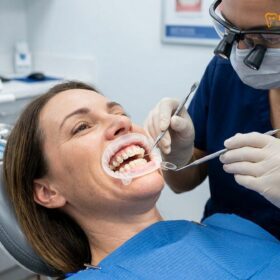
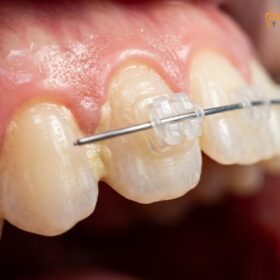
Invisalign attachments and buttons are essential clinical accessories that provide clear aligners with the necessary grip to perform complex tooth movements. While aligners alone can tip teeth, these small composite resin bumps and hooks enable precise root control, rotation, and bite correction for predictable orthodontic outcomes.
Clinical Summary:
Invisalign attachments are tooth-colored composite resin shapes bonded to specific teeth, acting as handles for aligners to push against. Buttons are small hooks used to anchor orthodontic elastics for jaw alignment. Together, they transform clear aligners from simple cosmetic trays into advanced biomechanical devices capable of treating severe malocclusions, deep bites, and complex rotations. The application process is entirely non-invasive, utilizing temporary dental adhesives that preserve the natural enamel. Clinical success relies heavily on these accessories to deliver targeted forces, making them a non-negotiable component for moderate to severe orthodontic cases.
Key Takeaways:
- Attachments provide the necessary geometric grip for aligners to execute complex movements like extrusion, intrusion, and root torque.
- Buttons serve as critical anchor points for rubber bands to correct skeletal discrepancies such as overbites and underbites.
- The bonding and removal processes are painless, non-invasive, and do not cause permanent damage to natural tooth enamel.
- Meticulous oral hygiene is required to prevent plaque biofilm accumulation around the microscopic margins of these accessories.
- Prompt replacement of detached attachments is vital to prevent tracking issues and treatment delays.
What are Invisalign Attachments and Buttons?
Attachments are tooth-colored composite resin bumps that help aligners grip teeth, while buttons are small hooks designed to hold orthodontic elastics for bite correction.
When patients first explore Orthodontics using clear aligner therapy, they often envision a completely smooth, featureless plastic tray. However, to achieve comprehensive tooth movement, orthodontists must frequently utilize auxiliary features. The two most common additions to a clear aligner treatment plan are attachments and buttons, each serving a distinct and vital biomechanical purpose.
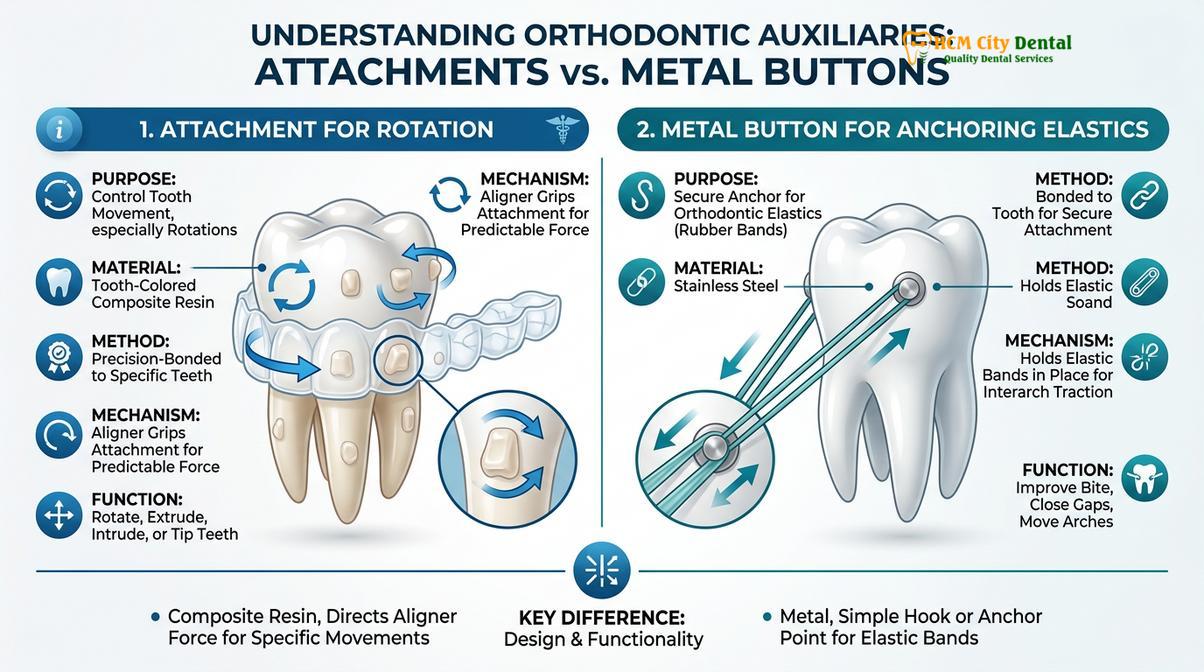
Invisalign Attachments (often referred to by patients as Invisalign bumps on teeth) are tiny, geometrically precise shapes made from dental composite resin. This is the exact same biocompatible material used for standard tooth-colored fillings. These attachments are bonded directly to the facial (front) or lingual (back) surfaces of specific teeth. They are not one-size-fits-all; advanced orthodontic software calculates the exact size, shape (rectangular, beveled, ellipsoid), and orientation of each attachment based on the specific directional force required to move that individual tooth[1].
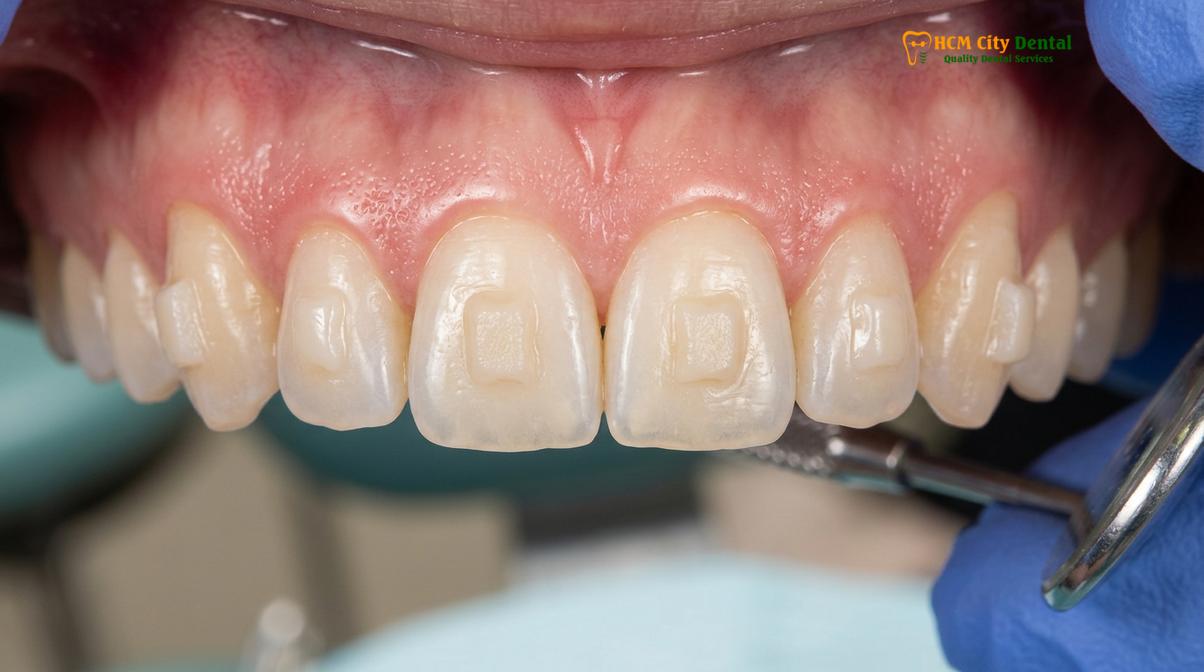
Invisalign Buttons, on the other hand, are small, distinct hooks or nodes. While attachments are designed to interface directly with the plastic of the aligner tray, buttons are designed to serve as anchor points for orthodontic rubber bands (elastics). These clear aligner buttons can be made of tooth-colored composite, clear plastic, or sometimes metal, depending on the required durability and location in the mouth. They can be bonded directly to the tooth surface (requiring a small cutout in the aligner tray) or manufactured as an integrated hook directly on the aligner plastic itself.
The distinction between the two is crucial for understanding your treatment plan. Attachments dictate how individual teeth move within the jawbone, whereas buttons and elastics dictate how the upper and lower jaws align with each other to correct the overall bite.
The Physics of Tooth Movement: Why Plastic Needs Grip
Smooth plastic aligners struggle to grip round teeth for complex movements; attachments provide a flat surface to apply targeted orthodontic rotational force.
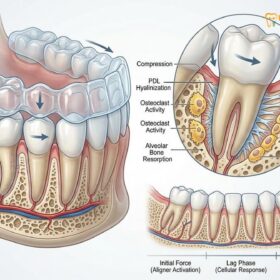
To understand why these accessories are necessary, one must understand the fundamental physics of orthodontics. Teeth move through the jawbone via a biological process called bone remodeling, which is triggered by sustained, controlled mechanical pressure. Traditional metal braces achieve this by tying a rigid wire to a bracket glued to the tooth, allowing the orthodontist to pull and torque the tooth in any direction.
Clear aligners operate on a different biomechanical principle: they move teeth by pushing them. A clear aligner is essentially a rigid plastic shell that is slightly misaligned with the current position of the teeth but perfectly aligned with the desired next position. When seated, the plastic flexes and exerts a pushing force against the tooth crown[2].
“Without attachments, a clear aligner is like a wrench trying to turn a perfectly round pipe. The smooth plastic simply slips off the tooth’s natural contours. The composite resin provides the necessary geometric edge for the plastic to grip and apply directional force.”
— Dr. Nguyen Van Cuong, Lead Orthodontist
This pushing mechanism works exceptionally well for simple tipping movements (leaning a tooth forward or backward). However, human teeth are highly contoured. Canines and premolars, for instance, are somewhat conical or cylindrical. If an aligner attempts to rotate a cylindrical tooth, the smooth plastic will simply slide over the enamel without transferring any meaningful orthodontic rotational force. By bonding a small, angled attachment to the tooth, the aligner now has a flat, rigid surface to push against, effectively acting as a handle to twist the tooth into its correct orientation.
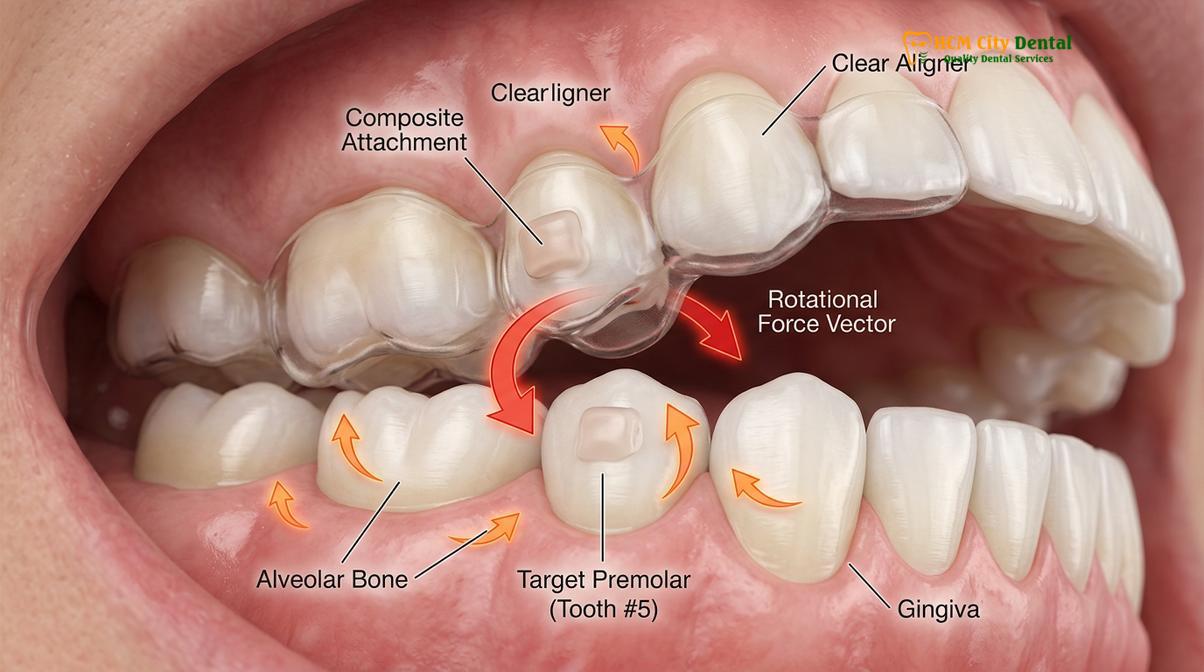
Furthermore, the center of resistance of a tooth is located roughly halfway down its root, encased in bone. Applying force only to the visible crown often results in tipping rather than bodily movement (moving the crown and root together). Attachments allow the aligner to apply a “couple” system of forces—pushing on the attachment while simultaneously pushing on the opposite side of the tooth crown—to achieve complex root torque and bodily translation[3].
How Attachments Help Correct Rotations and Intrusions
By acting as precise anchor points, attachments allow aligners to push teeth vertically into the gums or rotate cylindrical teeth into proper alignment.
The evolution of clear aligner therapy from a simple cosmetic tool to a comprehensive orthodontic system is largely due to the development of optimized attachments. Before these innovations, clear aligners were strictly limited to treating mild crowding and spacing. Today, with the strategic placement of composite resin attachments, orthodontists can tackle highly complex malocclusions.
Extrusion (Pulling Teeth Outward)
Extrusion is the process of pulling a tooth vertically out of the gum line. Biomechanically, this is one of the most difficult movements for a clear aligner to achieve on its own. Because the aligner pushes from the top down, it has no natural mechanism to pull a tooth upward. An attachment provides an undercut. The aligner is designed to snap over this attachment, gripping it from underneath and applying a continuous upward pulling force as the tray attempts to seat itself fully.
Intrusion (Pushing Teeth Inward)
Intrusion involves pushing a tooth vertically into the jawbone, often necessary for correcting deep bites where the upper front teeth overlap the lower teeth too much. While an aligner can easily push down on a tooth, doing so requires anchorage. According to Newton’s third law, pushing down on the front teeth creates an equal and opposite force that tries to push the aligner off the back teeth. To prevent the aligner from dislodging, orthodontists place retention attachments on the premolars and molars, locking the tray in place so it can effectively intrude the anterior teeth.
Complex Rotations
As previously mentioned, rotating rounded teeth like canines requires significant leverage. Optimized rotation attachments are often teardrop-shaped or beveled. The aligner is manufactured with a corresponding pocket that is slightly offset. When the patient inserts the aligner, the plastic pocket engages the flat slope of the attachment, generating a continuous, precise rotational moment until the tooth aligns with the tray.
| Orthodontic Movement | Aligner Alone Capability | With Attachments/Buttons |
|---|---|---|
| Simple Tipping | Highly Effective | Enhanced Control |
| Space Closure (Gaps) | Moderate | Highly Effective (Bodily Movement) |
| Severe Rotation (>15 degrees) | Poor (Plastic slips) | Highly Effective (Provides grip) |
| Extrusion (Pulling tooth down) | Very Poor | Effective (Provides undercut) |
| A-P Bite Correction (Overbite) | Ineffective | Requires Buttons & Elastics |
For patients requiring post-treatment retention solutions after complex movements, understanding the mechanics of tooth relapse is crucial. If you have previously undergone treatment and experienced a retainer failure, consulting a clinical guide on broken fixed retainer repair can provide insight into maintaining these hard-won rotational corrections.
The Bonding and Removal Process: Is It Painless?
The placement of attachments involves a painless, drill-free bonding process using a template tray, and removal is safely done with a specialized polishing tool.
A common concern among patients is whether the application of these invisible braces accessories will be painful or damage their natural teeth. From a clinical perspective, the bonding and removal of attachments is a completely non-invasive, drill-free procedure that preserves the integrity of the dental enamel.
The Bonding Workflow
The application appointment typically occurs after your initial consultation and digital scanning. The process is highly precise and usually takes less than 30 minutes for a full arch.
- Tooth Preparation: The specific teeth receiving attachments are isolated to keep them dry. The enamel surface is gently cleaned and treated with a mild acidic gel (usually 37% phosphoric acid) for about 15-20 seconds. This creates microscopic pores in the enamel, allowing the adhesive to grip. The gel is then rinsed off, and the tooth is thoroughly dried.
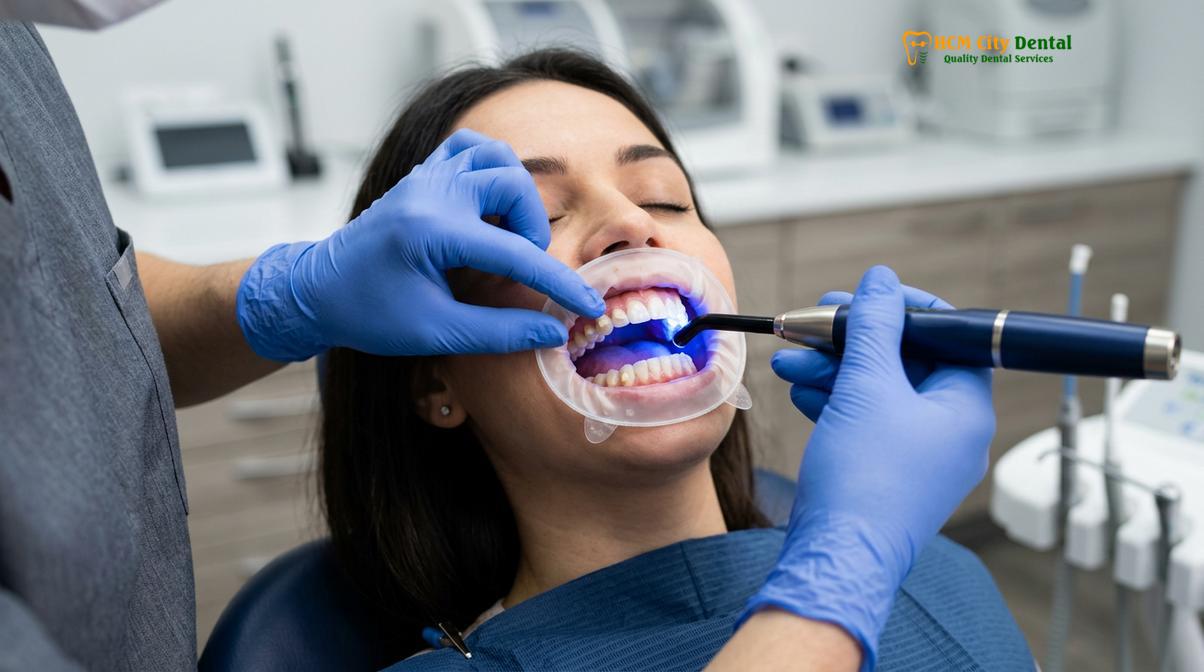
- Adhesive Application: A clear liquid bonding agent is painted onto the prepared enamel and cured with a specialized blue LED dental light.
- The Template Aligner: The orthodontist uses a custom-manufactured “template aligner.” This tray looks like a regular aligner but has small, empty reservoirs exactly where the attachments need to go. The clinician fills these reservoirs with a flowable, tooth-colored composite resin.
- Placement and Curing: The loaded template aligner is seated firmly over the patient’s teeth. The blue LED curing light is then applied through the clear plastic, instantly hardening the composite resin onto the teeth[4].
- Cleanup: The template aligner is removed, leaving the hardened attachments bonded to the teeth. Any excess resin (flash) is gently polished away.
Clinical Case Study: Complex Rotation Correction
A 28-year-old patient visited HCMC Dental Clinic in Ho Chi Minh City presenting with a severely rotated upper right canine (rotated nearly 45 degrees). Initial aligner therapy without attachments yielded minimal progress due to the tooth’s conical shape. Dr. Nguyen Van Cuong revised the ClinCheck plan to include an optimized, beveled rotation attachment on the canine. Within four aligner stages (approximately 8 weeks), the targeted orthodontic rotational force successfully guided the canine into proper arch alignment. The attachment was subsequently polished off, leaving the enamel pristine.
The Removal Process
At the conclusion of your treatment, or if an attachment needs to be repositioned, the removal process is equally straightforward. The orthodontist uses a specialized fluted carbide bur or a composite polishing point attached to a dental handpiece. These instruments are specifically designed to be softer than natural tooth enamel but harder than the composite resin. The clinician gently buffs away the attachment, vibrating the resin off the tooth surface without scratching the underlying enamel. Once the resin is removed, the tooth is polished to restore its natural, smooth luster.
Should you ever lose your final retainers after the attachments are removed, it is imperative to seek a lost retainer replacement immediately to prevent the teeth from shifting back to their original positions.
Maintaining Oral Hygiene Around Composite Resin Bumps
Because attachments create microscopic ledges on the teeth, meticulous brushing and flossing are required to prevent plaque accumulation and composite staining.
While clear aligners are celebrated for being removable—allowing for easier brushing and flossing compared to traditional metal braces—the presence of attachments introduces new hygiene considerations. These composite bumps create microscopic ledges and margins on the smooth surface of the tooth, providing ideal hiding spots for plaque biofilm and food debris.
If plaque is allowed to accumulate around the base of an attachment, the bacteria will produce acids that decalcify the underlying enamel. This can lead to permanent white spot lesions (demineralization) or active tooth decay. Furthermore, the composite resin material itself, while highly durable, is slightly porous and can absorb stains from dark-colored foods and beverages.
Clinical Hygiene Protocols
To maintain optimal oral health and aesthetics during your treatment, an aesthetic dentist HCMC will typically recommend the following protocols:
- Immediate Brushing: You must brush your teeth after every meal or snack before reinserting your aligners. Trapping food particles and sugars between the aligner and the attachments accelerates bacterial growth[5].
- Soft-Bristled Precision: Use a soft-bristled toothbrush and angle the bristles at 45 degrees toward the gum line and around the attachments to sweep away plaque from the microscopic margins.
- Interdental Cleaning: Flossing remains non-negotiable. Water flossers can also be highly effective at flushing out debris lodged around attachments and buttons.
- Stain Prevention: Minimize the consumption of highly pigmented items such as coffee, red wine, turmeric, and tobacco. If you do consume them, rinse your mouth vigorously with water immediately afterward. Note that while the aligners can be removed, the attachments remain on your teeth and can become discolored over time.
Understanding the long-term financial commitment of orthodontic retention is also important. Patients often compare international standards, such as the retainer cost Vietnam vs Korea or the retainer cost Vietnam vs Japan, to ensure they receive high-quality, cost-effective care for maintaining their newly aligned smiles.
When to See an Orthodontist During Treatment
Clear aligner therapy requires high patient compliance and careful monitoring. While the system is designed to be convenient, certain clinical situations require immediate professional intervention to keep the treatment on track.
Important Clinical Considerations:
You should schedule an immediate clinical evaluation if you experience any of the following:
- Detached Attachments: If a composite bump falls off, the aligner loses its grip on that specific tooth, potentially halting its movement.
- Tracking Issues: If you notice a visible “air gap” between the edge of your tooth and the aligner plastic, the tooth is not moving as planned. This often indicates that an attachment is not engaging properly.
- Button Failure: If a button used for elastics debonds, you will be unable to wear your rubber bands, stalling your bite correction progress.
- Severe Pain: While mild pressure is normal for the first 48 hours of a new tray, sharp, localized pain or extreme sensitivity around an attachment warrants a diagnostic check.
Regular monitoring ensures that the biomechanical forces are acting exactly as prescribed in the digital treatment plan. For international patients evaluating comprehensive care options, comparing the retainer cost Vietnam vs Canada highlights the value of receiving continuous, high-quality orthodontic supervision at specialized clinics like HCMC Dental Clinic.
Frequently Asked Questions
Are Invisalign attachments visible to others?
Invisalign attachments are made from tooth-colored composite resin, making them highly discreet. While they add slight texture to the teeth, they remain virtually invisible from a conversational distance, especially compared to traditional metal brackets. The exact visibility depends on the shade matching of the composite and the location of the attachment on the tooth.
Do attachments damage tooth enamel?
No, attachments do not damage tooth enamel when applied and removed correctly. Orthodontists use a safe, temporary dental adhesive that bonds the composite resin to the tooth surface without requiring any drilling or permanent alteration. The removal process utilizes specialized polishing tools that safely buff away the resin while preserving the natural enamel underneath.
What happens if an Invisalign attachment falls off?
If an attachment falls off, your aligner may lose the specific grip needed to move that tooth. You should contact your orthodontist promptly to have the composite bump replaced, ensuring your treatment timeline remains on track. Continuing to wear aligners without a prescribed attachment can lead to tracking errors where the tooth falls behind the digital plan.
How long do I need to wear clear aligner buttons?
Clear aligner buttons are typically worn for the duration of your elastic wear phase, which varies by patient. Once your bite alignment and jaw positioning have been successfully corrected, your orthodontist will safely remove the buttons. In some cases, buttons are only needed for a few months, while complex bite corrections may require them for the majority of the treatment.
Can I request to have my attachments removed for a special event?
Removing attachments mid-treatment is generally discouraged as it disrupts the continuous orthodontic force required for tooth movement. However, in exceptional circumstances like a wedding, your orthodontist may temporarily remove highly visible attachments, though this may extend your treatment time. You would need to have them rebonded immediately after the event to resume progress.
References
- American Journal of Orthodontics and Dentofacial Orthopedics. Biomechanics of clear aligners and the role of attachments. (2021).
- Journal of Clinical Orthodontics. Efficacy of composite resin attachments in complex rotational movements. (2020).
- European Journal of Orthodontics. Force delivery systems in clear aligner therapy: A comparative clinical study. (2019).
- Angle Orthodontist. Enamel surface evaluation after removal of orthodontic attachments. (2022).
- International Journal of Dentistry. Patient compliance and oral hygiene maintenance during clear aligner therapy. (2018).