Losing an Invisalign aligner abroad requires immediate action to prevent orthodontic relapse. Contact your primary orthodontist immediately, switch to your previous backup tray to hold your teeth in place, and avoid forcing the next aligner unless specifically instructed by your dental provider.
Clinical Summary:
Dr. Nguyen Van Cuong advises that misplacing a clear aligner during international travel is a common but manageable orthodontic emergency. The primary clinical objective is stabilizing the current dentition to prevent unwanted shifting. Patients must utilize their backup trays to maintain continuous pressure on the periodontal ligaments. Advancing to the next tray prematurely can cause severe tracking issues or root damage. Coordination with the home clinic is essential to arrange for a replacement tray or to safely modify the wear schedule while abroad.
Key Takeaways:
- Always travel with your most recently completed aligner and your next scheduled set.
- Reverting to the previous tray is the safest immediate action to prevent teeth from shifting.
- Prematurely advancing to the next tray can lead to poor tracking and potential root resorption.
- Your home orthodontist can often expedite international shipping for replacement trays.
- Local dental clinics can provide temporary retainers if your backup trays are also lost.
Lost Your Aligner: Why Immediate Action is Critical
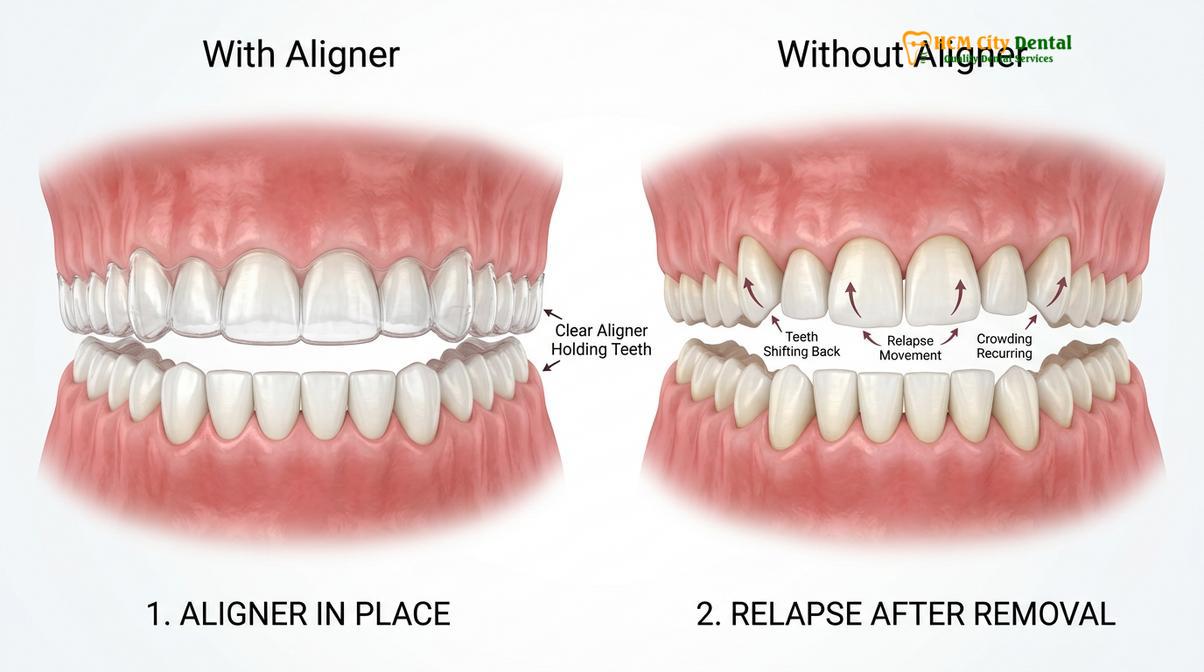
Immediate intervention is crucial because teeth begin shifting back to their original positions within hours of removing an active aligner, compromising your treatment progress.
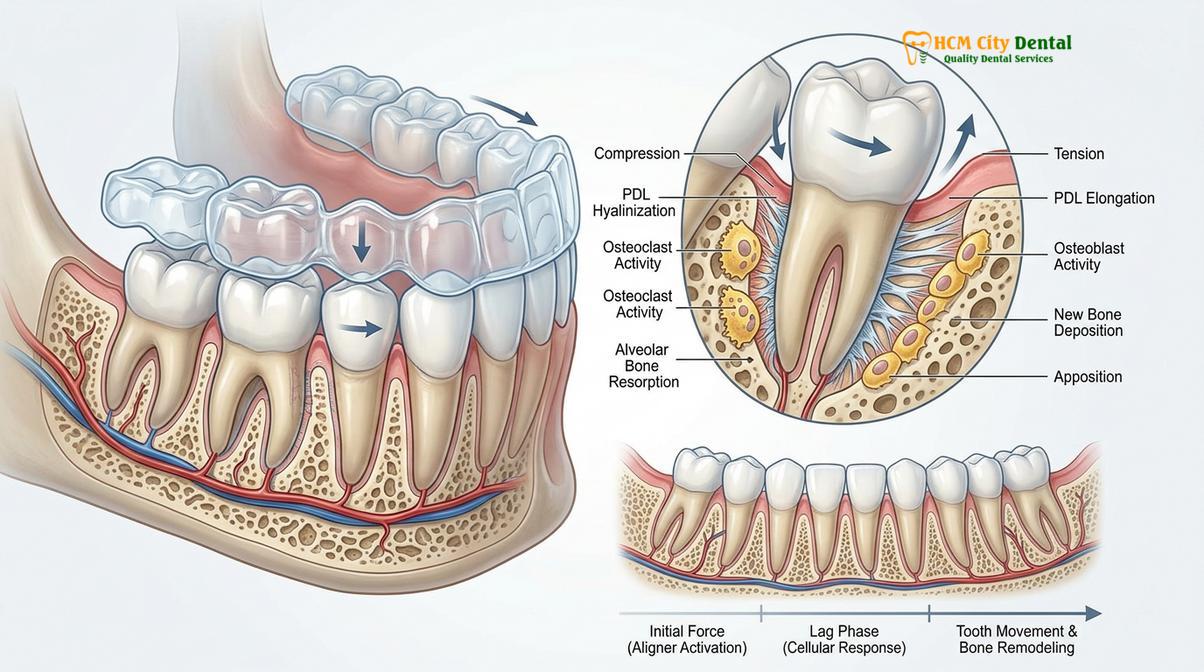
Experiencing a lost clear aligner vacation travel scenario can induce significant anxiety, but understanding the biological mechanisms of tooth movement helps clarify why immediate action is necessary. Orthodontic treatment relies on the continuous, controlled application of force to the teeth. This force stimulates the periodontal ligament (PDL)—the connective tissue that attaches the tooth root to the surrounding alveolar bone. When an aligner applies pressure, it triggers a complex biological response involving osteoclasts (cells that break down bone in the direction of movement) and osteoblasts (cells that build new bone behind the moving tooth)[1].
During active treatment, the bone surrounding your teeth is in a transient, softened state. The teeth are highly mobile and susceptible to movement in any direction. If the continuous force of the aligner is removed, the stretched periodontal fibers act like microscopic rubber bands, attempting to pull the teeth back to their original, pre-treatment positions. This phenomenon is known as orthodontic relapse mechanisms. Depending on the individual’s biology and the specific stage of treatment, noticeable shifting can occur within just a few hours of losing an aligner.
When traveling abroad, the disruption to your routine makes it easy to accidentally discard an aligner wrapped in a napkin or leave it behind in a hotel room. The immediate clinical priority is not necessarily to continue moving the teeth forward, but rather to arrest any backward movement. Allowing the teeth to shift freely not only undoes weeks of progress but can also render your subsequent aligners completely useless, as they will no longer fit the altered dental arch. Therefore, securing the teeth in their current position is the most critical first step in managing this orthodontic emergency.
The Backup Tray Rule: Should You Go Forward or Backward?
The standard clinical protocol dictates reverting to your most recently completed tray to stabilize the teeth, rather than prematurely forcing the next aligner in the sequence.
One of the most common dilemmas patients face is deciding whether to move forward to the next tray or backward to the previous one. The Invisalign backup tray rule is a fundamental guideline designed to protect the health of your teeth and the integrity of your treatment plan. As a general clinical standard, you should always revert to your previous tray unless you are in the final days of your current aligner’s wear cycle and have received explicit permission from your orthodontist to advance[2].
Moving backward to the previous tray acts as a temporary holding pattern. While it will not advance your treatment, it serves as a highly effective passive retainer. It ensures that the teeth remain in a known, stable position that matches a specific stage in your digital ClinCheck plan. This predictability is vital for your orthodontist when determining the next steps.
Clinical Warning: Never force a new aligner onto your teeth if it requires excessive pressure or causes severe pain. Forcing an ill-fitting tray can cause the aligner to warp, lead to tracking failures, and significantly increase the risk of root resorption (the permanent shortening of tooth roots).
Conversely, prematurely advancing to the next tray carries significant clinical risks. Aligners are programmed to move teeth by a maximum of 0.25 millimeters per stage. If you lose an aligner on day two of a fourteen-day cycle, your teeth have not yet completed the necessary biological movement to fit the subsequent tray. Forcing the next tray can cause the aligner to “bridge” or sit improperly over the teeth, meaning the programmed forces are applied to the wrong areas of the crown. This leads to tracking failures, where the teeth stop moving according to the plan, often requiring a complete mid-course correction or refinement scan.
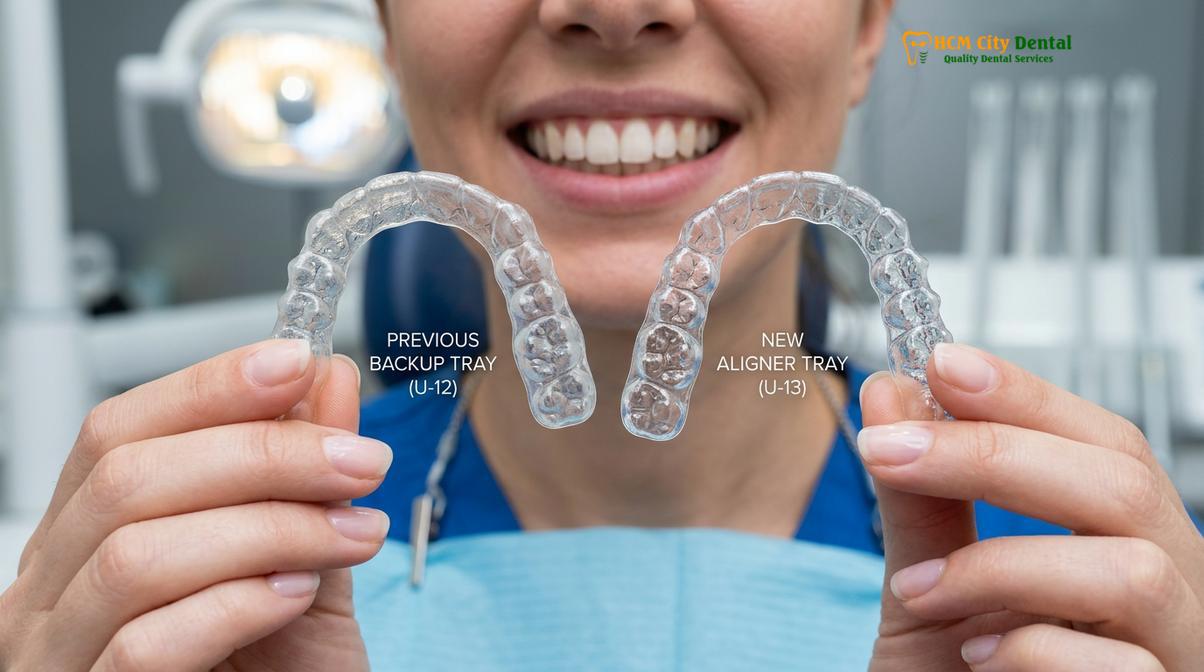
There is a narrow exception to this rule. If you lose your aligner on day twelve or thirteen of a fourteen-day cycle, your teeth may have already achieved the majority of the programmed movement. In this specific scenario, your orthodontist might advise you to carefully try in the next tray. If it seats fully without excessive force or severe discomfort, you may be instructed to wear it for an extended period (e.g., three weeks instead of two) to ensure the bone fully remodels around the new position. However, this decision must always be guided by professional urgent dental care advice.
Preventing Relapse: Keeping Your Current Tooth Position Safe
Maintaining continuous pressure with a well-fitting temporary aligner prevents the periodontal ligaments from pulling teeth out of their newly established alignment.
When managing an emergency abroad, shifted teeth lost aligner prevention becomes your primary focus. The biological memory of the periodontal ligament is remarkably strong. Without the physical barrier of an aligner, the transseptal fibers—which connect adjacent teeth—will contract, causing teeth to rotate or tip back toward their original malocclusion. This is why orthodontists universally recommend keeping all previous aligners during active treatment.
If you find yourself without your current aligner and without your immediate backup, the situation becomes more urgent. In such cases, you must find the most recent aligner that still fits comfortably. Even if you have to go back two stages, it is biologically safer to hold the teeth in an older, stable position than to let them drift unpredictably. Once teeth drift, they do not move back uniformly; some may rotate, while others may intrude or extrude, creating a complex misalignment that a standard replacement tray cannot fix[3].
“The most critical error a patient can make when losing an aligner abroad is doing nothing. Even a previous tray that feels slightly loose is infinitely better than leaving the teeth unsupported. Our goal is stabilization first, progression second.”
— Dr. Nguyen Van Cuong, HCMC Dental Clinic
If you have lost all your aligners while traveling, you must seek immediate assistance from a local dental professional. While a foreign dentist cannot access your proprietary Invisalign file to print a new active tray, they can take a digital scan or physical impression of your teeth in their current state. From this, they can fabricate a clear Essix retainer or a wire-based Hawley retainer within a few hours. This temporary appliance will act as a splint, freezing your progress and preventing relapse until you can return home or receive a replacement from your primary provider.
How to Request an Emergency Invisalign Reorder Globally
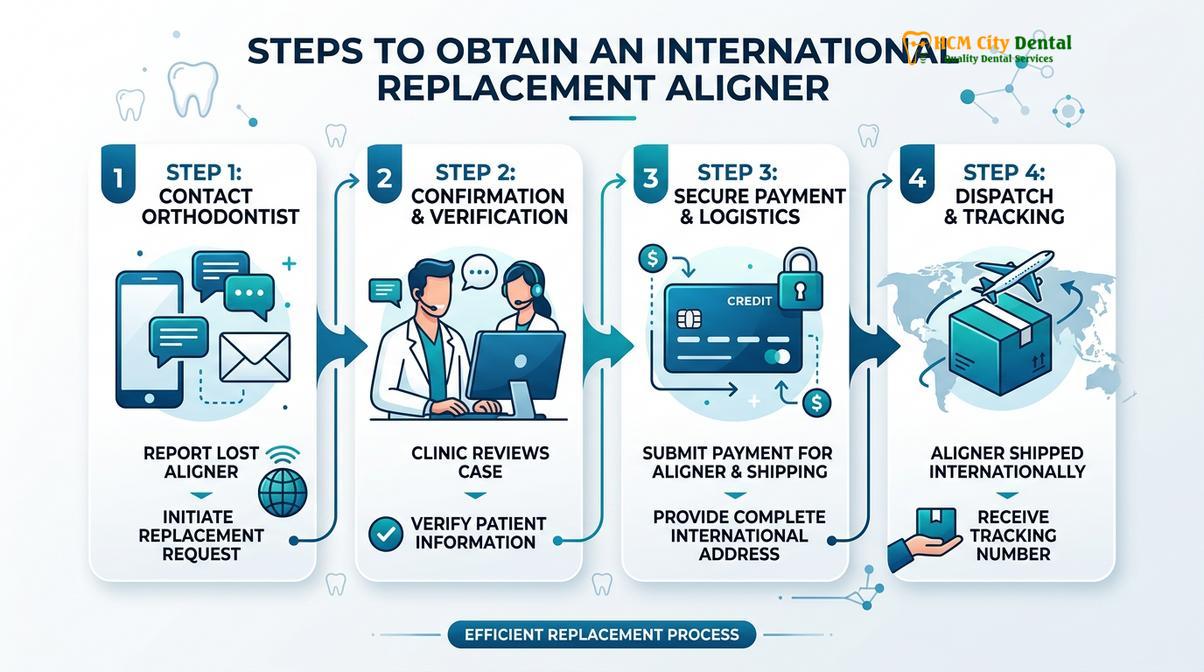
Patients must contact their original prescribing orthodontist to order a replacement tray, which can then be expedited via international courier to their travel destination.
Navigating an emergency aligner replacement abroad requires clear communication with your home clinic. Because clear aligner therapy is highly customized, replacement trays can only be ordered by the specific doctor who holds your digital treatment file. The Invisalign portal is restricted to the prescribing provider, meaning you cannot simply walk into a random certified clinic in another country and ask them to print tray number fourteen.
The workflow for requesting a replacement involves several precise steps. First, contact your home clinic immediately via phone or email. Provide them with your exact current tray number, the number of days you wore it before it was lost, and whether you are currently wearing a backup tray. Based on this clinical data, your orthodontist will decide whether to order a replacement of the lost tray or instruct you to move to the next stage.
Clinical Case Example: A patient visiting Ho Chi Minh City lost their active aligner (Tray 12) while dining. They immediately contacted their home provider and sought a local consultation at HCMC Dental Clinic. Because the patient had only worn Tray 12 for three days, their home orthodontist ordered a replacement. Meanwhile, the team at HCMC Dental Clinic verified the fit of the patient’s backup Tray 11, ensuring the teeth remained stable and healthy while waiting for the replacement to be shipped internationally via DHL.
If a replacement is ordered, it typically takes the manufacturer a few days to fabricate the tray. Once delivered to your home clinic, the staff can package it and use an international courier (such as FedEx, DHL, or UPS) to ship it to your hotel or temporary residence abroad. It is important to factor in international shipping times and potential customs delays for medical devices. Your home clinic will usually provide a tracking number so you can monitor the shipment.
For patients seeking cross-border advice, protocols remain largely consistent worldwide. For instance, patients frequently compare WA dentist emergency advice HCMC protocols when traveling between Western Australia and Vietnam, noting that international clinics follow the exact same stabilization guidelines: hold the current position, do not force progression, and coordinate with the primary provider[4].
| Days Worn Before Loss | Immediate Action | Orthodontist’s Likely Recommendation |
|---|---|---|
| 1 to 5 Days | Switch to previous backup tray | Order a replacement of the lost tray. |
| 6 to 10 Days | Switch to previous backup tray | Evaluate fit of next tray; may require replacement. |
| 11 to 14 Days | Try the next tray carefully | Advance to next tray and wear for an extended period. |
Planning Ahead: Travel Tips for Invisalign Patients
Proactive packing, including carrying multiple aligner stages and protective cases in your carry-on luggage, is the most effective strategy for managing orthodontic emergencies abroad.
The best way to handle a lost aligner is to prepare for the possibility before you even board your flight. Managing traveler dental care Invisalign requires a proactive approach to packing and daily habits. When preparing for international travel, or when relocating internationally during treatment, you should never rely solely on the single pair of aligners currently in your mouth.
Always pack your aligners in your carry-on luggage, never in checked baggage. Checked bags can be delayed or lost, which would leave you without your essential medical devices. Your travel kit should include your current aligners, the most recently completed set (your immediate backup), and the next two sets in your sequence. This ensures that regardless of when an emergency occurs, you have the necessary tools to either hold your position or safely advance under your doctor’s remote guidance.
“We strongly advise our traveling patients to carry at least three stages of aligners with them: the past, the present, and the future. This simple packing strategy turns a potential clinical crisis into a minor inconvenience.”
— Dr. Nguyen Van Cuong
Furthermore, strict adherence to using your aligner case is paramount. The vast majority of aligners are lost because they are wrapped in napkins at restaurants and accidentally thrown away by waitstaff. If the aligner is not in your mouth, it must be in its hard protective case. Bringing a brightly colored spare case can also help prevent leaving it behind on hotel nightstands or bathroom counters. Maintaining excellent oral hygiene while traveling is also critical; always carry a travel toothbrush, floss, and aligner cleaning crystals to ensure your trays remain hygienic and clear.
When to Seek Immediate Clinical Assistance
While losing an aligner is usually managed by reverting to a backup tray, certain scenarios require immediate, in-person clinical evaluation. If you lose your aligner and simultaneously experience a loss of multiple composite attachments (the tooth-colored bumps bonded to your teeth), your backup tray may not grip the teeth effectively. Attachments are crucial for directing complex forces; without them, the aligner may slip or fail to prevent relapse.
Additionally, if you attempt to insert your backup tray and experience severe, radiating pain, or if the tray visibly does not seat fully over the teeth (creating large air gaps at the biting edges), you must seek local professional help. This indicates that the teeth have already shifted significantly, and forcing the tray could cause trauma to the periodontal ligament or lead to orthodontic hardware emergencies if you have hybrid treatments involving partial braces.
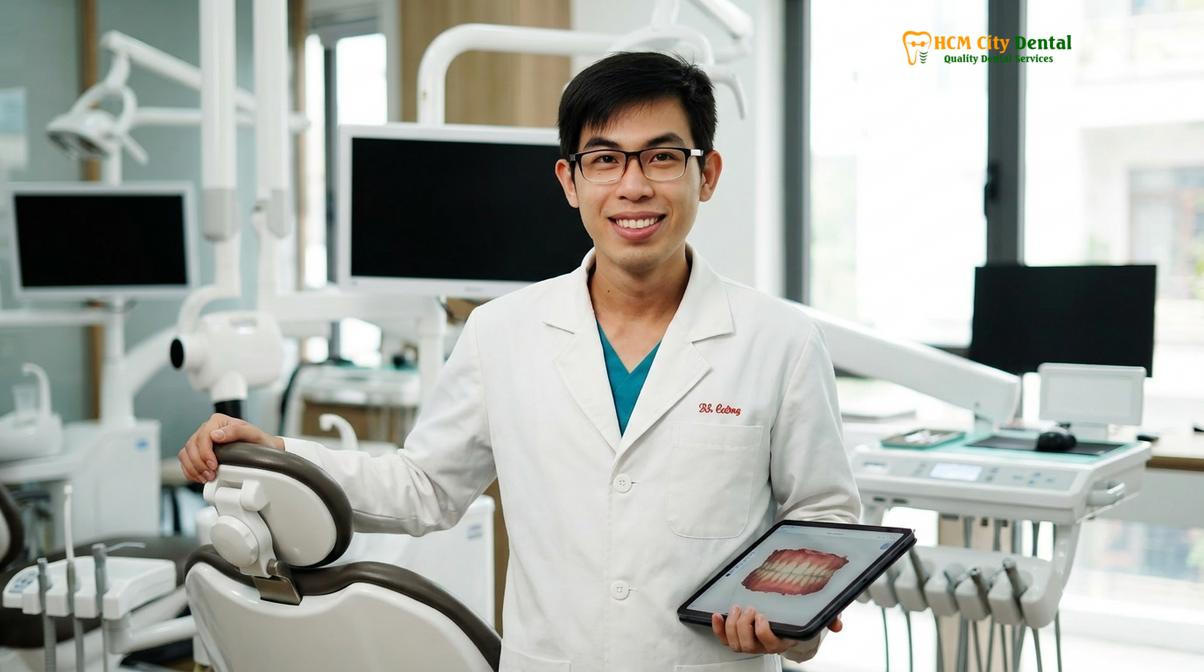
If you are traveling and find yourself in this situation, do not hesitate to contact a reputable local clinic. For example, patients visiting Ho Chi Minh City can schedule an emergency consultation at HCMC Dental Clinic. A local specialist can assess the tracking, verify the health of the underlying bone, and fabricate a temporary holding appliance if your backup trays are failing. They can also communicate directly with your home orthodontist to provide clinical photos and digital scans, ensuring your treatment plan remains coordinated and safe[5]. Whether you are comparing orthodontic treatment options for travelers or simply need an emergency retainer, professional intervention is always the safest route.
Frequently Asked Questions
What should I do if I lose my active Invisalign tray on vacation?
Immediately switch to your previous backup aligner to prevent your teeth from shifting. Contact your prescribing orthodontist as soon as possible to report the loss and determine if a replacement tray needs to be shipped to your location. Do not attempt to force the next tray in your series unless your doctor explicitly instructs you to do so, as this can cause severe tracking issues.
Is it safe to wear my previous set of aligners temporarily?
Yes, wearing your previous set of aligners is the safest clinical protocol to maintain your current tooth position. It acts as a temporary retainer, preventing orthodontic relapse while you wait for further instructions or a replacement tray. Ensure you wear this backup tray for the standard 20-22 hours a day to keep the periodontal ligaments stable.
How much does a single replacement Invisalign tray cost?
The cost of a single replacement Invisalign tray varies by provider but typically ranges from a nominal fee to a moderate clinical charge. Some comprehensive treatment plans include one or two free replacement trays under their warranty terms. It is best to review your initial contract or ask your clinic’s treatment coordinator about replacement fees.
Can a foreign dentist print a replacement Invisalign tray for me?
No, a foreign dentist cannot directly print an official Invisalign tray because your proprietary 3D treatment plan (ClinCheck) is controlled by your original provider. However, a local clinic can fabricate a temporary clear retainer to hold your teeth. They can also take digital scans to send to your home orthodontist to assist in evaluating your current dental alignment.
How long does it take for teeth to shift without an aligner?
Teeth can begin shifting back toward their original positions within just a few hours of removing an aligner. The periodontal ligaments remain highly active during orthodontic treatment, making continuous pressure essential to maintain your progress. This rapid relapse is why you must insert a backup tray or temporary retainer as quickly as possible after losing an active aligner.
References
- American Journal of Orthodontics and Dentofacial Orthopedics. Periodontal ligament memory and orthodontic relapse mechanisms. (2021).
- Journal of Clinical Orthodontics. Protocols for managing lost or damaged clear aligners during active therapy. (2020).
- European Journal of Orthodontics. Biomechanical considerations in clear aligner therapy and tracking failures. (2019).
- International Dental Journal. Emergency management of orthodontic patients in travel medicine. (2022).
- Journal of the American Dental Association. Root resorption risks associated with accelerated orthodontic forces. (2018).
For personalized guidance on managing orthodontic emergencies while traveling, or if you need immediate assistance with misplacing an orthodontic retainer, contact our specialist team at HCMC Dental Clinic.