
Dental Fillings & Bonding in Ho Chi Minh City — From $15, Pain-Free

Dr. Nguyen Van Cuong, DDS, MSc — hcmcdental.com/treatments/fillings/
hcmcdental.com/treatments/fillings/Whether you need a simple cavity filled, a chipped tooth bonded, or old silver fillings replaced — HCMC Dental provides BPA-free composite fillings, ceramic inlays, and cosmetic bonding with Dr. Cuong's expert hands. Save 70–90% versus USA, UK, or Australia.
What Is a Dental Filling?
A dental filling is a restorative procedure that repairs a tooth damaged by dental caries (tooth decay), cracks, or fracture. Dr. Cuong removes the decayed or damaged tissue, cleans the cavity, and fills the space with a biocompatible material — most commonly tooth-colored composite resin — to restore the tooth's original shape, function, and strength.
Understanding tooth anatomy helps clarify why prompt treatment matters:
- Enamel — The hard outer shell. Decay here is painless and easiest to treat.
- Dentin — The softer layer beneath enamel. Decay causes sensitivity. A filling is essential.
- Pulp — The nerve and blood vessel center. If decay reaches here, a root canal treatment is required instead of a filling.
Key fact: A filling placed at Stage 2 (enamel decay) costs $15–$35. The same tooth left untreated progresses to Stage 4 requiring a root canal ($200+) or Stage 5 requiring extraction and implant ($800–$1,500). Early treatment is always the most affordable option.
At HCMC Dental, Dr. Cuong uses exclusively BPA-free, mercury-free composite resins (3M Filtek Supreme Ultra, USA; Tokuyama Estelite Sigma Quick, Japan) — the same premium brands used in American and Australian dental clinics, at a fraction of the cost.
The 5 Stages of Tooth Decay — What Stage Are You At?
Tooth decay (dental caries) is a progressive bacterial disease. The earlier it is detected, the simpler and cheaper the treatment. Understanding which stage you are at helps you make an informed decision about urgency.
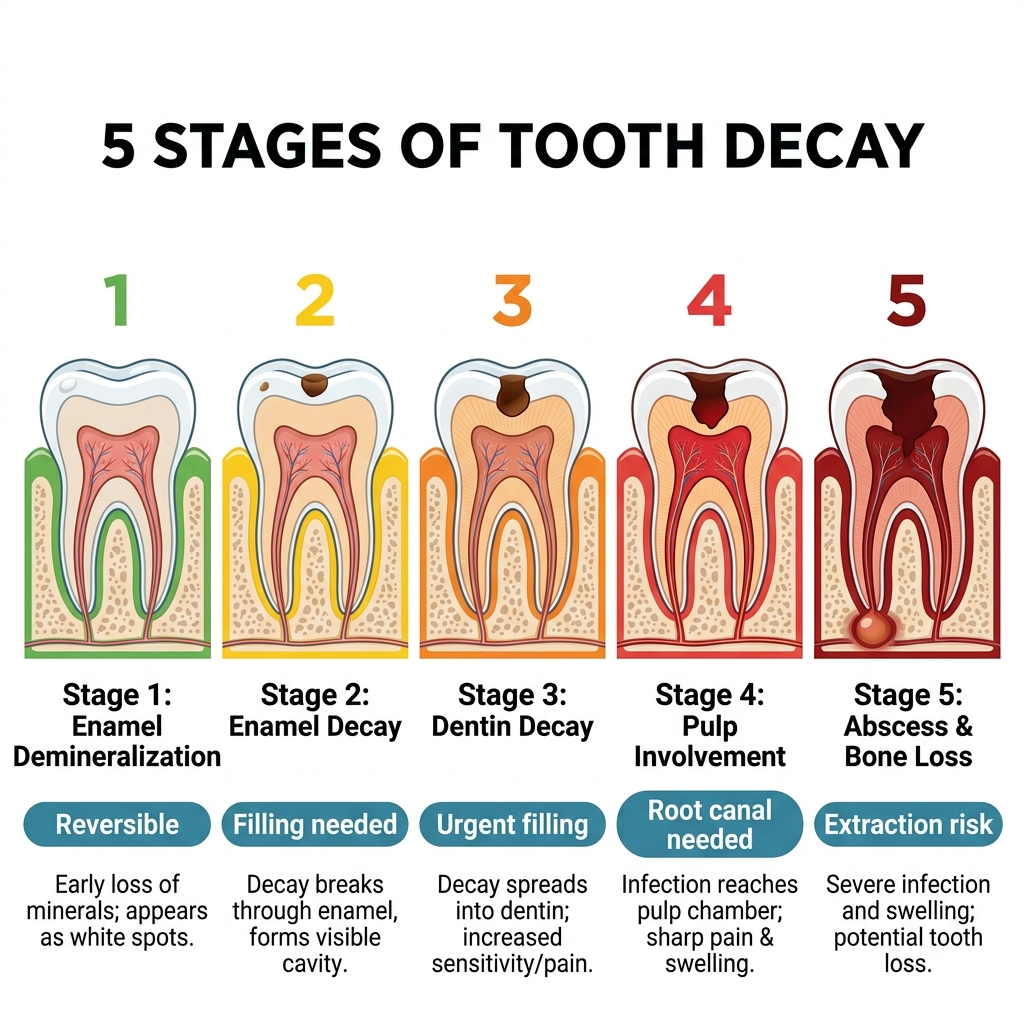
The 5 stages of tooth decay and the corresponding treatment at each stage.
Demineralization — White Spots on Enamel
Acid from bacteria begins dissolving enamel minerals. Appears as chalky white spots. Good news: This stage is reversible with fluoride toothpaste and varnish. No filling needed yet — but a 6-month checkup is essential.
Enamel Decay — Small Cavity Forms
Decay breaks through enamel, forming a visible dark spot or small hole. Usually painless. Treatment: Small composite filling from $15. Procedure takes 30–40 minutes. If caught here, the filling lasts 7–10 years.
Dentin Decay — Sensitivity Develops
Decay reaches the dentin layer (softer, closer to the nerve). Sensitivity to hot, cold, and sweets begins. The cavity is now larger. Treatment: Medium-to-large composite or ceramic inlay ($24–$80). Do not delay — dentin decay progresses rapidly.
Pulp Involvement — Root Canal Required
Bacteria reach the pulp (nerve center). Severe toothache, spontaneous pain, and possible swelling. A filling is no longer sufficient. Treatment: Root canal treatment ($200+) followed by a crown to protect the weakened tooth.
Abscess & Bone Loss — Extraction Risk
Infection spreads to the bone. Severe pain, swelling, and systemic risk. Root canal may still be possible in some cases, but extraction is often required. Treatment after extraction: Dental implant ($800–$1,500) or bridge. Prevention cost: $15 filling. End-stage cost: $800–$2,000+.
At Stage 1–3? A filling can save your tooth today.
Don't wait for pain to worsen. Message Dr. Cuong on WhatsApp for a same-day assessment.
8 Signs You May Need a Filling — Self-Check
You don't always need pain to need a filling. Many cavities are completely painless until they reach Stage 3 or 4. Here are the warning signs to watch for:
🟠 Checked 2 or more boxes? Message Dr. Cuong for a free WhatsApp assessment — no commitment required.
💬 Free WhatsApp AssessmentFilling Material Comparison — Which Is Right for You?
Not all fillings are created equal. The right material depends on the size and location of the cavity, your aesthetic goals, budget, and longevity expectations. Here is a complete comparison of every filling material Dr. Cuong uses at HCMC Dental:
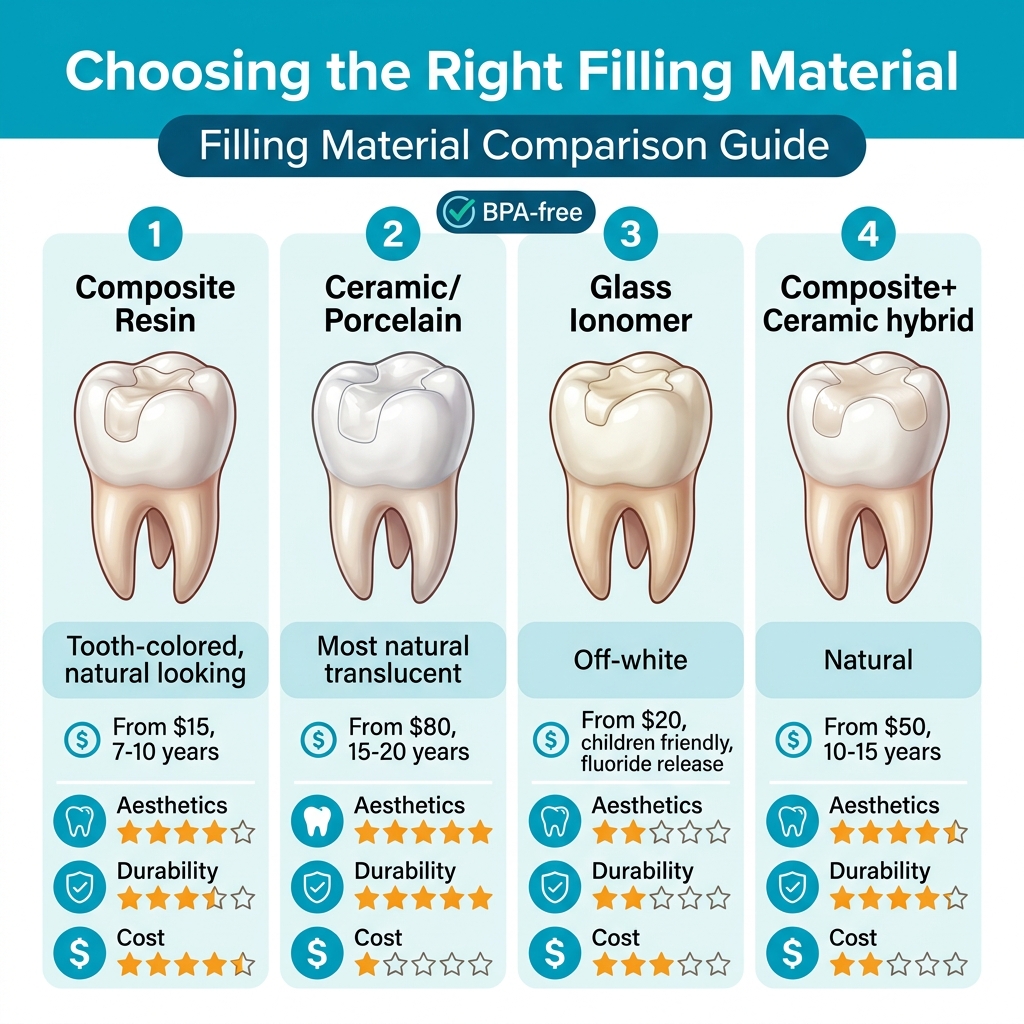
Composite resin, ceramic/porcelain, glass ionomer, and hybrid materials compared.
| Material | Appearance | Durability | Best For | HCMC Price |
|---|---|---|---|---|
| 🏆 Composite Resin | Tooth-colored, natural | 7–10 years | Front & back teeth, all cavity sizes, best value | From $15 |
| 💎 Ceramic / Porcelain Inlay | Most natural, translucent | 15–20 years | Large cavities, high-stress back teeth, visible areas | From $80 |
| 🧒 Glass Ionomer (GIC) | Off-white, opaque | 5–7 years | Children's teeth, cavities below gumline, temporary | From $20 |
| ⚡ Composite + Ceramic Hybrid | Natural, good translucency | 10–15 years | Mid-sized back tooth cavities, good balance of cost/longevity | From $50 |
| 🚫 Amalgam (Silver) — Legacy | Silver/dark, visible | 15–25 years | Not placed at HCMC Dental. Can be safely removed and replaced. | Removal from $30 |
HCMC Dental policy: We use only BPA-free, mercury-free composite resins and ceramic materials. We no longer place new amalgam fillings. All composite materials (3M Filtek Supreme Ultra, Tokuyama Estelite Sigma Quick) are FDA-cleared and used in top dental clinics globally.
The Composite Filling Procedure — 8 Steps, 30–60 Minutes
Knowing exactly what happens during your appointment eliminates anxiety and sets realistic expectations. Here is precisely how Dr. Cuong places a composite filling at HCMC Dental:
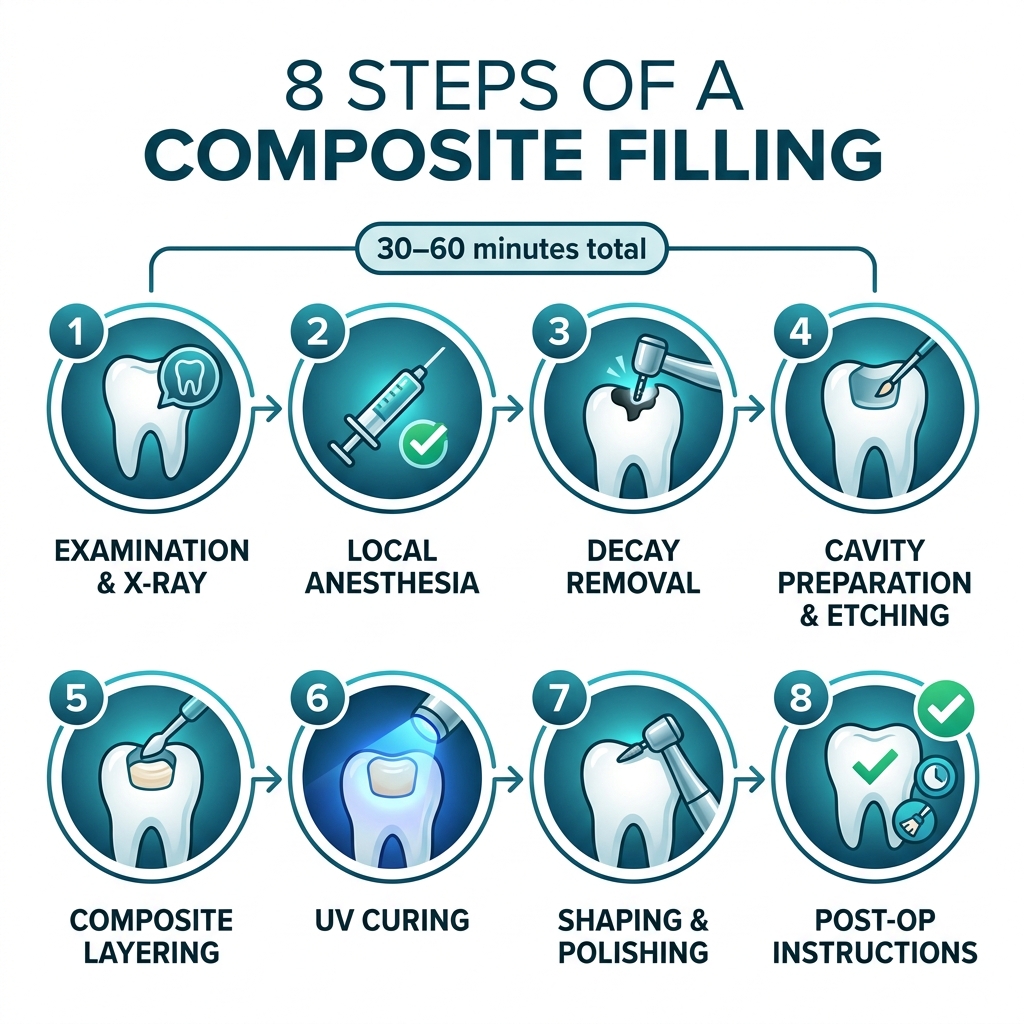
Examination & Digital X-Ray
Dr. Cuong reviews your digital X-ray to confirm the depth and extent of decay. The shade of your natural tooth is recorded using a professional shade guide. No extra charge for consultation and X-ray.
Local Anesthesia
Topical benzocaine gel is applied to the gum surface for 60 seconds first. Then Articaine 4% (the gold-standard local anesthetic) is administered. Most patients feel only mild pressure — not pain. Anesthesia takes full effect within 3–5 minutes.
Decay Removal
A precision high-speed handpiece removes all decayed tissue. Dr. Cuong uses conservative preparation — only the minimum necessary healthy tooth structure is removed. Caries detector dye may be used to confirm complete removal.
Cavity Preparation & Etching
The cavity is rinsed and dried. Phosphoric acid etching gel is applied for 15 seconds to create micro-porosity in the enamel and dentin, then rinsed off. A bonding agent (adhesive resin) is applied and UV-cured to create the micro-mechanical bond that anchors the composite.
Composite Layering
Shade-matched composite resin is applied in thin incremental layers (1–2mm each) to build up the restoration. Each layer is placed with artistic precision to recreate the natural anatomy — including the cusps, ridges, and marginal ridges of your tooth.
UV Curing
Each composite layer is hardened using a high-intensity blue-spectrum LED curing light (480–500nm wavelength). This activates the photoinitiators in the resin, creating a fully polymerized, hard restoration within 20–40 seconds per layer.
Shaping & Polishing
The filling is shaped to precisely match your natural bite using articulating paper. High-speed and finishing burs refine the anatomy. Diamond polishing discs and paste produce a final lustre that is visually indistinguishable from natural enamel.
Post-Op Instructions & Aftercare
Dr. Cuong explains what to expect: numbness for 2–3 hours, possible sensitivity for 1–7 days (normal), foods to temporarily avoid, and a WhatsApp contact for any questions. Most patients leave the clinic eating soft foods within hours.
Real Patient Results: Dental Filling & Tooth Restoration Cases
See authentic clinical cases restored by Dr. Nguyen Van Cuong at HCMC Dental Clinic in District 1, Ho Chi Minh City. All photographs are unretouched clinical documentation demonstrating single-visit composite resin restorations, molar anatomy rebuilding, and cervical abrasion repairs.

Interproximal & Cavity Composite Restoration
Decayed dental tissue carefully removed with micro-conservative precision, followed by layering of shade-matched nano-composite resin that bonds seamlessly with natural tooth enamel.
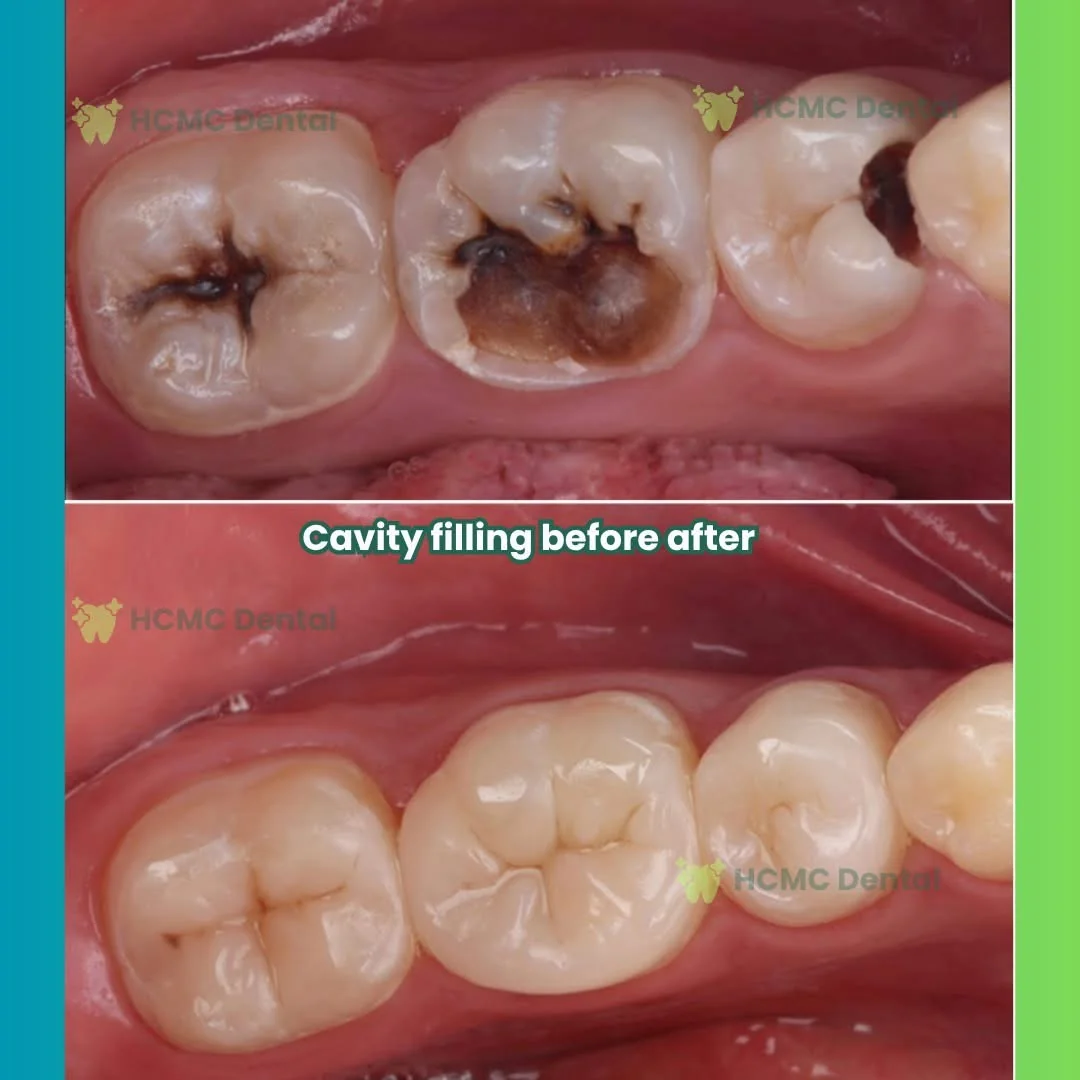
Deep Molar Cavity & Occlusal Anatomy Rebuilding
Deep occlusal fissure decay in lower molar excavated and rebuilt with high-strength posterior composite, restoring precise natural biting grooves and durable masticatory function.

Gumline Cervical Abrasion & Root Sensitivity Relief
Notched tooth enamel and exposed sensitive dentin at the gumline restored with flexible microfill composite, sealing exposed nerve pathways and ending temperature sensitivity instantly.
Dental Bonding — Fix Chips, Gaps & Discoloration in One Visit
Composite dental bonding is one of the most versatile and cost-effective cosmetic dental procedures available. Unlike veneers, bonding requires no enamel removal, no lab work, and no temporary restorations — Dr. Cuong applies and sculpts the composite resin directly on your tooth in a single appointment.
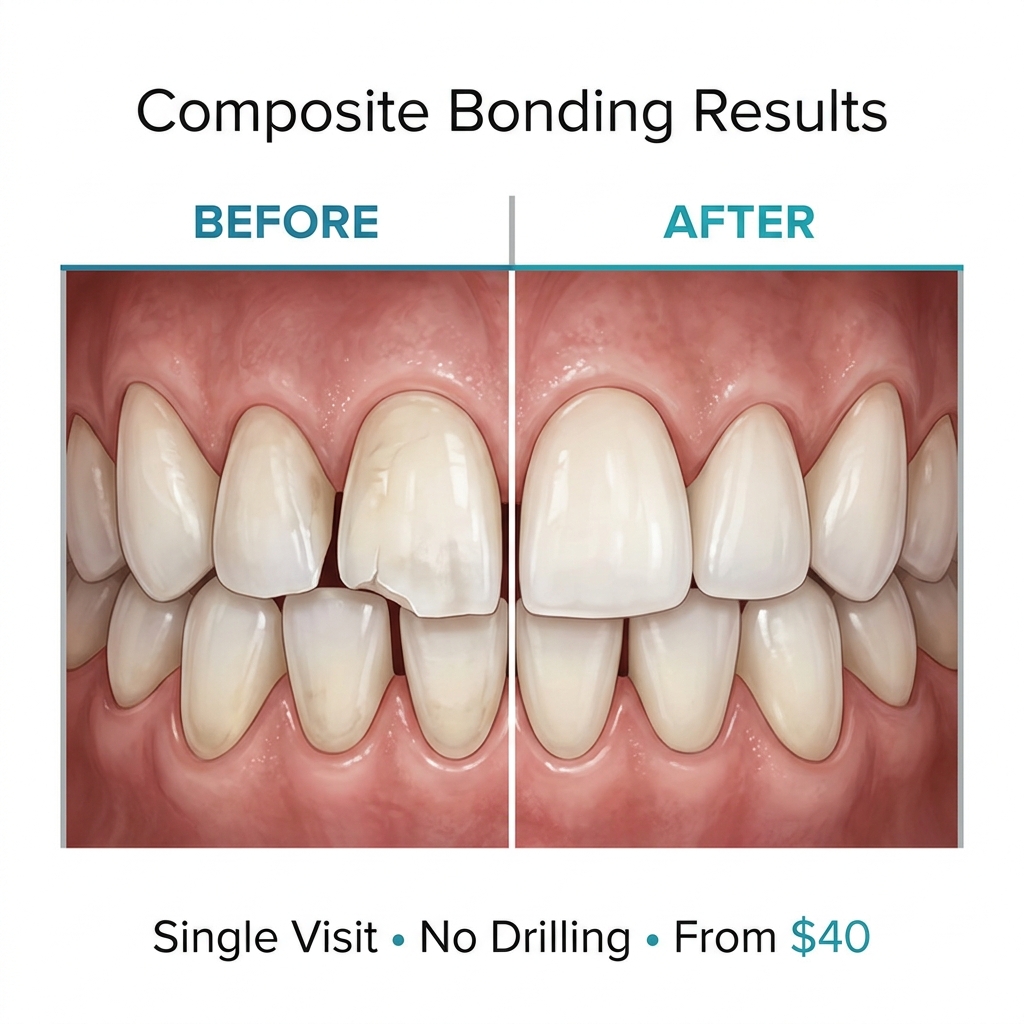
Composite bonding can restore a chipped or cracked tooth in a single visit from $40.
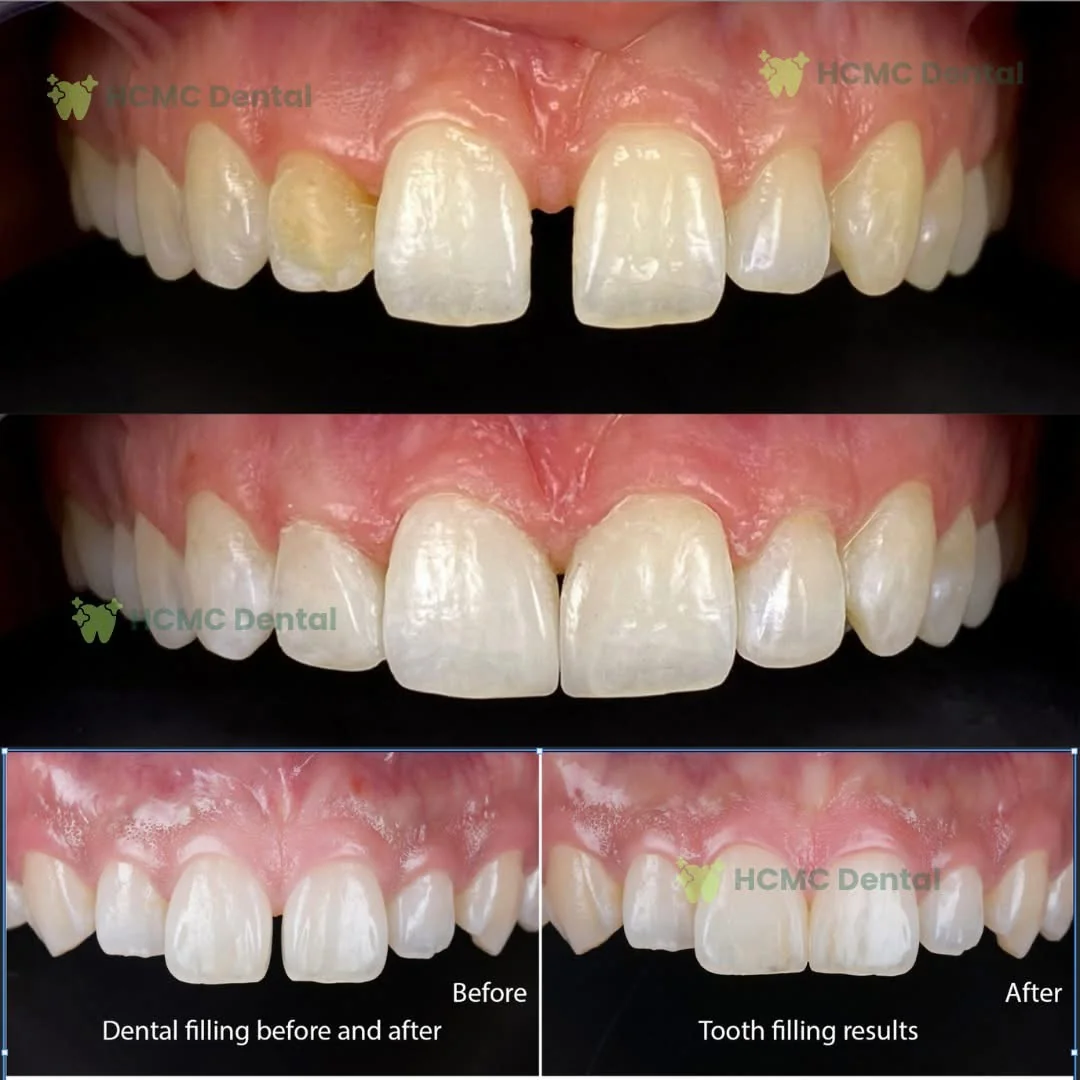
Incisal Edge Fracture Direct Composite Bonding
A fractured upper central incisor restored without drilling or anesthesia in a single 45-minute appointment. Dr. Cuong artistically layered multi-translucency composite resins to seamlessly match the natural halo, texture, and light reflection of adjacent teeth.
What Can Dental Bonding Fix?
- 🦷 Chipped or cracked teeth — most commonly front incisors
- 🦷 Gaps between teeth (diastema) — close small-to-medium gaps without braces
- 🦷 Discolored teeth — intrinsic staining that whitening cannot remove
- 🦷 Short or uneven teeth — lengthen or reshape for a balanced smile
- 🦷 Misshapen teeth — conical or peg-shaped teeth given a natural form
- 🦷 Exposed root surfaces — protect sensitive roots due to gum recession (see: gum treatment)
- 🦷 Minor teeth misalignment — optical illusion correction without orthodontics
Bonding Procedure — What to Expect
Dental bonding requires no injection and no drilling in most cases, making it ideal for anxious patients. Dr. Cuong lightly roughens the tooth surface, applies a conditioning liquid, then sculpts the composite in layers — building shape, adding depth, and creating a natural result. Each layer is UV-cured. The entire appointment takes 45–90 minutes per tooth. You leave with an immediately beautiful, fully functional restoration.
How Long Does Bonding Last?
With proper care, composite bonding lasts 5–8 years. To maximize longevity: avoid biting nails, pens, or hard foods with bonded teeth; wear a night guard if you grind; attend 6-month checkups so Dr. Cuong can polish or touch up as needed. Bonding does stain slightly over time — professional polishing restores its lustre.
Bonding Limitations: Composite bonding is ideal for minor cosmetic corrections. For severely discolored, extensively damaged, or multiple front teeth requiring complete transformation, porcelain veneers provide superior long-term aesthetics and durability. Dr. Cuong will advise the most appropriate treatment for your specific situation.
Bonding vs. Veneers vs. Whitening — Which Do You Need?
These three treatments are often confused. All three improve smile appearance, but they solve different problems. Here is a definitive comparison to help you choose:
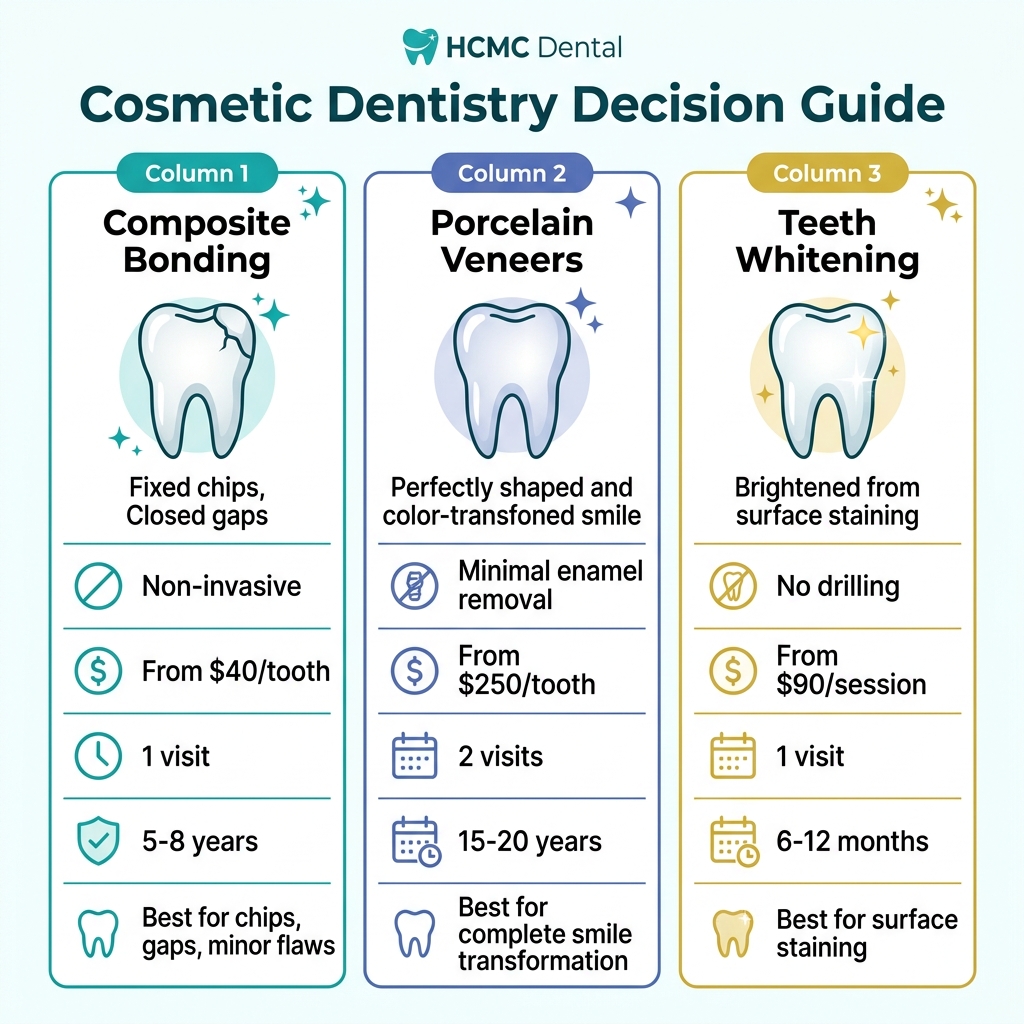
A complete 3-way comparison to help you choose the right cosmetic treatment.
| Feature | Composite Bonding | Porcelain Veneers | Teeth Whitening |
|---|---|---|---|
| Problem Solved | Chips, gaps, shape, minor color | Color + shape + size + severe staining | Surface staining only |
| Invasiveness | Non-invasive — no drilling | Minimal enamel removal | None |
| Cost at HCMC | From $40/tooth | From $250/tooth | From $90/session |
| Number of Visits | 1 visit (same day) | 2 visits (7–10 days) | 1 visit |
| Lifespan | 5–8 years | 15–20 years | 6–12 months |
| Best For | Minor cosmetic fixes, quick improvement, budget-conscious | Complete smile transformation, long-term investment | Surface coffee/tea/wine stains on healthy teeth |
| Can Fix Chips? | ✅ Yes — immediately | ✅ Yes — long-term | ❌ No |
| Whitening Effect? | Moderate — shade-matched | ✅ Best — custom porcelain shade | ✅ Yes — 2–8 shades lighter |
Not sure which treatment is right for your smile?
Send Dr. Cuong a WhatsApp message with a photo of your teeth — he'll advise the best option for your specific case, completely free.
Ceramic Inlays & Onlays — When a Filling Isn't Enough
When a cavity is too large for a conventional filling but does not require a full crown, a ceramic inlay or onlay is the ideal conservative solution. These lab-made restorations offer the strength and aesthetics of a crown without removing as much healthy tooth structure.
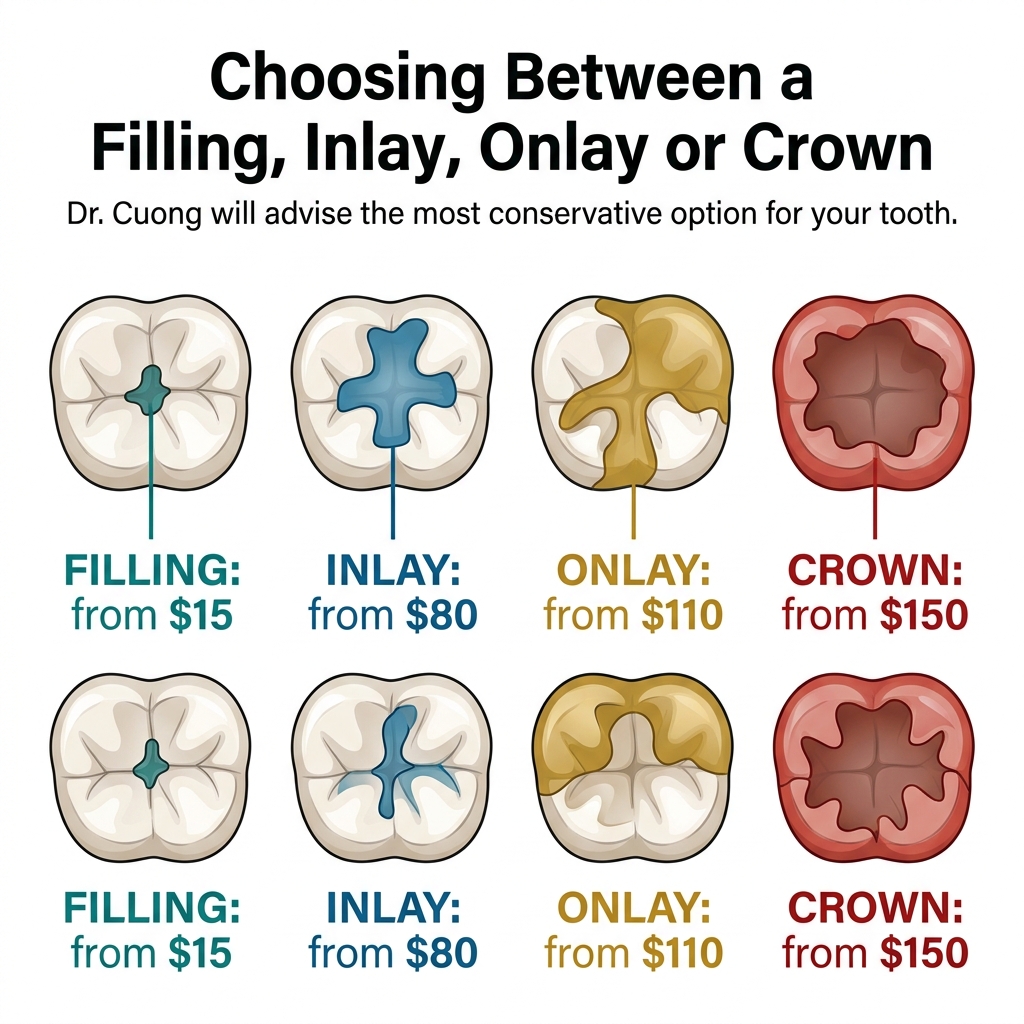
Choosing between a filling, inlay, onlay, or crown depends on how much of the tooth is affected.
| Restoration | Cavity Size | Cusps Involved? | Visits | HCMC Price |
|---|---|---|---|---|
| Composite Filling | Small–medium (1–2 surfaces) | ❌ No | 1 | From $15 |
| 🏆 Ceramic Inlay | Medium–large (between cusps) | ❌ No | 2 | From $80 |
| 🏆 Ceramic Onlay | Large (covers 1+ cusps) | ✅ Yes | 2 | From $110 |
| Full Crown | Very large / most of tooth | ✅ All cusps | 2–3 | From $150 |
Ceramic Inlay / Onlay Procedure (2 Visits)
Visit 1 (60 minutes): Decay removal, cavity preparation, and precise digital impressions are taken. A temporary filling protects the tooth. The impressions are sent to our dental laboratory, which fabricates the ceramic restoration over 7–10 days.
Visit 2 (30 minutes): The temporary is removed, the ceramic inlay/onlay is trial-fitted, adjusted if needed, and permanently cemented with high-strength adhesive resin. The final bite is checked and polished.
Cost comparison: A ceramic inlay at HCMC Dental starts from $80. The same restoration costs $600–$1,200 in the USA, £500–£950 in the UK, and AUD$800–$1,500 in Australia. The material quality is identical — only the location differs. Read our comprehensive Inlays, Onlays & Overlays Guide to explore this treatment in detail. See crowns and bridges if your tooth requires full coverage.
Children's Fillings & Fissure Sealants — Protecting Your Child's Teeth
Children are particularly vulnerable to dental caries because their enamel is thinner and the deep grooves of newly erupted molars trap plaque and bacteria easily. At HCMC Dental, Dr. Cuong treats patients of all ages — from toddlers to teens — with a gentle, child-friendly approach that builds positive dental habits for life.
Fillings for Baby Teeth — Why Treat Them?
A common misconception is that baby teeth don't need fillings because they will fall out. In reality, infected baby teeth cause pain, affect eating and speech, can spread infection to developing permanent teeth below, and are lost too early — disrupting the spacing of adult teeth. Treating baby teeth early with glass ionomer (GIC) or composite fillings prevents complications and preserves the natural arch.
Materials for Children
- Glass Ionomer Cement (GIC) — from $20: The preferred material for children's baby teeth. Bonds chemically to enamel and dentin, releases fluoride to strengthen surrounding teeth, and is gentle for small cavities.
- Composite Resin — from $15: Used for permanent teeth in children and teenagers. Tooth-colored, BPA-free, and durable.
- Stainless Steel Crowns — from $40: For severely decayed baby molars, a stainless steel crown can fully restore the tooth until natural exfoliation.
Fissure Sealants — The Best Cavity Prevention for Children
Fissure sealants are thin protective coatings applied to the deep grooves (fissures) of back teeth, sealing out bacteria and food debris before decay can begin. This painless procedure (no drilling, no injection) takes 15–20 minutes and can reduce cavity risk in back teeth by up to 80%.
Recommended for children aged 6–14 when first and second permanent molars erupt. Price: from $15 per tooth — or $50 for all four first molars.
Worried about your child's teeth?
Dr. Cuong is experienced with anxious young patients. Message for a gentle, pain-free consultation.
Safe Amalgam (Silver Filling) Removal & Replacement
Millions of people worldwide have old silver amalgam fillings placed decades ago. If you are concerned about the appearance of dark metal fillings, or simply want to upgrade to modern tooth-colored composite, HCMC Dental offers safe amalgam removal and composite replacement — from $30 per tooth.
Why Consider Replacing Amalgam Fillings?
- 🔸 Aesthetics — Dark silver fillings are highly visible when you laugh or open wide
- 🔸 Cracks & Expansion — Old amalgam expands and contracts with temperature, eventually cracking the surrounding tooth
- 🔸 Marginal gaps — Old amalgam restorations often develop gaps allowing new decay to form underneath
- 🔸 Mercury concerns — While the WHO considers amalgam safe when intact, some patients prefer mercury-free alternatives for peace of mind
- 🔸 Missing chunks — Fractured amalgam fillings leave the tooth vulnerable
HCMC Dental policy: We do not place any new amalgam fillings. All restorations use BPA-free composite resin or ceramic materials. Amalgam removal follows safety protocols including rubber dam isolation and high-volume evacuation to minimise any vapour exposure during removal.
Amalgam Removal Procedure
Dr. Cuong uses a rubber dam to isolate the tooth, then sections the old amalgam into chunks using a high-speed handpiece — removing it in fewer, larger pieces rather than grinding it (which increases vapour release). High-volume suction captures all particles. The cavity is then cleaned, prepared, and restored with shade-matched composite resin in the same appointment.
| Treatment | Time | HCMC Price | USA Equivalent |
|---|---|---|---|
| Amalgam removal + composite filling (small) | 45–60 min | From $30 | $250–$400 |
| Amalgam removal + composite filling (medium) | 60–75 min | From $45 | $350–$550 |
| Full-mouth amalgam replacement (4–8 teeth) | 2–3 visits | From $180 | $1,500–$3,000 |
Sensitive Teeth vs. Cavity — How to Tell the Difference
Tooth sensitivity and dental decay can produce very similar symptoms, making self-diagnosis difficult. Understanding the key differences helps you decide how urgently you need professional treatment.
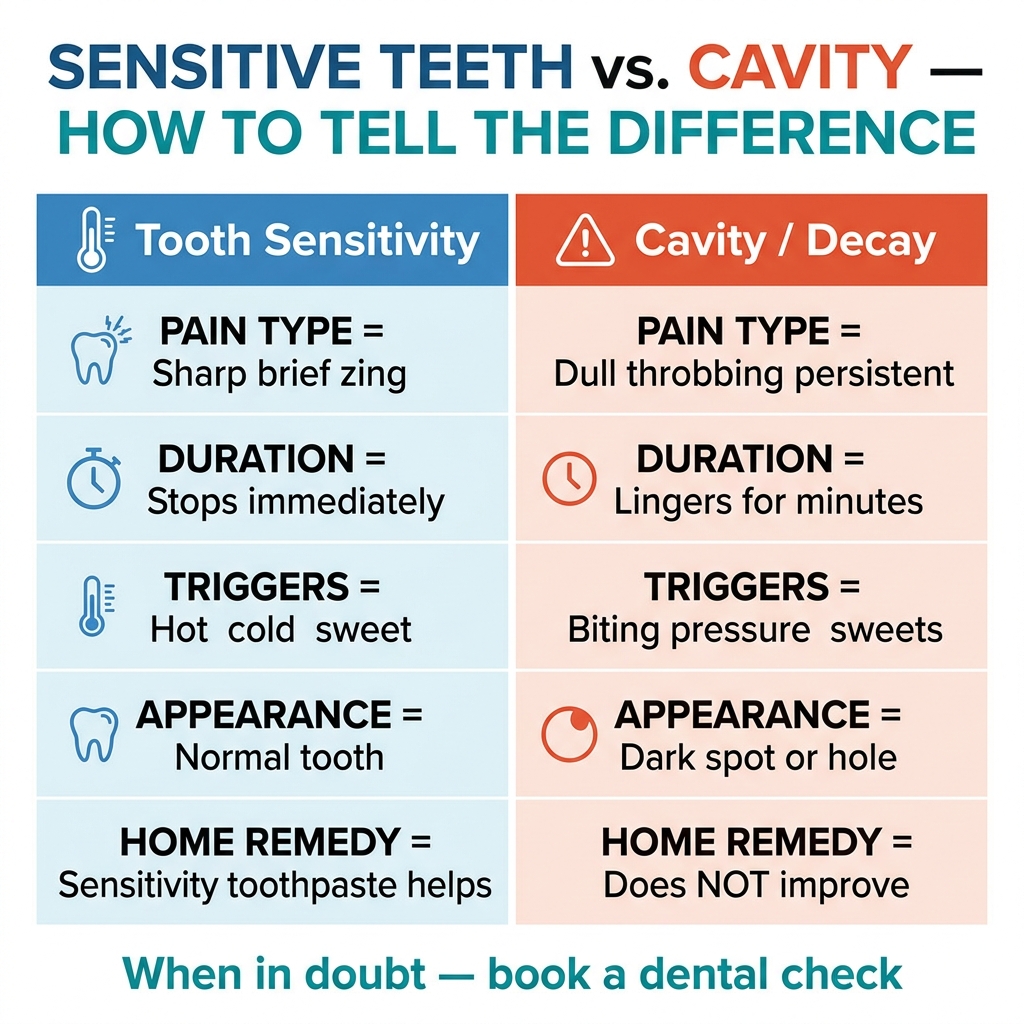
Key differences between tooth sensitivity and dental decay to guide your next step.
| Characteristic | 🌡️ Tooth Sensitivity | 🦠 Cavity / Decay |
|---|---|---|
| Pain Type | Sharp, brief "zing" | Dull, throbbing, persistent |
| Duration | Stops within seconds | Lingers for minutes after trigger |
| Triggers | Hot, cold, sweet, cold air | Biting pressure, sweet, hot, cold |
| Visible Change | Tooth looks normal | Dark spot, hole, or discoloration |
| Multiple Teeth? | Often several teeth | Usually one specific tooth |
| Home Remedy | Sensitivity toothpaste may help | Does NOT improve — worsens |
| Urgency | Monitor; see dentist if persistent | Needs dental treatment promptly |
Causes of Tooth Sensitivity (Without a Cavity)
- Enamel erosion from acidic foods and drinks (soft drinks, citrus, wine)
- Gum recession exposing the sensitive root surface (see: gum treatment)
- Teeth grinding (bruxism) wearing down enamel
- Over-whitening or recent professional whitening
- A cracked tooth not yet showing decay
- New filling sensitivity (completely normal for 1–7 days post-filling)
When in doubt — see Dr. Cuong. Only a clinical examination and digital X-ray can definitively distinguish sensitivity from decay. Many patients with "just sensitivity" are found to have early-stage cavities at checkup. Catching them early means a simple $15–$35 filling instead of a $200+ root canal. Message Dr. Cuong on WhatsApp if you're unsure.
After Your Filling — Complete Aftercare Guide
Proper aftercare maximizes your filling's longevity and ensures a comfortable recovery. Here is Dr. Cuong's complete post-filling protocol:
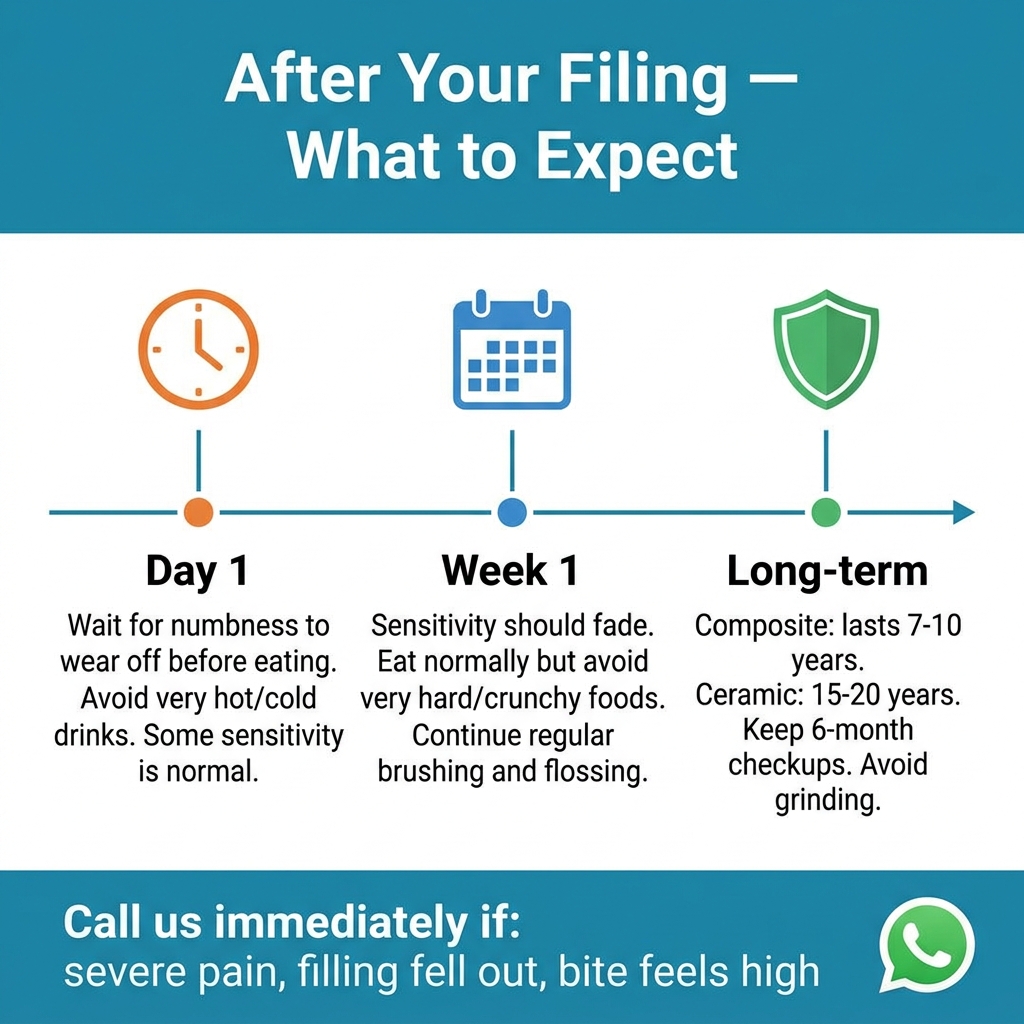
Immediately After (Day 1)
- ✅ Wait until the local anesthetic wears off completely before eating (2–3 hours)
- ✅ Avoid very hot or very cold foods and drinks for 24 hours
- ✅ Eat on the opposite side of the mouth for the first few hours
- ✅ Take ibuprofen or paracetamol if sensitivity is uncomfortable
- ✅ Brush gently — do not avoid the filled tooth
- ❌ Do NOT probe or bite down hard on the filled area to test it
First Week
- ✅ Mild sensitivity to hot, cold, and biting is normal — it typically resolves in 1–7 days
- ✅ Resume normal eating by Day 2–3 (avoid very hard foods for the first week)
- ✅ Continue regular brushing and flossing
- ⚠️ If your bite feels slightly "high" — the filling is a touch too tall. Message Dr. Cuong — a quick 5-minute adjustment solves this
Long-Term Care
- ✅ Brush twice daily with fluoride toothpaste
- ✅ Floss daily — do NOT skip the filled tooth
- ✅ Attend 6-month checkups — Dr. Cuong will monitor filling integrity
- ✅ Wear a night guard if you grind your teeth (bruxism significantly shortens filling lifespan)
- ✅ Avoid using filled front teeth to open packages or bite fingernails
- ❌ Avoid excessive coffee, tea, and wine in the first 48 hours (composite can absorb staining during full cure)
Contact Dr. Cuong immediately via WhatsApp if:
🔴 Severe pain or throbbing that does not respond to ibuprofen (may indicate pulp involvement — root canal needed)
🔴 Filling has fallen out (reshield the tooth with sugar-free gum temporarily)
🔴 Visible crack in the tooth around the filling
🔴 Swelling, fever, or pus — signs of infection requiring urgent treatment
6 Evidence-Based Steps to Prevent Cavities
Preventing cavities is always cheaper, less invasive, and more comfortable than treating them. These six evidence-based strategies, followed consistently, can reduce cavity risk by over 90%:
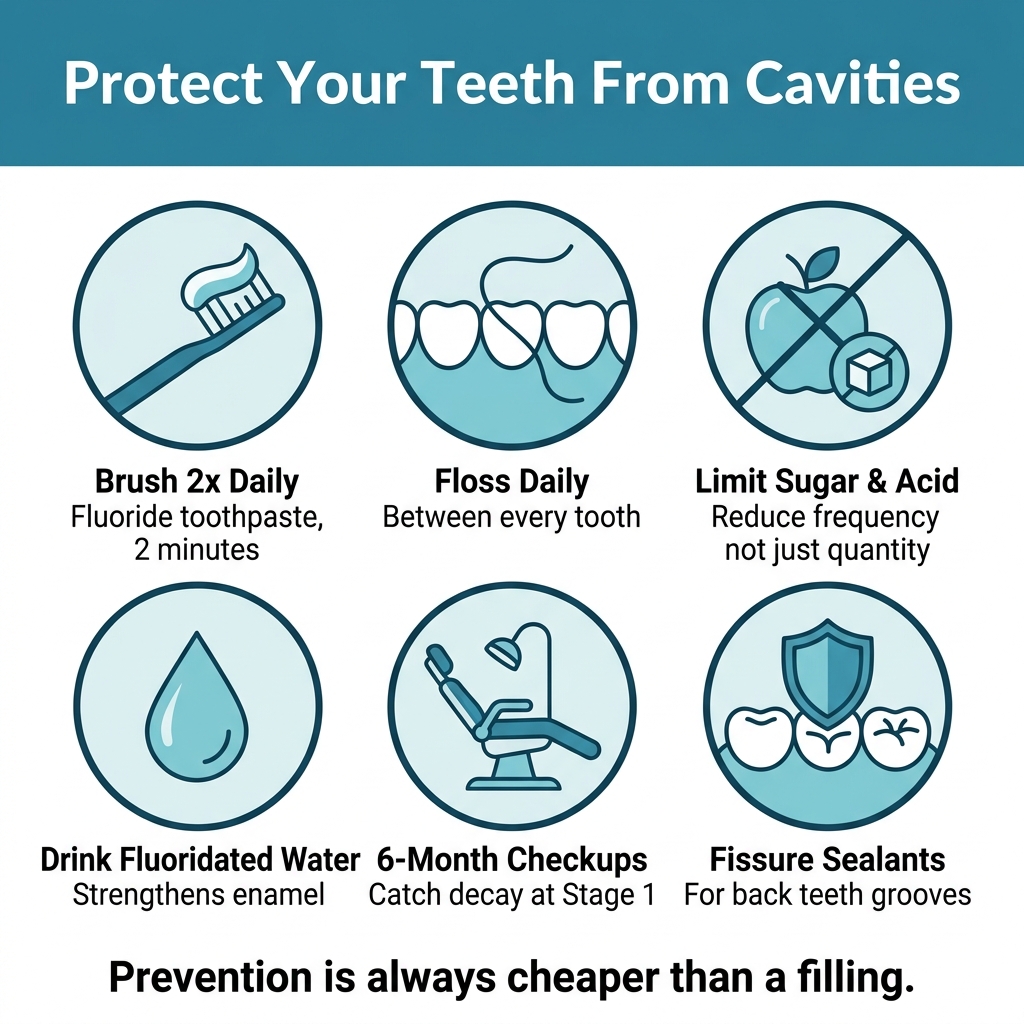
Prevention is always cheaper than a filling. These 6 steps dramatically reduce cavity risk.
Brush 2× Daily with Fluoride Toothpaste (1,450 ppm)
Use a soft-bristle brush for 2 minutes each session — morning and before bed. Electric toothbrushes remove up to 21% more plaque than manual. Fluoride strengthens enamel and reverses early demineralization. Do NOT rinse with water after brushing — let fluoride stay on teeth.
Floss Every Day — No Exceptions
Approximately 40% of cavities form between teeth where toothbrush bristles cannot reach. Flossing once daily removes interdental plaque before it mineralizes into tartar. Water flossers are an effective alternative. Floss before brushing so fluoride can reach the cleaned interdental spaces.
Reduce Sugar & Acid Frequency
It is not HOW MUCH sugar you eat — it is HOW OFTEN. Each sugar exposure causes 30 minutes of acid attack on enamel. Three sugary coffees spread throughout the day is far more damaging than one large dessert with a meal. Eat sweets with meals, limit snacking, and rinse with water after acidic foods.
Drink Fluoridated Water
Fluoride in drinking water (0.7 ppm) has reduced cavity rates by 25% globally. If your local water is not fluoridated, use fluoride mouthwash daily or ask Dr. Cuong about professional fluoride varnish applications every 6 months (from $15 — prevents far more than that in future treatment costs).
6-Month Dental Checkups
Stage 1–2 decay (the "fixable for $15" stages) is invisible to the naked eye and painless. Only digital X-rays and professional examination can detect it. Skipping checkups means decay progresses undetected from a $15 fix to a $200 root canal. A twice-yearly checkup at HCMC Dental is your cheapest form of dental insurance.
Fissure Sealants for Back Teeth
The deep grooves of molar and premolar teeth trap bacteria even with perfect brushing. Fissure sealants seal these grooves permanently. At HCMC Dental, fissure sealants cost from $15 per tooth — and reduce the risk of cavities in sealed teeth by up to 80%. Recommended for children (6–14) and adults with deep, cavity-prone grooves.
Dental Fillings in Vietnam — Save 70–90% vs USA, UK & Australia
Ho Chi Minh City (Saigon) has become one of Southeast Asia's premier dental tourism destinations, offering world-class dental care at a fraction of Western prices. At HCMC Dental, Dr. Cuong provides fillings and bonding using the same premium materials as US and Australian clinics — the only difference is location.
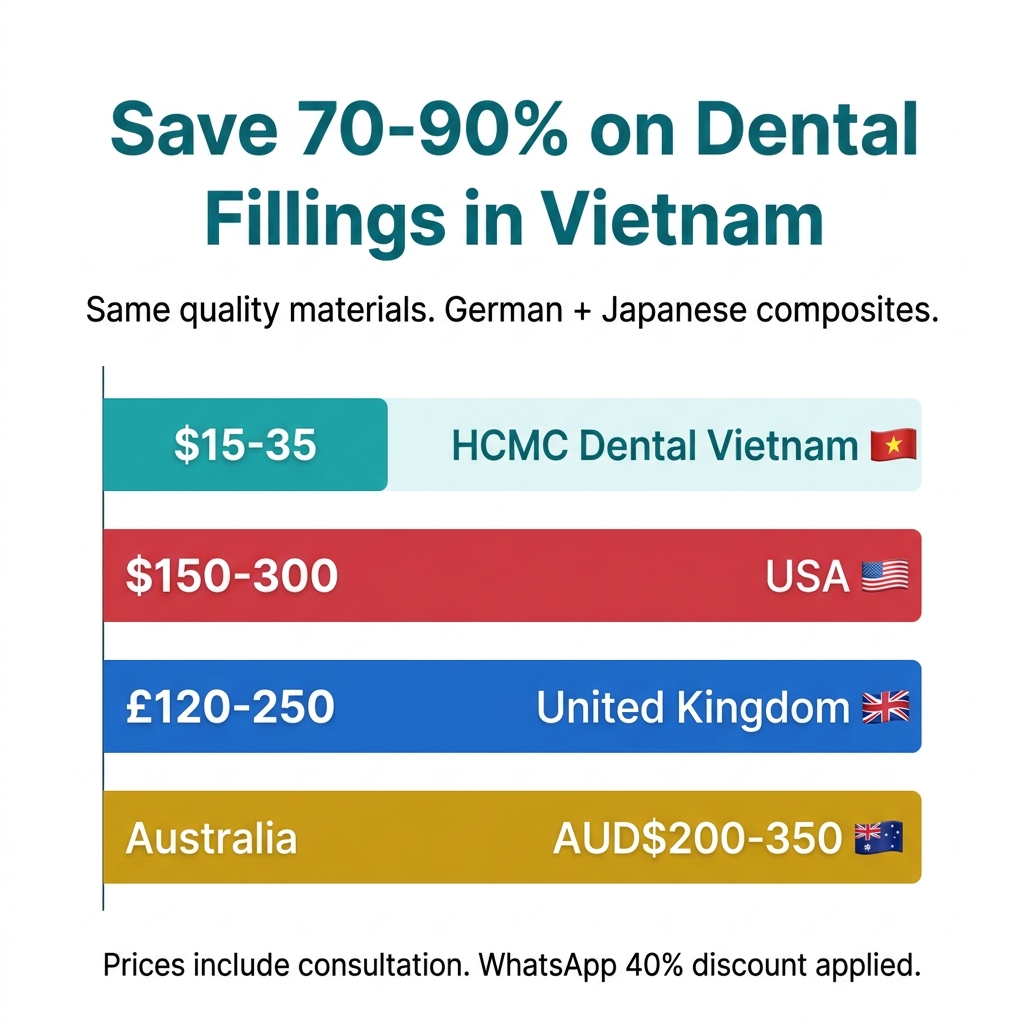
Same materials. Same quality. 70–90% lower cost in Ho Chi Minh City.
| Treatment | 🇻🇳 HCMC Dental (WA Rate) | 🇺🇸 USA | 🇬🇧 UK | 🇦🇺 Australia |
|---|---|---|---|---|
| Composite Filling (1 surface) | $15–25 | $150–250 | £100–180 | AUD$200–320 |
| Composite Filling (2–3 surfaces) | $24–45 | $200–350 | £150–280 | AUD$280–450 |
| Ceramic Inlay | $80–120 | $600–1,200 | £500–950 | AUD$800–1,500 |
| Composite Bonding (per tooth) | $40–80 | $300–600 | £250–500 | AUD$400–800 |
| Amalgam Removal + Composite | $30–55 | $250–500 | £200–400 | AUD$320–600 |
Planning Your Dental Trip to Ho Chi Minh City
- 🛬 Arrival Day: Rest and explore the city. HCMC is safe, vibrant, and easy to navigate.
- 📋 Day 1 (morning): Dental consultation with Dr. Cuong — digital X-rays, treatment plan, same-day composite fillings if needed.
- 🦷 Day 1 (afternoon) or Day 2: Additional fillings, bonding, or other treatments as planned.
- 🏖️ Day 3–4: Sightseeing, food tours, or relaxation while healing.
- ✈️ Day 5+: Fly home. WhatsApp follow-up with Dr. Cuong from your home country.
Planning a trip to Vietnam? Get your teeth fixed and save thousands.
Contact Dr. Cuong before you book flights — receive a personalised treatment plan and cost estimate.
Why Choose HCMC Dental & Dr. Cuong for Your Fillings?

Dr. Cuong specialises in conservative, aesthetic restorative dentistry — with a philosophy of preserving maximum tooth structure while delivering results that look and feel completely natural. His approach to composite artistry and dental bonding has earned a loyal following of international patients from the USA, UK, Australia, Germany, and across Asia.
👨⚕️ Full Dr. Cuong Profile6 Reasons Patients Choose HCMC Dental for Fillings
😰 Anxious About Dental Treatment?
Dental anxiety affects 36% of adults. Dr. Cuong's clinic is specifically designed to be a calm, judgment-free zone for anxious patients. Options include:
- Topical anesthetic gel before any injection — nearly eliminates needle sensation
- Step-by-step explanations before each action — no surprises
- Music or Netflix during treatment — you choose
- Frequent check-ins — signal with your hand to pause at any time
- Oral sedation available for moderate anxiety
- WhatsApp pre-consultation to discuss your concerns before your visit
What International Patients Say About Their Fillings
"I had 4 old silver fillings replaced with composite in one 2-hour appointment. The result is stunning — completely invisible. Dr. Cuong matched the shade so perfectly I can't even find which teeth were filled! Saved over $1,800 vs what my dentist quoted in Sydney."
"I was terrified of the dentist and had avoided going for 4 years. Dr. Cuong was incredibly patient and gentle. I had 3 fillings done with zero pain. The WhatsApp follow-up the next day really put my mind at ease. Can't believe I was so scared — will definitely come back."
"I had a chipped front tooth that was bothering me for years. Dr. Cuong did composite bonding in 45 minutes — it looks EXACTLY like my natural tooth. Nobody can tell. Cost me $40. My dentist at home wanted $350 for the same thing. Incredible value and incredible skill."
Which Dental Treatment Do You Need? — Decision Flowchart
Not sure if you need a filling, bonding, inlay, crown, or something else entirely? Use this decision tree to identify the right starting point — and then message Dr. Cuong to confirm with a professional assessment.
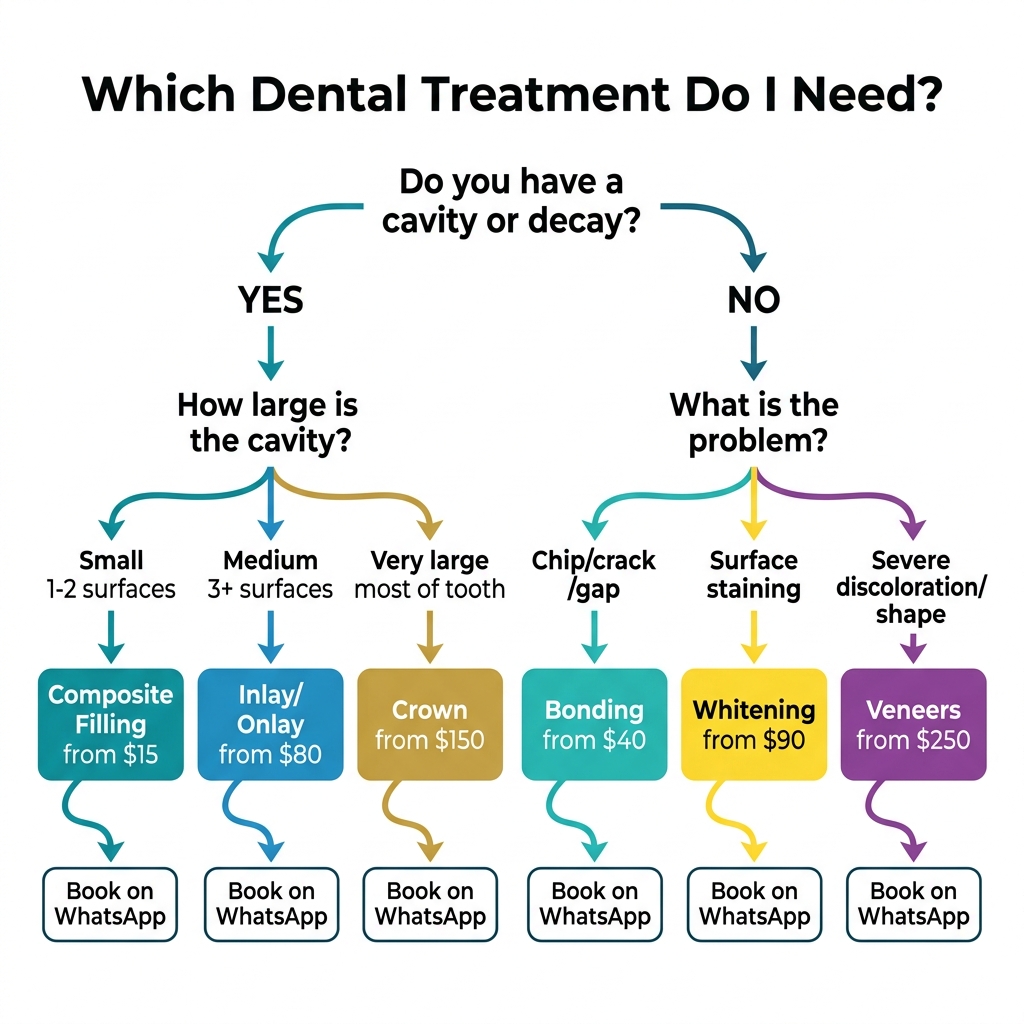
Use this flowchart as a starting guide — confirm with Dr. Cuong via WhatsApp for a personalised recommendation.
Know which treatment you need? Book now and get 40% off.
Send a WhatsApp message with your tooth concern or a photo — Dr. Cuong will reply within hours.
Complete Fillings & Bonding Pricing — Ho Chi Minh City
All prices shown are the 40% WhatsApp discount rate. Standard prices are 40% higher. No hidden fees.
🦷 Composite Fillings
BPA-Free · 3M Filtek💎 Dental Bonding
Most Popular · Same Day⚪ Ceramic Inlays & Onlays
15–20 Year LifespanAll prices above reflect the 40% WhatsApp discount rate. Standard rates are approximately 40% higher. Final pricing confirmed after digital X-ray examination. No hidden fees. No surprise charges. Consultation and digital X-ray included with all appointments.
💰 Full Pricing Page (All Treatments)Dental Fillings & Bonding FAQ — 25 Expert Answers from Dr. Cuong
Every question answered by Dr. Nguyen Van Cuong, DDS, MSc Oral Surgery — based on 8+ years of clinical practice.
Cost & Pricing
At HCMC Dental, composite fillings start from $15 for a single-surface cavity when you book via WhatsApp and receive the 40% discount. Multi-surface fillings (2 surfaces: from $24, 3+ surfaces: from $36) remain among the most affordable in Southeast Asia while using premium 3M Filtek and Tokuyama Estelite composites identical to those used in US/AU clinics. Standard (non-discounted) prices are $25–$60 depending on cavity size.
Yes — all restorative and cosmetic treatments including composite fillings, dental bonding, ceramic inlays, onlays, and amalgam replacement qualify for the 40% WhatsApp discount when you message Dr. Cuong directly before booking. Simply send a WhatsApp message with your treatment question and Dr. Cuong will provide a personalised cost estimate and confirm the discounted price before your appointment.
Yes. At HCMC Dental, the consultation and digital X-ray assessment are included with your filling appointment at no extra charge. Dr. Cuong will examine the extent of decay, discuss all treatment options, confirm the shade match, and proceed with treatment in the same visit whenever possible.
Yes. For patients with multiple small to medium cavities, Dr. Cuong routinely completes 3–6 fillings in a single appointment of 2–3 hours. For dental tourists with limited time in Vietnam, a full-mouth filling upgrade can be planned across 1–2 visits, making it highly practical for short trips.
For large cavities or high-stress back teeth, ceramic inlays are often the superior long-term investment. While composite fillings last 7–10 years, ceramic inlays last 15–20+ years, resist staining, and have a strength and translucency that matches natural tooth enamel. At HCMC Dental, ceramic inlays start from $80 (vs. $600–$1,200 in the USA), making the premium material entirely accessible.
Procedure & Pain
No — with proper local anesthesia you should feel pressure but no pain during the procedure. Dr. Cuong applies topical anesthetic gel first, then administers Articaine 4% (the gold standard local anesthetic) for a virtually painless injection. The filling procedure itself is completely painless. After the anesthetic wears off (2–3 hours), mild sensitivity is normal for 1–7 days and managed with over-the-counter ibuprofen or paracetamol.
A single composite filling typically takes 30–60 minutes from examination to final polish. This includes X-ray review, anesthesia, decay removal, layering, UV curing, bite adjustment and polishing. Ceramic inlays require 2 visits: 60 minutes for preparation and impressions, then 30 minutes for cementation 7–10 days later when the lab work is ready.
For cavities involving the dentin layer or deeper, a local anesthetic injection is required to ensure you feel no pain. Dr. Cuong uses topical benzocaine gel before the injection to numb the gum surface, making the needle essentially unfelt by most patients. For very small surface cavities (enamel-only), air abrasion may be possible without injection. For composite bonding (cosmetic, no drilling), no injection is needed at all.
Yes — local anesthetic does not affect your ability to drive. However, your mouth will remain numb for 2–3 hours after the appointment, so avoid eating on the numb side until sensation fully returns. If you opted for oral sedation (for anxious patients), you will need someone to drive you home and should not drive for 12 hours after sedation.
Dental anxiety is extremely common and Dr. Cuong has extensive experience treating anxious patients with compassion and patience. Options include: topical anesthetic before any injection, step-by-step explanations before each action, music/distraction during treatment, oral sedation for moderate anxiety, and IV sedation for severe dental phobia. Message Dr. Cuong on WhatsApp before your appointment to discuss your concerns — he will personalise your experience to make it as comfortable as possible.
Materials & Longevity
In order of longevity: Ceramic/Porcelain inlays and onlays last 15–20+ years, Composite resin fillings last 7–10 years (up to 12–15 years with excellent home care), Glass ionomer lasts 5–7 years (primarily used for children or temporary restorations). For maximum longevity, ceramic inlays are the gold standard, while composite offers the best balance of aesthetics, cost, and simplicity.
HCMC Dental uses exclusively BPA-free, mercury-free composite resins. We use 3M Filtek Supreme Ultra (USA) and Tokuyama Estelite Sigma Quick (Japan) — two of the most clinically validated and safest composites available worldwide. We do not place new amalgam (silver) fillings. These materials have been rigorously tested and approved by the FDA, ADA, and international dental bodies for safety and biocompatibility.
With proper care, composite fillings typically last 7–10 years, with many lasting 12–15 years. Longevity depends on: cavity size (smaller fillings last longer), tooth location (front teeth last longer than high-stress molars), home care quality (brushing, flossing, avoiding grinding), and regular 6-month checkups to detect early wear or marginal gaps.
A filling should be replaced when you experience: recurring sensitivity or pain around it, a visible crack or chip, the filling feels loose or has fallen out, your dentist detects a marginal gap (space between filling and tooth allowing bacteria entry), or significant discoloration affecting appearance. Do not wait for pain — Dr. Cuong can detect failing fillings at routine checkups before they become emergencies.
Dental Bonding
Dental bonding (composite bonding) is a cosmetic procedure where tooth-colored composite resin is applied directly to the tooth surface to repair chips, cracks, gaps (diastema), discoloration, short teeth, or misshapen teeth — all without removing any enamel. It is completely painless — no drilling, no injection required in most cases. A single visit of 45–90 minutes can transform your smile from $40 per tooth.
Composite bonding typically lasts 5–8 years with proper care. To maximize longevity: avoid biting nails or pens, avoid very hard foods (ice, nuts) with bonded teeth, wear a night guard if you grind your teeth, maintain regular 6-month dental checkups, and avoid staining beverages (coffee, red wine) in the first 48 hours. Bonding can be polished or repaired at checkups.
Yes — chipped front teeth are one of the most common and easiest applications for composite bonding. Dr. Cuong will shade-match the composite resin to your natural tooth color, sculpt the chip to perfectly restore the original shape, UV-cure it, and polish it to a natural lustre — all in a single appointment of approximately 45–60 minutes. No temporary restorations or lab work required.
Composite bonding: applied directly to the tooth with no enamel removal, completed in 1 visit, from $40/tooth, lasts 5–8 years — best for minor cosmetic issues (chips, small gaps, shape). Porcelain veneers: thin lab-made porcelain shells bonded to teeth with minimal enamel removal, 2 visits, from $250/tooth, lasts 15–20 years — best for complete smile transformation involving color, shape, and size. Bonding is the conservative first step; veneers are the premium long-term solution.
Dental Tourism
Absolutely. Composite fillings are completed in a single 30–60 minute appointment, making them perfectly suited for dental tourists with limited time. Even a 2-night stay in Ho Chi Minh City allows time for a full dental assessment and multiple fillings. Ceramic inlays require 2 visits (7–10 days apart), so a slightly longer stay or a follow-up visit is needed. Dr. Cuong offers WhatsApp follow-up after you return home.
Depending on the number and size of cavities, Dr. Cuong routinely completes 4–8 fillings in a single 2–3 hour appointment. For a full-mouth restoration involving both fillings and bonding, 2–3 appointments across a 5–7 day stay can comprehensively address most dental needs. Contact Dr. Cuong via WhatsApp with a summary of your dental concerns to receive a personalised treatment plan and cost estimate before your trip.
Yes. Dr. Cuong uses a professional shade guide with 16+ shades to precisely match your composite resin to your natural tooth color. Under good lighting, a well-placed composite filling is virtually indistinguishable from the natural tooth. For front teeth where aesthetics are paramount, Dr. Cuong uses the highest-grade translucent composites that mimic the optical properties of natural enamel and dentin.
Dr. Cuong provides WhatsApp follow-up support after you return home. Simply send a message describing any concern — sensitivity, bite feeling wrong, filling appearance — and Dr. Cuong will advise whether it is normal post-treatment response or requires action. If you experience a filling that has come out or a dental emergency, he will guide you on what to do locally. Most post-filling sensitivity resolves within 1–2 weeks without any intervention.
Prevention & General
The most effective cavity prevention protocol: brush twice daily for 2 minutes with fluoride toothpaste, floss daily (bacteria between teeth cause 40% of cavities), reduce sugar and acid frequency (how often you eat matters more than how much), drink fluoridated water, consider professional fluoride varnish applications, get fissure sealants for back teeth grooves, and attend 6-month dental checkups to catch demineralization at Stage 1 before a filling is needed.
Yes. Composite fillings are safe and appropriate for children and are preferred over amalgam for both safety and aesthetics. For baby teeth with smaller cavities, glass ionomer cement (GIC) is often used as it releases fluoride to help protect surrounding teeth. HCMC Dental also offers fissure sealants for children — a preventive coating applied to back teeth grooves to seal out decay before cavities form, from $15 per tooth.
Untreated cavities progressively worsen through 5 stages. Stage 1–2: Fluoride or small composite filling can reverse/arrest decay. Stage 3: Larger filling required, sensitivity common. Stage 4: Decay reaches the pulp — root canal treatment ($200+) becomes necessary. Stage 5: Abscess and bone loss — extraction may be the only option, followed by implant ($800–$1,500) or bridge ($500–$700) to replace the tooth. A $15–$35 filling today prevents $200–$1,500 in treatment costs later.
Still have a question not answered above?
💬 Ask Dr. Cuong — Free WhatsApp ConsultationRelated Dental Treatments at HCMC Dental
Fillings are just the beginning. HCMC Dental offers comprehensive dental care under one roof — all at 40% off Western prices.
Ready to Fix Your Teeth? Save 70–90% vs Western Prices.
Message Dr. Cuong on WhatsApp to receive your personalised quote with 40% discount applied. Same-day composite fillings and dental bonding available — no long wait.
📚 Clinical Guides & Filling Resources
In-depth medical resources, composite vs. ceramic comparisons, restoration costs, and care guides written by Dr. Cuong.
🦷 Dental Fillings & Restorations
- Dental Filling Cost Vietnam vs USA & Australia
- Dental Filling Cost Vietnam vs UK & Singapore
- Composite vs Ceramic Filling Comparison
- Dental Inlay, Onlay & Overlay vs Crown
- Same-Day Dental Filling with CEREC
- When Does a Filling Become a Crown?
- Tooth-Colored Filling Materials Compared
- Painless Cavity Treatment for Tourists
- Replacing Old Silver Amalgam Fillings
- Multiple Dental Fillings in One Visit
Related: Dental crowns for larger restorations → | Root canal for deep decay → | Veneers for cosmetic bonding alternatives → | Routine general checkups → | Dental Tourism Vietnam Guide →