Choosing between a dental inlay, onlay, overlay, or crown depends entirely on the amount of healthy tooth structure remaining. While crowns require significant enamel removal to encase the entire tooth, inlays and onlays conservatively replace only the damaged areas, preserving your natural biomechanical strength and reducing the risk of future complications.
Clinical Summary:
This comprehensive guide evaluates the clinical indications for indirect dental restorations, specifically comparing inlays, onlays, overlays, and full-coverage crowns. Modern adhesive dentistry prioritizes conservative tooth preparation, shifting the paradigm from aggressive full-crown reduction to defect-driven partial coverage (onlays/overlays). The decision relies on precise biomechanical factors, including isthmus width, remaining cusp thickness, and the presence of a ferrule. By leveraging advanced CAD/CAM technology and high-strength ceramics, clinicians can restore structural integrity while maximizing the preservation of healthy enamel and dentin.
Key Takeaways:
- Inlays fit precisely inside the tooth cusps, treating moderate decay that exceeds the structural capacity of a standard direct filling.
- Onlays and overlays provide essential tooth cusp coverage, replacing one or more missing cusps while preserving the healthy perimeter of the tooth.
- Full-coverage crowns are strictly reserved for severely compromised teeth requiring 360-degree structural reinforcement and a proper ferrule.
- Conservative tooth prep techniques significantly reduce the risk of pulpal trauma and the subsequent need for root canal therapy.
- Advanced adhesive bonding protocols allow partial ceramic restorations to perform with exceptional durability, often rivaling traditional crowns.
The Spectrum of Tooth Restorations: Beyond Simple Fillings
When a cavity or fracture is too large for a direct composite filling but the tooth is not entirely destroyed, dentists utilize indirect restorations fabricated in a laboratory to restore optimal strength and anatomy.
In the realm of modern restorative dentistry, the approach to repairing damaged teeth has evolved significantly. Historically, the treatment protocol was binary: small cavities received direct fillings (amalgam or composite resin), while teeth with larger defects were automatically ground down for full-coverage crowns. Today, the clinical spectrum is much more nuanced, focusing heavily on tissue preservation and biomimetic principles. Understanding this spectrum is crucial for patients seeking comprehensive restorative care that prioritizes the long-term health of their natural teeth.
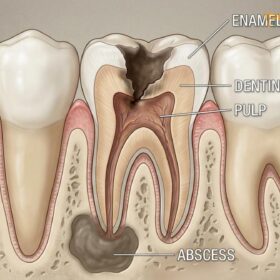
Direct composite fillings are excellent for small to moderate cavities. However, when a cavity becomes too large, composite resin presents distinct biomechanical limitations. As the composite material cures under a dental curing light, it undergoes a process called polymerization shrinkage. In a large cavity, this shrinkage creates immense stress on the remaining thin walls of the tooth, potentially leading to micro-cracks, postoperative sensitivity, and marginal leakage where bacteria can re-enter[1]. Furthermore, large direct fillings in posterior (back) teeth often struggle to withstand the heavy occlusal (chewing) forces generated by the human jaw, leading to premature wear or fracture of the filling material.
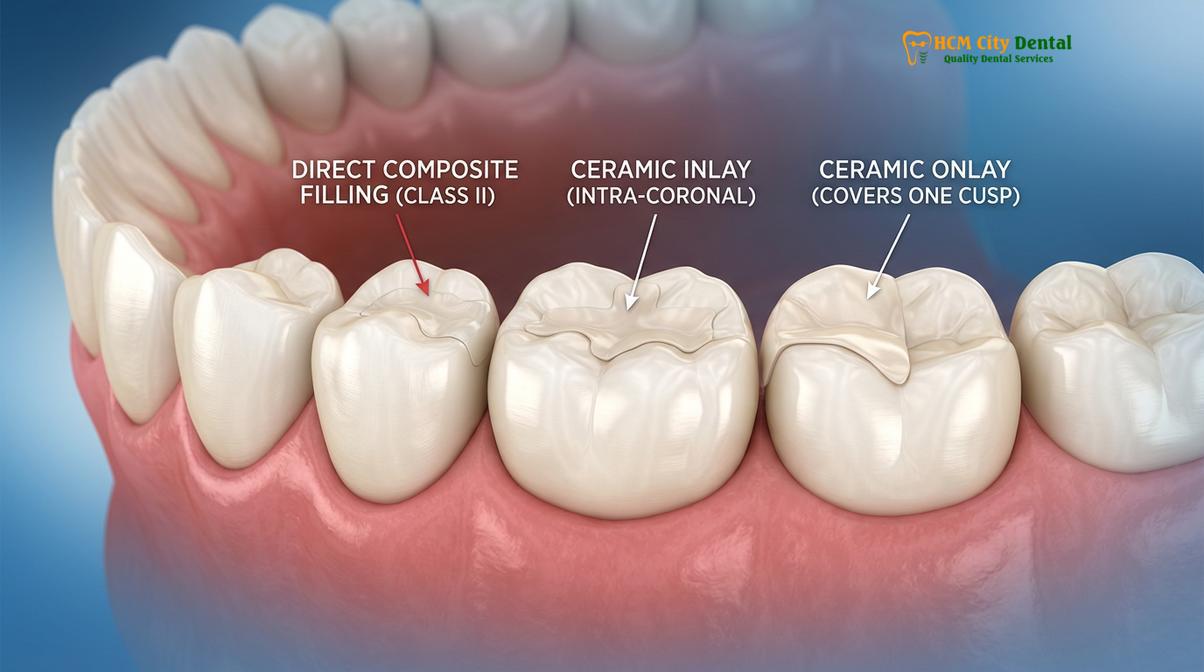
When a defect exceeds the safe parameters for a direct filling, an indirect dental restoration becomes the standard of care. Unlike direct fillings which are molded directly inside the mouth, indirect restorations are custom-fabricated outside the mouth—either in a dental laboratory or via in-office milling machines—before being permanently bonded into the tooth. This category includes inlays, onlays, overlays, and crowns. Because they are fabricated from high-strength materials like lithium disilicate or zirconia under controlled conditions, indirect restorations offer superior physical properties, precise anatomical contours, and zero polymerization shrinkage stress on the tooth structure.
Inlays, Onlays, and Overlays: Conservative Cusp Protection
Inlays, onlays, and overlays are defect-driven restorations that replace only the missing or weakened portions of a tooth, relying on advanced adhesive protocols rather than aggressive mechanical retention.
The philosophy of modern restorative dentistry is deeply rooted in the preservation of healthy tooth structure. Enamel, the hard outer layer of the tooth, is the most highly mineralized tissue in the human body and provides the ultimate bonding surface for dental adhesives. Once removed, it cannot regenerate. Therefore, when a tooth is damaged, the most biologically sound approach is to remove only the diseased or unsupported tissue and replace it with a restoration that precisely fits the defect.
An inlay is the most conservative of the indirect restorations. It is designed to fit entirely within the contours of the tooth, specifically between the cusps (the elevated points on the chewing surface). Inlays are indicated when the central groove of the tooth is compromised by decay or a failing old filling, but the surrounding cusps remain thick, strong, and structurally sound. They act much like a puzzle piece, dropping into the prepared cavity and bonding to the internal walls to restore the tooth’s integrity without altering its outer perimeter.
“The advent of reliable dentin and enamel bonding has rendered the aggressive mechanical retention of traditional crowns largely obsolete in many clinical scenarios. By adhering to biomimetic principles, we can now restore severely compromised teeth with partial-coverage overlays, preserving the critical cervical biomechanics and significantly extending the lifespan of the natural tooth.”
When the structural damage extends beyond the central groove and undermines one or more of the tooth’s cusps, an onlay is required. An onlay incorporates tooth cusp coverage, meaning it extends over the weakened cusp to protect it from the vertical forces of chewing. If a thin, undermined cusp is left unprotected, the wedging action of chewing can cause the cusp to fracture, potentially splitting the tooth down to the root. By covering the cusp, the onlay distributes the occlusal load evenly, acting as a protective helmet for the compromised section of the tooth while leaving the remaining healthy cusps untouched.
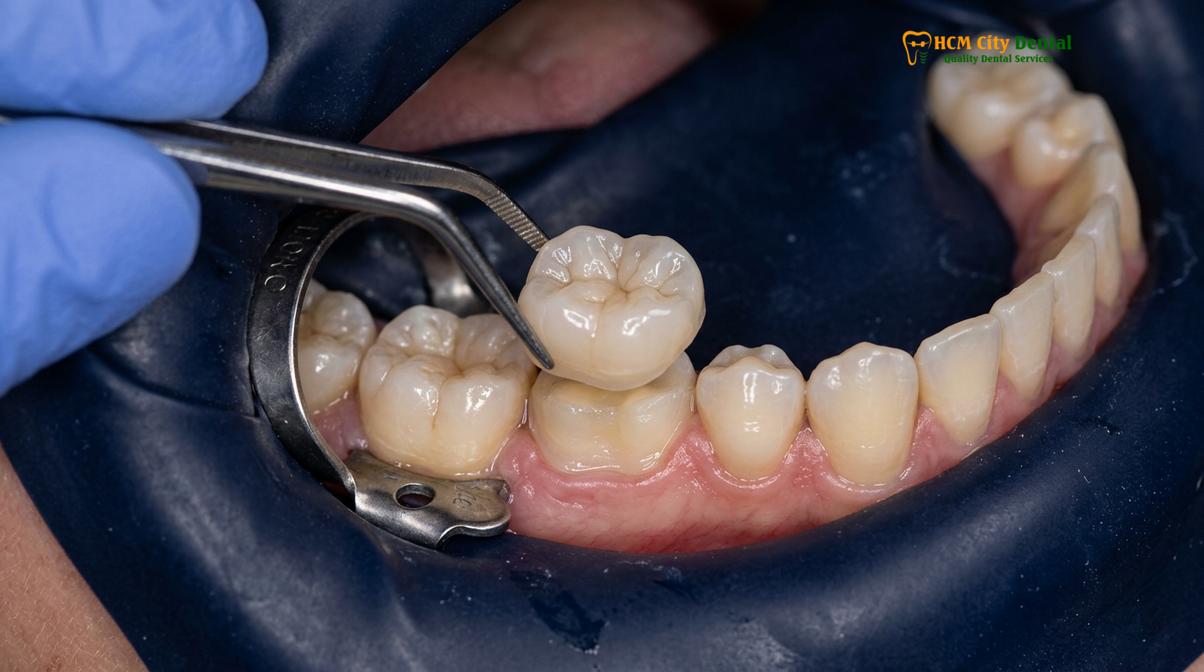
An overlay takes this concept a step further. It is utilized when all the cusps of a posterior tooth are weakened or missing, requiring complete coverage of the entire chewing surface. However, unlike a traditional crown, an overlay does not require the dentist to grind down the healthy perimeter (the sides) of the tooth down to the gumline. The preparation remains supragingival (above the gums), which is vastly healthier for the periodontal tissues and preserves a significant ring of natural enamel for superior adhesive bonding. Techniques such as Immediate Dentin Sealing (IDS)—where the freshly cut dentin is sealed with a bonding agent immediately after preparation—prevent bacterial contamination, reduce sensitivity, and dramatically increase the final bond strength of the ceramic restoration[2].
Preserving Tooth Structure: Why Overlays are Replacing Crowns in HCMC
Advancements in dental materials and bonding techniques have sparked a paradigm shift in Ho Chi Minh City, moving away from traditional crowns toward highly conservative ceramic overlays.
In recent years, the restorative landscape has transformed dramatically. Historically, dentists relied on the mechanical retention of full crowns to secure restorations, which necessitated the aggressive removal of healthy tooth structure. Today, leading clinics in Ho Chi Minh City are adopting biomimetic protocols that prioritize tissue preservation. This shift is heavily supported by the Vietnam Odonto-Stomatology Association (VOSA), which advocates for conservative restorative guidelines to enhance the long-term prognosis of natural teeth[6].
The transition from crowns to overlays is largely driven by the exceptional capabilities of modern dental adhesives and high-strength ceramics like lithium disilicate. Similar to the conservative preparation required for Porcelain Veneers at HCMC Dental Clinic, overlays prioritize enamel retention. By keeping the preparation margins above the gumline, overlays minimize periodontal inflammation and drastically reduce the risk of traumatizing the dental pulp. This conservative approach means patients experience less postoperative sensitivity and are far less likely to require root canal therapy in the future.
Full-Coverage Dental Crowns: Restoring Severely Damaged Teeth
A full coverage crown is a 360-degree restoration utilized when a tooth has suffered catastrophic structural loss, requiring complete encasement to withstand occlusal chewing forces and prevent vertical root fractures.
While the trend in modern dentistry leans heavily toward conservative partial coverage, the full coverage crown remains an indispensable tool in the restorative armamentarium. A crown is essentially a prosthetic cap that completely encases the visible portion of the tooth down to the gingival margin. To accommodate the thickness of the crown material (whether porcelain, zirconia, or metal), the dentist must circumferentially reduce the tooth, removing approximately 60% to 75% of its original coronal volume.
Because of this significant tissue removal, crowns are no longer the first line of defense for moderate decay. Instead, they are strictly indicated for teeth that have suffered catastrophic structural failure. The most common indication for a full crown is a tooth that has undergone root canal therapy, particularly in the posterior region. Endodontically treated teeth are inherently more brittle due to the loss of internal moisture and the extensive hollowing out required to access the root canals. A full crown provides the necessary 360-degree bracing to prevent these fragile teeth from splitting under the immense pressures of mastication.
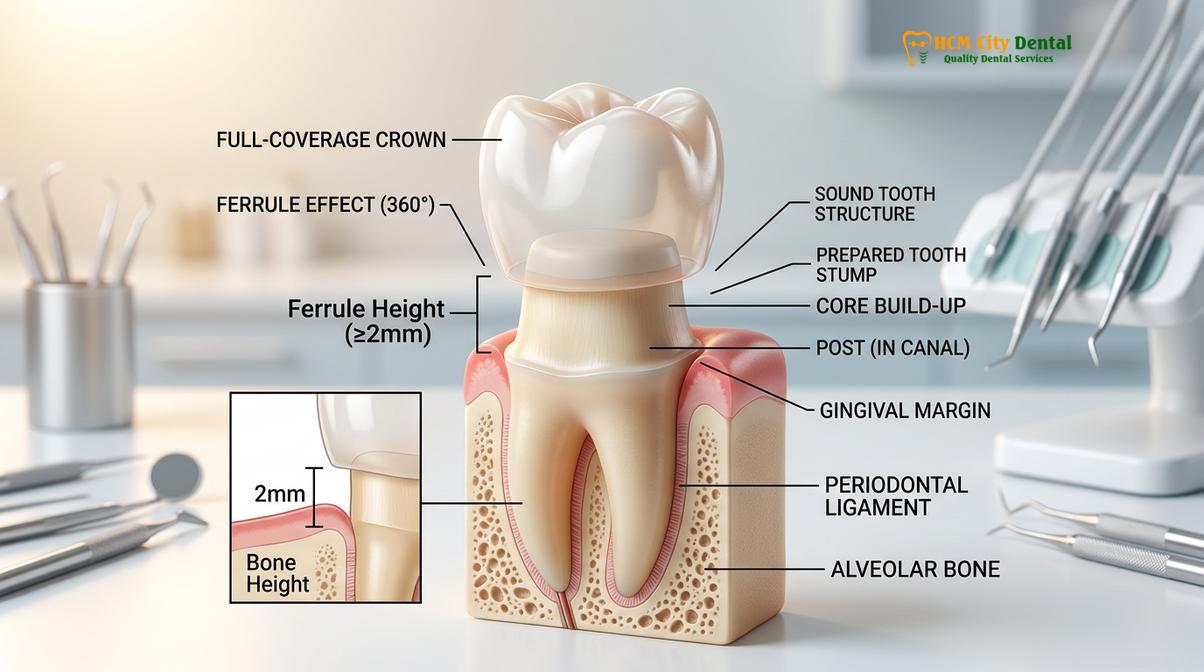
The biomechanical success of a full crown depends heavily on a concept known as the “ferrule effect.” A ferrule is a continuous band of healthy, solid tooth structure that extends at least 1.5 to 2.0 millimeters above the gumline and is at least 1.0 millimeter thick[3]. When the crown encircles this band of healthy tooth, it creates a bracing effect that distributes lateral forces and prevents the root from fracturing. If a tooth is broken off flush with the gumline and lacks a proper ferrule, placing a crown on it is highly unpredictable and often leads to catastrophic failure.
| Clinical Parameter | Inlay / Onlay / Overlay | Full-Coverage Crown |
|---|---|---|
| Tooth Structure Removal | Minimal (10% – 30%). Defect-driven preparation. | Extensive (60% – 75%). 360-degree reduction required. |
| Retention Mechanism | Chemical adhesion (micromechanical bonding to enamel/dentin). | Macromechanical retention (friction from parallel walls) + cementation. |
| Margin Location | Usually supragingival (above the gums), easier to clean. | Often subgingival (below the gums), higher risk of inflammation. |
| Primary Indications | Moderate to large decay, fractured cusps, replacing old amalgams. | Post-root canal posterior teeth, catastrophic fractures, severe wear. |
| Risk of Nerve Trauma | Low. Preserves distance from the pulp chamber. | Moderate to High. Aggressive prep can irritate the dental pulp. |
Clinical Decision Tree: Isthmus Width and Structural Integrity
The choice between partial and full coverage is dictated by precise clinical metrics, primarily the isthmus width of the cavity and the remaining thickness of the dentinal walls.
The decision to restore a tooth with a direct filling, an inlay, an onlay, or a crown is not arbitrary; it is guided by a strict clinical decision tree based on biomechanical measurements. Dentists evaluate the remaining tooth structure using specific parameters to determine the risk of future fracture and select the most appropriate restorative modality.
The first critical measurement is the isthmus width. The isthmus is the narrowest part of the cavity preparation, typically located between the cusps. Clinicians measure the width of the isthmus relative to the total intercuspal distance. If the cavity preparation is less than one-third of the intercuspal distance, a direct composite filling is usually sufficient. However, if the isthmus width exceeds one-half of the intercuspal distance, the remaining cusps are considered structurally compromised. In this scenario, placing a direct filling acts as a wedge, increasing the risk of the tooth splitting. Therefore, an indirect restoration with cusp coverage (an onlay or overlay) is strongly indicated to bind the tooth together[4].
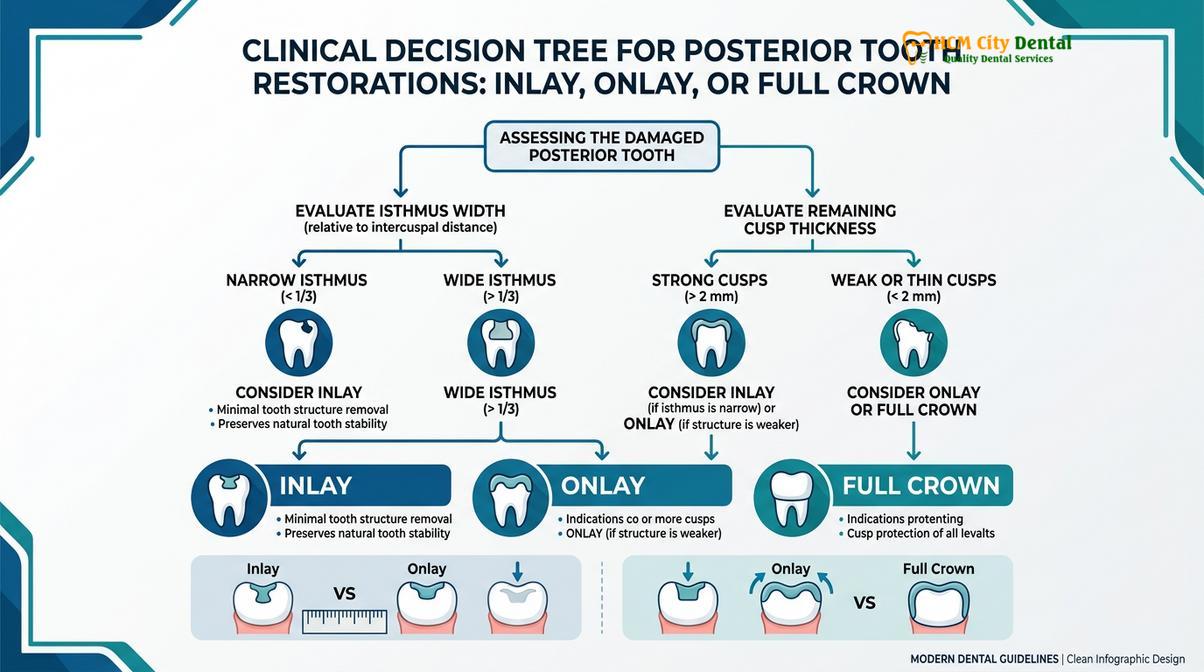
The second vital parameter is remaining cusp thickness. Even if the isthmus is not excessively wide, a cusp may be undermined by decay spreading laterally beneath the enamel. Dentists use specialized calipers to measure the thickness of the dentin supporting each cusp at its base. If the remaining cusp thickness is less than 2.0 millimeters, it is deemed too weak to withstand occlusal forces. The standard protocol is to reduce the height of that specific cusp by 1.5 to 2.0 millimeters and cover it with the ceramic restoration. This conservative tooth prep ensures that the chewing forces are absorbed by the high-strength ceramic rather than the fragile natural cusp, aligning with modern biomimetic restorative dentistry guidelines[5].
“Objective clinical measurements, rather than subjective visual estimates, must drive the restorative decision. By quantifying the remaining dentin thickness and isthmus width, clinicians can predictably select the most conservative restoration that still provides adequate biomechanical protection against catastrophic fracture.”
Case Study: Restoring Function at HCMC Dental Clinic
Clinical Case: A recent patient visiting HCMC Dental Clinic in Ho Chi Minh City presented with a severely fractured lower molar. The patient had an old, large amalgam filling that had caused a micro-fracture in the lingual cusp. Upon clinical examination and 3D imaging, it was determined that while one cusp was completely lost, the remaining three cusps and the entire outer perimeter of enamel were perfectly healthy.
Instead of grinding down the entire tooth for a traditional crown, the clinical team at HCMC Dental Clinic opted for a conservative ceramic onlay. The old amalgam and decay were carefully removed, and the missing cusp was rebuilt using a high-strength lithium disilicate restoration. By utilizing advanced rubber dam isolation and immediate dentin sealing, the onlay was bonded seamlessly to the remaining enamel. This approach not only restored the patient’s chewing function but also preserved over 70% of their natural tooth structure, demonstrating the profound benefits of partial-coverage restorations.
When to Consult a Specialist
Understanding when to seek professional evaluation is critical for preserving your natural teeth. You should consult a restorative dental specialist if you experience any of the following symptoms:
- Sharp pain when biting down, which quickly disappears after releasing pressure (a classic sign of a cracked tooth or failing filling).
- Visible fracture lines or missing pieces of tooth structure, especially around old, large silver fillings.
- Persistent sensitivity to hot or cold temperatures that lingers for more than a few seconds.
- Food consistently getting trapped between specific teeth, indicating a broken or open contact point that requires structural repair.
Important Clinical Note: Early intervention is key. A tooth that currently only needs a conservative inlay or onlay can quickly deteriorate into requiring a full crown or even a root canal if left untreated. Do not ignore localized pain when chewing.
Expert Clinical Perspective
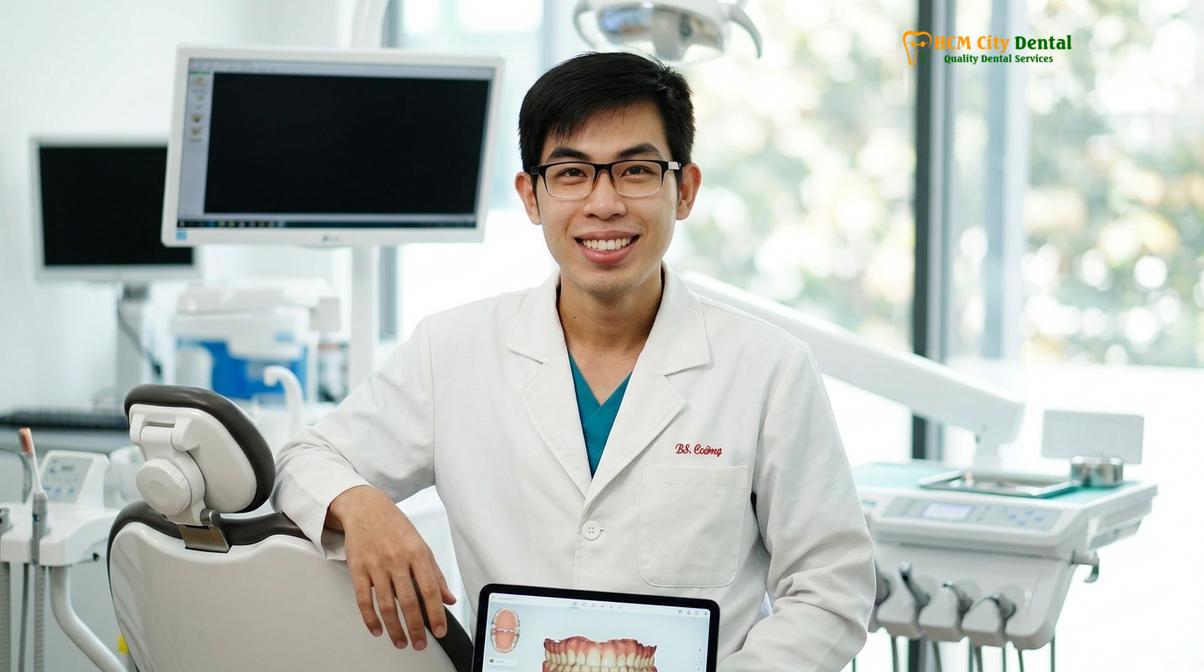
Dr. Nguyen Van Cuong, a leading restorative specialist, emphasizes that preserving natural enamel is the cornerstone of modern dentistry. According to Dr. Cuong, utilizing advanced adhesive protocols allows for highly conservative treatments that respect the tooth’s original biomechanics. By carefully evaluating each patient’s unique structural needs, he ensures that restorations like onlays and overlays provide maximum durability while safeguarding the underlying dental pulp.
References
- Journal of Prosthetic Dentistry. Survival rates of ceramic onlays and partial coverage restorations.
- International Journal of Periodontics & Restorative Dentistry. The ferrule effect and biomechanical stability in severely damaged teeth.
- Dental Materials. Immediate dentin sealing and its impact on bond strength of indirect restorations.
- Journal of the American Dental Association. Clinical outcomes of CAD/CAM lithium disilicate overlays vs full coverage crowns.
- Operative Dentistry. Biomimetic restorative dentistry and conservative tooth preparation guidelines.
- Vietnam Odonto-Stomatology Association (VOSA). National guidelines on conservative restorative dentistry and biomimetic protocols.
If you have a damaged tooth or an old filling that needs replacement, a conservative approach can save your natural smile. Contact HCMC Dental Clinic in Ho Chi Minh City today to schedule a comprehensive structural evaluation and discover if an inlay, onlay, or overlay is the right clinical choice for you.
For premium porcelain crowns, bridges, and advanced smile reconstructions, visit our Dental Crowns & Bridges service page at HCMC Dental Clinic in Ho Chi Minh City.