The cost of dental fillings in Vietnam is significantly lower than in the US and Australia, often saving patients up to 80%. While a standard composite restoration costs hundreds of dollars in Western clinics, Ho Chi Minh City offers identical premium materials for a fraction of the price.
Clinical Summary:
Analyzing the dental filling cost Vietnam vs USA Australia highlights a major shift in global healthcare economics. Western dental practices are burdened by exorbitant overhead, malpractice insurance, and administrative costs, which artificially inflate the price of routine restorative care. In contrast, top-tier clinics in Ho Chi Minh City operate with lower localized overhead while utilizing the exact same imported, globally certified materials—such as 3M composites and E.max ceramics. This allows international patients to receive uncompromising clinical quality, comprehensive diagnostics, and long-lasting restorations at highly competitive rates, making cross-border dental care a clinically sound and financially strategic choice.
Key Takeaways:
- Patients routinely save between 60% and 80% on restorative dental procedures in Vietnam compared to Western averages.
- The affordability is driven by lower operational overhead, not by compromises in clinical quality or material standards.
- Premium, globally recognized materials (like 3M Filtek and Ivoclar E.max) are standard in reputable Saigon clinics.
- Combining multiple restorations or upgrading to ceramic inlays often offsets the entire cost of international travel.
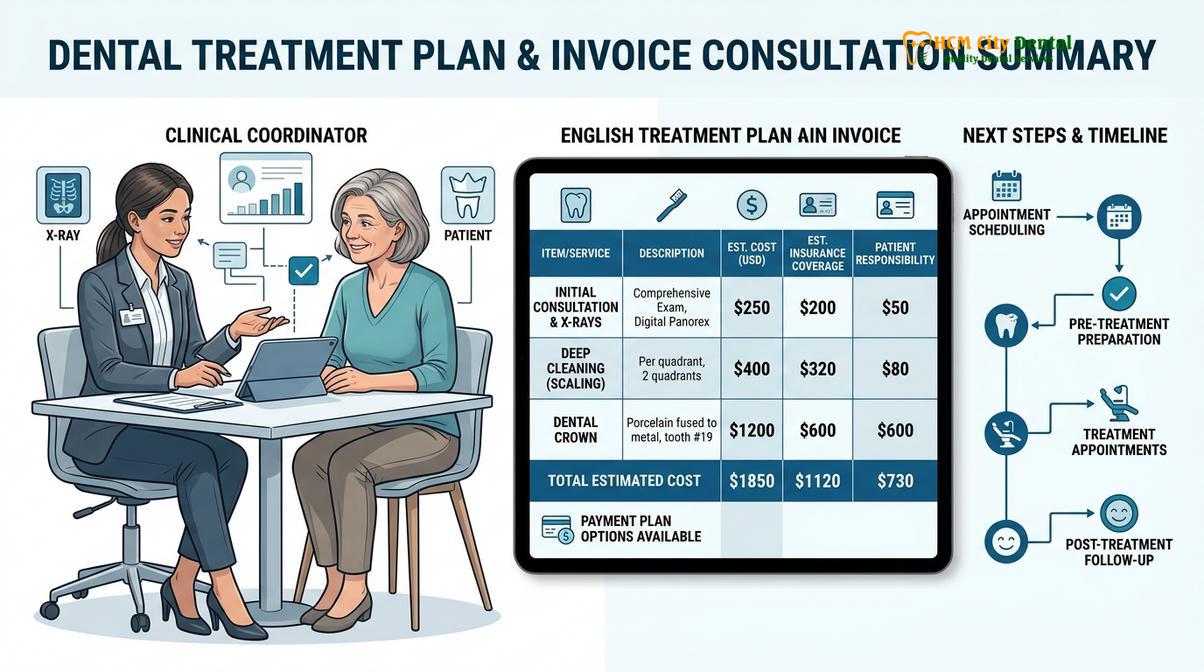
- Reputable clinics provide fully itemized, English-language invoices to facilitate seamless international insurance claims.
Why Dental Fillings Cost a Fortune in the West
The high cost of restorative dentistry in the US and Australia is primarily driven by exorbitant clinic overhead, malpractice insurance premiums, and complex administrative fees rather than the actual cost of dental materials.
To understand the vast discrepancy in global dental pricing, one must look beyond the clinical procedure itself and examine the underlying economics of running a healthcare facility. In major Western cities like New York, Los Angeles, Sydney, or Melbourne, the operational overhead for a dental practice is staggering. Dentists face astronomical commercial real estate rents, high labor costs for specialized staff, and the heavy burden of student loan debt from dental schools. These localized economic pressures dictate the baseline pricing for every procedure, from a simple check-up to complex general dentistry treatments.
Furthermore, the administrative burden in Western healthcare systems adds a significant layer of hidden costs. Clinics must employ dedicated billing specialists to navigate the labyrinth of insurance networks, pre-authorizations, and claim denials. The cost of malpractice insurance is also exceptionally high in litigious environments. Consequently, when a patient pays for a composite filling in the US or Australia, only a small fraction of that fee covers the actual composite resin and the dentist’s clinical time; the vast majority subsidizes the clinic’s operational ecosystem[1].
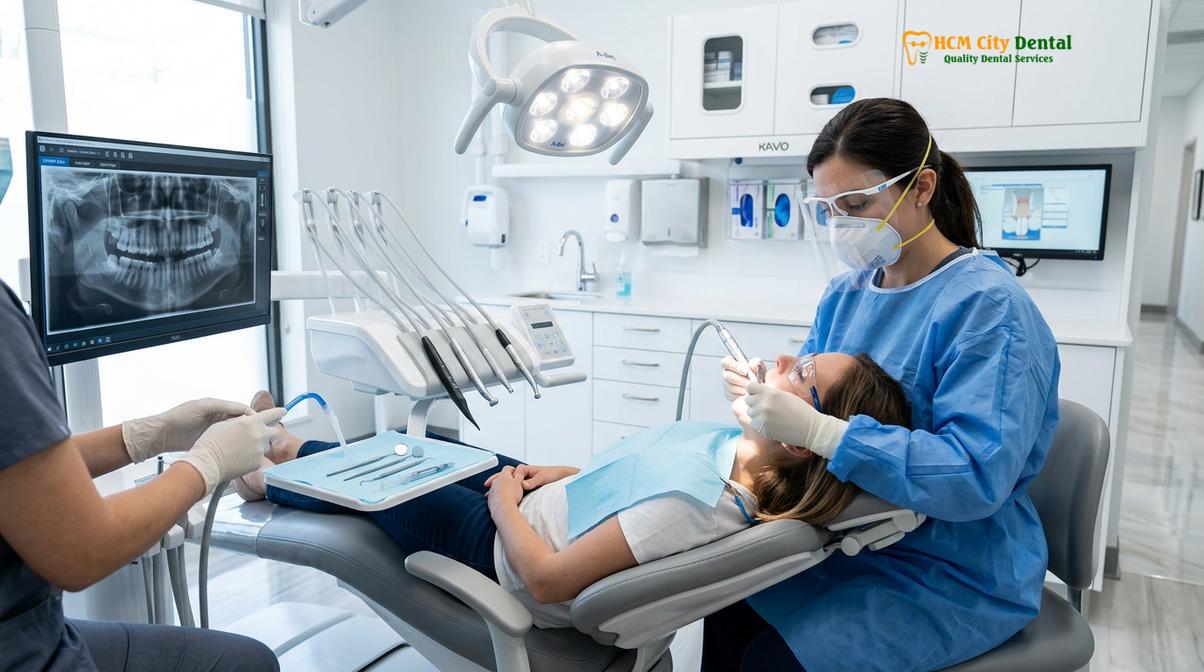
“The retail price of restorative dental care in Western markets is heavily skewed by administrative overhead and commercial real estate costs, making routine treatments financially inaccessible for many uninsured or underinsured patients.”
In contrast, the economic landscape in Vietnam allows for a much leaner operational model. While the cost of importing premium dental materials remains the same globally, the localized costs of commercial space, administrative labor, and clinical operations are significantly lower. The Vietnamese government also actively supports the modernization of medical infrastructure, reducing import tariffs on essential healthcare technologies. This unique economic environment enables clinics to offer world-class care without the inflated price tag, passing the operational savings directly to the patient.
Price Comparison: US & Australian Cities vs Ho Chi Minh City
A direct price comparison reveals that patients in Ho Chi Minh City pay a fraction of Western prices for identical restorative procedures, utilizing the exact same global material brands.
When evaluating the financial benefits of dental tourism, a side-by-side comparison of specific procedures provides the clearest picture. The savings become particularly evident when looking at the Dental Fillings category, where the volume of required restorations can quickly escalate the total bill in a Western clinic. Whether a patient requires a simple direct composite restoration or a more complex indirect ceramic inlay, the price differential is substantial.
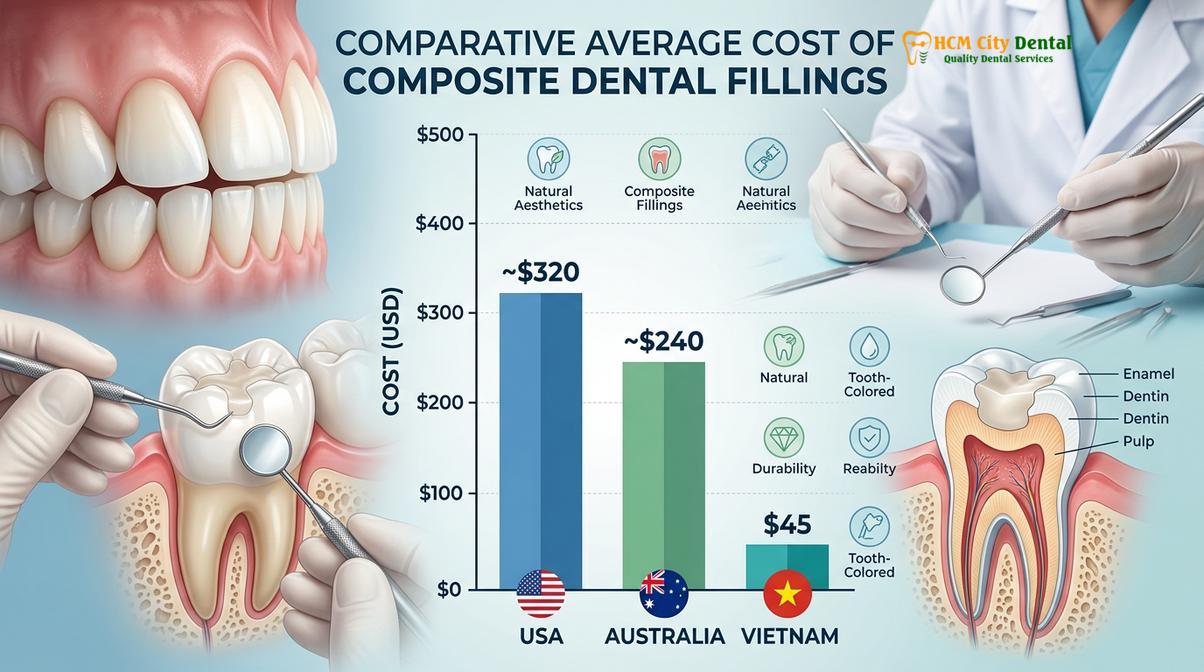
For instance, the average composite filling cost US patients face can range from $150 to $350 per tooth, depending on the number of surfaces involved and the clinic’s geographic location. In Australia, similar treatments often exceed $200 AUD. However, in Ho Chi Minh City, the exact same procedure, utilizing identical light-cured composite resins from brands like 3M or GC, typically costs between $20 and $40 USD.
| Restorative Procedure | Average Cost in USA (USD) | Average Cost in Australia (AUD) | Average Cost in HCMC (USD) |
|---|---|---|---|
| Standard Composite Filling (1-2 surfaces) | $150 – $250 | $180 – $250 | $20 – $40 |
| Complex Composite Filling (3+ surfaces) | $250 – $350 | $250 – $350 | $30 – $50 |
| Ceramic Inlay (CAD/CAM Milled) | $800 – $1,200 | $900 – $1,400 | $200 – $350 |
| Ceramic Onlay (Partial Crown) | $900 – $1,500 | $1,000 – $1,600 | $250 – $400 |
The disparity becomes even more pronounced when upgrading to indirect restorations. The ceramic inlay price Australia clinics charge can easily surpass $1,000 AUD per tooth due to the high costs of local dental laboratories and CAD/CAM milling time. In Vietnam, patients can receive custom-milled E.max or Zirconia inlays for a fraction of that cost, often completed within a single day thanks to in-house digital laboratories[2]. This level of affordability allows patients to choose the most clinically appropriate, durable material rather than settling for a cheaper, less effective option dictated by budget constraints.
Composite Resin vs Ceramic Inlays/Onlays Cost Analysis
While direct composite resins offer an economical solution for minor decay, custom-milled ceramic inlays and onlays provide superior long-term durability for larger cavities, with both options being highly affordable in Vietnam.
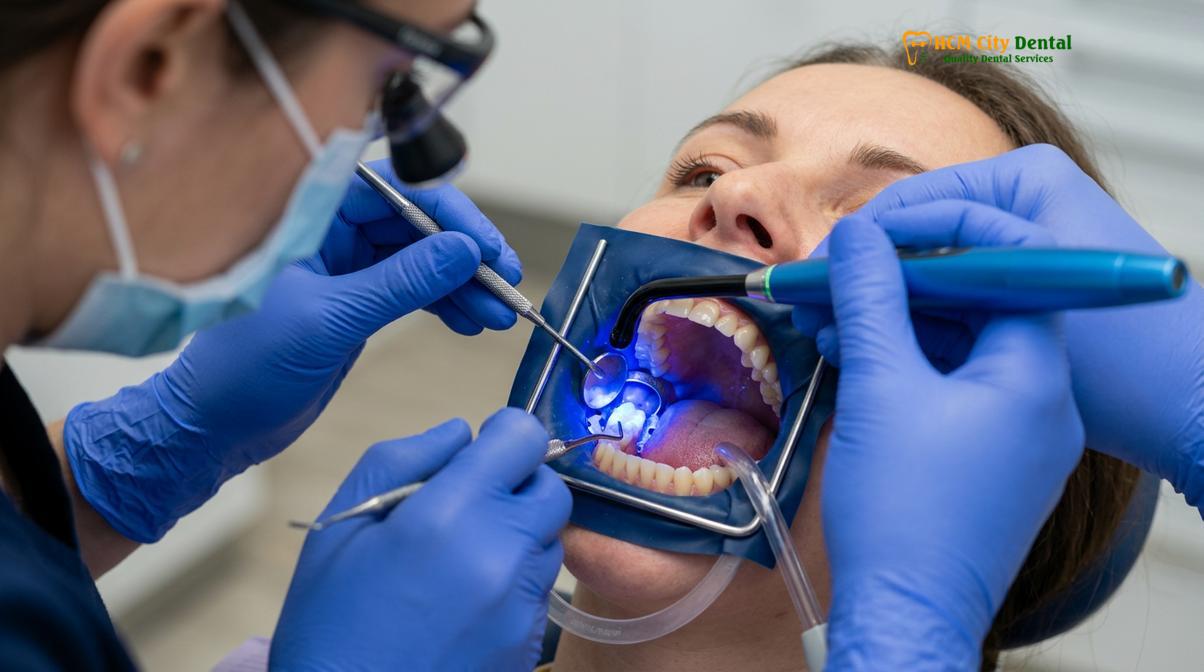
Understanding the clinical and financial differences between restorative materials is crucial for making an informed decision about your oral health. Direct composite resins are the standard of care for small to medium-sized cavities. The procedure involves removing the decayed tissue, applying a bonding agent, and layering a tooth-colored resin that is hardened with a specialized curing light. This Vietnam cavity treatment is highly efficient, minimally invasive, and incredibly cost-effective. However, composite resins are subject to polymerization shrinkage and gradual wear over time, making them less ideal for restoring large structural defects on load-bearing molars.
For extensive decay or fractured teeth that do not quite require a full dental crown, indirect restorations—specifically ceramic inlays and onlays—are the superior clinical choice. These restorations are custom-fabricated outside the mouth, often using advanced CAD/CAM (Computer-Aided Design and Computer-Aided Manufacturing) technology. Materials like lithium disilicate (E.max) offer exceptional biomechanical strength, mimicking the natural flexural properties of human enamel while providing unparalleled aesthetic integration[3].
Clinical Case Review: Comprehensive Restorative Upgrade
A 42-year-old expatriate presented to HCMC Dental Clinic with multiple failing, decades-old amalgam fillings that were causing micro-fractures in her lower molars. Dr. Nguyen Van Cuong conducted a thorough clinical evaluation and recommended replacing the compromised amalgams with custom-milled E.max ceramic onlays. Because of the highly competitive Same-day filling cost and in-house CAD/CAM capabilities, the patient was able to upgrade all four molars to premium ceramics for less than the price of a single onlay in her home country, ensuring long-term structural integrity and a flawless aesthetic result.
In Western countries, the cost barrier often forces patients to choose large, structurally compromised composite fillings over the more appropriate ceramic inlays. In Ho Chi Minh City, the affordability of digital dentistry removes this financial barrier. Patients can opt for the most durable, conservative treatment plan without the anxiety of exorbitant out-of-pocket expenses, ensuring their natural tooth structure is preserved and protected for decades.
Traveler Budgets: How 3 Fillings Can Cover Your Flight to Saigon
For patients requiring multiple restorations, the cumulative savings on just three to four fillings in Vietnam can completely offset the cost of round-trip airfare and local accommodation.
The concept of dental tourism is rooted in simple mathematics: when the cost of travel is lower than the savings on medical care, crossing borders becomes a highly logical financial decision. While flying internationally for a single, small cavity might not yield a net positive return, the financial dynamics shift dramatically for patients requiring multiple restorations, root canal therapies, or ceramic upgrades.
Consider a patient based in Melbourne, Australia, who requires four moderate-to-large restorations. If their local dentist recommends ceramic inlays for optimal longevity, the total treatment plan could easily exceed $4,500 AUD. Alternatively, that same patient can book a round-trip flight to Ho Chi Minh City (approximately $600 – $800 AUD) and secure premium accommodation in the city center for a week (approximately $400 AUD). The District 1 dental savings on those four ceramic inlays—costing roughly $1,200 AUD total in Vietnam—means the patient spends a combined $2,400 AUD for a world-class vacation and premium dental care, saving over $2,000 AUD compared to staying home[4].
This economic reality has transformed Ho Chi Minh City into a premier hub for medical travelers. Beyond the financial incentives, patients benefit from the efficiency of the care. Reputable clinics are accustomed to treating international visitors and optimize their scheduling to complete comprehensive treatment plans within tight travel windows, ensuring that patients can enjoy the cultural and culinary delights of Vietnam without spending their entire holiday in a dental chair.
Expat Insurance Claims and Treatment Invoices in English
Reputable dental centers in Vietnam provide comprehensive, English-language documentation and standardized diagnostic codes, ensuring seamless reimbursement processes for international health insurance policyholders.
For expatriates living and working in Southeast Asia, navigating healthcare reimbursement is a critical component of managing personal finances. Fortunately, the Expat dental pricing HCMC clinics offer is not only affordable but also fully compatible with major international health insurance networks, including providers like Cigna, Aetna, Bupa, and Allianz.
The standard protocol for international dental claims operates on a “pay-and-claim” basis. The patient pays for the treatment upfront at the clinic and subsequently submits the required documentation to their insurance provider for reimbursement. To facilitate this process, top-tier clinics maintain dedicated international patient departments. These teams are trained to generate meticulous, itemized invoices in English, utilizing globally recognized FDI tooth numbering systems and standardized CDT (Current Dental Terminology) or ICD codes[5].
“Transparency in medical billing and the use of standardized international diagnostic codes are paramount for expatriates seeking to leverage their global health insurance policies for cross-border dental care.”
When you complete your treatment, the clinic will provide a comprehensive claim packet. This typically includes the itemized receipt, pre- and post-operative digital X-rays, and a detailed clinical report signed by the attending specialist. This level of administrative professionalism ensures that insurance claims are processed swiftly and without unnecessary bureaucratic delays, allowing expats to maximize their policy benefits while receiving exceptional care.
When to See a Doctor (Clinical Considerations)
While dental fillings are highly effective for treating mild to moderate tooth decay, they are not a universal solution for all dental pain. It is crucial to understand the clinical limitations of restorative resins and recognize the signs that indicate a more severe underlying issue. If you experience sharp, lingering pain when consuming hot or cold foods, or if you feel a deep, throbbing ache that radiates to your jaw or ear, you must seek immediate professional evaluation.
Clinical Warning: Severe, spontaneous tooth pain that wakes you up at night is a strong indicator of irreversible pulpitis (nerve infection). In such cases, a simple filling will not resolve the issue, and attempting to cover an infected nerve can lead to severe abscesses and systemic complications.
According to Dr. Nguyen Van Cuong, a thorough clinical examination, including high-resolution digital radiography and vitality testing, is mandatory before any restorative procedure. If the decay has breached the pulp chamber, root canal therapy will be required to salvage the tooth, followed by a full-coverage crown to restore its structural integrity. Never ignore persistent dental pain, and always rely on a qualified specialist to determine the appropriate scope of treatment based on objective diagnostic data.
Frequently Asked Questions
How much does a tooth filling cost in Saigon?
A standard composite tooth filling in Saigon typically ranges from $20 to $40 USD per tooth. The exact price depends on the size of the cavity, the tooth’s location, and the specific brand of imported resin used. Clinics maintain transparent pricing, ensuring patients know the exact cost before treatment begins.
Do international health insurances cover fillings in Vietnam?
Yes, most international health insurance plans cover dental fillings performed in Vietnam. Patients usually pay upfront and submit the clinic’s standardized English invoice, complete with international treatment codes, for reimbursement. It is always advisable to check your specific policy’s annual limits and co-pay requirements.
How long do Saigon dental fillings last?
Composite fillings placed in Saigon generally last between 5 to 7 years, while ceramic inlays can last 10 to 15 years. Longevity depends heavily on your oral hygiene, dietary habits, and routine dental check-ups. Using premium materials ensures the restorations withstand normal occlusal forces effectively.
Are the dental materials used in Vietnam the same as in the US?
Absolutely. Reputable clinics in Vietnam import the exact same premium dental materials, such as 3M composite resins and Ivoclar E.max ceramics, that are standard in top-tier US and Australian dental practices. The cost savings come from lower operational overhead, not inferior clinical supplies.
Is it safe to fly immediately after getting a dental filling?
Yes, it is perfectly safe to fly immediately after receiving a standard composite or ceramic filling. Unlike surgical extractions or sinus lifts, routine restorative work is not affected by the cabin pressure changes during a flight, allowing dental tourists to travel home without delay.
References
- Journal of the American Dental Association. Economic analysis of dental practice overhead and restorative pricing models. (2021).
- Australian Dental Journal. Comparative costs of direct and indirect restorations in urban dental centers. (2020).
- Clinical Oral Investigations. Longevity and biomechanical performance of CAD/CAM ceramic inlays vs direct composites. (2019).
- International Journal of Medical Tourism. Patient motivations and economic outcomes in cross-border dental care. (2022).
- Journal of Global Health Economics. Standardization of dental billing codes for international insurance reimbursement. (2018).
For a personalized assessment of your restorative needs and a detailed cost breakdown, contact our team to schedule a comprehensive consultation at HCMC Dental Clinic.
For pricing, booking, and a free clinical assessment, visit our Dental Fillings & Bonding service page at HCMC Dental Clinic in Ho Chi Minh City.

![Black Stain on Teeth: How to Get Rid Of [Solved] | Dr. Cuong](https://hcmcdental.com/wp-content/uploads/2025/07/black-stain-on-teeth-how-to-get-rid-of-1-dr-cuong-hcmc-dental-clinic-280x280.jpg)