For international patients traveling to Vietnam for restorative dentistry, learning how to read a 3D CBCT dental implant treatment plan to avoid unnecessary grafts is the single most powerful skill you can acquire. Every year, thousands of dental tourists receive aggressive surgical quotes recommending full-mouth extractions, multiple sinus lifts, and extensive block grafts. Often, these invasive treatment plans are drafted by high-volume clinics prioritizing profit margins over conservative, biomimetic care. Without the ability to independently verify your own clinical data, you risk falling victim to over-treatment, hidden fees, and irreversible surgical procedures.
At HCMC Dental Clinic in District 1, Ho Chi Minh City, we believe in radical clinical transparency. Led by Dr. Nguyen Van Cuong (Dr. Cuong), DDS, our philosophy is rooted in evidence-based implantology: save natural teeth whenever possible, utilize advanced 3D diagnostics to bypass unnecessary grafting, and provide 100% all-inclusive pricing. This comprehensive guide will teach you how to audit a dental implant quote and avoid an unnecessary bone graft by understanding the critical data hidden within your own 3D Cone Beam Computed Tomography (CBCT) scan.
Clinical Summary:
Auditing your dental implant quote requires transitioning from flat 2D X-rays to volumetric 3D CBCT analysis. By learning to identify your alveolar ridge width (≥6mm), vertical bone height (≥10mm), and bone density (D1–D4 Hounsfield Units), you can protect yourself against clinics that falsely claim you need mandatory bone grafts. Furthermore, understanding the five essential components of an implant package (fixture, healing abutment, custom titanium abutment, temporary crown, and final Zirconia crown) will shield you from bait-and-switch pricing models common in dental tourism.
Key Takeaways:
- Never Accept 2D Diagnoses: A flat 2D panoramic X-ray (OPG) has up to 25% magnification distortion and cannot measure bone width, making it medically negligent for planning complex All-on-4 surgeries or major bone grafts.
- Read Your Own Numbers: A safe standard implant requires at least 6mm of horizontal bone width and 10mm of vertical height. If your CBCT shows these dimensions, you likely do not need a vertical block graft.
- Graftless Alternatives Exist: Tilted All-on-4 implants, 6mm–8mm short Roxolid implants, and pterygoid anchorage can safely bypass the maxillary sinus and inferior alveolar nerve, eliminating the need for painful, expensive sinus lifts.
- Beware the $399 Bait-and-Switch: Ultra-cheap implant advertisements almost always exclude the custom titanium abutment, 3D surgical guide, and final Zirconia crown, leading to massive hidden fees in the chair.
- Demand Genuine Passports: Always verify that your clinic uses genuine, traceable fixtures (Straumann, Nobel Biocare, Osstem) with official lot stickers, rather than unverified clone implants that void global warranties.
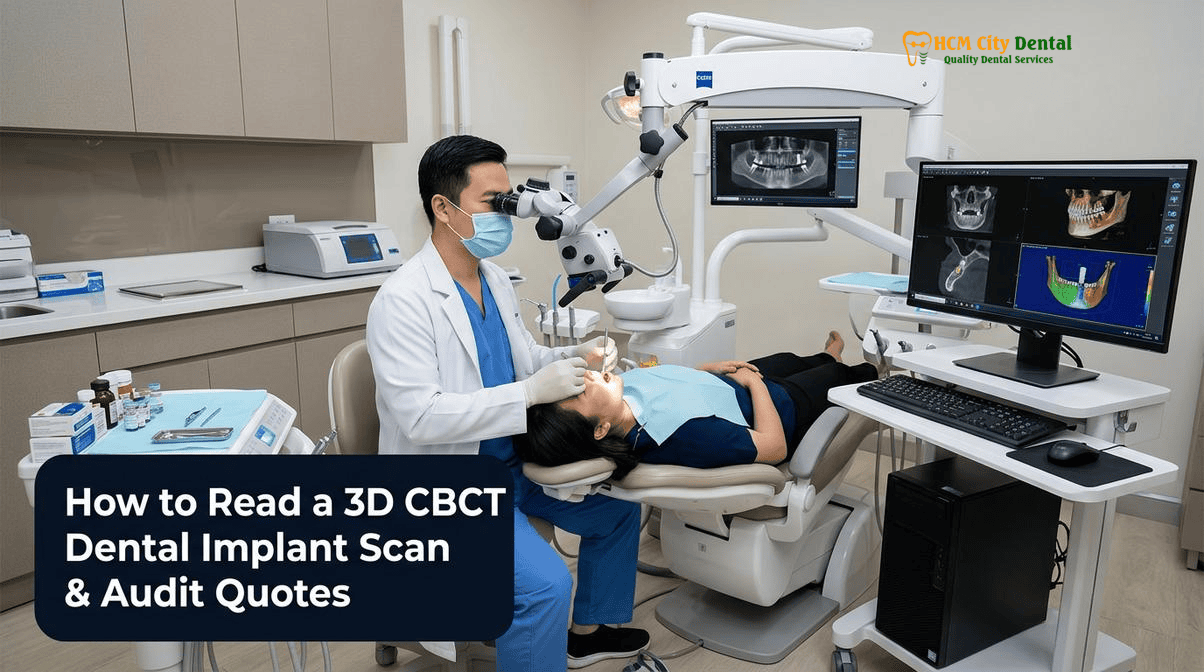
Red Flag #1: Recommending Full-Arch Extraction & All-on-4 Based Only on a 2D Panoramic X-Ray When Natural Teeth Can Be Saved with Biomimetic/Perio Care
One of the most alarming red flags in a dental tourism treatment plan regarding over-treatment is the recommendation to extract all remaining teeth for an All-on-4 prosthesis based solely on a two-dimensional panoramic X-ray (OPG). While All-on-4 is a life-changing protocol for patients with terminal dentition, it is an irreversible amputation of the natural alveolar bone and periodontal ligaments. High-volume commercial clinics often push this procedure because it is highly profitable and standardizes the workflow, ignoring the possibility of saving the patient’s natural teeth.
A 2D OPG compresses the complex, curved, three-dimensional anatomy of the human skull into a single flat plane. This inherent technological limitation causes severe superimposition of anatomical structures and introduces magnification distortion ranging from 10% to 25%[1]. On a 2D X-ray, a surgeon cannot see the buccal (cheek side) or lingual (tongue side) thickness of the bone. They cannot accurately trace the three-dimensional pathway of the inferior alveolar nerve or measure the exact volumetric capacity of the maxillary sinus. Planning a major surgical intervention without 3D data is akin to navigating a complex maze blindfolded.
Before agreeing to full-arch extractions, patients must ask: When to save natural teeth vs. extract for All-on-4 implants? At HCMC Dental Clinic, Dr. Nguyen Van Cuong, DDS, employs a strict biomimetic and periodontal preservation protocol. If a tooth has adequate bone support and can be restored using microscopic endodontics, deep margin elevation, or periodontal splinting, it should be saved. Natural teeth possess proprioception—the ability to sense pressure—which dental implants lack. Retaining healthy natural roots preserves the surrounding alveolar bone and maintains the natural biomechanics of your bite. If a clinic rushes to extract teeth without offering a comprehensive periodontal and endodontic evaluation via Safe Dental Implants Ho Chi Minh City: 3D CBCT & Guided Surgery, you should immediately seek a second opinion.
How Patients Can Read the 3 Key Numbers on Their Own 3D CBCT Cross-Section: Alveolar Ridge Width (≥6mm), Vertical Height (≥10mm), and Bone Density (D1–D4 HU)
To protect yourself from unnecessary surgical procedures, you must understand how to read a 3D CBCT scan for bone width and height in dental implants. When you request your raw DICOM files from an imaging center, specialized software (such as BlueSkyBio, Exocad, or Carestream) allows you to view cross-sectional slices of your jawbone. There are three critical metrics you and your surgeon must evaluate to determine if an implant can be placed safely without grafting.
1. Alveolar Ridge Width (Horizontal Bone): Minimum 6mm
For a standard dental implant (typically 3.5mm to 4.0mm in diameter) to integrate successfully, it must be completely encased in healthy bone. The golden rule of implantology dictates that there must be at least 1.0mm to 1.5mm of buccal (outer) and lingual (inner) cortical bone surrounding the titanium fixture. Therefore, if a 4.0mm implant is planned, the total horizontal width of the alveolar ridge must be at least 6.0mm to 7.0mm. If your CBCT cross-section shows a ridge width of 7mm, and a clinic tells you that you need an expensive horizontal ridge expansion or block graft, you are likely facing over-treatment.
2. Vertical Bone Height: Minimum 10mm (Standard) or 6mm (Short Implants)
Vertical bone height is measured from the crest of the alveolar ridge down to the nearest vital anatomical structure—specifically, the inferior alveolar nerve canal in the lower jaw, and the floor of the maxillary sinus in the upper jaw. Traditionally, a standard implant requires at least 10mm of vertical height to ensure primary stability and avoid nerve injury. If your scan shows 12mm of vertical bone above the nerve, a vertical bone graft is completely unnecessary. However, if you only have 6mm to 8mm of vertical height, modern advancements allow for the use of specialized short implants, which we will discuss in the next section.
3. Bone Density: The D1 to D4 Scale (Hounsfield Units)
Bone is not uniformly solid; it consists of a dense outer shell (cortical bone) and a spongy inner matrix (cancellous or trabecular bone). CBCT software measures bone density in Hounsfield Units (HU)[2]. The Lekholm and Zarb classification divides bone into four categories:
- D1 Bone (>1250 HU): Dense oak-like bone, typically found in the anterior lower jaw. Excellent for immediate loading, but requires careful drilling to avoid overheating.
- D2 Bone (850–1250 HU): Thick cortical bone with a dense trabecular core. The ideal bone for dental implants, offering perfect primary stability and blood supply.
- D3 Bone (350–850 HU): Thin cortical bone with a porous core, common in the anterior upper jaw.
- D4 Bone (<350 HU): Soft, styrofoam-like bone, typically found in the posterior upper jaw. This bone requires specialized surgical techniques (like osseodensification) to compress the bone and achieve stability without grafting.
“Empowering patients to read their own CBCT scans changes the entire dynamic of the consultation. When a patient can look at the screen, see 8 millimeters of horizontal width, and understand that their bone density is a healthy D2, they can confidently reject a predatory quote that includes thousands of dollars in unnecessary synthetic bone grafts.”
— Dr. Nguyen Van Cuong, DDS (Vietnam MOH License 0003265/BL-CCHN)
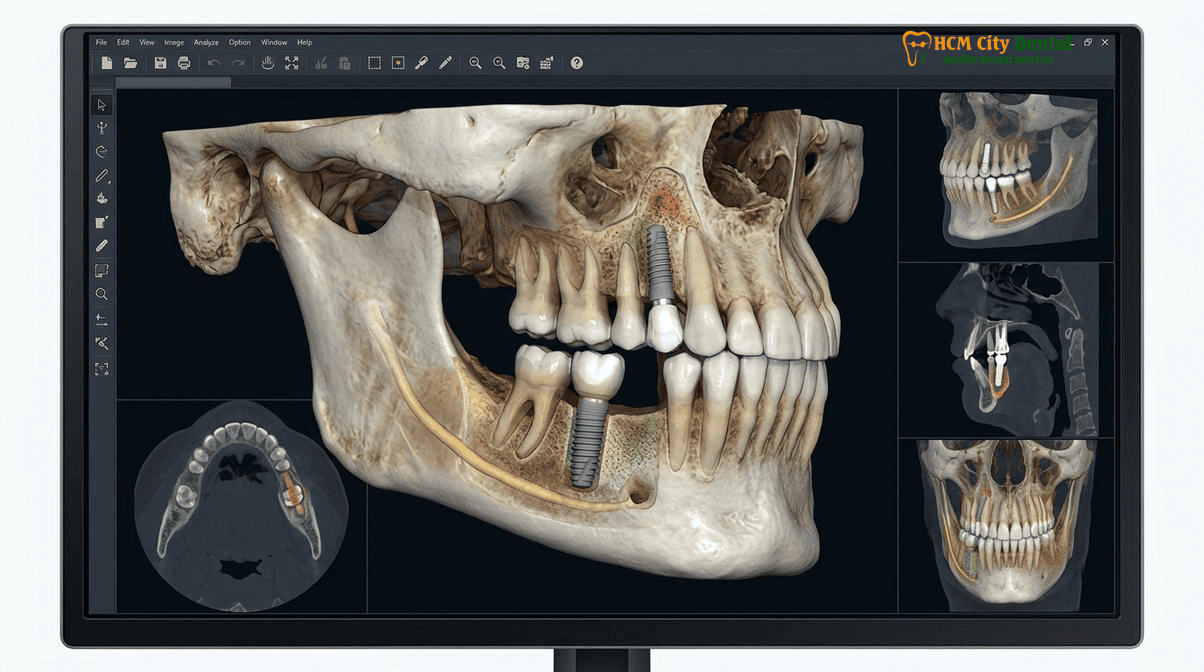
Red Flag #2: Billing ‘Mandatory Bone Grafts & Sinus Lifts’ When Tilted All-on-4 Implants, 6mm–8mm Roxolid Short Implants, or Pterygoid Anchorage Eliminate Grafting
One of the most lucrative procedures for commercial dental clinics is the sinus lift (sinus augmentation) and vertical block grafting. When teeth are lost in the posterior upper jaw, the maxillary sinus often pneumatizes (expands downward), leaving only a few millimeters of bone. Many clinics will automatically quote a bilateral lateral window sinus lift—a highly invasive surgery that adds $2,000 to $4,000 to the bill, causes significant facial swelling, and delays implant placement by 6 to 9 months.
However, modern evidence-based implantology offers several graftless alternatives that are safer, faster, and more cost-effective. If a clinic insists that sinus lifts are “mandatory” without discussing these alternatives, it is a major red flag.
Alternative 1: Short Dental Implants (6mm–8mm)
If you have 6mm of vertical bone below the sinus, you do not necessarily need a sinus lift. Premium implant manufacturers, such as Straumann, have developed ultra-strong titanium-zirconium alloys (Roxolid) and highly hydrophilic surface treatments (SLActive). These advancements allow surgeons to place Short Dental Implants (6mm–8mm) vs. Vertical Bone Grafting & Sinus Lift Surgery in Vietnam: Survival & Cost with survival rates equal to standard 10mm implants[3]. By using a 6mm implant in 6.5mm of bone, the surgeon completely avoids the sinus cavity, eliminating the need for grafting, reducing surgical morbidity, and cutting costs significantly.
Alternative 2: Tilted Implants in the All-on-4 Protocol
For full-arch restorations, the original All-on-4 protocol developed by Dr. Paulo Malo was specifically designed to bypass the maxillary sinuses and the mental foramen. By tilting the posterior implants at a 30- to 45-degree angle, the surgeon anchors the fixtures into the dense anterior bone, completely avoiding the deficient posterior regions. This graftless approach allows for immediate loading (attaching a fixed temporary bridge on the same day) and saves the patient from months of healing associated with sinus lifts.
Alternative 3: Pterygoid and Zygomatic Implants
In cases of severe maxillary atrophy where even tilted implants are not viable, advanced surgeons can utilize the pterygomaxillary region or the zygomatic (cheek) bone for anchorage. Bone Grafting, Sinus Lifts & Zygomatic Implants in Vietnam | HCMC Dental provides a stable, graftless solution for patients who have been told they do not have enough bone for traditional implants. These techniques require specialized surgical training and should only be performed by highly experienced specialists like Dr. Nguyen Van Cuong.
Red Flag #3: The ‘Bait-and-Switch’ $399 Implant Fixture Ad That Excludes the Custom Titanium Abutment, Temporary Crown, 3D Surgical Guide, and Zirconia Crown
The most pervasive deceptive marketing tactic in dental tourism is the bait-and-switch pricing model. You may see advertisements for “Dental Implants in Vietnam for $399!” This price seems incredibly attractive until you sit in the dental chair and realize that the $399 only covers the titanium screw placed into the bone. It completely ignores the hidden costs in cheap dental implant quotes, such as the abutment and crown, which are essential for you to actually chew food.
Clinical Warning: The 5 Components of a Complete Implant Package
To avoid surprise bills, ensure your quote explicitly includes all five of these line items:
- The Implant Fixture: The titanium screw surgically placed into the jawbone.
- The Healing Abutment (Gingival Former): A temporary cap placed on the implant to shape the gum tissue during the 3-month healing phase.
- The Custom Titanium Abutment: The crucial connector piece that screws into the implant fixture and supports the final crown. Cheap quotes often use generic, ill-fitting stock abutments that cause gum inflammation.
- The 3D Surgical Guide & CBCT Scan: The digital planning and 3D-printed stent required for safe, precise placement.
- The Final Zirconia Crown: The visible, tooth-colored ceramic restoration.
When you audit your quote, demand an all-inclusive price. At HCMC Dental Clinic, our Dental Implants in Vietnam: Complete Cost Breakdown & How to Avoid Hidden Fees policy ensures that the price you see online is the exact price you pay. For example, our Single Korean Implant package (Dentis / Neo Biotech / Dentium) is strictly $462 – $654 USD online, which includes the fixture, the abutment, and the surgical placement. The final Zirconia HT Crown is a transparent $154 USD. There are zero hidden fees for healing abutments or standard surgical protocols.
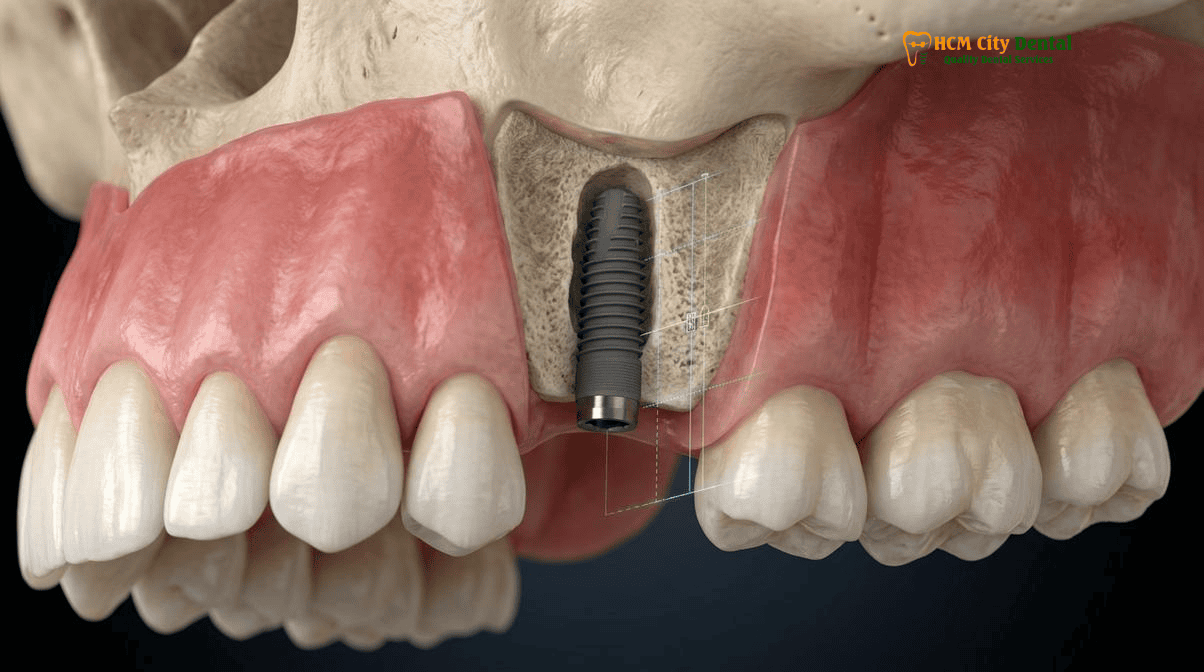
Red Flag #4: Unverified Clone Implant Fixtures With No Lot Sticker vs. Genuine Straumann, Nobel Biocare & Osstem Lifetime Global Passports
Another critical area where high-volume clinics cut corners is the origin and authenticity of the biomaterials used. The global dental market is flooded with “clone” implants—cheap, unverified fixtures manufactured to look like premium brands but lacking the rigorous surface treatments, sterile packaging, and metallurgical purity required for long-term osseointegration[4].
When an implant is placed in your jaw, it must integrate with your bone at a cellular level. Premium brands invest billions in research to develop surfaces like Straumann’s SLActive or Nobel Biocare’s TiUnite, which actively stimulate bone-forming cells (osteoblasts) and drastically reduce healing times. Clone implants often have contaminated surfaces that lead to early failure, peri-implantitis, and severe bone loss.
How can you protect yourself? Demand the Global Implant Passport and Lot Sticker. Every genuine implant from reputable manufacturers (Straumann, Nobel Biocare, Osstem, Dentium) comes in a sealed, sterile vial with a unique, traceable lot number sticker. After surgery, the clinician must peel this sticker off the vial and place it directly into your physical implant passport or medical record. This passport guarantees that the implant is genuine and provides you with an international lifetime warranty. If you travel back to Australia, the US, or Europe and require maintenance, any dentist can look at your passport, identify the exact thread pitch and connection type, and order the correct tools. If a clinic refuses to provide the original lot sticker, you are likely receiving a counterfeit or grey-market product.
Objective Clinical Comparison: Evaluating the 4 Dental Clinic Models in Ho Chi Minh City
When researching the Best Dentist & Dental Clinics in Ho Chi Minh City (2026 Comparison Guide), international patients must understand that not all clinics operate under the same business model. Your clinical outcome, continuity of care, and final cost are heavily dictated by which of the four distinct operating models you choose.
Model 1: 1-on-1 Doctor-Direct Specialist Boutique (HCMC Dental Clinic)
This model prioritizes clinical excellence, strict quality control, and direct accountability. At HCMC Dental Clinic in District 1, Dr. Nguyen Van Cuong, DDS, personally oversees every step of your treatment—from the initial 3D CBCT diagnosis and digital surgical planning to the implant placement and final Zirconia prosthetics. There are no associate hand-offs. Because this model operates with lower corporate overhead and avoids third-party agency commissions, it can offer a transparent -40% direct online pre-booking savings while utilizing premium, genuine biomaterials.
Model 2: Multi-Doctor Expat Clinics & Private Dental Hospitals
Clinics such as Westcoast International Dental Clinic, Starlight Dental Clinic, Elite Dental, and Worldwide Dental & Cosmetic Surgery Hospital cater heavily to the affluent expat communities in Thao Dien (District 2) and District 1. These facilities offer excellent, Western-standard care, luxurious waiting rooms, and multi-disciplinary teams. However, their massive corporate overhead, prime real estate costs, and large marketing budgets mean their fee schedules are typically 40% to 60% higher than Model 1 clinics. Furthermore, patients may be handed off between different specialists for surgery and prosthetics.
Model 3: High-Volume Domestic Dental Chains
Brands like Peace Dentistry, Kim Dental, and multi-domain groups (Saigon Center Dental / Saigon Implant Center) operate dozens of branches across Vietnam. Their business model relies on high patient turnover and aggressive marketing. While they offer budget-friendly prices, the clinical experience can feel rushed. Patients often face a “revolving door” of junior associate dentists, meaning the doctor who performs your consultation may not be the one performing your surgery. This lack of continuity increases the risk of miscommunication and surgical errors.
Model 4: Third-Party Medical Tourism Booking Agencies
Agencies like Dental Departures or WhatClinic are not medical facilities; they are referral brokers. They aggregate clinic listings and charge a 15% to 25% commission for every patient they book. This commission is ultimately baked into your treatment cost. Booking through a third-party agency creates a barrier between you and the operating surgeon, complicating warranty claims and post-operative accountability. Booking directly with a MOH-licensed clinic ensures direct communication and medical responsibility.
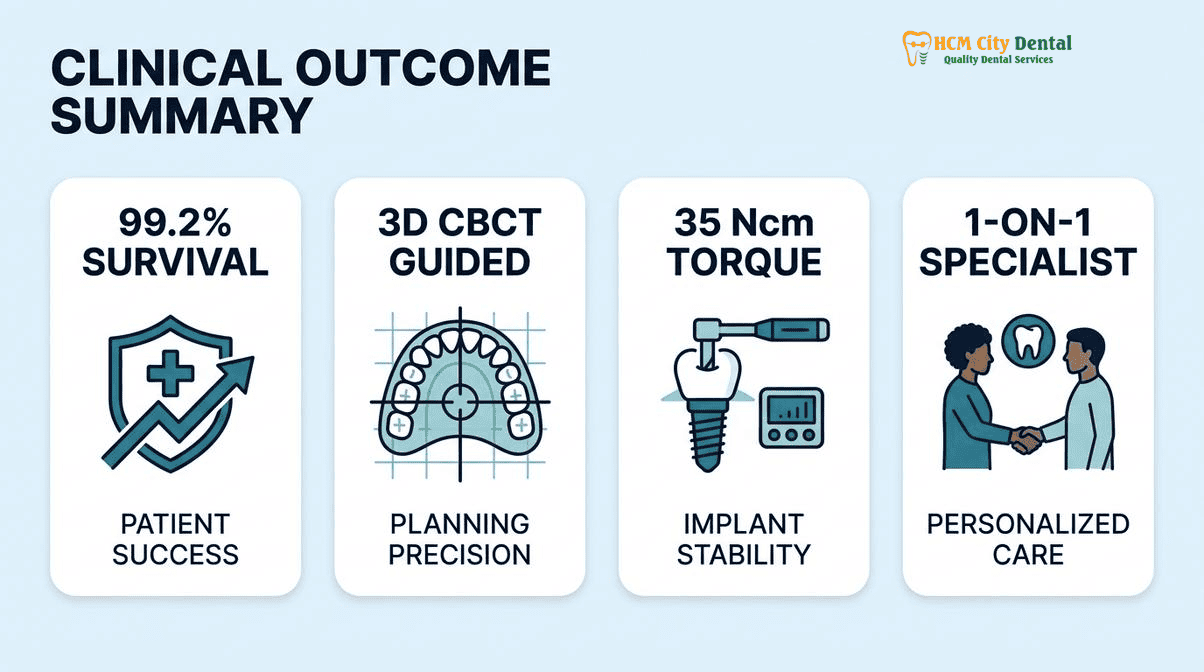
2026 Transparent All-Inclusive Implant Fee Schedule & Free Second-Opinion 3D CBCT Audit with Dr. Nguyen Van Cuong, DDS (District 1)
At HCMC Dental Clinic, we adhere strictly to the guidelines set forth by the Vietnam Ministry of Health and VOSA regarding transparent pricing and biomaterial traceability[5]. We do not use bait-and-switch tactics. Below is our official 2026 fee schedule, reflecting our -40% online booking pricing compared to walk-in rates.
| Implant & Prosthetic Procedure (2026) | Online Booking Price (USD) | Online Booking Price (VND) | Walk-In / Benchmark Price |
|---|---|---|---|
| Single Korean Implant (Dentis / Neo Biotech / Dentium fixture + abutment) | $462 – $654 USD | 12,000,000 – 17,000,000 VND | $769 – $1,090 walk-in |
| Single European / Swiss Implant (Straumann BLT-SLA / BLA-Active) | $962 – $1,346 USD | 25,000,000 – 35,000,000 VND | $1,603 – $2,244 walk-in |
| 100% Metal-Free Zirconia Ceramic Implant | $1,154 USD | 30,000,000 VND | $1,923 walk-in |
| Implant Zirconia HT Crown + Custom Abutment | $154 USD | 4,000,000 VND | $256 walk-in |
| All-on-4 Full-Arch Implants (Complete package with final Zirconia bridge) | From $6,346 USD / arch | 165,000,000 VND (Economy) | $8,846 – $10,000 (Straumann) |
| All-on-6 Full-Arch Implants (Complete package) | From $8,654 USD / arch | 225,000,000 VND (Economy) | $12,308 – $13,462 (Straumann) |
| 3D CBCT Scan (In-house Carestream) | $18 USD | 480,000 VND | $30 walk-in |
Clinical Case Study: Avoiding a $4,000 Unnecessary Graft
An Australian patient contacted HCMC Dental Clinic after receiving a quote from a high-volume chain in District 7. The chain recommended bilateral sinus lifts, block grafts, and 8 implants for the upper jaw, totaling over $18,000 USD. The patient felt uneasy and requested their DICOM files. Upon sending the files to Dr. Cuong for a free second opinion, the 3D CBCT audit revealed 7mm of vertical bone below the sinuses. Dr. Cuong designed a graftless treatment plan utilizing 6mm Straumann Roxolid short implants and a targeted All-on-6 protocol. The surgery was completed safely without any sinus lifts, saving the patient over $4,000 USD and 6 months of painful recovery time.
“True medical ethics means telling a patient when they don’t need surgery. By offering a free, remote 3D CBCT audit, we empower international patients to verify their own anatomy and protect themselves from aggressive, profit-driven treatment plans before they ever board a flight to Vietnam.”
— Dr. Nguyen Van Cuong, DDS — Clinical Director & Specialist Profile
If you have received a confusing or expensive implant quote, you do not have to accept it blindly. Getting a second opinion dental implant review with Dr. Cuong in Ho Chi Minh City is simple, secure, and completely free of charge. Request your raw DICOM files from your local dentist, upload them to a secure cloud drive, and send the link to our official WhatsApp at +84 853 020 003. Dr. Cuong will personally analyze your bone width, height, and density to provide a transparent, evidence-based treatment plan.
Frequently Asked Questions
Why should you never accept a major dental implant or bone grafting quote that was written from a flat 2D OPG X-ray without a 3D CBCT scan?
A 2D panoramic X-ray (OPG) compresses complex three-dimensional jaw anatomy into a single flat image, resulting in up to 25% magnification distortion and superimposition of structures. It cannot show the horizontal width of your bone or the exact buccal-lingual position of the inferior alveolar nerve. Accepting a surgical quote based solely on 2D imaging often leads to unexpected intraoperative discoveries, such as insufficient bone width, which then results in surprise bills for emergency bone grafting or, worse, nerve damage.
What 5 line items must be explicitly written in an all-inclusive dental implant quote so you never face surprise bills in the dental chair?
To avoid the bait-and-switch pricing model, your quote must explicitly list: 1) The titanium implant fixture (specifying the exact brand and model), 2) The healing abutment and custom titanium prosthetic abutment, 3) The temporary crown (if immediate loading is planned), 4) The 3D surgical guide and CBCT scan fees, and 5) The final Zirconia ceramic crown. If a clinic advertises a $399 implant, it almost certainly excludes the abutment and crown, which will be billed later at highly inflated rates.
How can I verify that my dentist is a licensed specialist with the Vietnam Ministry of Health (such as Dr. Nguyen Van Cuong, MOH License 0003265/BL-CCHN)?
You should always ask the clinic to provide the doctor’s official Vietnam Ministry of Health (MOH) Practice License number before booking. For example, Dr. Nguyen Van Cuong operates under MOH License 0003265/BL-CCHN. You can verify this credential against the national database or ask to see the physical certificate displayed at the clinic. Additionally, check for active memberships in recognized organizations like the Vietnam Odonto-Stomatology Association (VOSA) and the International Congress of Oral Implantologists (ICOI).
What should I do if one clinic tells me I need 4 sinus lifts and 12 implants while another recommends graftless All-on-4 or saving my natural teeth?
Conflicting treatment plans are a major red flag for potential over-treatment. If one clinic recommends aggressive extractions and extensive grafting, you must seek a second opinion from a specialist who practices biomimetic dentistry and utilizes advanced graftless protocols. By analyzing your 3D CBCT DICOM files, a conservative specialist can determine if your natural teeth can be saved through periodontal care, or if tilted All-on-4 implants and short 6mm Roxolid fixtures can safely bypass the need for invasive sinus lifts.
How can I send my existing X-rays, 3D CBCT DICOM files, and competing clinic quotes to Dr. Nguyen Van Cuong for a free, no-obligation second opinion?
You can request your raw DICOM files from your local imaging center or current dentist (you have a legal right to your medical records). Compress the files into a ZIP folder and send them via a secure file-sharing link (like Google Drive or WeTransfer) directly to HCMC Dental Clinic’s official WhatsApp at +84 853 020 003. Dr. Nguyen Van Cuong will personally review your 3D scans and competing quotes to provide a transparent, objective clinical audit and an all-inclusive 2026 fee schedule.
References
- Journal of Oral & Maxillofacial Implants. (2023). ‘Dimensional Accuracy and Diagnostic Yield of Cone-Beam Computed Tomography (CBCT) vs. 2D Panoramic Radiography in Pre-Surgical Implant Planning.’
- International Journal of Periodontics & Restorative Dentistry. (2022). ‘Quantitative Assessment of Alveolar Bone Density Using Hounsfield Units in CBCT: Implications for Primary Implant Stability.’
- Clinical Implant Dentistry and Related Research. (2023). ‘Survival Rates of Extra-Short (6mm) Dental Implants Compared to Standard Implants with Vertical Bone Grafting in the Posterior Maxilla.’
- Journal of Prosthetic Dentistry. (2024). ‘Economic Analysis of Dental Tourism: Hidden Costs, Bait-and-Switch Pricing Models, and the Importance of Component Traceability in Implantology.’
- Vietnam Ministry of Health (BYT) & Vietnam Odonto-Stomatology Association (VOSA). National Clinical Guidelines on Specialist Dental Care, Biomaterial Traceability & EN 13060 Class B Infection Control. (2024).