
Core lines
- Examination & prosthetic planning.
- Implant fixture + placement surgery.
- Healing abutment or cover screw phase.
- Final abutment + crown or bridge segment.
+84 853 020 003. Mon–Sat, 8:00 AM – 8:00 PM (GMT+7) · Sun closed. Now Sun, 6:04 AM Saigon
Dental implant cost in Vietnam

The dental implant cost in Vietnam ranges from $700 for Korean systems to $1,500 for premium Swiss brands per tooth. This represents a 60-70% saving compared to Western countries, while maintaining strict clinical standards, utilizing Grade 5 titanium, and offering comprehensive care for international patients.
Clinical Summary: Vietnam has emerged as a premier destination for restorative dentistry, offering high-quality implantology at a fraction of Western prices. The cost of dental implants in Vietnam depends on the implant system, ranging from $700 to $1,500, with potential additional fees for bone grafting or sinus lifts ($400-$800). Clinics in Ho Chi Minh City adhere to rigorous European CE and Class B autoclave sterilization standards. Patients can expect a streamlined 5-7 day surgical trip, with options for direct billing through international insurance partners like Allianz, Bupa, and Cigna.
Key Takeaways:
Online booking: up to 40% off walk-in on eligible lines — verified on pricing → Implants & Full-arch.
The total cost of an implant procedure depends on the chosen titanium fixture, abutment, and ceramic crown, with premium European systems priced higher than reliable Asian alternatives.
When evaluating the vietnam dental implants cost, patients must understand that the fee structure is generally divided into three main components: the surgical placement of the titanium fixture, the connecting abutment, and the final prosthetic crown. The global dental market offers a variety of implant systems, each backed by different levels of clinical research, material science, and proprietary surface technologies. In Vietnam, clinics provide access to the exact same top-tier brands used in the United States, Australia, and Europe, but at a significantly reduced price point due to lower operational overheads and localized laboratory fees [1].
For patients seeking cost-effective yet highly reliable solutions, South Korean brands such as Dentium and Osstem are excellent choices. These systems utilize advanced sandblasted and acid-etched (SLA) surface treatments to promote rapid osseointegration. The estimated cost for these Asian systems ranges from $700 to $950 per complete tooth. Conversely, patients with compromised bone density or those requiring specialized protocols may opt for premium European systems. Brands like Straumann and Nobel Biocare feature proprietary materials—such as Straumann’s Roxolid (a titanium-zirconium alloy) and SLActive surface—which accelerate healing and provide exceptional primary stability. These premium systems typically range from $1,100 to $1,500 per tooth.
Walk-in VND matches our catalogue. USD rounded at 26,000 VND/USD. Online column reflects −40% where applicable.
| Treatment | Brand / note | Walk-in | Online (−40%) |
|---|---|---|---|
| Economy Implant Package | Dentis (Hàn), Neo Biotech Fixture + Abutment (Crown excluded) |
20,000,000 VND $769 | 12,000,000 VND $462 −40% |
| Economy Plus Implant Package | Dentium (Hàn) Fixture + Abutment (Crown excluded) |
23,333,333 VND $897 | 14,000,000 VND $538 −40% |
| Standard Implant Package | Dentium Superline (Mỹ), IBS (Hàn) Fixture + Abutment (Crown excluded) |
28,333,333 VND $1,090 | 17,000,000 VND $654 −40% |
| Premium Implant Package | Ritter (Đức), B&B (Ý) Fixture + Abutment (Crown excluded) |
41,666,666 VND $1,603 | 25,000,000 VND $962 −40% |
| Premium Special Package | Straumann BLT-SLA (Thụy Sĩ) Fixture + Abutment (Crown excluded) |
46,666,667 VND $1,795 | 28,000,000 VND $1,077 −40% |
| High-End Implant Package | Straumann BLA-Active (Thụy Sĩ) Fixture + Abutment (Crown excluded) |
58,333,333 VND $2,244 | 35,000,000 VND $1,346 −40% |
| Crown on Implant (Per tooth) | Mão răng sứ gắn trên trụ Implant Range up to 6,000,000 VND (approx. $230) for premium ceramic |
6,666,667 VND $256 | 4,000,000 VND $154 −40% |
Augmentation items (bone graft, sinus lift) are listed separately on pricing.
Related: All-on-4 full-arch pricing →
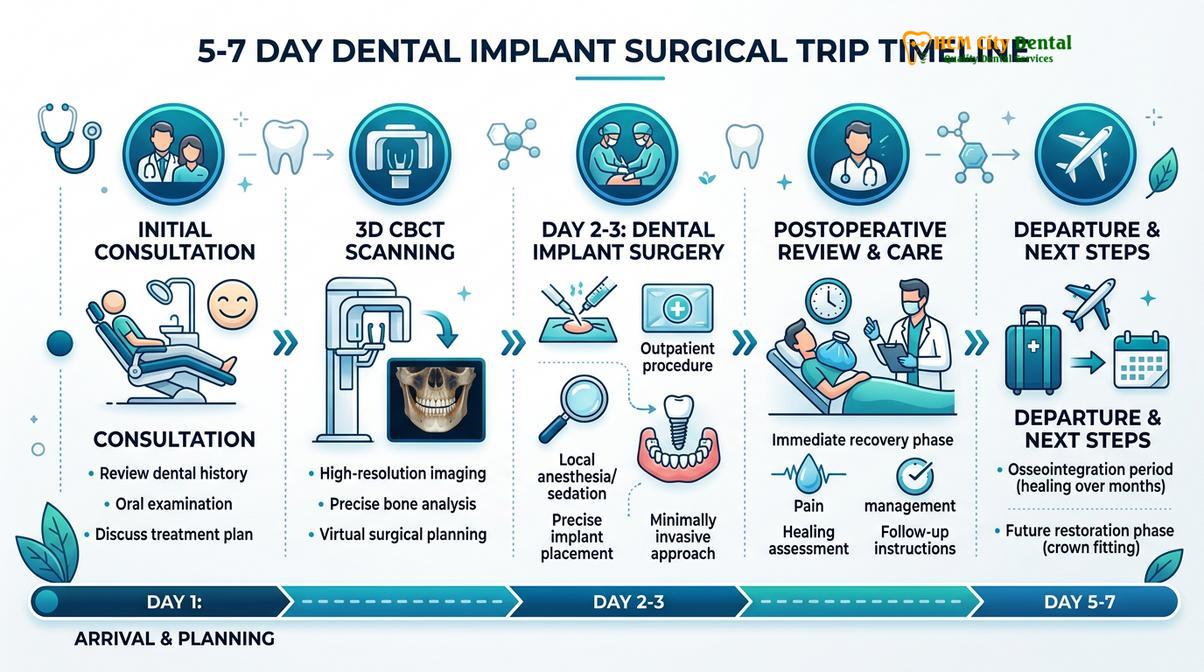
A standard surgical trip to Saigon requires 5 to 7 days for diagnostics, 3D planning, and the initial implant placement, followed by a healing period.
Understanding the clinical timeline is crucial for patients traveling abroad for medical care. The biological process of osseointegration—where the jawbone naturally fuses with the microscopic pores of the titanium implant—dictates the pace of the treatment. While the cost of dental implants in vietnam is highly appealing, patients must plan for a two-stage journey, unless they meet the strict clinical criteria for immediate loading [2].
The initial surgical trip typically spans 5 to 7 days. Upon arrival at the clinic, the patient undergoes a comprehensive diagnostic phase. This includes a 3D Cone Beam Computed Tomography (CBCT) scan to assess bone volume, density, and the proximity of vital anatomical structures such as the mandibular nerve and the maxillary sinus. Using specialized software, the oral surgeon plans the exact trajectory, depth, and diameter of the implant. The surgery itself is usually performed on the second or third day under profound local anesthesia, ensuring a virtually painless experience. The remaining days in the city are dedicated to rest and a final postoperative evaluation to monitor early soft tissue healing and remove any non-resorbable sutures.
Following the initial placement, a healing period of 3 to 6 months is generally required. During this time, the bone cells (osteoblasts) migrate onto the titanium surface, locking the implant firmly into the jaw. Once osseointegration is confirmed via radiographic imaging, the patient returns for the restorative phase, which takes approximately 5 to 7 days to fabricate and fit the final custom crown or porcelain dental bridge.
In specific clinical scenarios, patients may inquire about same day dental implants. This protocol, known as immediate loading, involves placing a temporary crown on the implant within 48 hours of surgery. However, this is only viable if the implant achieves a high insertion torque (typically >35 Ncm) and excellent primary stability. If the bone is soft or compromised, immediate loading poses a high risk of micromovement, which can lead to fibrous encapsulation and ultimate implant failure. A thorough clinical assessment is mandatory to determine candidacy for this accelerated protocol.
Guided bone regeneration and maxillary sinus elevations add 3 to 6 months of healing time and $400 to $800 to the treatment fee when bone volume is insufficient.
A critical factor that can significantly impact the overall cost and duration of dental implant therapy is the availability of healthy bone structure. When teeth have been missing for a long period, or when periodontal disease has caused bone resorption, the alveolar ridge may lack the width or height necessary to support a titanium fixture. In these scenarios, adjunctive surgical procedures such as guided bone regeneration (GBR) or sinus elevation (sinus lifts) are clinically indicated to ensure long-term implant survival [3].
Guided bone regeneration involves placing bone graft materials—which can be autogenous (from the patient), allogenic (human donor), xenogenic (bovine source), or synthetic—into the deficient site. This graft is then covered with a protective biocompatible membrane to prevent soft tissue cells from invading the space, allowing new bone cells to slowly rebuild the ridge. In the upper jaw (maxilla), the proximity of the sinus cavities often limits the height of available bone. A sinus lift involves carefully elevating the Schneiderian membrane of the sinus floor and packing bone graft material beneath it, creating a thick foundation for the implant fixture.
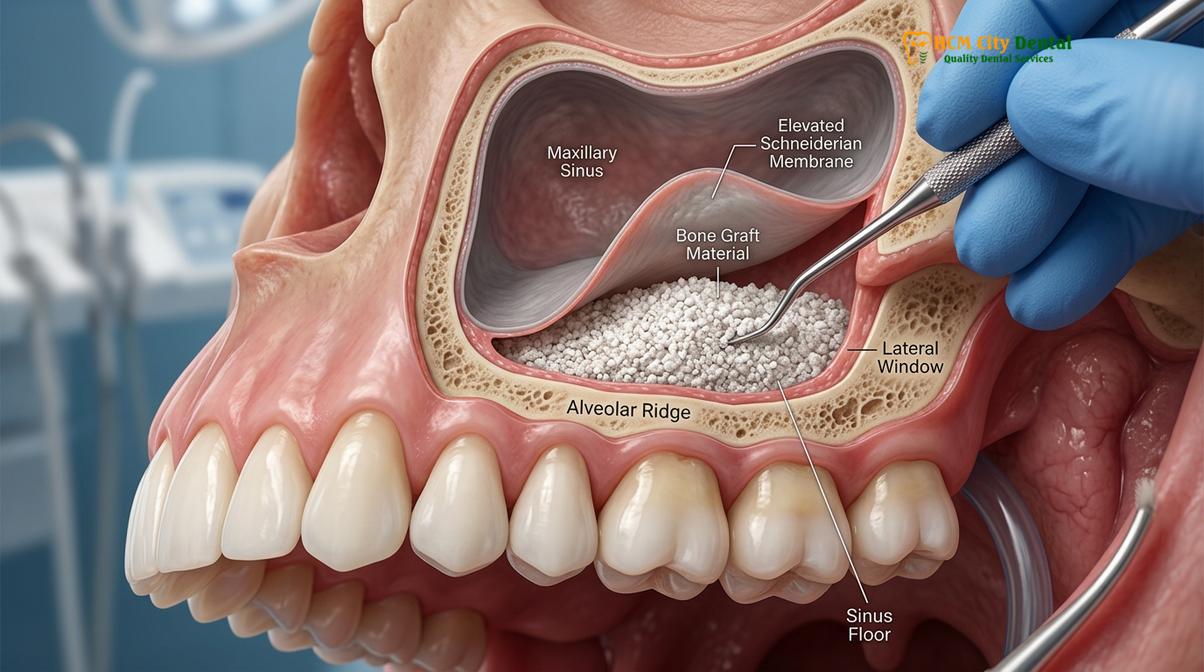
From a financial perspective, these advanced procedures represent an additional cost, typically adding $400 to $800 per surgical site, depending on the volume of graft material and the complexity of the sinus elevation (lateral window vs. osteotome approach). Clinically, they also extend the healing timeline, requiring an extra 3 to 6 months for the graft to consolidate and turn into mature bone before the implant can be loaded. Dr. Cuong emphasizes that attempting to place implants in deficient bone without augmentation to save time or cost carries a very high risk of early implant failure due to lack of structural support.
Selecting a clinic adhering to international European CE standards and Class B autoclave sterilization is essential for ensuring infection-free implant surgery.
While the financial savings of dental tourism in Vietnam are substantial, clinical safety and sanitation must never be compromised. Implant dentistry is an invasive surgical procedure that demands strict adherence to infection control protocols. When researching clinics in Ho Chi Minh City, international patients should look for facilities that transparently document their sterilization workflows and clinician credentials rather than selecting solely based on the lowest price [4].
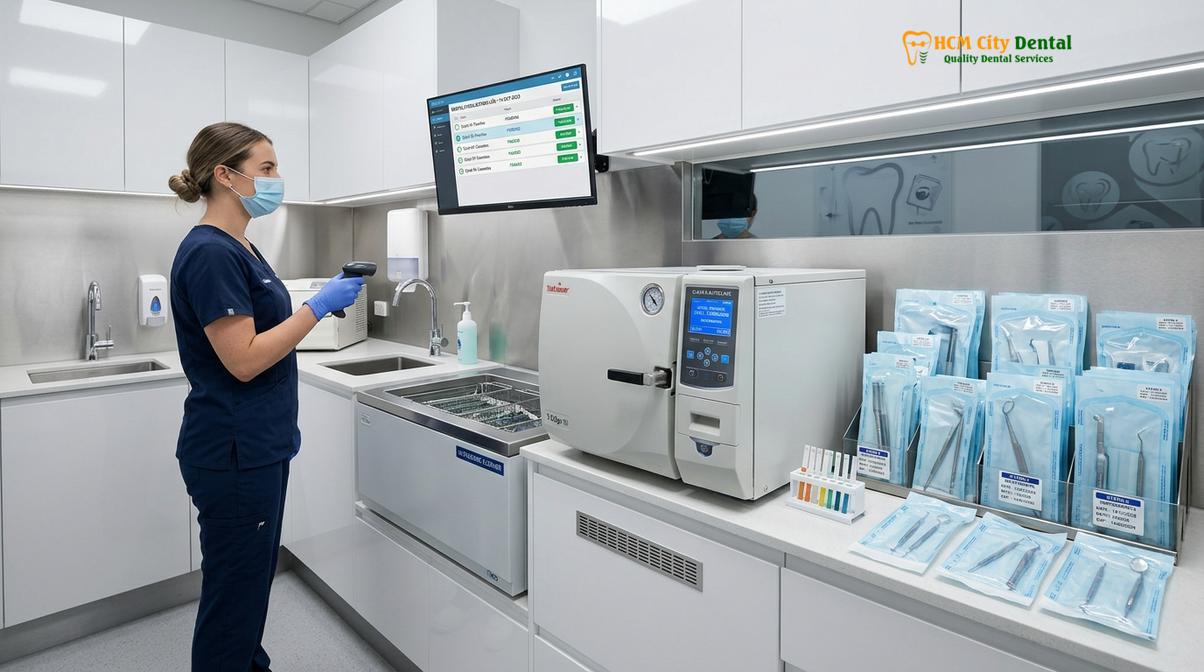
At HCMC Dental Clinic, all surgical procedures are performed in a dedicated, sterile operating suite. We strictly enforce European CE guidelines and utilize Class B autoclave vacuum sterilization for all surgical instruments, ensuring 100% destruction of microbial life, including spores. The use of premium Grade 5 titanium implant systems with CE and FDA approvals ensures excellent biocompatibility and reduces the risk of allergic or inflammatory reactions. Furthermore, patients receive an international warranty passport documenting the exact brand, size, and batch number of the placed implant, facilitating seamless follow-up care anywhere in the world.
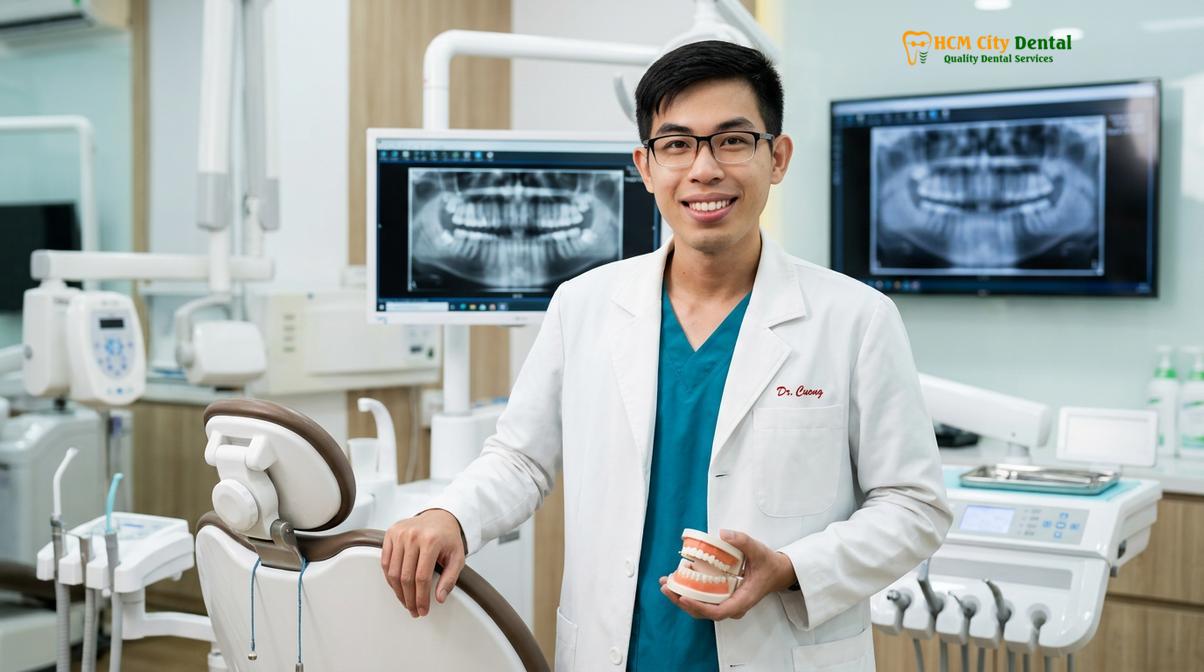
Equally important is the clinical expertise of the operator. Dr. Nguyen Van Cuong brings over 20 years of clinical experience, having placed thousands of implants ranging from single crowns to complex full-arch reconstructions. Dr. Cuong and his dental team speak fluent English, ensuring clear communication, detailed explanations of alternative options, and a supportive environment for patients who may experience dental anxiety.
Many global expat insurance providers cover dental treatments, and HCMC Dental offers cashless direct billing to simplify reimbursement.
Navigating the financial aspects of receiving dental treatment abroad requires proactive planning. While patients often pay out-of-pocket for dental tourism, expat families and long-term travelers living in Vietnam can often leverage their private international health insurance to cover a portion of their implant fees [5].
HCMC Dental Clinic has established direct billing agreements with several major global insurance networks, including Allianz, Bupa, Cigna, Liberty, and Aetna. This cashless direct billing setup means that for covered preventive or restorative procedures, the clinic coordinates directly with the insurer, allowing you to walk out without out-of-pocket payments for eligible lines. For implants and major restorative work, which often require pre-authorization, our administrative team compiles all necessary CBCT diagnostic reports, clinical charts, and detailed itemized invoices to expedite the approval process with your provider.
For patients whose plans require reimbursement rather than direct billing, we provide fully structured, English-language medical documentation, standardized dental codes, and official receipts. We also offer 0% interest monthly installment plans through major credit cards, distributing the cost of larger treatment plans over 3 to 12 months. When planning your budget, remember to ask for a comprehensive simulation that breaks down which items qualify for the 40% pre-arrival WhatsApp booking discount and which lines are subject to insurance coverage.
A full arch restoration case at our Saigon clinic demonstrates how precise 3D surgical guides deliver immediate function and aesthetics.
To illustrate the clinical application of these workflows, we present the case of a 58-year-old expat patient residing in Ho Chi Minh City who presented with severe dental attrition and multiple failing bridge segments in the upper arch. After a thorough CBCT evaluation, Dr. Cuong recommended an All-on-4 full-arch rehabilitation using premium Nobel Biocare implants, combined with an immediate temporary bridge to restore function and aesthetics within 48 hours of surgery.
The surgery was executed using a computer-guided surgical template, ensuring precise implant placement and avoiding the maxillary sinus cavities without the need for extensive bone grafting. The Nobel implants achieved excellent primary stability (insertion torque >40 Ncm), allowing the immediate attachment of the temporary acrylic bridge. After a 4-month osseointegration phase, the temporary bridge was replaced with a final, custom CAD/CAM milled monolithic zirconia bridge. The patient reported a complete restoration of masticatory force and a highly natural smile aesthetic, highlighting the efficiency and predictability of modern digital protocols.
Identifying early warning signs of severe tooth loss or failing dental bridges is crucial for preventing irreversible jawbone resorption.
Patients should consult an experienced implantologist if they experience persistent tooth pain, loose teeth, or if existing crowns and bridges feel unstable. Severe tooth loss not only compromises chewing function and speech but also triggers rapid, irreversible jawbone resorption. Early diagnostic intervention with 3D CBCT imaging can determine whether immediate implant placement is viable, preserving the natural bone ridge and avoiding the need for more complex, costly bone grafting procedures in the future.
A full mouth restoration using All-on-4 or All-on-6 techniques generally ranges from $4,500 to $10,000 per arch. The final fee depends on the chosen implant system, the need for extensive bone grafting, and the material of the final fixed prosthesis. This comprehensive approach offers a permanent, non-removable solution for complete edentulism.
Same day dental implants are generally safe when strict clinical criteria, such as high primary stability and adequate bone density, are met. However, immediate loading is not suitable for everyone and requires a comprehensive 3D CBCT evaluation prior to surgery. If bone quality is compromised, a traditional delayed loading protocol is safer to ensure successful osseointegration.
Most comprehensive quotes provided by reputable clinics include the titanium fixture, the abutment, and a standard ceramic crown. However, upgrading to premium materials like full zirconia may incur an additional fee, so patients should always request an itemized treatment plan to understand exactly what is covered in the quoted price.
A standard surgical trip requires a 5 to 7-day stay in the city. This timeframe allows for initial diagnostics, the surgical placement of the implants, and a crucial postoperative follow-up to ensure proper early healing before you fly home. A second trip is required 3 to 6 months later for the final crown placement.
Many international expat insurance policies offer partial or full coverage for restorative dentistry, depending on your specific tier. Clinics often provide direct billing services or detailed medical invoices with standardized codes to assist with your reimbursement claims. It is advisable to contact your provider for pre-authorization before commencing treatment.
Related Clinical Guides: Full Mouth Implant Cost | Diet After Implant Surgery | Dental Tourism Vietnam Guide