For decades, international patients suffering from severe bone loss in the posterior jaws faced a daunting, singular pathway to dental restoration: invasive bone grafting. In the upper jaw, this meant a lateral window sinus lift; in the lower jaw, it meant complex vertical ridge augmentation or even inferior alveolar nerve repositioning. These procedures, while effective, carry significant morbidity, extended healing times of up to 12 months, and substantially higher costs. Today, the paradigm of implantology has shifted dramatically. The clinical debate of short dental implants 6mm vs vertical bone graft sinus lift has been largely settled by advancements in titanium-zirconium alloys, macro-thread engineering, and precision 3D-guided surgery. At HCMC Dental Clinic in District 1, Ho Chi Minh City, international patients now have access to minimally invasive alternatives that deliver equivalent long-term survival rates without the need for extensive bone harvesting.
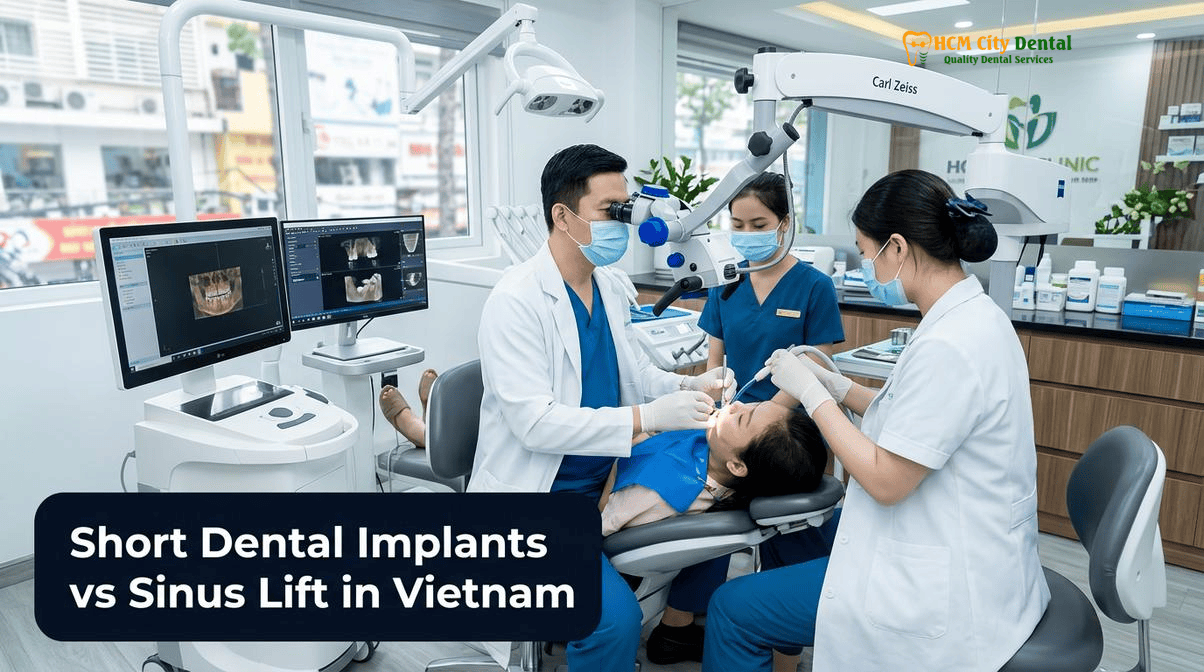
Under the clinical direction of Dr. Nguyen Van Cuong (Dr. Cuong), DDS (Vietnam MOH License 0003265/BL-CCHN), our specialist team utilizes evidence-based protocols to rehabilitate severely atrophic jaws. By leveraging ultra-short and short implants (ranging from 4mm to 8mm), we can often bypass the maxillary sinus and the mandibular nerve canal entirely. This approach not only reduces surgical trauma and post-operative swelling but also cuts the overall treatment timeline in half, making it an ideal solution for dental travelers and expats seeking world-class, efficient care in Vietnam.
Clinical Summary:
The choice between short dental implants (6mm–8mm) and traditional vertical bone grafting or sinus lift surgery depends heavily on residual bone height, bone density, and patient preference regarding surgical morbidity. Modern short implants, particularly those utilizing Straumann Roxolid (Ti-Zr) alloys and wide-diameter plateau designs, demonstrate survival rates exceeding 95%, statistically matching standard 10mm+ implants placed in grafted bone. By eliminating the need for complex sinus elevations, short implants offer a faster, safer, and more cost-effective rehabilitation pathway for patients with atrophic posterior maxillae and mandibles, provided strict biomechanical protocols—such as splinting adjacent crowns—are followed.
Key Takeaways:
- Anatomical Preservation: Short implants (≤8mm) allow for successful osseointegration in areas with only 6mm to 8mm of residual bone, avoiding the maxillary sinus and inferior alveolar nerve.
- Material Superiority: Advanced alloys like Straumann Roxolid (15% Zirconium, 85% Titanium) provide the tensile strength necessary to support heavy molar loads on a 6mm fixture.
- Biomechanical Stability: Splinting two adjacent short implants effectively neutralizes off-axis forces, overcoming traditional concerns regarding the crown-to-implant ratio.
- Reduced Timeline & Cost: Bypassing a lateral window sinus lift saves patients 4 to 8 months of healing time and thousands of dollars, requiring fewer flights to Vietnam.
- Transparent Pricing: At HCMC Dental Clinic, premium European/Swiss implants start at $962 USD online, and high-quality Korean implants start at $462 USD online, offering savings of up to 70% compared to Western clinics.
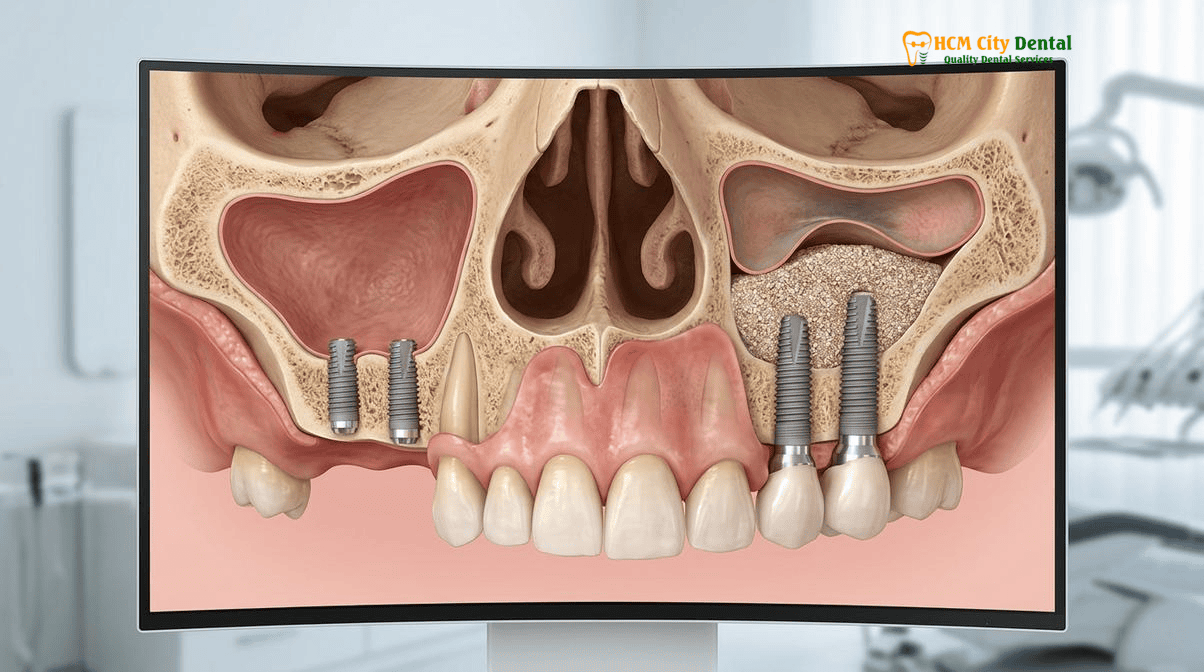
The Anatomical Dilemma of Posterior Bone Resorption: Pneumatized Maxillary Sinuses and High Mandibular Nerve Canals
The posterior regions of the human jaw present some of the most challenging anatomical landscapes for implant dentistry. When molar teeth are extracted and not immediately replaced, the alveolar bone undergoes rapid, progressive disuse atrophy. In the first year following an extraction, up to 50% of the alveolar ridge width can be lost, followed by a steady decline in vertical height. This resorption is compounded by specific anatomical structures unique to the upper and lower jaws.
In the posterior maxilla (upper jaw), the loss of tooth roots removes the structural barrier that holds the maxillary sinus floor in place. Consequently, the sinus cavity begins to expand downward—a process known as sinus pneumatization. Simultaneously, the crestal bone resorbs upward. This dual action can leave patients with a paper-thin layer of bone, sometimes measuring less than 2mm to 3mm in height, separating the oral cavity from the sinus membrane (Schneiderian membrane). Historically, placing a standard 10mm or 12mm implant in this region was impossible without first performing a sinus lift to rebuild the lost vertical dimension[1]. For patients exploring Bone Grafting, Sinus Lifts & Zygomatic Implants in Vietnam | HCMC Dental, understanding this anatomical limitation is the first step in treatment planning.
The posterior mandible (lower jaw) presents an equally perilous challenge. Running horizontally through the lower jawbone is the inferior alveolar nerve canal, which supplies sensation to the lower lip, chin, and teeth. As the posterior mandibular ridge resorbs downward following tooth loss, the distance between the crest of the bone and the roof of the nerve canal shrinks. Placing an implant that is too long risks penetrating this canal, leading to paresthesia (numbness) or dysesthesia (painful sensation) of the lower face. Traditional solutions for severe mandibular atrophy included vertical ridge augmentation using titanium mesh and autogenous bone blocks, or highly invasive nerve lateralization surgeries—both of which carry high complication rates.
Furthermore, the prosthetic rehabilitation of these severely resorbed ridges must account for Misch’s classifications of prosthetic design. Depending on the degree of bone loss, a patient may require an FP1 prosthesis (replacing only the anatomical crown), an FP2 prosthesis (replacing the crown and a portion of the root), or an FP3 prosthesis (utilizing pink gingival porcelain to replace lost soft tissue and bone). When standard implants are placed into heavily grafted bone, achieving an aesthetic FP1 or FP2 emergence profile can be highly unpredictable. Short implants, placed at the native crestal bone level, often simplify the prosthetic phase, allowing for more predictable critical and subcritical emergence contours as defined by Su and Gonzalez-Martin.
What Defines a Modern ‘Short’ (6mm–8mm) and ‘Ultra-Short’ (<6mm) Dental Implant in 2026 Implantology?
The definition of a “short” dental implant has evolved significantly over the past three decades. In the 1990s, when implants were primarily machined with smooth titanium surfaces, any fixture shorter than 10mm was considered short and was associated with higher failure rates. However, as surface topography technologies advanced—transitioning from smooth to moderately rough surfaces like SLA (Sandblasted, Large-grit, Acid-etched) and SLActive—the required length for successful osseointegration decreased dramatically.
According to the latest consensus from the International Team for Implantology (ITI) and current European guidelines, the classification of implant lengths in 2026 is strictly defined:
- Standard Implants: Greater than 8mm in length (typically 10mm, 12mm, or 14mm).
- Short Implants: Measuring exactly 6mm to 8mm in length.
- Ultra-Short Implants: Measuring less than 6mm in length (e.g., 4mm or 5mm).
The viability of these shorter fixtures is rooted in the biomechanics of load distribution. Extensive finite element analysis (FEA) and clinical studies have proven that when a dental implant is subjected to occlusal (chewing) forces, the stress is not distributed evenly along the entire length of the implant. Instead, the vast majority of the stress—up to 80%—is concentrated at the crestal bone level, specifically absorbed by the first 5 to 6 threads of the implant[2]. Therefore, the apical portion (the bottom tip) of a 12mm implant contributes very little to the actual load-bearing capacity of the fixture.
This biomechanical reality means that a 6mm implant, if properly designed and integrated, possesses nearly the same functional load-bearing capacity as a 10mm implant. The key to success lies not in the length, but in the primary stability achieved during surgery and the quality of the bone-to-implant contact (BIC). At HCMC Dental Clinic, we utilize 3D-Guided Dental Implants & Specialist Oral Surgery in Vietnam to precisely map the bone density (measured in Hounsfield Units) and plan the exact trajectory of short implants, ensuring maximum engagement with the dense cortical bone.
Material & Macro-Thread Engineering: Why Straumann Roxolid (Ti-Zr Alloy) and Wide-Diameter Plateau Designs Match 10mm+ Survival Rates
While the concept of short implants is biomechanically sound, the physical execution requires exceptional material science. A 6mm implant placed in the posterior molar region must withstand immense vertical and lateral chewing forces, often exceeding 500 Newtons. If a standard Grade 4 commercially pure titanium implant is manufactured at a 6mm length with a narrow diameter, the risk of metal fatigue and fixture fracture increases.
To overcome this, modern implantology relies on advanced metallurgy and macro-thread engineering. The gold standard in this arena is the Straumann Roxolid Ti-Zr 6mm short implant. Roxolid is a proprietary alloy consisting of 15% Zirconium and 85% Titanium. This specific combination yields a material with a tensile strength up to 50% higher than pure titanium. This extraordinary strength allows manufacturers to create short implants with wider diameters (e.g., 4.8mm or 6.0mm) without compromising the internal connection where the abutment attaches.
“When we evaluate a patient for minimally invasive dental implants seniors Vietnam, our primary goal is to avoid unnecessary surgical trauma. By utilizing a Straumann Roxolid 6mm implant, we harness the strength of a titanium-zirconium alloy that allows us to safely restore a molar without touching the sinus membrane. The SLActive surface further accelerates blood clot stabilization, ensuring rapid osseointegration even in softer Type III or Type IV bone.”
— Dr. Nguyen Van Cuong, DDS
In addition to the material alloy, the macro-geometry of the implant plays a crucial role. Short implants often feature a wider diameter to compensate for the reduced length. Increasing the diameter of an implant from 3.3mm to 4.8mm increases the total surface area available for bone integration by a much larger margin than increasing the length from 6mm to 10mm. Furthermore, specific designs, such as plateau-root forms or aggressive deep-thread profiles, are engineered to maximize initial mechanical retention (primary stability) in compromised bone[3].
For patients seeking the highest tier of clinical reliability, consulting with Dr. Nguyen Van Cuong, DDS (Clinical Director — MOH License 0003265/BL-CCHN) ensures that the selection of the implant fixture—whether it be a premium Swiss Straumann or a high-quality Korean Dentium—is perfectly matched to the patient’s specific bone density profile and occlusal demands.
Debunking the Old Crown-to-Implant Ratio Myth: Why Splinting Two Short Molar Implants Eliminates Crestal Overload
One of the most persistent historical arguments against short implants was the fear of an unfavorable crown-to-implant (C/I) ratio. In natural teeth, a healthy root is typically 1.5 to 2 times longer than the visible crown. Early implantologists assumed this same ratio must apply to dental implants. If a patient had severe bone loss, placing a 6mm implant to support a 12mm tall prosthetic crown would result in a C/I ratio of 2:1. It was theorized that this would act as a lever, magnifying lateral forces and causing the implant to tear out of the bone or the crestal bone to resorb.
However, decades of clinical data have thoroughly debunked this myth. Dental implants do not function like natural teeth; they lack a periodontal ligament (PDL) and are rigidly ankylosed to the bone. Because the stress is concentrated at the first few threads, the length of the lever arm (the crown height) has a negligible effect on the apical portion of the implant, provided the crestal bone integration is solid.
To further mitigate any risk of crestal overload—especially in patients with heavy bruxism (teeth grinding)—specialists employ a highly effective biomechanical strategy: splinting. When a patient requires the replacement of two adjacent molars using short implants, the resulting crowns are fused (splinted) together into a single unit rather than left as two separate crowns.
Splinted short implants posterior mandible nerve protocols offer immense advantages. By joining the two restorations, any off-axis lateral force applied to one tooth is immediately distributed across both implant fixtures. This cross-arch stabilization effectively neutralizes the lever effect, drastically reducing the micro-strain on the crestal bone and virtually eliminating the risk of prosthetic screw loosening[4]. To ensure absolute precision in the placement and parallelism of these splinted fixtures, our clinic utilizes 3D-Printed Surgical Guide & Flapless Computer-Guided Dental Implants in Vietnam: Precision & Cost, allowing for perfect prosthetic alignment.
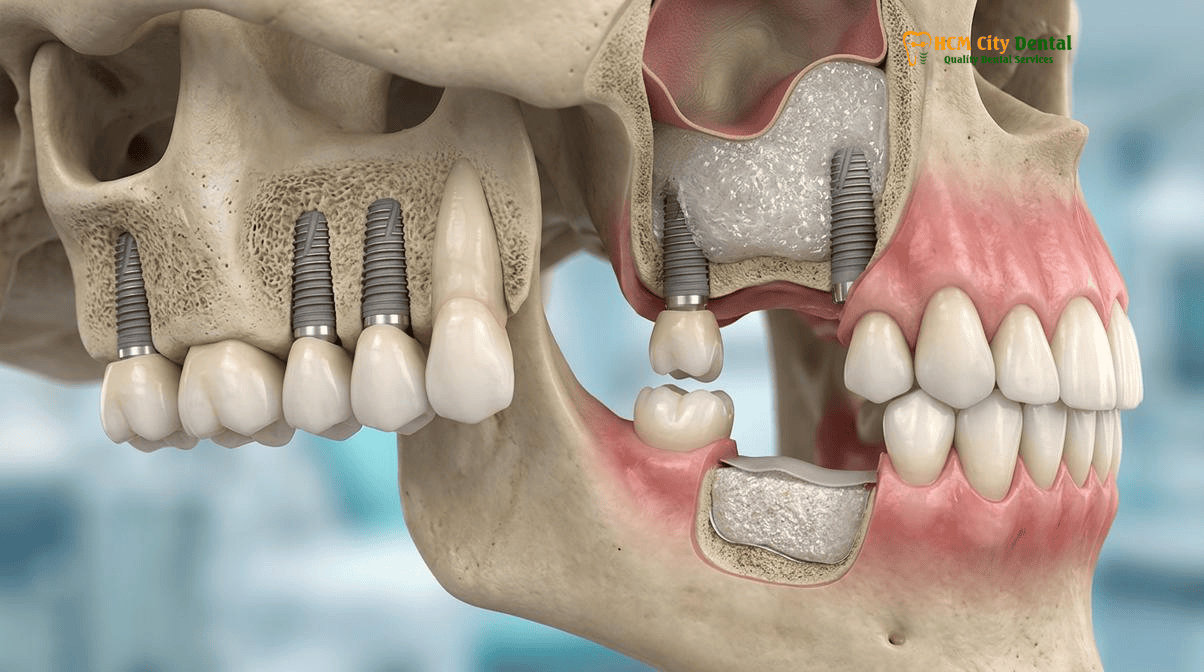
Head-to-Head Clinical Comparison: 6mm Short Implants vs. Lateral Window Sinus Lift or Vertical Ridge Augmentation (Morbidity, Time & Cost)
When a patient presents with only 5mm to 7mm of residual bone in the posterior maxilla, the clinical decision matrix directly compares the placement of short implants against a traditional lateral window sinus lift followed by standard implants. The differences in patient experience, timeline, and financial investment are profound.
The Traditional Sinus Lift & Vertical Augmentation Pathway
A lateral window sinus lift is a major pre-prosthetic surgery. The surgeon creates a bony window in the side of the upper jaw, carefully peels back the delicate Schneiderian membrane, and packs the void with a mixture of xenograft (bovine bone) and autogenous bone. If the patient requires Sticky Bone, L-PRF & A-PRF Platelet-Rich Fibrin in Dental Bone Grafting: 2026 Biological Protocol in Vietnam, blood is drawn and centrifuged to create growth-factor-rich fibrin to mix with the graft.
Morbidity: High. Patients often experience significant facial swelling, bruising, and discomfort for 7 to 14 days. There is a risk of membrane perforation (which can lead to graft infection or sinusitis).
Timeline: The graft must heal for 6 to 9 months before implants can be placed. Once placed, the implants require another 3 to 4 months to integrate. Total time: 9 to 13 months. For international patients, this means a minimum of three separate trips to Vietnam.
Cost: High. The patient pays for the sinus lift surgery, the volume of bone graft material, the barrier membranes, and eventually the standard implants and crowns.
The Short Implant Pathway
If the patient has at least 6mm of bone, a 6mm short implant can be placed directly into the native bone. In some cases, a highly conservative transcrestal sinus lift (using osteotomes to gently tap the sinus floor up by 1mm to 2mm without opening a lateral window) may be performed simultaneously with implant placement.
Morbidity: Very Low. The procedure is often flapless or minimally invasive. Post-operative swelling is minimal, and patients typically return to normal activities within 24 to 48 hours.
Timeline: The implants are placed in a single visit and require 3 to 4 months to osseointegrate. Total time: 3 to 4 months. This requires only two trips to Vietnam.
Cost: Significantly lower. The patient avoids the fees associated with major bone grafting and lateral window surgery.
Clinical Case Study: Expat Patient from Australia
A 62-year-old Australian patient presented to HCMC Dental Clinic with missing first and second lower right molars. CBCT analysis revealed severe vertical resorption, leaving only 7mm of bone above the inferior alveolar nerve. In Australia, the patient was quoted over $12,000 AUD for vertical bone block grafting, nerve lateralization, and two standard implants, with a 14-month timeline. Dr. Nguyen Van Cuong utilized dynamic 3D navigation to safely place two 6mm Straumann Roxolid implants, leaving a safe 1mm buffer above the nerve canal. The implants were splinted with a monolithic Zirconia HT bridge 3 months later. The patient experienced zero nerve complications, saved over 8 months of treatment time, and reduced their total cost by nearly 65%.
It is also critical to consider long-term maintenance. Should peri-implantitis (bone loss around the implant) occur years later, managing a failing implant in a grafted sinus is highly complex. Conversely, short implants in native bone can be managed using Lang’s CIST Protocol (Cumulative Interceptive Supportive Therapy), utilizing erythritol air-polishing, Er:YAG laser decontamination, and implantoplasty to arrest the disease progression[5]. For complex extractions preceding implant placement, we utilize Piezosurgery Ultrasonic Bone Surgery for Sinus Lifts & Impacted Wisdom Teeth in Vietnam: Safety & Cost to preserve every millimeter of precious native bone.
Clinical Precaution: When Short Implants Are Contraindicated
Short implants are not a universal solution. If the residual bone height is less than 4mm to 5mm, primary stability cannot be achieved, and a lateral sinus lift or vertical augmentation becomes mandatory. Additionally, patients with extremely poor bone density (Type IV bone) or uncontrolled systemic conditions may require standard-length implants in grafted bone to ensure long-term survival. Always consult with Dr. Nguyen Van Cuong, DDS for a comprehensive 3D CBCT evaluation to determine your exact anatomical candidacy.
“The paradigm has shifted from ‘growing bone to fit the implant’ to ‘selecting the implant to fit the native bone.’ By utilizing chairside technologies like the Smart Dentin Grinder to recycle extracted teeth into autogenous graft material, and combining it with short, wide-diameter implants, we offer our international patients a biological, minimally invasive protocol that respects their anatomy and their time.”
— Dr. Nguyen Van Cuong, DDS
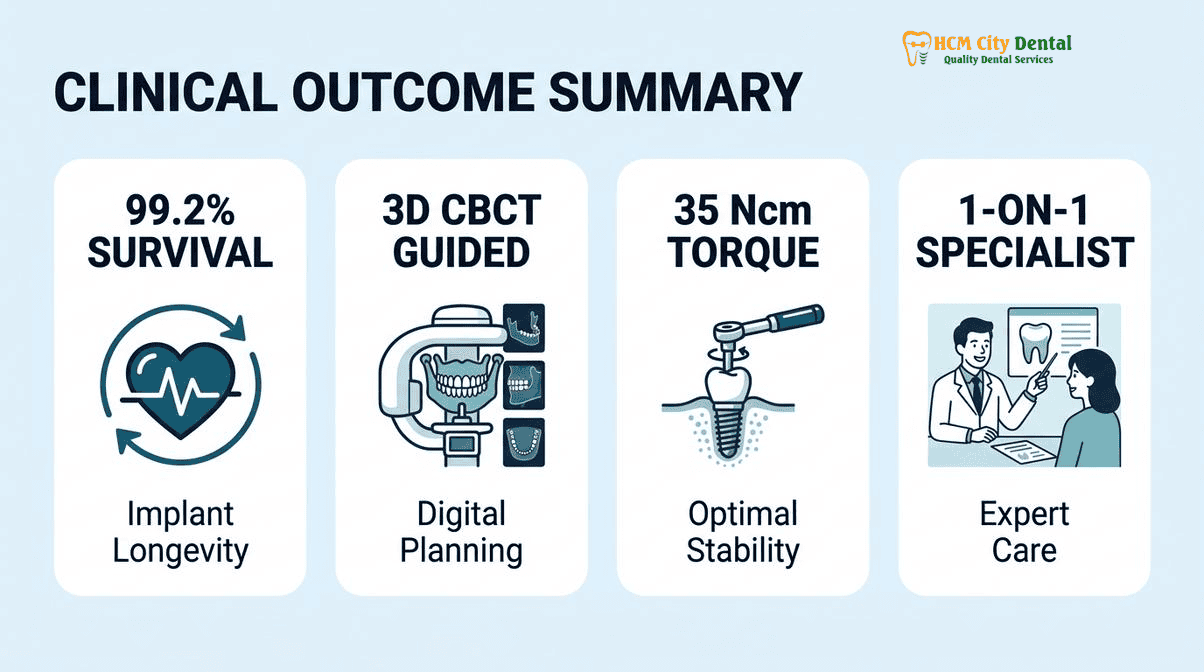
2026 Short Implant, Crestal Sinus Lift & Bone Grafting Fee Schedule at HCMC Dental Clinic (District 1)
For dental travelers, transparency in pricing is just as important as clinical excellence. At HCMC Dental Clinic, we maintain a strict, globally competitive fee schedule. By booking online, international patients secure a -40% reduction compared to walk-in rates, making world-class implantology highly accessible. Below is the exact 2026 fee schedule for single implants, related grafting procedures, and prosthetic restorations.
For a comprehensive overview of all treatments, please visit our Official 2026 Dental Price List & -40% Online Booking Fee Schedule.
| Treatment / Procedure (2026 Protocol) | Online Booking Fee (-40% USD) | Walk-In / Standard List Price (USD) |
|---|---|---|
| Single Korean Implant (Dentis / Neo Biotech / Dentium fixture + abutment) | $462 – $654 | $769 – $1,090 |
| Single European / Swiss Implant (Straumann BLT-SLA / BLA-Active / Ritter) | $962 – $1,346 | $1,603 – $2,244 |
| 100% Metal-Free Zirconia Ceramic Implant | $1,154 | $1,923 |
| Implant Zirconia HT Crown + Custom Abutment | $154 | $256 |
| All-on-4 Full-Arch Implants (Complete package with Zirconia bridge) | From $6,346 / arch | From $10,576 / arch |
| All-on-6 Full-Arch Implants (Complete package) | From $8,654 / arch | From $14,423 / arch |
| 3D CBCT Scan (Diagnostic Imaging) | $18 | $30 |
| Surgical Wisdom Tooth Extraction (Piezotome) | $58 – $115 / tooth | $96 – $191 / tooth |
Note: All fees are calculated at a fixed exchange rate of $1 USD = 26,000 VND. The online booking rates represent a 40% discount applied exclusively to patients who schedule their consultations prior to arriving in Ho Chi Minh City.
Frequently Asked Questions
Are 6mm short dental implants as strong and long-lasting as standard 10mm or 12mm implants placed into grafted bone?
Yes. Extensive clinical research and finite element analysis demonstrate that the majority of occlusal stress is absorbed by the first 5 to 6 threads of a dental implant. When utilizing advanced materials like a Straumann Roxolid Ti-Zr 6mm short implant with a wide diameter, the survival rates (often exceeding 95% over 10 years) are statistically comparable to standard 10mm implants placed in augmented bone, while significantly reducing surgical morbidity.
How much residual bone height above the mandibular nerve or below the sinus floor is required for a 6mm short implant?
To safely place a 6mm short implant, a minimum of 6mm to 7mm of residual vertical bone height is typically required. This allows the implant to be fully engaged in native bone while maintaining a critical 1mm to 2mm safety margin above the inferior alveolar nerve canal in the mandible, or just below the Schneiderian membrane in the maxilla, avoiding the need for complex vertical bone augmentation.
Why does Dr. Nguyen Van Cuong frequently splint two adjacent short molar crowns together instead of leaving them separate?
Splinting two adjacent short molar implants is a biomechanical strategy used to eliminate crestal overload and counteract the crown to implant ratio biomechanics molar challenge. By joining the crowns, off-axis lateral forces (such as those generated during heavy chewing or bruxism) are distributed evenly across both fixtures, drastically reducing the risk of screw loosening, micro-movement, and marginal bone loss.
How many months of healing time and how many flights to Vietnam do short implants save compared to a two-stage lateral sinus lift?
Opting for short implants can save patients 4 to 8 months of healing time. A traditional lateral window sinus lift often requires a 6-month graft consolidation period before implants can even be placed, followed by another 3 to 4 months of osseointegration, necessitating at least three trips to Vietnam. Short implants are typically placed in a single surgical visit and restored 3 to 4 months later, requiring only two trips.
How much do Straumann Roxolid and Korean short dental implants cost at HCMC Dental Clinic in District 1?
Under our 2026 online booking fee schedule, a premium European/Swiss implant (such as Straumann BLT-SLA or BLA-Active) costs $962 – $1,346 USD online. A high-quality Korean implant (Dentis, Neo Biotech, Dentium) costs $462 – $654 USD online. The final Zirconia HT Crown with a custom abutment is an additional $154 USD online. This transparent pricing structure saves international patients up to 70% compared to US or Australian dental fees.
References
- International Journal of Oral & Maxillofacial Implants. Long-Term Comparative Outcomes of Short Implants Versus Maxillary Sinus Elevation in Posterior Maxilla Rehabilitation. (2024).
- Journal of Clinical Periodontology. Short versus standard implants at sinus augmented sites: a systematic review and meta-analysis. (2023).
- Clinical Oral Implants Research. Influence of implant length, diameter, and geometry on stress distribution: a finite element analysis. (2021).
- Journal of Prosthetic Dentistry. Biomechanical evaluation of splinted short implants in the posterior mandible: A 5-year retrospective study. (2022).
- Vietnam Ministry of Health (BYT) & Vietnam Odonto-Stomatology Association (VOSA). National Clinical Guidelines on Specialist Dental Care, Biomaterial Traceability & EN 13060 Class B Infection Control. (2024).