For edentulous patients seeking full-arch rehabilitation, navigating the complex biomechanics of implant-supported prosthetics can be overwhelming. When evaluating a milled titanium bar overdenture vs locator attachments all on 4, patients are essentially choosing between three distinct philosophies of biomechanical support, retention, and daily maintenance. While a fixed All-on-4 zirconia bridge represents the gold standard for permanent, non-removable teeth, advanced removable options—specifically the CAD/CAM milled titanium bar (RP4) and the Zest Locator snap-in system (RP5)—offer profound clinical advantages for patients with severe maxillary bone loss, compromised facial lip support, or limited manual dexterity. At HCMC Dental Clinic in District 1, Ho Chi Minh City, our specialist prosthodontic team utilizes 3D dynamic optical navigation, digital photogrammetry, and precision CAD/CAM milling to engineer full-arch restorations that deliver uncompromising bite force, aesthetic excellence, and long-term peri-implant health.
Clinical Summary:
The decision between a milled titanium bar overdenture, a Locator snap-in denture, and a fixed All-on-4 bridge hinges on Misch’s prosthetic classifications. A fixed All-on-4 (FP3) provides permanent, non-removable teeth but requires meticulous under-bridge hygiene and sufficient bone volume. A CAD/CAM milled titanium bar overdenture (RP4) is 100% implant-borne, offering the rock-solid stability of fixed teeth with the hygienic accessibility and facial lip support of a removable prosthesis (including a palate-free upper arch). A Zest Locator overdenture (RP5) is a highly economical, tissue-and-implant-supported option that utilizes 2 to 4 implants to snap the denture securely into place, though it allows for slight posterior tissue compression during heavy chewing. Under the clinical direction of Dr. Nguyen Van Cuong, DDS, HCMC Dental Clinic provides world-class, evidence-based execution of all three modalities at a fraction of Western costs.
Key Takeaways:
- Biomechanical Support: A milled titanium bar overdenture (RP4) is 100% rigid and implant-borne, eliminating posterior rocking, whereas a Locator overdenture (RP5) relies partially on the gums for support.
- Palatal Comfort: A 4 implant bar overdenture palate free upper arch completely uncovers the roof of the mouth, restoring natural taste and temperature sensation.
- Facial Aesthetics: For patients with severe maxillary atrophy, a removable overdenture with an acrylic flange provides superior upper lip support compared to a fixed All-on-4 bridge.
- Maintenance: Routine Zest Locator nylon insert replacement in Vietnam is an affordable, fast chairside procedure required every 6–12 months to maintain optimal retention.
- Cost Efficiency: At HCMC Dental Clinic, a 2-Implant Locator Overdenture is $1,846 USD, while a complete Fixed All-on-4 package starts from $6,346 USD per arch, representing a -40% savings via our 2026 online booking fee schedule.
Fixed (FP3) vs. Removable (RP4 / RP5) Full-Arch Implant Restorations: Understanding Your 3 Core Options
To make an informed decision regarding full-arch dental implants, patients must first understand the foundational biomechanical classifications established by Dr. Carl Misch. These classifications dictate how the prosthetic teeth are supported, how they interface with the underlying bone and soft tissue, and how occlusal (biting) forces are distributed across the dental implants[1]. When comparing a snap in implant overdenture vs fixed all on 4, we are evaluating three primary categories: FP3, RP4, and RP5.
FP3 (Fixed Prosthesis 3): The Fixed All-on-4 / All-on-6 Bridge
An FP3 restoration is a completely fixed, non-removable hybrid bridge. It replaces not only the missing clinical crowns of the teeth but also a portion of the missing gingival (gum) tissue using pink porcelain or composite. To achieve a highly aesthetic result and hide the transition line between the artificial gums and the patient’s natural gums, the intaglio (tissue-facing) surface of the bridge must be placed at least 3mm apical to the high lip line via surgical alveoloplasty (bone reduction). The patient cannot remove this bridge; it is permanently screwed into the implants using Multi-Unit Abutments (MUAs). For more details on this permanent solution, explore our guide to 3D-Guided All-on-4 & All-on-6 Full-Arch Dental Implants in Vietnam.
RP4 (Removable Prosthesis 4): The CAD/CAM Milled Titanium Bar Overdenture
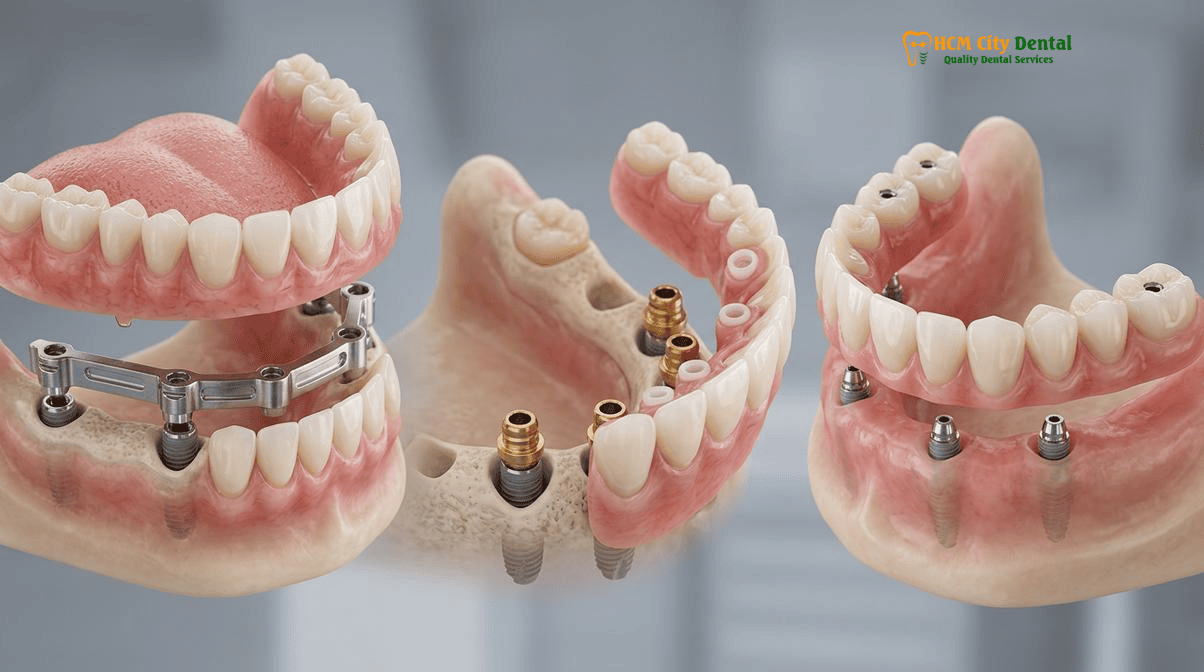
An RP4 restoration is a removable overdenture that is 100% implant-borne. The dental implants are splinted together by a rigid, custom-milled titanium bar. The overdenture contains clips or attachments that snap onto this bar. Because the bar is entirely supported by the implants, the overdenture does not rest on the patient’s gums. This eliminates all tissue compression, sore spots, and posterior rocking, providing a bite force nearly identical to an FP3 fixed bridge, but with the advantage of being removable by the patient for easy cleaning.
RP5 (Removable Prosthesis 5): The Locator Snap-In Overdenture
An RP5 restoration is a removable overdenture that is implant-retained but tissue-supported. It typically utilizes 2 to 4 unsplinted implants equipped with Zest Locator abutments. The overdenture snaps onto these abutments, providing excellent retention (preventing the denture from falling out or floating). However, because the implants are not splinted by a rigid bar, the posterior (back) portion of the denture still rests on the patient’s gums. When the patient bites down hard, the gums absorb a portion of the force, allowing for slight vertical movement.
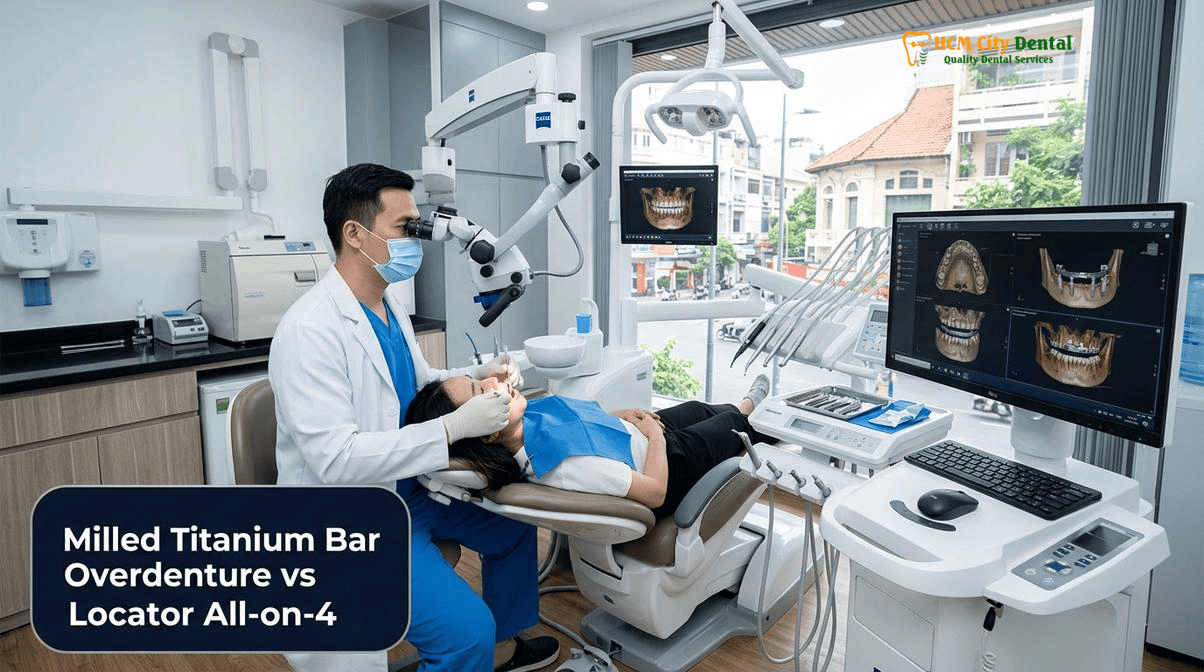
2-to-4 Implant Zest Locator Overdentures (RP5 Soft-Tissue + Implant Support): Economy, Retention & Nylon Insert Maintenance
For patients transitioning from traditional, loose-fitting dentures, the Zest Locator overdenture represents a life-changing upgrade at a highly accessible price point. By strategically placing two to four implants in the anterior mandible (lower jaw) or maxilla (upper jaw), the prosthesis is transformed from a floating piece of acrylic into a securely anchored snap-in denture.
The Biomechanics of RP5 Support
In an RP5 configuration, the implants serve primarily as retentive anchors rather than load-bearing pillars. The Zest Locator system utilizes a low-profile titanium abutment attached to the implant, and a corresponding metal housing embedded in the intaglio surface of the denture. Inside this metal housing sits a colored nylon retention insert. When the patient seats the denture, the nylon insert snaps over the Locator abutment, locking the prosthesis in place.
Because the posterior segments of the denture remain tissue-supported, the prosthesis acts as a Class I lever during mastication. The Locator attachments act as the fulcrum, and the posterior gums absorb the compressive load. While this drastically improves chewing efficiency compared to traditional dentures, patients may still experience slight mucosal compression when eating tough foods like steak or raw vegetables.
Zest Locator Nylon Insert Replacement in Vietnam
The nylon inserts inside the Locator housings are designed to wear out over time to protect the titanium implants from excessive stress. These inserts come in various retention strengths, color-coded for easy identification (e.g., blue for 1.5 lbs of retention, pink for 3.0 lbs, clear for 5.0 lbs). Depending on the patient’s bite force, insertion/removal habits, and bruxism tendencies, these inserts typically lose their “snap” every 6 to 12 months.
“Locator overdentures are a brilliant, cost-effective solution for edentulous patients, particularly in the lower jaw. However, patients must understand that the nylon inserts are consumable parts. Routine Zest Locator nylon insert replacement in Vietnam is a simple, 15-minute chairside procedure that instantly rejuvenates the retention of the prosthesis, ensuring long-term comfort and implant safety.”
— Dr. Nguyen Van Cuong (Dr. Cuong), DDS
At HCMC Dental Clinic, we utilize genuine Zest Dental Solutions components to ensure optimal performance and longevity. Patients traveling to Ho Chi Minh City for dental tourism often schedule a brief maintenance visit to have their inserts replaced and their prosthesis professionally ultrasonically cleaned.
CAD/CAM Milled Titanium Bar Overdentures (RP4 100% Rigid Implant-Borne Support): Palate-Free Comfort and Zero Posterior Rocking
When evaluating a milled titanium bar overdenture vs locator attachments all on 4, the milled bar represents a quantum leap in biomechanical stability. By splinting four or more implants together with a rigid titanium framework, the prosthesis is elevated from an RP5 (tissue-supported) to an RP4 (100% implant-borne) classification[2].
The Engineering of the CAD/CAM Milled Bar
Historically, implant bars were cast from gold or base metal alloys, a process prone to shrinkage, porosity, and microscopic inaccuracies that could introduce strain onto the implants. Today, at HCMC Dental Clinic, we utilize advanced digital workflows. Following implant placement, we capture the exact 3D position of the implants using digital photogrammetry. This data is imported into CAD (Computer-Aided Design) software, where a custom bar is engineered to follow the exact contours of the patient’s alveolar ridge.
The bar is then subtractively milled from a solid puck of Grade 5 Titanium (Ti-6Al-4V) using a 5-axis CNC milling machine. This process achieves a passive fit with tolerances of less than 10 microns. For an in-depth look at the biocompatibility and strength of these materials, review our Titanium Grade 4 vs Grade 5 Dental Implants: 2026 Study. The resulting bar is incredibly lightweight, exceptionally strong, and completely passive, ensuring zero stress is transferred to the integrating bone.
The 4 Implant Bar Overdenture Palate Free Upper Arch
One of the most significant complaints patients have regarding traditional upper dentures is the thick acrylic plate that covers the hard palate. This palatal coverage is necessary in traditional dentures to create a suction seal. However, it severely blunts the patient’s ability to taste food, perceive temperature, and articulate certain phonetic sounds.
Because a CAD/CAM milled titanium bar provides absolute, rigid retention and support, the need for palatal suction is entirely eliminated. A 4 implant bar overdenture palate free upper arch is designed in a horseshoe shape, completely uncovering the roof of the mouth. Patients report a dramatic improvement in their quality of life, as they can once again enjoy the full sensory experience of eating and speaking naturally.
Zero Posterior Rocking
Unlike the RP5 Locator system, the RP4 milled bar overdenture does not touch the posterior gum tissue. The overdenture rests entirely on the titanium bar, utilizing precision attachments (such as Hader clips, Dolder bars, or integrated Locators tapped directly into the milled bar). When the patient bites down with maximum force, the load is distributed evenly across the rigid bar and directed axially down the implants. There is zero tissue compression, zero sore spots, and zero posterior rocking, providing a masticatory experience that rivals a fixed All-on-4 bridge.
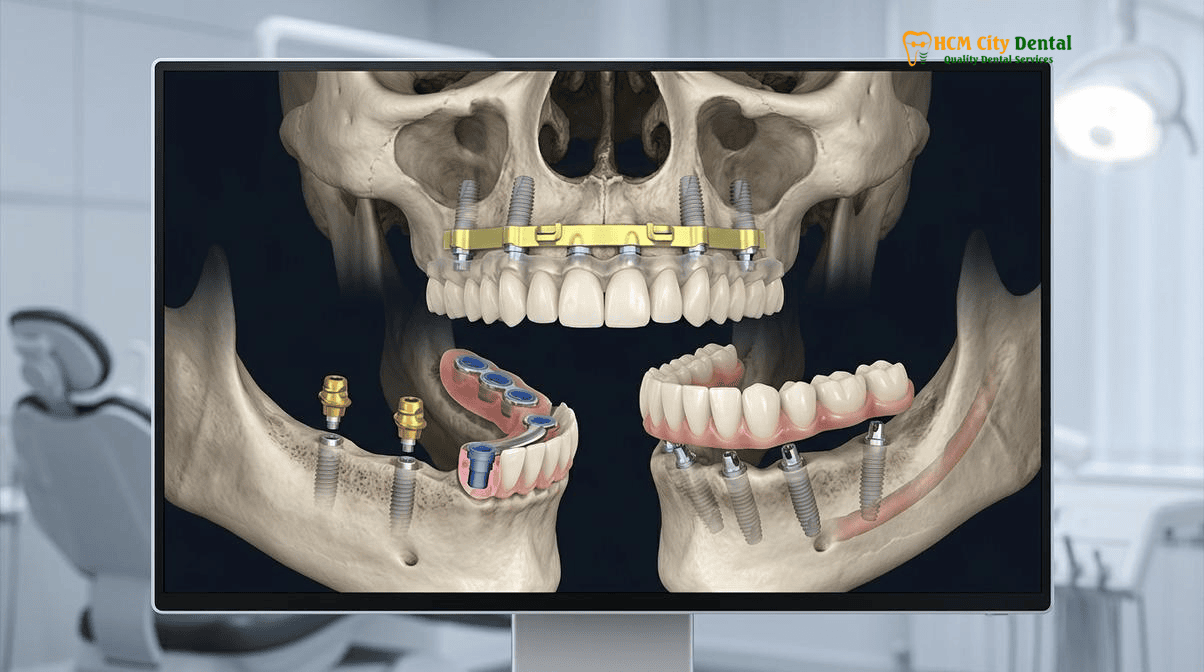
When a Removable Milled Bar Overdenture Is Clinically Superior to a Fixed All-on-4 Bridge (Severe Maxillary Atrophy & Facial Lip Support)
A common misconception among patients is that a fixed All-on-4 bridge is universally superior to a removable overdenture. In reality, the choice between a snap in implant overdenture vs fixed all on 4 is dictated by the patient’s unique anatomical presentation, specifically the degree of maxillary bone resorption and the requirement for facial lip support[3].
The Challenge of Severe Maxillary Atrophy
When a patient loses their upper teeth, the maxillary bone undergoes rapid and progressive resorption, shrinking upward and inward toward the nasal cavity. This loss of bone volume not only makes implant placement challenging but also removes the hard tissue foundation that supports the upper lip and the base of the nose. Without this support, the upper lip collapses inward, the nasolabial folds deepen, and the patient takes on a prematurely aged, “sunken” facial appearance.
If a fixed All-on-4 bridge (FP3) is placed in a patient with severe maxillary atrophy, the prosthetic teeth must be designed to replace both the missing teeth and the massive volume of missing bone. To provide adequate lip support, the fixed bridge would need a massive, bulky flange of pink porcelain extending high up under the lip. This creates a severe hygiene trap. The patient would find it nearly impossible to clean beneath this massive fixed flange, leading to food impaction, halitosis, and inevitable peri-implantitis.
The RP4 Solution: Aesthetic Flanges and Hygiene Access
In cases of severe atrophy, a removable CAD/CAM milled titanium bar overdenture (RP4) is clinically superior. The overdenture can be designed with a full acrylic labial flange that physically pushes the upper lip outward, restoring youthful facial contours, smoothing wrinkles, and providing ideal aesthetics. Because the prosthesis is removable, the patient simply takes it out at night to effortlessly clean the titanium bar and the implants. They achieve the facial support of a traditional denture with the rock-solid bite force of a fixed bridge.
Clinical Case Study: Restoring Facial Harmony in District 1
Patient Profile: A 68-year-old Australian expat presented to HCMC Dental Clinic with a severely resorbed maxilla after wearing a traditional upper denture for 15 years. He requested a fixed All-on-4 bridge but suffered from profound upper lip collapse.
Clinical Assessment: Dr. Nguyen Van Cuong, DDS, utilized 3D CBCT imaging to evaluate the bone volume. An FP3 fixed bridge would have required a massive, unhygienic anterior cantilever to support his lip. Furthermore, the posterior maxilla lacked sufficient bone for standard implants.
Surgical & Prosthetic Execution: Dr. Cuong placed 4 anterior Straumann Roxolid implants and 2 bicortical Pterygoid implants engaging the dense pterygoid plate (>45 Ncm immediate load without sinus lift). A CAD/CAM milled titanium bar was fabricated, supporting a palate-free RP4 overdenture with a custom labial flange.
Outcome: The patient achieved 100% rigid, implant-borne bite force, complete restoration of his upper lip profile, and effortless daily hygiene access. To learn more about our lead specialist’s expertise, visit Dr. Nguyen Van Cuong, DDS (Clinical Director — MOH License 0003265/BL-CCHN).
Bite Force Efficiency, Palatal Taste Restoration, and Daily Cleaning Accessibility for Senior Patients
The long-term success of any full-arch implant rehabilitation depends not only on surgical precision but also on the patient’s ability to maintain pristine peri-implant hygiene. When comparing RP4 vs RP5 implant overdenture support against fixed FP3 bridges, hygiene accessibility is a critical differentiating factor, particularly for senior patients with compromised manual dexterity or arthritis.
Bite Force and Masticatory Efficiency
A patient with natural, healthy teeth can generate a maximum bite force of approximately 500 to 700 Newtons (N). A patient wearing traditional, tissue-supported dentures typically generates only 50 to 100 N, severely limiting their diet to soft, processed foods.
An RP5 Locator overdenture significantly improves this, allowing for bite forces in the range of 200 to 300 N. However, an RP4 milled titanium bar overdenture or an FP3 fixed All-on-4 bridge restores bite force to near-natural levels (400 to 600 N). This allows patients to confidently consume a nutrient-dense diet of crisp vegetables, nuts, and meats, which is vital for systemic health and longevity.
Lang’s CIST Protocol and Peri-Implantitis Prevention
Dental implants are impervious to tooth decay, but they are highly susceptible to peri-implantitis—an inflammatory condition caused by bacterial plaque that destroys the surrounding bone[4]. Fixed All-on-4 bridges require meticulous daily maintenance using water flossers, super floss, and interdental brushes to clean the 2-3mm gap between the bridge and the gums. If a patient lacks the dexterity or motivation to perform this daily regimen, a fixed bridge is contraindicated.
A removable overdenture (whether RP4 or RP5) eliminates this hygiene barrier. The patient simply removes the prosthesis, allowing direct, unobstructed access to the implants or the titanium bar. They can brush the abutments just like natural teeth. At HCMC Dental Clinic, we strictly adhere to Lang’s CIST Protocol (Cumulative Interceptive Supportive Therapy) for peri-implant maintenance, utilizing Swiss EMS AirFlow erythritol air-polishing and PEEK ultrasonic tips to safely decontaminate implant surfaces without scratching the titanium.
Clinical Precaution: The Importance of Routine Maintenance
Regardless of whether you choose a Locator overdenture, a Milled Bar, or a Fixed All-on-4, professional maintenance is mandatory. Plaque biofilm can mineralize into calculus on titanium abutments just as it does on natural teeth. We recommend professional ultrasonic scaling and AirFlow therapy every 6 months. If you notice bleeding, swelling, or suppuration around your implants, contact Dr. Nguyen Van Cuong immediately. Early intervention using diode laser decontamination and L-PRF Sticky Bone grafting can arrest peri-implant mucositis before it progresses to irreversible bone loss. Learn more about our advanced biological protocols at Sticky Bone, L-PRF & A-PRF Platelet-Rich Fibrin in Dental Bone Grafting: 2026 Biological Protocol in Vietnam.
2026 Locator Overdenture, Milled Titanium Bar & Fixed All-on-4 Fee Schedule at HCMC Dental Clinic (District 1)
For international patients, expats, and dental travelers, the implant supported overdenture cost Ho Chi Minh City represents a profound value proposition. By leveraging Vietnam’s lower operational overhead while maintaining strict adherence to international biomaterial standards and EN 13060 Class B infection control[5], HCMC Dental Clinic delivers world-class prosthodontic rehabilitation at a fraction of the cost of clinics in Australia, the US, or the UK.
Below is our official 2026 fee schedule, reflecting our transparent -40% online booking pricing model. All procedures are performed by Dr. Nguyen Van Cuong, DDS, utilizing genuine, globally traceable biomaterials (Straumann, Dentium, Zest Dental Solutions).
| Treatment Modality | 2026 Online Booking Price (USD) | Walk-In / Standard Price (USD) | Estimated Cost in Australia / US (USD) |
|---|---|---|---|
| 2-Implant Locator Snap-On Overdenture (RP5) Includes 2 implants, Locator abutments, and reinforced acrylic overdenture | $1,846 USD (48,000,000 VND) | $3,076 USD | $6,000 – $9,000 USD |
| CAD/CAM Milled Titanium Bar Overdenture (RP4) Includes 4 implants, custom milled bar, and premium palate-free overdenture | $3,500 – $4,500 USD (Varies by implant brand) | $5,800 – $7,500 USD | $12,000 – $18,000 USD |
| Fixed All-on-4 Full-Arch Implants (FP3) Complete package with temporary & final Zirconia bridge (Economy) | From $6,346 USD / arch (165,000,000 VND) | $10,576 USD | $20,000 – $30,000 USD |
| Single Korean Implant Dentis / Neo Biotech / Dentium fixture + abutment | $462 – $654 USD (12,000,000 – 17,000,000 VND) | $769 – $1,090 USD | $3,000 – $4,500 USD |
| Single European / Swiss Implant Straumann BLT-SLA / BLA-Active | $962 – $1,346 USD (25,000,000 – 35,000,000 VND) | $1,603 – $2,244 USD | $4,500 – $6,000 USD |
“Transparency in pricing is a cornerstone of ethical medical tourism. We provide our international patients with exact, itemized treatment plans before they ever board a flight. Whether a patient requires a simple 2-implant Locator overdenture or a complex CAD/CAM milled titanium bar with Pterygoid implants, they receive uncompromising clinical excellence at our guaranteed online booking rates.”
— Dr. Nguyen Van Cuong (Dr. Cuong), DDS
To view our complete, comprehensive list of services—including microscopic endodontics, Invisalign, and porcelain veneers—please visit our Official 2026 Dental Price List & -40% Online Booking Fee Schedule.
Frequently Asked Questions
Does an upper 4-implant milled titanium bar overdenture cover the roof of my mouth (palate) like a traditional denture?
No. A properly designed 4 implant bar overdenture palate free upper arch completely uncovers the roof of your mouth. Because the rigid CAD/CAM milled titanium bar provides 100% of the necessary support and retention (RP4 classification), there is no need for palatal acrylic to create suction. This restores your ability to taste food fully, perceive temperature accurately, and speak without the bulky feeling of a traditional denture.
Why does a CAD/CAM milled titanium bar overdenture feel as solid as fixed teeth while a 2-implant Locator denture can still rock slightly?
The difference lies in the biomechanical support classification. A milled titanium bar overdenture is an RP4 prosthesis, meaning it is 100% implant-borne. The denture rests entirely on the rigid titanium bar, preventing any tissue compression or posterior rocking. In contrast, a 2-implant Locator overdenture is an RP5 prosthesis, which is both implant-retained and tissue-supported. While the Locators hold the front of the denture securely, the back of the denture still rests on your gums, allowing for slight vertical movement (rocking) when chewing heavy foods.
How often do the colored nylon retention inserts inside Locator or bar overdentures need to be snapped out and replaced?
For patients utilizing Zest Locator systems, the nylon retention inserts (which come in varying retention strengths such as blue, pink, and clear) typically require replacement every 6 to 12 months, depending on your bite force and how frequently you remove the prosthesis. Routine Zest Locator nylon insert replacement in Vietnam is a fast, inexpensive chairside procedure at HCMC Dental Clinic that instantly restores the tight ‘snap’ of your overdenture.
Why might Dr. Nguyen Van Cuong recommend a removable milled bar overdenture for patients with extreme upper lip collapse or limited manual dexterity?
When a patient has suffered severe maxillary bone resorption, they lose the foundational support for their upper lip, leading to a sunken facial appearance. A removable milled bar overdenture includes an acrylic labial flange that physically pushes the lip outward, restoring youthful facial aesthetics—something a fixed All-on-4 bridge (FP3) often cannot achieve without looking unnaturally bulky. Additionally, because the overdenture is removable, patients with arthritis or limited dexterity can easily take it out to clean the implants and the bar, preventing peri-implantitis.
What is the 2026 price difference between a Locator overdenture, a Milled Bar overdenture, and a Fixed All-on-4 bridge in District 1?
At HCMC Dental Clinic in District 1, Ho Chi Minh City, our transparent 2026 online booking fee schedule offers significant savings. A 2-Implant Locator Snap-On Overdenture costs $1,846 USD. A premium CAD/CAM Milled Titanium Bar Overdenture typically ranges between $3,500 and $4,500 USD depending on the implant brand and bar complexity. A Fixed All-on-4 Full-Arch Implant package (including temporary and final Zirconia bridge) starts from $6,346 USD per arch. These rates represent a -40% savings compared to walk-in prices or standard fees in Australia and the US.
References
- Misch, C. E. (2014). Prosthetic Options in Implant Dentistry: The FP1, FP2, FP3, RP4, and RP5 Classifications. International Journal of Oral & Maxillofacial Implants.
- Hassan, A., et al. (2022). Axial and Non-axial Retention Forces of Milled Titanium Bar vs. Locator Attachments in Implant Overdentures. Journal of Prosthetic Dentistry.
- Goodacre, C. J., & Bernal, G. (2019). Maxillary Atrophy and Facial Lip Support: Indications for Removable Implant Overdentures vs. Fixed Prostheses. Journal of Prosthodontics.
- Lang, N. P., & Berglundh, T. (2011). Peri-implant Diseases: Where Are We Now? The CIST Protocol for Peri-Implantitis Management. Journal of Clinical Periodontology.
- Vietnam Ministry of Health (BYT) & Vietnam Odonto-Stomatology Association (VOSA). National Clinical Guidelines on Specialist Dental Care, Biomaterial Traceability & EN 13060 Class B Infection Control. (2024).