The paradigm of oral implantology has fundamentally shifted from freehand, visually estimated surgical placement to highly precise, prosthetically driven Computer-Assisted Implant Surgery (CAIS). For international patients, expatriates, and dental travelers seeking world-class restorative care in Vietnam, understanding the technological nuances between dynamic navigation x-guide vs static 3D surgical guide implants is critical for ensuring optimal biomechanical outcomes, minimizing surgical morbidity, and achieving long-term aesthetic success. At HCMC Dental Clinic in District 1, Ho Chi Minh City, the integration of both real-time optical tracking dental implant surgery and static stereolithographic sleeve guide accuracy allows our clinical team to tailor the surgical approach to the specific anatomical constraints of each patient.
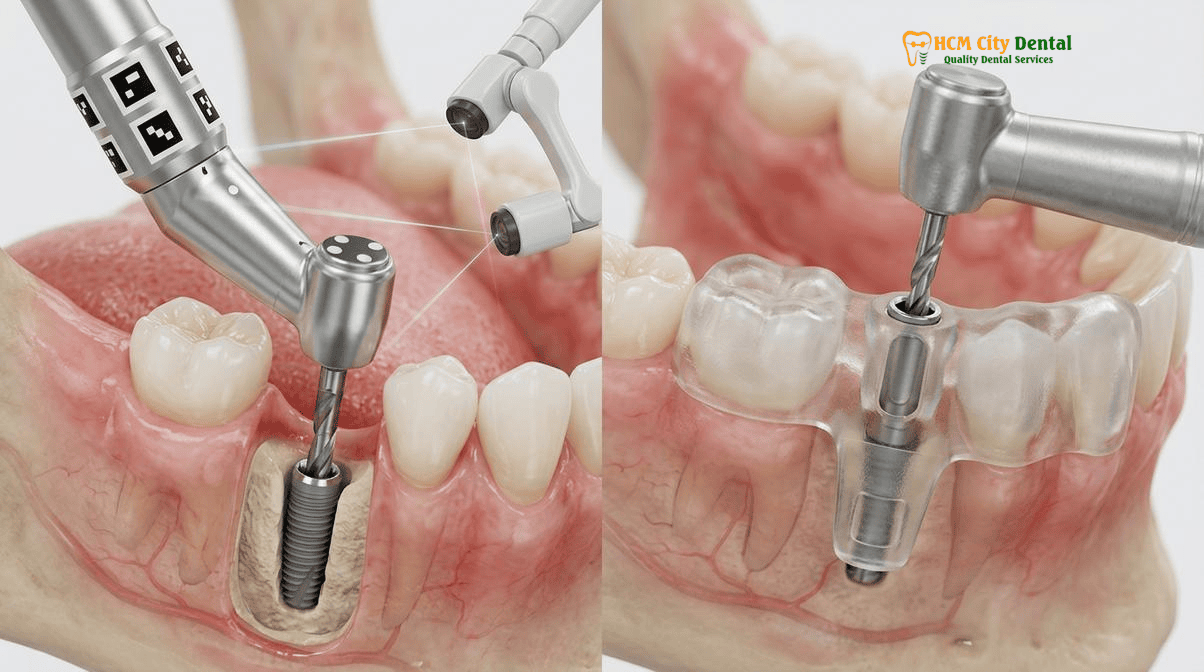
While both modalities rely on preoperative 3D Cone Beam Computed Tomography (CBCT) and intraoral surface scans to virtually plan the ideal implant trajectory, their execution in the surgical theater differs dramatically. Static guides utilize a physical, 3D-printed resin template with embedded metal sleeves to mechanically restrict the drill’s path. In contrast, dynamic navigation operates like a surgical GPS, utilizing stereoscopic cameras and fiducial markers to track the handpiece in real time, projecting the drill’s exact position, depth, and angulation onto a live 3D monitor. This comprehensive clinical review explores the peer-reviewed accuracy benchmarks, specific clinical indications, and the advanced prosthodontic protocols utilized by Dr. Nguyen Van Cuong, DDS (Clinical Director — MOH License 0003265/BL-CCHN) to deliver uncompromising implant success.
Clinical Summary:
Computer-Assisted Implant Surgery (CAIS) encompasses two primary modalities: static 3D-printed surgical guides and dynamic optical navigation. Static guides provide rigid, physical drill stabilization through a printed resin template, making them highly effective for full-arch stackable protocols and knife-edge ridges. However, they can restrict saline irrigation and are contraindicated in patients with limited mouth opening. Dynamic navigation (such as the X-Guide system) utilizes real-time stereoscopic camera tracking to project the drill’s exact 3D position onto a monitor, eliminating the need for a physical guide. This allows for superior visibility, optimal irrigation, same-day surgical execution, and seamless placement in tight posterior spaces. Both systems demonstrate exceptional accuracy, with angular deviations consistently below 2.5 degrees and apical deviations under 1.0mm, significantly outperforming traditional freehand surgery.
Key Takeaways:
- Unmatched Precision: Both dynamic navigation and static guides achieve sub-millimeter accuracy, drastically reducing the risk of neurological injury, sinus perforation, or adjacent root damage compared to freehand placement.
- Posterior Accessibility: Dynamic navigation is the gold standard for a limited mouth opening posterior molar guided implant, as it eliminates the vertical height requirements of physical guide sleeves and elongated drills.
- Surgical Visibility & Cooling: Real-time optical tracking dental implant surgery allows for unobstructed direct vision of the surgical site and optimal saline irrigation, preventing thermal bone necrosis.
- Full-Arch Superiority: Static 3D-printed stackable guides remain the preferred modality for complex All-on-4 and All-on-6 immediate loading cases requiring extensive alveoloplasty and immediate prosthetic indexing.
- Advanced Prosthodontics: Accurate 3D positioning via CAIS is essential for achieving Misch’s FP1 to FP3 prosthetic classifications and establishing Su & Gonzalez-Martin Critical/Subcritical emergence contours.
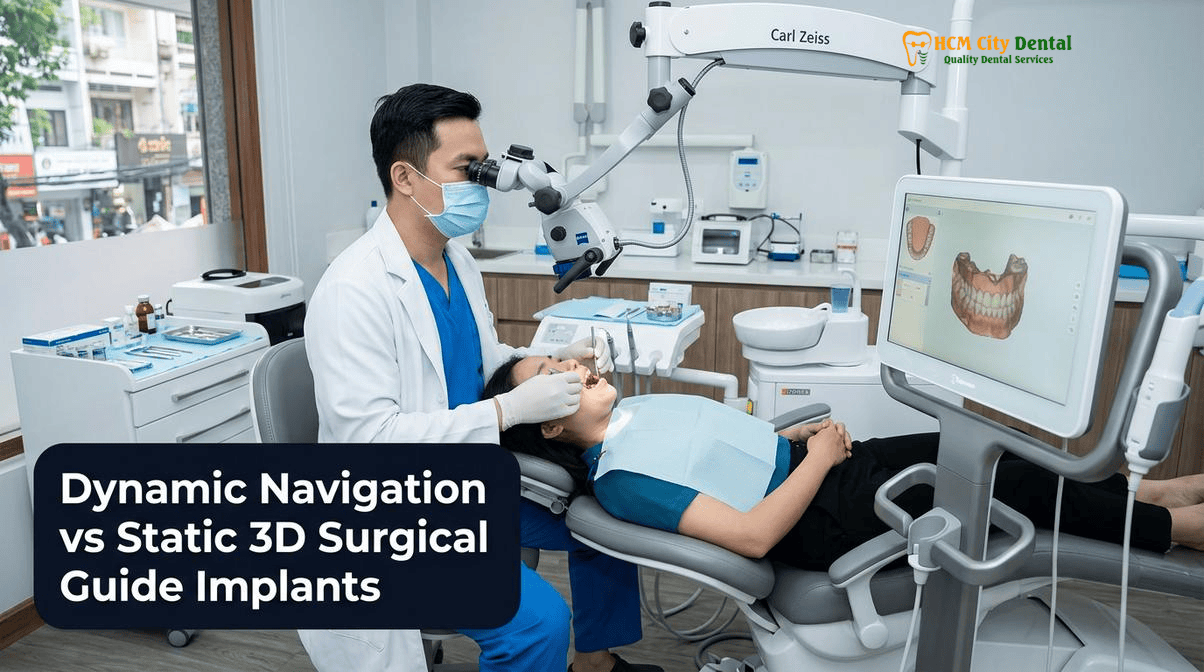
The Evolution of Computer-Assisted Implant Surgery (CAIS): Static Sleeve-Guided Templates vs. Real-Time Optical Dynamic Navigation
Historically, dental implant placement relied heavily on the surgeon’s tactile feedback, anatomical knowledge, and two-dimensional panoramic radiographs. While experienced clinicians could achieve high success rates, freehand surgery inherently carries a higher risk of angular deviation apex deviation guided implantology errors, potentially leading to compromised prosthetic emergence profiles, fenestrations, or damage to critical structures such as the inferior alveolar nerve. The advent of 3D CBCT imaging catalyzed the development of Computer-Assisted Implant Surgery (CAIS), allowing clinicians to plan implants virtually based on the final restorative goal—a concept known as “prosthetically driven implantology.”
The first generation of CAIS introduced static stereolithographic sleeve guide accuracy. By merging DICOM data from the CBCT with STL data from an intraoral scanner, clinicians could design a physical resin template. This template, manufactured via 3D printing, features precise cylindrical holes fitted with metal sleeves. During surgery, the template is seated over the patient’s teeth, mucosa, or bone, and specialized guided drills are passed through the sleeves, mechanically restricting the drill’s trajectory to match the virtual plan[1]. For more insights into this specific workflow, patients can review our detailed guide on 3D-Printed Surgical Guide & Flapless Computer-Guided Dental Implants in Vietnam: Precision & Cost.
While static guides revolutionized implant safety, they presented inherent clinical limitations. The physical presence of the guide obscures direct visual access to the osteotomy site. Furthermore, the tight tolerance between the drill and the metal sleeve can impede the flow of sterile saline irrigation, increasing the risk of overheating the dense cortical bone. Most critically, the combined vertical height of the guide, the sleeve, and the elongated guided drill often makes posterior placement impossible in patients with limited mouth opening (trismus).
To overcome these physical limitations, the industry developed real time optical tracking dental implant surgery, commonly referred to as dynamic navigation (e.g., the X-Guide system). Instead of a physical template, dynamic navigation utilizes advanced motion-tracking technology. The surgeon operates freehand, but the surgical handpiece and the patient’s jaw are continuously tracked by overhead stereoscopic cameras. The system projects a live, 3D crosshair onto a monitor, guiding the surgeon’s depth, angle, and position in real time. This evolution represents a monumental leap in computer assisted implant surgery Ho Chi Minh City, offering the precision of a guide without the physical obstructions.
“The transition from static 3D-printed guides to dynamic optical navigation is akin to moving from a printed paper map to a live GPS system. While static guides provide excellent mechanical restriction, dynamic navigation grants us unparalleled surgical freedom, real-time adaptability, and unobstructed visibility, which is absolutely critical when navigating complex posterior anatomy or managing dense cortical bone.”
— Dr. Nguyen Van Cuong, DDS (Clinical Director, HCMC Dental Clinic)
How Dynamic Optical Tracking Works: Stereoscopic Cameras, Fiducial Markers, and Live 3D CBCT Crosshair Feedback
The technological architecture of dynamic navigation vs static surgical guide implants is highly sophisticated, relying on principles similar to those used in neurosurgery and orthopedic navigation. The workflow begins with the placement of a fiducial marker array (often called an X-Clip) onto the patient’s teeth. A 3D CBCT scan is then acquired with this clip in place. The fiducial markers serve as a fixed, high-contrast reference point that the navigation software uses to register the patient’s physical anatomy to the digital CBCT data.
Once the virtual implant planning is complete—taking into account bone density, nerve proximity, and the ideal prosthetic emergence profile—the patient is seated for surgery. The fiducial marker array is reattached to the patient’s teeth, and a tracking array is attached to the surgical handpiece. Overhead stereoscopic cameras emit and detect infrared light, continuously tracking the spatial relationship between the patient’s jaw and the drill tip in three-dimensional space[2].
Before drilling commences, the surgeon performs a rapid calibration process, touching the drill tip to a known reference point to confirm sub-millimeter accuracy. During the osteotomy preparation, the surgeon looks at a high-definition monitor rather than directly into the patient’s mouth. The software displays a target view (often resembling a bullseye) and a depth indicator. The surgeon aligns the virtual drill axis with the planned trajectory, keeping the crosshairs centered within the bullseye while monitoring the real-time depth gauge to ensure the exact planned apical position is reached without over-penetration.
This live 3D CBCT crosshair feedback allows for continuous micro-adjustments. If the patient moves slightly, the cameras instantly detect the shift, and the on-screen graphics update in real time, ensuring the drill trajectory remains perfectly aligned with the virtual plan. This dynamic adaptability is a cornerstone of the advanced protocols utilized at HCMC Dental Clinic, ensuring that even the most complex cases meet the stringent criteria for long-term success, as documented in our Dental Implant Success Rate in Vietnam: 2026 Clinical Study (99.2%).
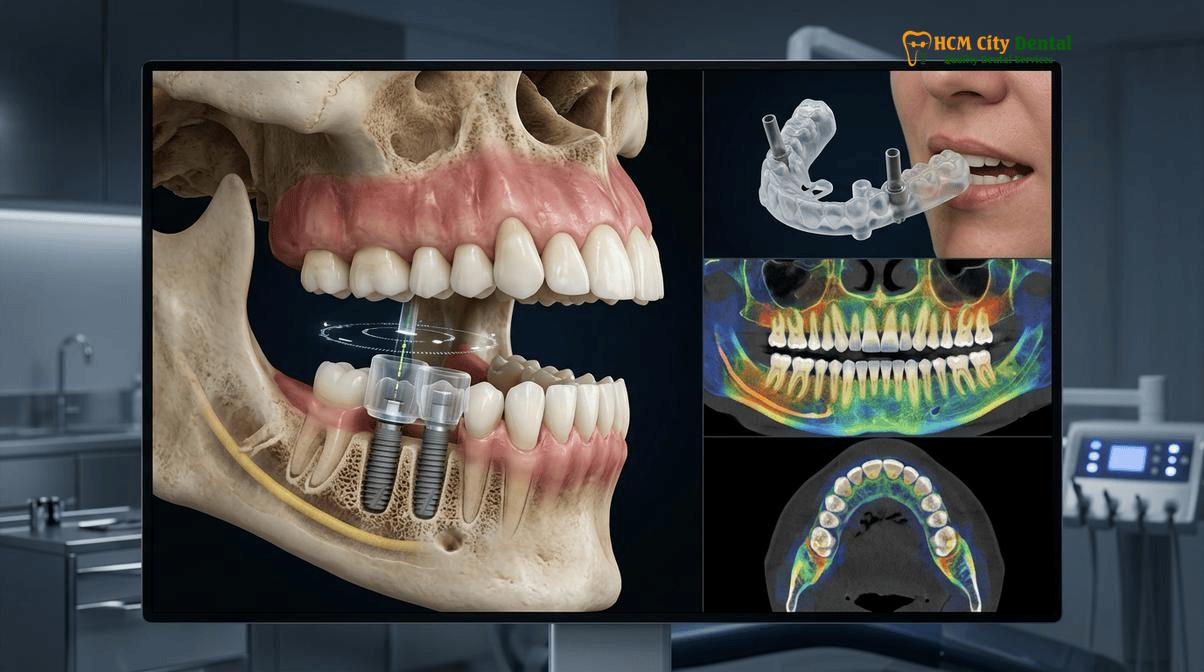
Peer-Reviewed Accuracy Benchmarks: Coronal Entry (<0.7mm), Apical Deviation (<1.0mm), and Angular Precision (<2.5 Degrees)
When evaluating dynamic navigation x-guide vs static 3D surgical guide implants, clinical accuracy is the paramount metric. Accuracy in implantology is typically measured across three distinct parameters by superimposing the postoperative CBCT scan over the preoperative virtual plan: coronal entry deviation (the error at the top of the implant), apical deviation (the error at the tip of the implant), and angular deviation (the difference in trajectory).
Extensive peer-reviewed literature confirms that both static and dynamic CAIS modalities significantly outperform freehand placement. For static stereolithographic sleeve guide accuracy, systematic reviews report mean coronal deviations of approximately 0.9mm to 1.2mm, mean apical deviations of 1.2mm to 1.5mm, and mean angular deviations of 2.5 to 3.5 degrees[3]. The slight deviations in static guides are often attributed to the intrinsic tolerance (gap) between the metal sleeve and the drill key, which is necessary to allow the drill to rotate without binding but permits a small degree of “wobble.”
Conversely, real time optical tracking dental implant surgery demonstrates comparable, and in some studies, superior precision. Clinical trials evaluating dynamic navigation report mean coronal entry deviations of less than 0.7mm, apical deviations of less than 1.0mm, and angular precision consistently below 2.5 degrees[4]. Because dynamic navigation eliminates the mechanical tolerance of a physical sleeve, the angular deviation apex deviation guided implantology metrics are often tighter, provided the surgeon maintains strict visual adherence to the on-screen target.
This sub-millimeter precision is not merely an academic achievement; it has profound clinical implications. Accurate 3D positioning is the foundation for preventing peri-implantitis. According to Lang’s CIST Protocol (Cumulative Interceptive Supportive Therapy), implants placed too far buccally or with improper angulation are highly susceptible to mucosal recession and bone loss. By utilizing CAIS, Dr. Nguyen Van Cuong, DDS ensures that implants are placed within the optimal bony envelope, allowing for the creation of Su & Gonzalez-Martin Critical/Subcritical emergence contours via custom PEEK or composite healing abutments. This meticulous positioning supports long-term tissue stability and facilitates the delivery of high-strength 1,100–1,200 MPa monolithic 3Y-TZP zirconia restorations.
Where Dynamic Navigation Outperforms Static Guides: Limited Posterior Mouth Opening (<35mm), Tight Interdental Spaces, and Same-Day Plan Adjustments
While static guides are highly effective, there are specific clinical scenarios where dynamic navigation vs static surgical guide implants proves vastly superior. The most prominent indication for dynamic navigation is the limited mouth opening posterior molar guided implant. Patients with trismus, TMJ disorders, or simply a naturally small oral cavity often present with maximum incisal openings of less than 35mm. A static surgical guide requires the vertical stacking of the patient’s teeth, the resin guide, the metal sleeve, the drill key, and an elongated guided drill. In the posterior maxilla or mandible, this combined height frequently exceeds the patient’s physical opening capacity, rendering the static guide useless.
Dynamic navigation completely circumvents this issue. Because there is no physical guide in the mouth, the surgeon can use standard-length, or even short, drills. The optical cameras track the handpiece regardless of the vertical clearance, allowing for precise, guided placement of 6mm–8mm Straumann Roxolid (Ti-Zr) splinted short implants in the posterior regions without requiring the patient to stretch their jaw uncomfortably.
Another significant advantage is the management of tight interdental spaces. In cases where the mesiodistal space between adjacent teeth is extremely narrow (e.g., replacing a single mandibular incisor), a static guide sleeve may be too wide to fit between the adjacent crowns. Dynamic navigation requires no physical sleeve, allowing the surgeon to navigate a narrow drill precisely between the adjacent roots without the risk of iatrogenic damage.
Furthermore, dynamic navigation allows for same-day surgical execution and intraoperative plan adjustments. If a patient presents to HCMC Dental Clinic for an emergency extraction and immediate implant, a CBCT can be taken, the virtual plan created, and the surgery performed via dynamic navigation in a single visit. Static guides typically require digital CAD design, 3D printing, washing, and UV curing—a process that usually delays surgery by 24 to 48 hours. Additionally, if the clinical reality during surgery dictates a slight change in implant position (e.g., discovering a localized bone defect), the dynamic navigation plan can be adjusted on the software in seconds, whereas a static guide would have to be entirely reprinted.
Clinical Case Study: Posterior Molar Replacement with Limited Opening
Patient Profile: A 52-year-old Australian expatriate presented to HCMC Dental Clinic in District 1 with a missing mandibular right first molar (Tooth 46). The patient had a history of TMJ dysfunction, resulting in a maximum mouth opening of only 32mm.
Clinical Challenge: The limited vertical clearance made the use of a traditional static 3D-printed surgical guide impossible, as the guided drill and sleeve assembly required at least 40mm of vertical space. Freehand placement carried a high risk of angular deviation and potential injury to the inferior alveolar nerve due to poor visibility.
Surgical Protocol: Dr. Nguyen Van Cuong, DDS utilized real-time optical dynamic navigation. A fiducial marker clip was placed, and a 3D CBCT scan was acquired. The implant was virtually planned to optimize the emergence profile for a monolithic zirconia crown. During surgery, standard-length drills were tracked by the stereoscopic cameras, allowing for precise osteotomy preparation despite the restricted opening. Unobstructed saline irrigation prevented bone overheating.
Outcome: A premium European implant was placed with an insertion torque of 45 Ncm. The postoperative CBCT confirmed an apical deviation of just 0.6mm and an angular deviation of 1.2 degrees from the virtual plan. The patient experienced minimal postoperative discomfort and received a custom CAD/CAM zirconia crown three months later, achieving a flawless Misch FP1 prosthetic result.
Where Static 3D-Printed Guides Remain Superior: Physical Drill Stabilization in Knife-Edge Extraction Sockets and Full-Arch Stackable Guides
Despite the advanced capabilities of dynamic navigation, static stereolithographic sleeve guide accuracy remains the gold standard for specific, highly complex surgical scenarios. The primary advantage of a static guide is rigid, physical drill stabilization. When preparing an osteotomy on a steep, knife-edge alveolar ridge or within the sloping walls of a fresh extraction socket, a freehand drill (even when guided by dynamic navigation on a screen) has a tendency to “skate” or deflect off the dense cortical bone. A static guide physically locks the drill into the correct trajectory, preventing this deflection and ensuring the osteotomy begins exactly at the planned entry point.
Furthermore, static guides are indispensable for comprehensive full-arch rehabilitation, such as All-on-4 or All-on-6 immediate loading protocols. These cases often require significant bone reduction (alveoloplasty) to create restorative space and hide the transition line beneath the high lip line, achieving a Misch FP3 (hybrid pink gingival porcelain) or RP4 (100% implant-borne CAD/CAM milled titanium bar overdenture) prosthetic outcome. Stackable static guide systems utilize a bone-supported base guide pinned to the maxilla or mandible. This base guide dictates the exact level of bone reduction. Subsequent guides are then “stacked” onto the base guide to direct the multi-vector drilling for the implants, including complex bicortical Pterygoid implants engaging the maxillary tuberosity and pterygoid plate.
Finally, the stackable guide system allows for the immediate, precise indexing of the provisional PMMA prosthesis. The physical connection between the surgical guide and the prosthetic template ensures that the temporary bridge aligns perfectly with the newly placed multi-unit abutments, facilitating immediate loading with cross-arch stabilization. While dynamic navigation is exceptional for single and multiple implants, the physical control provided by stackable static guides makes them the preferred choice for full-arch immediate loading at HCMC Dental Clinic.
“In implantology, there is no single ‘best’ tool for every scenario. Dynamic navigation is our go-to for posterior precision and limited mouth opening, offering unmatched visibility. However, when we are executing a full-arch All-on-6 reconstruction requiring aggressive alveoloplasty and immediate prosthetic conversion, the rigid physical stabilization of a 3D-printed stackable guide system is absolutely irreplaceable.”
— Dr. Nguyen Van Cuong, DDS (Clinical Director, HCMC Dental Clinic)
2026 Computer-Guided & Navigation-Assisted Implantology Fee Schedule at HCMC Dental Clinic (District 1)
At HCMC Dental Clinic, we believe that advanced technology should be accessible. By maintaining an in-house digital laboratory, 3D printing capabilities, and advanced dynamic navigation systems, we eliminate third-party laboratory delays and markups. For international patients and dental travelers, we offer a transparent, highly competitive 2026 fee schedule. Patients who book online receive a -40% preferred rate compared to standard walk-in pricing. All implant procedures are meticulously planned and executed by Dr. Nguyen Van Cuong, DDS, adhering strictly to the highest international standards of infection control and biomaterial traceability[5]. For a comprehensive overview of all our treatments, please visit our Official 2026 Dental Price List & -40% Online Booking Fee Schedule.
| Computer-Assisted Implant Procedure (2026) | Walk-In / Standard Price (USD) | -40% Online Booking Price (USD) | VND Equivalent (Online) |
|---|---|---|---|
| 3D CBCT Scan & Digital Planning | $30 USD | $18 USD | 480,000 VND |
| Single Korean Implant (Dentis / Neo Biotech / Dentium) Includes fixture + standard abutment | $769 – $1,090 USD | $462 – $654 USD | 12,000,000 – 17,000,000 VND |
| Single European / Swiss Implant (Ritter / Straumann BLT-SLA / BLA-Active) Includes fixture + standard abutment | $1,603 – $2,244 USD | $962 – $1,346 USD | 25,000,000 – 35,000,000 VND |
| 100% Metal-Free Zirconia Ceramic Implant | $1,923 USD | $1,154 USD | 30,000,000 VND |
| Implant Zirconia HT Crown + Custom Abutment | $256 USD | $154 USD | 4,000,000 VND |
| All-on-4 Full-Arch Implants (Economy Package) Includes temporary & final Zirconia bridge | From $10,576 USD | From $6,346 USD / arch | 165,000,000 VND |
| All-on-6 Full-Arch Implants (Economy Package) Includes temporary & final Zirconia bridge | From $14,423 USD | From $8,654 USD / arch | 225,000,000 VND |
Note: The fees listed above reflect the -40% online booking discount ($1 USD = 26,000 VND). Complex cases requiring chairside Smart Dentin Grinder autogenous grafting, L-PRF Sticky Bone GBR, or the management of peri-implantitis via Lang’s CIST protocol (erythritol air-polishing, diode/Er:YAG laser decontamination) will be assessed during the initial 3D CBCT consultation. For more clinical data and statistical outcomes, explore our 2026 Clinical Dental Research & Statistical Reports Hub.
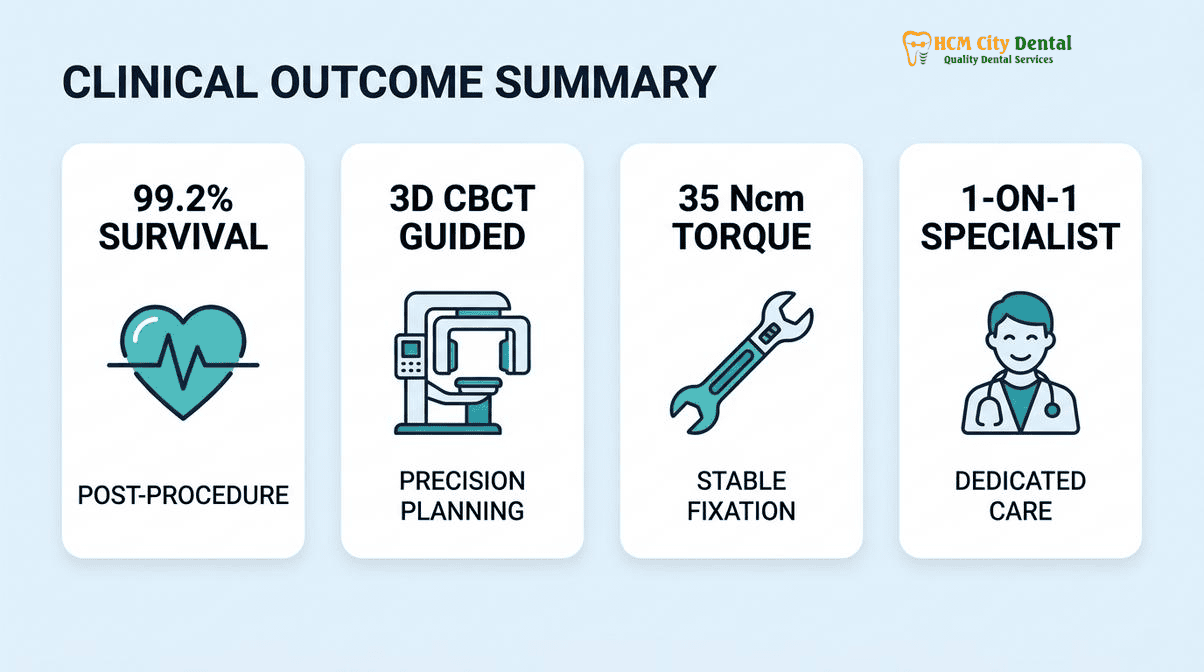
Clinical Precautions & Post-Operative Care
While computer-assisted implant surgery significantly reduces surgical trauma and accelerates healing, patients must adhere strictly to post-operative protocols to ensure osseointegration. Avoid chewing hard foods on the implant site, refrain from smoking (which drastically increases the risk of implant failure), and maintain meticulous oral hygiene. If you experience severe, throbbing pain that worsens after 72 hours, excessive swelling, or a foul taste in your mouth, these may be signs of early infection or peri-implant mucositis. Do not wait. Contact Dr. Nguyen Van Cuong immediately via our 24/7 WhatsApp triage line at +84 853 020 003. For a detailed guide on distinguishing normal recovery from complications, read our article on Normal Post-Op Healing vs. Early Implant Complications: 7 Clinical Red Flags.
Frequently Asked Questions
Why can’t a static 3D-printed surgical guide be used if I have limited jaw opening in the back molar area?
Static 3D-printed surgical guides require a vertical stacking of the guide itself, the metal sleeve, the drill key, and the elongated guided drill. This combined height often exceeds 35mm to 40mm. If a patient has limited mouth opening (trismus) or requires a posterior molar implant, there simply is not enough vertical clearance to insert the drill into the guide sleeve. Dynamic navigation eliminates the physical guide entirely, allowing the surgeon to use standard-length drills tracked by optical cameras, making it the ideal solution for limited posterior mouth opening.
Does saline cooling water reach the bone drill better during dynamic navigation than through a closed static guide sleeve?
Yes. One of the primary drawbacks of static stereolithographic sleeve guides is that the physical resin template and metal sleeve can block the external saline irrigation from reaching the cutting flutes of the drill deep within the osteotomy. This increases the risk of thermal necrosis (bone overheating), which can compromise osseointegration. Because dynamic navigation uses real-time optical tracking without any physical barrier in the mouth, the surgical site remains completely open, allowing for optimal, unobstructed saline cooling and direct visual confirmation of the surgical field.
Which system is better for full-arch All-on-4 and All-on-6 immediate loading: stackable static guides or dynamic tracking?
For complex full-arch immediate loading procedures (such as All-on-4 or All-on-6), static 3D-printed stackable guides generally remain superior. Stackable guides provide rigid physical stabilization for bone reduction (alveoloplasty), precise multi-vector drilling, and immediate indexing of the provisional prosthesis. While dynamic navigation is highly accurate for single or multiple implants, managing extensive bone reduction and immediate full-arch prosthetic conversion is currently more streamlined and predictable using a physical stackable static guide system.
Can computer-assisted implant surgery be performed on the exact same day as my 3D CBCT scan in Ho Chi Minh City?
Yes, but primarily with dynamic navigation. Because dynamic navigation relies on software calibration and optical tracking, the 3D CBCT scan can be taken, the virtual implant planned, and the surgery executed in a single visit without waiting for a laboratory to print a physical guide. Conversely, static 3D-printed guides require time for digital CAD design, 3D printing, washing, curing, and sleeve insertion, which typically necessitates a delay of 24 to 48 hours between the scan and the surgical appointment.
What is the 2026 cost of computer-guided implant placement at HCMC Dental Clinic in District 1?
At HCMC Dental Clinic in District 1, Ho Chi Minh City, the 2026 online booking fee for a single Korean implant (Dentis, Neo Biotech, or Dentium) ranges from $462 to $654 USD. Premium European or Swiss implants (such as Straumann BLT-SLA or BLA-Active) range from $962 to $1,346 USD. These comprehensive packages utilize advanced computer-assisted implant surgery protocols to ensure maximum precision, safety, and long-term biomechanical success.
References
- Block, M. S., Emery, R. W., & Cullum, D. R. (2017). Improving Implant Placement Accuracy with Dynamic Navigation Surgery. Journal of Oral and Maxillofacial Surgery.
- Stefanelli, L. V., DeGroot, B. S., Lipton, D. I., & Mandelaris, G. A. (2019). Accuracy of a Dynamic Dental Implant Navigation System in a Private Practice. International Journal of Oral & Maxillofacial Implants.
- Tahmaseb, A., Wu, V., Wismeijer, D., Coucke, W., & Evans, C. (2018). The accuracy of static computer-aided implant surgery: A systematic review and meta-analysis. Clinical Oral Implants Research.
- Jorba-García, A., González-Barnadas, A., Camps-Font, O., & Figueiredo, R. (2021). Accuracy assessment of dynamic navigation and static surgical guides for dental implant placement: A systematic review and meta-analysis. Clinical Oral Investigations.
- Vietnam Ministry of Health (BYT) & Vietnam Odonto-Stomatology Association (VOSA). National Clinical Guidelines on Specialist Dental Care, Biomaterial Traceability & EN 13060 Class B Infection Control. (2024).