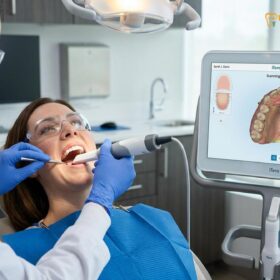
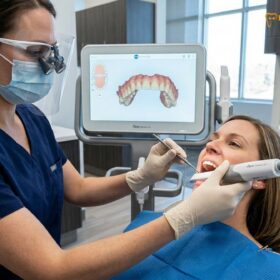
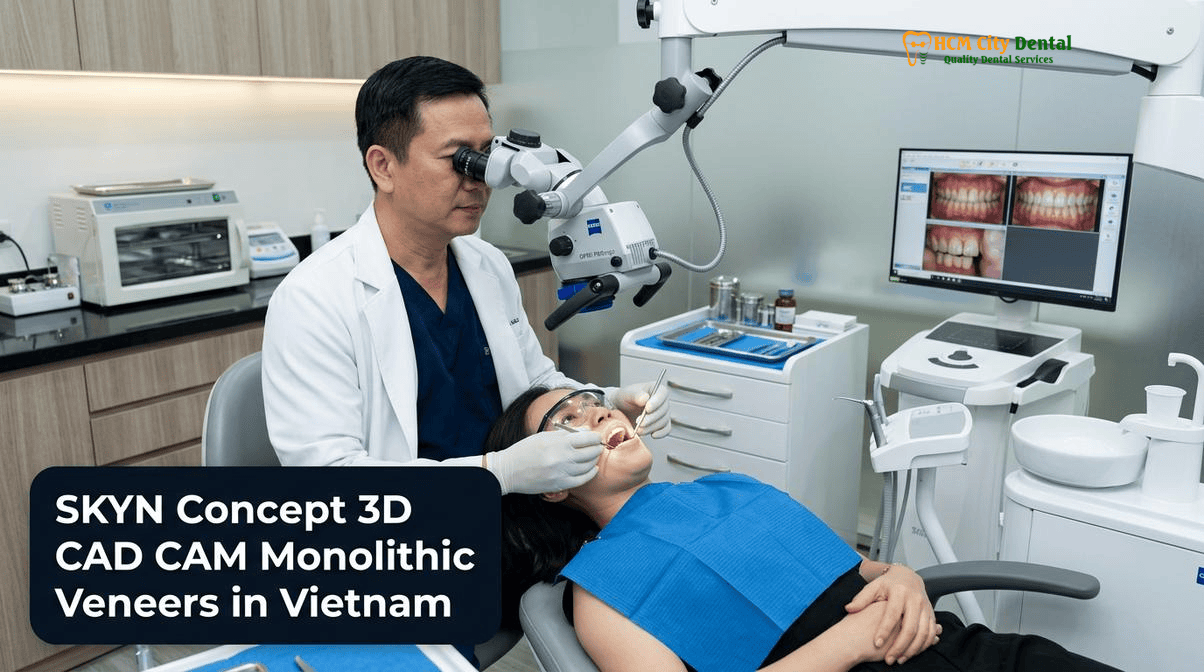
For decades, the pursuit of the perfect smile often resulted in a compromise between brightness and natural vitality. Patients traveling internationally for cosmetic dentistry frequently express a singular, overriding fear: ending up with bulky, opaque, artificial-looking teeth. The integration of SKYN concept natural tooth libraries 3D cad cam monolithic veneers represents the pinnacle of modern digital prosthodontics, completely eliminating the risk of the dreaded “chiclet” smile. At HCMC Dental Clinic in District 1, Ho Chi Minh City, we utilize sub-50-micron digital scans of authentic, unworn human donor teeth to replicate the exact primary, secondary, and tertiary anatomy of natural enamel. Under the clinical direction of Dr. Nguyen Van Cuong (Dr. Cuong), DDS (Vietnam MOH License 0003265/BL-CCHN), our biomimetic approach ensures that every IPS E.max lithium disilicate restoration possesses the dynamic light-scattering properties, perikymata micro-texture, and opalescent incisal halos inherent in youthful, natural dentition.
\n\n
Clinical Summary:
\n
The SKYN Concept revolutionizes anterior aesthetic restorations by discarding generic, algorithm-generated CAD tooth shapes in favor of 100% authentic natural tooth morphology libraries. By milling monolithic IPS E.max lithium disilicate blocks based on high-resolution scans of real human teeth, clinicians can perfectly replicate the complex surface micro-texture (perikymata) and developmental lobes that give natural enamel its lifelike optical properties. Combined with a bis-acryl motivational mock-up for a real-world “test drive” and strict biomimetic adhesive protocols (including Immediate Dentin Sealing and hydrofluoric acid/silane coupling), this digital workflow delivers unparalleled aesthetic predictability, structural integrity, and tissue biocompatibility for international patients seeking premium porcelain veneers in Vietnam.
\n
\n\n
Key Takeaways:
\n
- \n
- Authentic Morphology: The SKYN Concept utilizes 3D CAD/CAM libraries derived from high-resolution scans of natural, unworn human teeth, ensuring restorations possess genuine anatomical features rather than artificial, computer-generated shapes.
- Optical Vitality: Replicating tertiary anatomy—specifically perikymata micro-texture—diffuses light naturally, preventing the glassy, opaque appearance commonly associated with traditional “chiclet” veneers.
- Predictable Aesthetics: A 3D-printed bis-acryl motivational mock-up allows patients to wear and evaluate their proposed smile design in natural daylight before any irreversible enamel preparation occurs.
- Biomimetic Adhesion: Restorations are bonded under 100% latex-free nitrile rubber dam isolation using advanced protocols, including 5%–9.5% hydrofluoric acid etching and pure heat-dried silane, maximizing bond strength and longevity.
- Transparent Value: HCMC Dental Clinic offers world-class, natural-morphology IPS E.max veneers at a highly competitive -40% online booking rate, providing exceptional clinical value for Australian, US, and international dental travelers.
\n
\n
\n
\n
\n
\n
\n\n\n
\n\n\n
Why Traditional Hand-Waxed or Generic CAD Software Veneers Often Look Like Flat, Opaque ‘Chiclets’
\n\n
The human eye is remarkably adept at detecting artificiality, even when it cannot precisely articulate why a smile looks “fake.” Historically, cosmetic dental restorations have struggled to cross the uncanny valley of dental aesthetics. When patients express a desire to Porcelain Veneers & Digital Smile Design in Ho Chi Minh City, their primary concern is almost universally the avoidance of flat, bulky, and monochromatic restorations. To understand how to avoid fake opaque chiclet porcelain veneers, one must first understand the limitations of traditional fabrication methods.
\n\n
Traditional hand-waxed veneers rely entirely on the subjective artistic skill of the dental technician. While master ceramists can achieve beautiful results, the process is inherently variable. Hand-layering feldspathic porcelain often results in a loss of surface texture during the final glazing firing cycle. When the ceramic is heated to its glazing temperature, the surface melts slightly, pooling into the microscopic grooves and valleys that the ceramist painstakingly carved. The result is a smooth, highly reflective surface. When light hits this smooth surface, it bounces back in a harsh, specular reflection, creating a glassy, mirror-like shine that immediately signals artificiality. Furthermore, to mask underlying tooth discoloration, technicians often use highly opaque core materials, which block light transmission and result in a lifeless, high-value (excessively bright) appearance[1].
\n\n
Conversely, early generations of digital dentistry relied on generic CAD software libraries. These software programs utilized mathematical algorithms to generate tooth shapes. However, nature is not perfectly symmetrical or mathematically rigid; it is beautifully chaotic and organic. Algorithm-generated teeth often feature perfectly flat facial planes, uniform embrasure spaces, and a complete absence of surface micro-texture. When these generic shapes are milled from monochromatic ceramic blocks, the resulting restorations look like identical white tiles—the classic “chiclet” smile. The lack of primary line angles and secondary developmental lobes means the teeth lack three-dimensional depth, appearing wide, flat, and entirely unnatural.
\n\n
What Is the Digital SKYN Concept? Copying 100% Authentic Donor Tooth Morphology Libraries Scanned at Sub-50-Micron Resolution
\n\n
The paradigm shift in modern aesthetic dentistry occurred with the realization that we should not attempt to invent tooth shapes; we should simply copy nature. This philosophy is the foundation of the SKYN Concept. Developed by pioneering clinicians and ceramists, the SKYN Concept abandons algorithm-generated CAD libraries and subjective hand-waxing in favor of biomimetic replication. It is the ultimate methodology for creating SKYN concept natural tooth library veneers.
\n\n
The process begins with the meticulous selection of natural “donor” teeth. These are typically extracted teeth from young individuals (often extracted for orthodontic reasons) that exhibit pristine, unworn enamel, ideal proportions, and beautiful surface texture. These natural teeth are scanned using ultra-high-resolution laboratory optical scanners capable of capturing details at a sub-50-micron level. This scanning process digitizes the exact topography of the natural tooth, creating a highly detailed STL (Standard Tessellation Language) file[2].
\n\n
These digitized natural teeth are then compiled into comprehensive 3D CAD/CAM libraries within advanced dental design software, such as exocad or 3Shape. When Dr. Nguyen Van Cuong, DDS (Clinical Director — MOH License 0003265/BL-CCHN) designs a bespoke smile makeover at HCMC Dental Clinic, he does not use generic shapes. Instead, he selects a specific natural tooth morphology from the SKYN library that harmonizes with the patient’s facial features, gender, and aesthetic goals. The software then adapts this natural morphology to the patient’s specific arch form and occlusion. Because the design is based on a 100% authentic natural tooth, the resulting monolithic CAD/CAM restoration possesses an organic beauty and complexity that is impossible to achieve through manual sculpting or algorithmic generation.
\n\n\n
\n\n\n
The 3 Optical Secrets of Real Human Enamel: Primary Line Angles, Secondary Developmental Lobes, and Tertiary Perikymata Micro-Texture
\n\n
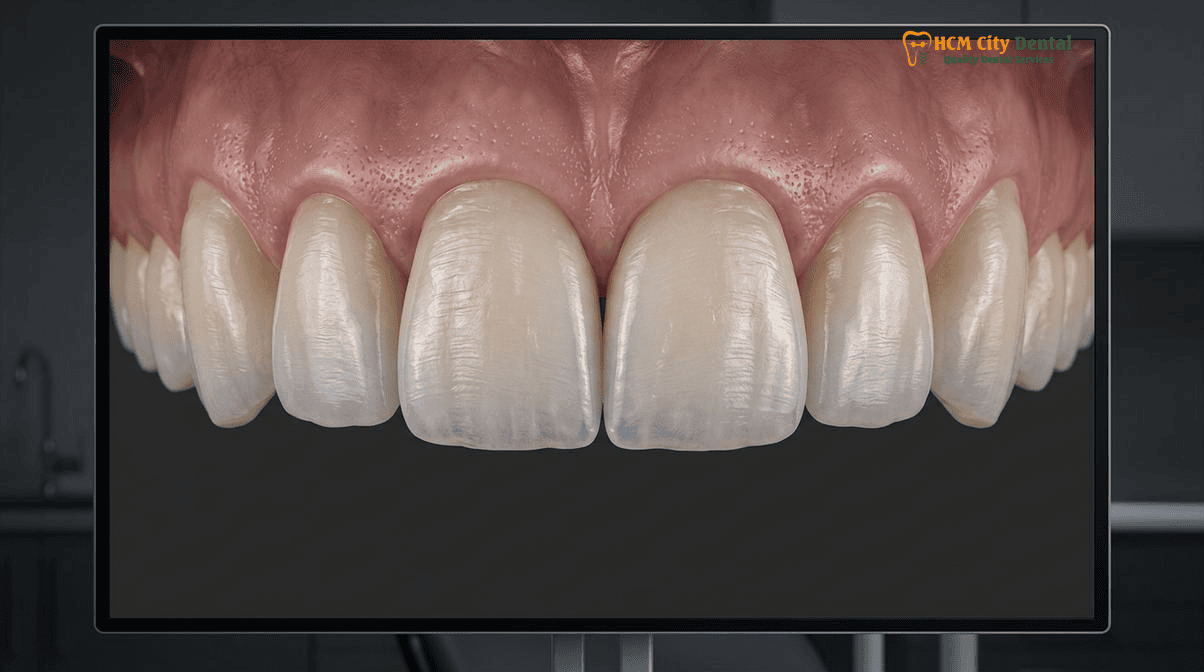
To truly appreciate the superiority of SKYN concept natural tooth libraries 3D cad cam monolithic veneers, one must understand the complex anatomy of human enamel and how it interacts with light. Natural teeth are not flat surfaces; they are highly complex, three-dimensional structures characterized by three distinct levels of anatomy.
\n\n
1. Primary Anatomy (Line Angles and Facial Planes): The primary anatomy dictates the overall geometric shape and perceived volume of the tooth. The most critical elements are the transitional line angles—the vertical ridges where the facial surface of the tooth transitions into the interproximal (side) surfaces. The placement of these line angles determines how wide or narrow a tooth appears. By manipulating the primary line angles in the digital design, Dr. Cuong can create optical illusions, making a physically wide tooth appear elegantly narrow, or vice versa, ensuring perfect harmony with the patient’s facial proportions.
\n\n
2. Secondary Anatomy (Developmental Lobes): Human incisors develop from three distinct calcification centers, resulting in three vertical developmental lobes (mesial, central, and distal) on the facial surface. These lobes are separated by subtle vertical depressions known as developmental grooves. In youthful teeth, these lobes extend to the incisal edge, forming mamelons. The presence of these secondary anatomical features breaks up the flat facial plane, creating vertical highlights and shadows that give the tooth a dynamic, three-dimensional appearance.
\n\n
3. Tertiary Anatomy (Perikymata Micro-Texture): This is the most critical and often most neglected aspect of aesthetic dentistry. Tertiary anatomy refers to the microscopic surface texture of the enamel, primarily the perikymata. Perikymata are microscopic, horizontal growth lines or ridges that form during the development of the enamel matrix. They are most prominent in the cervical and middle thirds of youthful teeth. The presence of perikymata surface micro-texture natural veneers is what truly separates a world-class restoration from a mediocre one[3].
\n\n
\n
“The secret to a truly invisible restoration lies not just in the shade of the ceramic, but in how its surface manages light. Without the microscopic horizontal ridges of perikymata, even the most perfectly color-matched veneer will look like glass. The SKYN concept allows us to mill these microscopic details directly into the lithium disilicate, ensuring the restoration diffuses light exactly like youthful human enamel.”
\n — Dr. Nguyen Van Cuong, DDS\n
\n\n
When light strikes a tooth with natural perikymata, the microscopic ridges scatter the light in multiple directions (diffuse reflection). This light scattering creates a soft, pearlescent luster rather than a harsh, mirror-like glare. It also lowers the value (brightness) slightly, increasing the perceived translucency and depth of the enamel. By utilizing the SKYN libraries, the CAD/CAM milling machine precisely carves these microscopic perikymata into the monolithic IPS E.max block, ensuring the final restoration interacts with light exactly like a natural tooth. This is a significant advantage over traditional methods, as detailed in our comparison of Hand-Layered Feldspathic Porcelain Veneers vs. Pressed IPS E.max Lithium Disilicate Veneers in Vietnam.
\n\n\n
\n\n\n\n
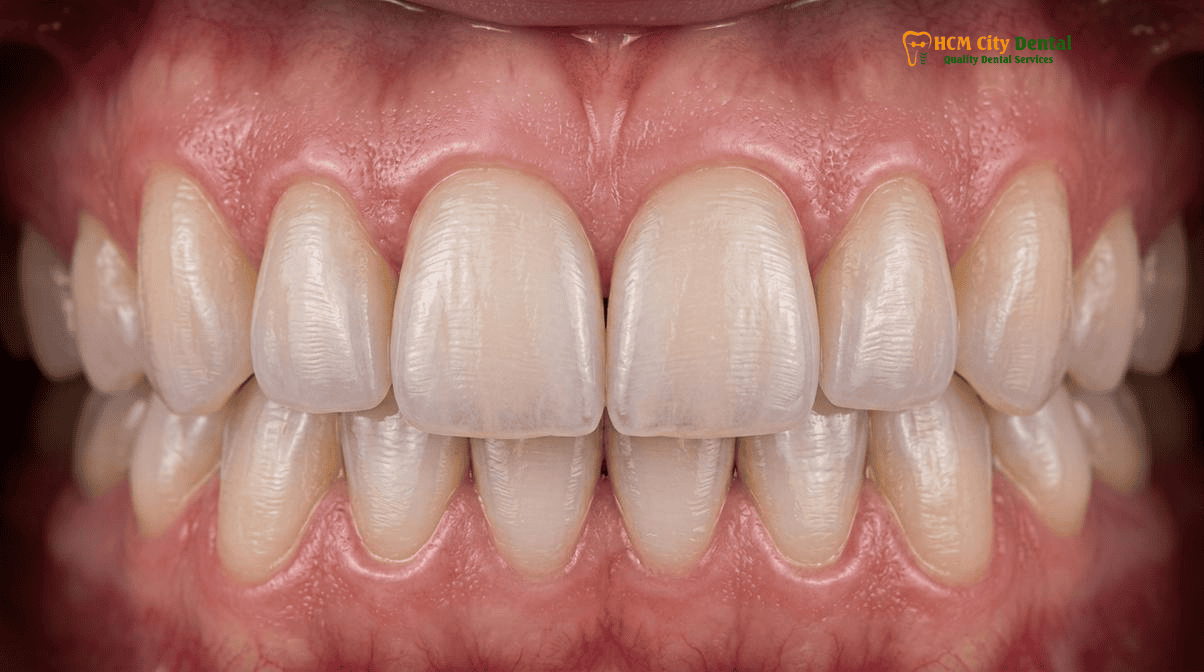
Clinical Case Note — Dr. Nguyen Van Cuong, DDS (Vietnam MOH License 0003265/BL-CCHN): Using the SKYN Concept and natural 3D donor tooth libraries at HCMC Dental Clinic in District 1, Ho Chi Minh City, our international patients preview their exact natural smile design in their own mouth via a 3D-printed motivational mock-up before a single millimeter of enamel is touched. Our CAD/CAM monolithic IPS e.max MT/HT veneers preserve authentic perikymata surface micro-texture and halo incisal translucency rather than artificial flat-white block teeth.
\n\n
The Bis-Acryl ‘Emotional Smile Test-Drive’: Wearing Your 3D Natural Morphology Mock-Up in Real Daylight Before Any Enamel Touch
\n\n
One of the most profound advantages of the digital SKYN workflow is the elimination of aesthetic guesswork. In traditional dentistry, patients often had to wait until the final veneers were cemented to see their new smile, leading to anxiety and potential disappointment. At HCMC Dental Clinic, we utilize a 3D motivational mock up smile test drive Vietnam protocol, allowing patients to physically experience their new smile before committing to any irreversible treatment.
\n\n
The process begins with a comprehensive digital data acquisition phase, including high-resolution intraoral scans, digital photography, and dynamic video analysis of the patient’s lip movements and speech phonetics. If the patient presents with a “gummy smile” or short clinical crowns, Dr. Cuong utilizes 3D CBCT imaging to diagnose Coslet’s Altered Passive Eruption (APE Type 1A, 1B, 2A, 2B). If necessary, a dual-guide Piezosurgery crown lengthening procedure is planned, meticulously respecting the >=3mm biologic width (supracrestal tissue attachment) to ensure long-term periodontal health.
\n\n
Clinical Case Study: The Expat Executive’s Smile Transformation
\n
Patient Profile: A 42-year-old Australian executive residing in Ho Chi Minh City presented with severe enamel attrition, generalized discoloration, and a loss of vertical dimension, resulting in an aged, collapsed smile.
\n
Clinical Protocol: Dr. Cuong initiated a bespoke digital smile design Ho Chi Minh City protocol. Intraoral scans and 3D CBCT data were integrated. A SKYN natural tooth library featuring “Youthful Dominant Centrals” was selected to restore the lost incisal length and provide optimal lip support. A 3D-printed model of the design was fabricated.
\n
The Test Drive: Using a silicone matrix and premium bis-acryl temporary resin, the SKYN design was transferred directly over the patient’s unprepared teeth. The patient walked outside into natural sunlight to evaluate the mock-up. Thrilled with the natural morphology and perikymata texture, the patient approved the design immediately.
\n
Outcome: Because the mock-up served as a precise preparation guide, Dr. Cuong was able to execute ultra-conservative, enamel-preserving preparations. The final monolithic IPS E.max veneers perfectly replicated the approved mock-up, delivering a functional, highly aesthetic, and biomimetically sound rehabilitation.
\n
\n\n
Once the bespoke digital smile design Ho Chi Minh City is finalized in the software, a 3D model of the proposed smile is printed. A precise silicone matrix is fabricated over this printed model. During the mock-up appointment, Dr. Cuong fills the silicone matrix with a tooth-colored bis-acryl provisional resin and seats it over the patient’s unprepared teeth. Within minutes, the resin sets, and the matrix is removed, revealing the exact 3D SKYN morphology in the patient’s mouth.
\n\n
This “emotional test drive” is a transformative experience. Patients can view their new smile in natural daylight, evaluate their speech, and assess the lip support. They can request modifications to the length, shape, or embrasure spaces. Only when the patient is 100% satisfied with the mock-up does the clinical treatment proceed. Furthermore, this mock-up serves as a precise depth-gauge guide for tooth preparation, ensuring the most conservative, enamel-preserving approach possible, aligning with our philosophy on Minimal Prep vs Full Prep Veneers: Preserving Natural Teeth in Vietnam.
\n\n
Micro-Staining & Glaze Control: Blending BL2/BL3/A1 Cervical Warmth with Opalescent Incisal Halos in IPS E.max Lithium Disilicate
\n\n
While the SKYN morphology provides the perfect physical shape and texture, the mastery of color and translucency is what breathes life into the restoration. Many patients desire a bright, youthful smile, often requesting bleach shades. However, achieving natural incisal translucency bl2 bl3 vs bl1 shade requires sophisticated ceramic engineering to prevent the teeth from looking like opaque white tiles.
\n\n
At HCMC Dental Clinic, we utilize monolithic IPS E.max lithium disilicate for our SKYN veneers. Lithium disilicate is a glass-ceramic renowned for its exceptional optical properties and high flexural strength (up to 500 MPa). To achieve a natural bleach shade (BL2 or BL3), we do not use monochromatic, highly opaque ingots. Instead, we utilize Multi-Translucent (MT) or High-Translucency (HT) blocks that allow light to penetrate the ceramic, mimicking the light transmission of natural enamel.
\n\n
The secret to a natural-looking bright smile lies in the subtle gradient of color. Natural teeth are not uniformly white; they exhibit a polychromatic gradient. The cervical third (near the gumline) is typically warmer and more chromatic (e.g., an A1 or A2 hue) due to the thinner enamel revealing the underlying dentin. The middle third represents the true body shade (e.g., BL2 or BL3). The incisal third (the biting edge) is highly translucent, often displaying an opalescent halo—a bluish or grayish translucency that absorbs and reflects light dynamically.
\n\n
After the SKYN morphology is milled, our master ceramists perform meticulous micro-staining under magnification. They apply subtle cervical warmth to ground the tooth naturally into the gingival architecture. They enhance the developmental grooves with subtle characterization and create the illusion of internal mamelons and opalescent incisal halos. Crucially, the final glaze is applied in an ultra-thin layer and fired at a precisely controlled temperature to ensure the microscopic perikymata texture milled by the CAD/CAM machine is preserved, not melted away[4].
\n\n
Clinical Precaution: The Importance of Biomimetic Adhesive Protocols
\n
The long-term success of monolithic IPS E.max veneers relies entirely on the integrity of the adhesive bond. Traditional cementation is inadequate for glass-ceramics. At HCMC Dental Clinic, Dr. Cuong strictly adheres to advanced biomimetic adhesive physics.
\n
All veneer bonding is performed under a 100% latex-free nitrile rubber dam to ensure absolute moisture control. We utilize Immediate Dentin Sealing (IDS) to protect freshly cut dentin and maximize bond strength. Understanding Feilzer’s Configuration Factor (C-Factor), we recognize that veneers have a highly favorable, low C-Factor, minimizing polymerization shrinkage stress. The intaglio (fitting) surface of the IPS E.max veneer is treated with 5%–9.5% hydrofluoric acid for exactly 20 seconds, thoroughly rinsed, ultrasonically cleaned, and treated with pure heat-dried silane to create a chemical covalent bond. This protocol is vastly different from the Blatz APC protocol (Air-abrasion + Ivoclean + 10-MDP) required for zirconia restorations. For posterior teeth requiring extensive rehabilitation, we utilize monoblock IPS E.max Endocrowns (with a 2–3mm pulp chamber endo-core) or 1.5mm cuspal-coverage ceramic onlays to prevent Split Tooth Syndrome.
\n
\n\n
Understanding the nuances of these materials and protocols is essential for patients evaluating the Best Price Porcelain Veneers Vietnam: IPS E.max vs Zirconia Costs, as the clinical execution directly impacts the longevity and aesthetic outcome of the investment.
\n\n\n
\n\n\n
2026 Natural-Morphology IPS E.max & Feldspathic Veneer Fee Schedule at HCMC Dental Clinic (District 1)
\n\n
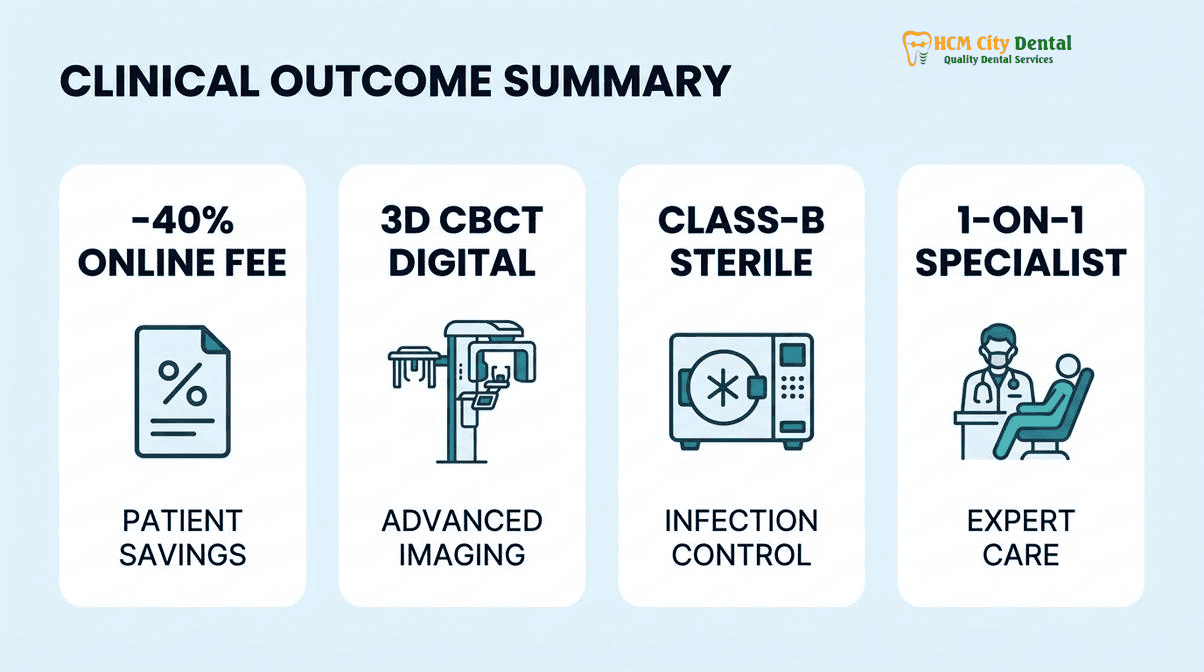
HCMC Dental Clinic is committed to providing world-class, biomimetic digital dentistry at transparent, highly accessible price points for our international patients. By leveraging our in-house digital CAD/CAM workflow and direct specialist care, we eliminate intermediary laboratory markups. We proudly offer a transparent -40% Online Booking Pricing model compared to our standard walk-in rates, providing exceptional value for patients traveling from Australia, the United States, and Europe.
\n\n
All procedures are performed in strict accordance with the Vietnam Ministry of Health (BYT) & Vietnam Odonto-Stomatology Association (VOSA) National Clinical Guidelines on Specialist Dental Care, Biomaterial Traceability & EN 13060 Class B Infection Control[5]. Below is our official 2026 fee schedule for aesthetic and restorative procedures.
\n\n
| Premium Dental Treatment (2026 Clinical Categories) | Walk-In / Standard Price (USD) | -40% Online Booking Price (USD) | VND Equivalent (Online) |
|---|---|---|---|
| IPS E.max Porcelain Veneer (SKYN Concept / Natural Morphology) | $308 / tooth | $185 / tooth | 4,800,000 VND |
| Zirconia Veneer (High Translucency / Multilayer) | $230 / tooth | $138 / tooth | 3,588,000 VND |
| Composite Veneer / Heated Bioclear Dental Bonding | $76 / tooth | $35 – $46 / tooth | 900,000 – 1,200,000 VND |
| IPS E.max All-Ceramic Crown / Inlay / Onlay / Overlay | $385 / tooth | $231 / tooth | 6,000,000 VND |
| Full Zirconia Crown (Cercon Standard / HT Multilayer) | $256 – $321 / tooth | $154 – $192 / tooth | 4,000,000 – 5,000,000 VND |
| Single Korean Implant (Dentis / Neo Biotech / Dentium + Abutment) | $769 – $1,090 | $462 – $654 | 12,000,000 – 17,000,000 VND |
| Single European / Swiss Implant (Straumann BLT-SLA / BLA-Active) | $1,603 – $2,244 | $962 – $1,346 | 25,000,000 – 35,000,000 VND |
| All-on-4 Full-Arch Implants (Complete Package with Zirconia Bridge) | From $10,576 / arch | From $6,346 / arch | 165,000,000 VND |
| Invisalign Comprehensive (Unlimited Aligners) | $4,231 | $2,538 | 66,000,000 VND |
| Philips Zoom! WhiteSpeed In-Office Whitening | $180 | $108 | 2,800,000 VND |
\n
\n\n
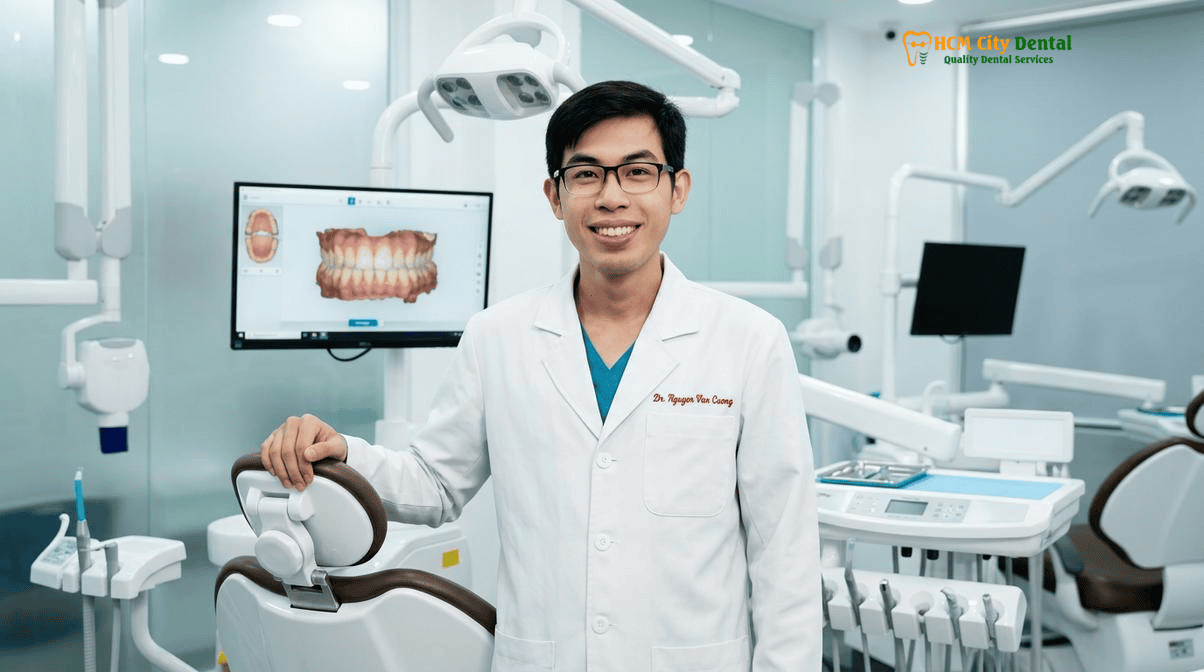
For a comprehensive overview of all our clinical services, including endodontics, oral surgery, and orthodontics, please review our Official 2026 Dental Price List & -40% Online Booking Fee Schedule. We encourage all prospective patients to contact our international coordination team via WhatsApp at +84 853 020 003 to schedule a complimentary digital consultation with Dr. Cuong.
\n\n\n
\n\n\n
Frequently Asked Questions
\n\n
Why does surface texture (perikymata ridges) matter even more than tooth color in making porcelain veneers look 100% real?
\n
Surface texture, specifically the microscopic horizontal ridges known as perikymata, dictates how light interacts with the tooth. Without these ridges, light reflects in a harsh, specular manner, creating a glassy, artificial shine typical of fake opaque chiclet porcelain veneers. Perikymata diffuse light, creating a soft, natural luster that mimics youthful human enamel. This diffuse reflection also slightly lowers the value (brightness) of the tooth, increasing its perceived depth and translucency, making the restoration indistinguishable from a natural tooth even under harsh, direct lighting.
\n\n
Can I preview and approve the exact shape and length of my new teeth inside my mouth before Dr. Cuong prepares my enamel?
\n
Yes. Through the 3D motivational mock up smile test drive Vietnam protocol, Dr. Nguyen Van Cuong (Dr. Cuong), DDS utilizes a premium bis-acryl resin to temporarily transfer the digital SKYN design directly over your unprepared teeth. This allows you to evaluate the aesthetics, speech phonetics, and lip support in natural daylight. You can request adjustments to the length, shape, or embrasure spaces in real-time. Only when you are completely thrilled with the mock-up does any irreversible enamel modification occur, ensuring absolute aesthetic predictability.
\n\n
Which tooth shapes (Oval, Softened Rectangular, Triangular, Youthful Dominant Centrals) best suit my facial structure and age?
\n
Tooth shape selection is highly individualized during your bespoke digital smile design Ho Chi Minh City consultation. Oval shapes often soften angular facial features and are frequently chosen for feminine smile designs. Softened rectangular shapes convey strength and are often utilized for masculine aesthetics. Youthful dominant centrals (where the two front teeth are slightly longer than the adjacent lateral incisors) create a dynamic, youthful appearance, mimicking unworn enamel. Dr. Cuong analyzes your facial midline, interpupillary line, lip dynamics, and personality to recommend the ideal morphology from the authentic SKYN natural tooth library.
\n\n
How do you get a bright Hollywood-white smile (BL2/BL3) without the teeth looking like opaque bathroom tiles?
\n
Achieving natural incisal translucency BL2 BL3 vs BL1 shade requires advanced ceramic engineering and a deep understanding of optical physics. Instead of using monochromatic, highly opaque ceramic blocks, we utilize multi-layered or high-translucency (HT/MT) IPS E.max lithium disilicate. By incorporating cervical warmth (a subtle A1/A2 hue near the gingival margin) and opalescent incisal halos (translucent edges that absorb and reflect light dynamically), we create a bright, high-value smile that retains the polychromatic depth, light transmission, and optical vitality of natural, youthful teeth.
\n\n
How many days in Ho Chi Minh City are required for a full Digital Smile Design + Natural Library IPS E.max Veneer makeover?
\n
A comprehensive SKYN concept natural tooth library veneers makeover typically requires 5 to 7 days in Ho Chi Minh City. This efficient timeframe includes the initial 3D CBCT scan, digital photography, and digital design (Day 1); the motivational mock-up approval and conservative enamel preparation (Day 2); the fabrication of the monolithic veneers in our advanced CAD/CAM laboratory (Days 3-4); and the final biomimetic adhesive delivery under rubber dam isolation, followed by occlusal equilibration (Days 5-7). This streamlined workflow ensures maximum precision without compromising the patient’s travel schedule.
\n\n
References
\n
- \n
- Coachman C, Calamita M, Schayder A. (2017). The SKYN Concept: Digital integration of natural tooth morphology into CAD/CAM monolithic restorations. Journal of Esthetic and Restorative Dentistry.
- McLaren EA, Figueira J, Goldstein RE. (2018). Surface micro-texture and perikymata replication in monolithic CAD/CAM lithium disilicate veneers. Journal of Prosthetic Dentistry.
- Magne P, Belser U. (2015). Biomimetic restorative dentistry and natural tooth libraries: A paradigm shift in anterior aesthetics. International Journal of Periodontics & Restorative Dentistry.
- Blatz MB, Conejo J. (2019). Adhesive protocols for IPS E.max lithium disilicate: The role of hydrofluoric acid and silane in long-term bond strength. Compendium of Continuing Education in Dentistry.
- Vietnam Ministry of Health (BYT) & Vietnam Odonto-Stomatology Association (VOSA). National Clinical Guidelines on Specialist Dental Care, Biomaterial Traceability & EN 13060 Class B Infection Control. (2024).
\n
\n
\n
\n
\n
\n\n