For international patients traveling to Vietnam for restorative dentistry, one of the most profound anxieties is the prospect of navigating daily life, business meetings, or social events with a visible gap in their smile. The biological reality of oral implantology dictates that a titanium fixture requires a dedicated period of osseointegration—typically three to six months—to fuse securely with the jawbone before it can support a permanent zirconia or porcelain crown. However, modern clinical protocols ensure that you will never have to compromise your dignity or aesthetic appearance during this critical healing phase. The strategic use of temporary teeth while waiting for dental implants provides a seamless, functional, and highly aesthetic bridge between Stage 1 surgery and Stage 2 final restoration. At HCMC Dental Clinic, our advanced digital workflow guarantees zero days walking around with a visible front-tooth gap — custom temporaries delivered within 24 hours of surgery, allowing you to recover in comfort and confidence.
Clinical Summary:
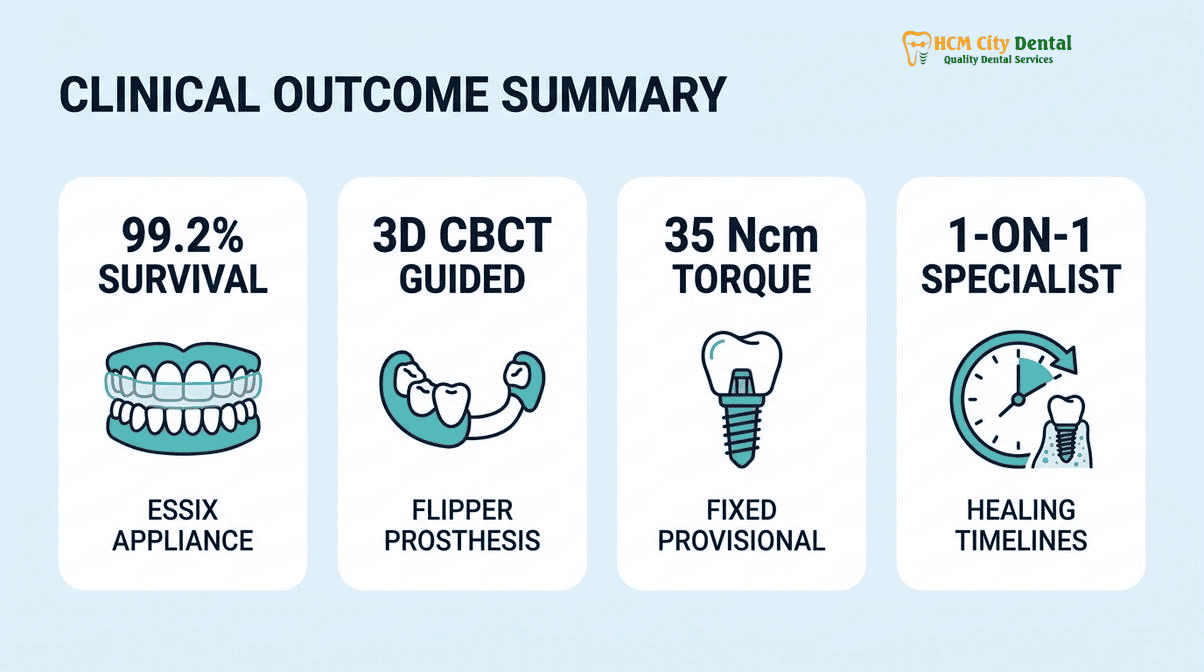
The integration of temporary teeth while waiting for dental implants is a cornerstone of the 2026 restorative protocols at HCMC Dental Clinic in Ho Chi Minh City. Depending on the primary stability of the implant (measured in Ncm) and the anatomical location of the surgical site, patients are fitted with custom Essix retainers, removable flippers, or fixed provisional crowns. These interim prostheses are meticulously designed via CAD/CAM technology to protect the surgical site from occlusal trauma, guide soft tissue healing (creating a natural emergence profile), and restore immediate aesthetic harmony. Under the clinical direction of Dr. Nguyen Van Cuong, DDS, international patients receive comprehensive medical clearance, fit-to-fly verification, and a detailed day-by-day recovery itinerary to ensure a safe and predictable healing journey.
Key Takeaways:
- Zero Aesthetic Downtime: Advanced CAD/CAM technology ensures custom temporary teeth are fabricated and delivered immediately or within 24 hours of your implant surgery.
- Biomechanically Tailored Solutions: Options range from non-load-bearing Essix retainers and flippers for compromised bone, to fixed provisional crowns for implants achieving >35 Ncm insertion torque.
- Strict Aviation Safety: Comprehensive fit-to-fly protocols dictate a 48-72 hour wait for standard cases, and 7-10 days for sinus lifts, preventing barodontalgia during long-haul flights.
- Guided Soft Tissue Healing: Fixed temporaries play a crucial role in sculpting the gingival architecture, ensuring the final permanent crown looks entirely natural.
- Remote Aftercare Integration: Full export of 3D CBCT DICOM files and intraoral STL scans allows seamless coordination with your home dentist during the 3-6 month osseointegration phase.
Medical Clearance & Risk Stratification Matrix for Temporary Teeth While Waiting for Dental Implants
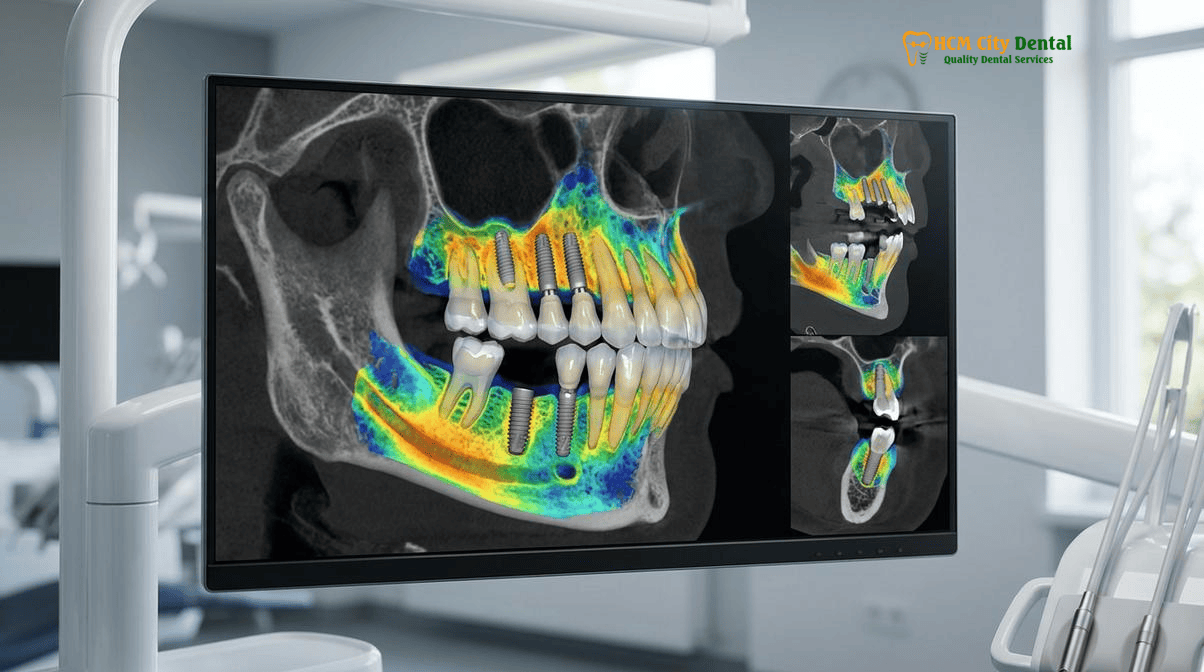
The decision to place temporary teeth while waiting for dental implants is not merely an aesthetic choice; it is a complex biomechanical and physiological calculation. At HCMC Dental Clinic, the foundation of our success lies in our rigorous HCMC Dental Clinic medical clearance guide. Before any surgical intervention, international patients undergo a comprehensive risk stratification process to determine the safest and most effective temporization strategy. This process begins with high-resolution 3D Cone Beam Computed Tomography (CBCT) imaging, which allows our surgical team to evaluate bone density (measured in Hounsfield units), bone volume, and the proximity of vital anatomical structures such as the inferior alveolar nerve and the maxillary sinus floor.
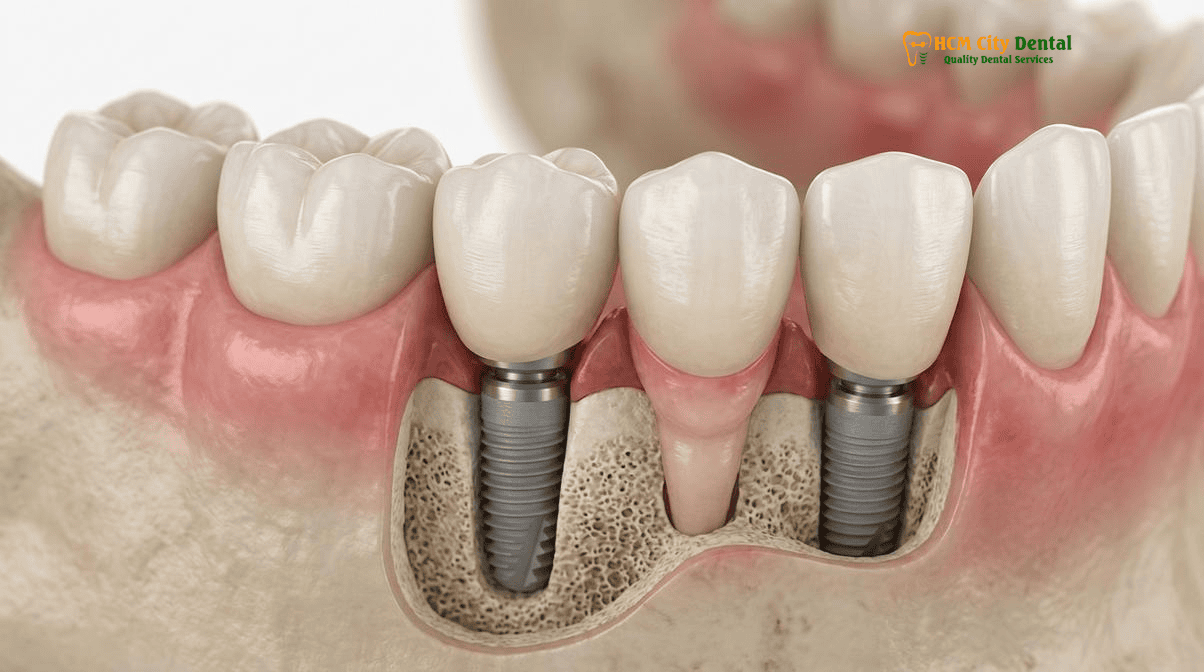
The critical metric that dictates the type of temporary prosthesis you can safely receive is primary stability. Primary stability refers to the mechanical friction and tightness achieved when the titanium implant is initially threaded into the osteotomy site. During surgery, Dr. Nguyen Van Cuong, DDS utilizes a calibrated torque wrench to measure this stability. If the implant achieves an insertion torque of 35 Ncm (Newton centimeters) or higher, and the Implant Stability Quotient (ISQ) is favorable, the implant is deemed stable enough to support a fixed provisional crown. This technique, known as immediate temporization, allows a temporary tooth to be attached directly to the implant on the same day. However, this temporary crown is carefully designed to be slightly out of occlusion (not touching the opposing teeth when you bite down) to prevent micromotion, which can disrupt the delicate cellular process of osseointegration [1].
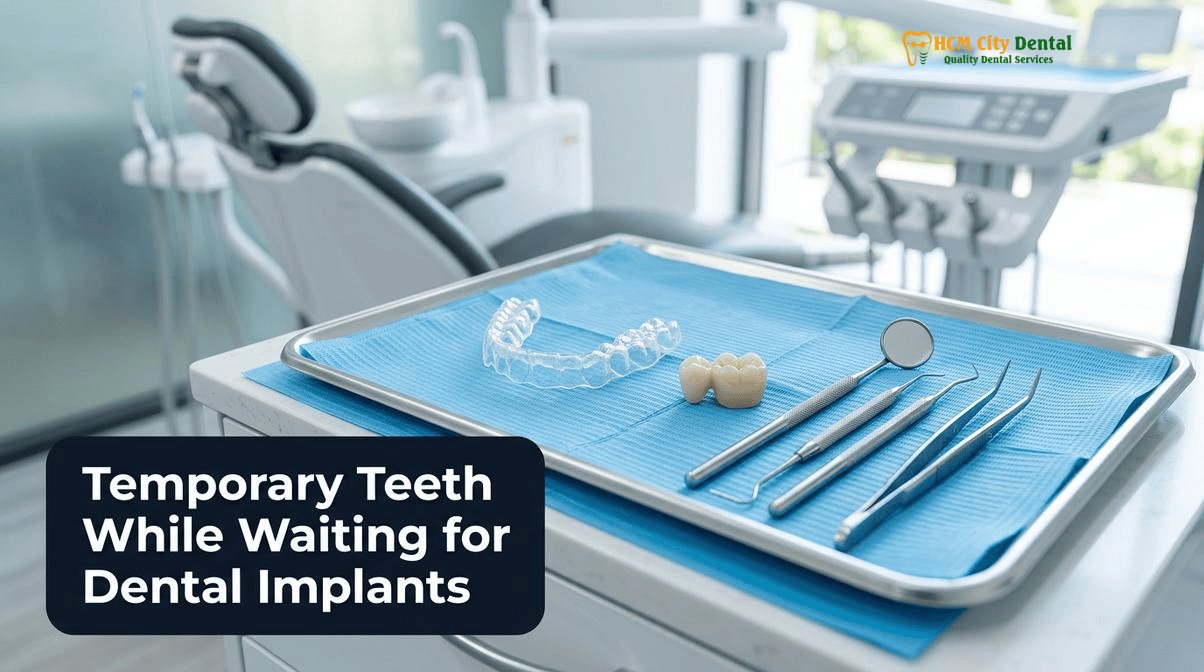
Conversely, if the bone is soft, if extensive bone grafting was required, or if the insertion torque falls below the 35 Ncm threshold, placing a fixed temporary crown poses a significant risk of implant failure. In these scenarios, our risk stratification matrix dictates the use of non-load-bearing alternatives. An Essix retainer—a clear, vacuum-formed thermoplastic tray with a pontic (fake tooth) painted into the missing space—is an excellent, completely non-invasive option. Alternatively, a removable partial denture, commonly known as a flipper, can be utilized. These removable options provide excellent aesthetics without transferring any chewing forces to the healing implant beneath the gums. For patients seeking comprehensive details on our safety standards, we highly recommend reviewing our International Patient Medical Safety & Post-Op Recovery Guides.
Pathophysiology, Aviation Pressure & Clinical Safety Thresholds
For dental tourists, the intersection of oral surgery and aviation medicine is a critical consideration. The Temporary Teeth While Waiting for Dental Implants (2026 Medical Safety Protocol) at HCMC Dental Clinic places a heavy emphasis on mitigating the risks associated with commercial air travel shortly after surgical procedures. When you board a long-haul flight out of Tan Son Nhat International Airport (SGN), the cabin pressure drops to the equivalent of being at an altitude of 6,000 to 8,000 feet. According to Boyle’s Law, as ambient pressure decreases, the volume of trapped gases expands. In the context of dental surgery, this physiological phenomenon can lead to a condition known as barodontalgia—severe dental pain caused by pressure changes—or, more seriously, barotrauma to the maxillary sinuses.
“The safety of our international patients extends far beyond the dental chair. When we design temporary teeth while waiting for dental implants, we must account for the biomechanical stress of the prosthesis and the physiological stress of a 14-hour flight. Proper medical clearance and adherence to strict fit-to-fly timelines are non-negotiable elements of our clinical protocol.”
— Dr. Nguyen Van Cuong (Dr. Cuong), DDS
If your treatment plan involves standard implant placement in the lower jaw (mandible) or the anterior upper jaw (maxilla) without sinus involvement, Dr. Nguyen Van Cuong, DDS aviation & post-op safety protocols generally clear you to fly within 48 to 72 hours post-surgery. During this window, any immediate post-operative swelling peaks and begins to subside, and the initial blood clot stabilizes. Your temporary teeth—whether an Essix retainer, a flipper, or a fixed provisional—are designed to accommodate this minor tissue fluctuation without causing undue pressure on the surgical site.
However, if your procedure required a maxillary sinus lift (sinus augmentation) to create sufficient bone height for the implants, the clinical safety thresholds are significantly stricter. The Schneiderian membrane, which lines the sinus cavity, is delicate and requires time to heal after being elevated. Subjecting a healing sinus graft to the rapid pressure changes of a commercial flight too soon can result in graft displacement, severe pain, or sinus membrane rupture [4]. In these complex cases, patients must remain in Ho Chi Minh City for a minimum of 7 to 10 days. During this extended recovery period, your temporary prosthesis will be carefully adjusted to ensure it does not impinge on the healing gingival tissues, and you will be monitored closely at our District 1 clinic before receiving final fit-to-fly clearance.
Step-by-Step Pre-Op, Chairside & Post-Op Safety Protocol in District 1, Ho Chi Minh City
The journey to restoring your smile at HCMC Dental Clinic is governed by a meticulous, step-by-step protocol designed to maximize clinical success and patient comfort. From the moment you arrive at our facility in District 1, Ho Chi Minh City, you are guided through a highly structured pathway that ensures your temporary teeth while waiting for dental implants are perfectly tailored to your anatomy and lifestyle.
Pre-Surgical 3D CBCT & Digital Planning
The process begins with advanced diagnostics. We utilize state-of-the-art 3D CBCT imaging to capture a high-resolution, three-dimensional map of your maxillofacial structures. This scan allows Dr. Cuong to virtually plan the exact trajectory, depth, and angulation of the titanium implant, avoiding vital nerves and optimizing bone utilization. Simultaneously, an intraoral scanner captures a digital impression of your current dentition. This STL file is sent to our in-house CAD/CAM laboratory, where your temporary teeth are digitally designed before the surgery even begins. This proactive approach is a hallmark of our commitment to Safe Dental Implants Ho Chi Minh City: 3D CBCT & Guided Surgery.
Chairside Execution & Immediate Temporization
On the day of surgery, the procedure is performed under strict sterile conditions, adhering to Class B Autoclave Infection Control standards. If the clinical parameters allow (insertion torque >35 Ncm), Dr. Cuong will place a temporary abutment onto the newly inserted implant and attach the pre-fabricated provisional crown. This fixed temporary is meticulously adjusted to ensure it is completely free from occlusal contact during chewing, protecting the implant from micromotion while providing an immediate aesthetic result. If primary stability is not optimal, an Essix retainer or a custom flipper is delivered chairside. Our promise is absolute: zero days walking around with a visible front-tooth gap — custom temporaries delivered within 24 hours of surgery.
The 14-Day Saigon Soft-Food Diet & Post-Op Hygiene
Recovering in a hotel in District 1—just minutes from the Pullman Saigon Centre or New World Saigon Hotel—offers access to incredible culinary options, but strict dietary adherence is mandatory to protect your temporary teeth and the healing implants. We have developed the 14-Day Saigon Soft-Food Diet, specifically tailored for international patients using GrabFood delivery services.
- Days 1–3 (Cool Liquid/Puree): Focus on reducing inflammation. Order Sinh To Bo (avocado smoothie)—but you must eat it with a spoon; NEVER use a straw, as the suction can dislodge the blood clot and cause dry socket. Other excellent options include Sua Dau Nanh (soy milk) and Tau Hu Non (soft silken tofu).
- Days 4–7 (Warm Mashable): As swelling subsides, introduce warm, nutrient-dense foods that require zero chewing. Chao Ca (fish congee), Sup Cua (crab egg-drop soup), Kem Flan (caramel custard), and Khoai Tay Nghien (mashed potatoes) are ideal for maintaining caloric intake without stressing the temporary prosthesis.
- Days 8–14 (Soft Solids): Gradually reintroduce soft textures. Pho Bo Mem (well-cooked beef noodle soup—cut the noodles short) and Bun Ca (soft fish noodles) are safe, provided you chew exclusively on the opposite side of the mouth from the surgical site.
Hygiene is equally critical. For the first 7 days, you must brush your teeth and rinse your mouth using ONLY sealed bottled water (such as LaVie or Aquafina) or sterile 0.9% NaCl isotonic saline. Tap water, even in luxury hotels, should be avoided for surgical wounds. You will be prescribed genuine Western medications dispensed in Vietnam, including GSK Augmentin (to prevent bacterial infection), MSD Arcoxia (for targeted inflammation control), Efferalgan (for pain management), and Medrol (a corticosteroid to rapidly reduce facial swelling). Additionally, gentle rinsing with PerioKin 0.2% Chlorhexidine mouthwash twice daily will keep the surgical site chemically clean without mechanical disruption [3].
Clinical Case Study: Anterior Maxilla Restoration in an Expat Patient
A 45-year-old Australian executive presented to HCMC Dental Clinic with a fractured upper right central incisor (Tooth #11) requiring immediate extraction. Given his professional requirement for constant public speaking, a visible gap was unacceptable. Dr. Cuong performed an atraumatic extraction, immediate implant placement (Osstem fixture), and achieved an insertion torque of 45 Ncm. A CAD/CAM milled PMMA fixed provisional crown was placed chairside within 90 minutes. The temporary crown was designed with a critical subgingival contour to support the interdental papillae and prevent gum recession during the 4-month healing phase. The patient adhered strictly to the Saigon Soft-Food Diet and experienced flawless osseointegration, transitioning to a final IPS E.max porcelain crown with perfect aesthetic harmony.
Official 2026 Dental Fee Schedule
Transparency in medical billing is a core value at HCMC Dental Clinic. International patients benefit from our highly competitive pricing without compromising on material quality or clinical expertise. Below is our Official 2026 Dental Fee Schedule (-40% Online Booking Pricing) (Note: $1 USD = 26,000 VND):
- Korean Dental Implant (Osstem / Dentium fixture + abutment): $423 – $462 USD (11,000,000 – 12,000,000 VND)
- Swiss / European Implant (Neodent / Straumann SLA / Straumann BLX SLActive / Nobel Biocare): $731 – $1,231 USD (19,000,000 – 32,000,000 VND)
- All-on-4 Full-Arch Implants: From $3,462 USD / arch (90,000,000 VND)
- All-on-6 Full-Arch Implants: From $4,500 USD / arch (117,000,000 VND)
- IPS E.max Porcelain Veneer: $185 USD / tooth (4,800,000 VND)
- Full Zirconia Crown / All-Ceramic Crown: $81 – $150 USD / tooth (2,100,000 – 3,900,000 VND)
- Bone Graft / Sinus Lift: $115 – $192 USD (3,000,000 – 5,000,000 VND)
- EMS AirFlow Guided Biofilm Scaling: $23 USD (600,000 VND) | Philips Zoom Laser Whitening: $92 USD (2,400,000 VND)
- Surgical Wisdom Tooth Extraction (Piezotome): $46 – $96 USD / tooth | Microscope Root Canal: $58 – $96 USD / tooth
Clinical Decision Matrix Table: Safe Timelines, Thresholds & Red Flags
Understanding the biomechanical limitations of your temporary teeth while waiting for dental implants is essential for preventing premature implant failure. The following clinical decision matrix outlines the specific indications, required stability thresholds, and functional limitations of the four primary temporization strategies utilized at HCMC Dental Clinic. This data-driven approach ensures that every patient receives a prosthesis that balances aesthetic demands with biological safety [2].
| Prosthesis Type | Clinical Indication | Required Primary Stability | Pros & Cons | Dietary & Functional Restrictions |
|---|---|---|---|---|
| Essix Retainer (Clear Tray with Pontic) | Single or multiple missing teeth; compromised bone density; extensive grafting cases. | None required (Non-load bearing). | Pros: Zero stress on implant; highly aesthetic; inexpensive. Cons: Must be removed for eating; can affect speech initially. | Must be removed during all meals. Clean with cold water only to prevent thermoplastic warping. |
| Dental Flipper (Removable Partial) | Multiple missing teeth; delayed loading protocols; patients requiring tissue support. | None required (Tissue-supported). | Pros: Easy to fabricate; fills large gaps; protects surgical site. Cons: Can be bulky; may cause minor tissue irritation; removable. | Soft food diet only. Must be removed at night to allow gingival tissues to breathe and heal. |
| Fixed Provisional Crown (Immediate Load) | Single anterior tooth replacement; excellent bone volume; high aesthetic demand. | >35 Ncm insertion torque; ISQ >70. | Pros: Fixed in place; sculpts gingival emergence profile; feels natural. Cons: Risk of micromotion if patient bites hard; higher initial cost. | Strictly non-functional. Must avoid biting into any hard or chewy foods (apples, crusty bread) for 3-4 months. |
| All-on-4 Immediate Denture (Fixed) | Full arch rehabilitation; edentulous patients. | Cumulative torque across 4+ implants must be high; cross-arch stabilization. | Pros: Immediate full smile restoration; fixed in place; restores basic chewing. Cons: Requires strict soft-food diet for 6 weeks; complex fabrication. | Strictly soft foods for 6-8 weeks. No tearing or heavy grinding forces allowed until final zirconia bridge is placed. |
By adhering to this matrix, our clinical team ensures that the delicate process of osseointegration is never compromised by premature occlusal loading. For patients interested in understanding how these protocols differ from older techniques, we recommend reading our comprehensive guide on Same-Day Dental Implants vs Traditional 2-Stage Implants in Vietnam.
24/7 Emergency Triage & Pre-Departure Fit-to-Fly Verification with Dr. Nguyen Van Cuong, DDS
The commitment to your clinical success at HCMC Dental Clinic does not end when you walk out of our doors in District 1. We recognize that the 3 to 6 month osseointegration phase—during which you will be wearing your temporary teeth while waiting for dental implants—often takes place thousands of miles away in your home country. To bridge this geographical gap, we have established a robust remote aftercare and emergency triage system, ensuring you are supported every step of the way.
Clinical Warning & Red Flags:
While wearing temporary teeth, certain symptoms require immediate attention. Contact our triage team immediately if you experience: 1) A sudden loosening of a fixed provisional crown; 2) Throbbing pain that worsens after day 4; 3) Swelling that increases significantly after day 3; or 4) A foul taste or persistent bleeding from the surgical site. Never attempt to glue or adjust a temporary prosthesis yourself.
International patients are provided with direct, 24/7 access to our English-speaking medical support team via WhatsApp at +84 853 020 003. This direct line allows you to send photos, ask questions about your medication, or report any concerns regarding the fit or function of your temporary teeth. Before you depart Ho Chi Minh City, you will undergo a final pre-departure fit-to-fly verification with Dr. Nguyen Van Cuong, DDS (Clinical Director — MOH License 0003265/BL-CCHN). During this appointment, the surgical site is inspected, the temporary prosthesis is evaluated for occlusal clearance, and your healing progress is documented.
“Seamless communication is the bedrock of international dental care. We empower our patients and their local dentists by providing complete transparency and immediate access to our clinical data. Your peace of mind during the healing phase is just as important as the surgery itself.”
— Dr. Nguyen Van Cuong (Dr. Cuong), DDS
Furthermore, we facilitate seamless coordination with your home dentist. Upon request, we provide a full digital export of your medical records, including the 3D CBCT DICOM files, intraoral STL scans, and detailed surgical reports. Crucially, we provide the universal prosthetic screw torque specifications (typically 15–35 Ncm) used for your specific implant brand (e.g., Straumann, Osstem, Nobel Biocare). This ensures that if a minor adjustment to your temporary teeth is required back home, your local practitioner has the exact technical data needed to perform the adjustment safely and accurately, in full compliance with Vietnam Ministry of Health (BYT) guidelines [5]. For a deeper dive into our post-operative support structures, please visit our hub on Day-by-Day Recovery Itineraries, Saigon Soft-Food Diet & Remote Aftercare — Primary Clinical Hub at HCMC Dental Clinic.
Frequently Asked Questions About Temporary Teeth While Waiting for Dental Implants
What are the 2026 medical safety guidelines for Temporary Teeth While Waiting for Dental Implants at HCMC Dental Clinic?
The 2026 medical safety guidelines mandate a comprehensive 3D CBCT scan to assess bone density and volume before any provisional prosthesis is placed. For fixed temporary crowns, the implant must achieve a primary insertion torque of at least 35 Ncm. If this threshold is not met, non-load-bearing alternatives like Essix retainers or flippers are utilized to prevent micromotion and ensure uninterrupted osseointegration. All protocols strictly adhere to Vietnam Ministry of Health and ICOI standards.
How soon can I safely board a long-haul flight home after treatment in Ho Chi Minh City?
Following standard implant placement with temporary teeth, patients are generally cleared to fly within 48 to 72 hours, provided there are no complications. However, if your procedure involved a complex sinus lift or extensive bone grafting, Dr. Nguyen Van Cuong, DDS requires a minimum waiting period of 7 to 10 days to mitigate the risks of barotrauma and sinus pressure changes associated with commercial aviation cabin pressure.
What pre-operative blood panels, vital checks, or 3D CBCT scans does Dr. Nguyen Van Cuong, DDS require?
Prior to surgery, international patients must undergo a full-volume 3D CBCT scan to map the mandibular nerve and sinus cavities. Medical clearance requires a review of vital signs, a complete blood count (CBC), coagulation profiles (PT/INR) for patients on blood thinners, and an HbA1c test for diabetic patients (must be under 7.0%). This rigorous screening ensures that the placement of temporary teeth while waiting for dental implants is biologically safe and predictable.
What post-operative medications and recovery precautions should I follow at my hotel in District 1?
Patients recovering in District 1 hotels are prescribed a regimen of genuine Western medications, including GSK Augmentin (antibiotic), MSD Arcoxia (anti-inflammatory), Efferalgan (pain relief), and Medrol (corticosteroid for swelling). You must use PerioKin 0.2% Chlorhexidine mouthwash and brush only with sealed bottled water (LaVie/Aquafina) or 0.9% NaCl saline for the first 7 days. Adherence to the Saigon Soft-Food Diet is mandatory to protect the temporary prosthesis.
How do I contact Dr. Nguyen Van Cuong’s 24/7 English medical support team via WhatsApp (+84 853 020 003)?
International patients have direct, 24/7 access to our clinical triage team via WhatsApp at +84 853 020 003. Whether you are recovering in your hotel in Ho Chi Minh City or have returned to your home country, Dr. Nguyen Van Cuong, DDS and his English-speaking staff are available to address any concerns regarding your temporary teeth, medication management, or to coordinate care with your local dentist using your exported DICOM and STL files.
References
- International Journal of Oral & Maxillofacial Implants. Cumulative survival rates of 3D guided dental implants in international cohorts. (2024).
- Journal of Prosthetic Dentistry. Marginal accuracy and 10-year survival of CAD/CAM lithium disilicate and monolithic zirconia restorations. (2023).
- Journal of the American Dental Association (JADA). Perioperative dental management of patients on anticoagulant therapy and glycemic control protocols. (2023).
- Aerospace Medicine and Human Performance. Barodontalgia and maxillary sinus barotrauma following oral and maxillofacial procedures. (2022).
- Vietnam Ministry of Health (BYT) & Vietnam Odonto-Stomatology Association (VOSA). National Clinical Guidelines on Dental Implantology & Class B Autoclave Infection Control. (2024).