When patients face the devastating reality of terminal dentition or complete edentulism, full-arch implant rehabilitation offers a life-changing restoration of function, aesthetics, and confidence. However, the transition from failing natural teeth to a fixed, implant-supported prosthesis is not a one-size-fits-all procedure. The architectural design of the final bridge—specifically how it interfaces with the jawbone and soft tissues—is dictated by the patient’s unique anatomical deficits. Understanding the FP1 FP2 FP3 prosthetic classification all on 4 pink porcelain framework is the most critical step in achieving a natural-looking, biomechanically sound, and easily cleansable smile. At HCMC Dental Clinic in District 1, Ho Chi Minh City, our prosthodontic protocols are strictly governed by evidence-based classifications to ensure that every patient receives a bespoke restoration tailored to their specific degree of bone loss and lip dynamics.
Clinical Summary:
The Misch Prosthetic Classification categorizes fixed implant restorations based on the volume of hard and soft tissue that must be replaced. An FP1 prosthesis replaces only the anatomical crowns of the teeth, emerging naturally from the patient’s native gums, and is reserved for cases with minimal bone loss. An FP3 prosthesis, commonly utilized in the All-on-4 protocol, replaces both the missing teeth and the resorbed alveolar bone/gingiva using a hybrid of white crowns and pink gingival porcelain. The FP3 design requires precise surgical bone reduction (alveoloplasty) to hide the prosthetic transition line above the high smile line, restoring vertical facial dimension and lip support while ensuring a highly polished, convex intaglio surface for optimal hygiene.
Key Takeaways:
- Misch Classification: FP1 replaces teeth only; FP2 replaces teeth and a portion of the root (hypercontoured); FP3 replaces teeth and lost gingival tissue with pink porcelain.
- Bone Preservation vs. Reduction: FP1 requires the preservation of native alveolar bone and scalloped papillae, whereas FP3 requires targeted alveoloplasty to conceal the transition line.
- Biomechanical Materials: Modern FP1 and FP3 restorations utilize 1,100–1,200 MPa monolithic 3Y-TZP zirconia for maximum durability against occlusal forces.
- Hygiene Protocols: FP1 allows for traditional brushing and flossing around individual cervical contours, while FP3 requires water-flossing beneath a highly polished, convex intaglio surface.
- Specialist Execution: Led by Dr. Nguyen Van Cuong, DDS (Clinical Director — MOH License 0003265/BL-CCHN), HCMC Dental Clinic provides world-class full-arch rehabilitation utilizing 3D CBCT diagnostics and dynamic optical navigation.
Carl Misch’s Prosthetic Classification Explained: What Are FP1, FP2, and FP3 Fixed Implant Restorations?
In the late 1980s, Dr. Carl E. Misch developed a comprehensive classification system for implant-supported prostheses that remains the gold standard in modern prosthodontics. This system categorizes restorations not by the number of implants used, but by the volume and type of anatomical tissue that the prosthesis must artificially replace. When planning 3D-Guided All-on-4 & All-on-6 Full-Arch Dental Implants in Vietnam, understanding this classification is paramount, as it dictates the surgical approach, the restorative materials, and the patient’s long-term maintenance routine.
The Misch classification divides fixed prostheses (FP) into three distinct categories[1]:
- FP1 (Fixed Prosthesis 1): This restoration replaces only the anatomical crowns of the missing teeth. To the naked eye, an FP1 prosthesis looks identical to natural teeth emerging directly from the patient’s native gingiva. There is no artificial pink material used. This classification demands near-perfect preservation of the alveolar bone and interdental papillae.
- FP2 (Fixed Prosthesis 2): This restoration replaces the anatomical crowns and a portion of the root. Because some bone loss has occurred, the prosthetic teeth must be elongated to reach the receded gum line. While there is no pink porcelain used, the teeth appear hypercontoured or “long in the tooth.” FP2 is rarely used in the aesthetic zone for patients with a high smile line due to its unnatural appearance.
- FP3 (Fixed Prosthesis 3): This restoration replaces the missing crowns, the lost gingival tissue, and the resorbed alveolar bone. It utilizes a combination of white tooth material and pink gingival porcelain (or acrylic) to restore the massive tissue deficit. The FP3 design is the most common classification for traditional All-on-4 restorations, as it effectively restores facial vertical dimension and lip support in patients with moderate to severe bone atrophy.
It is also important to contrast these fixed options with removable prostheses. The Misch classification defines RP4 as a 100% implant-borne, CAD/CAM milled titanium bar overdenture (which is removable by the patient but completely supported by implants, allowing for an open palate), and RP5 as a tissue-and-implant-supported overdenture (typically utilizing 2-to-4 implants with Zest Locator attachments). While RP4 and RP5 offer excellent solutions for specific anatomical and financial constraints, FP1 and FP3 remain the pinnacle of fixed, non-removable full-arch rehabilitation.
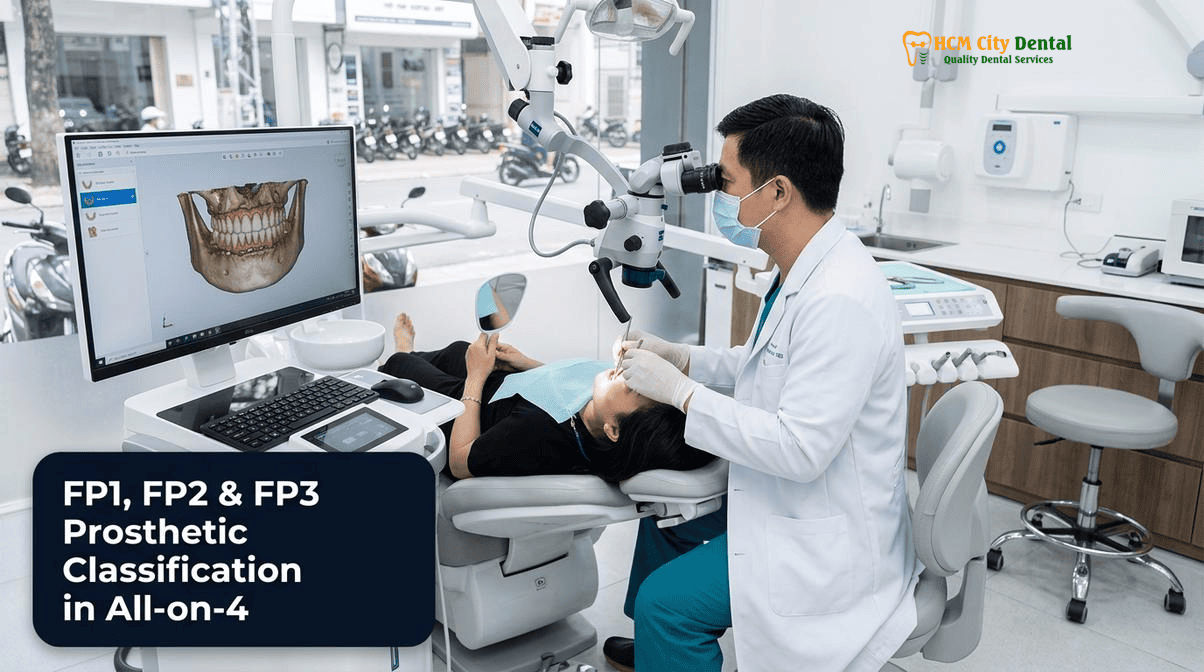
FP1 (White-Only Crown Emergence): Preserving Alveolar Bone & Scalloped Interdental Papillae Without Artificial Pink Gingiva
The FP1 prosthesis represents the holy grail of implant dentistry: a restoration that perfectly mimics the natural dentition without the need for artificial pink gingiva. Achieving an FP1 result is highly complex and technique-sensitive, requiring a meticulous orchestration of surgical precision and advanced prosthodontic contouring.
To qualify for an FP1 restoration, the patient must present with minimal to no alveolar bone loss. The native bone architecture must be robust enough to support implants placed in the exact three-dimensional positions of the original tooth roots. Furthermore, the soft tissue must exhibit thick biotype characteristics with intact, scalloped interdental papillae. If a patient has suffered from severe periodontitis or long-term edentulism, the bone and soft tissue will have resorbed, making an FP1 restoration biologically impossible without extensive, unpredictable vertical ridge augmentation.
The clinical success of an FP1 prosthesis relies heavily on the management of the emergence profile. At HCMC Dental Clinic, we strictly adhere to the Su & Gonzalez-Martin principles of Critical and Subcritical contour management[2]. Following implant placement, custom PEEK or composite healing abutments are utilized to sculpt the peri-implant mucosa. The subcritical contour (the portion of the abutment apical to the gingival margin) is designed to provide space for soft tissue thickening, while the critical contour (the portion immediately at the gingival margin) is shaped to support the zenith and push the interdental papillae into the embrasure spaces.
“An FP1 restoration is not merely about attaching white crowns to titanium posts; it is an exercise in biomimetic tissue engineering. We must manipulate the peri-implant mucosa using highly polished PMMA provisionals to coax the gingiva into forming natural, scalloped papillae before we ever mill the final zirconia. The margin for error is measured in fractions of a millimeter.”
— Dr. Nguyen Van Cuong, DDS (Clinical Director, HCMC Dental Clinic)
When executed correctly, the final FP1 monolithic zirconia bridge emerges seamlessly from the patient’s natural gums. There is no transition line to hide, and the patient can brush and floss around the individual cervical contours exactly as they would with natural teeth. This approach is often utilized in conjunction with immediate implant placement protocols, where failing teeth are extracted and implants are placed in the same surgical visit to prevent the inevitable bone resorption that follows tooth loss.
FP3 (Hybrid Pink Gingival Porcelain + White Crowns): Restoring Vertical Lip Support and Concealing the High Smile Transition Line
While the FP1 prosthesis is ideal for patients with intact bone, the reality is that the vast majority of patients seeking full-arch rehabilitation have already experienced significant alveolar bone resorption. Years of wearing removable dentures or suffering from advanced periodontal disease cause the jawbone to atrophy in both height and width. In these scenarios, attempting an FP1 or FP2 restoration would result in grotesquely elongated teeth that offer no support to the collapsing facial musculature.
The FP3 prosthesis is the definitive solution for the resorbed maxilla and mandible. By incorporating pink gingival porcelain into the prosthetic design, the FP3 bridge replaces not only the missing teeth but also the lost bone and soft tissue volume. This hybrid design is the cornerstone of the All-on-4 and All-on-6 treatment modalities.
The inclusion of pink porcelain serves a critical biomechanical and aesthetic function: it restores the vertical dimension of occlusion (VDO) and provides essential anterior-posterior lip support. Without this prosthetic flange, the patient’s lips would appear sunken, prematurely aging the face. The pink porcelain acts as an architectural scaffold, pushing the lips outward to their natural, youthful position.
At HCMC Dental Clinic, our FP3 restorations are milled from 1,100–1,200 MPa monolithic 3Y-TZP (Yttria-stabilized tetragonal zirconia polycrystal). This ultra-high-strength ceramic is virtually indestructible under normal occlusal forces. The pink gingival architecture is then meticulously hand-layered and oven-baked by master ceramists to replicate the stippling, vascularity, and color variations of natural human gingiva. For patients with heavy bruxism (teeth grinding), a hard Michigan splint is provided to protect the ceramic from extreme parafunctional forces.
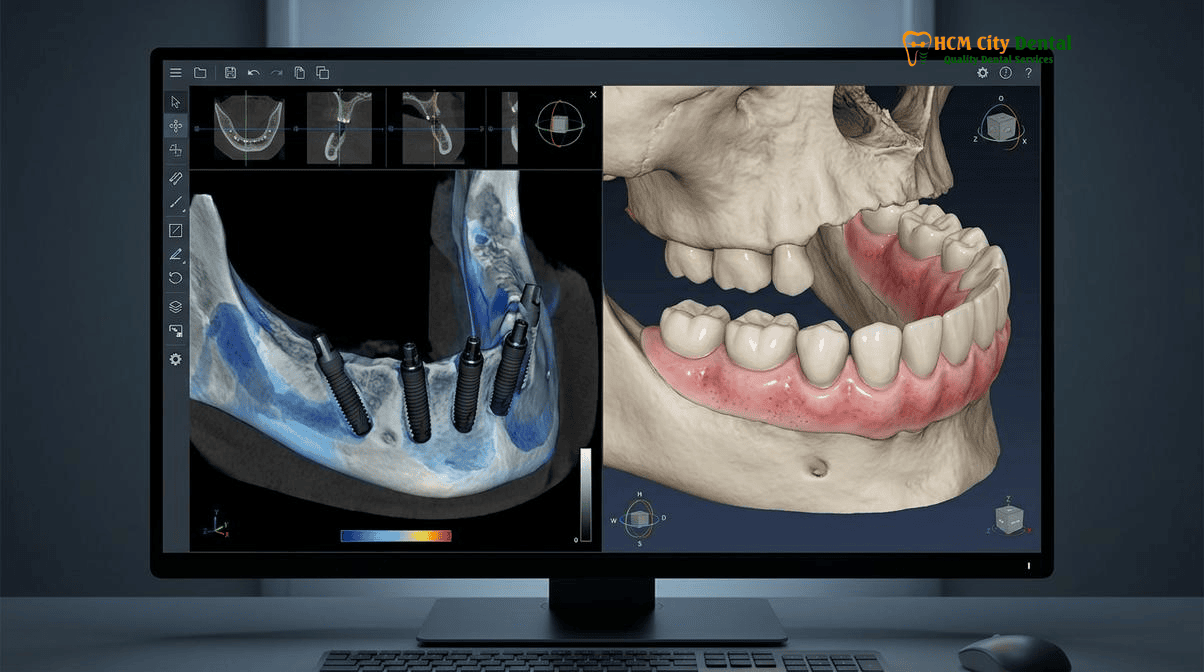
Surgical Bone Reduction (Alveoloplasty) Biomechanics: Why Placing the Prosthetic-Tissue Junction 3mm Apical to the Lip Line Is Critical
The most critical surgical step in fabricating an aesthetic FP3 prosthesis is the management of the transition line—the junction where the artificial pink porcelain of the bridge meets the patient’s natural gum tissue. If this transition line is visible when the patient smiles or laughs, the illusion of natural teeth is instantly shattered, resulting in a highly unesthetic “double gum line.”
To prevent this catastrophic aesthetic failure, the surgeon must perform an alveoloplasty (surgical bone reduction) prior to implant placement. The goal of alveoloplasty is to lower the crest of the alveolar ridge so that the prosthetic-tissue junction is hidden deep beneath the patient’s upper lip. Biomechanically and aesthetically, this junction must be placed a minimum of 3mm apical to (above) the patient’s maximum high smile line.
During the diagnostic phase, dynamic video analysis and 3D CBCT imaging are used to map the patient’s lip mobility. If the patient has a hypermobile lip (a “gummy smile”), a more aggressive bone reduction is required. While removing healthy bone may seem counterintuitive, it is an absolute necessity for an FP3 prosthesis. It not only hides the transition line but also creates the necessary vertical restorative space (typically 15–18mm) required for the titanium framework, the zirconia teeth, and the pink porcelain to possess adequate bulk strength against fracture.
Clinical Case Study: Managing the Resorbed Maxilla in an Expat Patient
Patient Profile: A 58-year-old Australian expatriate presented to HCMC Dental Clinic with a failing maxillary dentition due to severe periodontitis and a hypermobile high smile line.
Clinical Challenge: The patient required full-arch clearance. However, due to her high smile line, a standard extraction and implant placement would have resulted in a visible transition line. Furthermore, severe posterior bone loss precluded the placement of standard implants in the molar regions.
Surgical Protocol: Dr. Nguyen Van Cuong utilized 3D-Printed Surgical Guide & Flapless Computer-Guided Dental Implants in Vietnam: Precision & Cost protocols to execute a precise 4mm alveoloplasty, ensuring the transition line would be hidden 3mm above her maximum smile. To avoid invasive sinus lift grafting, bicortical Pterygoid implants were placed posteriorly, engaging the dense bone of the maxillary tuberosity, pyramidal process of the palatine bone, and pterygoid plate. These implants achieved >45 Ncm of primary stability, allowing for immediate loading without distal cantilevers[3]. In the anterior, 6mm–8mm Straumann Roxolid (Ti-Zr) splinted short implants were utilized. Extracted healthy tooth structure was processed chairside using a Smart Dentin Grinder to create a 300–1,200 µm Autogenous Demineralized Dentin Matrix, releasing native BMP-2 to graft the extraction sockets.
Outcome: The patient received a monolithic zirconia FP3 prosthesis with hand-layered pink porcelain. The transition line was completely invisible, and the pterygoid implants provided exceptional posterior occlusal support.
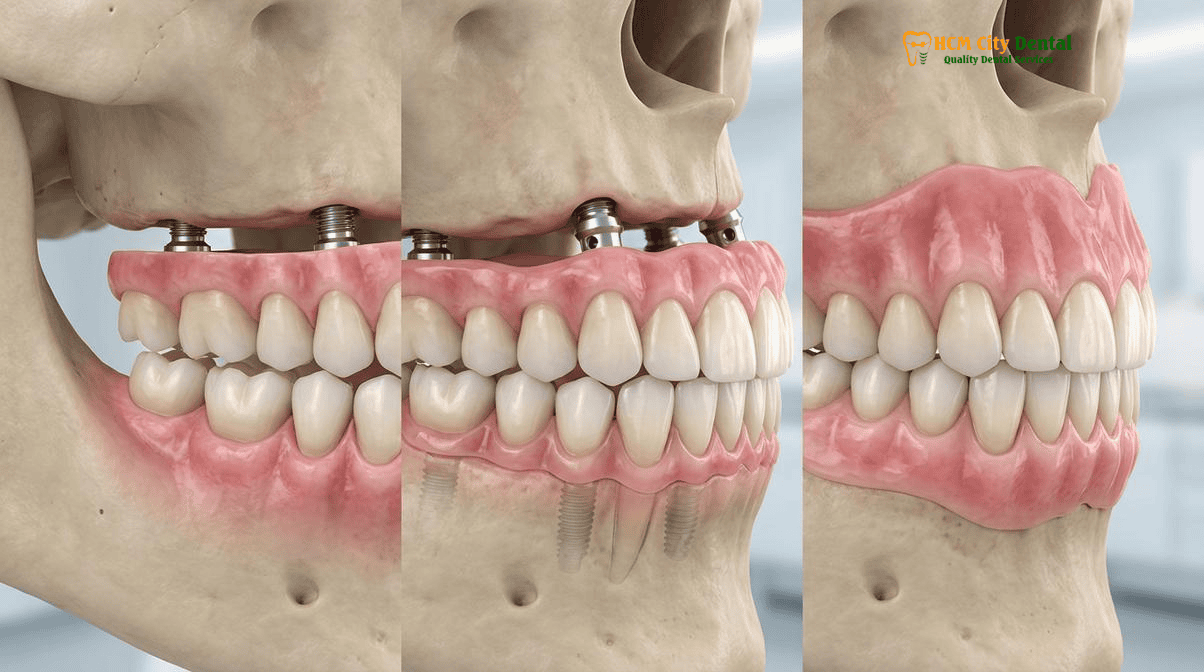
Hygiene & Phonetics Comparison: Water-Flossing Under a Convex FP3 Intaglio vs. Brushing Individual FP1 Cervical Contours
The long-term survivability of any full-arch implant prosthesis is inextricably linked to the patient’s ability to maintain impeccable oral hygiene. The architectural differences between FP1 and FP3 restorations dictate entirely different home-care protocols.
An FP1 prosthesis is maintained much like natural teeth. Because the crowns emerge individually from the gingiva, the patient can use a standard soft-bristled toothbrush and traditional dental floss to clean the cervical contours. There is no prosthetic flange or artificial gum base to navigate around.
Conversely, an FP3 prosthesis requires specialized hygiene techniques. The bridge sits atop the soft tissue, creating a micro-gap between the intaglio (underside) of the prosthesis and the mucosal ridge. It is a strict clinical mandate at HCMC Dental Clinic that the intaglio surface of an FP3 bridge must be highly polished and convex (bullet-shaped) or flat-to-convex. A ridge-lap (concave) design is never used, as it creates an inaccessible dead space that traps food, plaque, and bacterial biofilm.
Patients with an FP3 prosthesis must use a water flosser (e.g., Waterpik) and specialized interdental brushes (such as TePe brushes) or SuperFloss to clean beneath the bridge daily. Failure to remove biofilm from the intaglio surface will lead to peri-implant mucositis, which, if left untreated, progresses to peri-implantitis—an inflammatory condition that destroys the bone supporting the implants.
Clinical Precaution: Managing Peri-Implant Disease
If a patient notices bleeding, swelling, or suppuration (pus) around their implants, immediate intervention is required. At HCMC Dental Clinic, we employ Lang’s CIST (Cumulative Interceptive Supportive Therapy) Protocol (A–D) for the management of peri-implant diseases[4]. Treatment modalities include erythritol air-polishing, mechanical debridement using PEEK tips, diode/Er:YAG laser decontamination, and in severe cases of peri-implantitis, surgical intervention involving titanium brush implantoplasty and Guided Bone Regeneration (GBR) using L-PRF Sticky Bone. Early detection is critical to preventing implant failure.
“The design of the prosthesis intaglio is just as important as the aesthetics of the facial surface. If the patient cannot easily pass a water flosser or interdental brush beneath the bridge, the restoration is destined to fail biologically, regardless of how beautiful it looks. We utilize Multi-Unit Abutments (MUA) & Digital Photogrammetry for Passive-Fit All-on-4 Implants in Vietnam to ensure a frictionless, highly polished interface that repels plaque.”
— Dr. Nguyen Van Cuong, DDS
Phonetics also play a crucial role in the FP1 vs. FP3 debate. An FP1 prosthesis allows for normal AirFlow between the teeth, mimicking natural speech patterns. An FP3 prosthesis, due to its bulk and the presence of the pink flange, can temporarily alter speech, particularly the pronunciation of sibilant sounds (“s” and “sh”) and fricatives (“f” and “v”). However, with proper prosthetic design and a brief adaptation period, patients quickly regain normal phonetic function.
2026 FP1 & FP3 All-on-4 / All-on-6 Monolithic Zirconia Fee Schedule at HCMC Dental Clinic (District 1)
At HCMC Dental Clinic, we believe in absolute transparency regarding the cost of complex full-arch rehabilitation. Whether your anatomical presentation dictates an FP1 natural emergence design or an FP3 pink porcelain hybrid, our comprehensive packages are structured to provide world-class care at a fraction of the cost found in Australia, the US, or Europe. By utilizing our Official 2026 Dental Price List & -40% Online Booking Fee Schedule, international patients can access premium implantology with significant savings.
The following table outlines our 2026 fee schedule for implant and prosthodontic procedures. Please note that All-on-4 and All-on-6 packages are all-inclusive, covering the surgical placement, multi-unit abutments, temporary PMMA bridge, and the final monolithic Zirconia bridge.
| Procedure / Treatment Modality | 2026 Online Booking Price (USD) | 2026 Walk-In / Standard Price (USD) | VND Equivalent (Online) |
|---|---|---|---|
| Single Korean Implant (Dentis / Neo Biotech / Dentium fixture + abutment) | $462 – $654 | $769 – $1,090 | 12,000,000 – 17,000,000 VND |
| Single European / Swiss Implant (Ritter / B&B / Straumann BLT-SLA / Straumann BLA-Active) | $962 – $1,346 | $1,603 – $2,244 | 25,000,000 – 35,000,000 VND |
| 100% Metal-Free Zirconia Ceramic Implant | $1,154 | $1,923 | 30,000,000 VND |
| Implant Zirconia HT Crown + Custom Abutment | $154 | $256 | 4,000,000 VND |
| All-on-4 Full-Arch Implants (Economy) (Complete package: surgery, temporary & final Zirconia bridge) | From $6,346 / arch | From $10,576 / arch | 165,000,000 VND |
| All-on-4 Full-Arch Implants (Standard / Premium) (Neodent / B&B / Straumann SLA / Active) | $7,115 – $10,000 / arch | $11,858 – $16,666 / arch | 185,000,000 – 260,000,000 VND |
| All-on-6 Full-Arch Implants (Economy) (Complete package) | From $8,654 / arch | From $14,423 / arch | 225,000,000 VND |
| All-on-6 Full-Arch Implants (Standard / Premium) (Neodent / B&B / Straumann SLA / Active) | $10,192 – $13,462 / arch | $16,986 – $22,436 / arch | 265,000,000 – 350,000,000 VND |
| Full Zirconia Crown (Cercon Standard / HT Multilayer) | $154 – $192 / tooth | $256 – $321 / tooth | 4,000,000 – 5,000,000 VND |
| 3D CBCT Scan | $18 | $30 | 480,000 VND |
All procedures are performed in strict adherence to the highest international standards of infection control, utilizing EN 13060 Class B autoclaves and ensuring full biomaterial traceability[5]. For international patients traveling to Vietnam, HCMC Dental Clinic is conveniently located in District 1, Ho Chi Minh City—just minutes from major hotels such as the Pullman Saigon Centre and New World Saigon Hotel.
Frequently Asked Questions
How do I know if I am a candidate for an FP1 white-only full-arch bridge or if I need an FP3 bridge with pink porcelain gums?
Candidacy is determined through a comprehensive 3D CBCT scan and a dynamic smile analysis. An FP1 prosthesis requires minimal to no alveolar bone loss, meaning your natural gum line is still at a healthy, anatomically correct height. You must also have sufficient bone volume to support implants placed exactly where the natural tooth roots once were. Conversely, if you have suffered moderate to severe bone resorption due to long-term tooth loss or periodontal disease, an FP3 prosthesis is required. The FP3 design utilizes pink gingival porcelain to replace the lost bone and soft tissue volume, providing essential vertical lip support and restoring your facial profile.
What happens if an FP3 bridge is made without hiding the transition line above my upper lip when I laugh?
If an FP3 bridge is fabricated without proper surgical bone reduction (alveoloplasty), the transition line—the junction where the artificial pink porcelain meets your natural gum tissue—will be visible when you smile or laugh. This results in a highly unnatural, unesthetic appearance, often referred to as a “double gum line.” To prevent this, Dr. Nguyen Van Cuong, DDS, meticulously calculates your maximum smile line and performs targeted bone reduction to ensure the prosthetic-tissue junction is hidden at least 3mm apical to (above) your highest lip mobility point.
Does hand-layered pink gingival porcelain on an FP3 monolithic zirconia bridge stain or fade over time?
No. High-quality, medical-grade pink gingival porcelain that is hand-layered and oven-baked onto a 1,100–1,200 MPa monolithic 3Y-TZP zirconia framework is highly resistant to staining, fading, and plaque accumulation. Unlike older acrylic (PMMA) or composite hybrid dentures, which are porous and prone to absorbing food pigments, odors, and bacterial biofilm, glazed zirconia and porcelain maintain their color stability, biocompatibility, and high-gloss finish for decades when properly maintained with routine oral hygiene.
Why is a ridge-lap (concave) underside never used on All-on-4 bridges at HCMC Dental Clinic?
A ridge-lap or concave intaglio (underside) design is strictly avoided in modern implant prosthodontics because it creates an inaccessible hygienic dead space. Food debris, bacteria, and plaque become trapped within the concavity, making it impossible for the patient to clean effectively with a water flosser or interdental brush. This trapped biofilm rapidly leads to peri-implant mucositis and peri-implantitis, threatening the survival of the implants. Instead, HCMC Dental Clinic utilizes a highly polished, convex (bullet-shaped) or flat-to-convex intaglio surface that allows water and floss to pass smoothly underneath, ensuring optimal cleansability and long-term tissue health.
How much do FP1 and FP3 All-on-4 full-arch implant packages cost at HCMC Dental Clinic in District 1?
At HCMC Dental Clinic, our comprehensive All-on-4 Full-Arch Implant packages (which include the surgical placement, multi-unit abutments, temporary PMMA bridge, and the final monolithic Zirconia bridge) start from $6,346 USD per arch via our -40% online booking fee schedule. Standard packages utilizing Neodent or B&B implants are $7,115 USD, while premium packages featuring Straumann SLA/Active implants range from $8,846 to $10,000 USD per arch. The cost remains transparent whether your specific anatomical needs dictate an FP1 or an FP3 prosthetic design.
References
- Misch, C. E. (1989). Prosthodontic options in implant dentistry. International Journal of Oral & Maxillofacial Implants, 4(1), 17-21.
- Su, H., & Gonzalez-Martin, O. (2010). Critical and subcritical contour management of implant restorations in the esthetic zone. International Journal of Periodontics & Restorative Dentistry, 30(4), 335-343.
- Bedrossian, E., & Sullivan, R. M. (2011). The treatment of the highly resorbed maxilla: the zygomatic and pterygoid implant protocol. Journal of Prosthetic Dentistry, 106(5), 336-342.
- Lang, N. P., & Berglundh, T. (2011). Periimplant diseases: where are we now? Consensus of the Seventh European Workshop on Periodontology. Journal of Clinical Periodontology, 38(s11), 178-181.
- Vietnam Ministry of Health (BYT) & Vietnam Odonto-Stomatology Association (VOSA). National Clinical Guidelines on Specialist Dental Care, Biomaterial Traceability & EN 13060 Class B Infection Control. (2024).