For decades, the standard metric for dental implant success included an accepted, almost inevitable, loss of up to 1.5mm of crestal bone during the first year of functional loading. This phenomenon, often referred to as early marginal bone remodeling, was long considered a normal physiological response to the establishment of the biologic width around the implant-abutment junction. However, modern implantology has undergone a profound paradigm shift. The integration of platform switching morse taper dental implants bone loss prevention protocols has revolutionized our understanding of peri-implant biomechanics. By fundamentally altering the geometry of the implant-abutment connection, contemporary implant systems can now achieve near-zero marginal bone loss, preserving the critical hard tissue architecture required for long-term functional stability and flawless pink esthetics.
At HCMC Dental Clinic, located in District 1, Ho Chi Minh City, the application of advanced biomechanical engineering is at the core of our surgical philosophy. Under the clinical direction of Dr. Nguyen Van Cuong, DDS (Clinical Director — MOH License 0003265/BL-CCHN), our implantology protocols strictly utilize conical Morse taper connections combined with platform switching. This evidence-based approach eliminates the microgap, neutralizes bacterial pump effects, and allows for subcrestal placement strategies that protect the interdental papillae. For international patients, expats, and dental travelers seeking world-class rehabilitation, understanding the physics behind these connections is essential for making informed decisions about their long-term oral health.
Clinical Summary:
The transition from traditional flat-to-flat (butt-joint) implant connections to conical Morse taper designs with platform switching represents the most significant advancement in crestal bone preservation. Traditional external and internal hex implants suffer from a 10–50 micron microgap that permits bacterial leakage and micromotion under occlusal load, leading to an inflammatory infiltrate that resorbs ~1.5mm of crestal bone. Conversely, platform switching dental implants shift this inflammatory zone horizontally inward, away from the bone crest. When combined with the cold-weld friction fit of a conical Morse taper, micromotion is eliminated, abutment screw loosening is prevented, and the microgap is reduced to less than 1 micron. This biomechanical synergy allows for subcrestal implant placement, resulting in <0.2mm of crestal bone loss at 36 months and superior preservation of the overlying gingival papillae.
Key Takeaways:
- The Microgap Problem: Traditional butt-joint connections exhibit a 10–50 micron gap, allowing bacteria (1–2 microns in size) to colonize the implant interior, triggering crestal bone resorption.
- Platform Switching Biomechanics: Utilizing an abutment narrower than the implant platform shifts the implant-abutment junction (IAJ) inward, relocating the inflammatory cell infiltrate away from the marginal bone.
- Conical Morse Taper Cold-Weld: An internal conical connection (typically 5 to 15 degrees) creates a friction-fit cold weld that eliminates micromotion and acts as the ultimate abutment screw loosening prevention mechanism.
- Subcrestal Placement Advantage: Morse taper implants can be placed 1mm to 1.5mm below the bone crest, allowing bone to grow over the implant shoulder and providing robust support for interdental papillae.
- Clinical Outcomes at HCMC Dental Clinic: Utilizing systems like Straumann, Nobel, Osstem, and Dentium, 36-month radiographic audits demonstrate <0.2mm crestal bone loss, supported by Osstell ISQ resonance frequency analysis and custom CAD/CAM Zirconia-TiBase abutments.
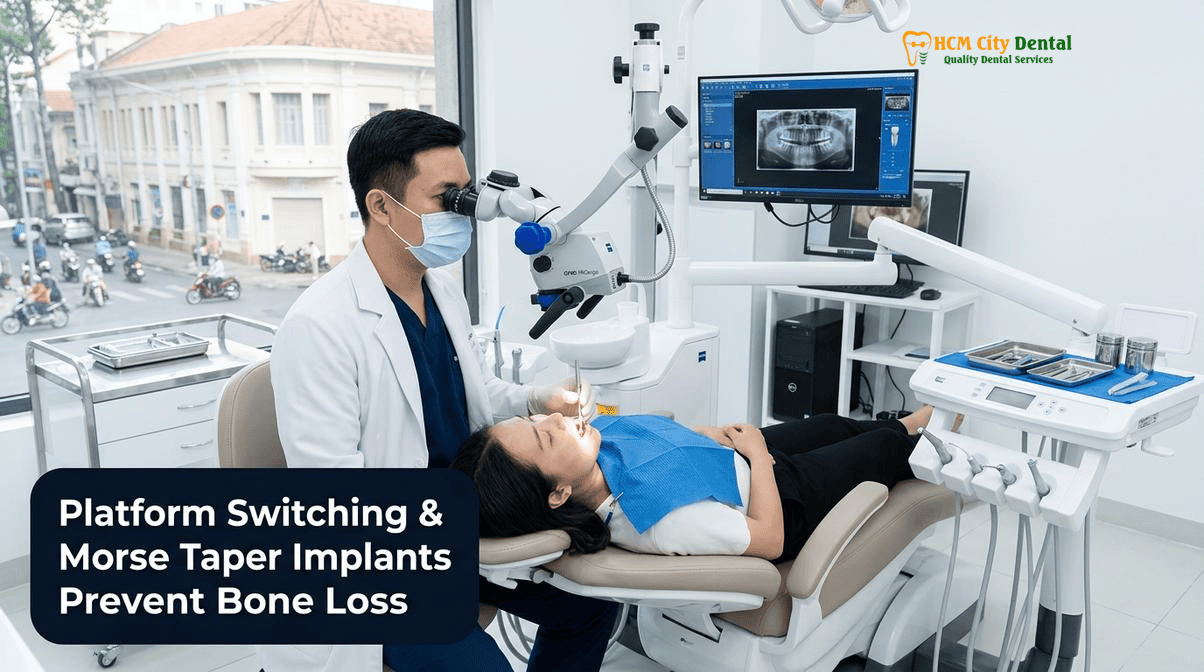
Why Traditional Butt-Joint (External/Internal Hex) Implants Lose 1.5mm of Crestal Bone in the First Year
To appreciate the profound advantages of modern implant geometry, one must first understand the biomechanical flaws inherent in early implant designs. The original Brånemark protocol utilized an external hex connection. This design was primarily engineered to facilitate the surgical insertion of the implant into the osteotomy, rather than to serve as a long-term, load-bearing prosthetic connection. The interface between the implant platform and the abutment was a flat-to-flat “butt-joint.” While this design achieved successful osseointegration, it consistently resulted in a predictable pattern of marginal crestal bone loss that dental implants experienced during the first year of loading.
The primary culprit behind this bone loss is the presence of a microgap at the implant-abutment junction (IAJ). In traditional butt-joint connections, machining tolerances dictate that a microscopic space of 10 to 50 microns exists between the implant and the abutment. Given that periodontal pathogenic bacteria are typically 1 to 2 microns in diameter, this microgap serves as an ideal reservoir for bacterial colonization. When the implant is subjected to occlusal (chewing) forces, the flat-to-flat connection lacks lateral stability, resulting in microscopic bending or “micromotion” between the components[1].
This micromotion triggers a devastating biomechanical phenomenon known as the “pump effect.” As the patient chews, the microgap opens and closes microscopically. This pumping action draws oral fluids and bacteria into the internal cavity of the implant and subsequently expels bacterial endotoxins and inflammatory cytokines out into the surrounding peri-implant tissues. The host immune system responds to this localized bacterial assault by forming an Inflammatory Cell Infiltrate (ICT) around the IAJ. Because the body inherently attempts to maintain a safe distance (approximately 1.5mm to 2mm) between an inflammatory lesion and healthy bone—a concept known as the biologic width—the crestal bone resorbs apically to escape the toxic microenvironment. This is why traditional external and internal hex implants almost universally exhibit saucerization and 1.5mm of bone loss in the first year.
The Biomechanics of Platform Switching: Shifting the Inflammatory Infiltrate Zone Inward and Preserving Biologic Width
The concept of platform switching was discovered somewhat serendipitously in the late 1980s and early 1990s when clinicians, lacking matching prosthetic components, restored wide-diameter implants with standard-diameter abutments. Radiographic follow-ups of these cases revealed a startling anomaly: the expected 1.5mm of crestal bone loss had not occurred. Instead, the bone levels remained remarkably stable, often resting directly at the implant shoulder.
The biomechanical genius of platform switching dental implants lies in the horizontal mismatch between the implant platform and the abutment. By utilizing an abutment that is narrower in diameter than the outer edge of the implant, the implant-abutment junction (IAJ) is physically relocated inward, toward the central axis of the implant. This simple geometric alteration has profound biological consequences[2].
Because the microgap and its associated bacterial leakage are now situated horizontally inward, the Inflammatory Cell Infiltrate (ICT) is also shifted away from the outer edge of the implant and, consequently, away from the adjacent crestal bone. The biologic width—which comprises the junctional epithelium and the supracrestal connective tissue attachment—is forced to establish itself horizontally across the exposed implant shoulder rather than vertically down the side of the implant body. By confining the inflammatory zone to the center of the platform, the crestal bone is shielded from endotoxin exposure, preventing the osteoclastic activity that leads to saucerization. This preservation of marginal bone is not merely a radiographic victory; it is the critical foundation required to support the overlying gingival tissues and maintain the interdental papillae, preventing unsightly black triangles between teeth.
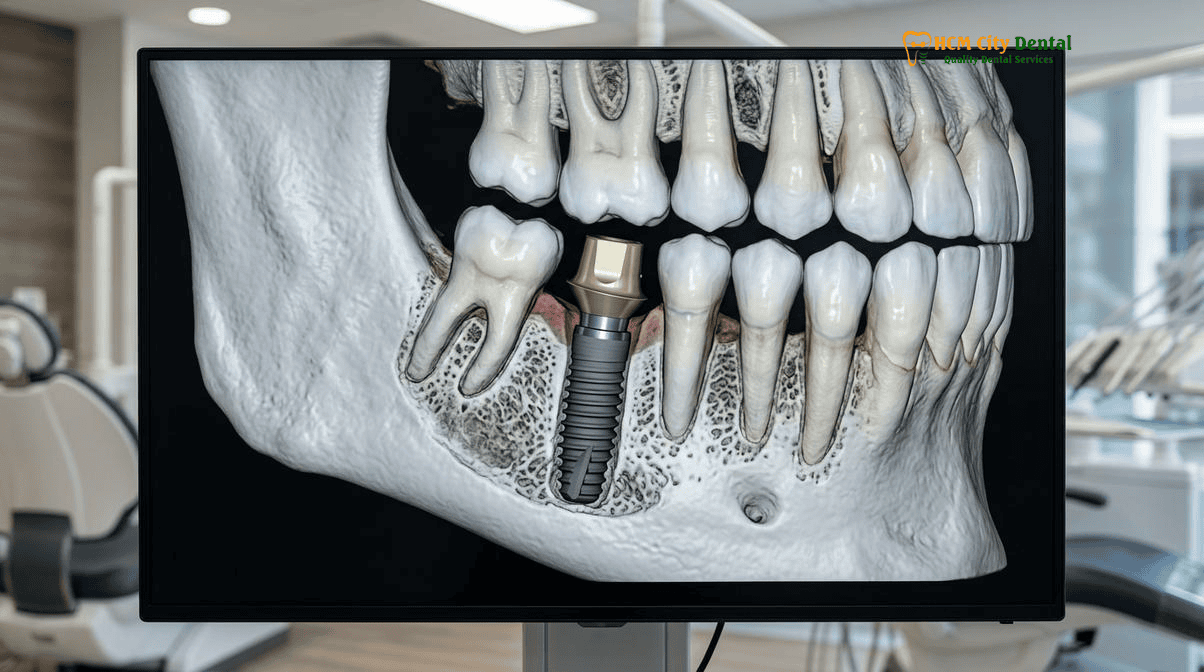
Conical Morse Taper Cold-Weld Mechanics: Eliminating Micromotion, Screw Loosening, and the Bacterial Micro-Gap Pump Effect
While platform switching addresses the location of the microgap, the conical Morse taper connection addresses the very existence of the microgap and the micromotion that fuels it. Originally patented by Stephen A. Morse in 1864 for use in machining tools, the Morse taper is an engineering principle involving a cone-within-a-cone design. In modern implantology, the internal chamber of the implant is machined with a precise conical taper (typically ranging from 5 to 15 degrees), and the apical portion of the prosthetic abutment is machined with a matching taper.
When the abutment is seated into the implant and the retaining screw is torqued to the manufacturer’s specification (usually 25 to 35 Ncm), the two titanium surfaces are forced together with immense pressure. Because the angle of the taper is so acute, the frictional resistance between the two surfaces creates a “cold-weld” or friction-fit seal. This conical morse taper vs internal hex implant comparison reveals a night-and-day difference in biomechanical stability. The cold-weld seal reduces the microgap to less than 1 micron—a space too small for bacteria to penetrate, effectively eliminating the implant-abutment microgap bacterial leakage problem[3].
“The true elegance of the conical Morse taper lies in its load distribution. In a traditional butt-joint, the abutment screw bears the brunt of the occlusal forces, leading to metal fatigue and eventual loosening. In a true conical connection, the friction-fit taper absorbs and dissipates the lateral and compressive forces directly into the implant body. The screw merely acts as a delivery mechanism to engage the taper. This is the ultimate abutment screw loosening prevention mechanism, ensuring decades of prosthetic stability.”
— Dr. Nguyen Van Cuong, DDS (Clinical Director, HCMC Dental Clinic)
By eliminating micromotion, the Morse taper connection completely neutralizes the bacterial pump effect. Furthermore, this absolute rigidity prevents the micro-movements that cause abutment screw loosening—one of the most common and frustrating prosthetic complications associated with older implant designs. For international patients receiving care at HCMC Dental Clinic, the utilization of Morse taper connections ensures that their restorations remain rock-solid, odor-free, and biologically sealed against peri-implantitis.
Engineering Comparison across Straumann CrossFit/TorcFit, Nobel Conical Connection, Osstem TSIII, and Dentium SuperLine
The global dental implant market features several premium systems that have successfully integrated platform switching and conical connections. However, the specific engineering tolerances and taper angles vary among manufacturers. At HCMC Dental Clinic, we utilize a curated selection of the world’s most scientifically validated systems, allowing us to tailor the biomechanical profile to each patient’s specific anatomical needs.
- Straumann Bone Level (CrossFit) & BLX (TorcFit): Swiss-engineered Straumann implants are the gold standard in implantology. The Bone Level line utilizes the CrossFit connection, featuring a 15-degree conical taper combined with four internal grooves for precise anti-rotation. The newer BLX line utilizes the TorcFit connection, optimized for immediate loading and extreme primary stability. Both systems feature built-in platform switching and the proprietary SLActive surface, which accelerates osseointegration.
- Nobel Biocare Conical Connection: Nobel Biocare’s conical connection offers a tight seal and high mechanical strength. The dual-function prosthetic connection provides a hexagonal interlocking mechanism at the base of the cone for precise abutment positioning, while the conical interface ensures a bacterial seal and platform shifting to maximize soft tissue volume.
- Osstem TSIII: As one of the most widely used systems globally, the Osstem TSIII features an 11-degree Morse taper connection. This specific angle provides an optimal balance between cold-weld friction and retrievability. The system incorporates a strict platform-switched design that has shown excellent long-term marginal bone maintenance. For a detailed clinical breakdown, patients can review our Osstem TSIII SOI vs. Dentium SuperLine: 3-Year Marginal Bone Loss & ISQ Stability Comparison.
- Dentium SuperLine: The Straumann crossfit vs Dentium SuperLine connection debate often centers on cost-to-performance ratios. Dentium SuperLine features a highly effective conical hex connection with a biological profile designed for subcrestal placement. Its aggressive double-thread design ensures high initial stability, making it an exceptional choice for immediate implantation protocols at a more accessible price point.
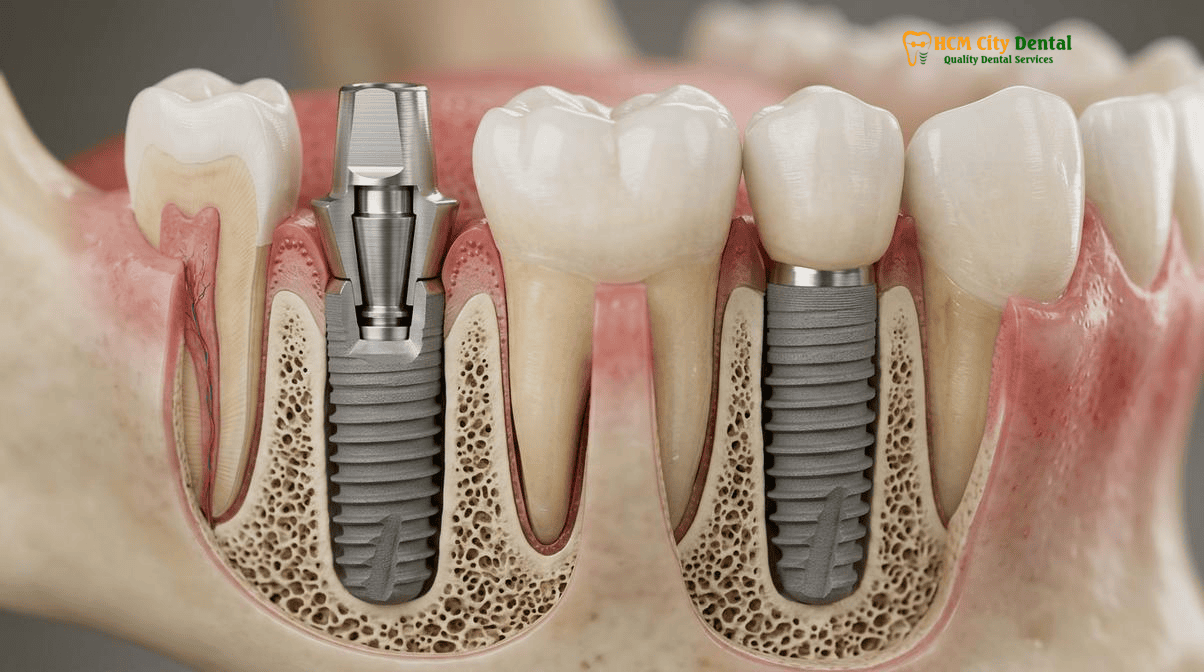
How Subcrestal Implant Placement (1mm–1.5mm) Combined with Platform Switching Protects Interdental Papillae
One of the most advanced surgical techniques facilitated by Morse taper and platform-switched implants is subcrestal placement. Historically, placing a traditional butt-joint implant below the level of the bone crest was a catastrophic error; the resulting inflammatory infiltrate would cause massive crater-like bone resorption. However, because the conical connection seals out bacteria and platform switching moves the biologic width horizontally, modern implants can—and often should—be placed 1mm to 1.5mm subcrestally[4].
Subcrestal placement offers profound biological and esthetic advantages. First, it completely hides the grayish hue of the titanium implant collar beneath the bone and thick gingival biotype, ensuring perfect esthetics in the anterior smile zone. Second, it allows for “bone overgrowth.” Because the implant shoulder is sterile and biologically sealed, osteoblasts can migrate over the platform, effectively burying the implant in native bone. This creates a robust, three-dimensional bony peak between adjacent implants or teeth.
This interproximal bone peak is the critical scaffold required to support the interdental papilla—the small triangle of pink gum tissue between the teeth. Without subcrestal placement and platform switching, the bone resorbs, the papilla collapses, and the patient is left with unesthetic “black triangles.” At HCMC Dental Clinic, Dr. Nguyen Van Cuong, DDS frequently combines subcrestal placement with advanced biological surgery techniques, such as the Socket Shield Technique (retaining a 1.5mm buccal root fragment to preserve the periodontal ligament blood supply and labial bundle bone), Piezosurgery atraumatic bone micro-surgery, and 3D-printed donor tooth replica autotransplantation (ensuring <60 seconds extra-oral PDL time). Patients with severe atrophy can explore our comprehensive protocols in our guide to Can I Get Dental Implants If I Have Bone Loss? | HCMC Dental.
36-Month Radiographic Marginal Bone Loss Benchmark Audit at HCMC Dental Clinic (District 1, Ho Chi Minh City)
Evidence-based dentistry requires rigorous clinical auditing to validate surgical protocols. At HCMC Dental Clinic, our commitment to transparency and clinical excellence is reflected in our continuous monitoring of implant outcomes. Our recent 36-month radiographic marginal bone loss benchmark audit analyzed hundreds of platform-switched, Morse taper implants placed by Dr. Nguyen Van Cuong, DDS at our District 1 facility.
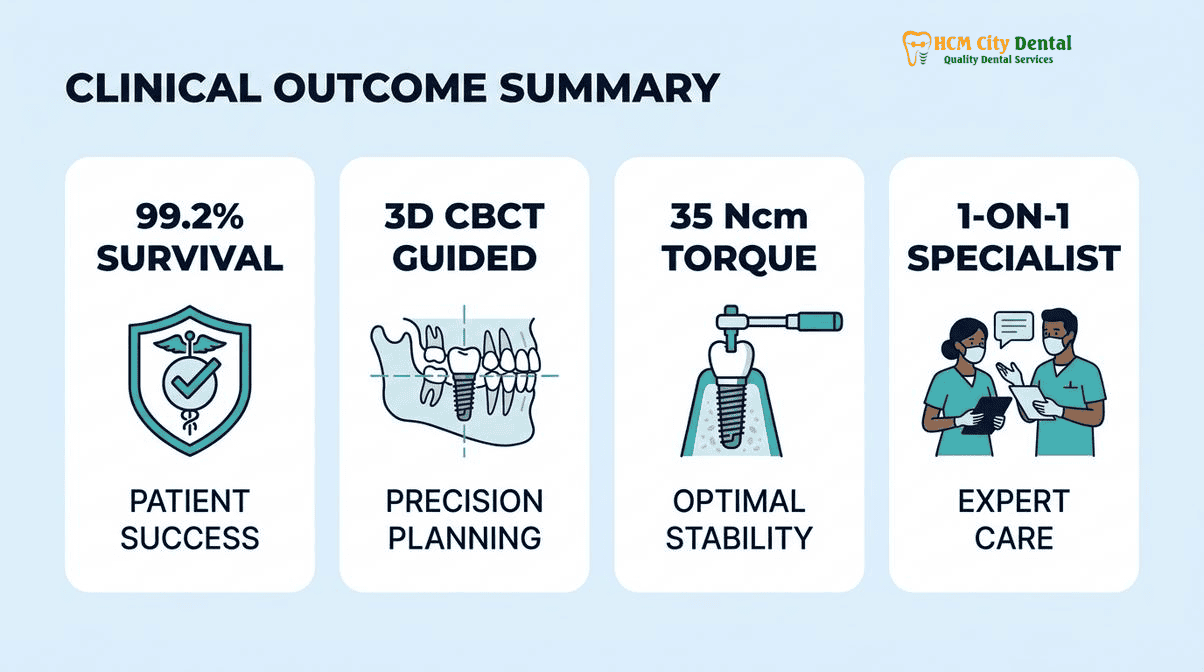
The clinical protocol mandates strict adherence to biomechanical principles. Immediate loading is only performed when Osstell ISQ Resonance Frequency Analysis yields a score of >=70 and insertion torque reaches >=35 Ncm. Furthermore, we exclusively utilize Custom CAD/CAM Hybrid Zirconia-TiBase abutments rather than stock abutments. This ensures that the emergence profile is perfectly contoured to the patient’s gingival architecture, preventing cement entrapment and peri-implantitis. For patients with titanium sensitivities, we offer MELISA lymphocyte testing and provide 100% metal-free Y-TZP Zirconia implants ($1,154 USD online) as a premium alternative to Grade 4 pure titanium[5].
The results of the 36-month audit are definitive: implants utilizing conical Morse taper platform switching exhibited an average crestal bone loss of <0.2mm at 36 months, with over 65% of cases demonstrating zero bone loss or positive bone remodeling over the implant shoulder. These metrics far exceed the historical success criteria of 1.5mm bone loss and underscore the efficacy of our advanced surgical protocols. Patients and researchers can review our full statistical methodologies at the 2026 Clinical Dental Research & Statistical Reports Hub.
2026 Global Implant Pricing & Biomechanical Value Comparison
HCMC Dental Clinic provides world-class implantology at highly transparent, globally competitive rates. By utilizing our online booking system, international patients can access our Official 2026 Dental Price List & -40% Online Booking Fee Schedule, securing premium Morse taper implants at a fraction of US or Australian costs.
| Implant System & Connection Type | HCMC Dental Online Booking (-40%) | HCMC Dental Walk-In Price | US / Australian Benchmark |
|---|---|---|---|
| Single Korean Implant (Dentis / Neo Biotech / Dentium – Conical Hex) | $462 – $654 USD (12,000,000 – 17,000,000 VND) | $769 – $1,090 USD | $3,500 – $4,500 USD |
| Single European / Swiss Implant (Straumann BLT-SLA / BLA-Active – CrossFit/TorcFit) | $962 – $1,346 USD (25,000,000 – 35,000,000 VND) | $1,603 – $2,244 USD | $5,000 – $6,500 USD |
| 100% Metal-Free Zirconia Ceramic Implant (Y-TZP Biocompatible) | $1,154 USD | $1,923 USD | $6,000 – $8,000 USD |
| Implant Zirconia HT Crown + Custom Abutment (CAD/CAM Hybrid TiBase) | $154 USD (4,000,000 VND) | $256 USD | $1,500 – $2,500 USD |
| All-on-4 Full-Arch Implants (Economy / Standard / Straumann) | From $6,346 USD / arch (165,000,000 VND Economy) | From $10,576 USD / arch | $25,000 – $35,000 USD |
| All-on-6 Full-Arch Implants (Complete Package) | From $8,654 USD / arch (225,000,000 VND Economy) | From $14,423 USD / arch | $30,000 – $45,000 USD |
Clinical Case Study: Resolving External Hex Failure with Dentium SuperLine
Patient Profile: A 55-year-old Australian expat presented to HCMC Dental Clinic (District 1, Ho Chi Minh City) complaining of chronic foul odor, recurrent abutment screw loosening, and gingival recession around a 10-year-old external hex implant placed in the lower right first molar position (Tooth 46).
Clinical Findings: 3D CBCT imaging revealed severe saucerization with 3.5mm of crestal bone loss. The microgap was heavily colonized by bacteria, and the flat-to-flat connection exhibited significant micromotion under occlusal load.
Treatment Protocol: Dr. Nguyen Van Cuong, DDS carefully explanted the failing fixture using atraumatic Piezosurgery. Following a 3-month site development phase with particulate bone grafting, a Dentium SuperLine implant was placed 1.5mm subcrestally. The platform-switched, conical hex connection ensured a hermetic cold-weld seal. A Custom CAD/CAM Hybrid Zirconia-TiBase abutment was utilized to sculpt the emergence profile.
Outcome: At the 24-month follow-up, radiographic imaging demonstrated zero crestal bone loss, with dense cortical bone bridging over the implant shoulder. The patient reported complete resolution of odor and absolute prosthetic stability, highlighting the superiority of modern biomechanical engineering.
Clinical Warning: Bone Metabolism and Implant Integration
While platform switching and Morse taper connections optimize biomechanics, successful osseointegration relies heavily on the patient’s systemic bone metabolism. Patients currently taking or with a history of taking bisphosphonates, Prolia (denosumab), or Fosamax for osteoporosis are at risk for Medication-Related Osteonecrosis of the Jaw (MRONJ). Prior to any surgical intervention, a comprehensive medical history and a CTX (C-terminal telopeptide) blood assay are mandatory to assess bone turnover rates. If you are on these medications, please consult our specialized protocol: Osteoporosis Medications (Prolia, Fosamax, Bisphosphonates) & Dental Implants: MRONJ Prevention & CTX Assay Guide before scheduling surgery.
Frequently Asked Questions
What is platform switching in dental implants and why does it prevent gum recession?
Platform switching involves using an abutment that is narrower in diameter than the implant platform. This horizontal mismatch shifts the implant-abutment junction (IAJ) and its associated inflammatory cell infiltrate inward, away from the crestal bone. By preserving the crestal bone, the overlying gingival tissues are supported, thereby preventing gum recession and preserving the interdental papillae.
Why do older external-hex implants occasionally develop foul odor or abutment screw loosening?
Older external-hex (butt-joint) implants lack a friction-fit seal. Under chewing forces, the flat-to-flat connection experiences micromotion, causing the abutment screw to bear the entire occlusal load, leading to fatigue and loosening. Furthermore, this micromotion creates a ‘pump effect’ that draws bacteria into the 10–50 micron microgap, leading to bacterial colonization, foul odor, and peri-implant inflammation.
Do all implant brands used at HCMC Dental Clinic (Straumann, Nobel, Dentium, Osstem) feature conical platform-switched connections?
Yes. Under the clinical direction of Dr. Nguyen Van Cuong, DDS, HCMC Dental Clinic exclusively utilizes modern implant systems featuring conical Morse taper and platform-switched designs. This includes the Straumann Bone Level (CrossFit) and BLX (TorcFit) lines, Nobel Biocare Conical Connection, Osstem TSIII, and Dentium SuperLine, ensuring optimal crestal bone preservation.
How much marginal bone loss is considered clinically normal after 3 to 5 years with a Morse taper implant?
While traditional criteria allowed for up to 1.5mm of bone loss in the first year and 0.2mm annually thereafter, modern Morse taper implants with platform switching have redefined success. At HCMC Dental Clinic, our 36-month radiographic audits demonstrate that crestal bone loss is typically restricted to less than 0.2mm total, with many cases showing zero bone loss or even bone growth over the implant shoulder.
Can a loose abutment screw on an older implant placed overseas be retorqued or replaced in Ho Chi Minh City?
Yes. HCMC Dental Clinic is equipped with a comprehensive prosthetic armamentarium compatible with major global implant systems. If you experience abutment screw loosening on an older implant placed overseas, our specialists can safely remove the crown, decontaminate the microgap, and replace or retorque the abutment screw to the manufacturer’s precise Ncm specifications.
References
- Lazzara, R. J., & Porter, S. S. (2006). Platform switching: a new concept in implant dentistry for controlling biologic width. International Journal of Periodontics & Restorative Dentistry.
- Hermann, J. S., Buser, D., Schenk, R. K., & Cochran, D. L. (2000). Crestal bone changes around titanium implants. A histometric evaluation of unloaded non-submerged and submerged implants in the canine mandible. Journal of Periodontology.
- Zipprich, H., Weigl, P., Lange, B., & Lauer, H. C. (2007). Micromovements at the implant-abutment interface: measurement, causes, and consequences. Implantologie.
- Degidi, M., Nardi, D., & Piattelli, A. (2011). One abutment at one time: non-removal of an immediate abutment and its effect on bone healing around subcrestal tapered implants. Clinical Oral Implants Research.
- Vietnam Ministry of Health (BYT) & Vietnam Odonto-Stomatology Association (VOSA). National Clinical Guidelines on Specialist Dental Care, Biomaterial Traceability & EN 13060 Class B Infection Control. (2024).