Securing TMJ treatment dental insurance in Saigon requires understanding whether your policy classifies temporomandibular joint disorders under medical or dental coverage. Expatriates and international patients can successfully claim reimbursements for custom nightguards, occlusal splints, and diagnostics by submitting precise English medical reports and official VAT invoices.
Clinical Summary:
Navigating TMJ treatment dental insurance in Saigon involves a strategic approach to clinical documentation and policy comprehension. Temporomandibular joint (TMJ) disorders often straddle the line between medical and dental insurance categories, creating complexities in the reimbursement process. International insurers typically require comprehensive diagnostic evidence, including CBCT scans and detailed English medical reports outlining the medical necessity of interventions like occlusal splints, physical therapy, or bite adjustments. Clinics in Ho Chi Minh City facilitate this process by providing standardized documentation, including the mandatory Vietnamese VAT (red) invoice. Understanding the specific reimbursement protocols for major global providers ensures patients can access necessary conservative therapies without bearing the full out-of-pocket financial burden. Proper pre-authorization and accurate clinical coding are paramount for successful claims.
Key Takeaways:
- TMJ therapies may be classified under either medical or dental insurance, depending on the specific policy terms and the etiology of the disorder.
- Comprehensive clinical documentation, including diagnostic imaging and English medical reports, is mandatory for successful international claims.
- Official Vietnamese VAT invoices (electronic red invoices) are strictly required by global insurers for financial reimbursement.
- Conservative treatments like custom occlusal splints and stabilization devices are frequently covered under major global health plans.
- Pre-authorization is highly recommended before commencing extensive TMJ therapies to guarantee coverage limits and avoid denied claims.
Navigating Global Health Policies for TMJ/TMD Coverage
Global health policies often categorize TMJ/TMD treatments based on the etiology of the disorder, determining whether claims fall under dental limits or general medical coverage.
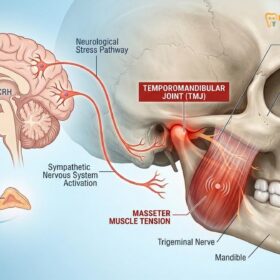
Understanding how your international health insurance policy categorizes Temporomandibular Joint Disorders (TMD) is the critical first step in securing reimbursement for treatment in Vietnam. The temporomandibular joint is anatomically unique; it is a complex hinge and gliding joint that connects the mandible to the temporal bone. Because TMD can originate from muscular dysfunction (myalgia), structural joint degradation (arthralgia), or dental malocclusion, insurance companies frequently debate whether the condition is fundamentally a medical issue or a dental one. This classification significantly impacts your coverage limits, deductibles, and co-payment structures.
In many comprehensive global health plans, treatments that address the structural integrity of the joint itself—such as MRI diagnostics, arthrocentesis, or joint surgery—are classified under medical coverage. Conversely, treatments that involve modifying the dentition or utilizing intraoral appliances, such as custom nightguards or occlusal splints, are often relegated to the dental rider of the policy. Patients must carefully review their policy wording to identify specific exclusions or sub-limits related to “craniomandibular disorders” or “TMJ syndrome.”

From a clinical perspective, accurate diagnostic coding is essential for insurance approval. Dr. Nguyen Van Cuong emphasizes that a vague diagnosis of “jaw pain” is frequently rejected by international insurers. Instead, the clinical documentation must utilize precise terminology, differentiating between conditions such as disc displacement with reduction, masticatory muscle myositis, or temporomandibular osteoarthritis. By providing a definitive, evidence-based diagnosis supported by clinical examination and radiographic imaging, the likelihood of a successful claim increases substantially[1].
“The intersection of dentistry and medicine is most apparent in the treatment of temporomandibular disorders. Insurers require objective clinical evidence that the prescribed therapy is a medical necessity rather than a preventative or elective dental procedure. Detailed diagnostic mapping is the cornerstone of successful international claim reimbursement.”
Furthermore, many policies stipulate a “step-therapy” approach. This means the insurer will only authorize advanced or invasive treatments if conservative measures have been documented as ineffective. Therefore, initial claims for reversible therapies like stabilization splints or physical therapy are generally processed with less friction than immediate requests for surgical intervention or extensive prosthodontic rehabilitation.
Bupa, Allianz, Cigna Global: Claim Reimbursement Policies
Major international insurers maintain distinct reimbursement protocols for TMJ therapies, requiring patients to understand their specific policy limits, waiting periods, and direct billing options.
Expatriates residing in Ho Chi Minh City typically hold international health insurance policies from major providers such as Bupa, Allianz, or Cigna. Each of these entities operates with specific protocols regarding the adjudication of TMJ-related claims. Navigating these protocols requires a clear understanding of the difference between direct billing networks and the traditional pay-and-claim reimbursement model.
For patients utilizing an Allianz direct billing network, the process is generally streamlined if the treating clinic has an active partnership with the insurer. In a direct billing scenario, the clinic submits the proposed treatment plan and estimated costs directly to Allianz for pre-authorization. Once approved, the patient is only responsible for their deductible or co-insurance percentage at the time of service. However, it is crucial to note that TMJ treatments often require a detailed medical questionnaire to be completed by the attending dentist before direct billing is authorized, ensuring the condition is not pre-existing (if a waiting period applies).
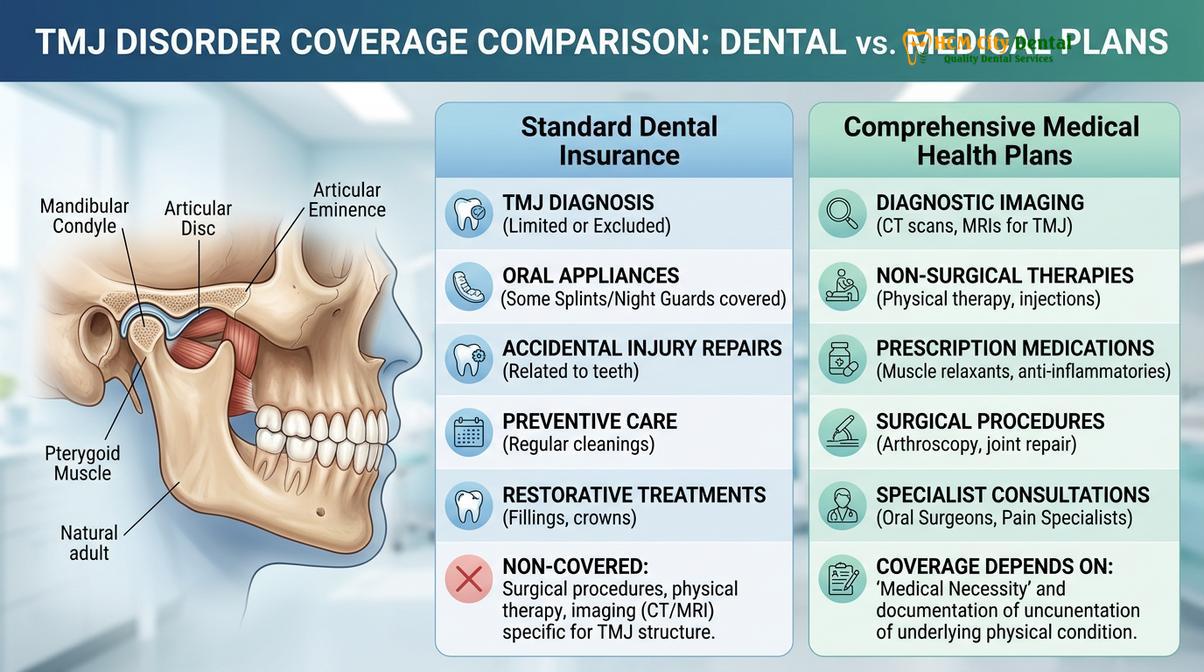
When processing a Bupa dental claim HCMC, patients frequently utilize the pay-and-claim method, especially for outpatient dental services. Bupa Global policies often feature robust dental riders, but they strictly enforce annual limits and specific waiting periods for major restorative or orthodontic work related to TMJ. Patients must pay the clinic in full, collect all necessary documentation, and submit the claim via the Bupa global portal. Bupa is particularly stringent regarding the submission of itemized invoices that clearly separate consultation fees, diagnostic imaging costs, and the specific laboratory fees for appliance fabrication.
Similarly, securing a Cigna global health reimbursement for TMJ therapy requires meticulous attention to detail. Cigna often requires a “Treatment Guarantee” or pre-authorization for any procedure exceeding a certain financial threshold. If a patient requires a complex occlusal splint or a series of therapeutic injections, submitting a pre-treatment estimate along with the clinical rationale is highly advisable to prevent unexpected out-of-pocket expenses[2].
Comparative Overview of Typical Expat Insurance Requirements
| Insurance Provider | Typical TMJ Classification | Pre-Authorization Requirement | Common Documentation Needed |
|---|---|---|---|
| Allianz Care | Often split: Medical (Joint) / Dental (Splints) | Required for treatments over specific limits | Medical report, X-rays, Itemized VAT invoice |
| Bupa Global | Usually under Dental Rider (Major Restorative) | Recommended for appliances & surgery | Standard claim form, Clinical notes, Red invoice |
| Cigna Global | Dependent on etiology (Trauma vs. Bruxism) | Mandatory for Treatment Guarantee | Detailed diagnosis codes, CBCT, Proof of payment |
Regardless of the provider, patients must be aware of waiting periods. Many international dental plans impose a 6 to 12-month waiting period for major treatments, which often includes the fabrication of complex TMJ appliances. Verifying your policy’s active status and specific waiting period clauses before initiating treatment is a vital administrative step.
Document Requirements: English Medical Reports and VAT Invoices
Successful insurance reimbursement for TMJ therapy in Vietnam strictly requires comprehensive English medical reports, diagnostic imaging evidence, and official government-issued VAT invoices.
The most common reason for the denial of a TMJ treatment dental insurance claim in Saigon is inadequate or improper documentation. International insurance adjudicators process thousands of claims daily; they rely entirely on the objective data provided in the submitted paperwork to determine medical necessity and policy compliance. Therefore, the administrative output of your chosen dental clinic is just as important as their clinical expertise.
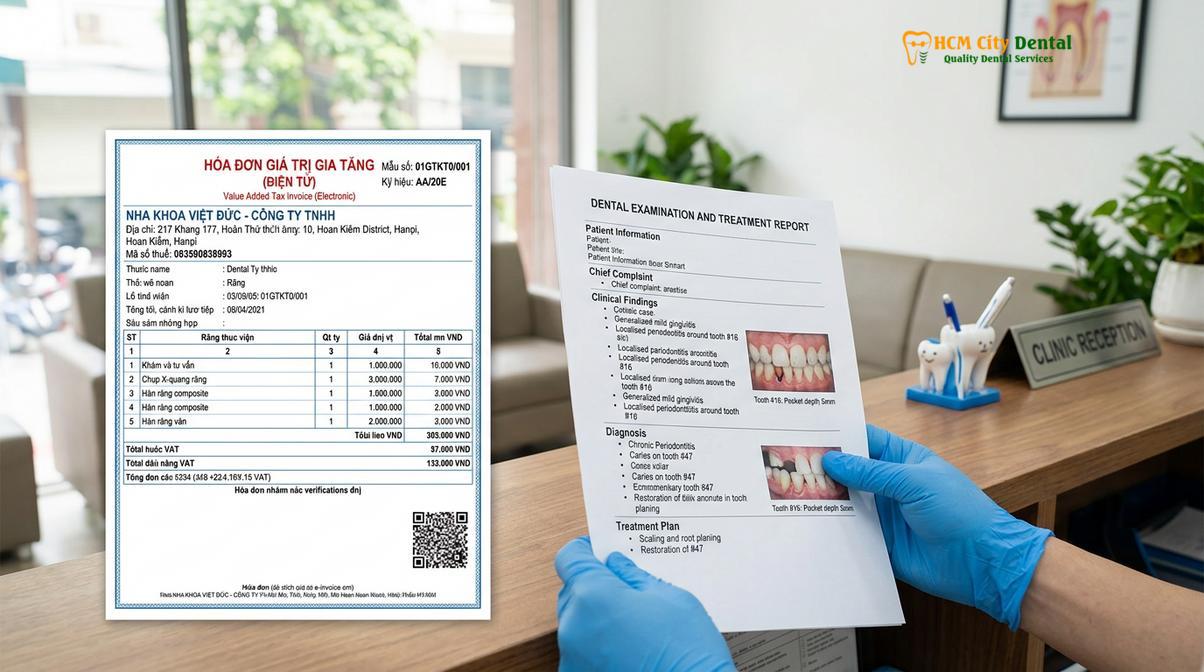
First and foremost is the English Medical Report. A standard clinic receipt or a brief note stating “jaw pain treatment” is insufficient. The medical report must be a comprehensive clinical document that outlines the patient’s chief complaint, the duration of symptoms, and the findings of the clinical examination (such as limited range of motion, muscle tenderness, or joint crepitus). It must state a definitive diagnosis and detail the prescribed treatment plan. If the treatment involves an appliance, the report should specify the type of device—for instance, differentiating between a simple soft guard and a complex hard acrylic splint designed for joint stabilization[3].
Diagnostic evidence is the second pillar of a successful claim. Insurers want proof that the diagnosis is based on objective findings. This typically involves submitting digital copies of panoramic X-rays or, more preferably, 3D Cone Beam Computed Tomography (CBCT) scans. These images allow the insurer’s dental consultants to verify the presence of structural abnormalities, condylar wear, or severe malocclusion that justifies the proposed intervention.
Important Financial Documentation Warning: International insurance companies will NOT accept standard clinic receipts, credit card slips, or proforma invoices as proof of payment. You MUST request an official Vietnamese Electronic VAT Invoice (commonly known as a “Red Invoice” or “Hóa Đơn Đỏ”) before leaving the clinic. This document is legally required to prove that the transaction was officially recorded and taxed under Vietnamese law.
To generate the VAT invoice, the clinic will require your full legal name (as it appears on your passport), your passport number, and your registered address. This electronic document contains a unique tax code and is universally accepted by global insurers like Bupa, Allianz, and Cigna. Ensuring that the dates, amounts, and patient details on the VAT invoice perfectly match the medical report and the insurance claim form is critical to avoiding administrative delays.
Step-by-Step Claim Submission Guide for Expat Reimbursement
Submitting a successful TMJ treatment claim involves a systematic workflow from the initial clinical consultation and pre-authorization to the final submission of standardized financial documents.
For expatriates navigating the healthcare system in Ho Chi Minh City, following a structured workflow minimizes the stress associated with insurance claims. The process begins long before the actual treatment is rendered and concludes only when the reimbursement is deposited into your account.
Step 1: The Initial Consultation and Diagnostic Phase
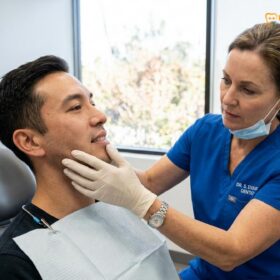
Your journey begins with a comprehensive clinical evaluation. During this visit, the dentist will perform a physical examination of your jaw, muscles, and bite, followed by necessary imaging (such as a CBCT scan). At this stage, you should inform the clinic that you intend to file an insurance claim. The clinic will then prepare a detailed treatment plan and a cost estimate.
Step 2: Pre-Authorization (If Required)
Before proceeding with the fabrication of a splint or any irreversible procedure, submit the treatment plan, cost estimate, and initial medical report to your insurance provider. Request a formal pre-authorization or “Treatment Guarantee.” This step confirms exactly how much of the cost will be covered and identifies any out-of-pocket expenses you will incur. While waiting for approval, the clinic may take digital impressions or scans of your teeth to prepare for the appliance fabrication.
Clinical Case Example: Expat Insurance Navigation
An expatriate teacher presented to HCMC Dental Clinic in Ho Chi Minh City with severe morning jaw pain and limited mouth opening. Dr. Nguyen Van Cuong diagnosed the patient with sleep bruxism-induced myalgia and prescribed a custom stabilization splint. Because the patient held a Cigna global policy, the clinic’s administrative team immediately generated a comprehensive English medical report detailing the diagnosis and a pre-treatment estimate. The patient submitted these documents for pre-authorization. Within 48 hours, Cigna approved the treatment under the policy’s major dental rider. The patient proceeded with the treatment, paid the clinic, received the official VAT invoice, and successfully claimed an 80% reimbursement within two weeks.
Step 3: Treatment Execution and Final Documentation
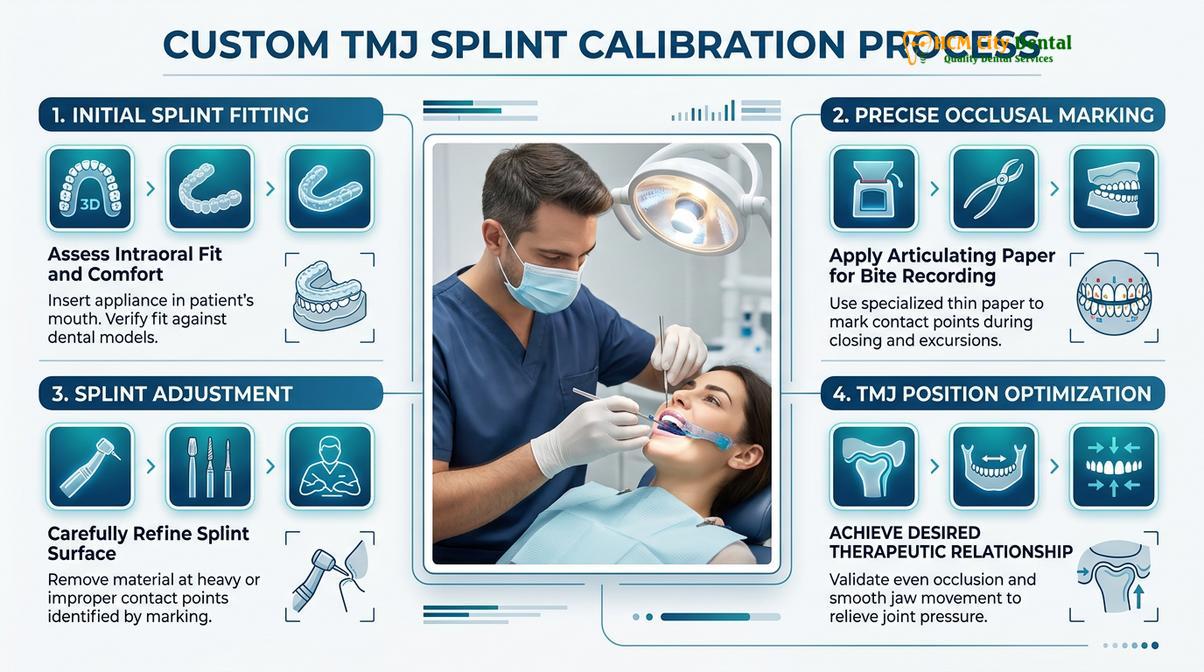
Once pre-authorization is secured, you will return to the clinic for the delivery and calibration of your TMJ appliance or the administration of your therapy. Upon completion of the active treatment phase, you must settle the final bill. At this exact moment, request the official electronic VAT invoice and ensure you receive the finalized, signed, and stamped English medical report.
Step 4: Claim Submission and Follow-Up
Compile your claim form, the medical report, the diagnostic images, and the VAT invoice. Most modern insurers allow you to upload these documents via a secure online portal or mobile application. Ensure all scans are clear and legible. After submission, monitor the claim status. If the insurer requests additional clinical rationale, promptly contact your dental clinic to provide supplementary notes[4].
Clinical TMJ Treatments Covered by Insurance
Insurance policies typically prioritize conservative, reversible TMJ therapies such as custom occlusal splints and physical therapy before authorizing invasive surgical interventions.
When seeking reimbursement, it is helpful to understand which clinical treatments are most readily approved by insurance adjudicators. The overarching principle in TMJ management is to utilize the most conservative, reversible, and evidence-based therapies first. Insurers align with this philosophy, generally providing robust coverage for non-invasive modalities.
Custom Occlusal Splints and Nightguards:
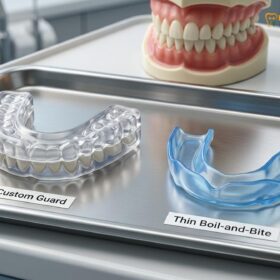
The fabrication of a custom intraoral appliance is the most common TMJ treatment covered by dental insurance. These devices, which include stabilization splints, Michigan splints, and anterior repositioning appliances, are designed to decompress the joint space, relax the masticatory muscles, and protect the dentition from the forces of bruxism. Insurers typically require proof that the device is custom-fabricated in a dental laboratory based on precise impressions, distinguishing it from over-the-counter boil-and-bite guards, which are never covered. Understanding the differences between an occlusal splint and a standard night guard is vital, as insurers may code and reimburse them differently.
“Conservative splint therapy remains the gold standard for initial TMD management. By altering the occlusal scheme and providing a stable platform for the mandible, these custom devices significantly reduce joint loading and muscle hyperactivity, offering predictable clinical outcomes that align with insurance requirements for evidence-based care.”
Neuromodulator Therapy (Botox):
The use of masseter Botox therapy for TMJ pain is highly effective for muscular-driven TMD, but insurance coverage is notoriously variable. While some medical plans cover Botox for diagnosed chronic migraines associated with TMD, many dental plans classify it as an off-label or cosmetic exclusion. Extensive documentation proving the failure of traditional splint therapy is usually required to secure reimbursement for therapeutic injections.
Specialized Appliances and Bite Adjustment:
In cases of severe clenching, specialized devices like NTI-tss devices may be prescribed to inhibit masseter contraction. If the TMD is directly caused by a misaligned bite, occlusal equilibration (bite adjustment) may be necessary. This involves selectively reshaping the biting surfaces of the teeth to create a harmonious occlusion. Insurers generally cover bite adjustments if supported by computerized occlusal analysis or detailed articulation records[5]. Furthermore, early intervention for pediatric bruxism is often covered under preventative or interceptive orthodontic riders, emphasizing the importance of early diagnosis.
When to See a Doctor
Immediate clinical evaluation is necessary if you experience severe jaw locking, sudden changes in your bite, or chronic facial pain that disrupts daily activities.
While mild, transient jaw clicking without pain is common and often does not require intervention, certain symptoms warrant prompt professional evaluation. You should schedule a consultation at a specialized facility, such as HCMC Dental Clinic in Ho Chi Minh City, if you experience any of the following red-flag symptoms:
- Jaw Locking: An inability to fully open or close your mouth, indicating a potential acute disc displacement or severe muscle spasm.
- Chronic, Unrelenting Pain: Facial pain, earaches, or headaches that persist for more than a few days and do not respond to over-the-counter analgesics.
- Sudden Bite Changes: A feeling that your upper and lower teeth no longer fit together correctly, which may signal structural changes within the joint capsule.
- Difficulty Chewing: Pain or severe fatigue in the jaw muscles while eating normal foods.

Early diagnosis not only prevents the progression of joint degradation but also simplifies the insurance authorization process, as conservative treatments are more likely to be effective in the early stages of the disorder. A thorough clinical examination will determine the exact etiology of your symptoms and guide the formulation of an evidence-based, insurance-compliant treatment plan.
Frequently Asked Questions
Does international insurance cover Botox injections for TMJ?
Coverage for Botox injections varies by policy; while some medical plans cover it for diagnosed chronic migraines or severe muscular TMD, many dental plans classify it as an exclusion. Pre-authorization with a detailed medical necessity report is essential. Insurers typically require documented evidence that conservative treatments, such as splint therapy and physical therapy, have been attempted and failed before they will consider authorizing neuromodulator injections for masticatory muscle pain.
Will my dental insurance pay for a replacement splint?
Most dental insurance policies allow for a replacement occlusal splint or nightguard every three to five years, provided the previous device is documented as lost, broken, or no longer clinically viable due to anatomical changes. If a replacement is needed sooner due to severe bruxism wearing through the acrylic, the treating dentist must provide a specific narrative report explaining the rapid degradation to justify the early replacement claim.
How do I request a formal tax invoice (red invoice) in Vietnam?
You must request the formal electronic VAT invoice (often called a red invoice) at the clinic’s reception before finalizing your payment. You will need to provide your full name, passport number, and permanent address for the official tax system. This document is legally required by international insurers to prove the financial transaction is legitimate and cannot be substituted with a standard printed clinic receipt.
Is a CBCT scan required for a TMJ insurance claim?
While not universally mandatory, a CBCT scan is highly recommended and frequently requested by insurers to objectively prove structural joint degradation, disc displacement, or osteoarthritis, thereby justifying the medical necessity of the prescribed TMJ therapy. High-resolution 3D imaging provides indisputable evidence of the joint’s condition, significantly reducing the likelihood of claim denial based on insufficient diagnostic data.
Can I use direct billing for TMJ treatment in Saigon?
Direct billing for TMJ treatment is possible if your clinic has an established network agreement with your specific insurer and the treatment is pre-authorized. Otherwise, you must utilize the pay-and-claim reimbursement method. Even within direct billing networks, TMJ treatments often require a pre-treatment estimate and medical questionnaire to be approved by the insurer before the clinic can waive your upfront payment.
References
- Journal of the American Dental Association. Occlusal splint therapy for temporomandibular disorders: a clinical review. (2020).
- Journal of Oral Rehabilitation. Efficacy of Michigan repositioning splints in TMD patients. (2019).
- Journal of Prosthetic Dentistry. Computerized occlusal analysis and bite mapping in TMJ therapy. (2021).
- Clinical Oral Investigations. Masseter Botox injections for chronic jaw pain and bruxism. (2018).
- International Journal of Oral and Maxillofacial Surgery. TMJ arthrocentesis and hyaluronic acid injections. (2022).