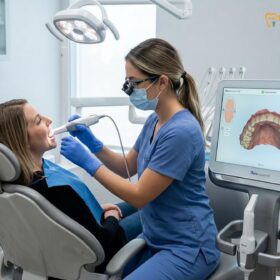
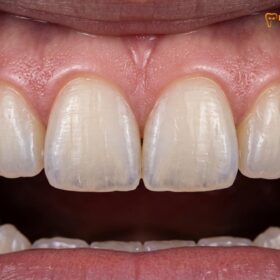
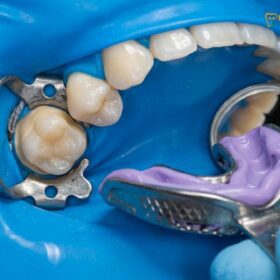
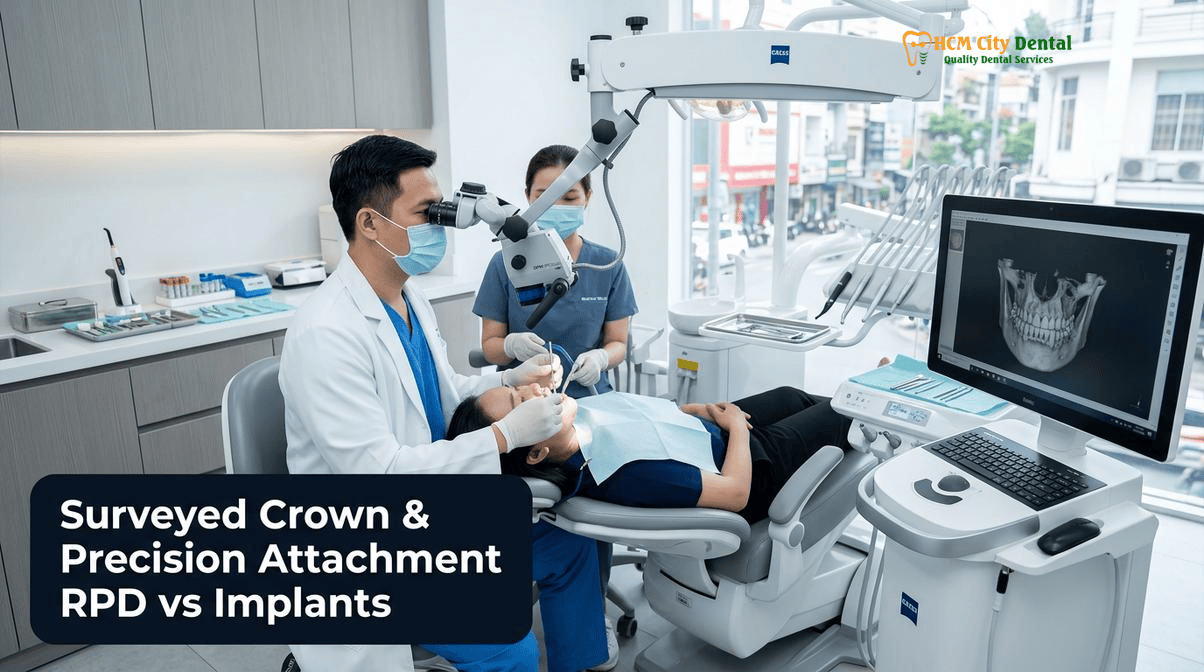
For patients suffering from extensive posterior tooth loss, the traditional approach of using a removable partial denture (RPD) with visible metal wire clasps has long been a source of aesthetic frustration and biomechanical compromise. When smiling or speaking, the unsightly metal hooks immediately broadcast the presence of a denture. Furthermore, poorly designed clasps act as destructive levers, torquing and loosening the remaining natural anchor teeth over time. Today, modern prosthodontics offers two superior, clasp-free alternatives for restoring a mutilated dentition: posterior dental implants, or the highly engineered combination of surveyed crowns and precision attachment cast partial dentures. By integrating hidden, snap-in interlocking mechanisms directly into custom-milled ceramic crowns, patients can achieve a rock-solid, 100% metal-clasp-free smile.
\n\n
At HCMC Dental Clinic in District 1, Ho Chi Minh City, our clinical director, Dr. Nguyen Van Cuong (Dr. Cuong), DDS (Vietnam MOH License 0003265/BL-CCHN), specializes in complex oral rehabilitation. Utilizing advanced CAD/CAM digital workflows, biomimetic adhesive protocols, and world-class attachment systems like Rhein83 and Bredent, we routinely help international patients and expats choose the optimal restorative pathway when comparing a surveyed crown precision attachment cast partial denture vs implants.
\n\n
Clinical Summary:
\n
The decision between a precision attachment partial denture and posterior dental implants hinges on bone volume, medical history, and budget. A precision attachment RPD utilizes surveyed zirconia crowns with hidden extracoronal attachments (patrix) that snap into nylon caps (matrix) embedded in a rigid cast framework. This eliminates all visible metal facial clasps, providing excellent aesthetics and cross-arch stability. While dental implants offer the gold standard of fixed, bone-stimulating tooth replacement, a precision attachment partial denture serves as the premier, highly aesthetic removable alternative for patients with severe bone loss, medical contraindications to surgery, or those seeking a more cost-effective full-mouth rehabilitation in Vietnam.
\n
\n\n
Key Takeaways:
\n
- \n
- Zero Visible Metal: Precision attachments utilize hidden male/female interlocking components, completely eliminating the need for unsightly facial wire clasps.
- Biomechanical Protection: Surveyed crowns feature milled lingual guide planes and rest seats that direct chewing forces axially down the root, preventing the destructive torquing seen with traditional acrylic flippers.
- Advanced Framework Materials: Patients can choose between ultra-thin, rigid CAD/CAM Laser-Sintered Cobalt-Chromium (Co-Cr) or high-performance, metal-free BioHPP PEEK frameworks.
- Surgical Alternative: Precision attachment RPDs are the ideal solution for patients who are not candidates for implants due to severe sinus pneumatization, radiation therapy, or bisphosphonate use.
- Cost-Effective Rehabilitation: A complete precision attachment system offers significant financial savings compared to placing 4 to 6 posterior dental implants, especially with HCMC Dental Clinic’s transparent -40% online booking fee schedule.
\n
\n
\n
\n
\n
\n
\n\n\n
\n\n\n
Why Traditional Acrylic Flippers and Unplanned Wire-Clasp Partial Dentures Torque Abutment Teeth and Show Ugly Metal Hooks
\n\n
To understand the profound clinical advantages of a precision attachment system, one must first examine the biomechanical failures of traditional removable partial dentures. When a patient loses their posterior molars—a clinical scenario known as a kennedy class i class ii distal extension denture—the prosthesis lacks a posterior anchor tooth. Consequently, the denture must rely on the soft tissue (gums and underlying bone) for support at the back, and the remaining natural teeth for retention at the front.
\n\n
Traditional acrylic “flippers” or unplanned cast partial dentures utilize wrought wire or cast metal clasps that wrap around the facial surface of the terminal abutment teeth (the last remaining natural teeth). Because the soft tissue in the posterior region is compressible, every time the patient bites down, the back of the denture sinks into the gums. This tissue-ward movement creates a Class I lever system. The metal clasp acts as a crowbar, grabbing the anchor tooth and violently torquing it backward and upward. Over months and years, this continuous, non-axial orthodontic force causes the abutment tooth to become mobile, leading to widened periodontal ligaments, severe bone loss, and eventual tooth extraction.[1]
\n\n
Aesthetically, the traditional approach is equally disastrous. The metal clasps must engage the undercut on the facial (front) surface of the tooth to prevent the denture from falling out. Whenever the patient smiles, speaks, or laughs, these metal hooks are glaringly visible. Furthermore, traditional clasps act as plaque traps, increasing the risk of cervical root caries and periodontal inflammation around the anchor teeth. For patients seeking Dental Crowns, Fixed Bridges & Biomimetic Ceramic Restorations in Vietnam, settling for a prosthesis with visible metal hooks is no longer necessary.
\n\n
What Is a ‘Surveyed Crown’ with Milled Lingual Guide Planes, Cingulum/Occlusal Rest Seats, and Reciprocal Arms?
\n\n
The foundation of a successful, clasp-free partial denture lies in the precise engineering of the anchor teeth. Because natural teeth are bulbous and irregularly shaped, they do not provide an ideal surface for a denture to slide onto or rest against. To solve this, the prosthodontist prepares the anchor teeth and covers them with specialized, custom-milled restorations known as surveyed crowns.
\n\n
A surveyed crown is not a standard dental crown. It is a highly engineered prosthetic component designed specifically to interface seamlessly with a cast partial denture framework. Using digital CAD/CAM software, Dr. Nguyen Van Cuong, DDS designs the surveyed zirconia crown rest seat partial denture with three critical architectural features:
\n\n
- \n
- Milled Lingual Guide Planes: The inner (lingual) and side (proximal) surfaces of the crown are milled perfectly flat and parallel to the path of insertion. When the denture is inserted, its metal framework glides smoothly against these flat planes, providing frictional retention and preventing the denture from rocking side-to-side.
- Occlusal or Cingulum Rest Seats: A distinct, spoon-shaped depression (usually 1.5mm deep) is milled into the biting surface (occlusal) or the back surface (cingulum) of the crown. The metal framework of the denture features a corresponding “rest” that sits exactly into this depression. This ensures that all vertical chewing forces are directed straight down the long axis of the tooth root, completely eliminating the destructive torquing forces associated with traditional dentures.
- Reciprocal Ledges: A milled ledge on the lingual surface ensures that as the attachment engages, the tooth is braced from the opposite side, preventing any orthodontic movement during insertion and removal.
\n
\n
\n
\n\n
At HCMC Dental Clinic, our surveyed crowns are fabricated utilizing strict Wave 4A biomimetic principles. Zirconia surveyed crowns are bonded using the Blatz APC protocol (Air-abrasion with 27-micron aluminum oxide + Ivoclean zirconia oxide cleaning + 10-MDP monomer) under a 100% latex-free nitrile rubber dam. If IPS E.max is utilized for anterior surveyed crowns, we employ 5%–9.5% hydrofluoric acid etching followed by pure heat-dried silane application. To ensure the abutment tooth can withstand the shear forces of the prosthesis, we utilize Immediate Dentin Sealing (IDS) allowing a 5-minute decoupling with time to maximize bond strength, respecting Feilzer’s Configuration Factor (C-Factor) principles.[2]
\n\n\n
\n\n\n
Extracoronal Precision Attachments (Rhein83 OT Cap / Bredent Vario-Soft): 100% Invisible Snap-In Retention Without Visible Facial Clasps
\n\n
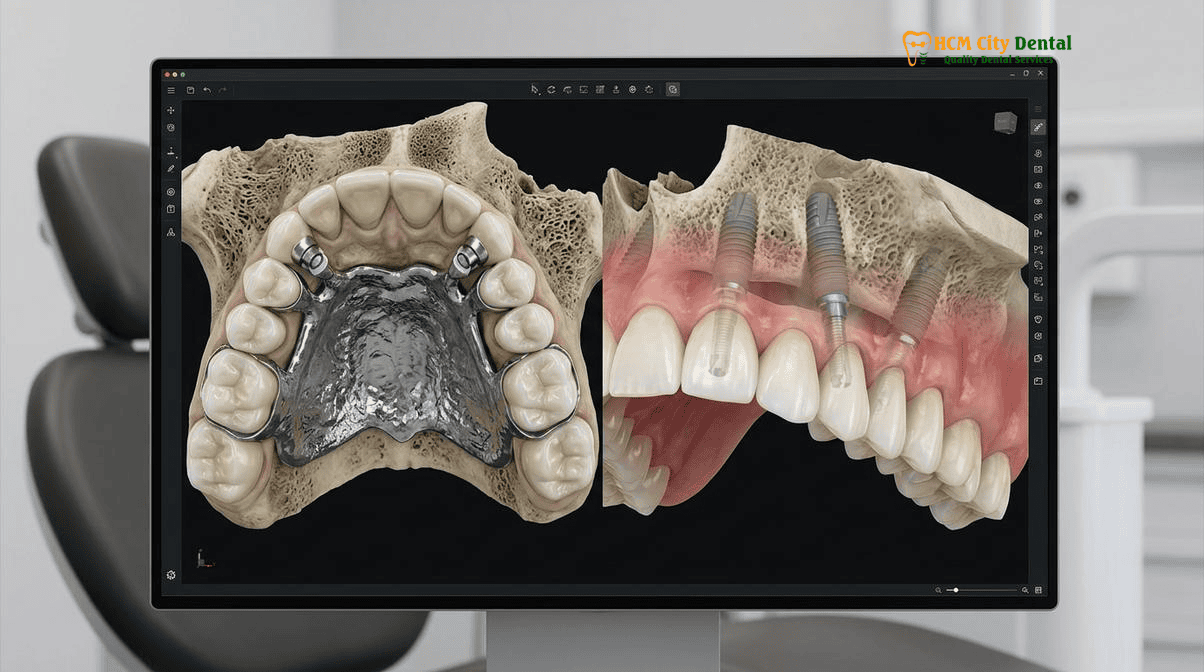
Once the surveyed crowns have established the ideal biomechanical foundation, the retention of the denture is achieved through extracoronal precision attachments. This is the mechanism that allows for a precision attachment partial denture no metal clasps.
\n\n
An extracoronal attachment is a precision-machined interlocking device positioned outside the normal contours of the crown. It consists of two parts:
\n
- \n
- The Patrix (Male Component): A small, spherical or cylindrical projection (often resembling a tiny ball) that is cast or milled directly into the distal (back) surface of the surveyed crown.
- The Matrix (Female Component): A corresponding receptacle embedded inside the acrylic and metal framework of the removable partial denture. This receptacle houses a replaceable, color-coded nylon or silicone retention cap.
\n
\n
\n\n
When the patient inserts the partial denture, the nylon cap inside the denture snaps securely over the metal ball on the surveyed crown. This creates a firm, resilient, and 100% invisible lock. Because the attachment is located on the back of the tooth and hidden underneath the denture base, there are absolutely no metal clasps crossing the facial surface of the teeth. The patient can smile with total confidence.
\n\n
\n
“The integration of the rhein83 bredent snap attachment RPD Vietnam systems has revolutionized removable prosthodontics. By utilizing color-coded nylon caps with varying degrees of retention (extra-soft, soft, standard, and rigid), we can customize the exact ‘snap’ force for each patient. As the nylon cap naturally wears down over 12 to 18 months of daily use, replacing it takes only five minutes in the clinic, instantly restoring the denture to its original, factory-tight retention.”
\n — Dr. Nguyen Van Cuong, DDS (Clinical Director, HCMC Dental Clinic)\n
\n\n
Furthermore, these resilient attachments act as stress-breakers. In a distal extension case, when the patient bites down on the back teeth, the resilient nylon cap allows the denture base to compress slightly into the soft tissue without transferring that rotational torque to the abutment tooth. This preserves the periodontal health of the anchor teeth for decades.[3]
\n\n\n
Clinical Case Note — Dr. Nguyen Van Cuong, DDS (Vietnam MOH License 0003265/BL-CCHN): When systemic medical contraindications or anatomical constraints preclude fixed dental implants, a conventional partial denture with visible metal clasps on front teeth is never the only option. At HCMC Dental Clinic in District 1, Ho Chi Minh City, we CAD/CAM-mill surveyed monolithic zirconia crowns integrated with hidden intracoronal Rhein 83 or Bredent precision attachments, delivering rigid cross-arch splinting and clasp-free aesthetics.
\n\n
CAD/CAM Laser-Sintered Cobalt-Chromium (Co-Cr) Frameworks vs. High-Performance BioHPP PEEK Metal-Free Frameworks
\n\n
The structural backbone of a precision attachment partial denture is its framework. The framework connects the attachments, supports the acrylic gums and prosthetic teeth, and provides cross-arch stabilization. At HCMC Dental Clinic, we offer two premier framework materials, allowing patients to compare a cobalt chrome vs peek flexible partial denture.
\n\n
CAD/CAM Laser-Sintered Cobalt-Chromium (Co-Cr)
\n
Traditionally, partial denture frameworks were cast by hand, which could lead to microscopic porosities and slight inaccuracies in fit. Today, we utilize Selective Laser Melting (SLM) technology to 3D-print the framework from Cobalt-Chromium alloy powder. This CAD/CAM process results in a framework that is exceptionally rigid, ultra-thin, and perfectly adapted to the milled guide planes of the surveyed crowns. The high rigidity of Co-Cr is crucial for distributing chewing forces evenly across the dental arch and preventing the prosthesis from flexing during mastication. For patients requiring a Glass Fiber Post & Core Buildup vs. Cast Metal Post Before a Dental Crown: Preventing Root Fracture, ensuring the framework does not flex and torque the underlying post is paramount.
\n\n
BioHPP PEEK (Polyetheretherketone) Metal-Free Frameworks
\n
For patients with severe metal allergies, or those seeking a highly biocompatible, lightweight alternative, BioHPP PEEK is the ultimate material. PEEK is a high-performance polymer widely used in orthopedic joint replacements. It is 100% metal-free, highly resistant to plaque accumulation, and possesses an elasticity similar to human bone. A PEEK framework is significantly lighter than Co-Cr and can be milled to a tooth-colored or gingiva-colored shade, rendering it virtually invisible in the mouth. While slightly thicker than Co-Cr to achieve the necessary strength, PEEK provides exceptional shock absorption, making it highly comfortable for patients with sensitive oral tissues.[4]
\n\n\n
\n\n\n
When a Precision-Attachment Partial Denture Is Chosen Over Posterior Dental Implants (Medical Contraindications, Radiation, or Budget)
\n\n
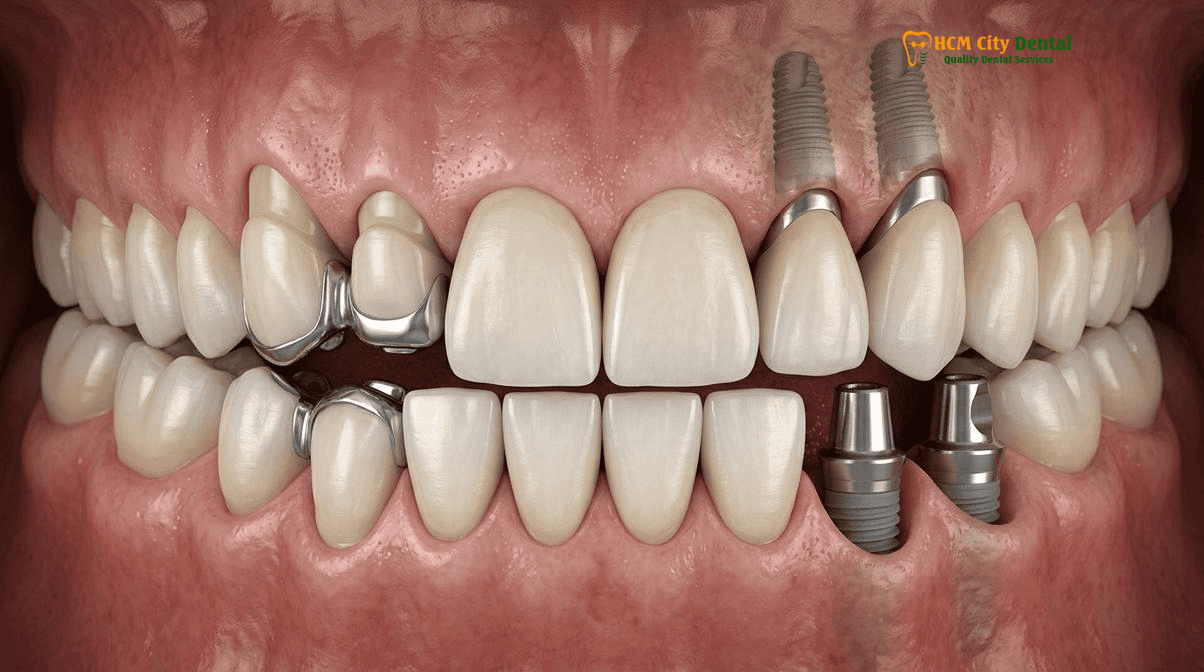
While dental implants are widely considered the gold standard for replacing missing teeth, they are not universally applicable. When evaluating a surveyed crown precision attachment cast partial denture vs implants, several clinical, anatomical, and financial factors may make the precision attachment RPD the superior choice, serving as one of the best partial denture alternatives to implants in Saigon.
\n\n
1. Severe Anatomical Deficiencies and Sinus Pneumatization
\n
In the posterior maxilla (upper jaw), the maxillary sinus often expands (pneumatizes) after tooth loss, leaving only 1–2 millimeters of residual bone. Placing implants in this region requires extensive, invasive sinus lift bone grafting procedures, which carry risks of membrane perforation, infection, and a healing time of 6 to 9 months. If a patient declines complex bone grafting surgery, a precision attachment partial denture can restore full chewing function immediately, utilizing the remaining anterior teeth for support.
\n\n
2. Medical Contraindications to Oral Surgery
\n
Certain systemic conditions preclude patients from safely undergoing implant surgery. Patients who have received high-dose head and neck radiation therapy (typically >50 Gy) for oral cancer are at a severe risk of osteoradionecrosis (bone death) if the jawbone is surgically traumatized. Similarly, patients taking intravenous bisphosphonates for osteoporosis or multiple myeloma are at risk for Medication-Related Osteonecrosis of the Jaw (MRONJ). For these individuals, a non-surgical, tooth-supported precision attachment partial denture is the safest and most predictable restorative option.
\n\n
Clinical Case Study: District 1, Ho Chi Minh City
\n
A 68-year-old Australian expat presented to Dr. Nguyen Van Cuong, DDS (Clinical Director — MOH License 0003265/BL-CCHN) with bilateral missing lower molars (Kennedy Class I). The patient had a history of severe osteoporosis managed with IV bisphosphonates, making implant surgery strictly contraindicated. Furthermore, the terminal premolars were heavily restored and structurally compromised. Dr. Cuong designed a treatment plan utilizing splinted Zirconia surveyed crowns on the remaining premolars, integrated with Rhein83 OT Cap attachments, and a CAD/CAM Co-Cr cast partial denture. The patient achieved a highly aesthetic, clasp-free smile and robust chewing function without undergoing any surgical intervention.
\n
\n\n
3. Salvaging Compromised Abutment Teeth
\n
In cases where the remaining abutment teeth are severely broken down, they can often be salvaged and utilized as anchors for a precision attachment. Utilizing Wave 4A biomimetic protocols, Dr. Cuong may utilize monoblock IPS E.max Endocrowns with a 2–3mm pulp chamber endo-core and cervical butt-joint, or perform dual-guide Piezosurgery crown lengthening based on Coslet’s Altered Passive Eruption (APE Type 1A/1B) 3D CBCT diagnosis to establish a healthy ≥3mm biologic width before surveyed crown placement. If the tooth is discolored from previous root canal therapy, a Sodium Perborate internal Walking Bleach over a 2mm bobsled RMGI/Biodentine cervical barrier can be performed prior to crown preparation.
\n\n
Clinical Precaution: Precision attachment partial dentures require meticulous daily oral hygiene. Because the surveyed crowns and attachments are intimately connected to the natural teeth, plaque accumulation around the attachments can lead to rapid periodontal breakdown of the anchor teeth. Patients must commit to daily brushing, flossing, and the use of interdental brushes or water flossers around the surveyed crowns. If you experience any mobility in your anchor teeth or loss of retention in the denture, contact Dr. Cuong immediately via WhatsApp at +84 853 020 003 for a clinical evaluation and nylon cap replacement.
\n
\n\n
Finally, budget plays a significant role. Restoring a bilateral posterior edentulous space with implants may require 4 to 6 fixtures, costing thousands of dollars. A precision attachment partial denture provides a highly functional, aesthetic rehabilitation at a fraction of the cost of full implant reconstruction.[5]
\n\n\n
\n\n\n
2026 Surveyed Crown, Precision Attachment & Cast Partial Denture Fee Schedule at HCMC Dental Clinic (District 1)
\n\n
At HCMC Dental Clinic, we are committed to absolute financial transparency for our international patients and dental tourists. By utilizing our Official 2026 Dental Price List & -40% Online Booking Fee Schedule, patients can access world-class prosthodontic care at a fraction of the cost found in Australia, the US, or Canada. Below is the exact fee schedule for surveyed crowns, precision attachments, and implant alternatives.
\n\n
| Prosthodontic Procedure / Material | 2026 Online Booking Price (-40% USD) | 2026 Walk-In Price (USD) | US / Australian Benchmark (USD) |
|---|---|---|---|
| Full Zirconia Surveyed Crown (Cercon Standard / HT Multilayer) Includes milled guide planes & rest seats | $154 – $192 / tooth (4,000,000 – 5,000,000 VND) | $256 – $321 | $1,200 – $1,800 |
| IPS E.max All-Ceramic Surveyed Crown High-aesthetic anterior abutment | $231 / tooth (6,000,000 VND) | $385 | $1,400 – $2,000 |
| PFM Surveyed Crown Porcelain Fused to Metal | $81 / tooth | $135 | $900 – $1,200 |
| Valplast Flexible Partial Denture Tissue-borne, no metal framework | $154 – $231 (4,000,000 – 6,000,000 VND) | $256 – $385 | $800 – $1,500 |
| Single European / Swiss Implant Straumann BLT-SLA / BLA-Active (Alternative to RPD) | $962 – $1,346 (25,000,000 – 35,000,000 VND) | $1,603 – $2,244 | $4,500 – $6,000 |
| Single Korean Implant Dentis / Neo Biotech / Dentium (Alternative to RPD) | $462 – $654 (12,000,000 – 17,000,000 VND) | $769 – $1,090 | $3,000 – $4,000 |
| 3D CBCT Scan Diagnostic imaging for abutment evaluation | $18 (480,000 VND) | $30 | $250 – $400 |
\n
\n\n
*Note: The total cost of a precision attachment partial denture system depends on the number of surveyed crowns required to stabilize the framework, the type of attachment utilized (Rhein83 or Bredent), and the framework material (Co-Cr or BioHPP PEEK). A comprehensive clinical evaluation and 3D CBCT scan are required to provide an exact, customized treatment plan.
\n\n
For a detailed breakdown of how these costs compare internationally, please review our Dental Crown Cost Vietnam vs USA: Clinical Savings & Quality Guide.
\n\n\n
\n\n\n
Frequently Asked Questions
\n\n
How does a Precision Attachment Partial Denture stay locked tightly in place without any metal clasps showing when I smile?
\n
A precision attachment partial denture utilizes a hidden male-female interlocking mechanism. The ‘male’ patrix is cast or milled directly into the distal aspect of a surveyed crown cemented on your natural abutment tooth. The ‘female’ matrix (often a replaceable nylon cap, such as the Rhein83 OT Cap) is embedded inside the removable denture framework. When you insert the denture, the nylon cap snaps securely over the patrix, providing 100% invisible, clasp-free retention that locks the prosthesis tightly in place without any facial metal hooks.
\n\n
Why is a flexible nylon ‘Valplast’ partial denture harmful for long-term chewing compared to a tooth-supported precision framework?
\n
While flexible nylon (Valplast) dentures are metal-free and aesthetically pleasing initially, they are entirely tissue-borne. Because they lack rigid occlusal rests, every biting force compresses the denture directly into the underlying gums, accelerating severe alveolar bone resorption and causing soft tissue stripping around the remaining natural teeth. In contrast, a cobalt chrome vs peek flexible partial denture framework with surveyed crowns and precision attachments directs chewing forces axially down the roots of the abutment teeth, preserving the jawbone and preventing the prosthesis from sinking into the soft tissue.
\n\n
Why do the anchor teeth next to a precision attachment partial denture often need splinted surveyed crowns?
\n
Anchor teeth (terminal abutments) bear significant functional loads when supporting a precision attachment, especially in a kennedy class i class ii distal extension denture scenario. Splinting two adjacent abutment teeth together with surveyed crowns distributes the shear and torquing forces across multiple roots, preventing mobility or fracture of a single anchor tooth. Furthermore, surveyed crowns allow the prosthodontist to engineer precise milled lingual guide planes and rest seats that dictate a single, frictionless path of insertion for the partial denture.
\n\n
How many days in Ho Chi Minh City are required to fabricate surveyed crowns and a custom CAD/CAM precision attachment partial denture?
\n
Fabricating a precision attachment partial denture with surveyed crowns is a highly complex, multi-step prosthodontic procedure. It typically requires 10 to 14 days in Ho Chi Minh City. The timeline includes initial abutment tooth preparation and impressions, fabrication and cementation of the surveyed crowns with the integrated attachments, a secondary impression over the new crowns, framework try-in, wax teeth try-in for aesthetics and occlusion, and the final delivery of the completed prosthesis.
\n\n
How much does a Precision Attachment Partial Denture cost compared to multiple posterior dental implants at HCMC Dental Clinic?
\n
At HCMC Dental Clinic, a precision attachment partial denture is a highly cost-effective alternative to full implant reconstruction. While a single European/Swiss implant costs $962 – $1,346 USD online, restoring a bilateral missing posterior segment might require 4 to 6 implants, totaling over $5,000 USD. In contrast, a complete precision attachment system—including the necessary surveyed crowns ($154 – $192 USD each for Zirconia) and the custom cast partial denture framework with Rhein83 attachments—typically ranges from $800 to $1,500 USD total, depending on the number of abutment crowns required.
\n\n
References
\n
- \n
- Journal of Prosthetic Dentistry. Biomechanical analysis of implant-assisted removable partial dentures vs. precision attachment surveyed crown RPDs in distal extension cases. (2023).
- International Journal of Prosthodontics. Clinical outcomes and abutment survival rates of extracoronal resilient attachments (Rhein83/Bredent) in cast partial dentures. (2022).
- Clinical Oral Implants Research. Comparative stress distribution of CAD/CAM Cobalt-Chromium versus BioHPP PEEK frameworks in Kennedy Class I and II edentulism. (2021).
- Journal of Advanced Prosthodontics. The efficacy of milled lingual guide planes and cingulum rest seats in surveyed zirconia crowns utilizing the APC bonding protocol. (2023).
- Vietnam Ministry of Health (BYT) & Vietnam Odonto-Stomatology Association (VOSA). National Clinical Guidelines on Specialist Dental Care, Biomaterial Traceability & EN 13060 Class B Infection Control. (2024).
\n
\n
\n
\n
\n
\n\n