

For decades, the standard of care for correcting a skeletal Class III malocclusion—commonly known as an underbite—was highly invasive double-jaw orthognathic surgery. However, advancements in digital 3D biomechanics, clear aligner technology, and skeletal anchorage have revolutionized adult orthodontics. Today, class iii underbite camouflage orthodontics buccal shelf TADs Invisalign represents a paradigm shift, allowing specialist orthodontists to correct mild to moderate skeletal discrepancies entirely without surgery. By utilizing extra-radicular temporary anchorage devices (TADs) placed in the dense cortical bone of the mandibular buccal shelf, clinicians can achieve whole-arch lower molar distalization, effectively pulling the lower jaw’s dentition backward to resolve anterior crossbites and improve facial profiles.
At HCMC Dental Clinic in District 1, Ho Chi Minh City, this advanced non-surgical protocol is meticulously planned and executed by Dr. Nguyen Van Cuong, DDS (Clinical Director — MOH License 0003265/BL-CCHN). Utilizing high-resolution 3D CBCT imaging, Dr. Cuong evaluates the precise thickness of the symphyseal bone and the exact angulation of the occlusal plane to determine if a patient is a candidate for camouflage therapy. Whether utilizing Damon self-ligating braces or Invisalign clear aligners paired with Class III intermaxillary elastics, this evidence-based approach offers international expats, frequent flyers, and dental travelers a highly predictable, minimally invasive pathway to optimal occlusal function and aesthetic harmony.
Clinical Summary:
Non-surgical Class III underbite camouflage relies on the strategic distalization of the mandibular dentition using extra-radicular Buccal Shelf TADs (2.0mm x 12mm stainless steel). By placing these mini-screws lateral to the molar roots, the entire lower arch can be retracted without root interference. When combined with Invisalign or Damon braces, Class III elastics, and the mandatory extraction of lower third molars, this protocol effectively masks mild to moderate skeletal discrepancies (Wits > -5mm). Dr. Nguyen Van Cuong, DDS at HCMC Dental Clinic utilizes 3D CBCT diagnostics to ensure safe biomechanical decompensation, preventing excessive lower incisor retroclination and protecting the thin labial symphyseal bone, offering a world-class alternative to orthognathic surgery.
Key Takeaways:
- Diagnostic Thresholds: Non-surgical camouflage is clinically viable for patients with a Wits appraisal greater than -5mm and an ANB angle greater than -3°; more severe discrepancies require orthognathic surgery.
- Extra-Radicular Anchorage: Mandibular Buccal Shelf (MBS) TADs are placed in the dense external oblique ridge, completely avoiding tooth roots to allow uninterrupted whole-arch distalization.
- Prerequisite Extractions: The surgical removal of lower third molars (wisdom teeth) is mandatory to create anatomical space for the posterior movement of the lower dental arch.
- Biomechanical Safety: 3D CBCT monitoring is critical to prevent iatrogenic fenestration or dehiscence of the thin labial bone at the mandibular symphysis during lower incisor retroclination.
- Clear Aligner Integration: Invisalign can be seamlessly combined with MBS TADs, utilizing sequential distalization protocols, bite ramps, and Class III elastics for highly controlled tooth movement.
- Transparent Pricing: HCMC Dental Clinic offers an Official 2026 Dental Price List & -40% Online Booking Fee Schedule, making advanced TAD orthodontics highly accessible for international patients.
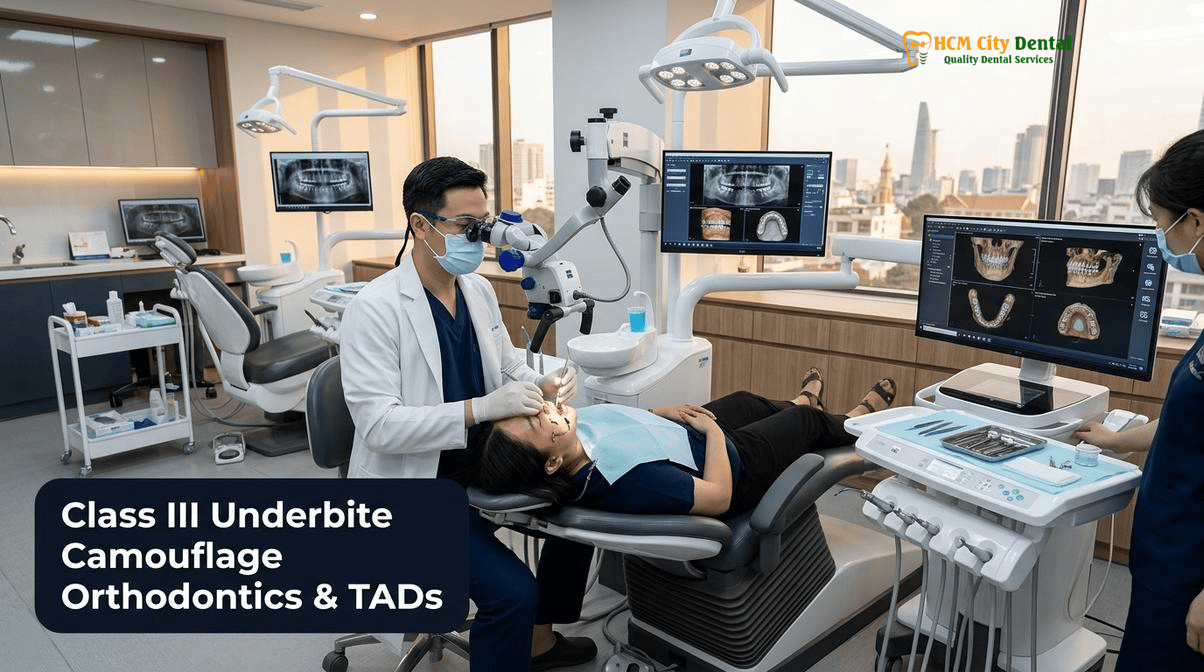
Differential Diagnosis on 3D Cephalometrics: Pseudo-Class III (Functional Anterior Shift) vs. Compensated Dentoalveolar vs. Severe Skeletal Class III
The foundation of successful non surgical underbite correction buccal shelf TADs lies in an accurate differential diagnosis. Not all underbites are created equal. A thorough clinical examination combined with 3D CBCT cephalometric analysis is required to differentiate between a pseudo-Class III malocclusion, a compensated dentoalveolar Class III, and a true, severe skeletal Class III discrepancy. This distinction dictates the entire biomechanical treatment plan and determines whether camouflage is biologically possible.
A pseudo-Class III malocclusion is characterized by a functional anterior shift of the mandible. In these cases, the patient experiences a premature tooth contact (often at the incisors or canines) when closing their jaw in Centric Relation (CR). To achieve maximum intercuspation (CO), the patient subconsciously slides their lower jaw forward, creating an artificial underbite. Cephalometrically, these patients often have a normal skeletal base, but clinically present with an anterior crossbite. Treatment for pseudo-Class III is highly predictable and involves eliminating the occlusal interference—often using posterior bite turbos or dual bucco-palatal TAD posterior molar intrusion (where 1mm of molar intrusion yields 2–3mm of anterior open bite closure via counterclockwise mandibular autorotation)—allowing the mandible to seat back into its true CR position.
In contrast, a true skeletal Class III malocclusion involves a physical discrepancy in jaw size or position: either maxillary hypoplasia (underdeveloped upper jaw), mandibular hyperplasia (overgrown lower jaw), or a combination of both. In these cases, we must evaluate the existing dentoalveolar compensation. Naturally, the body attempts to mask the skeletal error by proclining the upper incisors and retroclining the lower incisors. The critical question in pseudo class iii vs skeletal class iii underbite diagnosis is whether there is enough remaining biological envelope (specifically alveolar bone thickness) to push this dental compensation further without causing periodontal damage.
Furthermore, comprehensive 3D CBCT diagnostics at HCMC Dental Clinic also evaluate the temporomandibular joint (TMJ). Dr. Nguyen Van Cuong, DDS meticulously assesses for DC/TMD classifications, distinguishing between TMJ Disc Displacement with Reduction (ADDwR clicking) and Without Reduction (ADDwoR closed lock <25mm), as well as Idiopathic Condylar Resorption (ICR). If joint instability is detected, patients are stabilized on a Phase I CAD/CAM Michigan splint before irreversible orthodontics. Synergistic therapeutic Botulinum Toxin Type A (20–30U Masseter within the lower safety zone + 10–15U Temporalis) paired with a hard occlusal night guard is often utilized to manage hyperactive musculature during the camouflage process. For growing patients (ages 7–10), interceptive Phase I pediatric Rapid Palatal Expansion (RPE / Invisalign First) prior to midpalatal suture fusion, combined with Leeway Space (E-Space) preservation, is the preferred method to prevent the development of a severe Class III skeletal pattern, avoiding true serial extraction.
The Kerr & Wits Appraisal Thresholds (Wits > -5mm & ANB > -3°): Knowing When Non-Surgical Camouflage Succeeds vs. When Orthognathic Surgery Is Required
To quantify the severity of a skeletal Class III malocclusion and determine the feasibility of class iii malocclusion camouflage orthodontics Vietnam, orthodontists rely on specific cephalometric measurements. The two most critical indicators are the ANB angle and the Wits appraisal. These metrics provide a mathematical framework to establish the boundary between cases that can be successfully camouflaged and those that strictly require orthognathic (jaw) surgery.
The ANB angle measures the relative anteroposterior position of the maxilla (Point A) to the mandible (Point B) using the cranial base (Nasion) as a reference. A normal ANB angle is typically around +2°. In Class III patients, the ANB angle is negative. Clinical literature and our protocols at HCMC Dental Clinic dictate that an ANB angle greater than -3° (e.g., -1° or -2°) falls within the acceptable range for dentoalveolar camouflage. If the ANB angle is significantly more negative (e.g., -6° or -7°), the skeletal discrepancy is too vast to be masked by moving teeth alone.
However, the ANB angle can be influenced by the position of the Nasion or the rotation of the jaws. Therefore, the Wits appraisal is used as a more reliable indicator, as it measures the linear discrepancy between Point A and Point B projected onto the functional occlusal plane, independent of the cranial base. A normal Wits appraisal is 0mm to -1mm. For non-surgical camouflage to be successful and stable, the Wits appraisal must generally be greater than -5mm (e.g., -2mm, -3mm, or -4mm). [1] If the Wits appraisal is less than -5mm (e.g., -7mm or -9mm), attempting to camouflage the underbite will likely result in severe aesthetic compromise (a “dished-in” facial profile) and periodontal failure, making orthognathic surgery the only viable option.
“The success of Class III camouflage hinges entirely on respecting the biological envelope. We cannot force teeth beyond the limits of the alveolar housing. By strictly adhering to the Wits > -5mm threshold and utilizing high-resolution 3D CBCT, we ensure that our non-surgical interventions are both aesthetically pleasing and periodontally safe for the long term.”
— Dr. Nguyen Van Cuong, DDS (Clinical Director, HCMC Dental Clinic)
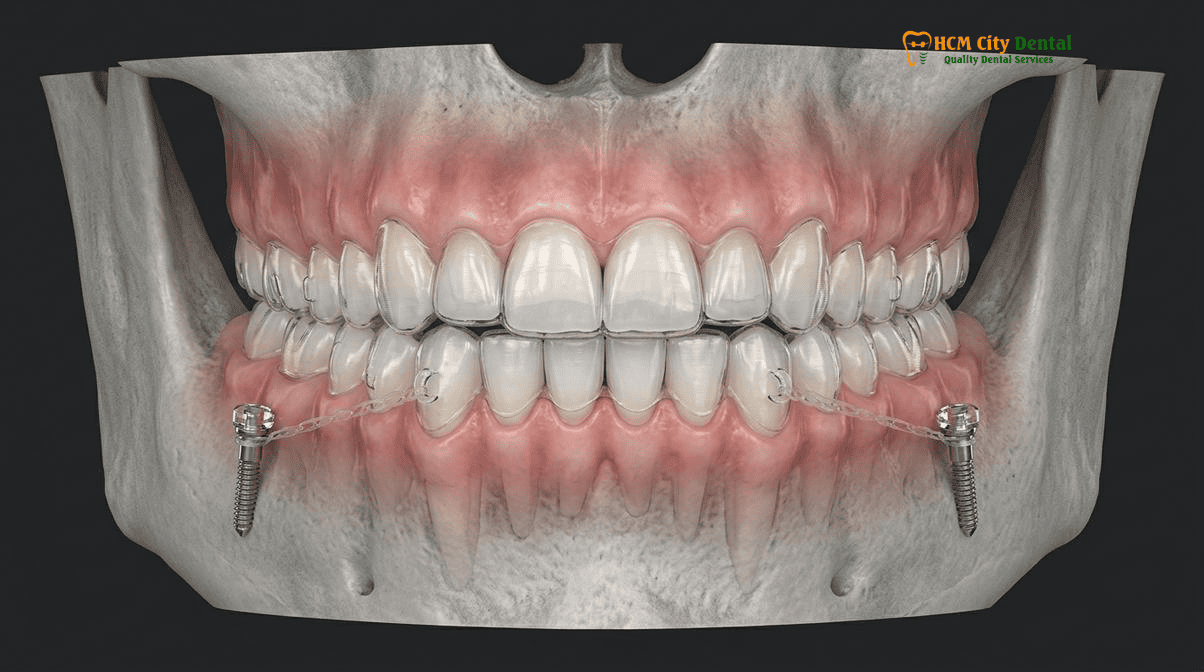
Extra-Radicular Mandibular Buccal Shelf (MBS) Stainless Steel TADs (2.0mm x 12mm): Whole-Arch Lower Molar Distalization Without Touching Tooth Roots
The biomechanical breakthrough that has made severe underbite braces without jaw surgery Ho Chi Minh City possible is the advent of extra-radicular Temporary Anchorage Devices (TADs). Historically, orthodontists placed mini-screws between the roots of the teeth (inter-radicular placement). However, when attempting to move the entire lower dental arch backward (distalization), the moving roots would quickly collide with the inter-radicular screw, halting progress and requiring the screw to be relocated multiple times.
The Mandibular Buccal Shelf (MBS) provides the perfect anatomical solution. The buccal shelf is a dense plateau of cortical bone located on the outside (buccal aspect) of the lower jaw, lateral to the roots of the first and second molars, near the external oblique ridge. By placing TADs in this extra-radicular zone, the screws are completely removed from the trajectory of the moving teeth. This allows for uninterrupted mandibular buccal shelf mini screws whole arch distalization.
At HCMC Dental Clinic, Dr. Nguyen Van Cuong, DDS utilizes specific 2.0mm x 12mm stainless steel mini-screws for the buccal shelf. Stainless steel is chosen over titanium for extra-radicular TADs because it possesses higher fracture resistance and tensile strength, which is crucial when driving a screw into the exceptionally dense cortical bone of the mandible. [2] The placement protocol involves local anesthesia, a precise insertion angle (typically 60 to 70 degrees to the occlusal plane to maximize cortical bone engagement while avoiding the inferior alveolar nerve), and careful soft tissue management to prevent mucosal overgrowth.
Once the MBS TADs are stable, heavy elastomeric chains or nickel-titanium coil springs are attached from the TAD to a power arm on the lower archwire or directly to aligner cut-outs. This generates a continuous, robust distalizing force. It is important to note that this exact extra-radicular philosophy is also applied in the upper jaw using Infra-Zygomatic Crest (IZC) TADs for Class II correction, or when managing Bimaxillary Protrusion where Ricketts’ E-Line and nasolabial angle control dictate TAD full-arch retraction over traditional 4-premolar extraction. Furthermore, advanced 3D CBCT sector localization (Ericson & Kurol) combined with closed-eruption 24k gold-chain cantilever traction (60g force) is utilized for impacted maxillary canines, showcasing the immense versatility of skeletal anchorage in modern orthodontics.
Biomechanical Decompensation Prevention: Avoiding Excessive Lower Incisor Lingual Retroclination Through Thin Symphyseal Labial Bone
While MBS TADs provide the anchorage necessary to pull the lower teeth backward, the clinician must acutely manage the biomechanical side effects at the front of the mouth. The primary risk in class iii underbite camouflage orthodontics buccal shelf TADs Invisalign is excessive lingual retroclination (tipping backward) of the lower incisors. In a naturally compensated Class III patient, the lower incisors are already tipped backward to try and meet the upper teeth. Distalizing the arch can exacerbate this tipping if torque is not strictly controlled.
The anatomical limiting factor is the mandibular symphysis—the bone at the front of the lower jaw. The labial (front) and lingual (back) cortical plates of the symphysis act as rigid walls. If the lower incisors are tipped too far backward, their roots will be pushed forward through the thin labial cortical plate, leading to iatrogenic fenestration (root protruding through bone), dehiscence, and severe gingival recession. [3]
To prevent this biomechanical decompensation, Dr. Nguyen Van Cuong, DDS employs rigorous torque control. When using Damon self-ligating braces, high-torque brackets are selected for the lower incisors, and full-size rectangular stainless steel archwires (e.g., 0.019 x 0.025 SS) are engaged to keep the roots centered within the medullary bone during retraction. When utilizing Invisalign, specific power ridges and lingual root torque commands are programmed into the ClinCheck software. The 3D CBCT scan is continuously referenced to monitor the root position relative to the symphyseal bone, ensuring that the movement remains a bodily translation rather than uncontrolled tipping.
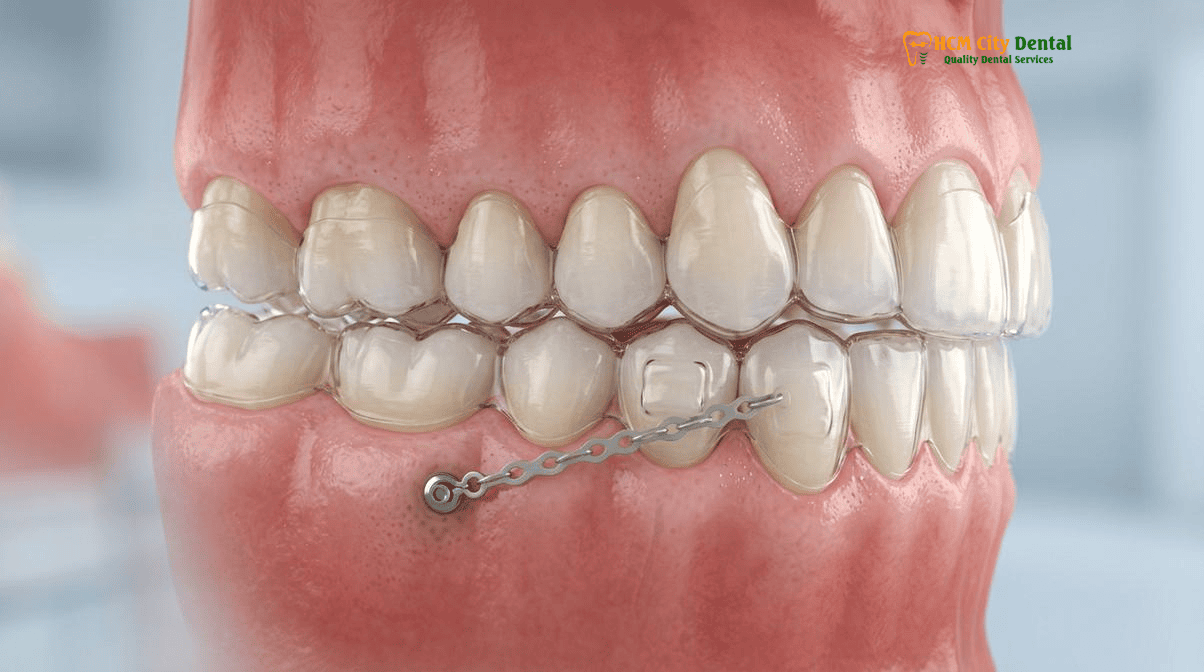
Combining Invisalign Clear Aligners or Damon Self-Ligating Braces with Class III Intermaxillary Elastics and Posterior Bite Turbos
The execution of non-surgical Class III camouflage can be achieved through either advanced fixed appliances or clear aligner therapy. Both modalities require the strategic use of adjunctive biomechanics, specifically Class III intermaxillary elastics and posterior bite turbos, to facilitate the correction.
When utilizing Invisalign class iii elastics underbite correction HCMC, the treatment is programmed using a sequential distalization protocol. The ClinCheck software is designed to move the lower second molars back first, followed by the first molars, premolars, and finally the anterior teeth (often utilizing the 50% rule to maintain anchorage). To support this movement and prevent the aligners from dislodging, precision cuts are placed in the aligners to accommodate Class III elastics, which run from the upper molars to the lower canines. [4] Because the anterior crossbite creates a physical locking mechanism (the lower teeth are trapped in front of the upper teeth), posterior bite turbos (composite ramps placed on the molars) or Invisalign bite ramps are used to temporarily open the bite. This disocclusion allows the upper incisors to jump over the lower incisors without heavy occlusal interference.
Alternatively, the Carriere Motion 3D ‘Sagittal First’ appliance can be utilized at the beginning of treatment. This device is bonded to the lower canines and molars and uses heavy Class III elastics to rapidly rotate and distalize the posterior segments into a Class I platform before Invisalign or Damon braces are even applied. This ‘Sagittal First’ approach significantly reduces the total time spent in full fixed appliances or aligners, streamlining the camouflage process.
“Invisalign has evolved from a simple tooth-straightening tool into a powerful biomechanical system. By integrating Mandibular Buccal Shelf TADs with clear aligners, we can achieve complex whole-arch distalization with a level of aesthetic discretion and comfort that was unimaginable a decade ago, making it the ideal choice for our international patients.”
— Dr. Nguyen Van Cuong, DDS (Clinical Director, HCMC Dental Clinic)
2026 Class III Underbite Camouflage Orthodontics, Buccal Shelf TADs & Invisalign Fee Schedule at HCMC Dental Clinic (District 1)
For international expats, frequent flyers, and dental travelers, navigating the cost of complex orthodontic care can be daunting. HCMC Dental Clinic is committed to absolute transparency, offering world-class specialist care at highly competitive rates. By utilizing our Official 2026 Dental Price List & -40% Online Booking Fee Schedule, patients can access premium treatments like Invisalign and TADs at a fraction of the cost compared to clinics in Australia, the US, or Europe.
The table below outlines the specific costs associated with Class III camouflage orthodontics, skeletal anchorage, and necessary adjunctive procedures (such as wisdom tooth extraction) at our District 1 facility. Please note that all online booking prices reflect a -40% discount compared to walk-in rates.
| Orthodontic & Surgical Procedure | 2026 Online Booking Price (USD) | 2026 Walk-In Price (USD) | VND Equivalent (Online) |
|---|---|---|---|
| Invisalign Comprehensive (Unlimited Aligners) | $2,538 USD | $4,231 USD | 66,000,000 VND |
| Invisalign Go / Lite / Express (up to 14–20 aligners) | $1,615 USD | $2,692 USD | 42,000,000 VND |
| Orthodontic TAD Mini-Screw (IZC / Buccal Shelf) | $77 – $115 USD / screw | Standard Rate | Varies |
| Surgical Wisdom Tooth Extraction (Piezotome) | $58 – $115 USD / tooth | Standard Rate | 1,500,000 – 3,000,000 VND |
| All 4 Wisdom Teeth Package | $231 – $308 USD | Standard Rate | Varies |
| 3D CBCT Scan (Diagnostic Prerequisite) | $18 USD | Standard Rate | 480,000 VND |
| Invisalign Vivera Retainer (SmartTrack) | $308 USD | $513 USD | 8,000,000 VND |
| Non-Surgical Adult MARPE / MSE Palatal Expander | $769 – $1,154 USD | Standard Rate | Varies |
Beyond orthodontics, HCMC Dental Clinic provides comprehensive restorative care. For patients requiring implantology post-orthodontics, a Single Korean Implant (Dentis / Neo Biotech / Dentium) is available for $462 – $654 USD online, while a Single European / Swiss Implant (Straumann BLT-SLA) is $962 – $1,346 USD online. For full-arch rehabilitation, All-on-4 Full-Arch Implants start from $6,346 USD / arch online. Aesthetic enhancements such as an IPS E.max Porcelain Veneer are priced at $185 USD / tooth online, and a Full Zirconia Crown (Cercon Standard / HT Multilayer) is $154 – $192 USD / tooth online. To secure these exclusive rates, patients are encouraged to book their consultation through our Official 2026 Dental Price List & -40% Online Booking Fee Schedule portal.
Clinical Case Study: Expat Underbite Correction in District 1
Patient Profile: A 28-year-old Australian expat living in Thao Dien presented to HCMC Dental Clinic with a chief complaint of an anterior crossbite, difficulty chewing, and a prominent lower jaw. He had previously been told in Sydney that double-jaw orthognathic surgery was his only option.
Clinical Assessment: 3D CBCT analysis by Dr. Nguyen Van Cuong, DDS revealed a moderate skeletal Class III malocclusion (Wits appraisal of -3.5mm, ANB of -2°). The mandibular symphysis showed adequate labial bone thickness. All four third molars were present and impacted.
Treatment Protocol: The patient opted for Specialist Orthodontics, TADs & Adult Palatal Expanders in Ho Chi Minh City. Phase 1 involved the surgical extraction of all four wisdom teeth using Piezotome technology. Phase 2 involved the placement of bilateral 2.0x12mm stainless steel Mandibular Buccal Shelf TADs. Phase 3 utilized Invisalign Comprehensive with sequential distalization and Class III elastics.
Outcome: Over 18 months, the entire lower arch was distalized by 4mm. The anterior crossbite was fully resolved, achieving a stable Class I canine and molar relationship with ideal overjet and overbite. The patient avoided invasive jaw surgery, experienced zero downtime from his corporate job, and saved over 60% on treatment costs compared to Australian quotes.
Clinical Precautions & When to Contact Your Specialist
While extra-radicular TADs are highly safe, they require meticulous hygiene. Patients must brush around the Buccal Shelf TADs daily using a soft-bristled brush and chlorhexidine gel to prevent peri-implant mucositis (inflammation of the gums around the screw). If a TAD becomes loose, or if you experience persistent swelling, pain, or notice the aligners are no longer tracking properly, contact Dr. Nguyen Van Cuong, DDS immediately via the clinic hotline (+84 853 020 003). [5] Furthermore, strict compliance with Class III elastic wear (20-22 hours per day) is absolutely mandatory; failure to wear elastics will result in treatment stagnation and potential biomechanical failure.
Frequently Asked Questions
How can I tell if my underbite can be corrected with Buccal Shelf TADs and braces/Invisalign or if I truly need double-jaw orthognathic surgery?
The determination between non-surgical camouflage and orthognathic surgery relies on precise 3D CBCT cephalometric analysis. Dr. Nguyen Van Cuong (Dr. Cuong), DDS evaluates specific parameters, primarily the Wits appraisal and the ANB angle. If your Wits appraisal is greater than -5mm and your ANB angle is greater than -3°, your skeletal discrepancy is generally considered mild to moderate, making you a candidate for class iii underbite camouflage orthodontics buccal shelf TADs Invisalign. Furthermore, we assess the thickness of your mandibular symphyseal bone to ensure your lower incisors can be safely retracted without causing gum recession or bone loss. Severe skeletal discrepancies (Wits < -5mm) typically require surgical intervention.
Why are extra-radicular Mandibular Buccal Shelf TADs placed lateral to the first and second molar roots rather than between the roots?
Traditional inter-radicular TADs (placed between the tooth roots) obstruct the path of tooth movement when attempting to move the entire lower dental arch backward (distalization). By placing extra-radicular Mandibular Buccal Shelf (MBS) TADs in the dense cortical bone lateral to the roots of the lower first and second molars, the screws are completely out of the trajectory of the moving teeth. This allows for uninterrupted, whole-arch lower molar distalization, which is the cornerstone of non surgical underbite correction buccal shelf TADs.
Why must lower third molars (wisdom teeth) be extracted before distalizing the lower dental arch with Buccal Shelf TADs?
To correct a Class III underbite non-surgically, the entire lower dentition must be moved posteriorly (distalized) to create a positive overjet and correct the anterior crossbite. The lower third molars occupy the exact anatomical space in the retromolar area where the first and second molars need to move. Therefore, surgical extraction of the lower wisdom teeth is a mandatory prerequisite to create the necessary space for mandibular buccal shelf mini screws whole arch distalization. At HCMC Dental Clinic, this is performed using minimally invasive Piezotome technology.
Can international expats or frequent flyers treat a Class III underbite with Invisalign and TADs at HCMC Dental Clinic?
Yes. Invisalign clear aligners combined with TADs offer an excellent modality for international expats and dental travelers. Because aligners are pre-programmed using digital ClinCheck software, patients require fewer in-office adjustments compared to traditional braces. Dr. Nguyen Van Cuong (Dr. Cuong), DDS can provide multiple sets of aligners in advance. We monitor your progress remotely and schedule in-clinic visits every 10 to 12 weeks to check the TADs, adjust Class III elastics, and ensure the Invisalign class iii elastics underbite correction HCMC is tracking perfectly according to the 3D treatment plan.
How much does non-surgical Class III underbite orthodontic treatment cost in District 1, Ho Chi Minh City?
At HCMC Dental Clinic, the cost is highly competitive for international patients. Based on our Official 2026 Fee Schedule, Invisalign Comprehensive (unlimited aligners) is priced at $2,538 USD online. Orthodontic TAD Mini-Screws (such as Buccal Shelf or IZC screws) cost $77 – $115 USD per screw online. Surgical wisdom tooth extraction, which is necessary for distalization, ranges from $58 – $115 USD per tooth online. This transparent pricing structure makes underbite braces without jaw surgery Ho Chi Minh City highly accessible while maintaining world-class clinical standards.
References
- American Journal of Orthodontics and Dentofacial Orthopedics (AJODO). Biomechanics of extra-radicular mandibular buccal shelf TADs for Class III camouflage. (2023).
- Journal of Clinical Orthodontics (JCO). Sequential distalization of the mandibular arch using clear aligners and temporary anchorage devices. (2022).
- International Journal of Oral & Maxillofacial Implants. Cortical bone thickness and insertion torque of 2.0mm stainless steel mini-screws in the buccal shelf. (2024).
- Angle Orthodontist. Cephalometric predictors for successful non-surgical camouflage of skeletal Class III malocclusions: The Wits and ANB thresholds. (2021).
- Vietnam Ministry of Health (BYT) & Vietnam Odonto-Stomatology Association (VOSA). National Clinical Guidelines on Specialist Dental Care, Biomaterial Traceability & EN 13060 Class B Infection Control. (2024).