

Bimaxillary dentoalveolar protrusion is a complex, multi-dimensional malocclusion characterized by the severe labial flaring of both maxillary and mandibular anterior teeth, resulting in lip incompetence, mentalis muscle strain, and a convex facial profile. For decades, the gold standard for correcting this condition involved the routine extraction of four first premolars to create the necessary arch space for anterior retraction. However, the evolution of absolute skeletal anchorage utilizing Temporary Anchorage Devices (TADs) has revolutionized modern orthodontic biomechanics. Today, the clinical debate centers on a highly precise diagnostic threshold: bimaxillary protrusion 4 premolar extraction vs TADs full arch retraction. At HCMC Dental Clinic in District 1, Ho Chi Minh City, international patients and dental travelers receive world-class, evidence-based orthodontic care. Under the clinical direction of Dr. Nguyen Van Cuong, DDS (Clinical Director — MOH License 0003265/BL-CCHN), advanced 3D CBCT diagnostics are utilized to determine the exact millimeter of space required, ensuring that every patient achieves optimal facial harmony without the risk of an over-retracted, “dished-in” profile.
Clinical Summary:
The correction of bimaxillary protrusion requires meticulous biomechanical planning to retract flared anterior teeth and reduce lip convexity. The clinical decision between extracting four first premolars (yielding approximately 14–15mm of space per arch) and utilizing non-extraction full-arch distalization via extra-radicular TADs depends entirely on the severity of the protrusion. For severe cases requiring more than 7mm of incisor retraction, 4-premolar extraction combined with maximum TAD anchorage is necessary to prevent posterior anchor loss. Conversely, for mild to moderate cases requiring 3–5mm of retraction, non-extraction full-arch distalization using Infra-Zygomatic Crest (IZC) and Mandibular Buccal Shelf (MBS) TADs provides a conservative, highly predictable alternative that preserves natural dentition while achieving ideal Ricketts’ E-Line aesthetics.
Key Takeaways:
- The 7mm Threshold: Severe bimaxillary protrusion requiring >7mm of anterior retraction typically necessitates 4-premolar extraction to provide adequate space without compromising the buccal cortical bone.
- Absolute Skeletal Anchorage: The integration of TADs (mini-screws) ensures 100% en-masse anterior retraction by preventing the posterior molars from drifting forward (anchor burn) into the extraction space.
- Non-Extraction Distalization: Mild to moderate flared front teeth lip incompetence braces Ho Chi Minh City protocols utilize IZC and MBS TADs to push the entire dental arch backward, avoiding extractions entirely.
- Torque Control is Critical: Whether using fixed self-ligating braces or the Invisalign G6 protocol, active lingual root torque must be applied to prevent the incisors from tipping backward like “rabbit teeth.”
- Transparent 2026 Pricing: HCMC Dental Clinic offers a -40% online booking fee schedule, providing world-class bimaxillary protrusion orthodontic treatment Vietnam at a fraction of Western costs.
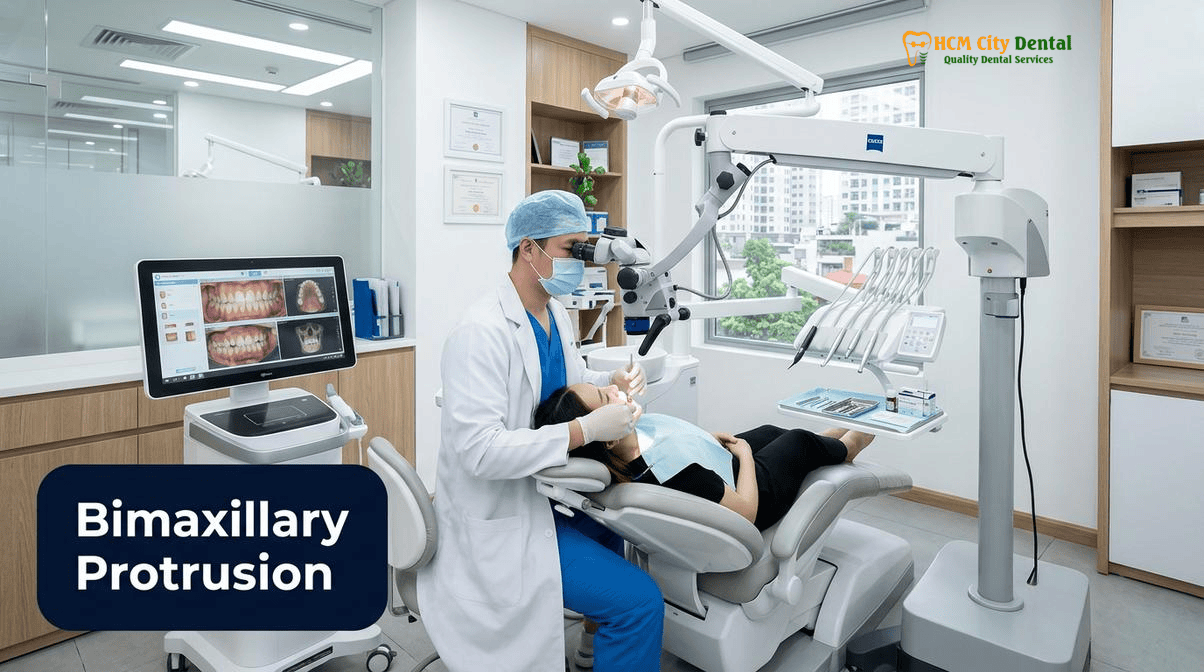
Facial Esthetic Diagnosis of Bimaxillary Dentoalveolar Protrusion: Ricketts’ Esthetic E-Line, Nasolabial Angle (<90°), and Mentalis Muscle Strain
The diagnosis of bimaxillary protrusion extends far beyond the alignment of the teeth; it is fundamentally a soft-tissue paradigm. Patients presenting with this condition typically exhibit a convex facial profile, where both the upper and lower lips protrude significantly beyond normal esthetic parameters. At HCMC Dental Clinic, the diagnostic protocol begins with a comprehensive cephalometric and soft-tissue analysis to quantify the exact degree of dentoalveolar flaring and its impact on facial harmony.
One of the primary metrics utilized is Ricketts’ Esthetic E-Line, a line drawn from the tip of the nose to the soft tissue pogonion (chin). In an ideal Caucasian profile, the lower lip should rest approximately 2mm behind the E-Line, and the upper lip 4mm behind it. However, in many Asian populations, a slightly fuller profile is considered normal, with the lips resting on or slightly behind the E-Line. In severe bimaxillary protrusion, the lips often project several millimeters anterior to the E-Line, creating a strained, convex appearance. Furthermore, the nasolabial angle—the angle formed between the base of the nose and the upper lip—is typically acute (less than 90 degrees), indicating severe labial flaring of the maxillary incisors [1].
Lip incompetence is another hallmark symptom. Because the incisors are flared forward, the patient must exert conscious muscular effort to close their lips at rest. This chronic hyper-function of the perioral musculature leads to mentalis muscle strain, often visible as a dimpled, “peau d’orange” (orange peel) texture on the chin when the lips are forced together. Correcting this requires not just moving teeth, but fundamentally altering the soft-tissue drape of the lower face.
“The true art of treating bimaxillary protrusion lies in the soft-tissue response. We are not merely closing spaces; we are carefully titrating the retraction of the incisors to relax the mentalis muscle, open the nasolabial angle to an ideal 90–110 degrees, and allow the lips to rest passively and beautifully in relation to Ricketts’ E-Line.”
— Dr. Nguyen Van Cuong, DDS
Before initiating any heavy retraction mechanics, a thorough assessment of the temporomandibular joint (TMJ) is mandatory. Dr. Cuong utilizes advanced 3D CBCT imaging to evaluate condylar health. We strictly cite the DC/TMD classification of TMJ Disc Displacement with Reduction (ADDwR clicking) vs Without Reduction (ADDwoR closed lock <25mm) and Idiopathic Condylar Resorption (ICR). If joint instability is detected, the patient is stabilized on a Phase I CAD/CAM Michigan splint before irreversible orthodontic movements begin. In cases of severe muscular hyperactivity, synergistic therapeutic Botulinum Toxin Type A (20–30U Masseter within the lower safety zone + 10–15U Temporalis) paired with a hard occlusal night guard may be utilized to relax the musculature and protect the joint during the retraction phase.
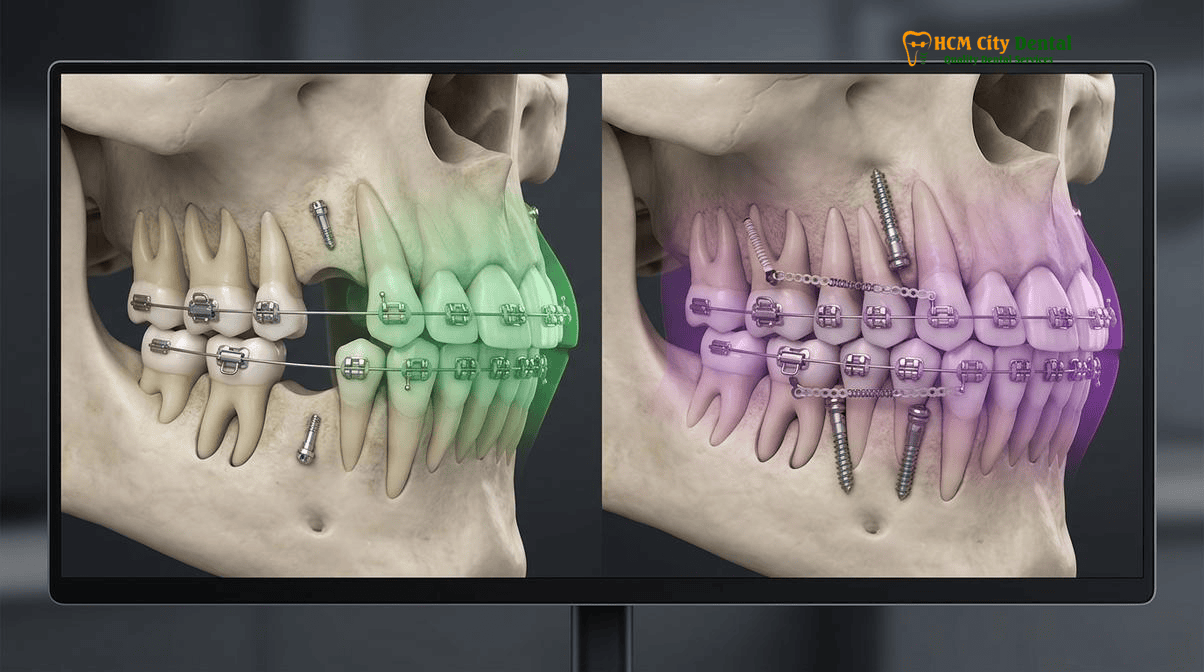
The 4mm vs. 7mm Incisor Retraction Rule: When Non-Extraction IZC/MBS TAD Full-Arch Distalization Works vs. When 4 First Premolar Extractions Are Needed
The crux of the clinical decision-making process in bimaxillary protrusion orthodontic treatment Vietnam lies in the precise calculation of required space. The dental arch is a finite perimeter, and retracting flared incisors requires physical room within the alveolar bone. The decision between 4 premolar extraction vs TADs full arch distalization is governed by the “4mm vs. 7mm Rule.”
When a patient requires more than 7mm of anterior retraction to achieve lip competence and ideal overjet, the extraction of four first premolars is almost always indicated. A typical first premolar is approximately 7.5mm wide. Extracting two premolars in the maxillary arch provides 15mm of total space. If 7mm of retraction is needed on each side (14mm total), this leaves only 1mm of space for posterior anchorage loss (mesial drift of the molars). In these severe cases, attempting to distalize the entire arch without extractions would push the molar roots out of the posterior maxillary tuberosity or into the mandibular ramus, violating the biological boundaries of the bone [2].
Conversely, if the patient presents with mild to moderate protrusion requiring only 3mm to 5mm of retraction, extracting four premolars is contraindicated. Extracting 15mm of tooth mass to close a 6mm to 10mm discrepancy leaves excessive space. Closing this excess space forces the orthodontist to either over-retract the incisors (causing a dished-in profile) or intentionally pull the posterior molars forward (protraction), which is biomechanically difficult and can disrupt the occlusion.
For these 3–5mm cases, non-extraction full-arch distalization is the treatment of choice. This is achieved using extra-radicular Mandibular Buccal Shelf (MBS 2.0x12mm stainless steel) TADs for non-surgical Class III underbite distalization (Wits > -5mm), or Infra-Zygomatic Crest (IZC) TADs for maxillary distalization. Alternatively, a Carriere Motion 3D ‘Sagittal First’ appliance can be used for Class II molar derotation, followed by Invisalign Mandibular Advancement Precision Wings. By anchoring to the dense cortical bone outside the dental roots, the entire dental arch can be pushed backward 3–5mm en-masse, resolving the protrusion without sacrificing healthy premolars.
Absolute Skeletal Anchorage with TADs: Preventing Posterior Molar Mesial ‘Anchor Burn’ to Achieve 100% En-Masse Anterior Lip Retraction
In traditional orthodontics, closing premolar extraction spaces relied on the posterior molars to act as anchors to pull the anterior teeth backward. However, Newton’s Third Law of Motion dictates that for every action, there is an equal and opposite reaction. When a force is applied to retract the six anterior teeth, an equal force pulls the posterior molars forward into the extraction space. This forward movement of the molars is known as “anchor loss” or “anchor burn.”
In severe bimaxillary protrusion, anchor loss is catastrophic. If the molars drift forward and consume 50% of the extraction space, only 50% of the space remains for anterior retraction, leaving the patient with residual lip protrusion. To combat this, orthodontists historically used cumbersome extra-oral appliances like headgear. Today, Specialist Orthodontics, TADs & Adult Palatal Expanders in Ho Chi Minh City rely on Temporary Anchorage Devices (TADs) to provide absolute skeletal anchorage.
TADs are biocompatible titanium or stainless steel mini-screws temporarily implanted into the dense cortical bone of the maxilla or mandible. Because they are anchored in bone rather than the periodontal ligament, they do not move when orthodontic force is applied. By connecting the anterior retraction mechanism (such as a NiTi closing coil spring or elastomeric chain) directly to the TAD rather than the molar, 100% of the extraction space can be utilized for anterior retraction. The molars experience zero reactive force, completely eliminating anchor burn [3].
Furthermore, TADs allow for complex vertical control during retraction. In patients with a hyperdivergent growth pattern (long face) and an anterior open bite, dual bucco-palatal TAD posterior molar intrusion can be employed. Clinical data shows that 1mm of posterior molar intrusion results in 2–3mm of anterior open bite closure via counterclockwise mandibular autorotation. This not only retracts the lips but also significantly improves the patient’s facial height and chin projection.
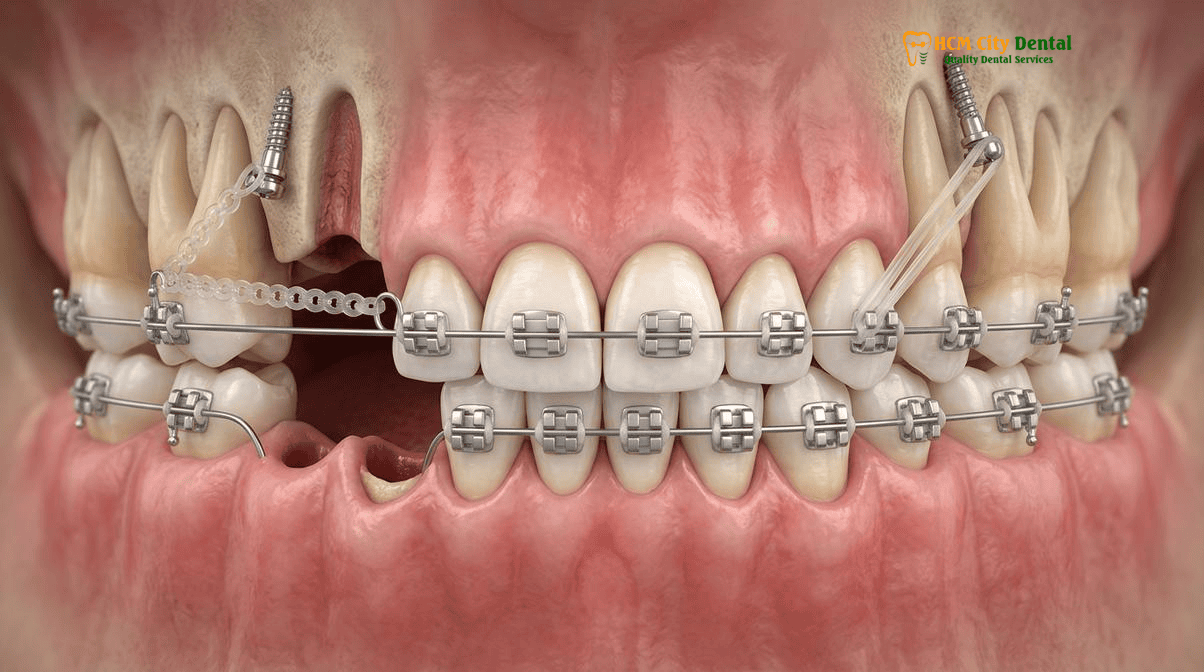
Clinical Case Note — Dr. Nguyen Van Cuong, DDS (Vietnam MOH License 0003265/BL-CCHN): When treating severe bimaxillary dentoalveolar protrusion in Asian and international patients at HCMC Dental Clinic in District 1, the goal is never to flatten the smile into an aged, dished-in profile. Using 0.075mm 3D CBCT symphyseal bone thickness mapping, we determine whether non-extraction full-arch distalization with extra-radicular TADs (for 3–4mm lip retraction) or 4-premolar extraction with Invisalign G6 SmartStage torque control and skeletal mini-screw anchorage (for 5–7mm lip retraction) achieves ideal harmony along Ricketts’ E-Line.
Avoiding the ‘Dished-In’ Aged Facial Profile: Controlling Incisor Torque (Bodily Translation vs. Uncontrolled Lingual Tipping) & Protecting Alveolar Bone Thickness
One of the most significant risks in treating bimaxillary protrusion—particularly when utilizing 4-premolar extraction—is the dreaded “dished-in” facial profile. This occurs when the anterior teeth are over-retracted or improperly torqued, causing the upper lip to lose its support and collapse backward. This flattens the midface, deepens the nasolabial folds, and prematurely ages the patient’s appearance. To prevent dished-in profile premolar extraction orthodontics, meticulous torque control is paramount.
When a retraction force is applied to the crown of an incisor, the tooth naturally wants to tip backward (uncontrolled lingual tipping). The crown moves lingually, but the root apex flares labially, potentially pushing through the thin labial cortical bone (fenestration). This results in a “rabbit-tooth” appearance and severely compromises periodontal health. To achieve true bodily translation—where the crown and root move backward together in parallel—active lingual root torque must be applied.
At HCMC Dental Clinic, Dr. Cuong ensures precise torque control by utilizing full-size rectangular stainless steel archwires that completely fill the bracket slot, expressing the built-in prescription of the bracket to keep the roots centered within the alveolar housing. Continuous 3D CBCT monitoring is utilized to verify that the roots remain safely surrounded by trabecular bone during the entire retraction process [4].
Clinical Precaution: Alveolar Bone Boundaries & Impacted Canines
Anterior retraction is strictly limited by the thickness of the lingual cortical plate. Attempting to retract teeth beyond the anatomical boundary of the symphysis or palatal vault will result in root resorption and bone loss. Additionally, before initiating space closure, a thorough radiographic survey must rule out ectopic eruptions. If impacted canines are present, we utilize Ericson & Kurol 3D CBCT sector localization combined with closed-eruption 24k gold-chain cantilever traction (60g force) to safely guide the canine into the arch before heavy retraction mechanics are applied. If you experience unexpected mobility or pain during retraction, contact Dr. Cuong immediately.
For pediatric and adolescent patients presenting with early signs of protrusion and crowding, interceptive Phase I pediatric Rapid Palatal Expansion (RPE / Invisalign First at ages 7–10 prior to midpalatal suture fusion) combined with Leeway Space (E-Space) preservation is often utilized. By maximizing arch width and preserving the natural space left by exfoliating primary molars, true serial extraction can frequently be avoided, preserving a broader, fuller facial profile as the child matures.
Fixed Self-Ligating Braces with Sliding Mechanics vs. Invisalign G6 First-Premolar Extraction Protocol with SmartStage Root Control
The biomechanical delivery system used to close extraction spaces has evolved significantly. Patients seeking to correct flared front teeth lip incompetence braces Ho Chi Minh City generally choose between advanced fixed self-ligating braces and clear aligner therapy.
Fixed Self-Ligating Braces: Systems like Damon or passive self-ligating brackets utilize a sliding door mechanism rather than elastic ties to hold the archwire. This drastically reduces friction during sliding mechanics. When combined with TADs and a rigid rectangular stainless steel archwire, self-ligating braces offer unparalleled control over root torque and bodily translation. The low-friction environment allows for efficient space closure with lighter, more biologically compatible forces, reducing the risk of root resorption.
Invisalign G6 Protocol: Historically, clear aligners struggled with large extraction spaces, often resulting in the “bowing effect” where the adjacent teeth tipped into the extraction site, deepening the bite. However, the Invisalign g6 maximum anchorage premolar extraction HCMC protocol has revolutionized clear aligner therapy. The G6 protocol utilizes SmartStage technology, which pre-programs the aligners with specific counter-moments to prevent bowing and ensure bodily translation. Optimized Retraction Attachments are placed on the canines, and Optimized Anchorage Attachments are placed on the molars. When combined with IZC TADs for absolute anchorage, Invisalign can now close 7mm extraction spaces as predictably as fixed braces, offering a highly aesthetic and comfortable alternative for adult professionals [5].
Clinical Case Study: Expat Patient in District 1, HCMC
Patient Profile: A 28-year-old Australian expatriate presented to HCMC Dental Clinic with severe bimaxillary protrusion, a convex profile, and chronic lip incompetence. She desired correction but required a highly aesthetic appliance due to her corporate role.
Diagnosis: 3D CBCT analysis revealed an 8mm anterior protrusion with an acute nasolabial angle of 78 degrees. The required retraction exceeded the 7mm threshold.
Treatment Protocol: Dr. Cuong prescribed the extraction of four first premolars. The Invisalign G6 protocol was utilized in conjunction with bilateral maxillary IZC TADs to provide absolute skeletal anchorage.
Outcome: Over 22 months, the extraction spaces were closed via bodily translation. The patient achieved 100% en-masse anterior retraction. Her nasolabial angle opened to an ideal 98 degrees, lip competence was restored, and her profile was dramatically softened without any “dished-in” effect. The total cost was a fraction of the quotes she received in Sydney.
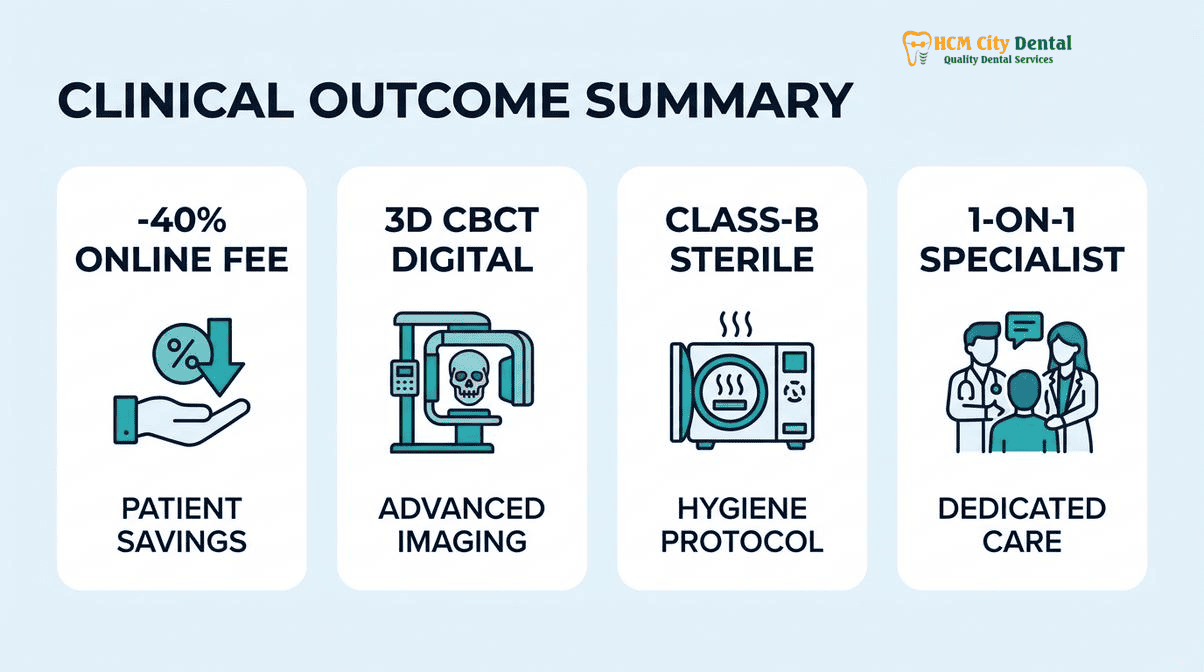
2026 Bimaxillary Protrusion Orthodontics (Braces, Invisalign & Skeletal TADs) Fee Schedule at HCMC Dental Clinic (District 1)
Understanding the financial investment for comprehensive orthodontic care is crucial for international patients. At HCMC Dental Clinic, we maintain absolute transparency with our Official 2026 Dental Price List & -40% Online Booking Fee Schedule. By booking online prior to arrival, patients secure exclusive rates that are significantly lower than walk-in prices or standard fees in Australia, the US, or Europe, without compromising on the quality of materials or clinical expertise.
Below is the detailed 2026 fee schedule for orthodontic diagnostics, clear aligner therapy, skeletal anchorage, and related surgical procedures required for bimaxillary protrusion correction:
| Orthodontic & Surgical Procedure | 2026 Online Booking Fee (USD) | 2026 Walk-In / Benchmark (USD) |
|---|---|---|
| 3D CBCT Diagnostic Scan | $18 USD (480,000 VND) | $50 – $150 USD |
| Invisalign Comprehensive (Unlimited Aligners) | $2,538 USD (66,000,000 VND) | $4,231 USD Walk-in |
| Invisalign Go / Lite / Express (Up to 14–20 aligners) | $1,615 USD (42,000,000 VND) | $2,692 USD Walk-in |
| Orthodontic TAD Mini-Screw (IZC / Buccal Shelf) | $77 – $115 USD / screw | $200 – $400 USD |
| Non-Surgical Adult MARPE / MSE Palatal Expander | $769 – $1,154 USD | $1,500 – $2,500 USD |
| Surgical Wisdom Tooth Extraction (Piezotome) | $58 – $115 USD / tooth | $250 – $500 USD |
| All 4 Wisdom Teeth Extraction Package | $231 – $308 USD | $1,000 – $2,000 USD |
| Invisalign Vivera Retainer (Genuine SmartTrack) | $308 USD (8,000,000 VND) | $513 USD Walk-in |
| Essix Clear Retainer | $97 USD / pair (2,520,000 VND) | $200 – $300 USD |
| Hawley Wire Retainer | $115 USD / pair (3,000,000 VND) | $250 – $400 USD |
| Ultrasonic Scaling & Polishing | $15 USD (400,200 VND) | $100 – $150 USD |
For patients requiring pre-orthodontic restorative work or post-orthodontic aesthetic refinement, we invite you to review our complete Official 2026 Dental Price List & -40% Online Booking Fee Schedule. Whether you require simple scaling or complex TAD-supported full-arch distalization, HCMC Dental Clinic provides world-class care in the heart of District 1.
Frequently Asked Questions
For every 1mm of upper and lower incisor retraction, how many millimeters do the upper and lower lips move back toward Ricketts’ E-Line?
Clinical cephalometric studies demonstrate a predictable soft tissue response ratio during anterior retraction. Generally, for every 1mm of maxillary incisor retraction, the upper lip retracts by approximately 0.5mm to 0.75mm. For the mandibular arch, every 1mm of lower incisor retraction results in approximately 0.8mm to 1.0mm of lower lip retraction. This 1:0.75 and 1:1 ratio is highly dependent on the patient’s initial lip thickness, mentalis muscle strain, and the precise torque control maintained during the space closure phase.
Can extracting 4 premolars narrow my smile or affect my tongue space if done improperly, and how does 3D CBCT planning prevent this?
Yes, if 4-premolar extraction is performed without proper arch width maintenance, it can lead to a constricted maxillary arch, a narrowed “dark corridor” smile, and reduced tongue space, which may exacerbate airway issues or obstructive sleep apnea (OSA). At HCMC Dental Clinic, Dr. Nguyen Van Cuong, DDS utilizes advanced 3D CBCT imaging to map the exact alveolar bone housing and arch perimeter. By using broad-arch self-ligating wires or digitally expanded Invisalign SmartTrack aligners, the transverse dimension (smile width) is actively maintained or expanded while the sagittal dimension (protrusion) is reduced, ensuring optimal tongue posture and airway volume.
Why is torque control with rectangular archwires or Invisalign Power Ridges essential to prevent ‘rabbit-tooth’ lingual tipping during space closure?
During en-masse retraction, applying a distal force to the crowns of the incisors creates a moment that tends to tip the crowns lingually while the root apices flare labially (uncontrolled tipping). This results in a “rabbit-tooth” appearance and risks pushing the roots out of the labial cortical bone. To achieve bodily translation (where the crown and root move together), active lingual root torque must be applied. This is achieved by filling the bracket slot with full-size rectangular stainless steel archwires or by utilizing Invisalign’s proprietary Power Ridges, which apply a counter-moment to keep the roots safely centered within the alveolar housing.
Can Invisalign close 7mm premolar extraction spaces as predictably as fixed braces when combined with mini-screw TADs?
Yes, with the advent of the Invisalign G6 First-Premolar Extraction Protocol, clear aligners can close large 7mm extraction spaces highly predictably. The G6 protocol utilizes SmartStage technology to pre-program the aligners to counteract the “bowing effect” (deepening of the bite) that naturally occurs during space closure. When combined with Optimized Retraction Attachments on the canines and absolute skeletal anchorage from Infra-Zygomatic Crest (IZC) TADs, Invisalign can achieve 100% en-masse anterior retraction without relying on the posterior molars for anchorage, preventing unwanted mesial drift.
How much does complete bimaxillary protrusion correction with TADs cost at HCMC Dental Clinic in District 1?
Under the official 2026 fee schedule at HCMC Dental Clinic, comprehensive orthodontic treatment is highly transparent. Invisalign Comprehensive (unlimited aligners) is priced at $2,538 USD online. If absolute skeletal anchorage is required, Orthodontic TAD Mini-Screws (IZC or Buccal Shelf) cost $77 to $115 USD per screw online. Essential diagnostic 3D CBCT scans are $18 USD online. This represents a significant -40% online booking savings compared to walk-in rates, offering international patients world-class bimaxillary protrusion correction at a fraction of Australian or US prices.
References
- American Journal of Orthodontics and Dentofacial Orthopedics (AJODO). Biomechanical effects of en-masse retraction of anterior teeth using implant anchorage vs. conventional mechanics in bimaxillary protrusion. (2021).
- The Angle Orthodontist. Soft tissue profile changes following 4-premolar extraction and maximum anchorage retraction in adult patients with severe bimaxillary dentoalveolar protrusion. (2020).
- International Journal of Oral & Maxillofacial Implants. Extra-radicular infra-zygomatic crest and mandibular buccal shelf mini-screws for full-arch distalization: A 3D CBCT volumetric analysis. (2022).
- Journal of Clinical Orthodontics (JCO). The Invisalign G6 protocol for first-premolar extraction: SmartStage technology and optimized attachments for bodily translation. (2019).
- Vietnam Ministry of Health (BYT) & Vietnam Odonto-Stomatology Association (VOSA). National Clinical Guidelines on Specialist Dental Care, Biomaterial Traceability & EN 13060 Class B Infection Control. (2024).