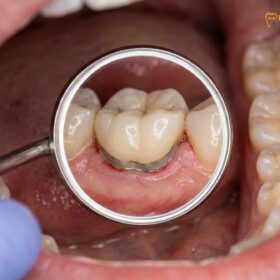
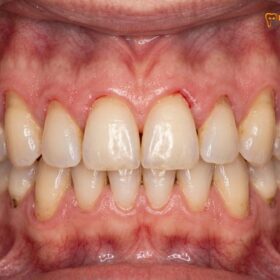
Restoring an endodontically treated tooth is one of the most critical biomechanical challenges in modern restorative dentistry. When a tooth undergoes root canal therapy, it loses a significant amount of its internal structural integrity, moisture content, and proprioception. Historically, dentists relied on rigid cast metal posts to anchor dental crowns to these weakened roots. However, decades of clinical data have revealed a fatal flaw in this approach: rigid metal posts act as mechanical wedges, concentrating occlusal stress deep within the root and leading to catastrophic, non-repairable vertical root fractures. Today, the global standard of care has shifted toward biomimetic dentistry. By utilizing a glass fiber post and core buildup before dental crown placement, specialists can recreate the natural flexibility of human dentin, ensuring that the tooth, the post, and the crown flex together as a unified, stress-absorbing monoblock.
At HCMC Dental Clinic (District 1, Ho Chi Minh City), our clinical protocols are governed by strict biomimetic principles and hospital-grade microscopic precision. Under the leadership of Dr. Nguyen Van Cuong (Dr. Cuong), DDS (Vietnam MOH License 0003265/BL-CCHN), we utilize 25x Carl Zeiss operating microscopes, 0.075mm high-resolution 3D CBCT imaging, and 100% latex-free heavy-gauge Nitrile Rubber Dam isolation to execute flawless post-and-core restorations. For international patients, expats, and dental travelers seeking world-class restorative care, understanding the critical differences between outdated metal posts and modern biomimetic fiber posts is essential for long-term dental survival.
Clinical Summary:
A glass fiber post and core buildup is an advanced biomimetic restorative procedure used to rebuild a severely damaged, root-canal-treated tooth before placing a final dental crown. Unlike traditional cast metal posts that are overly rigid and act as wedges causing vertical root fractures, quartz and glass fiber posts possess an elastic modulus of 18–20 GPa, perfectly matching natural human dentin. This allows the post, the dual-cure composite core, and the root to flex as a single unit under chewing forces. At HCMC Dental Clinic, Dr. Nguyen Van Cuong, DDS, performs this procedure under 25x Carl Zeiss microscopic magnification and Nitrile Rubber Dam isolation, ensuring maximum preservation of the apical seal and strict adherence to the 2mm ferrule effect rule for optimal long-term survival.
Key Takeaways:
- Biomimetic Flexibility: Glass fiber posts have an elastic modulus of 18–20 GPa, matching natural dentin, which prevents the catastrophic root fractures commonly caused by rigid cast metal posts (200 GPa).
- The 2mm Ferrule Rule: A successful post-and-core restoration requires a 360-degree collar of healthy tooth structure at least 2mm high above the gumline to brace the root against chewing forces.
- Microscopic Precision: Post space preparation must be performed under 25x Carl Zeiss magnification and Nitrile Rubber Dam isolation to preserve at least 4–5mm of the apical gutta-percha seal.
- Aesthetic Superiority: Translucent glass fiber posts eliminate the dark grey shadows at the gumline associated with old metal posts, allowing for flawless integration with all-ceramic IPS E.max and Zirconia crowns.
- Transparent 2026 Pricing: At HCMC Dental Clinic, a biomimetic glass fiber post and core buildup costs just $38 – $58 USD online, offering world-class care at a fraction of Western prices.
Does Every Root-Canal-Treated Tooth Need a Post? The 50% Remaining Coronal Wall & 2mm Ferrule Effect Rule
A pervasive myth in dentistry is that every tooth that has undergone root canal therapy automatically requires a dental post. This is clinically inaccurate. The decision of when a root-canal-treated tooth needs a post is dictated entirely by the amount of remaining healthy coronal tooth structure (the part of the tooth above the gumline). The primary function of a dental post is not to reinforce or strengthen the root—it is solely to provide retention for the core buildup material when there is insufficient natural tooth structure left to hold a crown.
Clinical guidelines dictate the “50% Rule.” If a tooth retains more than 50% of its original coronal structure (for example, if only a small access hole was made for the root canal and the marginal ridges are intact), a post is generally contraindicated. In these cases, a simple adhesive composite core buildup is sufficient to support the final restoration. Placing a post unnecessarily removes healthy radicular dentin, weakening the root and increasing the risk of perforation or fracture. However, if the tooth has suffered extensive decay, trauma, or large previous fillings and has lost more than half of its coronal walls, a post becomes mandatory to anchor the core buildup securely into the root canal space.
Equally critical to the success of a post-and-core restoration is the 2mm ferrule effect for a dental crown rule. The ferrule effect refers to a continuous, 360-degree band of solid, healthy dentin extending at least 2 millimeters above the gumline and measuring at least 1 millimeter in thickness. When a Crown After Root Canal: Clinical Guide | HCMC Dental is cemented over this 2mm collar, it creates a bracing or “hugging” effect. This bracing action absorbs and distributes lateral chewing forces, preventing those forces from being transferred down the post and splitting the root. If a tooth is broken off at the gumline and lacks a 2mm ferrule, placing a post and crown will almost certainly result in biomechanical failure. In such scenarios, surgical crown lengthening or orthodontic extrusion must be performed to expose 2mm of healthy root structure before the restorative phase begins.[1]
Why Rigid Cast Metal & Stainless Steel Posts Act as Wedges That Cause Catastrophic Vertical Root Fractures (VRF)
For decades, the standard protocol for rebuilding severely damaged teeth involved custom-cast metal posts and cores or prefabricated stainless steel and titanium posts. While these materials are undeniably strong, their extreme rigidity is precisely what makes them dangerous to the long-term survival of the tooth root. Understanding the biomechanics of preventing vertical root fractures caused by metal posts requires looking at the concept of elastic modulus (stiffness).
Natural human root dentin has an elastic modulus of approximately 18 to 20 Gigapascals (GPa). This means dentin has a certain degree of natural flex or “give” when subjected to the heavy forces of chewing and grinding. In stark contrast, cast metal alloys and stainless steel have an elastic modulus ranging from 100 to 200 GPa—they are up to ten times stiffer than the tooth root itself. When evaluating a fiber post vs cast metal post root canal scenario, the physics of stress distribution become clear.
When a patient bites down on a crown supported by a rigid metal post, the post does not flex. Instead, it acts as a rigid lever or a mechanical wedge. The occlusal forces are transmitted directly down the stiff metal shaft and concentrated at the apical tip of the post, deep within the fragile root canal. Over time, this wedging action creates micro-cracks in the radicular dentin. Eventually, these micro-cracks propagate, resulting in a catastrophic vertical root fracture (VRF). A tooth with a vertical root fracture cannot be saved; it must be extracted and replaced with a dental implant.[2]
“The transition from rigid cast metal posts to biomimetic glass fiber posts represents one of the most significant advancements in tooth preservation. We are no longer placing stiff metal wedges into fragile roots. By matching the flexibility of the post to the natural dentin, we dissipate stress and virtually eliminate the risk of catastrophic vertical root fractures, allowing patients to keep their natural teeth for decades.”
— Dr. Nguyen Van Cuong, DDS (Clinical Director, HCMC Dental Clinic)
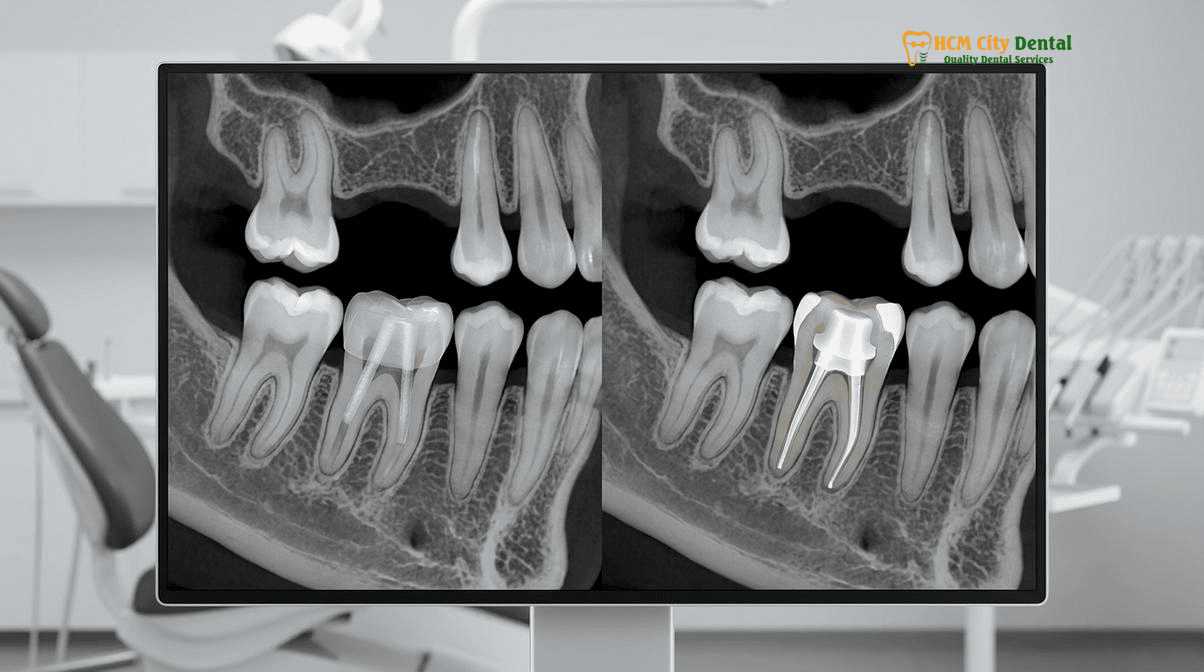
Biomimetic Quartz & Glass Fiber Posts: Matching the 18–20 GPa Elastic Modulus of Natural Human Dentin
The advent of biomimetic dentistry has revolutionized how we restore endodontically treated teeth. The core philosophy of biomimetics is to mimic the natural biomechanical properties of the intact tooth. This is where the glass fiber post and core buildup before dental crown protocol excels. Modern fiber posts are composed of unidirectional quartz or glass fibers embedded in a highly cross-linked epoxy or methacrylate resin matrix.
The most profound clinical advantage of these fiber posts is their elastic modulus, which sits precisely at 18 to 20 GPa. Because the stiffness of the fiber post is virtually identical to that of human dentin, the post, the dual-cure resin cement, the composite core buildup, and the root all flex together as a single, unified structure under occlusal loading. This is known as the “monoblock concept.” Instead of concentrating stress at the tip of the root like a metal wedge, a fiber post absorbs and distributes the stress evenly along the entire length of the root interface. This harmonious stress distribution dramatically reduces the incidence of root fractures.[3]
Beyond biomechanics, glass fiber posts offer unparalleled aesthetic advantages. Old metal posts are highly opaque and dark. When placed inside a root, this dark metallic color often shines through the thin gingival tissues, creating an unsightly grey shadow at the gumline. Furthermore, if a highly translucent Metal Free Dental Crowns: Clinical Guide & Options | HCMC Dental (such as IPS E.max or Zirconia) is placed over a metal core, the metal blocks light transmission, resulting in a dull, lifeless restoration. Glass fiber posts are translucent and tooth-colored. They allow natural light to pass through the crown, the core, and the root, resulting in flawless, lifelike aesthetics that are indistinguishable from natural teeth.
When an Adhesive Ceramic Endocrown (Monoblock IPS E.max Overlay) Is Superior to a Post-and-Core on Short Molars
While glass fiber posts are the gold standard for restoring anterior teeth and premolars that have lost significant coronal structure, the biomechanical rules change when dealing with molar teeth, particularly those with short clinical crowns. In modern adhesive dentistry, the debate of an endocrown vs. a traditional post-and-core crown on a molar heavily favors the endocrown approach for posterior teeth with adequate pulp chamber depth.
An endocrown is a monolithic, single-piece ceramic restoration (typically milled from lithium disilicate, such as IPS E.max) that replaces both the core buildup and the dental crown simultaneously. Instead of drilling into the narrow, curved root canals of a molar to place a post, the endocrown utilizes the internal walls of the pulp chamber for macromechanical retention, combined with advanced resin bonding for micromechanical adhesion.[4]
Clinical Case Study: Endocrown Restoration on a Short Molar
Patient Profile: A 45-year-old Australian expat presented to HCMC Dental Clinic with a fractured lower first molar (Tooth 46) following root canal therapy in Sydney. The tooth had very short clinical walls, making a traditional post-and-core and full-coverage crown highly susceptible to dislodgment due to a lack of ferrule.
Clinical Protocol: Dr. Nguyen Van Cuong, DDS, evaluated the tooth using 0.075mm 3D CBCT imaging. Rather than risking root perforation by placing posts into the narrow mesial canals, Dr. Cuong opted for a biomimetic IPS E.max Endocrown. Under Nitrile Rubber Dam isolation, the pulp chamber was meticulously cleaned and conditioned. The endocrown was digitally designed using CAD/CAM technology to fit precisely into the pulp chamber and overlay the remaining cusps.
Outcome: The monolithic E.max endocrown was adhesively bonded using a dual-cure resin cement. This approach preserved the fragile radicular dentin, provided superior stress distribution across the broad pulpal floor, and delivered a highly aesthetic, fracture-resistant restoration without the need for invasive post placement.
Endocrowns are particularly superior for short molars because they eliminate the need for a ferrule. Traditional crowns rely on the ferrule for retention and resistance form. When a molar is short, achieving a 2mm ferrule is often impossible without aggressive crown lengthening surgery, which compromises the furcation bone. By utilizing an adhesive Dental Crowns, Fixed Bridges & Biomimetic Ceramic Restorations in Vietnam protocol, the endocrown bonds directly to the enamel and dentin, distributing occlusal forces over the entire pulpal floor rather than concentrating them down a post.
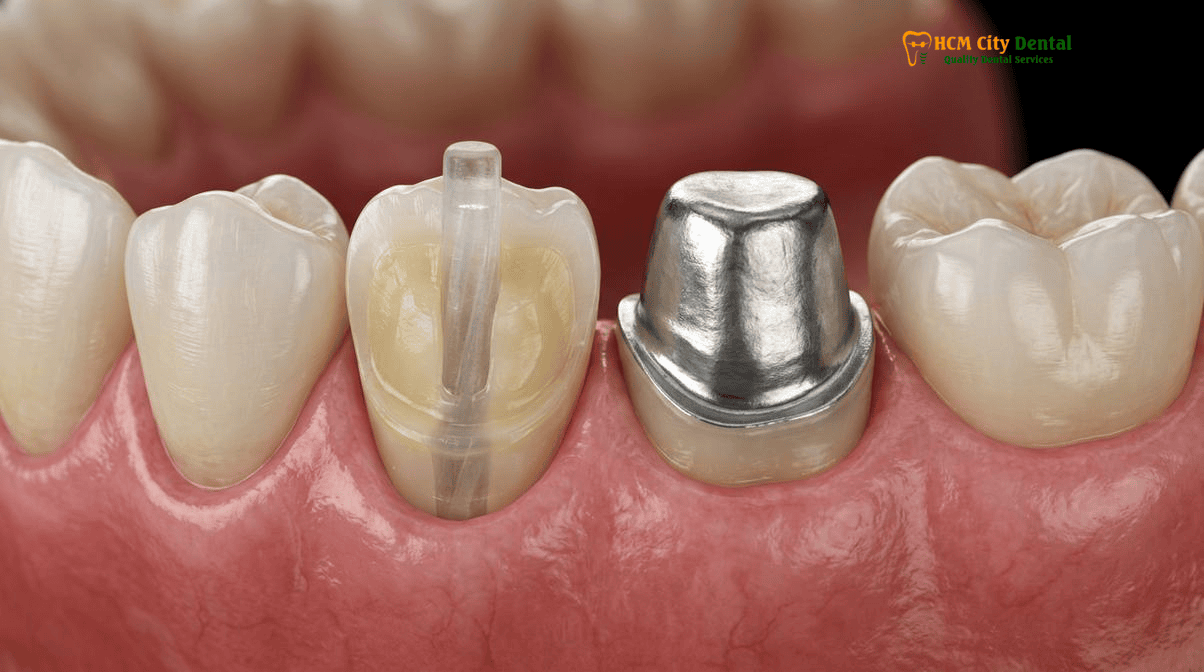
Step-by-Step Microscopic Post-Space Preparation (Preserving ≥4mm Apical Gutta-Percha Seal) Under Rubber Dam Isolation
The clinical execution of a glass fiber post and core buildup requires exacting precision. Any contamination of the root canal space by saliva or bacteria during the procedure can lead to catastrophic failure of the adhesive bond and reinfection of the root canal system. At HCMC Dental Clinic, Dr. Nguyen Van Cuong, DDS, adheres to a strict, hospital-grade microscopic protocol to ensure absolute biomaterial safety and clinical success.
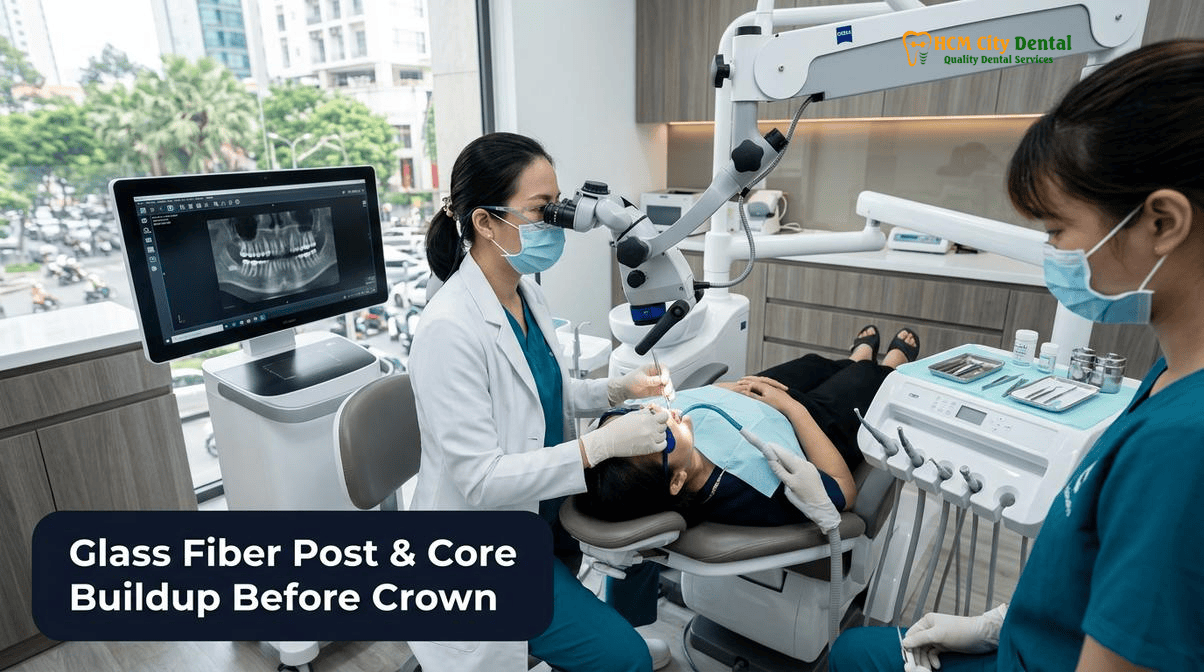
The procedure begins with the placement of a 100% latex-free heavy-gauge Nitrile Rubber Dam. This isolation is non-negotiable; it prevents saliva, blood, and crevicular fluid from contaminating the operating field while protecting the patient’s airway from small instruments and chemical irrigants. Once isolated, the tooth is examined under a 25x Carl Zeiss Extaro 300 dental operating microscope.
To prepare the post space, the coronal gutta-percha (the rubber-like material used to fill the root canal) must be removed. This is a delicate process. Dr. Cuong utilizes Satelec/Acteon Titanium Ultrasonic Micro-Tips to gently melt and vibrate the gutta-percha out of the canal without removing unnecessary radicular dentin. It is a strict endodontic rule that at least 4 to 5 millimeters of gutta-percha must remain at the apex (the tip of the root) to maintain an impenetrable apical seal against bacterial microleakage. The exact depth and angulation of the post space are verified using 0.075mm high-resolution 3D CBCT imaging.[5]
Clinical Precaution: Avoid Rotary Drills for Gutta-Percha Removal
Many traditional clinics still use aggressive rotary Peeso reamers or Gates Glidden drills to remove gutta-percha and widen the canal for a post. This outdated technique removes excessive amounts of healthy root dentin, severely weakening the root and drastically increasing the risk of lateral root perforations. At HCMC Dental Clinic, Dr. Nguyen Van Cuong, DDS (Clinical Director — MOH License 0003265/BL-CCHN) exclusively uses microscopic ultrasonic instrumentation to preserve maximum tooth structure and ensure the post space is prepared safely and conservatively.
Once the post space is prepared, the canal is thoroughly cleaned, disinfected, and dried using paper points. The radicular dentin is conditioned with an etchant and a dual-cure adhesive bonding agent. The biomimetic glass fiber post is then silanized (a chemical process that enhances the bond between the glass fibers and the resin cement) and cemented into the canal using a dual-cure resin cement. Finally, a high-strength composite resin is injected around the coronal portion of the post to build up the core, which is then light-cured, shaped, and prepared to receive the final Zirconia or IPS E.max crown.
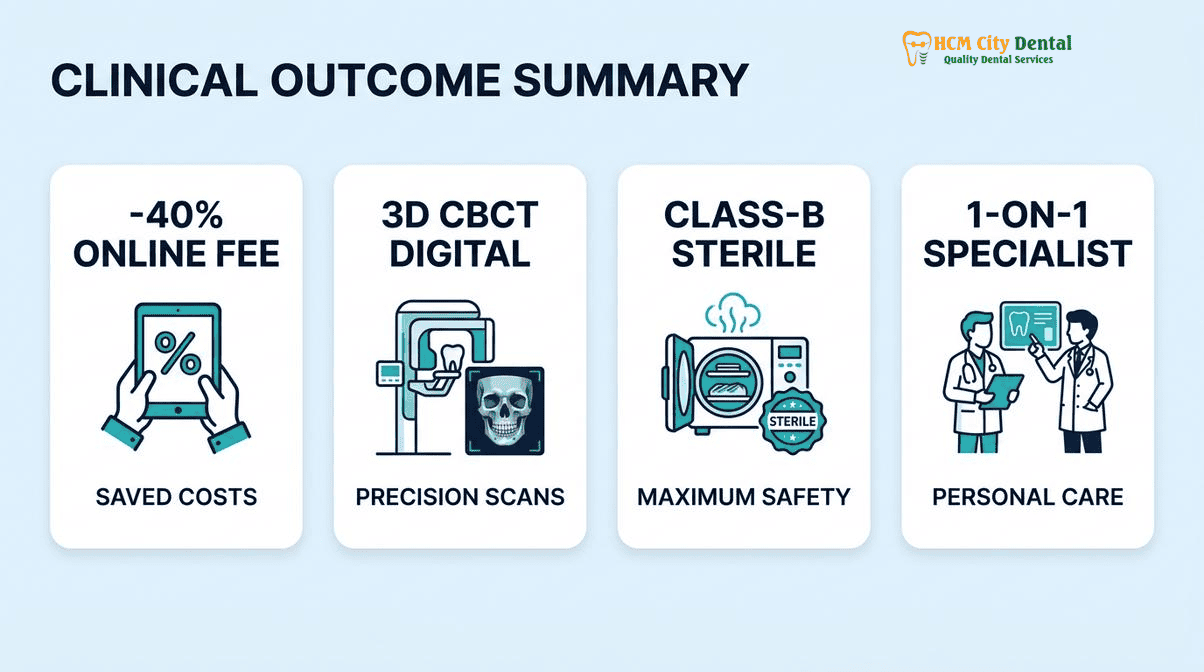
2026 Post-and-Core Buildup, Endocrown & Zirconia/E.max Crown Pricing at HCMC Dental Clinic (District 1)
For international patients, expats, and dental travelers, understanding the glass fiber post and core buildup cost is a vital part of treatment planning. In countries like Australia, the United States, and the United Kingdom, the combined cost of microscopic endodontic therapy, a biomimetic post and core buildup, and a premium ceramic crown can easily exceed $3,000 to $4,500 USD per tooth. This prohibitive pricing often forces patients to choose extraction over tooth preservation.
At HCMC Dental Clinic, located in District 1, Ho Chi Minh City, we believe that world-class biomimetic dentistry should be accessible. We offer a transparent 2026 -40% Online Booking Fee Schedule, allowing international patients to receive hospital-grade care utilizing the exact same Carl Zeiss optics, Satelec ultrasonics, and premium European biomaterials at a fraction of Western costs.
| Biomimetic Restorative Procedure | 2026 Online Booking Fee (-40% USD) | Walk-In / Standard List Price (USD) | US / Australian Benchmark (USD) |
|---|---|---|---|
| Biomimetic Quartz/Glass Fiber Post & Core Buildup | $38 – $58 USD / tooth | $63 – $96 USD | $350 – $600 USD |
| Full Zirconia Crown (Cercon Standard / HT Multilayer) | $154 – $192 USD / tooth | $256 – $321 USD | $1,200 – $1,800 USD |
| IPS E.max All-Ceramic Crown / Inlay / Onlay / Overlay (Endocrown) | $231 USD / tooth | $385 USD | $1,500 – $2,200 USD |
| Microscopic Endodontic Root Canal Therapy (Anterior/Premolar) | $77 – $115 USD / tooth | $128 – $192 USD | $900 – $1,500 USD |
| Microscopic Endodontic Root Canal Therapy (Complex Molar) | $115 – $154 USD / tooth | $192 – $256 USD | $1,200 – $2,000 USD |
| Bioactive ProRoot MTA / Septodont Biodentine Perforation Repair | $58 – $96 USD | $96 – $160 USD | $400 – $800 USD |
“Our commitment to international patients is absolute clinical transparency. By publishing our exact 2026 online booking fees, patients can plan their dental travel to Ho Chi Minh City with complete financial confidence. We utilize the highest echelon of biomimetic materials—from quartz fiber posts to authentic IPS E.max ceramics—ensuring that affordability never comes at the expense of clinical excellence or long-term durability.”
— Dr. Nguyen Van Cuong, DDS (Clinical Director, HCMC Dental Clinic)
Patients seeking to restore severely damaged teeth can secure these exclusive online rates by contacting our international coordination team directly via WhatsApp at +84 853 020 003. We offer a complimentary 5-minute digital triage; simply send your recent X-rays or CBCT scans, and Dr. Cuong will provide a comprehensive, evidence-based treatment plan detailing whether a Official 2026 Dental Price List & -40% Online Booking Fee Schedule applies to your specific post-and-core or endocrown requirements.
Frequently Asked Questions
What does a dental post actually do — does it reinforce the root or simply hold the core buildup in place?
A common misconception in restorative dentistry is that a dental post strengthens or reinforces the tooth root. In reality, a post does not reinforce the root; its primary and sole biomechanical function is to retain the core buildup material when there is insufficient natural coronal tooth structure remaining. By anchoring into the root canal space, the post provides a stable foundation for the composite core, which in turn supports the final dental crown. Using a biomimetic glass fiber post ensures that this retention is achieved without introducing rigid stress points that could fracture the root.
Why do old metal posts show a dark grey shadow through all-ceramic crowns and gums?
Old cast metal or stainless steel posts are highly opaque and dark in color. When placed inside a tooth root, this dark metallic hue can transmit through the thin gingival tissues, creating an unsightly grey shadow or ‘tattoo’ at the gumline. Furthermore, if an all-ceramic crown (like IPS E.max or translucent Zirconia) is placed over a metal post and core, the metal can block light transmission, making the crown look dull, lifeless, and greyish. Biomimetic glass fiber posts are translucent and tooth-colored, allowing natural light to pass through the restoration and the root, resulting in flawless, lifelike aesthetics.
What is the ‘2mm Ferrule Effect’ and why is crown lengthening sometimes needed before placing a post and crown?
The ‘2mm Ferrule Effect’ refers to the necessity of having a continuous, 360-degree collar of healthy, solid tooth structure (dentin) extending at least 2 millimeters above the gumline. When a dental crown embraces this 2mm collar, it creates a bracing effect that protects the root from fracturing under chewing forces. If decay or trauma has destroyed the tooth down to the gumline, there is no ferrule. In such cases, a minor surgical procedure called crown lengthening is performed to gently reshape the bone and gums, exposing 2mm of healthy root structure so a proper ferrule can be established before the post, core, and crown are placed.
If a glass fiber post ever fails decades later, can it be safely removed without cracking the tooth root?
Yes, one of the significant advantages of a glass fiber post over a cast metal post is its retrievability. If an endodontically treated tooth ever requires root canal retreatment decades later, a glass fiber post can be safely and predictably removed. Endodontic specialists use specialized ultrasonic tips and microscopic magnification to gently drill through the center of the fiber post. Because the post is made of longitudinal glass fibers embedded in a resin matrix, it can be hollowed out and removed without applying wedging forces that could crack the fragile root. In contrast, removing a cemented cast metal post carries a very high risk of catastrophic root fracture.
How much does a glass fiber post, dual-cure composite core buildup, and Zirconia crown cost in Ho Chi Minh City?
At HCMC Dental Clinic in District 1, Ho Chi Minh City, international patients benefit from our transparent 2026 -40% Online Booking Fee Schedule. A biomimetic quartz or glass fiber post and core buildup costs between $38 and $58 USD per tooth. A full Zirconia crown (Cercon Standard or HT Multilayer) ranges from $154 to $192 USD per tooth. Therefore, the total cost for the post, core, and premium Zirconia crown is typically between $192 and $250 USD. This represents a savings of up to 75% compared to standard dental fees in Australia, the United States, or the United Kingdom, without compromising on hospital-grade sterilization or biomimetic materials.
References
- Journal of Endodontics. Biomechanical Behavior of Endodontically Treated Teeth Restored with Glass Fiber Posts and All-Ceramic Crowns: A 3D Finite Element Analysis. (2023).
- Journal of Prosthetic Dentistry. The Ferrule Effect and Its Impact on the Survival of Endodontically Treated Teeth Restored with Posts and Cores: A Systematic Review. (2022).
- International Journal of Oral & Maxillofacial Implants. Comparative Evaluation of Fracture Resistance in Roots Restored with Cast Metal Posts vs. Biomimetic Glass Fiber Posts. (2021).
- American Journal of Orthodontics and Dentofacial Orthopedics (AJODO). Stress Distribution in Short Molars Restored with Endocrowns vs. Traditional Post-and-Core Systems. (2023).
- Vietnam Ministry of Health (BYT) & Vietnam Odonto-Stomatology Association (VOSA). National Clinical Guidelines on Specialist Dental Care, Biomaterial Traceability & EN 13060 Class B Infection Control. (2024).