A baby tooth extraction space maintainer is a custom-fabricated dental appliance designed to hold an extraction gap open after premature baby tooth loss. It prevents adjacent teeth from shifting, ensures permanent teeth erupt correctly, and significantly reduces the need for complex orthodontic interventions later in life.
Clinical Summary:
The premature extraction of primary molars disrupts the natural eruption sequence of the developing dentition. Space maintainers act as passive orthodontic devices to preserve arch length and prevent mesial drift. Pediatric dentists utilize advanced behavior management techniques to ensure comfortable placement, safeguarding the child’s future bite alignment, masticatory function, and airway development.
Key Takeaways:
- Space maintainers prevent adjacent teeth from drifting into the extraction site, preserving essential arch length.
- They are a critical preventive measure to avoid severe orthodontic crowding and permanent tooth impaction.
- Fixed appliances, such as the band-and-loop, are highly effective and require minimal patient compliance.
- The treatment involves a painless impression and cementation process utilizing child-friendly behavioral techniques.
- Early intervention supports proper jaw development, airway health, and the natural eruption of adult teeth.
When is Extraction Necessary?
Pediatric tooth extraction is considered a last resort when a primary tooth is unrestorable due to severe decay, advanced infection, or significant dental trauma.
In pediatric dentistry, the primary goal is always to preserve the natural dentition whenever clinically possible. However, Early Childhood Caries (ECC) can progress rapidly due to the unique anatomy of primary teeth. Before recommending an extraction, a comprehensive clinical and radiographic evaluation is performed to explore all restorative avenues. We prioritize minimally invasive techniques to manage decay and maintain the tooth’s structural integrity.
One highly effective non-invasive treatment is the application of Silver Diamine Fluoride (SDF). We offer cavity arrest using SDF, which halts active decay without the need for drilling or local anesthesia. While it is highly effective and painless, parents should be aware that SDF leaves a localized black stain exclusively on the decayed area. If the cavity requires filling, we evaluate the choice between Glass Ionomer Fillings (GIC) vs. Composite. We prioritize fluoride-releasing glass ionomer cement (GIC) for baby teeth due to its chemical bonding properties, moisture tolerance during placement, and continuous fluoride release, which actively prevents recurrent decay. Composite resins are utilized in scenarios where higher structural strength and perfect aesthetics are mandated.
If the decay has reached the nerve, a baby root canal (pulpotomy) followed by a stainless steel or zirconia crown may save the tooth. However, if the tooth is fractured below the gumline, exhibits severe mobility, or presents with an acute periapical abscess that threatens the developing permanent tooth germ beneath it, extraction becomes the only viable medical option.[1]
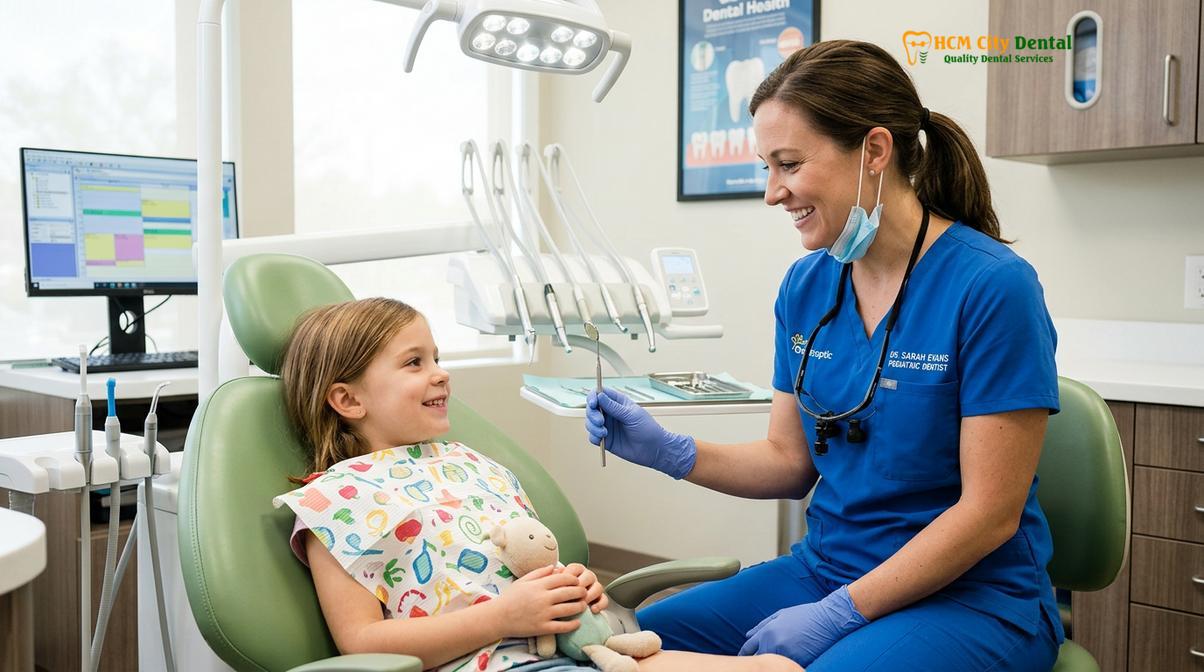
When an extraction is unavoidable, managing the child’s anxiety is paramount. We employ the “Tell-Show-Do behavioral management” technique, a cornerstone of pediatric dental care where we walk children through procedures step-by-step:
- Tell: We explain the procedure using non-threatening, child-friendly language. For example, local anesthesia is introduced as “sleepy juice,” a rubber dam is a “tooth raincoat,” and the ultrasonic scaler is a “water whistle.”
- Show: We demonstrate the instrument on their finger or hand, such as letting them feel the vibration of the rotating cup or the gentle breeze from the air syringe.
- Do: We proceed with the treatment only when the child is comfortable and ready, utilizing a “stop on request” protocol where they can raise their hand if they need a break.
For children with severe dental anxiety or extensive treatment needs, conscious sedation, nitrous oxide (laughing gas), or general anesthesia may be discussed to ensure a safe and trauma-free experience.
The Role of Baby Molars as Space Holders
Primary molars serve as natural space maintainers, guiding the eruption of permanent premolars and maintaining the structural integrity of the developing dental arch.
Many parents mistakenly believe that because baby teeth eventually fall out, their premature loss is inconsequential. Clinically, primary teeth play a multifaceted role in a child’s oral and systemic development. They are essential for proper mastication (chewing), speech articulation, and aesthetic self-esteem. Most importantly, they act as the biological blueprint for the permanent dentition.
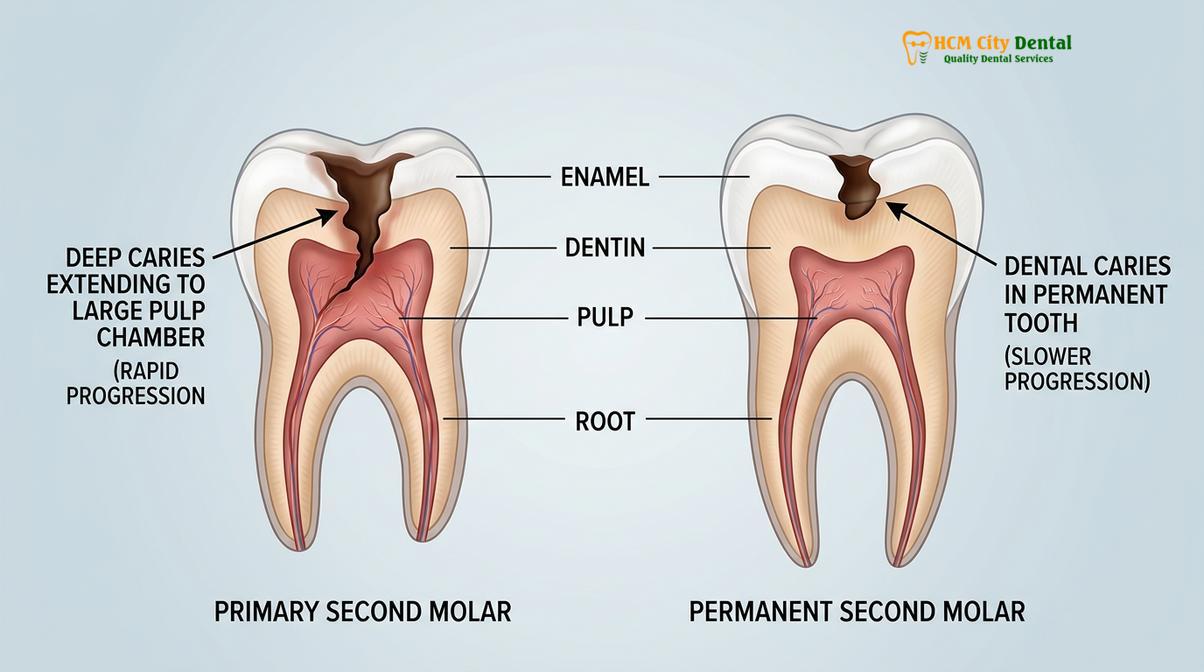
The anatomy of a primary tooth differs significantly from an adult tooth. Primary teeth possess thinner enamel and relatively larger pulp chambers. This anatomical reality means that once decay breaches the enamel, it can reach the nerve rapidly, leading to pain and infection much faster than in an adult tooth. Understanding this highlights the importance of preventive measures, which you can explore further in our guide on Kids Dental Cleaning & Fissure Sealants.
“Primary teeth are not merely temporary placeholders; they are the foundational blueprint for a child’s permanent occlusion and maxillofacial development. Their premature loss disrupts the delicate timeline of dental eruption.”
The shedding timeline of primary teeth is highly orchestrated. While front teeth (incisors) typically exfoliate around ages six to eight, the primary molars in the back of the mouth must remain functional until ages ten to twelve. These primary molars hold the precise mesiodistal space required for the permanent premolars developing beneath them. If a primary molar is lost early, the space must be artificially maintained to prevent severe developmental complications.[2]
What Happens if a Baby Tooth is Extracted Early?
Premature baby tooth loss without space management leads to the rapid shifting of adjacent teeth, causing severe space loss and potential impaction of developing adult teeth.
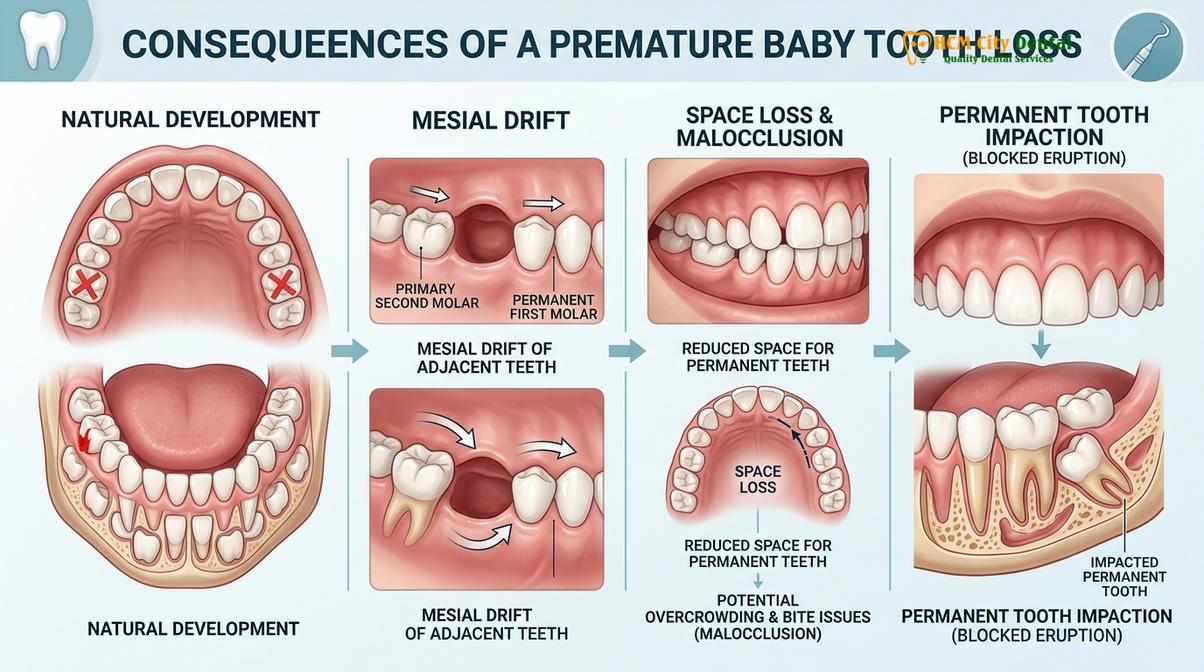
When a primary molar is extracted prematurely and the space is left unmanaged, a biomechanical phenomenon known as “mesial drift” occurs. The permanent first molars (the six-year molars), which erupt behind the primary teeth, have a strong natural tendency to drift forward (mesially) into any available space. Simultaneously, the teeth in front of the extraction site may drift backward.
This migration can happen surprisingly fast—sometimes within a matter of weeks or months. As the adjacent teeth collapse into the extraction gap, the arch length is significantly reduced. Consequently, when the permanent premolar is finally ready to erupt years later, it finds its path blocked. This leads to ectopic eruption (erupting in the wrong place, such as the roof of the mouth or high on the gums) or complete impaction (remaining trapped within the jawbone). To prevent orthodontic crowding, proactive space management is an absolute clinical necessity.[3]
Clinical Warning: Delaying the placement of a space maintainer appliance after a primary molar extraction can result in significant space loss within just a few weeks. This neglect often necessitates complex, lengthy, and costly orthodontic expansion treatments later in adolescence.
Furthermore, premature tooth loss and the resulting malocclusion are closely tied to broader developmental issues. At our clinic, we emphasize interceptive orthodontics and airway assessment. We evaluate early jaw development, thumb-sucking habits, and tongue-ties. We also screen for mouth breathing, a condition that can cause “adenoid facies” (long-face syndrome) and is a strong indicator of pediatric sleep apnea. Proper arch width, maintained by primary teeth or space maintainers, is vital for accommodating the tongue and ensuring a healthy, open airway. For more details on airway health, review our comprehensive Pediatric Sleep Apnea Airway Assessment.[5]
How Space Maintainers Work
A space maintainer appliance is a custom-fabricated metal or acrylic device that exerts passive support to keep the extraction gap open until the permanent tooth emerges.
A space maintainer appliance does not move teeth; rather, it acts as a passive barrier to prevent movement. Depending on the child’s age, the location of the missing tooth, and the number of teeth lost, a pediatric dentist will recommend a specific type of appliance. These devices are generally categorized into fixed (cemented in place) and removable options, though fixed appliances are overwhelmingly preferred for children due to compliance issues with removable retainers.
The most common types of fixed space maintainers include:
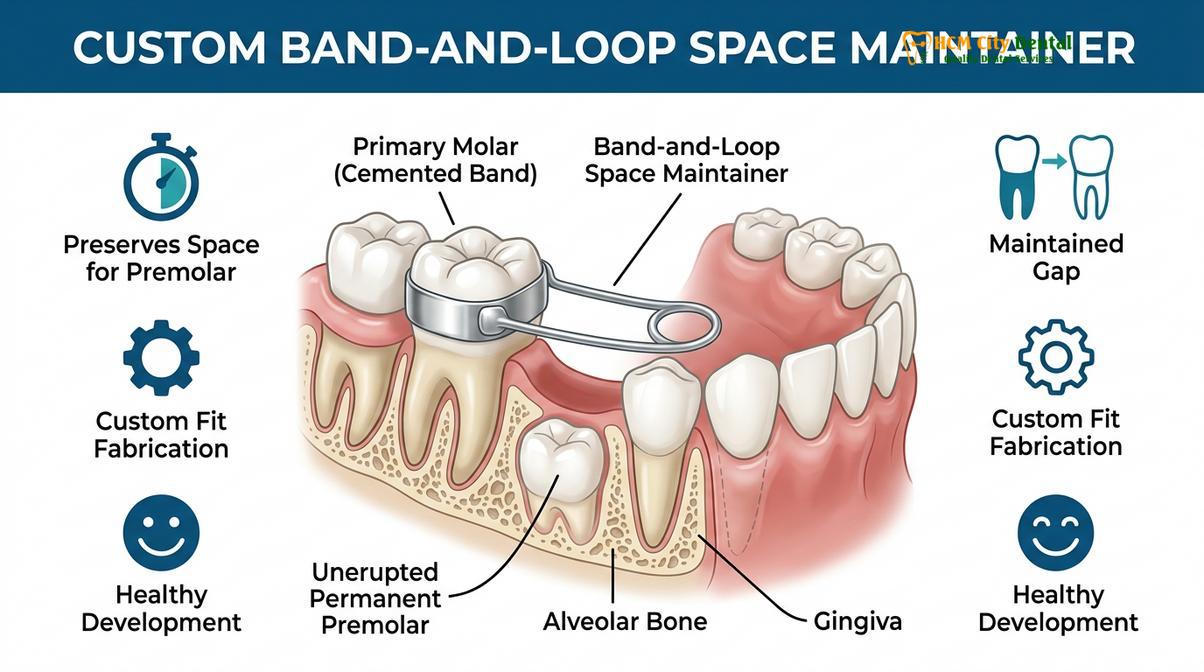
- Band-and-Loop: Used when a single primary molar is lost in a dental quadrant. A stainless steel band is cemented around the tooth adjacent to the empty space, and a wire loop extends across the gap to rest against the next tooth, holding the space open.
- Crown-and-Loop: Similar to the band-and-loop, but instead of a simple band, a stainless steel crown is placed over the abutment tooth. This is utilized when the supporting tooth has extensive decay and requires full-coverage restoration.
- Distal Shoe: A specialized appliance used when a primary second molar is lost before the permanent first molar has erupted. It features a metal extension that goes slightly under the gumline to guide the unerupted permanent molar into its correct position.
- Lingual Arch / Nance Appliance: Bilateral space maintainers used when multiple teeth are lost on both sides of the dental arch. The lingual arch connects the lower molars via a wire running along the inside of the lower teeth, while the Nance appliance does the same for the upper arch, utilizing an acrylic button that rests on the palate.
| Appliance Type | Primary Indication | Placement Location | Clinical Advantage |
|---|---|---|---|
| Band-and-Loop | Unilateral loss of a primary first molar | Cemented to adjacent molar | Highly durable, excellent patient tolerance, easy to clean. |
| Distal Shoe | Loss of primary second molar before adult molar erupts | Cemented to primary first molar, extends subgingivally | Guides the unerupted permanent six-year molar into proper alignment. |
| Lingual Arch | Bilateral loss of lower primary molars | Cemented to lower permanent molars | Maintains entire lower arch width and prevents lower incisor crowding. |
Choosing the correct appliance is a critical step in Pediatric Interceptive Orthodontics, ensuring that the foundation for the adult smile remains intact.
The Treatment Process
The clinical workflow involves a gentle extraction, followed by taking precise impressions to fabricate a custom-fitted space maintainer that is later cemented into place.
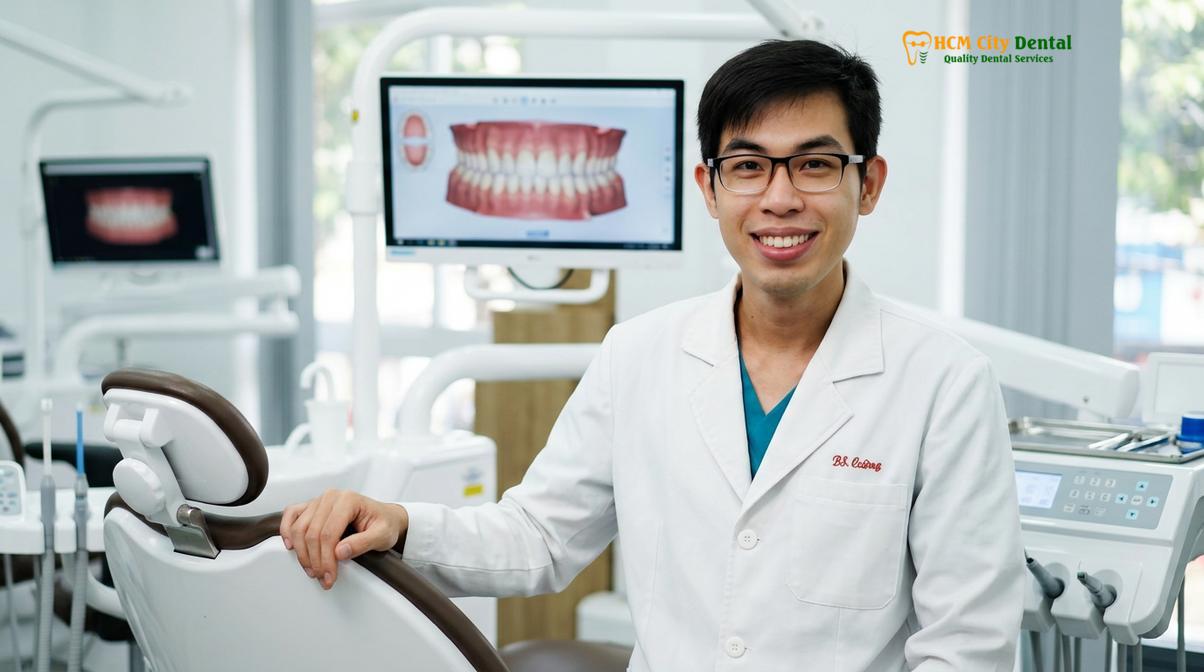
The process of receiving a baby tooth extraction space maintainer is straightforward and typically requires two short visits. During the first visit, if the tooth has not already been removed, the extraction is performed. Dr. Nguyen Van Cuong, a leading specialist in Children & Pediatric Dentistry, emphasizes creating a calm, predictable environment for young patients. By utilizing the Tell-Show-Do method, Dr. Cuong ensures the child is kept informed and relaxed throughout the extraction process, building long-term trust and minimizing dental anxiety. Following the extraction, kids dental extraction recovery protocols are discussed, which include a soft diet and mild over-the-counter pain management for a day or two.
Once the site is prepared, an impression of the child’s teeth is taken. Modern pediatric dentistry often utilizes digital intraoral scanners, which are much more comfortable for children than traditional gooey alginate impressions, eliminating the gag reflex. This digital model is sent to a dental laboratory where the custom space maintainer appliance is fabricated from medical-grade stainless steel.[4]
Clinical Case Study: Space Management Success
A young patient visited HCMC Dental Clinic in Ho Chi Minh City presenting with an unrestorable primary first molar due to severe decay. After a gentle extraction using behavioral desensitization techniques, Dr. Cuong took a digital scan. Two weeks later, a custom band-and-loop space maintainer was cemented. Over the next three years, the appliance successfully held the space, allowing the permanent premolar to erupt perfectly into alignment, completely avoiding the need for Phase 1 braces.
During the second visit, the appliance is tried in to ensure a perfect fit. It is then securely cemented onto the abutment tooth using a biocompatible, fluoride-releasing glass ionomer cement. The child is given instructions on how to care for the appliance, and parents are advised on dietary restrictions—specifically avoiding sticky candies like caramel or taffy that could dislodge the band.
“Effective pediatric dentistry relies on building trust; when a child understands the process through the Tell-Show-Do method, anxiety diminishes, and clinical outcomes improve significantly.”
Pediatric Dental Pricing Structure at HCMC Dental Clinic
We provide transparent, comprehensive pricing for pediatric dental procedures, ensuring families have access to high-quality preventive and restorative care without hidden costs.
Understanding the financial aspect of pediatric dental care is important for families. At our clinic, we strive to offer world-class treatments at accessible rates. Below is our current pricing structure for pediatric services. Please note that patients booking directly through our WhatsApp channel are eligible for a discount off the standard walk-in rates.
- Kids Consultation & Diagnostic check-up: 300,000 to 500,000 VND (~$12 to $20 USD).
- Fissure Sealant (per tooth): 400,000 to 600,000 VND (~$16 to $24 USD).
- Fluoride Varnish Application: 300,000 to 500,000 VND (~$12 to $20 USD).
- Pediatric Composite Filling (per tooth): 500,000 to 800,000 VND (~$20 to $32 USD).
- Pediatric Glass Ionomer Filling (GIC, fluoride-releasing, per tooth): 400,000 to 600,000 VND (~$16 to $24 USD).
- Baby Root Canal (Pulpotomy, per tooth): 1,000,000 to 1,500,000 VND (~$40 to $60 USD).
- Space Maintainer (fixed, band-and-loop, per unit): 2,000,000 to 3,000,000 VND (~$80 to $120 USD).
- Custom Pediatric Sports Mouthguard: 1,500,000 to 2,500,000 VND (~$60 to $100 USD).
Investing in a space maintainer is highly cost-effective when compared to the extensive orthodontic treatments required to correct severe crowding later. For families residing in or relocating to Vietnam, you can learn more about comprehensive orthodontic planning in our guide on Braces for Expat Children in Ho Chi Minh City.
When to See a Pediatric Dentist & Important Clinical Notes
Regular monitoring of the space maintainer is essential to ensure it remains intact and functions correctly until the permanent tooth is ready to erupt.
Once a space maintainer is placed, parents should schedule a visit to the pediatric dentist if they notice any of the following clinical signs:
- Appliance Mobility: If the metal band becomes loose or the wire is bent due to chewing hard foods, it must be recemented or adjusted immediately to prevent decay from forming under the loose band.
- Gum Irritation: If the child complains of pain or if the gums around the appliance appear red, swollen, or bleed easily, an evaluation is needed to check for plaque buildup or impingement.
- Eruption of the Permanent Tooth: As soon as the new adult tooth begins to break through the gum tissue beneath or near the wire loop, the space maintainer has fulfilled its purpose and must be professionally removed by the dentist.
Following the guidelines supported by the Vietnam Odonto-Stomatology Association (VOSA) and international pediatric dental standards, we recommend routine check-ups every six months. These visits allow the dentist to take necessary radiographs to track the development of the unerupted permanent teeth and ensure the space maintainer is still clinically appropriate. If you are unsure about the timing of your child’s dental development, consider reading our guide on the Best Age for Kids First Orthodontic Evaluation or exploring the differences between Phase 1 vs Phase 2 Braces.
References
- American Academy of Pediatric Dentistry. Management of the Developing Dentition and Occlusion in Pediatric Dentistry. (2022).
- Journal of Clinical Pediatric Dentistry. Efficacy of Fixed Space Maintainers Following Premature Loss of Primary Molars. (2021).
- International Journal of Paediatric Dentistry. Silver Diamine Fluoride and Glass Ionomer Cement Applications in Early Childhood Caries. (2020).
- Pediatric Dentistry Journal. Behavior Management Techniques: Tell-Show-Do and Conscious Sedation Protocols. (2023).
- Journal of the American Dental Association. Interceptive Orthodontics and Airway Assessment in Growing Children. (2019).
If your child has recently lost a baby tooth prematurely or requires an extraction, proactive space management is essential to protect their future smile. Contact HCMC Dental Clinic in Ho Chi Minh City today to schedule a comprehensive pediatric evaluation. Learn more about our specialized care by visiting our Children & Pediatric Dentistry page.