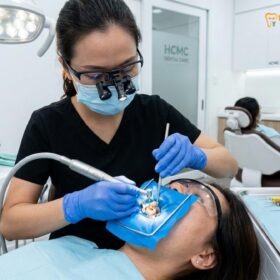
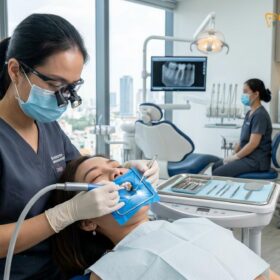
Rotary root canal treatment utilizes electric-powered handpieces and highly flexible nickel-titanium instruments to clean and shape infected tooth roots. This advanced endodontic technique offers superior precision, faster procedure times, and enhanced patient comfort compared to traditional manual stainless-steel filing methods.
Clinical Summary:
Rotary endodontics represents a paradigm shift in modern root canal therapy. By replacing rigid manual files with engine-driven, superelastic nickel-titanium (NiTi) instruments, clinicians can navigate complex root anatomies with unprecedented accuracy. This technology minimizes procedural errors such as canal transportation or ledging while significantly reducing chair time. The integration of advanced kinematics, including continuous rotation and reciprocating motion, ensures thorough debridement of the root canal system. Ultimately, this leads to highly predictable clinical outcomes, superior three-dimensional obturation, and a much more comfortable experience for the patient undergoing endodontic rehabilitation.
Key Takeaways:
- Engine-driven rotary instruments clean root canals faster and more efficiently than traditional manual files.
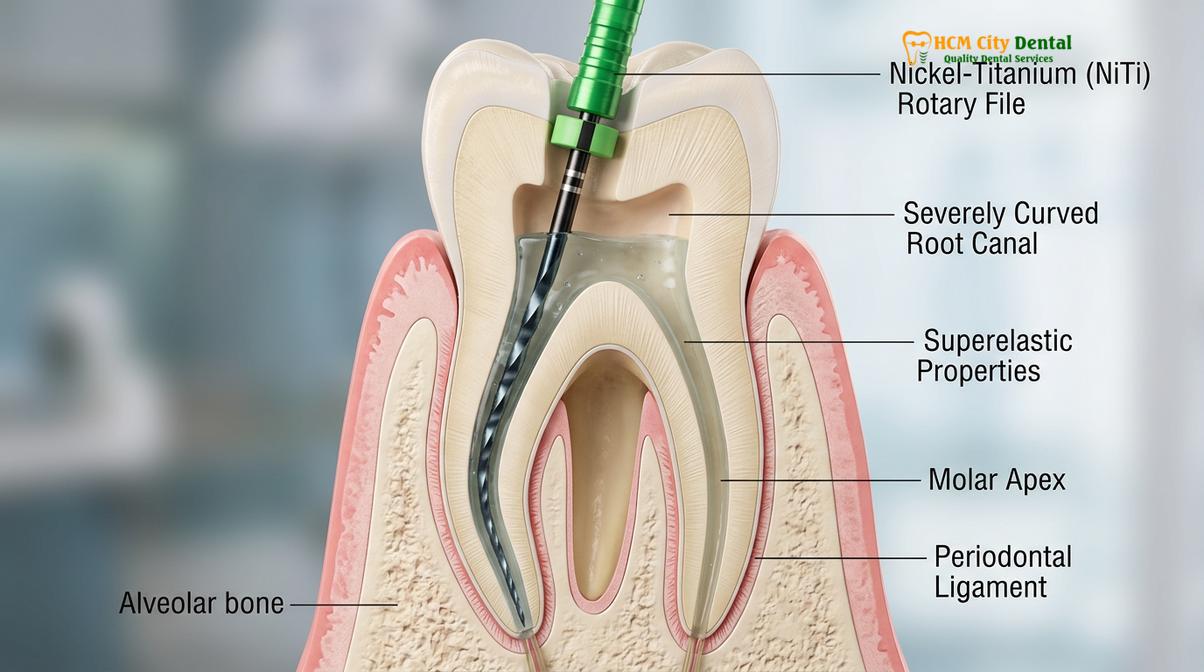
- Nickel-titanium (NiTi) alloys provide exceptional flexibility, allowing safe navigation of severely curved root canals.
- Advanced kinematics, including continuous rotation and reciprocation, optimize debris removal and reduce file stress.
- Modern rotary systems significantly lower the risk of procedural complications like canal ledging and file separation.
- Patients experience shorter appointments, less jaw fatigue, and a smoother postoperative recovery process.
Manual Files vs. Engine-Driven Rotary Endodontics
Transitioning from manual stainless-steel files to engine-driven rotary systems allows endodontists to shape root canals with greater speed, precision, and consistency.
Historically, the foundation of endodontic therapy relied heavily on manual instrumentation. Clinicians utilized stainless-steel K-files and reamers, manipulating them with their fingers to meticulously clean and shape the intricate pathways of the root canal system. While this traditional approach has saved countless teeth over the decades, it is inherently time-consuming and heavily dependent on the practitioner’s tactile feedback and physical stamina. Stainless steel, by its metallurgical nature, is relatively rigid. As the size of a stainless-steel file increases, its stiffness increases exponentially. This rigidity poses significant clinical challenges when negotiating the curved and often tortuous anatomy of human tooth roots.
When a stiff manual file is forced into a curved canal, the metal’s natural restoring force—its tendency to want to return to a straight position—exerts uneven pressure against the dentinal walls. This can lead to undesirable alterations in the canal’s natural trajectory. The introduction of engine-driven rotary endodontics revolutionized this workflow, addressing the mechanical limitations of manual filing. By utilizing a specialized electric handpiece that precisely controls torque and rotational speed, clinicians can achieve a continuous, smooth cutting action that manual manipulation simply cannot replicate.

This automated approach accelerates the shaping phase of the root canal procedure, allowing for rapid and efficient removal of infected pulpal tissue and contaminated dentin. More importantly, engine-driven systems ensure a highly uniform and predictable taper from the coronal orifice to the apical terminus. Achieving this continuously tapering funnel is one of the fundamental principles of endodontics, as it facilitates the deep penetration of antimicrobial irrigants and provides an ideal shape for the subsequent three-dimensional obturation (filling) of the canal space. [1] While manual files are still essential for initial canal exploration and establishing a glide path, the bulk of the shaping is now predominantly handled by sophisticated rotary technology.
The Flexibility of Nickel-Titanium (NiTi) Alloys: Navigating Curved Canals
The superelastic properties of nickel-titanium alloys enable rotary files to bend and adapt to severe root curvatures without permanently deforming or damaging the natural canal anatomy.
The cornerstone of modern rotary root canal treatment is the profound metallurgical advancement of nickel-titanium (NiTi) alloys. Developed initially for aerospace applications, NiTi possesses unique physical properties that make it exceptionally well-suited for endodontics: shape memory and superelasticity. Unlike conventional stainless steel, which undergoes permanent plastic deformation when bent beyond its yield point, NiTi can accommodate massive amounts of strain and still return to its original shape. This is due to a stress-induced phase transformation within the metal’s crystalline lattice.
When a nickel-titanium rotary file is introduced into a curved root canal, the mechanical stress of bending causes the alloy to transition from its resting austenitic phase into a more flexible martensitic phase. This localized transformation allows the file to bend significantly—sometimes up to 90 degrees—while maintaining its cutting efficiency and, crucially, its centering ability within the canal space. [2] Once the stress is removed as the file is withdrawn, the alloy instantly reverts to its austenitic phase, regaining its original straight form.
“The introduction of nickel-titanium metallurgy in endodontics fundamentally changed our approach to curved canals, allowing us to respect the original anatomy while achieving optimal disinfection and shaping.”
Because these highly flexible instruments conform to the natural curvature of the root rather than fighting against it, they drastically reduce the likelihood of straightening the canal. This preservation of the original canal anatomy is paramount for maintaining the structural integrity of the remaining radicular dentin. By avoiding excessive removal of tooth structure on the inner wall of the curve (the danger zone), clinicians can ensure a reduced root fracture risk over the patient’s lifetime. Furthermore, modern proprietary heat treatments (such as M-Wire, Gold wire, and Blue wire technologies) have been developed to optimize the phase transition temperatures of NiTi, making the files even more flexible and resistant to cyclic fatigue than their predecessors.
Reciprocating Motion vs. Continuous Rotation: The Physics of Shaping
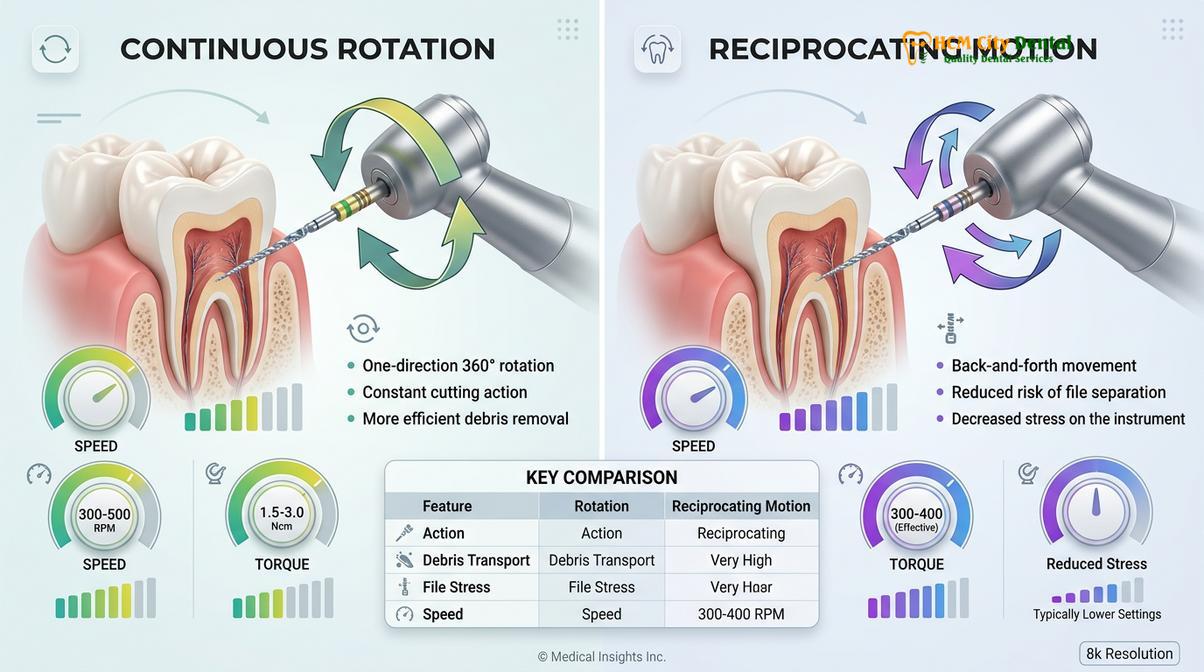
Modern endodontic motors utilize either continuous rotation for efficient debris removal or reciprocating motion to minimize torsional stress and prevent instrument fracture.
The kinematics—the specific movements—of rotary instruments play a vital role in the safety, efficacy, and speed of endodontic therapy. Historically, rotary systems operated exclusively in continuous rotation. In this mode, the file spins 360 degrees in a single direction, typically clockwise, at a constant speed (usually between 250 and 500 revolutions per minute). Continuous rotation is highly efficient at cutting dentin and acts like an auger, effectively lifting debris and infected tissue coronally out of the canal space. However, in narrow, calcified, or highly curved canals, continuous rotation can subject the file to significant mechanical stress. [3]
There are two primary types of stress that can cause a file to fail: torsional stress and cyclic fatigue. Torsional stress occurs when the tip of the file binds in the canal while the motor continues to turn the shaft, potentially causing the metal to twist and snap. Cyclic fatigue occurs when the file rotates freely within a curve; the metal undergoes alternating cycles of tension and compression, eventually leading to micro-cracks and fracture. To mitigate these risks, reciprocating motion was developed as an alternative kinematic approach.
Reciprocation involves an alternating, asymmetrical rotational movement. For example, the motor might drive the file 150 degrees counterclockwise to engage and cut the dentin, followed immediately by a 30-degree clockwise rotation to disengage the file and relieve stress. This “watch-winding” motion ensures that the file never completes a full 360-degree rotation in a single cycle, drastically reducing the accumulation of torsional stress. The net movement is still in the cutting direction, allowing the file to advance apically, but with a significantly enhanced safety margin.
| Feature | Continuous Rotation | Reciprocating Motion |
|---|---|---|
| Movement Pattern | 360-degree continuous spin (usually clockwise) | Alternating asymmetrical rotation (e.g., 150° CCW / 30° CW) |
| Cutting Efficiency | Very high; excellent at augering debris coronally | High; cuts efficiently but requires more frequent irrigation |
| Stress Management | Susceptible to torsional binding in tight canals | Relieves torsional stress; highly resistant to binding |
| Best Clinical Use Case | Straight to moderately curved canals; rapid shaping | Severely curved, narrow, or complex canal anatomies |
Both kinematics have their distinct advantages. Continuous rotation offers unparalleled efficiency in debris removal, while reciprocation offers superior safety in complex anatomies. Many modern endodontists utilize a hybrid approach, selecting the specific motor setting and file system based on the unique anatomical challenges presented by each individual tooth.
Minimizing Risk: Avoiding Ledging, Transportation, and File Fractures
Advanced rotary systems incorporate specific design features and torque-controlled motors to prevent procedural errors such as canal ledging, apical transportation, and instrument separation.
Endodontic therapy is a microsurgical procedure that requires meticulous precision. Procedural errors during the shaping phase can severely compromise the disinfection process and negatively impact the long-term prognosis of the tooth. Two of the most common complications associated with rigid manual files are ledging and apical transportation. Ledging occurs when a stiff file deviates from the natural canal path and cuts a gouge or artificial irregularity into the outer dentinal wall of a curve. Once a ledge is created, it becomes exceedingly difficult to bypass it and reach the true apex of the root.
Apical transportation, often referred to as “zipping,” involves the asymmetrical widening of the apical foramen (the opening at the tip of the root). This occurs when the restoring force of a rigid file causes it to cut more heavily on the outer wall of the apical curve, transforming the naturally round foramen into an elliptical, teardrop shape. This compromises the clinician’s ability to achieve a hermetic seal during obturation. Both of these complications are significantly minimized when using flexible nickel-titanium rotary files. Their superelasticity, combined with non-cutting (batt) tips, allows them to safely follow the natural canal trajectory, staying centered even in severe curvatures. [4]
Clinical Warning: While rotary systems are highly advanced, they must be used in conjunction with specialized, torque-controlled endodontic motors. Applying excessive apical pressure, skipping file sizes, or using fatigued instruments can still lead to file separation. Establishing a secure, reproducible manual glide path is an essential prerequisite before introducing any rotary file into the canal.
Furthermore, the risk of instrument separation (file breakage) is actively managed through advanced motor technology. Modern endodontic motors feature sophisticated auto-reverse mechanisms. If the motor’s microchip detects that the torque applied to the file exceeds a pre-set safety limit, it instantaneously stops and reverses the file’s rotation. This prevents the instrument from binding tightly in the dentin and fracturing. This technological safeguard, combined with strict single-use file protocols, ensures a highly predictable and safe procedure, contributing significantly to a reduced root fracture risk and a higher overall success rate for the saving of infected teeth.
Patient Benefits: Shorter Time in the Chair and Predictable Results
Rotary endodontics significantly reduces treatment time and postoperative discomfort, providing patients with a faster, more comfortable, and highly predictable root canal experience.
From a patient’s perspective, the clinical and metallurgical advancements of rotary endodontics translate directly into a vastly improved treatment experience. The most notable and immediate advantage is the significant reduction in chair time. Because engine-driven instruments shape the canals much more efficiently than manual filing, the overall duration of the shaping phase is often cut in half. This means the patient spends less time keeping their mouth open, which drastically reduces jaw fatigue, muscle strain, and the psychological stress often associated with lengthy dental procedures. [5]
In addition to speed, the smooth and continuous motion of the electric handpiece generates less vibration and physical manipulation of the tooth compared to the push-pull and twisting motions of manual filing. This gentler approach minimizes trauma to the periodontal ligament surrounding the root, frequently resulting in less postoperative inflammation and discomfort. Patients routinely report a smoother recovery process, requiring fewer over-the-counter analgesics in the days following the procedure.
Patient Case Study: A 45-year-old patient presented to HCMC Dental Clinic in Ho Chi Minh City experiencing acute irreversible pulpitis in a severely curved mandibular molar. Dr. Nguyen Van Cuong utilized a modern rotary system with reciprocating kinematics to safely navigate the complex, multi-canal anatomy. Thanks to the efficiency of the engine-driven files, the entire shaping, disinfection, and obturation process was completed in a single, streamlined visit. The patient reported minimal postoperative sensitivity and greatly appreciated the swift, comfortable experience provided by the advanced technology.
Beyond comfort and speed, the precision of rotary instruments leads to highly predictable and successful clinical outcomes. By creating a smooth, continuously tapering funnel, the canal is perfectly optimized for thorough chemical irrigation. Antimicrobial solutions can penetrate deeper into the apical third and lateral accessory canals, effectively eradicating bacterial biofilms. Furthermore, this ideal shape allows for a dense, void-free three-dimensional obturation using gutta-percha and bioceramic sealers. This meticulous seal prevents bacterial microleakage, ensuring the long-term survival and function of the treated tooth within the oral cavity.
Rotary Systems We Use: WaveOne Gold and ProTaper Ultimate
Utilizing industry-leading systems like WaveOne Gold and ProTaper Ultimate allows our clinicians to tailor the instrumentation approach to the specific anatomical challenges of each tooth.
The continuous evolution of endodontic file design has led to the development of highly specialized systems, each engineered to address specific clinical scenarios. At the forefront of reciprocating technology is the WaveOne Gold system. Utilizing advanced gold-wire metallurgy—a proprietary post-machining heat treatment—these files offer unparalleled flexibility and profound resistance to cyclic fatigue. The unique parallelogram cross-section of the file minimizes contact with the dentinal walls, reducing friction and the risk of binding. Remarkably, in many cases, a canal can be completely shaped using just a single WaveOne Gold file, streamlining the clinical workflow and minimizing the time the patient spends in the dental chair.

“By integrating advanced systems like WaveOne Gold into our daily practice, we elevate the standard of care. The enhanced metallurgy provides the confidence to tackle even the most challenging root curvatures safely and efficiently,” notes Dr. Nguyen Van Cuong.
For cases where continuous rotation is deemed more appropriate, systems like ProTaper Ultimate offer a comprehensive and highly efficient sequence of instruments. This system typically includes dedicated slider files for glide path management, shaper files for coronal flaring, and finisher files for precise apical preparation. These nickel-titanium rotary files are engineered with variable tapers and progressive cross-sections to maximize cutting efficiency while strictly preserving critical coronal dentin. The choice between these advanced systems is never arbitrary; it is based on rigorous clinical diagnostics and 3D radiographic imaging, ensuring that every patient at HCMC Dental Clinic receives the most appropriate, customized root canal therapy for their unique dental anatomy.
When to See a Doctor (Clinical Considerations)
While rotary root canal treatment is a highly effective and technologically advanced procedure, it is not a universal solution for all types of dental pain. Candidacy for this treatment depends entirely on a thorough clinical and radiographic examination by a qualified dental professional. Patients should seek immediate endodontic evaluation if they experience symptoms such as severe, spontaneous, or lingering tooth pain, extreme sensitivity to hot or cold temperatures, pain upon chewing, or visible swelling in the adjacent gums or face. These are classic signs of irreversible pulpitis, pulpal necrosis, or periapical periodontitis, which require prompt intervention to prevent the spread of infection.

However, there are clinical contraindications where rotary endodontics may not be viable. Teeth with deep vertical root fractures, massive structural decay leaving insufficient remaining tooth structure for a final restorative crown, or extremely calcified canals that cannot be negotiated even with advanced microscopic techniques may require alternative treatments, such as extraction and implant placement. It is crucial to consult with a specialist for personalized diagnostic advice. Early intervention is always the key to preserving the natural dentition, minimizing discomfort, and achieving the highest possible success rate for endodontic therapy.
Frequently Asked Questions
Do rotary root canals hurt less than traditional manual files?
Yes, rotary root canals generally cause less postoperative discomfort than traditional manual methods. Because the electric handpiece operates smoothly and efficiently, there is less physical manipulation of the tooth and surrounding tissues, leading to a more comfortable recovery and reduced jaw fatigue. The continuous, controlled motion minimizes trauma to the periodontal ligament, which is often the primary source of soreness following endodontic treatment.
Why is the risk of file breakage lower with modern NiTi files?
The risk is lower because modern nickel-titanium (NiTi) files possess superelastic properties that allow them to bend without breaking. Additionally, torque-controlled endodontic motors automatically reverse the file’s rotation if it encounters excessive resistance, preventing the instrument from binding and separating within the canal. The integration of single-use protocols also ensures that files are never subjected to cumulative cyclic fatigue across multiple patients.
How long does canal shaping take using rotary systems?
Canal shaping with rotary systems is significantly faster, often taking only 10 to 20 minutes per canal depending on anatomical complexity. This efficiency drastically reduces the overall appointment time compared to manual filing, which requires repetitive hand motions and frequent instrument changes. Consequently, patients spend less time in the dental chair, making the entire experience much more tolerable.
Can all teeth be treated with rotary endodontics?
While most teeth can be treated with rotary endodontics, severely calcified or abruptly curved canals may still require initial manual instrumentation. A clinician will meticulously assess the specific root anatomy using digital radiographs to determine the safest and most effective shaping protocol. In highly complex cases, a hybrid approach combining manual glide path creation with rotary finishing is often the standard of care.
Is rotary root canal treatment more expensive than traditional methods?
The cost is generally comparable, though some clinics may charge slightly more due to the advanced single-use technology and specialized motors involved. However, the clinical benefits of reduced chair time, higher precision, and highly predictable outcomes make it a valuable investment in preserving your natural tooth. Avoiding future complications or the need for retreatment often makes rotary endodontics the most cost-effective choice in the long run.
References
- Journal of Endodontics. Outcomes of root canal treatment and restoration longevity. (2020).
- International Endodontic Journal. Biofilms in endodontics and disinfection strategies. (2021).
- Journal of the American Dental Association. Microscope-assisted endodontics and missed canals. (2019).
- Clinical Oral Investigations. Biocompatibility of bioceramic root canal sealers. (2022).
- British Dental Journal. Pain management and dental anxiety in endodontics. (2018).