When choosing between an inlay, onlay, or filling, the decision depends primarily on the tooth decay size. Fillings are ideal for minor cavities, whereas inlays and onlays are indirect restorations designed to rebuild moderate-to-severe structural damage, offering superior strength and preventing polymerization shrinkage in larger cavities.
Clinical Summary:
The debate of inlay onlay vs filling centers on biomechanics and the preservation of natural tooth structure. Direct composite restorations are highly effective for conservative, small-scale decay. However, when a cavity exceeds 50% of the tooth’s width, direct fillings suffer from polymerization shrinkage and lack the structural integrity needed to withstand heavy occlusal forces. In these scenarios, Dr. Nguyen Van Cuong advocates for a strict preservation philosophy, utilizing custom-milled ceramic inlays and onlays. These indirect restorations act as partial crowns, sealing the cavity with exact marginal precision while avoiding the aggressive 360-degree shaving required for traditional full crowns. By leveraging advanced CAD/CAM technology and biocompatible materials like IPS e.max and Cercon HT Zirconia, modern dentistry can restore both the aesthetic beauty and functional strength of severely compromised teeth with exceptional long-term predictability.
Key Takeaways:
- Decay Size Dictates Treatment: Small cavities require direct fillings, while moderate-to-large defects necessitate inlays or onlays.
- Structural Integrity: Onlays cover weakened cusps, preventing the tooth from fracturing under heavy chewing forces.
- Zero Shrinkage: Lab-milled ceramics do not shrink upon placement, eliminating the micro-gaps common with large composite fillings.
- Maximum Preservation: Inlays and onlays save significantly more natural healthy enamel compared to traditional full-coverage dental crowns.
- Digital Precision: Modern restorations utilize 3D intraoral scanning and CAD/CAM milling for a flawless, microscopic fit.
The Limits of Direct Composite Fillings
Direct composite fillings are excellent for small cavities but struggle with structural integrity and polymerization shrinkage when applied to extensive areas of tooth decay.
For decades, the direct composite restoration has been the cornerstone of conservative dentistry. When a patient presents with a small, localized cavity, the clinical protocol is straightforward: remove the diseased tissue, apply an enamel bonding protocol, and pack a tooth-colored composite resin into the void. Because the surrounding natural tooth structure remains robust and intact, the filling simply acts as a plug, restoring the surface without bearing the brunt of the jaw’s immense biting forces.
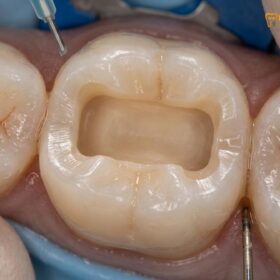
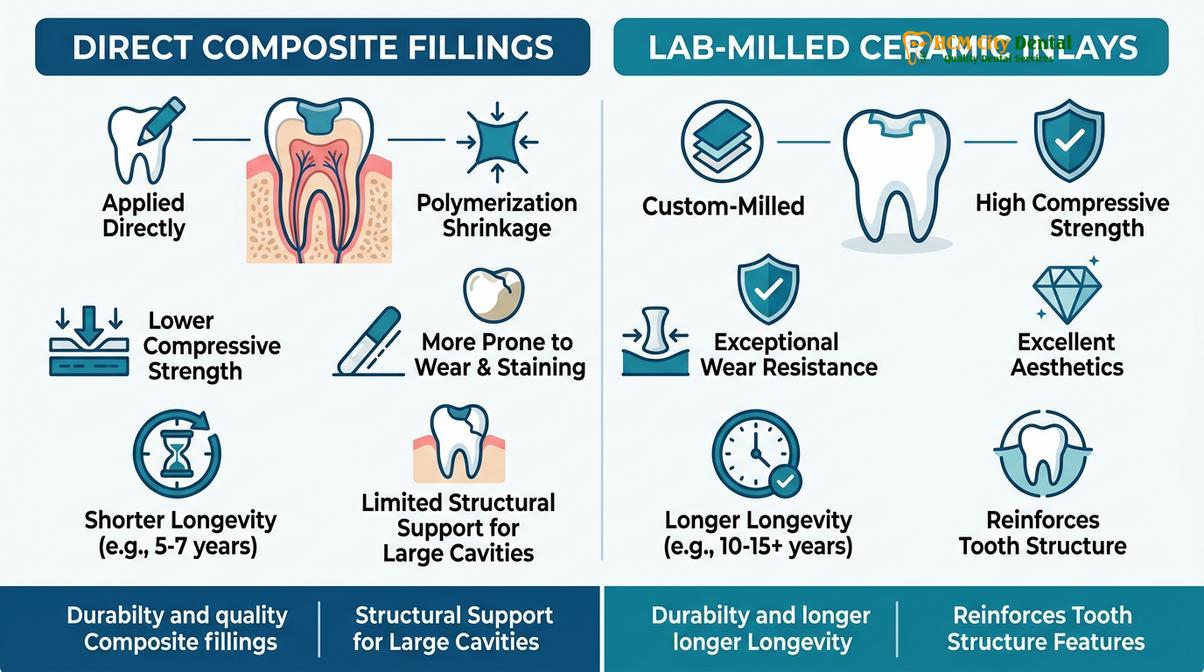
However, the clinical dynamics change drastically when evaluating the tooth decay size. If a cavity is deep and wide, the remaining walls of the tooth become thin and fragile. In these cases, placing a massive direct filling is biomechanically flawed. Composite resin, while aesthetically pleasing, lacks the compressive strength and rigidity of natural enamel or advanced dental ceramics. When subjected to the repetitive stress of mastication (chewing), a large filling can act as a wedge. Instead of distributing the force evenly, it drives the pressure outward against the weakened enamel walls, significantly increasing the risk of catastrophic tooth fractures.[1]
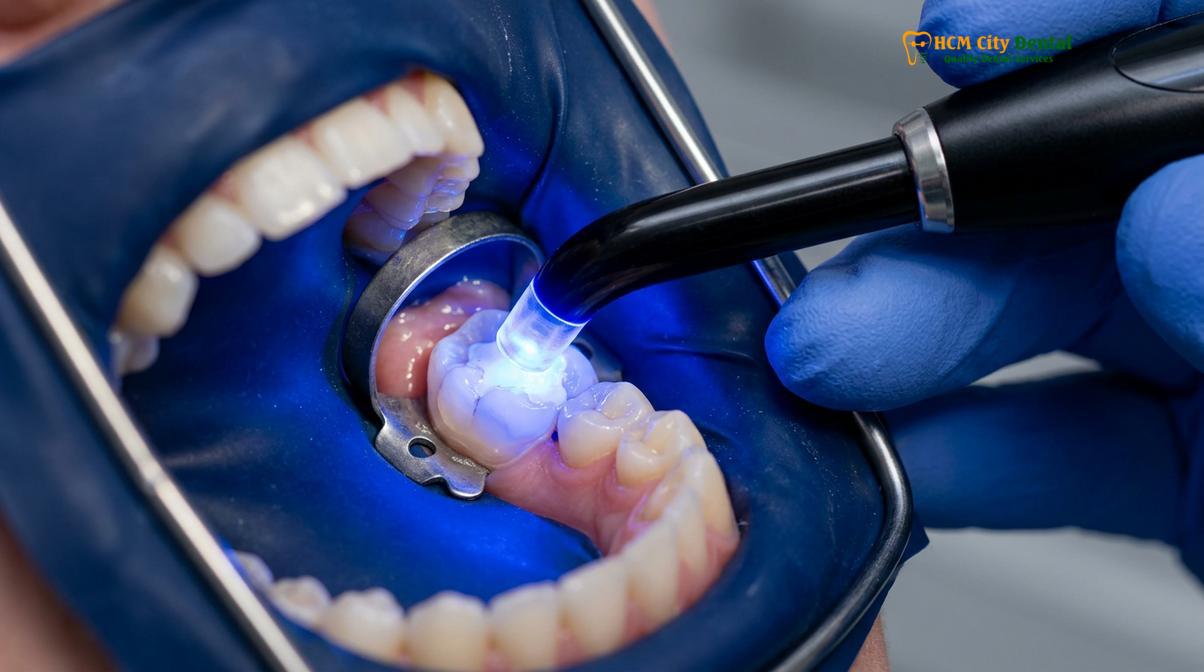
Furthermore, the physical properties of composite resin present challenges in large-scale applications. The material relies on micromechanical retention and must be built up in incremental layers. While this technique is highly successful for minor defects, attempting to rebuild an entire cusp or a massive central void with direct resin often leads to compromised structural integrity. The ongoing debate of filling vs inlay vs onlay is ultimately resolved by assessing the remaining healthy dentin and enamel; if the foundation is weak, a direct filling is no longer a viable long-term solution.
What is an Inlay and Onlay?
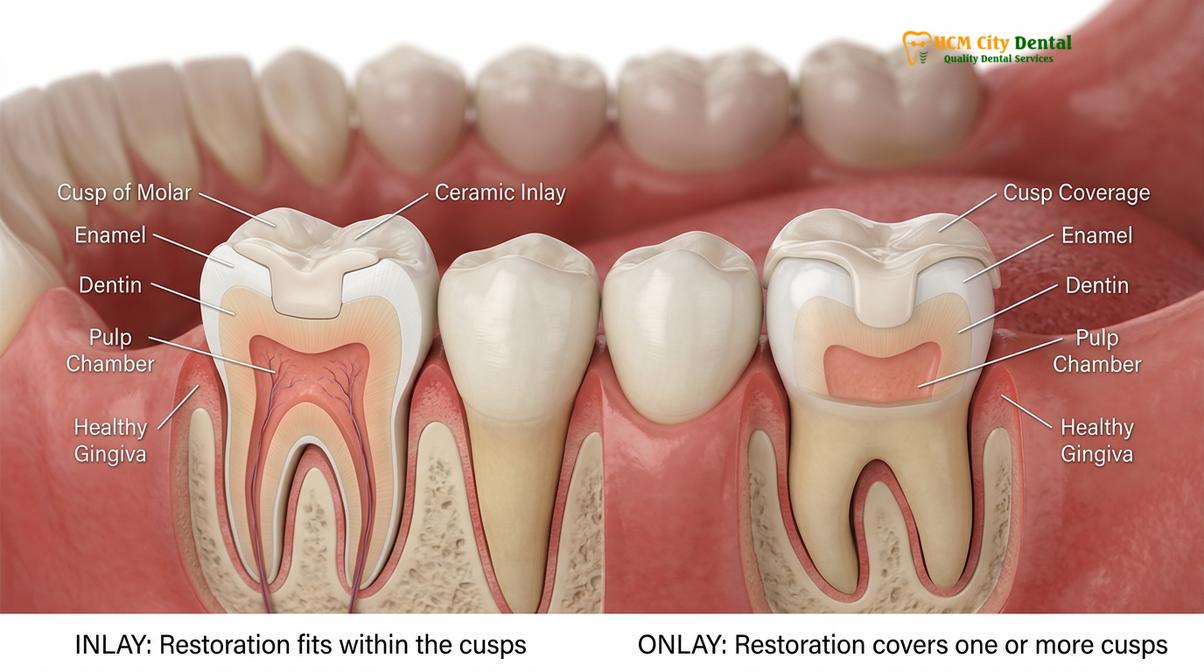
Inlays fit inside the tooth cusps, while onlays extend over one or more cusps, acting as partial crowns that preserve maximum natural enamel.
To address the limitations of direct fillings, modern dentistry utilizes the indirect restoration. Unlike a filling, which is molded directly inside the mouth, an indirect restoration is custom-fabricated outside the mouth in a specialized dental laboratory and then permanently bonded into place. This category includes both dental inlays and dental onlays, which are often referred to collectively as partial crowns or porcelain overlays.
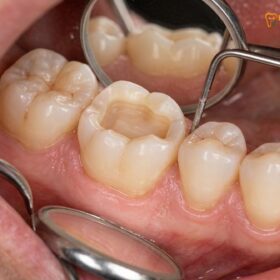
An inlay is designed to repair the chewing surface of a back tooth (molar or premolar). It fits perfectly within the cavity outline form, resting entirely inside the outer edges, or cusps, of the tooth. You can think of it as a highly precise, lab-made puzzle piece that replaces a large, failing silver filling or extensive central decay. When patients ask about a porcelain filling vs composite, they are typically referring to a ceramic inlay.
An onlay, on the other hand, is utilized when the decay or fracture is more extensive. If one or more of the tooth’s cusps are undermined or broken, an inlay is insufficient. An onlay extends over the damaged cusps, capping them to provide essential structural reinforcement. By covering the biting surface, the onlay absorbs the occlusal forces and protects the fragile underlying tooth structure from splitting.
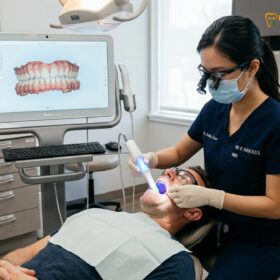
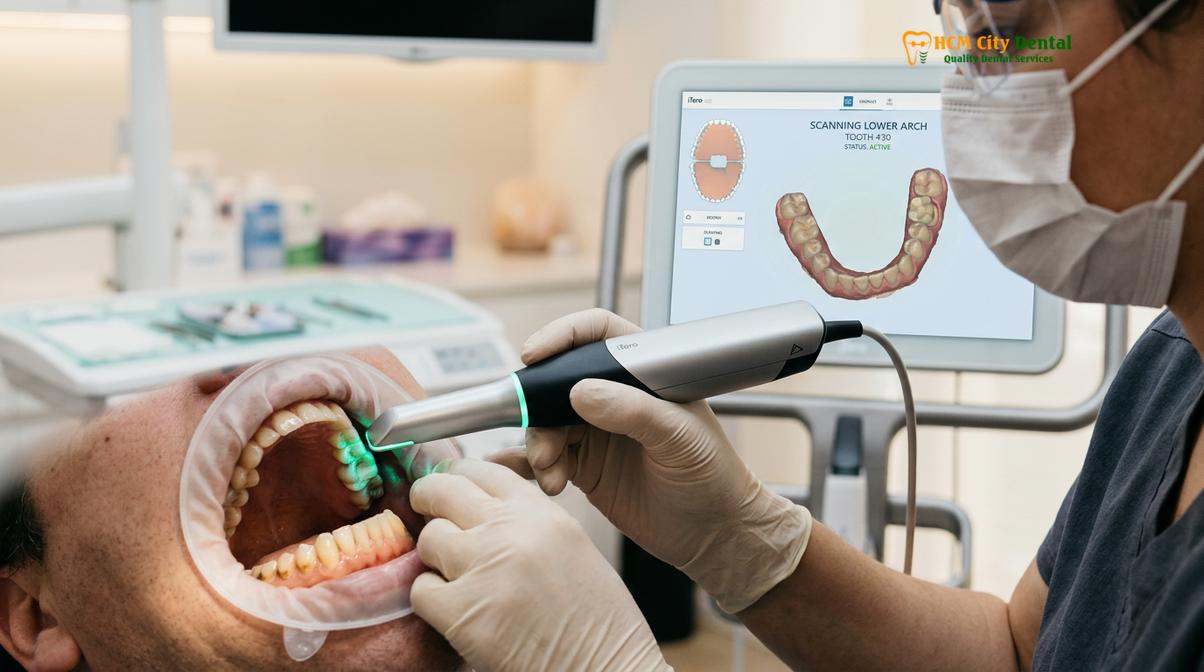
At HCMC Dental Clinic, the fabrication of these restorations is driven by a strict preservation philosophy. Rather than grinding down a tooth entirely to fit a traditional full crown, Dr. Nguyen Van Cuong meticulously prepares only the damaged areas, utilizing precise chamfer margins to preserve maximum healthy enamel. The clinic employs cutting-edge digital dentistry, utilizing iTero and Medit i700 intraoral scanners. This technology eliminates the need for messy, uncomfortable silicone impressions, capturing highly accurate 3D data of the prepared tooth. Through a direct lab partnership & CAD/CAM technology, the restoration is milled with microscopic precision from premium materials like Ivoclar’s IPS e.max lithium disilicate for the aesthetic zone, or Dentsply Sirona’s Cercon HT Zirconia for areas requiring maximum strength.[2]
Strength and Structural Integrity: 50% Rule
The 50% rule dictates that if a cavity compromises more than half of the tooth’s width, an inlay or onlay is required to restore structural integrity and withstand occlusal forces.
In clinical diagnostics, dentists rely on established biomechanical principles to determine the appropriate treatment. One of the most critical guidelines is the “50% Rule.” This rule states that if the width of the cavity preparation (the isthmus) exceeds half the distance between the tips of the tooth’s cusps, the tooth is structurally compromised. At this stage of decay, the remaining cusps act as unsupported cantilevers. Every time the patient bites down, these thin walls flex microscopically. Over time, this continuous flexing leads to micro-cracks, sensitivity, and eventually, a fractured tooth.
When evaluating an inlay vs filling, the 50% rule is the primary deciding factor. A direct composite restoration cannot bind these flexing walls together effectively. In contrast, an indirect restoration—specifically an onlay—is designed to provide cuspal coverage. By capping the weakened cusps with high-strength ceramic, the onlay splints the tooth together, transforming a fragile, hollowed-out structure into a unified, load-bearing unit. This restoration of structural integrity is paramount for patients with heavy bites or those suffering from bruxism (teeth grinding), where restoring the vertical dimension of occlusion (VDO) requires materials that will not rapidly wear down.
To better understand the clinical applications, consider the following comparison of restorative options based on the extent of tooth damage:
| Restoration Type | Ideal Tooth Decay Size | Cusp Involvement | Structural Support Provided |
|---|---|---|---|
| Direct Composite Filling | Small to moderate (Less than 50% width) | None (Fits entirely inside the tooth) | Low; relies on remaining natural tooth strength. |
| Dental Inlay | Moderate to large (Central decay) | None (Fits inside, but replaces large volume) | Medium; provides a rigid, non-shrinking core. |
| Dental Onlay / Overlay | Large (Exceeds 50% width) | Covers one or more weakened cusps | High; binds the tooth together and absorbs bite force. |
| Full Dental Crown | Severe (Minimal healthy structure left) | Covers all cusps (360-degree coverage) | Maximum; completely encases the remaining tooth. |
By adhering to these biomechanical principles, dentists can prevent the catastrophic failures often associated with over-extended fillings. The goal is always to select the most conservative restoration that still guarantees long-term functional stability.[3]
Polymerization Shrinkage vs. Lab-Fabricated Fit
Direct composites shrink during light-curing, creating micro-gaps that lead to secondary decay, whereas lab-fabricated inlays offer an exact marginal fit with zero internal shrinkage.
One of the most significant, yet rarely discussed, drawbacks of direct composite resin is a phenomenon known as polymerization shrinkage. When a dentist places a soft composite material into a cavity and cures it with a blue dental light, a chemical reaction occurs that hardens the resin. During this hardening process, the material physically shrinks by approximately 2% to 3% by volume. In a small cavity, this shrinkage is negligible and easily managed by modern bonding agents.
However, as the tooth decay size increases, the total volume of composite required increases exponentially. When a massive amount of composite shrinks, it pulls away from the cavity walls. This creates microscopic gaps at the margin—the critical junction where the filling meets the natural tooth. These micro-gaps are a breeding ground for bacteria, inevitably leading to secondary decay detection beneath the filling, post-operative sensitivity, and marginal staining.[4]
“The primary cause of failure in large direct restorations is the breakdown of the marginal seal due to polymerization shrinkage. By transitioning to a lab-milled ceramic inlay, we completely eliminate this shrinkage stress, ensuring a microscopic, watertight seal that protects the tooth for decades.”
This is precisely when to get inlay instead of filling. Because an inlay or onlay is an indirect restoration, it is fully fabricated and hardened in a laboratory furnace before it ever enters the patient’s mouth. The ceramic material undergoes zero shrinkage during the final placement. The dentist simply utilizes a highly advanced resin-adhesive cementation protocol to bond the precision-milled ceramic to the enamel.
The bonding protocol for these restorations is meticulous. The tooth is isolated, often with a rubber dam, to prevent moisture contamination. The enamel and dentin are treated with specific etching agents, and a dual-cure adhesive is applied. Once the inlay is seated, the margins are virtually seamless. This exact marginal fit, achieved through CAD/CAM milling, is the ultimate defense against bacterial microleakage, ensuring the underlying tooth structure remains pristine and protected.
Longevity Comparison: 5 Years vs. 15 Years
While a standard composite filling typically lasts five to seven years, a precision-milled ceramic inlay or onlay can function flawlessly for over fifteen years with proper care.
When evaluating dental treatments, longevity is a primary concern for patients. The lifespan of a restoration is directly tied to the material science behind it and the environment it must endure. The human mouth is a harsh environment, subject to extreme temperature fluctuations, acidic foods, and immense mechanical pressure. Under these conditions, the differences between a direct composite restoration and a ceramic indirect restoration become starkly apparent.
A standard composite filling, particularly a large one on a molar, has an average lifespan of five to seven years. Over time, the resin matrix absorbs water, stains, and gradually wears down under the friction of chewing. As the filling degrades, the bite alignment can shift, and the risk of the filling cracking or dislodging increases. In contrast, dental ceramics like IPS e.max and Zirconia are incredibly dense and wear-resistant. They mimic the physical properties of natural enamel almost perfectly. A well-placed inlay or onlay, supported by a healthy bonding protocol, routinely lasts 15 years or longer, with many surviving a lifetime.[5]
Clinical Case Study: Silver Filling Replacement
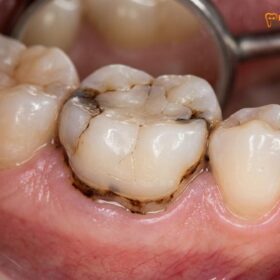
A 45-year-old patient visited HCMC Dental Clinic in Ho Chi Minh City complaining of sensitivity in a lower molar. Examination revealed a massive, failing amalgam (silver) filling with secondary decay and a hairline crack propagating down the lingual cusp. Because the defect was too large for a composite filling but the remaining facial enamel was perfectly healthy, Dr. Cuong recommended a conservative ceramic onlay. Using the Medit i700 scanner, a digital impression was taken. A custom IPS e.max onlay was milled and bonded, capping the cracked cusp and restoring the tooth’s structural integrity without the need for an aggressive full crown preparation. The patient reported immediate relief from sensitivity and a perfectly natural bite.
Beyond durability, biocompatibility is a crucial factor. Modern ceramic inlays and onlays are 100% metal-free. They do not corrode, they do not cause galvanic shocks (a common issue with mixed metal fillings), and they are highly compatible with the surrounding gingival (gum) tissues. This makes them an ideal choice for patients seeking holistic, long-lasting dental care that prioritizes both systemic health and aesthetic perfection.
Cost Analysis: Upfront Investment vs. Long-Term Value
Although inlays and onlays require a higher initial investment than direct fillings, their extended lifespan and prevention of future root canals make them highly cost-effective over time.
It is an undeniable fact that an indirect restoration costs more upfront than a direct filling. The higher price reflects the advanced technology involved, including 3D intraoral scanning, CAD/CAM milling, the use of premium imported ceramics, and the expertise of the dental laboratory technicians. However, evaluating the cost of dental care requires a long-term perspective.
Consider the lifecycle of a large composite filling. If a large filling fails after five years, it must be drilled out, removing even more natural tooth structure in the process. If the tooth fractures due to the lack of structural integrity, the patient may suddenly require a root canal treatment, a post and core buildup, and a full dental crown. The cumulative cost of these emergency procedures far exceeds the initial price of an onlay.
At HCMC Dental Clinic, the pricing structure for these premium restorations is designed to be transparent and highly competitive, especially for international patients utilizing the WhatsApp pre-booking system. According to the current clinic fee schedule:
- Inlay / Onlay (Lab-made ceramic): Walk-in price is approximately $385 (10.0M VND). However, with the WhatsApp pre-arrival booking discount, the cost is From $231 (6.0M VND), representing a 40% savings.
- Overlay / Partial Crown: Walk-in price is approximately $446 (11.6M VND). With the WhatsApp pre-booking discount, the cost is From $269 (7.0M VND) (-40%).
Financial Consideration: Opting for a cheap, oversized filling to save money in the short term is a false economy. The biomechanical failure of a massive filling often leads to catastrophic tooth fractures, resulting in the need for expensive root canals or even tooth extraction and implant placement.
Furthermore, patients receive complete peace of mind through a global warranty and remote WhatsApp checkup support, ensuring that their investment in their oral health is protected long after they return home.
When to See a Doctor
Determining the exact state of your dental health requires professional diagnostic imaging and clinical evaluation. You should schedule a consultation with a qualified prosthodontist or restorative dentist if you experience any of the following symptoms, which may indicate a failing filling or the need for a structural onlay:
- Sharp Pain on Biting: If you experience a sharp, zinging pain only when you bite down and release, this is a classic sign of a cracked tooth syndrome, often occurring under large, old fillings.
- Visible Cracks or Missing Pieces: If you can feel a sharp edge with your tongue or see that a portion of your tooth or filling has chipped away.
- Chronic Food Impaction: If food constantly gets stuck between your teeth in a specific area, it indicates that the marginal seal or the contact point of an old filling has failed, inviting secondary decay.
- Temperature Sensitivity: Prolonged sensitivity to hot or cold liquids that lingers for several seconds after the stimulus is removed.
“Patients often ignore minor sensitivity under old silver fillings, assuming it is normal. However, this is frequently the first warning sign of microleakage and internal decay. Early intervention with a conservative inlay can save the tooth from requiring a root canal.”
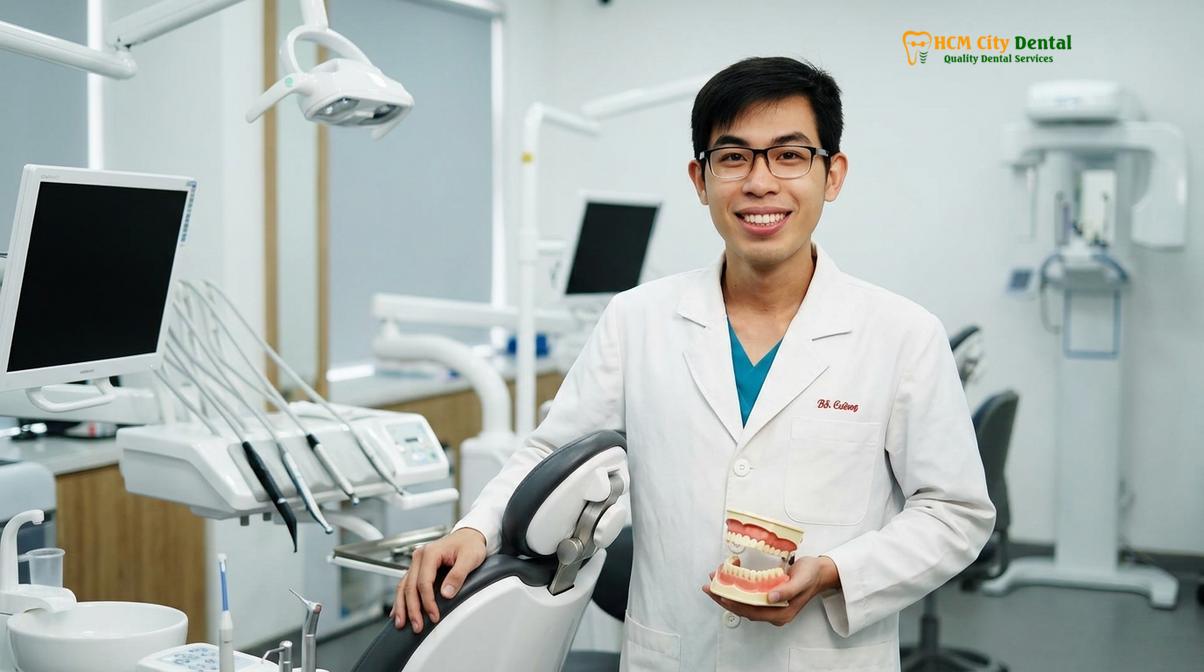
If you are experiencing any of these symptoms, or if you have been told you need a large filling and want a second opinion on conservative options, reaching out to a specialized center like HCMC Dental Clinic in Ho Chi Minh City can provide you with a comprehensive digital assessment and a personalized treatment plan tailored to preserve your natural smile.
Frequently Asked Questions
How do I know if I need an inlay or a filling?
The choice depends entirely on the tooth decay size and remaining structural integrity. If the cavity is small and confined to the center of the tooth, a direct filling is sufficient. However, if the decay compromises more than half of the tooth’s width or weakens the cusps, an inlay or onlay is clinically required to prevent future fractures. A dentist will use X-rays and 3D scans to measure the exact dimensions of the defect before making a recommendation.
Does a direct filling weaken the tooth?
A direct filling itself does not weaken the tooth, but placing a massive filling in a severely decayed tooth fails to provide necessary structural support. Large composite restorations can act as a wedge under heavy biting forces, potentially causing the remaining thin enamel walls to flex and crack over time. Therefore, the weakness comes from the extensive loss of natural tooth structure, which a simple filling cannot adequately reinforce.
Are inlays more expensive than fillings?
Yes, inlays require a higher initial investment because they are custom-milled in a dental laboratory using premium ceramics. However, their superior durability, resistance to wear, and ability to prevent costly future root canals or full crowns make them a highly cost-effective long-term investment for your oral health. When factoring in the lifespan of 15+ years for an inlay versus 5 years for a large filling, the indirect restoration offers far greater value.
How many appointments are needed for an inlay?
Traditionally, an inlay requires two appointments: one for preparation and scanning, and a second for permanent cementation. However, clinics equipped with advanced CAD/CAM milling technology can sometimes fabricate and place the custom ceramic restoration in a single extended visit, depending on the complexity of the case. During the interim period of a two-visit procedure, a temporary restoration is placed to protect the tooth.
Is the inlay or onlay procedure painful?
The procedure is highly comfortable and virtually pain-free, as it is performed under local anesthesia. Furthermore, modern digital dentistry utilizes intraoral scanners like the iTero or Medit i700, completely eliminating the need for uncomfortable, gag-inducing traditional silicone impression materials during the diagnostic phase. Post-operative sensitivity is also minimized due to the exact marginal seal achieved by the lab-milled ceramic.
References
- Journal of Esthetic and Restorative Dentistry. Biomechanical behavior of teeth restored with direct and indirect restorations. (2021).
- International Journal of Prosthodontics. Clinical evaluation of CAD/CAM ceramic inlays and onlays. (2020).
- Journal of Dentistry. Polymerization shrinkage stress in composite resins. (2019).
- American Dental Association. Guidelines on conservative cavity preparation and material selection. (2022).
- Journal of Prosthetic Dentistry. Long-term survival rates of lithium disilicate and zirconia partial crowns. (2023).