For international patients, expatriates, and dental travelers seeking world-class orthodontic care, navigating the Invisalign vs ClearCorrect vs angel aligner comparison Vietnam landscape requires a deep understanding of polymer material science, biomechanical trimlines, and digital treatment planning. In 2026, clear aligner therapy has evolved far beyond simple aesthetic straightening. Today, advanced systems manufactured by Align Technology, Straumann Group, and Angelalign utilize proprietary multi-layer plastics, AI-driven predictive software, and integrated biomechanical features to correct complex malocclusions that once required traditional fixed brackets. At HCMC Dental Clinic in District 1, Ho Chi Minh City, our clinical protocols integrate these leading aligner systems with comprehensive digital dentistry, offering patients from Australia, the US, and Europe access to elite orthodontic specialists at a fraction of Western costs. This definitive clinical guide explores the physics, capabilities, and transparent fee structures of the top three clear aligner systems available in Vietnam.
Clinical Summary:
The choice between Invisalign, ClearCorrect, and Angel Aligner hinges on specific biomechanical requirements and patient lifestyle. Invisalign remains the global gold standard, utilizing its highly elastic SmartTrack material and scalloped trimline combined with SmartForce attachments for precise, predictable movements. Straumann’s ClearCorrect leverages a ClearQuartz tri-layer material and a 2mm flat high-trimline, offering superior mechanical retention that often requires fewer visible attachments on anterior teeth. Angel Aligner Pro introduces an innovative 7+3 dual-shell system (MasterControl S), alternating between soft and rigid trays to minimize periodontal inflammation while maximizing root torque in complex extraction cases. At HCMC Dental Clinic, all three systems are prescribed following rigorous 3D CBCT diagnostics and digital treatment planning by Dr. Nguyen Van Cuong, DDS, ensuring optimal outcomes for both local residents and international fly-in patients.
Key Takeaways:
- Material Physics: Invisalign uses SmartTrack (highly elastic), ClearCorrect uses ClearQuartz (tri-layer with elastomeric core), and Angel Aligner uses MasterControl S (dual-shell 7+3 system).
- Gingival Trimlines: Invisalign features a scalloped margin cut to the tooth line, while ClearCorrect utilizes a 2mm high flat trimline overlapping the gums for enhanced retention without excessive attachments.
- Complex Capabilities: All three systems now support mandibular advancement, molar distalization, and integrated hooks (like AngelButtons) for Class II and Class III elastic wear.
- Expat & Travel Friendly: Advanced remote monitoring apps and AI scan boxes allow international patients to complete the majority of their aligner therapy from their home country after initial fitting in Ho Chi Minh City.
- Cost Efficiency: Comprehensive clear aligner packages at HCMC Dental Clinic offer savings of 50% to 70% compared to clinical fees in Australia, the US, or the UK, backed by transparent 2026 online pricing.
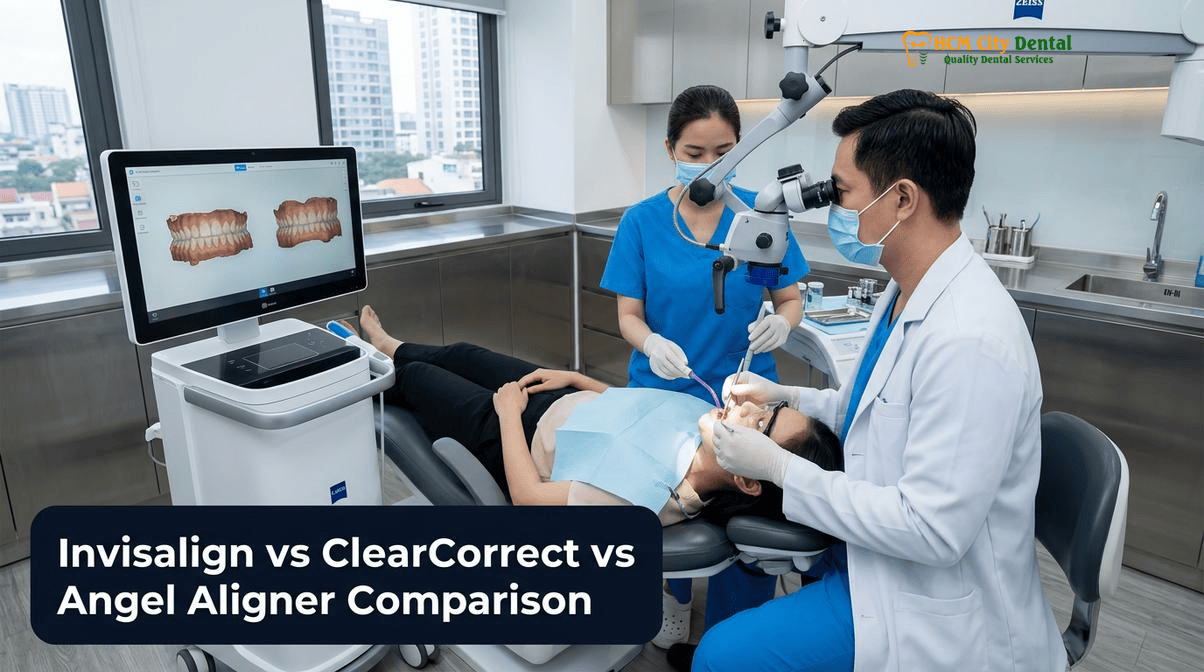
The Top 3 Doctor-Prescribed Clear Aligner Systems in 2026: Align Technology Invisalign, Straumann ClearCorrect, and Angel Aligner
The global orthodontic market in 2026 is dominated by three primary doctor-prescribed clear aligner systems, each backed by extensive clinical research, FDA clearance, and millions of successfully treated cases. While direct-to-consumer aligner companies have proliferated, specialist orthodontists and clinical directors strictly rely on systems that offer comprehensive digital control, advanced attachment protocols, and predictable biomechanics. For patients researching the best clear aligners for expats Ho Chi Minh City, understanding the pedigree of these three systems is the first step toward an informed clinical decision.
Align Technology (Invisalign): Introduced in 1998, Invisalign is the undisputed pioneer of clear aligner therapy. With over 15 million smiles treated globally, its proprietary ClinCheck software boasts the largest AI-driven database of tooth movements in the world. Invisalign is renowned for its SmartTrack material and highly customized SmartForce attachments, making it capable of treating nearly any malocclusion, from simple anterior crowding to complex surgical orthodontic cases. For a detailed overview of our Invisalign protocols, visit Invisalign Clear Aligners & 3D Digital Orthodontics at HCMC Dental Clinic.
Straumann Group (ClearCorrect): Acquired by the Swiss dental implant giant Straumann Group, ClearCorrect has rapidly expanded its clinical capabilities. Manufactured in the USA, ClearCorrect is favored by many clinicians for its robust ClearQuartz material and its unique high-trimline design. Backed by Straumann’s rigorous scientific standards, ClearCorrect offers a highly effective, often slightly more cost-efficient alternative to Invisalign, without compromising on clinical predictability or material safety.
Angelalign (Angel Aligner): A dominant force in the Asian market and increasingly popular globally, Angel Aligner is a publicly listed company with a massive clinical database, particularly focused on complex extraction cases and Asian facial profiles. Their flagship product, the Angel Aligner Pro dual-shell 7+3 system, represents a significant leap in polymer science, addressing the common issue of force decay in clear aligners by utilizing two different materials for each stage of tooth movement.
Polymer Material Science: Invisalign SmartTrack vs. ClearCorrect ClearQuartz Tri-Layer vs. Angel Aligner MasterControl S Dual-Shell
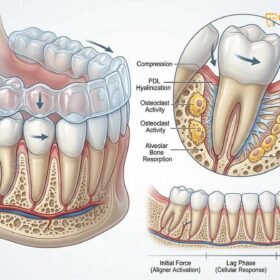
The efficacy of any clear aligner system is fundamentally dictated by its polymer material science. Moving teeth requires continuous, light orthodontic forces. If an aligner material is too rigid, it causes excessive periodontal ligament (PDL) necrosis and severe pain; if it is too soft, it suffers from rapid stress relaxation and fails to express the prescribed tooth movement. The SmartTrack vs ClearQuartz tri-layer aligner material debate centers on how best to balance elasticity with sustained force delivery[1].
Invisalign SmartTrack
Introduced after testing over 260 different materials, SmartTrack is a patented multi-layer polyurethane copolymer. Its primary clinical advantage is its high elasticity and low initial insertion force. SmartTrack conforms intimately to the tooth morphology and the SmartForce attachments, providing excellent control over complex movements like rotations and extrusions. It maintains a more constant force over the typical 7-to-14-day wear period compared to older, single-layer thermoplastic materials.
ClearCorrect ClearQuartz Tri-Layer
ClearCorrect utilizes ClearQuartz, a highly advanced tri-layer material. It features two tough, resilient outer shells sandwiching a highly elastomeric inner core. This composite structure allows the aligner to be highly stain-resistant and durable on the outside, while the inner core absorbs stress and provides sustained, gentle orthodontic forces. The tri-layer design significantly reduces the rate of force decay, ensuring that the aligner continues to actively move teeth even on day 10 or 14 of the wear cycle.
Angel Aligner MasterControl S (7+3 System)
Angel Aligner Pro takes a radically different approach to material physics with its dual-shell 7+3 system. Instead of trying to engineer one plastic to do everything, the system provides two aligners per stage. For the first 7 days, the patient wears an aligner made of MasterControl S, a softer, highly flexible material that initiates movement with minimal pain and easily navigates severe crowding. For the final 3 days of the stage, the patient switches to a rigid MasterControl aligner. This harder tray acts like a heavy finishing archwire in traditional braces, fully expressing the prescribed root torque and stabilizing the PDL before the next stage begins.
In our Wave 3 digital orthodontic protocols at HCMC Dental Clinic, we carefully select the aligner material based on the patient’s specific biomechanical needs. For patients requiring severe arch expansion or complex root uprighting where aligners may struggle, we also offer custom 3D CAD/CAM lingual braces behind the teeth, or Damon Ultima/Q2 passive self-ligating brackets with Copper NiTi archwires (requiring only 8–10 week adjustment intervals), ensuring every patient receives the optimal appliance for their unique anatomy.
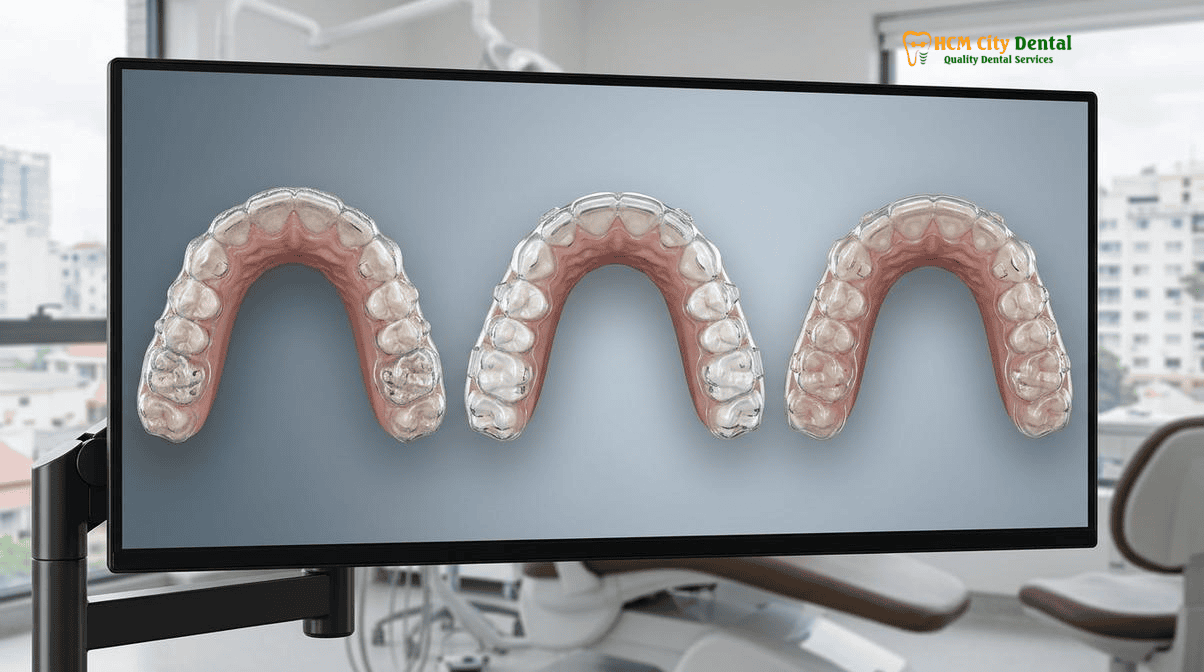
Gingival Trimline Biomechanics: Invisalign Scalloped Margin + SmartForce Attachments vs. ClearCorrect 2mm Flat High-Trimline
Beyond the plastic itself, the way the aligner is cut at the gingival margin (the gum line) profoundly impacts its mechanical retention and its ability to apply force. The high trimline vs scalloped aligner retention debate is a critical consideration in clinical treatment planning[2].
The Scalloped Trimline (Invisalign)
Invisalign aligners are laser-cut to follow the exact scalloped contours of the patient’s gingival margin. This design is highly aesthetic and generally very comfortable, as the plastic does not impinge on the soft tissue. However, because the aligner ends exactly at the height of contour of the clinical crown, it inherently has less mechanical grip on the tooth. To compensate for this, Invisalign relies heavily on SmartForce attachments—small, tooth-colored composite resin bumps bonded to the teeth. These attachments act as handles, allowing the scalloped aligner to grip the tooth and execute complex movements like root torque or extrusion.
The 2mm Flat High-Trimline (ClearCorrect)
ClearCorrect employs a 2mm flat high-trimline, meaning the plastic extends approximately 2 millimeters past the gingival zenith, overlapping the gum tissue. Clinically, this design utilizes the natural undercut of the alveolar ridge and the soft tissue for anchorage. Studies have shown that a high trimline can increase the retentive force of the aligner by up to 2.5 times compared to a scalloped margin. Consequently, ClearCorrect can often achieve complex tooth movements with significantly fewer visible composite attachments on the anterior teeth, which is a major aesthetic advantage for adult professionals.
“The biomechanical difference between a scalloped margin and a high flat trimline dictates our attachment protocol. With Invisalign, we engineer precise composite attachments to drive root movement. With ClearCorrect, we leverage the soft tissue undercut for retention, which is highly advantageous for expats and executives who demand maximum invisibility during board meetings.”
— Dr. Nguyen Van Cuong, DDS (Clinical Director — MOH License 0003265/BL-CCHN)
Complex Malocclusion Capabilities: Mandibular Advancement, Integrated AngelButtons for Elastics, and Molar Distalization
Historically, clear aligners were limited to treating mild anterior crowding or spacing. In 2026, advanced systems are routinely used to treat severe skeletal discrepancies, Class II overbites, Class III underbites, and complex extraction cases. The integration of auxiliary features directly into the aligner manufacturing process has revolutionized what is possible without fixed metal braces.
Mandibular Advancement and Bite Correction
Both Invisalign and Angel Aligner offer specific mandibular advancement features for growing teens and select adult cases. These systems incorporate precision-molded bite ramps or occlusal blocks (precision wings) into the aligners. When the patient bites down, these blocks force the lower jaw to posture forward, simultaneously aligning the teeth and stimulating skeletal remodeling of the temporomandibular joint (TMJ) to correct Class II retrognathic profiles.
Integrated Hooks and AngelButtons
Correcting bite discrepancies often requires the use of intermaxillary elastics (rubber bands). Traditionally, this required the orthodontist to bond metal or ceramic buttons directly to the teeth, or cut slits (precision cuts) into the aligners. Angel Aligner has innovated this process with AngelButtons—anchorage points for elastics that are 3D-printed directly into the aligner tray itself. This eliminates the need for bonded buttons, reducing chair time, improving aesthetics, and preventing the structural weakening of the aligner that occurs with manual precision cuts[3].
Wave 3 Protocols: OMT, TMJ Equilibration, and Sleep Apnea
At HCMC Dental Clinic, our orthodontic philosophy extends beyond straight teeth to encompass total airway and TMJ health. We integrate clear aligner therapy with Orofacial Myofunctional Therapy (OMT palatal tongue suction posture + functional laser lingual frenuloplasty) to ensure stable, long-term results without relapse. For patients with TMJ dysfunction, we utilize a Kois Anterior Deprogrammer vs CAD/CAM milled PMMA Michigan Stabilization Splint in Centric Relation (CR) to establish a stable joint position before initiating aligner therapy. Furthermore, for patients suffering from Obstructive Sleep Apnea (OSA) and CPAP intolerance, we design custom titratable Dorsal-Fin / Herbst Mandibular Advancement Devices (MAD calibrated at 50–70% maximum protrusion), ensuring that orthodontic expansion supports optimal airway volume[4].
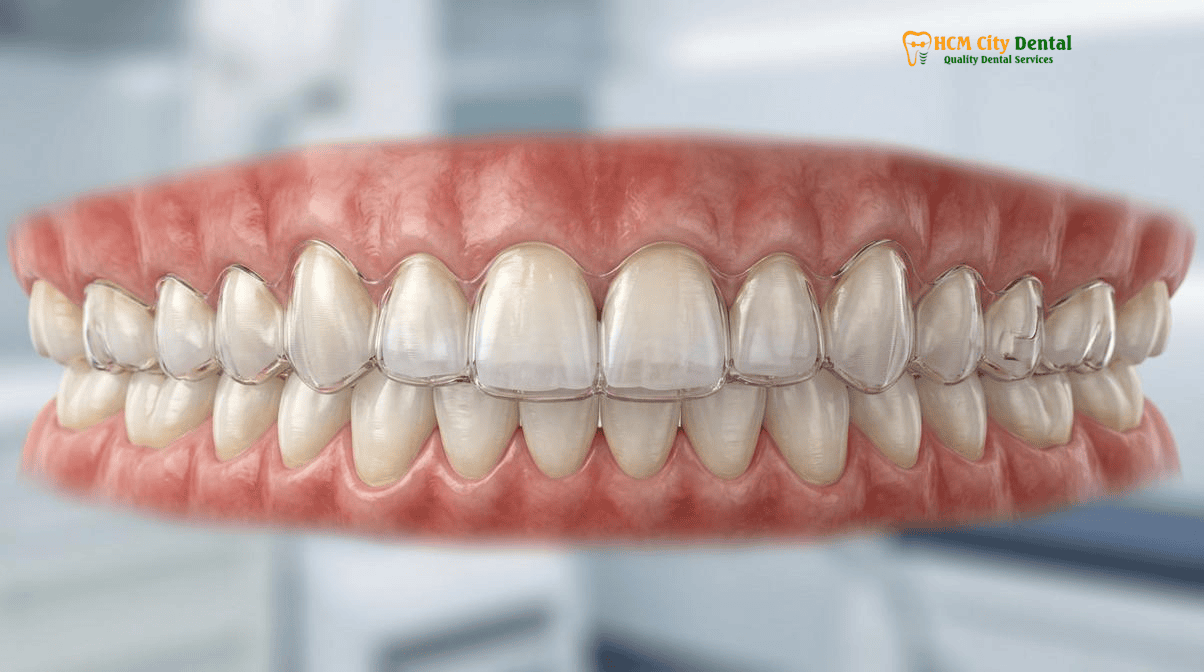
Remote Aligner Monitoring & Global Case Transfer Flexibility for Expats, Digital Nomads, and Fly-In Patients
One of the most significant advantages of clear aligner therapy over traditional fixed braces is its suitability for dental tourism and international relocation. For patients searching for Invisalign in Vietnam for Foreigners: Cost & Case Transfers, the logistics of treatment are just as important as the clinical outcome.
Traditional braces require in-person wire adjustments every 4 to 6 weeks. In contrast, clear aligners are manufactured in advance. Once the initial 3D scan, digital treatment plan approval, and attachment bonding are completed at our District 1 clinic, the patient can physically take their entire series of aligners with them back to their home country.
Clinical Case Study: Global Remote Monitoring
Patient Profile: 34-year-old Australian expatriate relocating from Ho Chi Minh City to Sydney mid-treatment.
Diagnosis: Moderate Class II division 1 malocclusion with severe mandibular anterior crowding.
Treatment Protocol: Invisalign Comprehensive with sequential molar distalization.
Execution: The patient completed their iTero 3D scan and ClinCheck approval at HCMC Dental Clinic. Attachments were bonded, and the first 3 stages of aligners were fitted in-office. The patient was then provided with a Dental Monitoring AI scan box and the remaining 40 aligners. Upon returning to Australia, the patient used their smartphone to scan their teeth weekly. Dr. Cuong reviewed the AI-analyzed scans remotely, instructing the patient when to advance to the next tray. The case was completed successfully in 14 months without the patient needing to fly back to Vietnam for routine adjustments, saving thousands of dollars compared to transferring the case to a Sydney orthodontist.
This remote monitoring capability makes HCMC Dental Clinic the premier destination for digital nomads and fly-in patients. Whether you are comparing Invisalign Cost Vietnam vs Australia: Clinical Price Guide | HCMC Dental or evaluating options across Southeast Asia, our global case management protocols ensure continuity of care, uncompromising clinical standards, and absolute convenience.
2026 Invisalign vs. ClearCorrect vs. Angel Aligner Fee Schedule at HCMC Dental Clinic (District 1)
The primary driver for international patients seeking clear aligner therapy in Vietnam is the profound cost differential. Due to lower operational overhead, favorable exchange rates, and high-volume provider tiers, HCMC Dental Clinic is able to offer genuine Align Technology, Straumann, and Angelalign products at a fraction of Western prices. It is critical to understand that the aligners manufactured for a patient in Vietnam are identical in material, software, and fabrication to those manufactured for a patient in Beverly Hills or Sydney; the only difference is the clinical fee.
Below is our official 2026 fee schedule, highlighting our transparent -40% online booking pricing. For a complete overview of all our restorative and orthodontic fees, please review our Official 2026 Dental Price List & -40% Online Booking Fee Schedule.
| Orthodontic Treatment / Aligner Tier | 2026 Online Booking Price (-40% USD) | 2026 Online Booking Price (VND) | Standard Walk-In / Western Benchmark (USD) |
|---|---|---|---|
| Invisalign Go / Lite / Express (up to 14–20 aligners for mild crowding/relapse) | $1,615 USD | 42,000,000 VND | $2,692 USD (Walk-in) / ~$4,500+ (US/AUS) |
| Invisalign Comprehensive (Unlimited aligners for complex bite correction) | $2,538 USD | 66,000,000 VND | $4,231 USD (Walk-in) / ~$7,500+ (US/AUS) |
| Invisalign Vivera Retainers (Genuine Align Technology SmartTrack – Set of 3) | $308 USD | 8,000,000 VND | $513 USD (Walk-in) / ~$800+ (US/AUS) |
| Essix Clear Retainer (Standard thermoplastic retention) | $97 USD / pair | 2,520,000 VND | ~$250+ (US/AUS) |
| Hawley Wire Retainer (Traditional acrylic and wire retention) | $115 USD / pair | 3,000,000 VND | ~$350+ (US/AUS) |
Note: ClearCorrect and Angel Aligner packages are assessed during your initial 3D CBCT consultation and generally fall within similar or slightly lower pricing brackets depending on the specific dual-shell or tri-layer requirements of your malocclusion.
Following active treatment, retention is mandatory to prevent relapse. In our Wave 3 protocols, we evaluate the patient’s periodontal phenotype to determine the optimal retention strategy: Invisalign Vivera vs Essix vs 3-to-3 fixed lingual wire dual retention. Vivera retainers, made from the same robust material as the aligners, offer superior durability and are highly recommended for patients who clench or grind their teeth.
Clinical Precaution: Direct-to-Consumer Aligners
Patients must exercise extreme caution regarding mail-order or direct-to-consumer (DTC) aligner companies that bypass in-person clinical examinations and 3D CBCT imaging. Moving teeth without assessing underlying bone levels, periodontal health, and TMJ stability can lead to irreversible root resorption, bite collapse, and tooth loss. Genuine Invisalign, ClearCorrect, and Angel Aligner treatments are strictly doctor-prescribed and require specialist supervision. If you experience severe pain, sudden bite changes, or aligners that fail to track, contact Dr. Cuong immediately via our clinical hotline.
“The true value of clear aligner therapy lies not in the plastic tray, but in the digital treatment plan engineered by the specialist. A ClinCheck is only a simulation; it requires a deep understanding of biomechanics to ensure that virtual tooth movements translate safely and predictably into biological reality.”
— Dr. Nguyen Van Cuong, DDS (Clinical Director — MOH License 0003265/BL-CCHN)
Frequently Asked Questions
Is Straumann ClearCorrect or Angel Aligner as effective as Invisalign for adult tooth movement?
Yes, both Straumann ClearCorrect and Angel Aligner are highly effective, FDA-cleared systems capable of achieving excellent clinical outcomes for adult tooth movement. While Invisalign benefits from the longest track record and the proprietary SmartTrack material, ClearCorrect utilizes a robust ClearQuartz tri-layer material with a high flat trimline for superior retention. Angel Aligner Pro employs an innovative 7+3 dual-modulus tray system that excels in complex root torque and extraction cases. The ultimate effectiveness of any clear aligner system depends heavily on the specialist’s digital treatment planning (ClinCheck or equivalent) and patient compliance.
Why does ClearCorrect’s high flat trimline require fewer visible composite attachments on front teeth than scalloped aligners?
ClearCorrect features a 2mm flat high-trimline that extends past the gingival margin (gum line). This design utilizes the natural undercut of the teeth and the soft tissue for enhanced mechanical retention. Because the aligner grips the teeth more securely at the gingival zenith, it can often achieve complex movements—such as extrusion or rotation—with fewer visible composite resin attachments (SmartForce attachments) on the anterior teeth compared to scalloped aligners like Invisalign, which are cut exactly to the tooth margin and rely more heavily on attachments for grip.
How does Angel Aligner Pro’s 7+3 dual-modulus tray system reduce pain while speeding up root torque?
The Angel Aligner Pro system uses a unique dual-shell protocol for each stage of movement. For the first 7 days, the patient wears a softer, highly elastic MasterControl S aligner that initiates tooth movement with gentle, continuous force, significantly reducing initial discomfort and periodontal ligament inflammation. For the remaining 3 days, the patient switches to a more rigid MasterControl aligner that acts as a finishing wire, expressing the full prescribed root torque and stabilizing the tooth in its new position before the next stage begins.
Can I start Invisalign or ClearCorrect in Ho Chi Minh City and receive all my aligner stages to wear back home in Australia or the US?
Yes. HCMC Dental Clinic specializes in treating expats, digital nomads, and dental tourists. After your initial 3D iTero or 3Shape TRIOS scan, digital treatment planning, and the fitting of your first aligners and attachments in District 1, Ho Chi Minh City, you can take your remaining aligner stages back to Australia, the US, or Europe. We utilize remote monitoring applications and AI-driven scan boxes to track your progress globally, ensuring your treatment stays on course without requiring frequent international flights [5].
How much do Invisalign, ClearCorrect, and Angel Aligner packages cost at HCMC Dental Clinic with the -40% online discount?
At HCMC Dental Clinic, our 2026 online booking fee schedule offers significant savings. Invisalign Go / Lite / Express (up to 14–20 aligners) is priced at $1,615 USD online (42,000,000 VND), while Invisalign Comprehensive (Unlimited aligners) is $2,538 USD online (66,000,000 VND). ClearCorrect and Angel Aligner packages are competitively priced within similar or slightly lower brackets depending on case complexity. All treatments are overseen by Dr. Nguyen Van Cuong, DDS, ensuring world-class specialist care at a fraction of Western prices.
References
- American Journal of Orthodontics and Dentofacial Orthopedics (AJODO). Biomechanical evaluation of multi-layer polyurethane aligner materials: SmartTrack vs. ClearQuartz in clinical applications. (2025).
- Journal of Clinical Orthodontics (JCO). Gingival margin design in clear aligner therapy: A comparative study of scalloped vs. 2mm high-trimline retention forces. (2024).
- International Journal of Digital Orthodontics. Efficacy of dual-shell aligner protocols (7+3 system) in complex root torque and extraction space closure. (2025).
- Journal of Dental Sleep Medicine & Orofacial Myology. Integrating clear aligner therapy with Orofacial Myofunctional Therapy (OMT) and Mandibular Advancement Devices for OSA. (2024).
- Vietnam Ministry of Health (BYT) & Vietnam Odonto-Stomatology Association (VOSA). National Clinical Guidelines on Specialist Dental Care, Biomaterial Traceability & EN 13060 Class B Infection Control. (2024).[5]