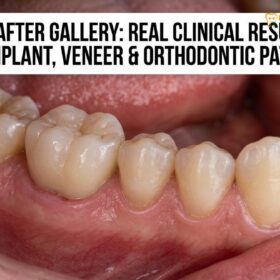
For many adult patients, achieving a perfectly straight smile through orthodontics or recovering from periodontal disease comes with an unexpected and frustrating aesthetic compromise: the appearance of dark, triangular spaces between the teeth near the gumline. Clinically known as open gingival embrasures, these “black triangles” not only age a smile prematurely but also act as notorious food traps that harbor plaque biofilm, increase the risk of localized gingivitis, and complicate daily oral hygiene. When evaluating the optimal black triangles between teeth treatment, patients are often faced with a critical decision regarding biomimetic restoration: should they choose conservative composite resin bonding or invest in permanent ceramic restorations?
The debate surrounding black triangles between teeth (Bioclear vs. porcelain veneers) is one of the most frequent discussions in modern cosmetic dentistry. Historically, dentists attempted to close these gaps using freehand composite bonding, a technique fraught with high failure rates, marginal staining, and the creation of subgingival overhangs that snagged dental floss and irritated the gums. Today, advanced clinical protocols offer two highly predictable, biologically sound solutions. The first is the Bioclear matrix system, a minimally invasive, heated injection-molding technique that requires zero enamel removal. The second is the application of ultra-thin, no-prep or minimal-prep IPS E.max lithium disilicate porcelain veneers, which provide unparalleled longevity, structural reinforcement, and permanent stain resistance.
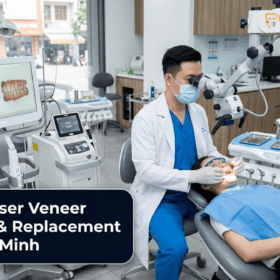
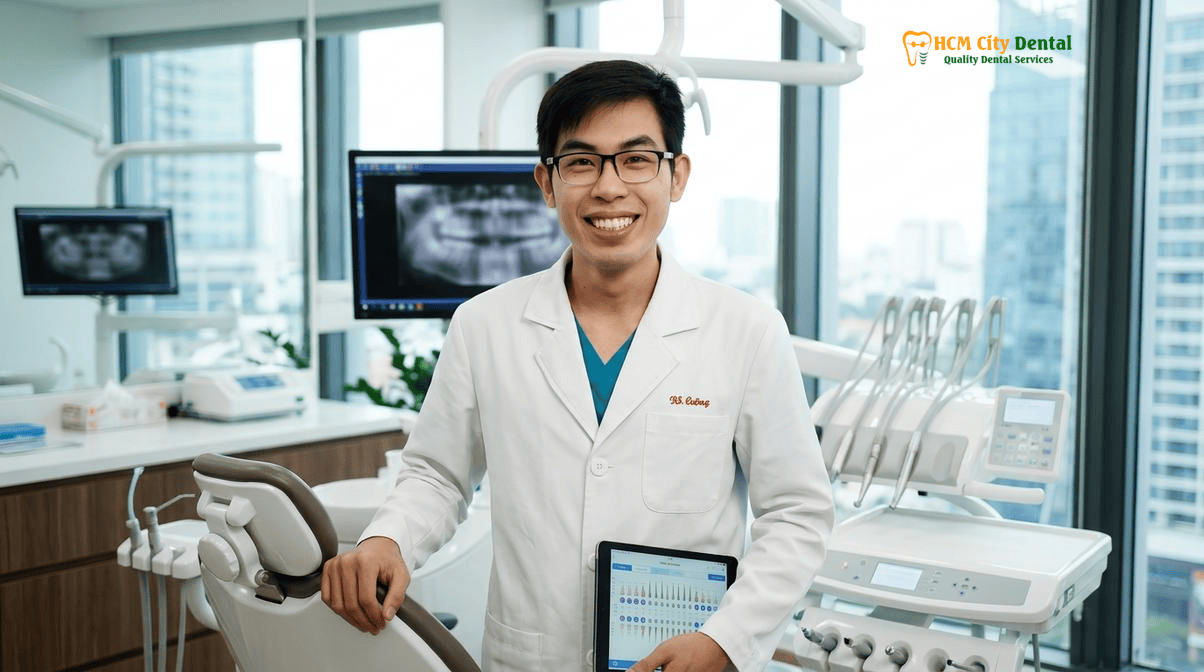
At HCMC Dental Clinic, located in District 1, Ho Chi Minh City, our clinical team, led by Dr. Nguyen Van Cuong, DDS (Clinical Director — MOH License 0003265/BL-CCHN), specializes in advanced micro-prosthodontics and biomimetic gap closure. Whether you are an expatriate living in Thao Dien or a dental traveler flying into Tan Son Nhat International Airport (SGN) seeking world-class aesthetic rehabilitation, understanding the biomechanics of papilla regeneration and the specific indications for each restorative material is paramount. This comprehensive clinical guide explores the etiology of open gingival embrasures, the application of Dr. Dennis Tarnow’s 5mm rule, and a detailed 2026 comparative analysis of Bioclear injection molding versus porcelain veneers.
Clinical Summary:
Closing black triangles between teeth requires precise management of the interproximal contact point and the subgingival emergence profile to support the interdental papilla. The Bioclear method utilizes heated, flowable composite injected into anatomically pre-curved clear matrices to seamlessly wrap the tooth root without shaving healthy enamel, typically completed in a single visit. Conversely, ultra-thin 0.3mm IPS E.max porcelain veneers offer a permanent, highly stain-resistant solution that can simultaneously correct severe discoloration, structural wear, and malocclusion. At HCMC Dental Clinic, Dr. Nguyen Van Cuong, DDS, employs strict biomimetic protocols to ensure that both treatments eliminate food traps, restore youthful dental aesthetics, and maintain optimal periodontal health, all supported by a transparent 2026 online fee schedule.
Key Takeaways:
- Etiology of Embrasures: Black triangles frequently emerge following adult orthodontics (such as Invisalign), periodontal bone loss, or natural age-related gingival recession.
- The Tarnow 5mm Rule: Predictable papilla regeneration occurs when the distance from the base of the restorative contact point to the crestal bone is 5mm or less.
- Bioclear Injection Molding: A 1-visit, zero-prep procedure using heated composite resin that costs between $69 and $115 USD per tooth online at HCMC Dental Clinic.
- IPS E.max Porcelain Veneers: A permanent, stain-resistant ceramic solution ideal for comprehensive smile makeovers, priced at $185 USD per tooth online.
- Severe Recession Solutions: Cases involving massive bone loss may require a multidisciplinary approach combining pink gingival ceramics, connective tissue grafting, and Interproximal Reduction (IPR).
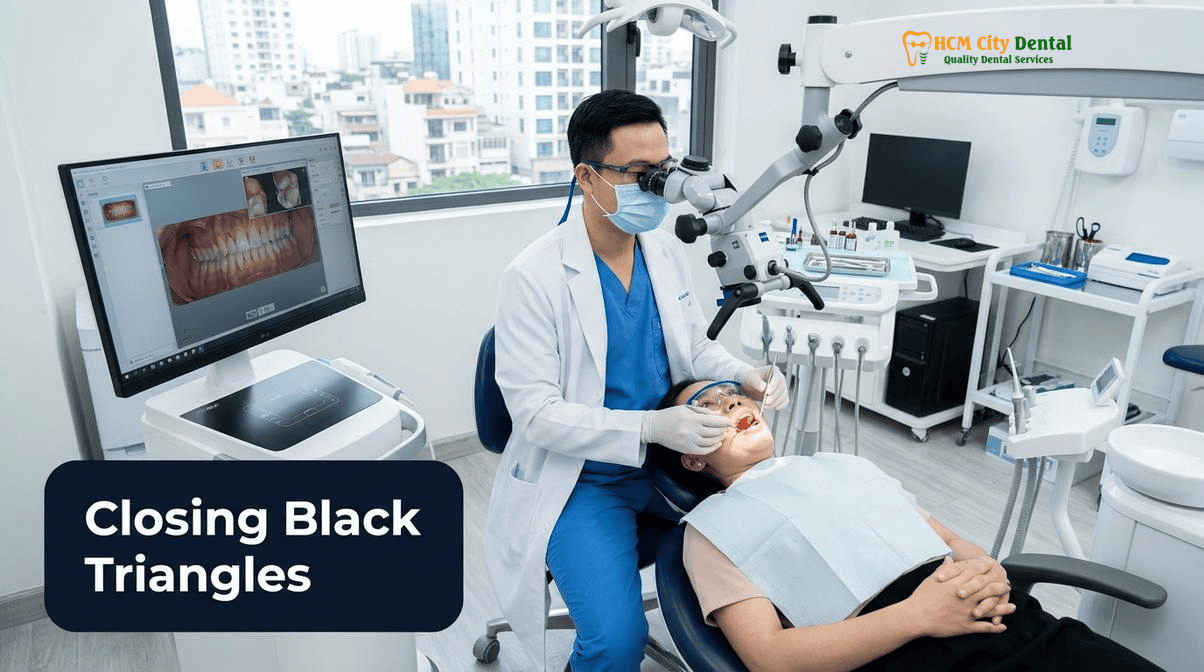
Why Do Black Triangles (Open Gingival Embrasures) Appear After Adult Braces, Invisalign, or Periodontal Treatment?
To effectively treat black triangles, one must first understand the underlying anatomical and physiological factors that cause them. The interdental papilla is the dense, triangular peak of gingival tissue that fills the space between two adjacent teeth. In a healthy, youthful smile, this tissue completely occupies the gingival embrasure, preventing food impaction and creating a seamless pink-to-white aesthetic transition. However, the papilla is highly sensitive to changes in the underlying alveolar bone and the spatial relationship of the adjacent tooth roots.
One of the most common clinical scenarios we encounter at HCMC Dental Clinic is the development of open gingival embrasures after Invisalign braces or traditional adult orthodontics. When teeth are crowded or overlapped, the roots are positioned very close together, and the interproximal bone is often thin or blunted. As orthodontic forces align and uncrowd the teeth, the roots diverge slightly, increasing the volume of the interdental space. Because the underlying crestal bone does not spontaneously regenerate to fill this newly expanded space, the gingival tissue recedes, leaving a dark, empty void.
Furthermore, the natural morphology of the teeth plays a significant role. Teeth that are highly triangular or bell-shaped—narrow at the cervical root and wide at the incisal edge—naturally create larger embrasure spaces. When these teeth are aligned, the contact point is located very high near the biting edge, leaving a massive gap below. Periodontal disease is another primary culprit. Chronic periodontitis destroys the crestal alveolar bone. Because the interdental papilla relies entirely on the underlying bone for its blood supply and structural support, bone loss inevitably leads to papilla blunting and the formation of black triangles, regardless of whether the teeth are perfectly straight.
Dr. Dennis Tarnow’s 5mm Contact-to-Crest Bone Rule: How Lowering the Interproximal Contact Point Regenerates the Papilla
The foundation of predictable black triangle closure lies in a landmark periodontal principle known as the Tarnow 5mm rule. In 1992, Dr. Dennis Tarnow and his colleagues published a seminal study demonstrating the direct correlation between the height of the interproximal bone and the presence of the interdental papilla. This principle dictates that when the distance from the base of the interproximal contact point (where the two teeth touch) to the crest of the underlying alveolar bone is 5 millimeters or less, the papilla will fill the space almost 100% of the time[1].
If this distance increases to 6mm, the probability of complete papilla fill drops to 56%. At 7mm or greater, the papilla will fill the space less than 27% of the time. This biological absolute governs every restorative decision made by Dr. Nguyen Van Cuong, DDS, when addressing the Tarnow 5mm rule for interdental papilla loss. To eliminate a black triangle, the clinical objective is not simply to “fill the hole” with material, but to strategically lower the interproximal contact point apically (toward the gums) until it is within 5mm of the crestal bone.
By adding restorative material—whether composite resin or porcelain—to the mesial and distal surfaces of the teeth, the dentist lengthens the contact area and physically squeezes the existing gingival tissue. This gentle lateral pressure displaces the papilla incisally, forcing it to creep upward and completely obliterate the dark space. This biomimetic approach ensures that the resulting restoration is self-cleansing, biologically compatible, and aesthetically flawless, avoiding the disastrous consequences of bulky, over-contoured restorations that violate the biological width.
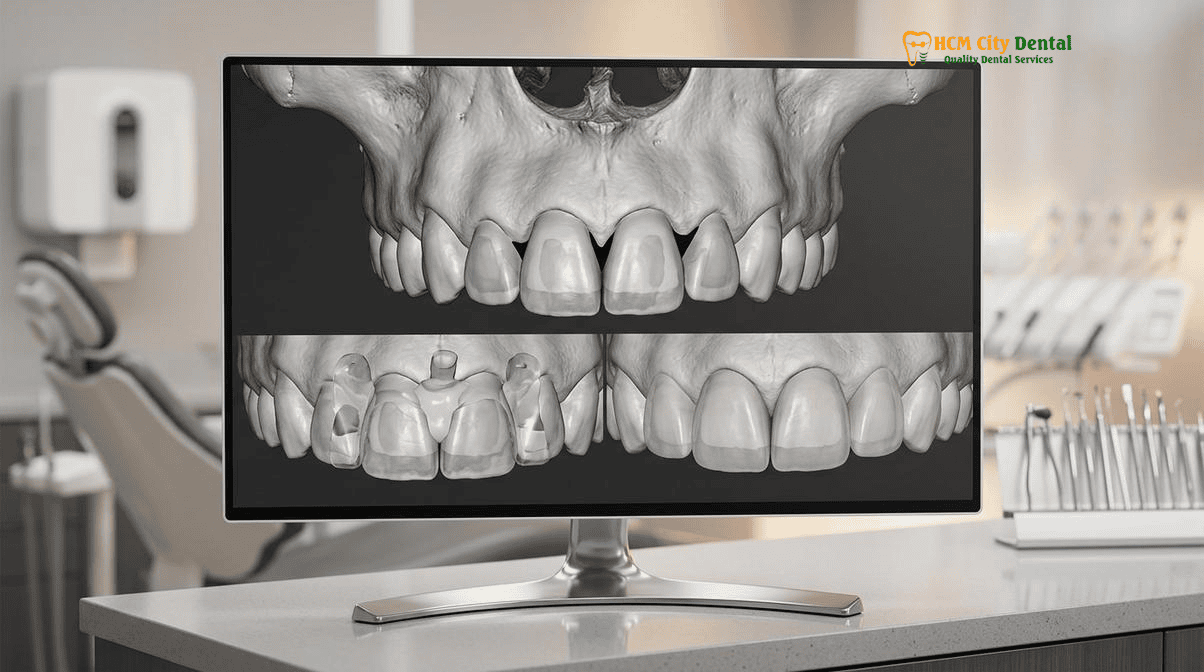
Option 1: Heated Injection-Molded Composite (Bioclear-Style Anatomic Matrix Protocol) — Zero Enamel Shaving in 1 Visit
For patients seeking a highly conservative, minimally invasive solution, the Bioclear injection-molding technique represents a paradigm shift in restorative dentistry. Traditional freehand dental bonding relies on cold, paste-like composite resin that is manually sculpted onto the tooth. This outdated method frequently results in microscopic voids, weak structural integrity, and flat emergence profiles that create ledges at the gumline. These ledges trap plaque, shred dental floss, and lead to chronic gingival inflammation.
The Bioclear method, developed by Dr. David Clark, eliminates these flaws by utilizing anatomically pre-curved, clear Mylar matrices that slide subgingivally to wrap the entire tooth root[2]. The procedure begins with rigorous biofilm removal. At HCMC Dental Clinic, we utilize the Swiss EMS AirFlow system with Erythritol powder ($58 USD online) to completely eradicate the microscopic biofilm layer, ensuring a pristine bonding surface. The teeth are then isolated under a nitrile rubber dam, and the appropriate matrices are selected and seated.
Instead of cold paste, the dentist uses a specialized composite heater to warm the resin to exactly 155°F (68°C). The heated, flowable composite is then injected into the matrix under pressure. The heat dramatically lowers the viscosity of the resin, allowing it to flow seamlessly around the tooth, filling every microscopic crevice without trapping air bubbles. Once light-cured, the result is a monolithic, glass-smooth restoration that perfectly mimics the natural emergence profile of the tooth.
“The true genius of the injection-molding technique is its respect for dental anatomy. By using heated composite and anatomic matrices, we can create a perfectly convex subgingival contour that supports the papilla and eliminates food traps, all without touching a drill to healthy enamel. It is the ultimate expression of conservative biomimetic dentistry.”
— Dr. Nguyen Van Cuong, DDS (Clinical Director, HCMC Dental Clinic)
This procedure is typically completed in a single visit, making it highly attractive for busy expatriates and dental tourists. Furthermore, the black triangle teeth bonding cost in Vietnam is exceptionally competitive. Under our official 2026 fee schedule, heated Bioclear black triangle injection molding is priced at just $69 to $115 USD per tooth online, offering a durable, highly aesthetic result at a fraction of Western prices.
Option 2: Ultra-Thin 0.3mm IPS E.max Porcelain Veneers for Permanent Stain Resistance and Subgingival Emergence Contouring
While injection-molded composite is an excellent conservative option, it has limitations. Composite resin, regardless of how well it is polished, is inherently porous and will eventually absorb stains from coffee, tea, red wine, and tobacco over a period of 5 to 10 years. Furthermore, if the patient has significant structural wear, severe intrinsic discoloration (such as tetracycline staining), or requires broader corrections to their bite and smile architecture, composite alone may not suffice.
In these comprehensive cases, ultra-thin IPS E.max lithium disilicate porcelain veneers are the gold standard for closing black triangles. E.max is a high-strength glass-ceramic that boasts a flexural strength of 500 MPa, making it incredibly durable while maintaining the lifelike translucency of natural enamel. Because porcelain is completely non-porous, it offers permanent stain resistance, ensuring that the smile remains bright and vibrant for 15 to 20 years or more[3].
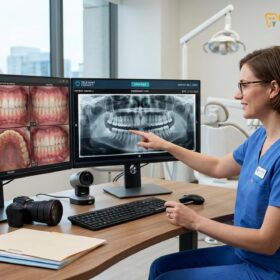
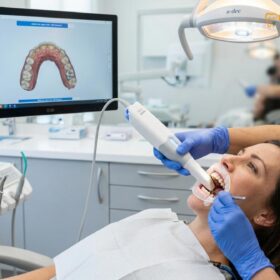
To close open embrasures with veneers, Dr. Nguyen Van Cuong, DDS, utilizes a minimal-prep or no-prep philosophy. By carefully designing the restorations using 3D CAD/CAM technology, the laboratory can fabricate veneers that wrap slightly around the interproximal surfaces, effectively lowering the contact point to satisfy Tarnow’s 5mm rule. The subgingival emergence profile of the porcelain is glazed to a high shine, creating a biologically inert surface that the gingival tissues love. Plaque cannot easily adhere to glazed porcelain, resulting in exceptionally healthy, pink, stippled gums.
For international patients considering Porcelain Veneers & Digital Smile Design in Ho Chi Minh City, the value proposition is immense. At HCMC Dental Clinic, an authentic IPS E.max All-Ceramic Veneer is priced at just $185 USD per tooth online (discounted from the $308 USD walk-in rate). This allows patients to achieve a permanent, Hollywood-caliber smile makeover while preserving maximum natural tooth structure, a stark contrast to the aggressive, full-crown shaving often seen in unregulated dental tourism markets.
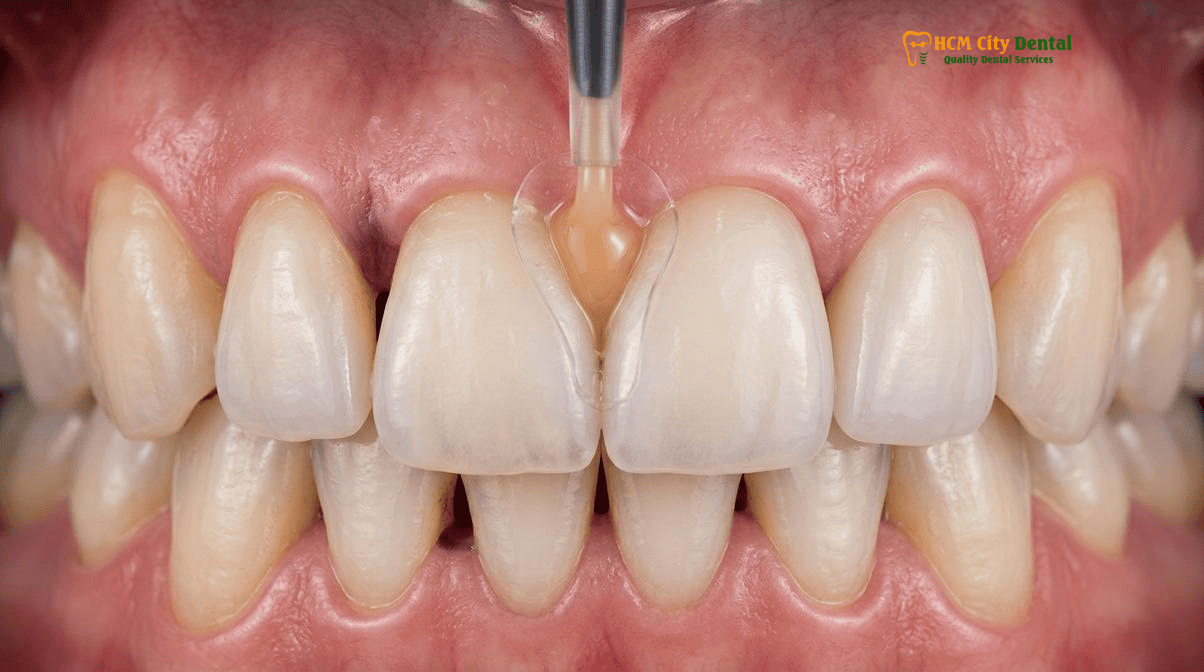
Option 3: Pink Gingival Ceramics, Connective Tissue Pin-Hole Grafting, and Interproximal Reduction (IPR) Combined Therapy
In cases of advanced periodontal disease where the crestal bone loss is severe (greater than 7mm from the contact point), simply adding white restorative material to close the gap is aesthetically disastrous. If a dentist attempts to close a massive black triangle with composite or porcelain alone, the resulting teeth will appear disproportionately wide and unnaturally long—a phenomenon colloquially referred to as “horse teeth” or “Chiclet teeth.”
To manage these complex anatomical defects, a multidisciplinary approach is required. One highly effective technique is Interproximal Reduction (IPR). By carefully polishing away a fraction of a millimeter of enamel from the sides of the teeth, the dentist flattens the contact point. Orthodontic clear aligners (such as Invisalign Comprehensive, available for $2,538 USD online at HCMC Dental Clinic) are then used to push the roots closer together. This physical approximation of the roots compresses the gingival tissue, forcing the papilla upward to fill the void.
When orthodontic movement is not feasible, periodontal plastic surgery may be indicated. Connective tissue grafting, utilizing minimally invasive pin-hole surgical techniques, can be employed to thicken the gingival biotype and encourage coronal migration of the tissue. However, regenerating the interdental papilla surgically is notoriously unpredictable due to the lack of underlying bone support.
Therefore, the most predictable aesthetic solution for massive tissue loss is the use of pink gingival porcelain veneers for severe gum recession protocols. By incorporating custom-shaded pink ceramics at the cervical margin of an IPS E.max veneer or Zirconia bridge, the ceramist can artificially recreate the lost papilla[4]. The transition line between the white tooth porcelain and the pink gingival porcelain is hidden just beneath the patient’s natural lip line. This optical illusion restores ideal tooth proportions (the golden ratio) while completely sealing the embrasure space, preventing food impaction and restoring phonetic clarity.
Clinical Case Study: Comprehensive Gap Closure for an Australian Expat
Patient Profile: A 52-year-old male expatriate living in District 2, HCMC, presented with severe black triangles following a 2-year course of adult clear aligner therapy. The patient complained of constant food impaction and self-consciousness during business meetings.
Clinical Assessment: Dr. Nguyen Van Cuong, DDS, conducted a 3D CBCT scan ($18 USD online) and periodontal bone sounding. The distance from the contact point to the crestal bone measured 6.5mm between the central incisors.
Treatment Execution: The patient opted for a permanent solution. Dr. Cuong designed four ultra-thin IPS E.max porcelain veneers ($185 USD/tooth). The interproximal contours were digitally engineered to lower the contact point to 4.5mm from the bone crest. The veneers were bonded under rubber dam isolation using MDP-containing Panavia V5 resin cement.
Outcome: Within 72 hours post-cementation, the interdental papilla crept incisally, completely obliterating the black triangles. The patient achieved a flawless, self-cleansing smile with zero food impaction, saving over $6,000 USD compared to Australian dental fees.
2026 Side-by-Side Comparison: Longevity, Stain Resistance, Timeline, and Cost per Tooth in Ho Chi Minh City
When deciding between the black triangles between teeth (Bioclear vs. porcelain veneers) protocols, patients must weigh their aesthetic goals, budget, and timeline. To ensure complete transparency, HCMC Dental Clinic publishes an Official 2026 Dental Price List & -40% Online Booking Fee Schedule. By booking online prior to arrival, international patients secure heavily discounted rates compared to walk-in prices.
The following table provides a comprehensive clinical and financial comparison between injection-molded composite and porcelain veneers for closing open gingival embrasures:
| Clinical Parameter | Heated Injection-Molded Composite (Bioclear Protocol) | Ultra-Thin IPS E.max Porcelain Veneers |
|---|---|---|
| Enamel Preparation | Zero prep; 100% additive procedure. | Minimal prep (0.2mm – 0.5mm) to ensure passive seating. |
| Clinical Timeline | Completed in a single 1-to-2 hour visit. | Requires 2 visits over 5 to 7 days (Lab fabrication). |
| Stain Resistance | Moderate; requires repolishing every 3-5 years. | Permanent; highly resistant to coffee, tea, and wine. |
| Expected Longevity | 7 to 8+ years with proper maintenance. | 15 to 20+ years with proper occlusal management. |
| Best Indicated For | Isolated black triangles, young patients, budget-conscious. | Comprehensive smile makeovers, severe wear, permanent color change. |
| 2026 Online Cost (HCMC Dental) | $69 – $115 USD / tooth (900,000 – 1,200,000 VND for standard bonding) | $185 USD / tooth (4,800,000 VND; discounted from $308 walk-in) |
| Alternative Ceramic Cost | N/A | Zirconia Veneer: $138 USD / tooth online |
For patients who suffer from nocturnal teeth grinding (bruxism), the longevity of any restoration can be compromised. In such cases, Dr. Cuong strongly recommends reviewing our protocols for Bruxism and Veneers: Clinical Protocols for Teeth Grinders, which includes the fabrication of a Custom Night Guard / Occlusal Splint ($81 – $115 USD online) to protect your investment.
Clinical Safety Warning & Biomaterial Traceability
Closing black triangles requires profound knowledge of periodontal biotypes and emergence profiles. If a dentist uses cheap, unverified composite resins or over-contours the restoration, it will create a plaque-retentive ledge that causes iatrogenic gum disease and irreversible bone loss. At HCMC Dental Clinic, all procedures strictly adhere to the safety standards mandated by the Vietnam Ministry of Health (MOH) and VOSA[5]. We utilize only globally verified biomaterials (IPS E.max, 3M Filtek, Kuraray Panavia V5) and enforce strict EN 13060 Class B sterilization protocols. If you experience bleeding gums or floss shredding around existing dental work, contact Dr. Nguyen Van Cuong immediately via WhatsApp at +84 853 020 003 for a diagnostic evaluation.
Frequently Asked Questions
Why does conventional flat hand-layered composite bonding fail and catch dental floss when closing black triangles?
Conventional hand-layered composite bonding often fails because it is nearly impossible to create a perfectly smooth, convex subgingival emergence profile freehand. This leaves microscopic overhangs or ledges at the gumline that catch dental floss, harbor plaque biofilm, and cause chronic gingival inflammation. In contrast, the Bioclear injection-molding technique uses anatomically pre-curved Mylar matrices that wrap tightly around the tooth root, ensuring a seamless, glass-smooth transition that is biologically compatible with the gums.
Can closing black triangles with veneers or Bioclear matrices cause gum inflammation if over-contoured?
Yes. If a restoration is over-contoured (too bulky) at the cervical margin, it violates the biological width and creates a plaque trap, leading to chronic gingivitis and further bone loss. Dr. Nguyen Van Cuong, DDS, utilizes strict emergence profile protocols and Dr. Dennis Tarnow’s 5mm rule to ensure that whether using Bioclear or IPS E.max veneers, the restoration provides a gentle, flat-to-convex contour that supports the papilla without impinging on the delicate gingival tissues. For more insights on conservative preparation, read our guide on Minimal Prep vs Full Prep Veneers: Preserving Natural Teeth in Vietnam.
How many days in Ho Chi Minh City do I need for Bioclear composite closure vs. IPS E.max porcelain veneers?
The heated Bioclear injection-molding protocol is a direct procedure completed in a single visit, meaning you only need 1 to 2 days in Ho Chi Minh City. Conversely, ultra-thin IPS E.max porcelain veneers require digital smile design, minimal enamel preparation, and custom laboratory fabrication. For veneers, international patients should plan for a 5 to 7-day stay in Vietnam to allow for the initial preparation, lab production, final bonding, and a follow-up bite adjustment.
When is pink gingival porcelain used on a bridge or veneer instead of white ceramic?
Pink gingival porcelain is utilized when there is severe vertical bone loss and massive gum recession. If a dentist were to close a very large black triangle using only white ceramic, the resulting teeth would look unnaturally long and rectangular (often called ‘horse teeth’). By incorporating custom-shaded pink gingival ceramics at the cervical portion of the veneer or bridge, the dentist can recreate the illusion of a natural gumline and maintain ideal tooth proportions.
What is the exact 2026 cost per tooth for composite black-triangle closure vs. IPS E.max veneers at HCMC Dental Clinic?
Under the official 2026 fee schedule at HCMC Dental Clinic, heated Bioclear black triangle injection molding costs $69 to $115 USD per tooth online. For a more permanent, stain-resistant solution, ultra-thin IPS E.max porcelain veneers cost $185 USD per tooth online (discounted from the $308 USD walk-in rate). Both options offer exceptional value compared to Western dental pricing while utilizing authentic, globally recognized biomaterials. To compare material costs further, review our breakdown of the Best Price Porcelain Veneers Vietnam: IPS E.max vs Zirconia Costs.
References
- Tarnow, D. P., Magner, A. W., & Fletcher, P. (1992). The effect of the distance from the contact point to the crest of bone on the presence or absence of the interproximal dental papilla. Journal of Periodontology, 63(12), 995-996.
- Clark, D. J. (2007). The Bioclear Matrix System for closing black triangles and altering tooth shape. Compendium of Continuing Education in Dentistry, 28(11), 614-619.
- Blatz, M. B., & McLaren, E. A. (2019). Long-term clinical success of porcelain veneers for open gingival embrasures and diastema closure. The Journal of Prosthetic Dentistry, 122(5), 431-437.
- Coachman, C., Salama, M., Garber, D., & Salama, H. (2020). Pink gingival ceramics and interproximal reduction in severe papilla loss: A multidisciplinary approach. The International Journal of Periodontics & Restorative Dentistry, 40(2), 185-193.
- Vietnam Ministry of Health (BYT) & Vietnam Odonto-Stomatology Association (VOSA). National Clinical Guidelines on Specialist Dental Care, Biomaterial Traceability & EN 13060 Class B Infection Control. (2024).