
✈ HCMC Dental · District 1 · Trusted by 500+ International Patients
All-on-4 Dental Implants in Vietnam
From $4,800/arch — Full Arch, Fixed, Forever

Quick Answer: Full-arch All-on-4 dental implants in Vietnam cost $7,500 to $9,500 USD per arch for premium Straumann systems, compared to $30,000+ in the West. The surgical phase requires only 1-2 days, with a temporary bridge fitted immediately.
Replace all missing teeth with a permanent fixed bridge on just 4 titanium implants. Same-day temporary teeth. Lifetime implant warranty. Save 70–80% vs USA prices.
📸 Send your X-ray via WhatsApp — get a free remote assessment within 24 hours
What Are All-on-4 Dental Implants?
💡 Quick Answer — for AI & Featured Snippets
All-on-4 is a full-arch dental restoration technique that replaces all teeth in one jaw using just 4 titanium implants. Two front implants are placed vertically; two posterior implants are angled at 30–45° to maximize bone contact and often eliminate the need for bone grafting. A fixed bridge of 10–14 porcelain teeth is then screwed onto these 4 implants — permanently replacing dentures with teeth that look, feel, and function like natural teeth.
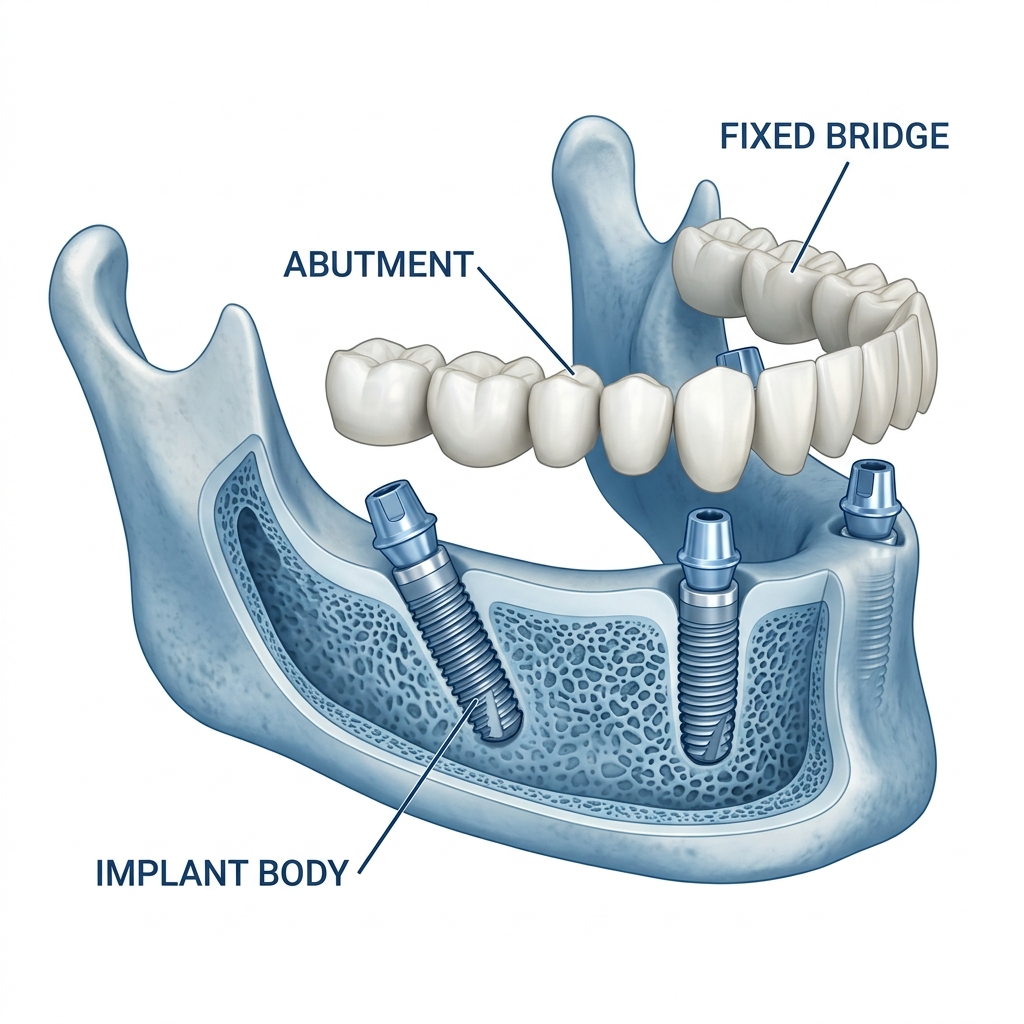
How All-on-4 Works — The Biomechanics
The genius of All-on-4 lies in its engineering. Traditional implant protocols require one implant per missing tooth (8–10 implants for a full arch). All-on-4 achieves the same result with just 4 implants by:
- Angular placement (30–45°): The two rear implants are tilted backward, distributing bite forces across a wider area of jawbone — like spreading weight across angled support columns rather than straight pillars.
- Anterior zone engagement: The two front implants anchor into the densest part of the jaw (the symphysis region), where bone density is highest.
- Immediate loading: High primary stability (>35 Ncm torque) allows a temporary fixed bridge to be fitted the same day, so you leave the clinic with teeth — not gaps.
All-on-4 vs Traditional Full Dentures — Key Differences
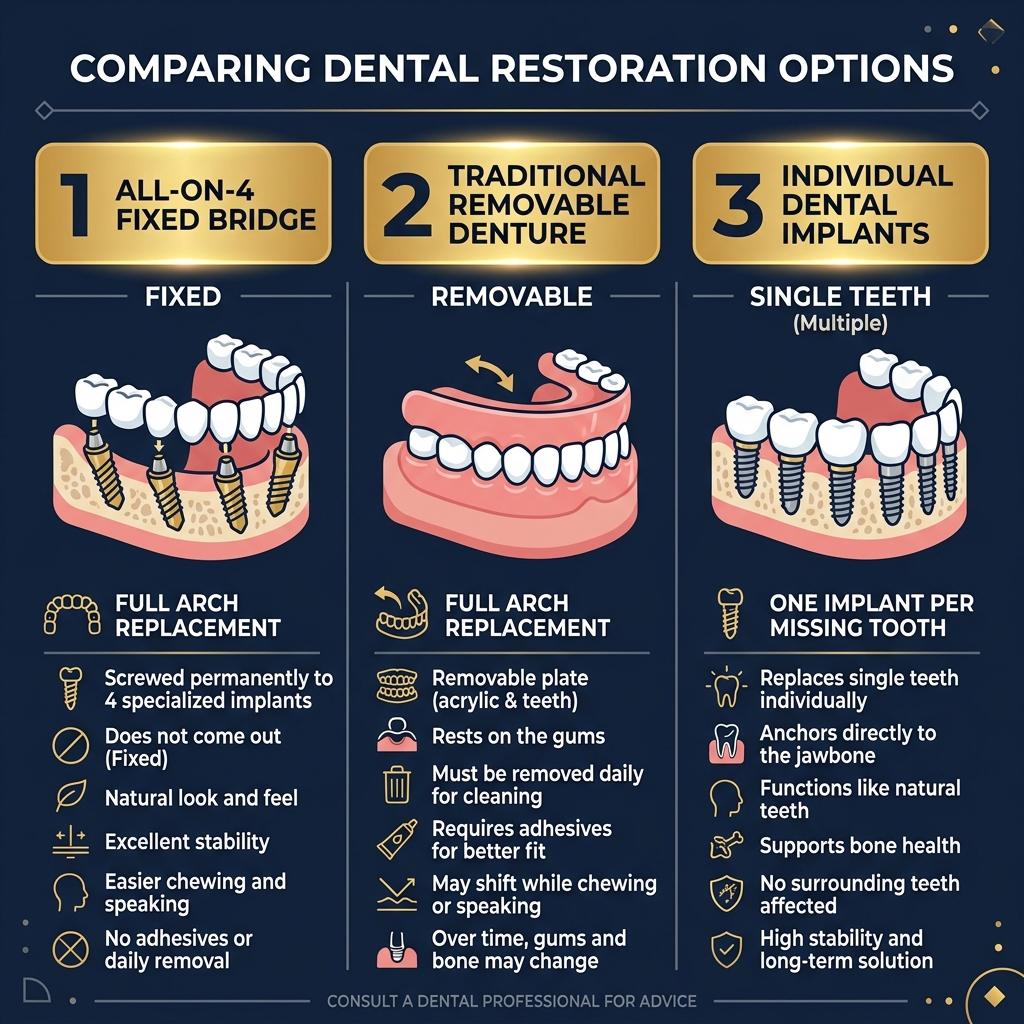
⚠️ The problem with dentures: Removable dentures accelerate jawbone resorption because they rest on the gums, not the bone. Over time (5–10 years), the jaw shrinks, the denture fits worse, and the face develops a "sunken" appearance. All-on-4 implants stimulate the bone just like natural tooth roots — preventing this deterioration entirely.
The Bridge: What Are the Actual "Teeth"?
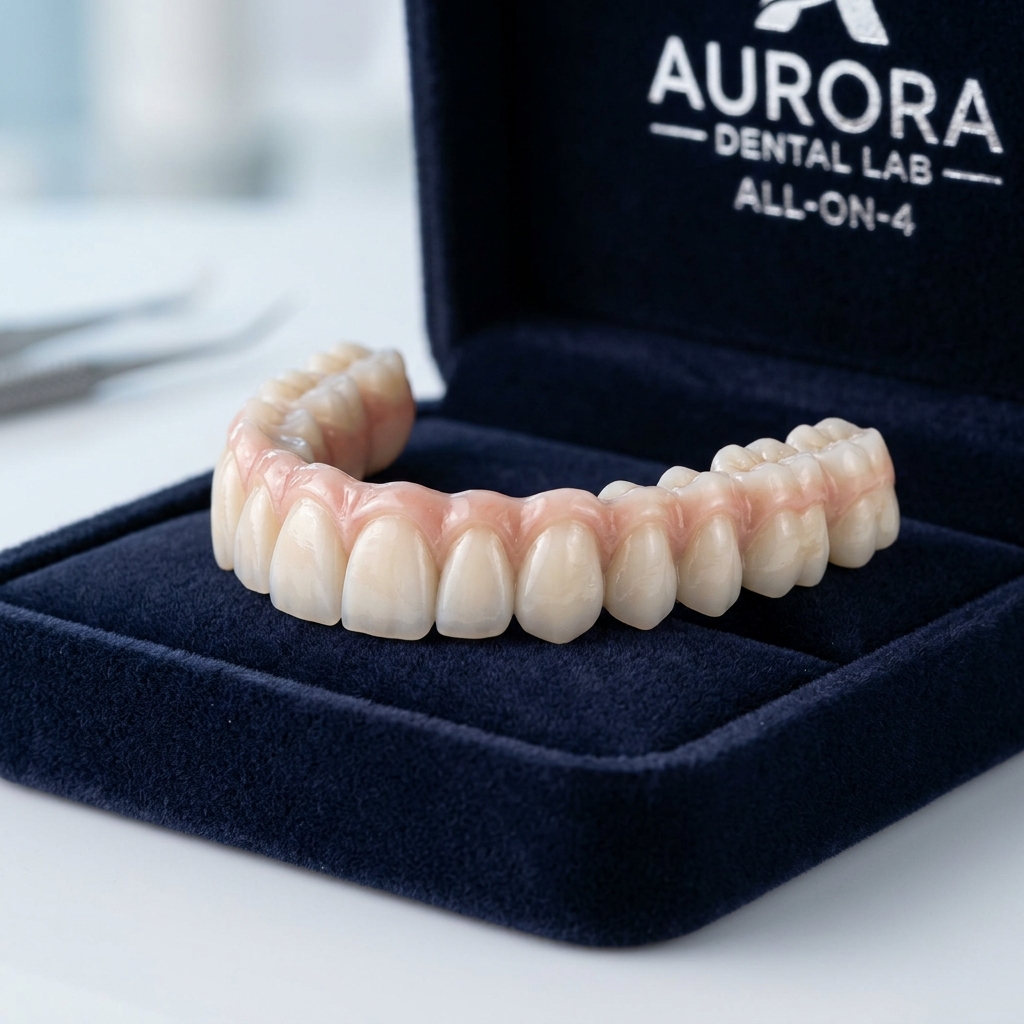
The bridge that attaches to your 4 implants is a full arch of 10–14 teeth. At HCMC Dental, Dr. Cuong offers:
- Temporary bridge (Trip 1): High-strength acrylic (PMMA). Looks great, functions well. Protects the implants during osseointegration. Soft-diet only.
- Permanent bridge (Trip 2): Monolithic Zirconia — the gold standard. Extremely strong (1,200 MPa), natural-looking translucency, stain-resistant. Can eat anything. Milled in-house with CAD/CAM technology for perfect fit.
Am I a Candidate for All-on-4?
General Candidacy Criteria
- All or most teeth missing
- Wearing uncomfortable dentures
- Multiple failing/decayed teeth
- Moderate bone density available
- Good general health
- Non-smoker or willing to quit
- Heavy smoker (failure risk 3×)
- Uncontrolled diabetes
- Active cancer treatment
- Severe bone loss (may need graft)
- Blood thinning medications
- Severe bruxism (night grinding)
⚠️ None of the above automatically disqualifies you. Dr. Cuong has treated complex cases including heavy smokers and patients with significant bone loss. A CBCT scan provides the definitive answer. Send your X-ray for a free assessment →
All-on-4 vs All-on-6 vs Dentures vs Single Implants
💡 Quick Answer
All-on-4 is best for most patients with failing or missing full arches — it offers the optimal balance of stability, cost, and speed. All-on-6 adds 2 extra implants for enhanced load distribution (recommended for upper jaw or high bite forces). Dentures require no surgery but deteriorate over time. Single implants are for replacing 1–3 individual teeth only.
| Feature | All-on-4 | All-on-6 | Full Denture | Single Implants |
|---|---|---|---|---|
| Implants required | 4 per arch | 6 per arch | 0 | 1 per tooth |
| Fixed (non-removable) | ✅ Yes | ✅ Yes | ❌ No | ✅ Yes |
| Same-day teeth | ✅ Usually | ✅ Usually | ✅ Yes | ❌ No |
| Bone grafting needed | Often avoided | Sometimes needed | Not needed | Often needed |
| Prevents bone loss | ✅ Yes | ✅ Yes | ❌ Accelerates loss | ✅ Yes |
| Best for | Full arch, moderate bone | Full arch, high bite force | Budget-only, no surgery | 1–3 individual teeth |
| HCMC Dental price | From $4,800/arch | Ask via WhatsApp | See Denture pricing | From $600/tooth |
| Implant warranty | ✅ Lifetime | ✅ Lifetime | N/A | ✅ Lifetime |
| Bridge warranty | 5 years | 5 years | 1–2 years | 5 years per crown |
When to Choose All-on-6 Over All-on-4
Dr. Cuong recommends All-on-6 when:
- Upper jaw treatment: The upper jaw (maxilla) naturally has softer, more porous bone than the lower jaw. Extra implants improve stability significantly.
- Higher bite force: Patients with a history of bruxism (teeth grinding) or heavier chewing patterns benefit from the added redundancy.
- Borderline bone density: When CBCT shows bone density at the lower threshold for All-on-4 primary stability targets.
- Patient preference: Some patients simply prefer the peace of mind of 2 extra implants.
💬 WhatsApp Dr. Cuong to discuss All-on-4 vs All-on-6 for your specific case →
📖 Or read our complete All-on-6 Implants Guide →
Implant Brands & Materials at HCMC Dental
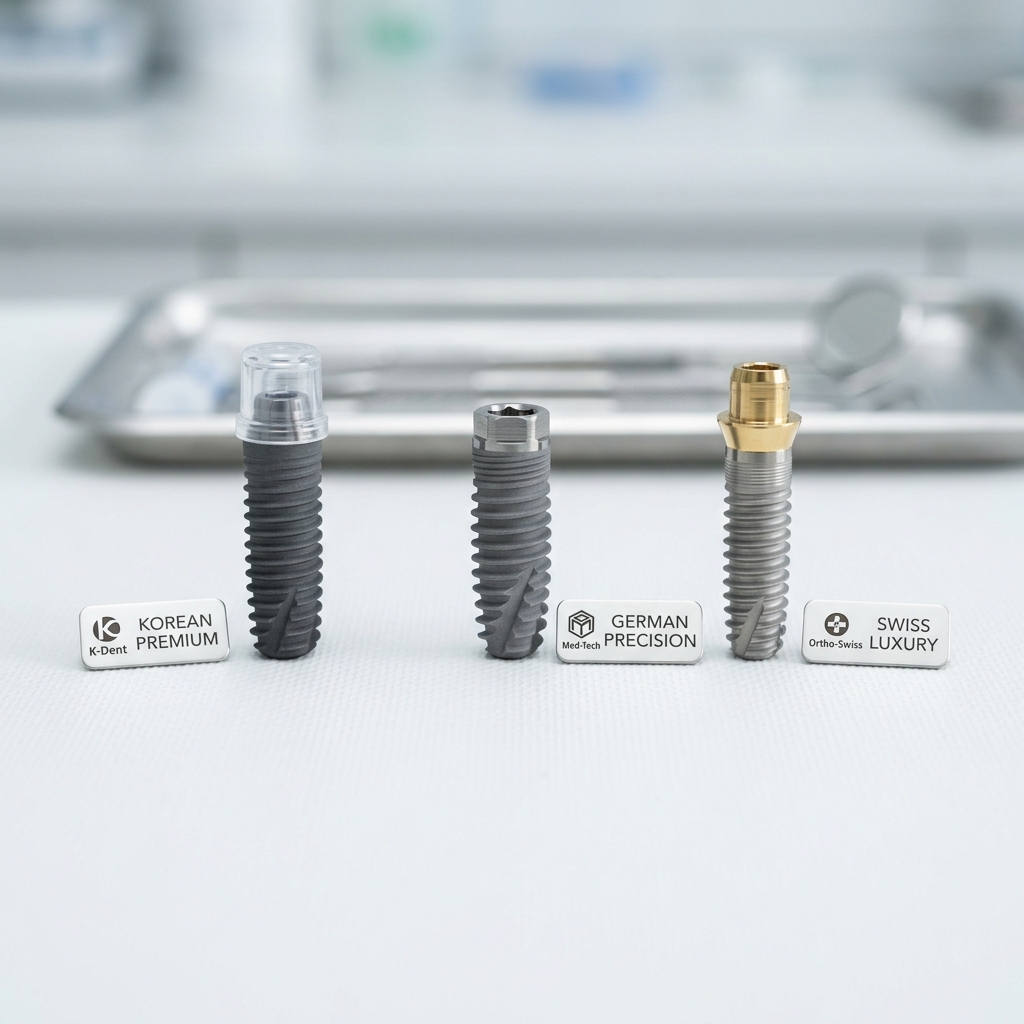
Dr. Cuong offers three implant system tiers — all ISO-certified, all with lifetime warranty on the implant body. The choice depends on your budget, bone quality, and long-term goals:
| Tier | Brand | Origin | Key Feature | Price from (WhatsApp) |
|---|---|---|---|---|
| 🥈 Economy All-on-4 | Dentis / Dentium | 🇰🇷 South Korea | 30M+ implants placed worldwide. Excellent osseointegration. FDA & CE certified. Best value. | $6,345/arch |
| 🥇 Standard All-on-4 | Neodent / B&B | 🇨🇭 Swiss / 🇮🇹 Italy | Excellent durability & precision, great option for mid-range budget. | $7,115/arch |
| 💎 Premium All-on-4 | Straumann SLA | 🇨🇭 Switzerland | World's #1 implant brand. SLA surface, lifetime warranty. Best for standard premium cases. | $8,845/arch |
| 🏆 High-End All-on-4 | Straumann Active | 🇨🇭 Switzerland | Ultimate active surface. Hydrophilic chemistry osseointegrates 40% faster. Best for compromised bone. | $10,000/arch |
💡 Which implant brand is best?
For most healthy, non-smoking patients, Korean premium implants (Osstem/MegaGen) offer excellent outcomes at the best value — used by implant surgeons in Japan, the US, and Europe. Swiss Straumann is the gold standard for complex cases, smokers, and diabetic patients due to its SLActive® surface. Dr. Cuong will recommend based on your CBCT results and medical history.
Bridge Materials: Temporary vs Permanent
Trip 1: Temporary Bridge (PMMA)
- High-strength acrylic (PMMA)
- 10–14 teeth, natural appearance
- Functional for eating soft foods
- Protects healing implants
- Soft diet required (8–12 weeks)
Trip 2: Permanent Bridge (Zirconia)
- Monolithic Zirconia (1,200 MPa strength)
- Milled in-house via CAD/CAM
- Natural translucency & color
- Stain-resistant, lasts 10–15+ years
- Full diet restored — eat anything!
Technology at HCMC Dental
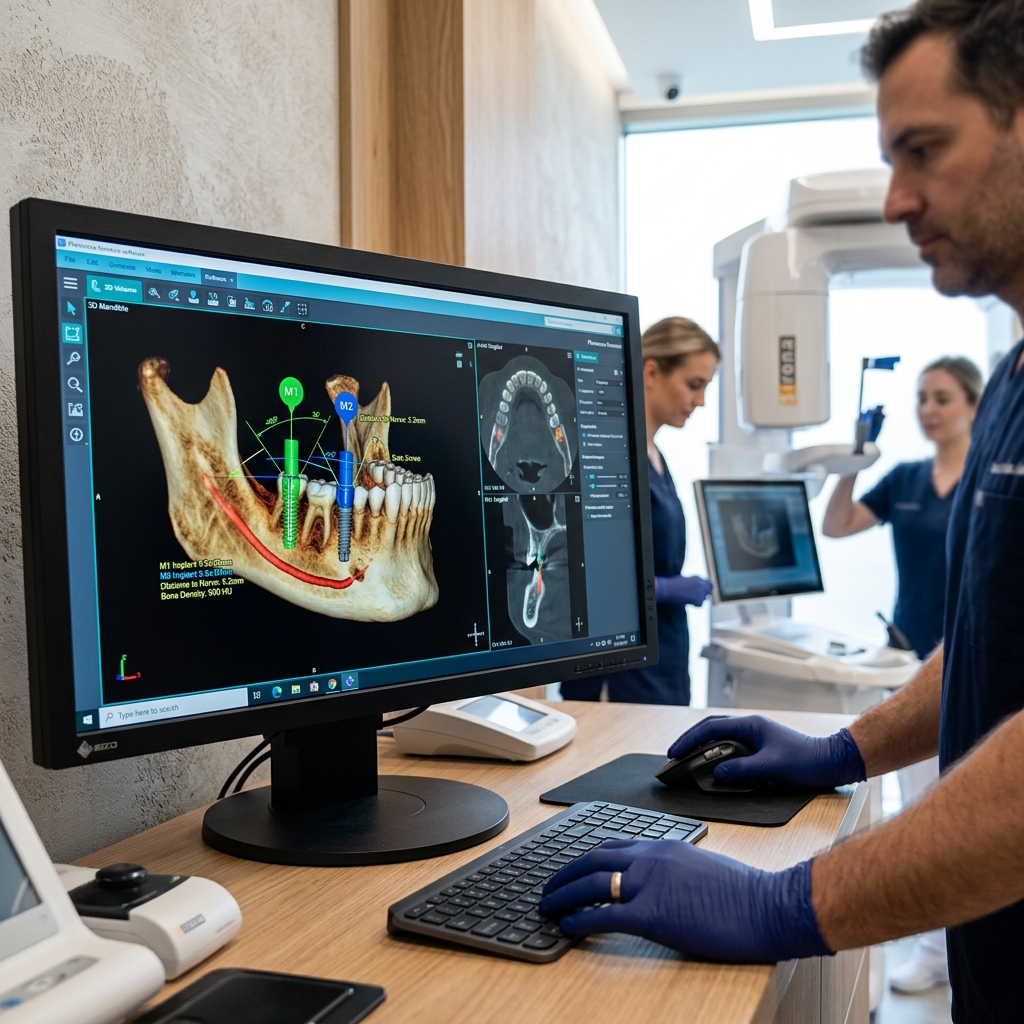
All-on-4 success depends heavily on precision planning. HCMC Dental uses the same technology found in top implant centres in Singapore, Australia, and the US:
🔬 3D CBCT Cone Beam Scan
3D X-ray with sub-millimeter precision. Maps bone density, sinus cavities, nerve pathways, and blood vessels. Essential for safe implant placement and determining if bone grafting is needed. Included in your consultation.
🖥️ Digital Implant Planning
Implant positions, angles, and depths are planned virtually using software (NobelClinician / coDiagnostiX). Dr. Cuong can show you the full treatment plan before a single incision is made — and share it digitally in advance via WhatsApp.
🎯 Surgical Guides (Optional)
3D-printed custom guides ensure implants are placed exactly where planned — to within 0.5mm accuracy. Reduces surgery time, bleeding, and swelling. Particularly valuable for complex All-on-4 cases.
⚙️ In-House CAD/CAM Milling
The permanent zirconia bridge is digitally designed and milled on-site. No outsourcing means faster turnaround, tighter quality control, and lower cost — savings passed directly to you.
Surgery: What Actually Happens on Surgery Day
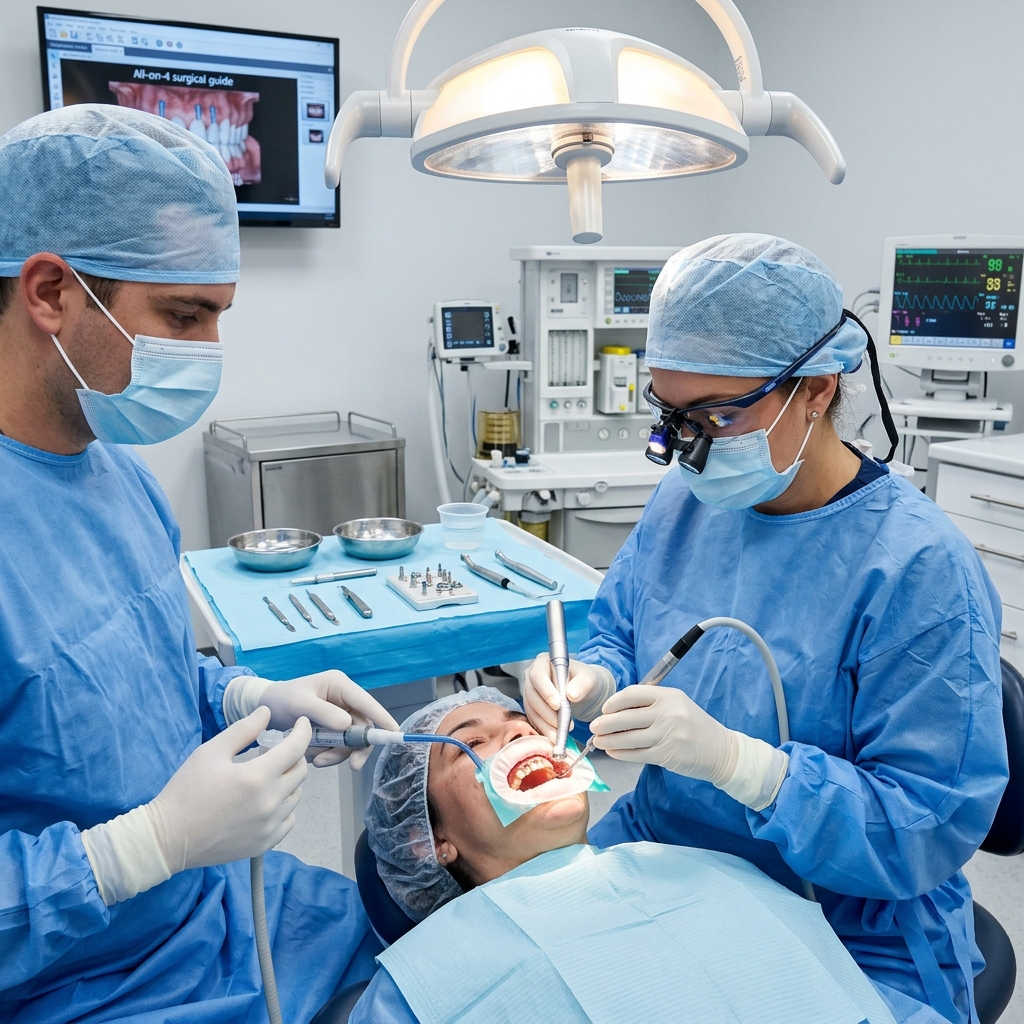
Vital signs checked. IV line established if sedation chosen. Final digital plan reviewed with Dr. Cuong. Any last questions answered.
Local anaesthetic injected (similar to routine filling injections). Complete numbness achieved within 5–10 minutes. You remain conscious throughout unless IV sedation was selected.
Remaining failing teeth removed. Minimal trauma technique used to preserve bone. Sockets sutured.
4 titanium implants placed in planned positions using the surgical guide. Primary stability tested with torque wrench (minimum 35 Ncm required for immediate loading). Total placement time: 45–60 minutes.
Pre-fabricated temporary bridge adjusted to your bite and screwed onto the 4 implants. Final bite check and adjustments. You sit up and smile — you have teeth.
Prescribed medications explained (antibiotics, pain relief, antiseptic mouthwash). Dietary guidelines provided. Dr. Cuong's WhatsApp number confirmed for any post-op questions.
Pain Management & Recovery
💡 Will All-on-4 surgery hurt?
During surgery: No. Local anaesthesia ensures complete numbness — you feel pressure and movement but no pain. After surgery: Moderate discomfort for days 2–5 (similar to wisdom tooth removal), well managed with prescribed ibuprofen and paracetamol. Most patients report the experience is far easier than expected. Pain peaks around day 2–3 then consistently improves.
Sedation Options
Local Anaesthesia (Standard)
Injection numbs the surgical site. You remain awake, aware of sounds, but feel zero pain. Fully alert to drive home (with escort recommended). No extra cost.
IV Sedation (Dental Anxiety)
Administered by qualified anaesthesiologist. You are deeply relaxed or sleep through the procedure. Woken up with teeth in place. Cannot drive home. Available on request — enquire via WhatsApp.
Related Guide: IV sedation for comfortable full-arch surgery →
Recovery Timeline — What to Expect
| Timeframe | What You Experience | What You Can Do |
|---|---|---|
| Day 1 | Numb mouth, mild bleeding, drowsy if sedated | Rest, liquids only, ice packs on cheeks |
| Days 2–3 | Peak swelling & bruising, discomfort (manageable with medication) | Light activity, liquid/purée foods |
| Days 4–7 | Swelling reduces significantly, discomfort fades | Short walks, still soft foods |
| Week 2 | Feeling much better, minor tenderness | Light sightseeing, soft foods expanded |
| Weeks 3–8 | Normal daily activities, implants integrating | All activities, semi-soft diet, work resumes |
| 4–6 Months | Full osseointegration complete, feeling natural | Normal everything |
| Trip 2 (+5–7 days) | Impressions, bridge delivery, full diet restored | Eat steak. Smile for photos. |
The 2-Trip Treatment Protocol — Your Complete Journey
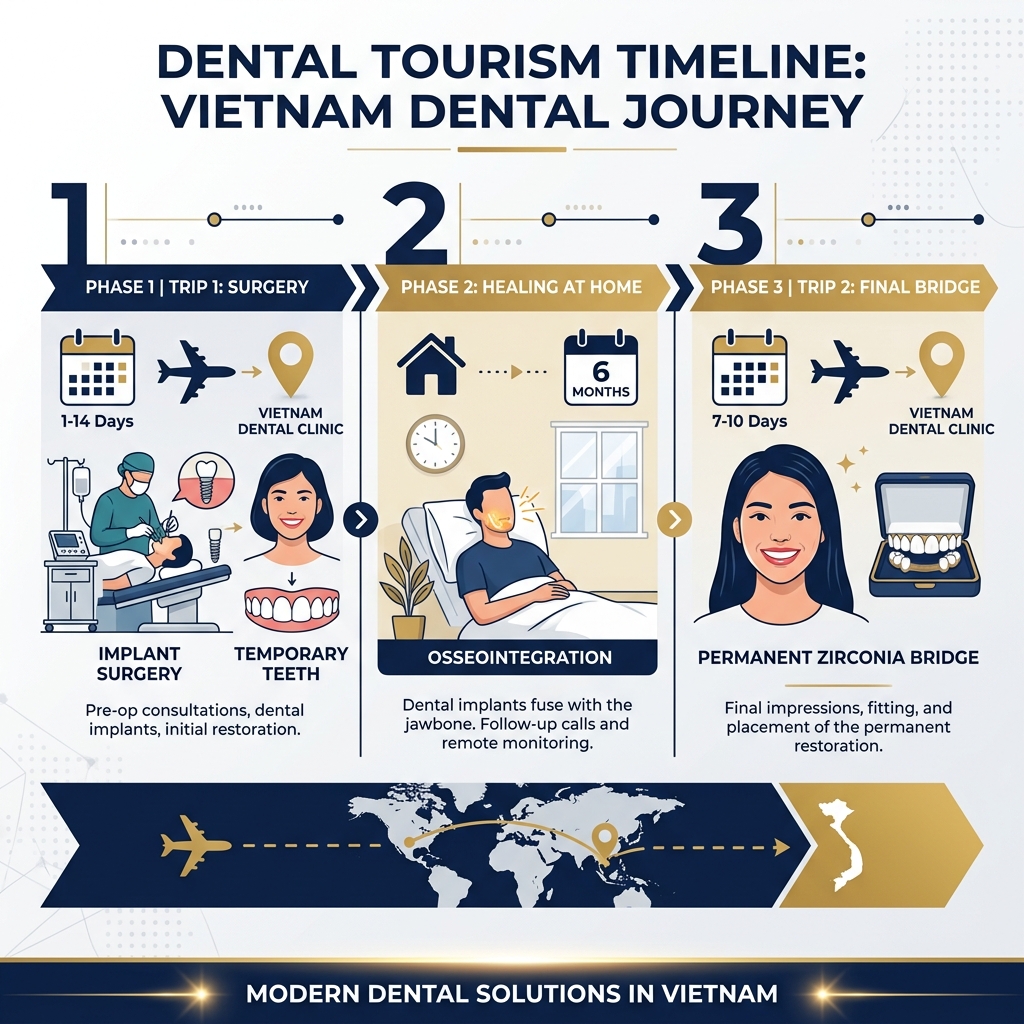
💡 How long does All-on-4 treatment take in Vietnam?
Treatment requires two trips to Vietnam. Trip 1 (10–14 days) covers all diagnostics, surgery, and temporary teeth. Trip 2 (7–10 days, 4–6 months later) delivers the permanent zirconia bridge. Total in-Vietnam time: approximately 18–24 days spread over 5–7 months.
🛫 Trip 1: Surgery & Temporary Teeth (10–14 Days)
Send panoramic X-ray or existing CBCT via WhatsApp. Dr. Cuong reviews and confirms suitability, sends preliminary treatment plan and itemized quote. Book flights and accommodation.
Fly into Tan Son Nhat Airport (SGN). District 1 hotel recommended — 5–15 min walk or short Grab ride to clinic. Rest and settle in.
Comprehensive oral examination. 3D CBCT scan. Blood pressure and health screening. Final treatment plan confirmed. Implant brand selected. Consent signed. Questions answered. Provisional bridge design previewed via Digital Smile Design.
Surgery typically 90–120 minutes per arch. Temporary fixed bridge fitted same day. Post-op medications prescribed. Rest at hotel.
Daily or every-other-day check-ups at the clinic. Suture check. Bite adjustment if needed. Explore HCMC gently — museums, river cruises, massages.
Final check-up before departure. Confirm implants stable, no infection. Dr. Cuong provides WhatsApp contact for any questions during osseointegration at home. Fly home with temporary fixed teeth and a new smile.
🏠 At Home: Osseointegration Phase (4–6 Months)
During this phase, your titanium implants fuse permanently with your jawbone (osseointegration). Key points:
- Timeline: Full fusion takes 4–6 months. Lower jaw fuses faster than upper jaw.
- You keep your temporary teeth throughout — functional, natural-looking, fixed.
- Dr. Cuong stays in touch via WhatsApp — send photos or video if concerned.
- Diet: Soft to semi-soft diet for the first 8–12 weeks. Then most normal foods.
- Activity: Resume normal work, exercise, and social life within 2–4 weeks.
✈️ Trip 2: Permanent Zirconia Bridge (7–10 Days)
CBCT scan confirms successful bone fusion. All 4 implants tested for stability (resonance frequency analysis). Temporary bridge removed.
Digital scan or physical impressions taken of implant positions. Color matching for natural-looking shade. Bridge design finalized in software.
Permanent zirconia bridge milled in-house with CAD/CAM. Temporary bridge re-seated while permanent one is completed. Quality checks performed.
Permanent bridge screwed into place. Bite check and final adjustments. Oral hygiene instructions for maintenance. Full diet officially restored. You can eat steak tonight.
🧳 What to Bring — Dental Tourism Packing Checklist
💡 HCMC Tips: Download the Grab app for cheap taxis. Airport SIM cards: ~$5 for 7-day data. USD accepted widely in District 1. Water flosser (~$15–20) available at Điện Máy Xanh stores.
Transparent All-on-4 Pricing at HCMC Dental
💬 WhatsApp Booking Discount — Save 40%
All-on-4 from $6,345/arch
Korean premium system · Fixed full arch · Temporary + permanent bridge
💬 Get My Personal Quote via WhatsApp| Package | Implant System | Standard Price | WhatsApp Price (-40%) | Includes |
|---|---|---|---|---|
| 🥈 Economy All-on-4 | Dentis / Dentium (South Korea) | $6,345/arch | ✅ CBCT scan ✅ Surgery ✅ Temp bridge ✅ Perm Zirconia ✅ All follow-ups ✅ Lifetime implant warranty ✅ 5-yr bridge warranty |
|
| 🥇 Standard All-on-4 | Neodent (Swiss) / B&B (Italy) | $7,115/arch | ||
| 💎 Premium All-on-4 | Straumann SLA (Swiss) | $8,845/arch | ||
| 🏆 High-End All-on-4 | Straumann Active (Swiss) | $10,000/arch | ||
| 🔵 All-on-6 | Any system | 💬 Ask via WhatsApp | 6 implants + all above | |
⚠️ Separate costs to budget for: If bone grafting or sinus lift is needed (determined by CBCT), this is quoted separately and transparently. Accommodation in District 1: $30–$120/night. Flights: vary by origin. Most patients save $15,000+ even after factoring all travel costs.
International Price Comparison
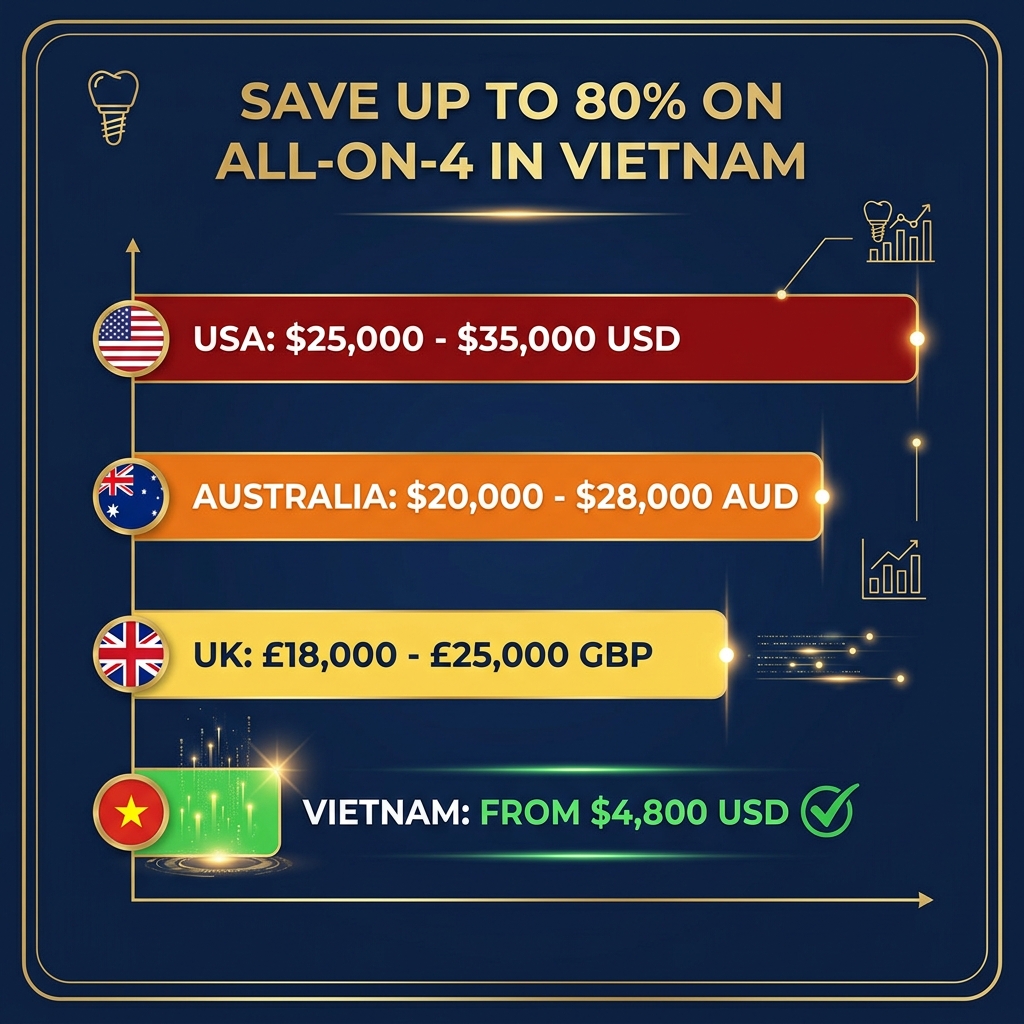
| Country | All-on-4 Cost (per arch) | Both Arches | Save vs Vietnam |
|---|---|---|---|
| 🇺🇸 USA | $25,000 – $35,000 | $50,000 – $70,000 | Save $20,200 – $30,200 |
| 🇦🇺 Australia | $18,000 – $25,000 AUD | $36,000 – $50,000 AUD | Save $13,000 – $20,000 |
| 🇬🇧 UK | £14,000 – £20,000 | £28,000 – £40,000 | Save £10,000 – £16,000 |
| 🇩🇪 Germany | €16,000 – €24,000 | €32,000 – €48,000 | Save €12,000 – €20,000 |
| 🇹🇭 Thailand | $9,000 – $14,000 | $18,000 – $28,000 | Save $4,200 – $9,200 |
| 🇻🇳 Vietnam (HCMC Dental) | $4,800 – $7,680 | $9,600 – $15,360 | ✅ Best value in Asia |
Even with return flights + 2 weeks hotel + spending money, most patients save $12,000–$25,000+.
Bone Grafting & Sinus Lift: Do You Need It?
💡 Do I need bone grafting for All-on-4?
In many cases, no. The angled posterior implants are specifically designed to engage available bone and bypass areas of bone loss — this is All-on-4's key advantage. However, patients with severe upper jaw resorption may need a sinus lift. A CBCT scan determines this precisely before surgery.
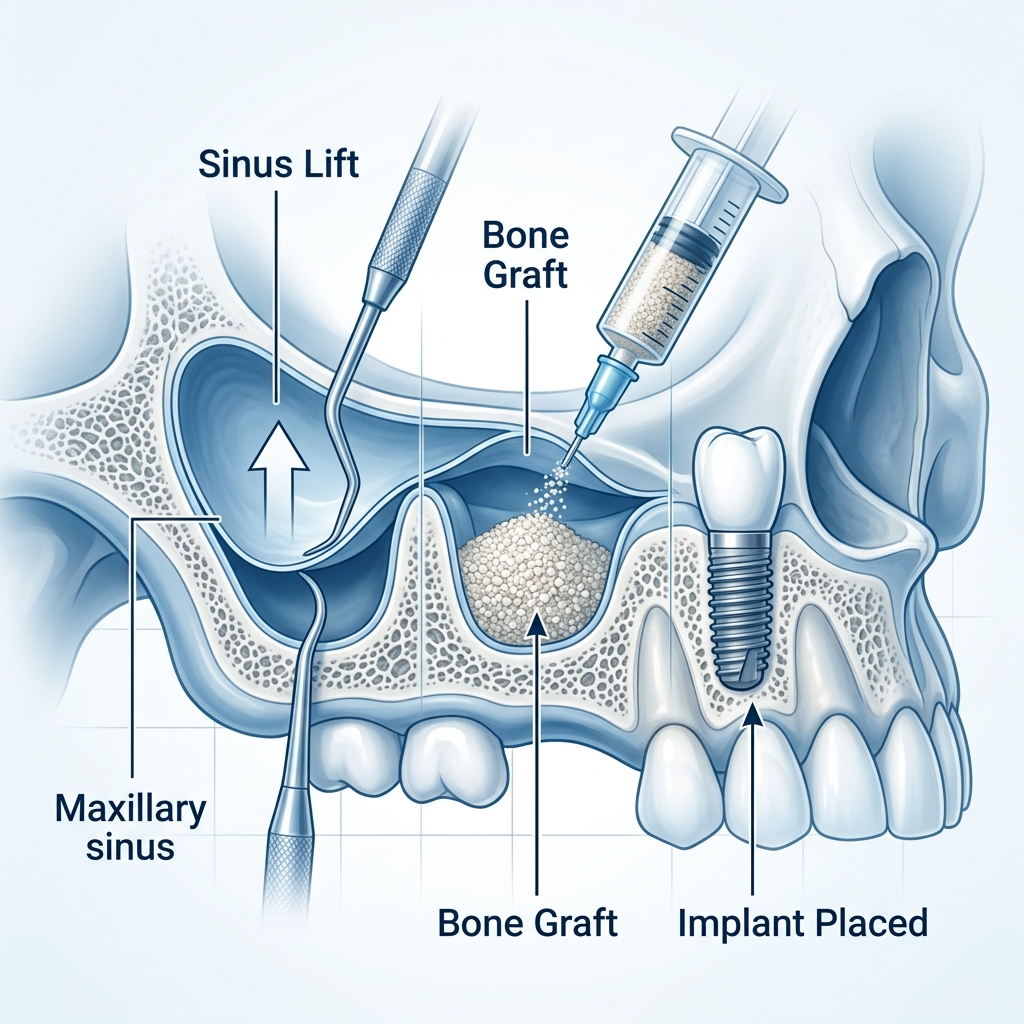
Why Bone Loss Happens
When a tooth is lost, the jawbone that supported it begins to resorb (shrink) within weeks. Without stimulation from tooth roots, the body reabsorbs bone as a biological resource. This is why long-term denture wearers often have dramatically reduced jawbone height and width — sometimes making implants impossible without grafting first.
Types of Bone Procedures at HCMC Dental
Internal Sinus Lift
Membrane gently elevated through the same hole as the implant. Less invasive. Healing: same as implant placement. Best for: 4–6mm of available bone below sinus.
External (Lateral) Sinus Lift
Window opened in cheekbone. More graft material placed. Requires 4–6 months healing before implants. Best for: less than 4mm bone available.
Ridge Augmentation
Rebuilds the width of jawbone. Often combined with implant placement. Uses biocompatible bone graft material.
Zygomatic Implants (Extreme Cases)
For severe upper jaw bone loss where sinus lift is not feasible. Extra-long implants anchor in the cheekbone (zygoma) instead. Dr. Cuong performs this specialized procedure. Enquire via WhatsApp →
All grafting is quoted transparently before your trip. Send your X-ray for a free assessment to determine if grafting is needed: 📸 WhatsApp X-ray to Dr. Cuong →
Beyond Teeth: How All-on-4 Restores Your Face
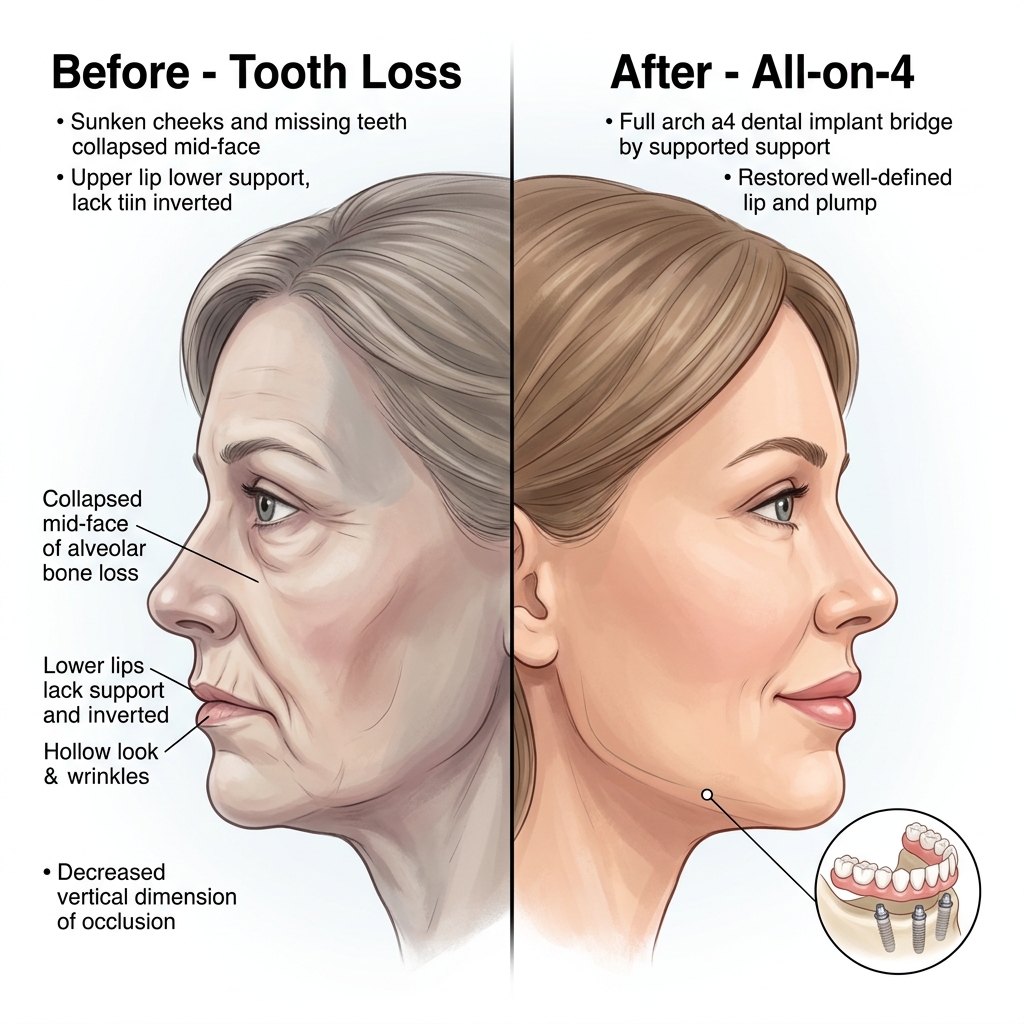
Most patients focus on the teeth. But Dr. Cuong's patients often remark that their face looks years younger after All-on-4 — and there's a biological reason for this:
The Facial Collapse Problem
Tooth loss triggers bone resorption. As bone shrinks over years, it causes:
- Collapsed lip support — lips fold inward without bone structure behind them
- Cheek hollowing — loss of volume in the midface area
- Chin rotation — the chin moves forward and upward as the jaw shrinks
- Deepened nasolabial folds — the lines from nose to mouth become pronounced
- Overall premature aging appearance — patients often look 10–15 years older than their age
How All-on-4 Reverses This
The fixed All-on-4 bridge restores the vertical dimension of the bite — the proper facial height that natural teeth provide. Combined with the titanium implants stimulating bone to halt further resorption, patients see:
- ✅ Fuller lip support — lips return to natural position
- ✅ Restored cheek fullness
- ✅ Correct facial proportions re-established
- ✅ Bone loss halted permanently
- ✅ Natural, younger-looking profile

Diet & Nutrition Timeline After All-on-4
💡 What can I eat after All-on-4 surgery?
Your diet progresses gradually from liquids to full normal eating over 3–6 months. After Trip 2 (permanent zirconia bridge), you can eat anything — including steak, apples, corn on the cob, and crusty bread. You will never need to modify your diet permanently.
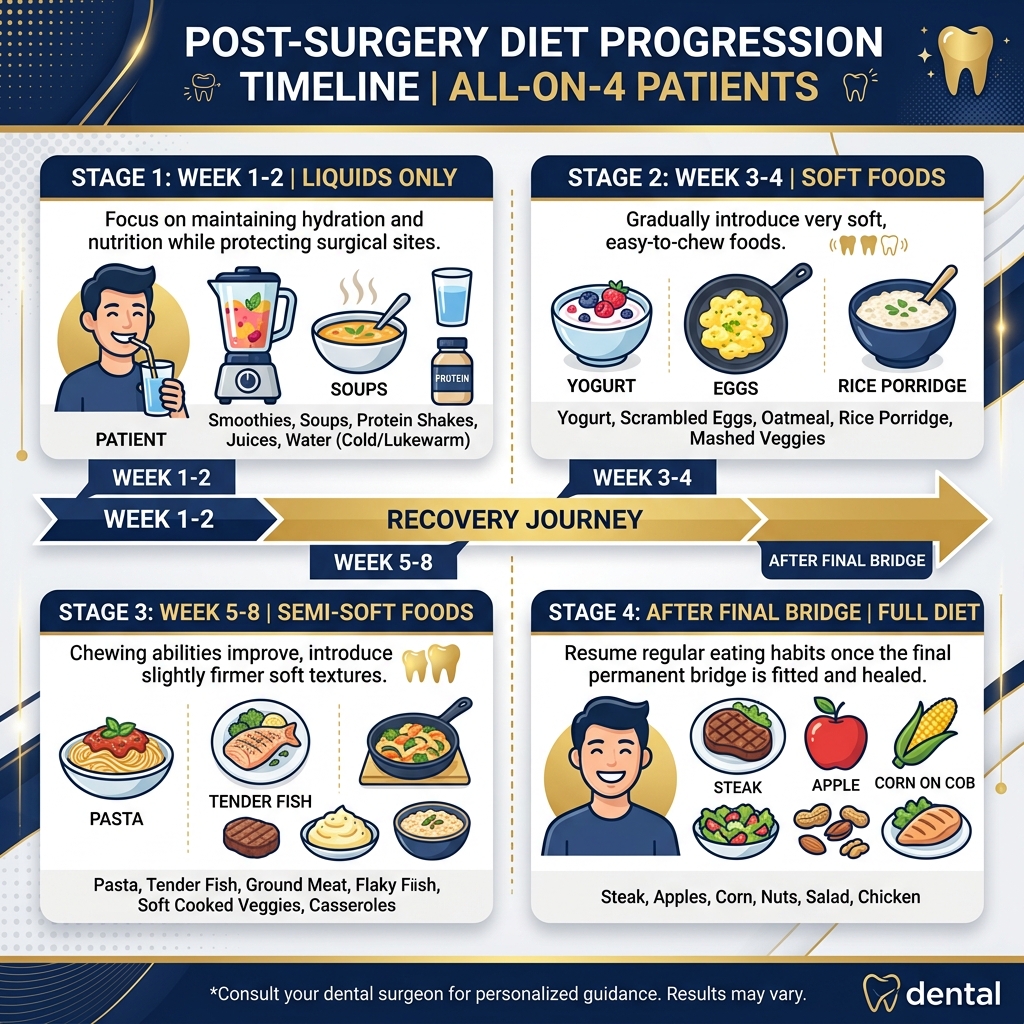
| Phase | Timeframe | ✅ Can Eat | ❌ Avoid |
|---|---|---|---|
| Liquid | Week 1–2 | Smoothies, broths, protein shakes, yogurt drinks, coconut water | Anything requiring chewing |
| Soft | Week 3–4 | Scrambled eggs, cháo (rice porridge), mashed potato, soft pasta, banana, tofu | Hard bread, raw vegetables, tough meat |
| Semi-soft | Week 5–8 | Phở (tender beef), noodles, soft fish, ground meat, cooked vegetables, soft fruits | Nuts, ice, hard candy, crusty bread |
| Gradual | Week 9–12 | Most normal foods, soft fruits, tender chicken | Ice, hard nuts, very chewy meats |
| Full Diet | After Trip 2 | Everything! Steak, apples, corn, pizza, nuts | Nothing restricted permanently |
Vietnam-Specific Nutrition Tips
- 🍜 Phở: Perfect for weeks 5–8! Choose tender beef (bò tái), let it cool slightly, and enjoy. Avoid tripe and tendon initially.
- 🥣 Cháo (rice porridge): Excellent recovery food during weeks 3–4. Available at every Vietnamese restaurant.
- 🥤 Sinh tố (smoothies): Vietnamese fruit smoothies from street vendors are excellent week 1–2 nutrition.
- 🥚 Trứng ốp la (fried eggs): Available everywhere, soft-cooked, perfect for weeks 3+.
- 💊 Nutrition for healing: High protein (for tissue repair), Vitamin D and Calcium (for bone fusion), avoid alcohol (slows healing), avoid hard supplements that require chewing.
Aftercare, Maintenance & Warranty
Warranty Coverage at HCMC Dental
Implant Posts
Korean (Osstem/MegaGen), German (MIS/Bego), Swiss (Straumann). Covers implant body failure and manufacturing defects.
Zirconia Bridge
Covers fracture and prosthetic defects. Bridge typically lasts 10–15+ years with proper care. Not voided by location — Dr. Cuong communicates with your local dentist if needed.
Daily Maintenance Routine
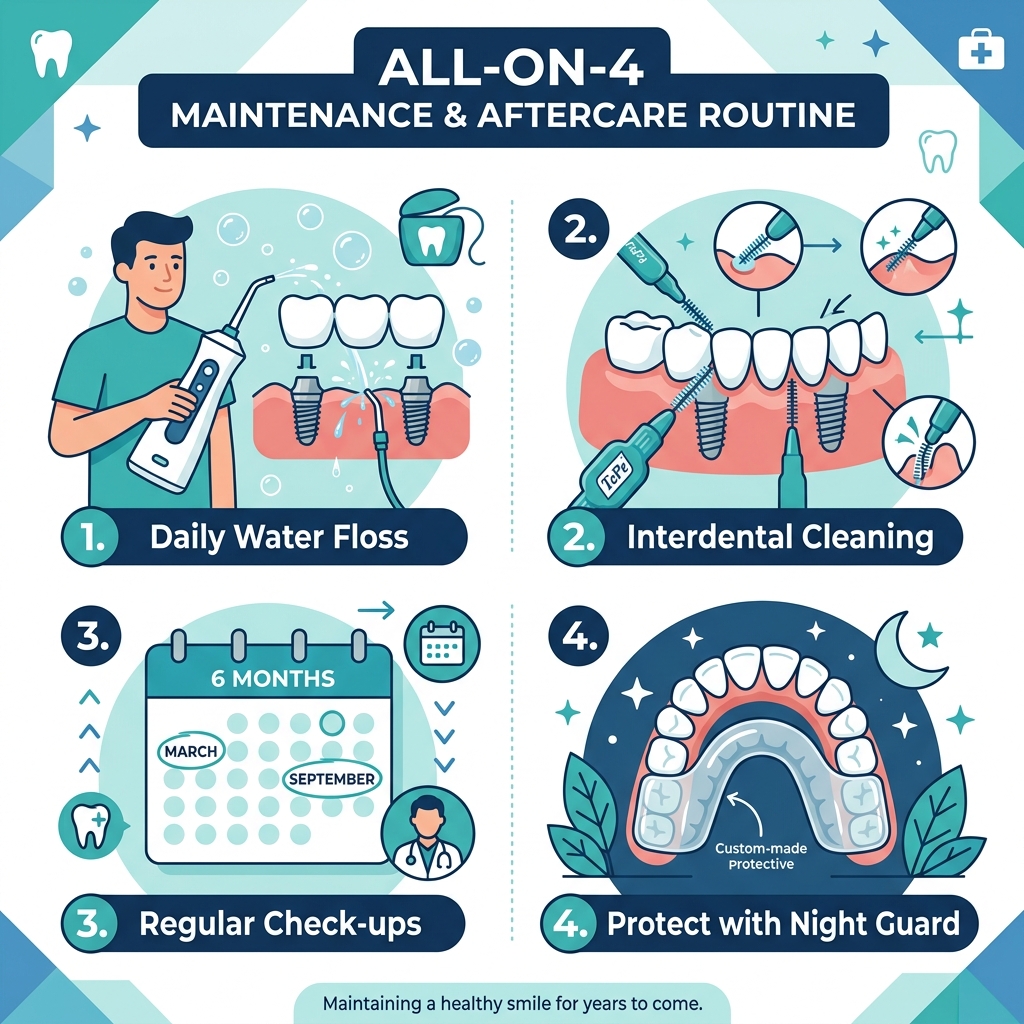
All-on-4 bridges are not removable for cleaning — they clean like natural teeth but require different tools:
- Water flosser (essential): Flush under the bridge along the gumline twice daily. The WaterPik or Oral-B Aquacare work well. Buy in HCMC for $15–20 at any electronics store.
- Interdental/proxy brush: Small brush that slides under the bridge between the 4 implant access points. Used after water flossing.
- Soft electric toothbrush: Brush the bridge surface and gumline twice daily. No harsh abrasives or whitening toothpaste (unnecessary for zirconia).
- Night guard (if bruxism): If you grind teeth at night, Dr. Cuong provides a custom night guard to protect your bridge. Essential for long-term protection.
- Regular check-ups: Every 6 months. At a dental clinic in your home country (Dr. Cuong will provide a clinical summary letter). Implant stability check once annually.
Risks, Complications & What to Expect Honestly
HCMC Dental believes in full transparency. Understanding realistic risks helps you make an informed decision and know what to watch for.
Success Rates
All-on-4 has excellent long-term outcomes in peer-reviewed research:
- Implant survival rate: 95–98% at 10 years (published studies, Nobel Biocare data)
- Bridge survival rate: 94–97% at 5 years
- Patient satisfaction: Consistently 95%+ in independent studies
Common Short-Term Effects (Normal)
- ✅ Swelling and bruising — days 2–5, peaks day 2–3, resolves by day 7–10
- ✅ Mild bleeding from surgical sites — first 24–48 hours, controlled with gauze
- ✅ Temporary altered speech — new bridge affects tongue position briefly, resolves within days
- ✅ Temporary bite changes — bridge adjusted at 48-hour and 1-week check-up
Rare Complications
- ⚠️ Implant failure (1–3%): Usually within first 6 months during osseointegration. More common in smokers. Covered by HCMC Dental warranty — replacement at no implant cost.
- ⚠️ Peri-implantitis: Gum disease around implants. Prevented by proper hygiene. Treated if caught early.
- ⚠️ Bridge fracture (<2%): More common with acrylic temporary than zirconia permanent. Warranty covered.
- ⚠️ Numbness: Temporary paresthesia in rare cases (<1%). Resolves in weeks to months. Virtually eliminated with CBCT-guided surgery.
🚨 Contact Dr. Cuong Immediately (WhatsApp) If You Experience:
- Temperature above 38.5°C (101.3°F) lasting more than 24 hours
- Swelling that increases after day 4 (should be decreasing)
- Bleeding that doesn't stop after 1 hour of firm gauze pressure
- Any implant or bridge feeling loose or mobile
- Spreading redness or swelling toward the neck
- Pain that increases after day 3 instead of decreasing
- Difficulty breathing or swallowing: Go to ER immediately, then WhatsApp
What Happens If an Implant Fails?
In the rare event that an implant fails to integrate: the failed implant is removed painlessly, the site heals for 2–3 months, a replacement implant is placed (covered by lifetime warranty on the implant body). This adds one additional healing period and potentially a third trip, but does not mean the overall treatment fails. Dr. Cuong has extensive experience managing these cases successfully.
Meet Dr. Cuong — Your All-on-4 Specialist

Dr. Cuong, BDS (Hons) — Prosthodontist & Implant Surgeon
- 🎓 8+ years clinical experience in implant dentistry and full-arch restorations
- 🏥 500+ All-on-X cases performed (All-on-4, All-on-6, Zygoma)
- 🌏 100% English-speaking — clear communication with international patients
- 📱 WhatsApp 24/7 — Dr. Cuong personally monitors your recovery
- ⭐ 4.9/5 Google rating from 178 verified international patient reviews
- 🔬 Trained in advanced implant techniques including zygomatic implants and immediate loading protocols
What International Patients Say
"I flew from Sydney for All-on-4 on both arches. The savings paid for 3 trips to Vietnam and I still came out $18,000 ahead. Dr. Cuong's English is perfect and he monitored my recovery via WhatsApp every week. The results are stunning."
— Jason S., Australia · All-on-4 Both Arches (Swiss Straumann)"I was terrified of surgery. Dr. Cuong spent 45 minutes answering all my questions before I even booked. The surgery was painless under sedation. I woke up with beautiful temporary teeth. 6 months later my permanent zirconia bridge is perfect."
— Margaret K., United Kingdom · All-on-4 Upper Arch (German Precision)Frequently Asked Questions — All-on-4 Implants
All-on-4 starts from $4,800/arch with Korean implants when booked via WhatsApp (40% discount). German systems from $5,760/arch, Swiss Straumann from $7,680/arch. Both arches: $9,600–$15,360. Compare: USA $50,000–$70,000 for both arches.
Two trips. Trip 1 (10–14 days): full consultation, CBCT scan, surgery, temporary fixed teeth. Trip 2 (7–10 days, 4–6 months later): final impressions and permanent zirconia bridge. Dr. Cuong monitors your progress via WhatsApp between trips.
During surgery: no pain — local anaesthesia ensures complete numbness (you feel pressure only). After surgery: moderate discomfort days 2–5, well controlled with prescribed medication. Most patients compare it to wisdom tooth removal recovery. IV sedation is available for anxious patients.
The titanium implant posts have a lifetime warranty and typically last 20–30+ years with proper care. The zirconia bridge has a 5-year warranty and lasts 10–15+ years on average. Key factors: no smoking, good oral hygiene, night guard if you grind, regular 6-month check-ups.
Often not. All-on-4's angled implants are specifically designed to maximise available bone and frequently eliminate the need for grafting — especially in the lower jaw. Upper jaw bone loss may require a sinus lift. A CBCT scan determines this precisely. Send your X-ray for a free remote assessment.
All-on-4 uses 4 implants per arch; All-on-6 uses 6. All-on-6 provides extra stability — recommended for upper jaw treatment, higher bite forces, or borderline bone density. The final bridge looks identical. All-on-6 costs approximately 20–30% more. Dr. Cuong recommends based on your CBCT.
Absolutely — one arch is very common. Many patients start with the most problematic arch and add the second arch on Trip 2 or a future visit. Single-arch All-on-4 is approximately half the full-mouth cost.
Week 1–2: liquids (smoothies, cháo, soups). Week 3–4: soft foods (eggs, pasta, mashed potato). Week 5–8: semi-soft (phở, tender meat, noodles). After permanent bridge (Trip 2): full unrestricted diet — steak, apples, corn, nuts, everything.
The bridge is fixed — cleaned like natural teeth with extra tools. Daily water flosser under the bridge (essential), interdental brushes, soft electric toothbrush. Night guard if you grind. 6-monthly professional check-ups. Dr. Cuong provides full aftercare instructions and a letter for your local dentist.
Smoking increases implant failure risk by 2–3×. Dr. Cuong strongly recommends quitting 2 weeks before and 3 months after surgery. For patients who cannot quit, Swiss Straumann SLActive implants are recommended — their hydrophilic surface achieves faster osseointegration even in compromised conditions. Full disclosure required at consultation.
Three tiers: Korean premium (Osstem/MegaGen) from $4,800/arch — excellent global track record. German precision (MIS/Bego) from $5,760/arch — engineering excellence. Swiss luxury (Straumann SLActive) from $7,680/arch — world's #1 implant brand. All carry lifetime warranty on the implant body.
Yes — this is encouraged. WhatsApp your panoramic X-ray or existing CBCT to Dr. Cuong. He will review and provide a preliminary assessment, confirm suitability, and give an itemized quote within 24 hours. No obligation, completely free.
All-inclusive package: CBCT scan, surgery, all follow-up appointments during Trip 1, temporary PMMA bridge, permanent monolithic zirconia bridge (Trip 2), lifetime implant warranty, 5-year bridge warranty, WhatsApp support throughout. Bone grafting / sinus lift quoted separately if needed.
Implant survival rate is 95–98% at 10 years. Short-term: swelling/bruising (normal, resolves in 7–10 days). Rare: implant failure (1–3%), covered by warranty with replacement. Very rare: temporary numbness (<1%), virtually eliminated with CBCT-guided surgery. Dr. Cuong discloses all risks at consultation.
Yes. HCMC Dental uses the same implant brands (Straumann, Osstem, MIS), same surgical protocols, and same CAD/CAM bridge fabrication technology as premium practices in the West. The difference is cost-of-living and operational overhead — not clinical quality. Dr. Cuong has treated patients referred by dentists in Australia, UK, and the US.
Have a question not answered here? WhatsApp Dr. Cuong directly →
Planning a dental trip? → Dental Tourism Vietnam Guide
Ready to Restore Your Smile?
Start with a free remote assessment. Send your X-ray via WhatsApp and Dr. Cuong will review and confirm suitability within 24 hours — no obligation.
💬 WhatsApp 24/7 · 🕐 Response within 24h · 📍 District 1, Ho Chi Minh City
🦷 Need comprehensive dental reconstruction? Explore our Full Mouth Rehabilitation guide →