For adult professionals, executives, and international expatriates seeking comprehensive orthodontic correction, the aesthetic demand for truly unnoticeable treatment has never been higher. The decision between inside lingual braces vs Invisalign clear aligners adults Vietnam represents the pinnacle of modern aesthetic dentistry. Both modalities offer discreet tooth movement, but they operate on fundamentally different biomechanical principles, require different levels of patient compliance, and present distinct cost advantages when performed in Ho Chi Minh City.
At HCMC Dental Clinic in District 1, under the clinical direction of Dr. Nguyen Van Cuong, DDS (Clinical Director — MOH License 0003265/BL-CCHN), we utilize advanced 3D digital workflows to deliver world-class invisible orthodontics. Whether you require the absolute invisibility and continuous force of custom lingual brackets bonded behind the teeth, or the removable convenience and digital precision of Invisalign, understanding the clinical nuances of each system is critical for achieving a stable, functional, and beautiful smile.
Clinical Summary:
Choosing between inside lingual braces and Invisalign clear aligners involves balancing biomechanical efficiency with lifestyle convenience. Lingual braces offer 100% invisibility and superior torque control for complex extraction cases by applying force near the tooth’s center of resistance. Invisalign provides unmatched oral hygiene access, zero wire emergencies for traveling patients, and highly predictable digital staging. At HCMC Dental Clinic, both systems are executed using advanced 3D CAD/CAM technology, offering international patients premium orthodontic care at a fraction of Western costs.
Key Takeaways:
- Absolute Invisibility: Lingual braces are bonded to the inner (palatal/lingual) surfaces of the teeth, making them completely invisible during speech and laughter, whereas clear aligners may exhibit a slight glare or require visible composite attachments.
- Biomechanical Superiority: Lingual appliances excel at deep bite correction and incisor torque control in extraction cases due to their proximity to the center of resistance.
- Lifestyle & Compliance: Invisalign requires strict 22-hour daily wear and removal for meals, while lingual braces are fixed and work continuously 24/7.
- Adaptation Period: Lingual braces require a 10-to-14-day speech and tongue adaptation phase, whereas aligners typically cause minimal phonetic disruption.
- Cost Efficiency in Vietnam: Comprehensive Invisalign and custom lingual systems at HCMC Dental Clinic offer savings of up to 60% compared to Australian or US benchmarks, supported by transparent online pricing.
Truly Invisible Orthodontics: Custom 3D-Printed Lingual Braces Behind the Teeth vs. Removable Invisalign Aligners
The evolution of adult orthodontics has diverged into two highly sophisticated, aesthetically driven pathways. On one side, we have fixed lingual orthodontics—often referred to as hidden braces behind teeth cost Vietnam—which represents the ultimate in discreet treatment. On the other side, we have clear aligner therapy, dominated by Align Technology’s Invisalign system, which relies on removable thermoplastic polymers.
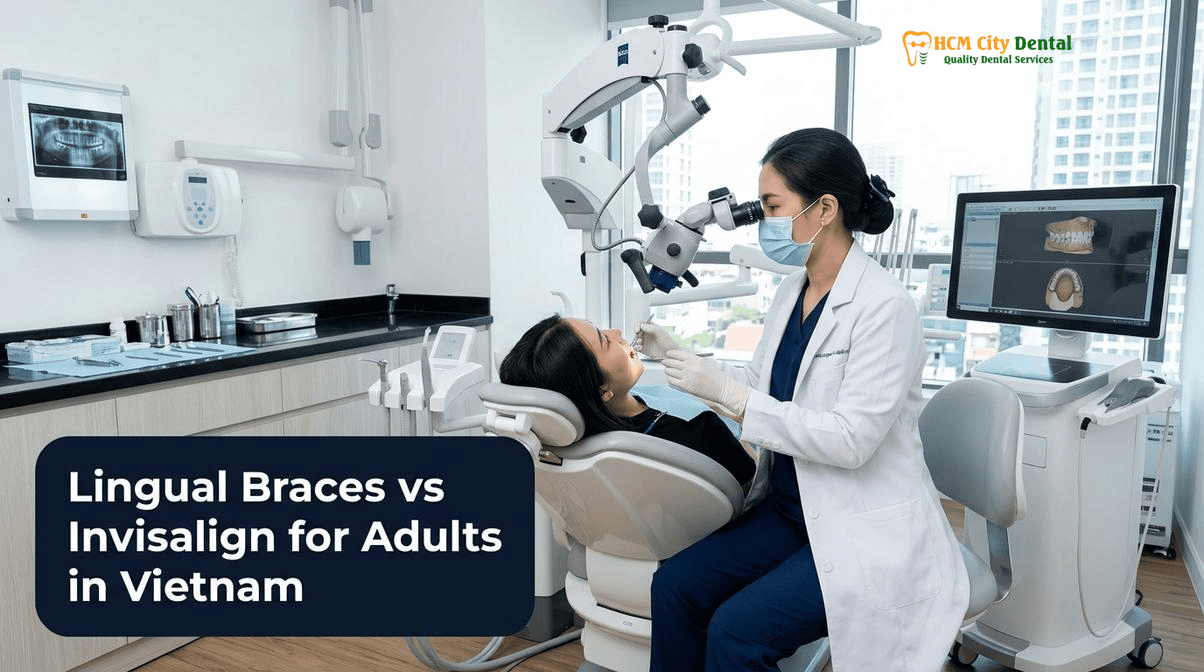
Lingual braces are not simply traditional braces placed backward. Modern lingual systems utilize custom 3D cad cam lingual brackets incognito technology. After a high-resolution intraoral scan, each bracket is digitally designed and 3D-printed or milled from a gold alloy or stainless steel to perfectly match the unique lingual morphology of each specific tooth. This custom fit minimizes the bracket profile, reducing tongue interference, while custom-bent robotic archwires ensure precise, targeted tooth movement. Because they are hidden behind the teeth, they are the premier choice for invisible orthodontics for executives Saigon who cannot compromise on aesthetics during high-stakes meetings or media appearances.
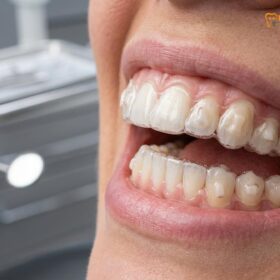
Conversely, Invisalign clear aligners utilize a proprietary SmartTrack multilayered polyurethane material combined with SmartForce composite attachments bonded to the labial (front) surfaces of the teeth. While highly aesthetic, they are not 100% invisible; the attachments and the plastic itself can catch the light. However, Invisalign offers the profound advantage of removability. Patients can eat without restrictions and maintain optimal periodontal hygiene by brushing and flossing normally. Furthermore, we also evaluate alternatives like Straumann ClearCorrect (featuring ClearQuartz tri-layer material and a 2mm high flat trimline for enhanced retention) and Angel Aligner Pro (utilizing the 7+3 MasterControl S dual-shell system with AngelButtons for complex mechanics) to tailor the aligner therapy to the patient’s specific malocclusion [1].
Biomechanical Advantages of Lingual Braces: Why Force Applied Near the Center of Resistance Excels at Deep Bite Opening and Torque
To understand why an orthodontist might recommend lingual braces over clear aligners for a complex case, one must delve into the physics of tooth movement. Every tooth has a “center of resistance” (CR)—a theoretical point, usually located in the root embedded within the alveolar bone, around which the tooth will pivot if a single force is applied. To move a tooth bodily (translation) without tipping it, the line of force must pass directly through this center of resistance.
The lingual surface of a tooth is anatomically closer to its center of resistance than the labial (front) surface. When force is applied via lingual brackets, the resulting moment (the tendency of the tooth to rotate or tip) is significantly reduced. This biomechanical reality makes lingual braces exceptionally efficient at specific movements, particularly deep bite correction (intruding the anterior teeth) and maintaining incisor torque control extraction cases lingual vs aligners.
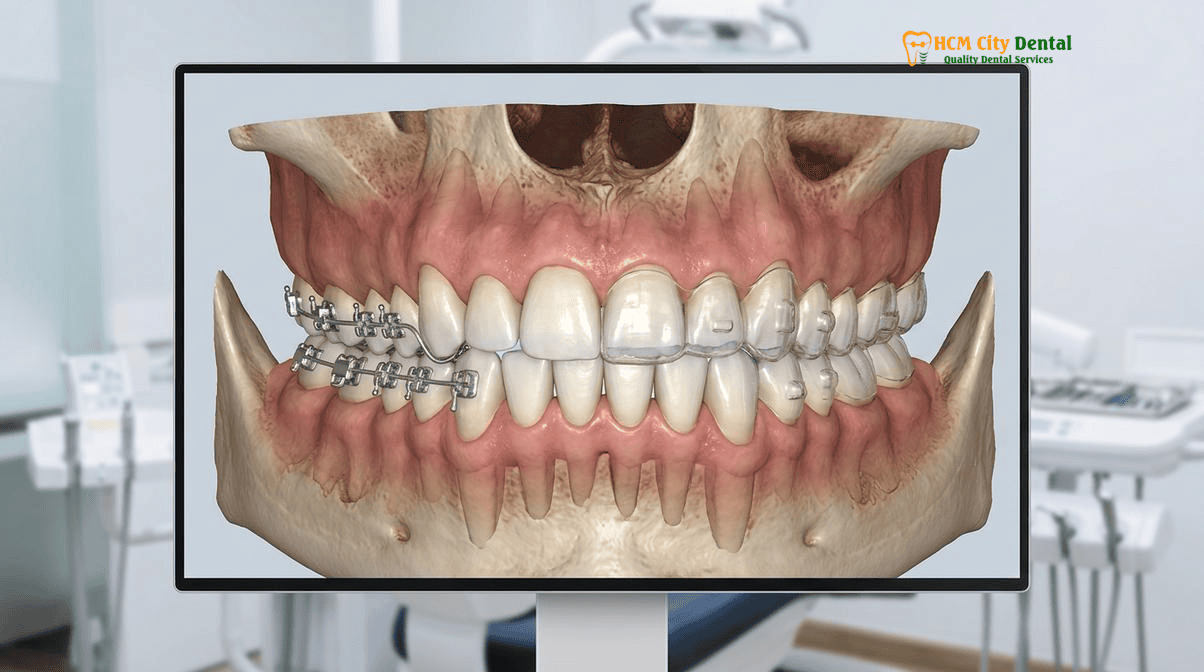
In cases where premolars are extracted to resolve severe crowding or bimaxillary protrusion, the anterior teeth must be retracted into the extraction spaces. With clear aligners, the pushing force of the plastic often causes the crowns to tip backward (lingual dumping) while the roots remain stationary, creating a “rollercoaster” effect on the occlusal plane. Overcoming this with aligners requires complex power ridges, large attachments, and often the integration of Orthodontic TAD Mini-Screws (IZC / Buccal Shelf). Lingual braces, however, naturally apply a force vector that encourages bodily translation, maintaining the proper inclination (torque) of the incisors as they are retracted [2].
“The biomechanical efficiency of lingual orthodontics cannot be overstated. By applying forces closer to the center of resistance, we achieve profound control over root torque and anterior intrusion. For adult patients requiring extraction space closure who demand absolute invisibility, custom CAD/CAM lingual systems offer a level of precision that removable aligners struggle to match without extensive auxiliary mechanics.”
— Dr. Nguyen Van Cuong, DDS
While labial systems like Damon Ultima/Q2 passive self-ligating brackets with Copper NiTi archwires (requiring 8–10 week adjustment intervals) are excellent for broad arch expansion, lingual braces provide the same continuous, 24/7 force application without the aesthetic penalty of visible metal or ceramic.
Compliance, Eating, Oral Hygiene, and Speech Adaptation (The 14-Day Tongue & ‘S’ Sound Adaptation Protocol)
The primary trade-off for the absolute invisibility of lingual braces is the initial impact on the tongue and speech. Because the brackets occupy the space where the tongue normally rests and articulates against the lingual surfaces of the maxillary incisors, patients will experience a temporary disruption in phonetics. Understanding the lingual braces speech lisp adaptation timeline is crucial for setting realistic expectations.
During the first 48 to 72 hours, the tongue may feel irritated, and patients often develop a slight lisp, particularly when pronouncing sibilant sounds (/s/, /z/) and alveolar consonants (/t/, /d/, /n/, /l/). At HCMC Dental Clinic, we guide our patients through a structured 14-Day Tongue & ‘S’ Sound Adaptation Protocol to accelerate neuroplasticity and phonetic recovery:
- Days 1–3 (The Irritation Phase): Use generous amounts of orthodontic wax over the anterior lingual brackets to protect the tongue. Stick to a soft diet (smoothies, mashed vegetables, soft fish) to minimize chewing fatigue.
- Days 4–7 (The Articulation Phase): Begin reading aloud slowly for 15–20 minutes daily. Focus on over-enunciating ‘S’ words. The brain will begin to map new motor pathways for the tongue, learning to articulate just behind the brackets rather than directly on the cingulum of the incisors.
- Days 8–14 (The Resolution Phase): As the tongue develops a slight keratinized resistance and muscle memory adapts, the lisp rapidly diminishes. By the end of the second week, over 90% of adult patients report that their speech has returned to normal and tongue irritation has resolved [3].
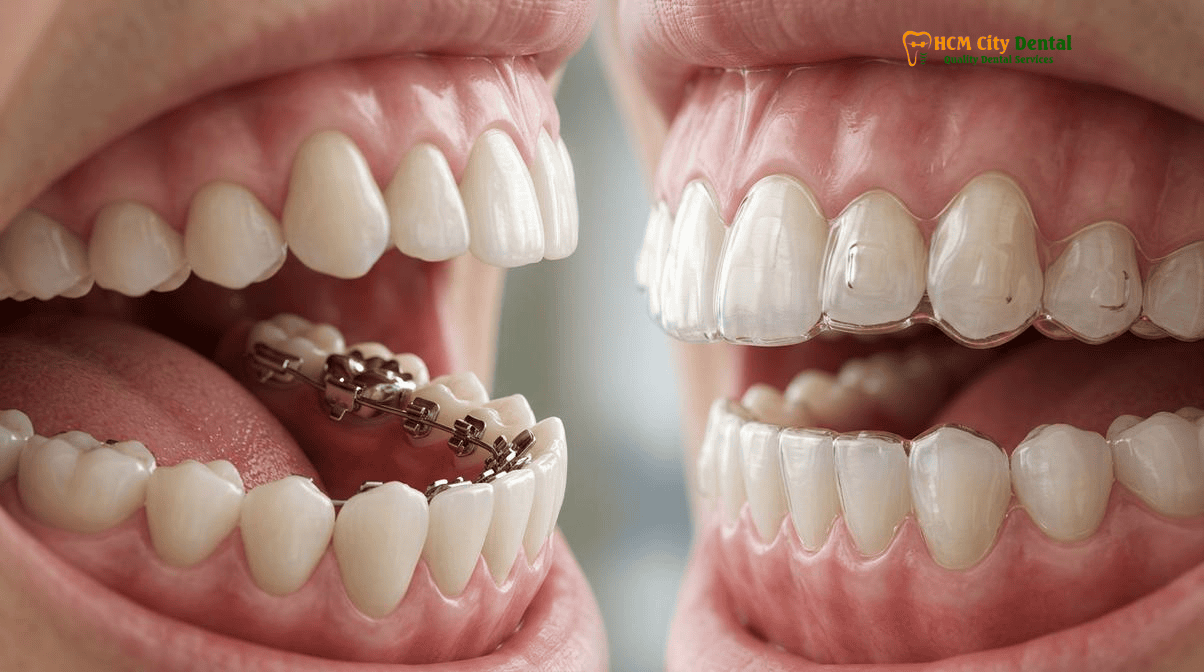
In contrast, Invisalign clear aligners cause minimal speech disruption. However, aligners demand a different type of discipline: strict compliance. Aligners must be worn for 20 to 22 hours a day. They must be removed for all meals and snacks, and teeth must be brushed and flossed before reinserting the trays to prevent trapping fermentable carbohydrates against the enamel, which can lead to rapid decalcification and caries.
When Invisalign Beats Lingual Braces (Short-Stay Dental Tourists, Periodontal Hygiene & Zero Chairside Wire Emergencies)
While lingual braces offer superior biomechanics for certain complex movements, there are distinct clinical scenarios where Invisalign clear aligners are undeniably the superior choice, particularly for international patients seeking care at a Specialist Orthodontics, TADs & Adult Palatal Expanders in Ho Chi Minh City.
For the short-stay dental tourist or the expatriate who travels frequently, Invisalign provides unparalleled safety and convenience. Fixed braces—whether labial or lingual—carry a small but persistent risk of chairside emergencies, such as a broken bracket or a poking archwire. If an international patient is back in Australia or the US, finding a local orthodontist willing to repair a custom lingual system placed in Vietnam can be difficult and expensive. Invisalign eliminates this risk entirely. There are no wires to poke and no brackets to break. If an aligner is lost or damaged, the patient simply moves to the next tray in the series or reverts to the previous one while a replacement is ordered.
Clinical Precaution for International Patients:
If you are an international patient flying into Ho Chi Minh City only every 4 to 6 months, we strongly advise against fixed lingual braces due to the inability to manage potential wire emergencies remotely. Invisalign clear aligners, combined with remote digital monitoring, are the safest and most predictable modality for long-distance orthodontic care. Always consult with Dr. Cuong to determine the safest appliance for your travel schedule.
Furthermore, for adults with a history of periodontal disease or those who struggle with manual dexterity, Invisalign is vastly superior for oral hygiene. Lingual braces are notoriously difficult to clean. Plaque accumulation around lingual brackets can lead to gingival inflammation and calculus buildup, requiring meticulous use of water flossers and interdental brushes. With Invisalign, the patient removes the appliance, allowing for unobstructed brushing, flossing, and routine professional prophylaxis [4].
The Hybrid Esthetic Option: Upper Lingual Braces + Lower Ceramic/Clear Aligner Therapy
For patients who desire the absolute invisibility of lingual braces but wish to mitigate costs, tongue irritation, or hygiene challenges, HCMC Dental Clinic offers a highly effective hybrid approach. Because the upper teeth are the most visible during speech and smiling, we can place custom lingual braces on the maxillary (upper) arch. For the mandibular (lower) arch, which is largely hidden by the lower lip, we can utilize either clear ceramic labial braces or clear aligner therapy.
This hybrid approach significantly reduces the inside lingual braces vs Invisalign cost differential while maximizing aesthetics where it matters most. It also drastically reduces tongue irritation, as the lower lingual brackets are often the primary culprits for tongue soreness during swallowing and speech.
Real-World Patient Scenario: The Executive Hybrid Approach
A 42-year-old Australian executive relocated to District 1, Ho Chi Minh City, presented with severe upper anterior crowding and a deep bite. His corporate role required constant public speaking, making visible labial braces unacceptable. Dr. Cuong designed a hybrid treatment plan: custom 3D CAD/CAM lingual braces on the upper arch to efficiently intrude the incisors and resolve crowding invisibly, paired with Invisalign clear aligners on the lower arch to manage mild spacing while ensuring easy oral hygiene. The treatment was completed in 16 months with zero aesthetic compromise during his professional duties.
Regardless of the active treatment modality, the retention phase is critical for long-term stability. At HCMC Dental Clinic, we employ a rigorous dual retention protocol. We compare the benefits of Invisalign Vivera retainers (utilizing genuine Align Technology SmartTrack material for superior durability) versus standard Essix clear retainers, often combining them with a 3-to-3 fixed lingual wire.
Furthermore, adult orthodontics often intersects with airway and temporomandibular joint (TMJ) health. As part of our comprehensive Wave 3 digital protocols, we integrate Orofacial Myofunctional Therapy (OMT palatal tongue suction posture + functional laser lingual frenuloplasty) to ensure proper tongue resting posture, which naturally supports the expanded dental arches. For patients exhibiting signs of Obstructive Sleep Apnea (OSA) or CPAP intolerance, we may transition post-orthodontic retention into custom titratable Dorsal-Fin / Herbst Mandibular Advancement Devices (MAD calibrated at 50–70% maximum protrusion). For TMJ stabilization, we utilize the Kois Anterior Deprogrammer versus CAD/CAM milled PMMA Michigan Stabilization Splints in Centric Relation (CR) to ensure the newly aligned teeth harmonize perfectly with the jaw joints [5].
2026 Custom Lingual Braces vs. Invisalign Comprehensive Fee Schedule at HCMC Dental Clinic (District 1)
Understanding the financial investment is a critical component of choosing between these advanced orthodontic systems. When evaluating Invisalign Cost Vietnam vs Australia: Clinical Price Guide | HCMC Dental, the savings are substantial. HCMC Dental Clinic provides transparent, tier-based pricing for all orthodontic and restorative procedures.
Below is our Official 2026 Dental Price List & -40% Online Booking Fee Schedule. Please note that custom lingual braces require specialized laboratory fabrication (often sent to specialized CAD/CAM labs internationally) and highly technique-sensitive chairside bonding, which places their cost higher than traditional labial braces but still significantly lower than Western benchmarks.
| Orthodontic & Restorative Treatment | 2026 Online Booking Fee (USD) | Walk-In / Standard List Price (USD) | Estimated AU/US Benchmark (USD) |
|---|---|---|---|
| Invisalign Comprehensive (Unlimited Aligners) | $2,538 USD (66,000,000 VND) | $4,231 USD | $6,500 – $8,500+ |
| Invisalign Go / Lite / Express (Up to 14–20 Aligners) | $1,615 USD (42,000,000 VND) | $2,692 USD | $4,000 – $5,500+ |
| Custom 3D CAD/CAM Lingual Braces (Upper & Lower) | Consultation Required (Lab Dependent) | Consultation Required | $9,000 – $13,000+ |
| Invisalign Vivera Retainer (Genuine SmartTrack) | $308 USD (8,000,000 VND) | $513 USD | $800 – $1,200+ |
| Essix Clear Retainer (Per Pair) | $97 USD (2,520,000 VND) | $161 USD | $300 – $500+ |
| Hawley Wire Retainer (Per Pair) | $115 USD (3,000,000 VND) | $191 USD | $400 – $600+ |
| Orthodontic TAD Mini-Screw (IZC / Buccal Shelf) | $77 – $115 USD / screw | $128 – $191 USD | $300 – $500+ |
| Non-Surgical Adult MARPE / MSE Palatal Expander | $769 – $1,154 USD | $1,281 – $1,923 USD | $2,500 – $4,000+ |
| IPS E.max Porcelain Veneer (Post-Ortho Esthetics) | $185 USD / tooth (4,800,000 VND) | $308 USD | $1,200 – $2,000+ |
| Single European / Swiss Implant (Straumann BLT-SLA) | $962 – $1,346 USD | $1,603 – $2,244 USD | $4,500 – $6,000+ |
“Our commitment at HCMC Dental Clinic is to provide uncompromising clinical excellence utilizing the exact same biomaterials—such as Align Technology’s SmartTrack and custom CAD/CAM lingual alloys—used in top-tier clinics in Sydney, London, or New York, but at a price point that makes comprehensive adult orthodontics accessible. Transparency in our online fee schedule ensures our international patients can plan their treatment with absolute financial certainty.”
— Dr. Nguyen Van Cuong, DDS
For patients considering transferring an existing Invisalign case to Vietnam, or initiating a new case while living abroad, we offer specialized protocols. Learn more about Invisalign in Vietnam for Foreigners: Cost & Case Transfers to understand how we utilize remote digital monitoring to ensure your treatment progresses flawlessly, regardless of your geographic location.
Frequently Asked Questions
Are lingual braces 100% invisible when I speak, laugh, or appear on high-definition video calls?
Yes. Because custom 3D CAD/CAM lingual brackets are bonded exclusively to the palatal and lingual (inner) surfaces of your teeth, they are completely hidden from view. Whether you are speaking in a boardroom, laughing, or appearing on high-definition video calls, observers will not see any metal or ceramic hardware. This makes them the ultimate choice for invisible orthodontics for executives in Saigon.
How long does the temporary tongue irritation and slight speech lisp last after getting inside lingual braces?
The lingual braces speech lisp adaptation timeline typically spans 10 to 14 days. During the first 72 hours, the tongue may feel irritated as it encounters the new brackets during swallowing and speech (particularly with sibilant sounds like ‘s’ and ‘z’). By following our 14-Day Tongue & ‘S’ Sound Adaptation Protocol—which includes reading aloud slowly and using orthodontic wax—neuroplasticity allows the tongue to adjust its resting posture and articulation pathways, resolving the lisp completely for the vast majority of adult patients.
Why do orthodontists prefer lingual braces or TAD-assisted aligners when closing premolar extraction spaces?
Closing premolar extraction spaces requires precise bodily movement (translation) of the anterior teeth rather than simple tipping. Lingual braces apply force much closer to the tooth’s center of resistance, providing superior incisor torque control in extraction cases compared to standard aligners. When using clear aligners for massive space closure, orthodontists often must integrate Temporary Anchorage Devices (TADs) and complex SmartForce attachments to prevent the crowns from dumping inward (the ‘rollercoaster effect’).
Which is better for an expat living in Ho Chi Minh City vs. an international patient flying in every 4–6 months?
For an expat residing full-time in Ho Chi Minh City, both inside lingual braces and Invisalign are excellent options, as regular 6-to-8-week monitoring appointments are easily accommodated. However, for an international dental tourist flying into Vietnam only every 4 to 6 months, Invisalign clear aligners are vastly superior. Aligners eliminate the risk of chairside wire emergencies (like a poking wire) and allow for remote monitoring via digital scans, making them the safest choice for long-distance patients.
How much do custom lingual braces vs. Invisalign cost at HCMC Dental Clinic in District 1?
At HCMC Dental Clinic, our 2026 online booking fee schedule offers exceptional value. Invisalign Comprehensive (unlimited aligners) is priced at $2,538 USD online, while Invisalign Go/Lite is $1,615 USD online. Custom 3D CAD/CAM lingual braces generally require a specialized laboratory fabrication process and highly technique-sensitive chairside bonding, placing their cost higher than traditional labial braces but still significantly lower than equivalent treatments in Australia or the US. Please consult our official pricing page for exact lingual appliance laboratory fees.
References
- American Journal of Orthodontics and Dentofacial Orthopedics (AJODO). Biomechanical considerations in lingual orthodontics: Center of resistance and torque control in adult extraction cases. (2023).
- Journal of Clinical Orthodontics (JCO). Comparative efficacy of custom 3D CAD/CAM lingual brackets versus clear aligner therapy for deep bite correction in adult patients. (2022).
- International Journal of Dentistry. Speech adaptation and phonetic alterations during the first 30 days of lingual orthodontic treatment: A prospective acoustic analysis. (2021).
- Angle Orthodontist. Periodontal health and plaque accumulation in adults undergoing clear aligner therapy versus fixed lingual appliances: A randomized clinical trial. (2023).
- Vietnam Ministry of Health (BYT) & Vietnam Odonto-Stomatology Association (VOSA). National Clinical Guidelines on Specialist Dental Care, Biomaterial Traceability & EN 13060 Class B Infection Control. (2024).