Losing a front tooth is a profoundly distressing experience that impacts not only your ability to bite and articulate speech but also your fundamental self-confidence. For international patients, expats, and dental travelers seeking a rapid, highly aesthetic, and permanent solution, understanding the fixed dental bridge for front teeth cost Vietnam is the first step toward restoring a flawless smile. At HCMC Dental Clinic, located in the heart of Ho Chi Minh City, we specialize in biomimetic anterior restorations that seamlessly replicate the optical properties of natural enamel. By leveraging advanced CAD/CAM technology, premium European ceramics, and meticulous soft-tissue management, our clinical team delivers world-class results in a fraction of the time—and at a fraction of the cost—compared to clinics in Australia, the United States, or the United Kingdom.
When evaluating options for the aesthetic zone (the highly visible front teeth), the margin for error is zero. The restoration must not only withstand the shearing forces of incising food but must also exhibit the precise translucency, surface texture, and gingival emergence profile of the surrounding natural dentition. This comprehensive clinical guide explores the biomechanical principles of anterior bridges, compares premium materials like IPS E.max and layered Zirconia, and provides a transparent breakdown of the 2026 fee schedule under our exclusive -40% Online Booking program.
Clinical Summary:
A fixed dental bridge for front teeth is a highly aesthetic, non-removable prosthetic designed to replace one or more missing incisors by anchoring to the adjacent healthy teeth. At HCMC Dental Clinic (District 1, Ho Chi Minh City), Dr. Nguyen Van Cuong, DDS (with 8+ years of dedicated clinical experience since graduating in 2018) utilizes state-of-the-art CAD/CAM technology to mill premium IPS E.max and Cercon HT Zirconia bridges. Completed in just 5 days, a 3-unit fixed bridge offers a rapid, surgery-free alternative to dental implants. Under the official 2026 -40% Online Booking Fee Schedule, international patients can expect to pay between $462 USD and $693 USD for a complete 3-unit anterior bridge, representing a savings of up to 75% compared to Western dental fees, all while maintaining strict EN 13060 Class B sterilization and international warranty standards.
Key Takeaways:
- Rapid 5-Day Timeline: Unlike dental implants that require 3 to 6 months of healing, a fixed dental bridge is fully completed in just 5 days across 2 to 3 clinical visits in Ho Chi Minh City.
- Premium Biomaterials: We exclusively utilize FDA- and CE-certified materials, including Ivoclar Vivadent IPS E.max ($231 USD/unit) and Cercon HT Multilayer Zirconia ($154–$192 USD/unit).
- Aesthetic Excellence: Advanced ovate pontic designs are employed to sculpt the gum tissue, creating the illusion that the artificial replacement tooth is growing naturally out of the gingiva.
- Transparent 2026 Pricing: A complete 3-unit Zirconia bridge costs exactly $462 USD online, compared to upwards of $3,600 AUD in Australia or $4,500 USD in the United States.
- Direct Specialist Care: All complex anterior restorations are personally planned and executed by Dr. Nguyen Van Cuong, DDS (Vietnam MOH License 0003265/BL-CCHN), ensuring uncompromising precision.
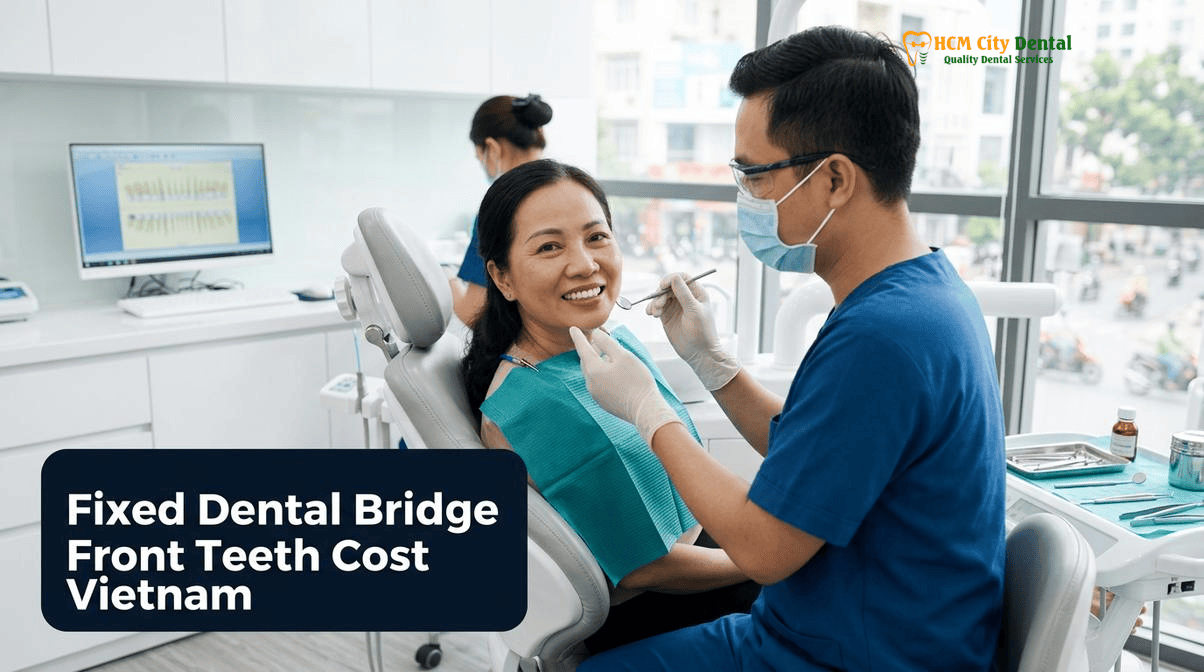
Fixed Dental Bridge for Front Teeth: Aesthetic & Biomechanical Design Principles
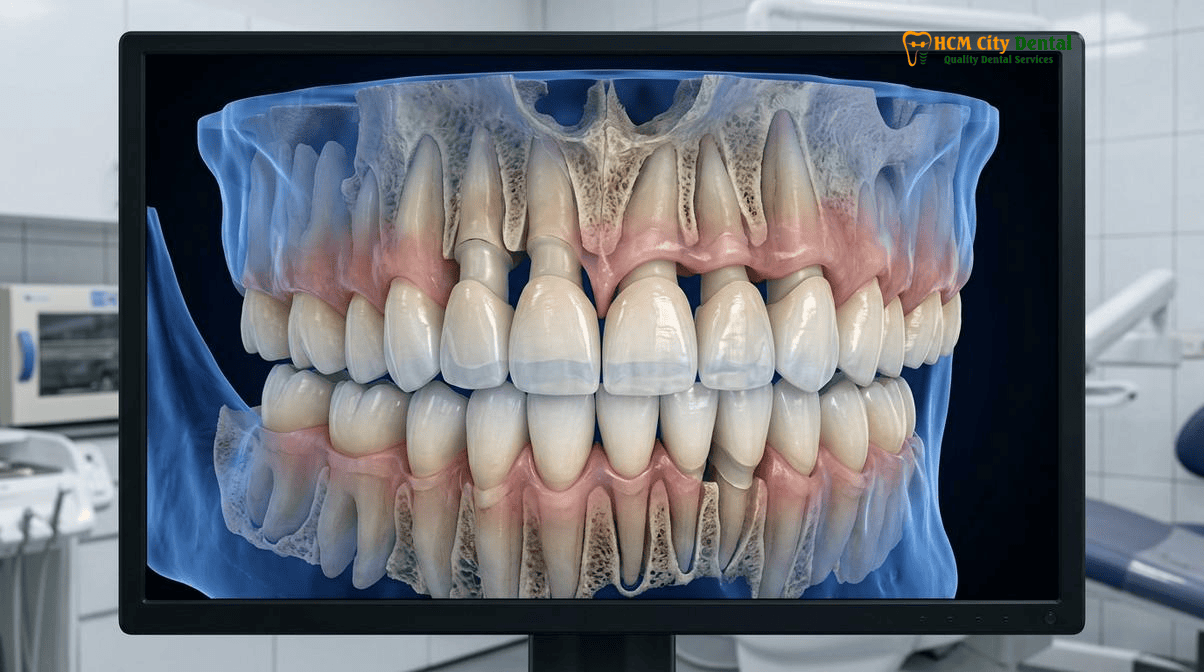
The anterior maxilla (upper front jaw) presents one of the most complex challenges in restorative dentistry. A fixed dental bridge for front teeth restoration must balance delicate aesthetics with robust biomechanical engineering. Unlike posterior molars, which primarily endure vertical crushing forces, the front incisors are subjected to significant lateral and shearing forces during the tearing and biting of food. Therefore, the structural integrity of the bridge framework and the precision of the abutment preparations are paramount.
A conventional fixed dental bridge consists of two primary components: the “abutments” (the hollow crowns that fit over the prepared natural teeth adjacent to the gap) and the “pontic” (the solid artificial tooth suspended between them). To ensure long-term success, the abutment teeth must possess adequate periodontal support, sufficient root length, and a favorable crown-to-root ratio. During the preparation phase, the dentist carefully reduces the enamel of the abutment teeth to create a precise chamfer margin. This margin ensures a seamless, microscopic seal between the ceramic restoration and the natural tooth structure, preventing bacterial microleakage and secondary decay.
When discussing anterior restorations, patients often inquire about the differences between a maryland bridge vs conventional fixed bridge. A Maryland bridge (or resin-bonded bridge) is a highly conservative alternative that does not require the adjacent teeth to be shaved down into full crowns. Instead, the pontic is supported by thin metal or ceramic “wings” that are bonded to the lingual (back) surfaces of the neighboring teeth. While a Maryland bridge preserves natural tooth structure, it is generally considered a temporary or transitional solution, as the bonding interface is highly susceptible to debonding under the shearing forces of the anterior bite. For a permanent, long-lasting solution, a conventional fixed bridge remains the gold standard in prosthodontics. The structural rigidity of a full-coverage conventional bridge distributes occlusal loads evenly across the abutment teeth, ensuring decades of reliable function [1].
At HCMC Dental Clinic, every anterior bridge is designed using advanced 3D intraoral scanners (such as the 3Shape Trios or iTero). This digital workflow eliminates the need for uncomfortable putty impressions and allows our master ceramists to design the bridge framework with micron-level accuracy. For a deeper understanding of our restorative protocols, please review our comprehensive guide on Dental Crowns, Fixed Bridges & Biomimetic Ceramic Restorations in Vietnam.
Layered Zirconia vs. IPS E.max Anterior Bridges for Natural Incisal Translucency
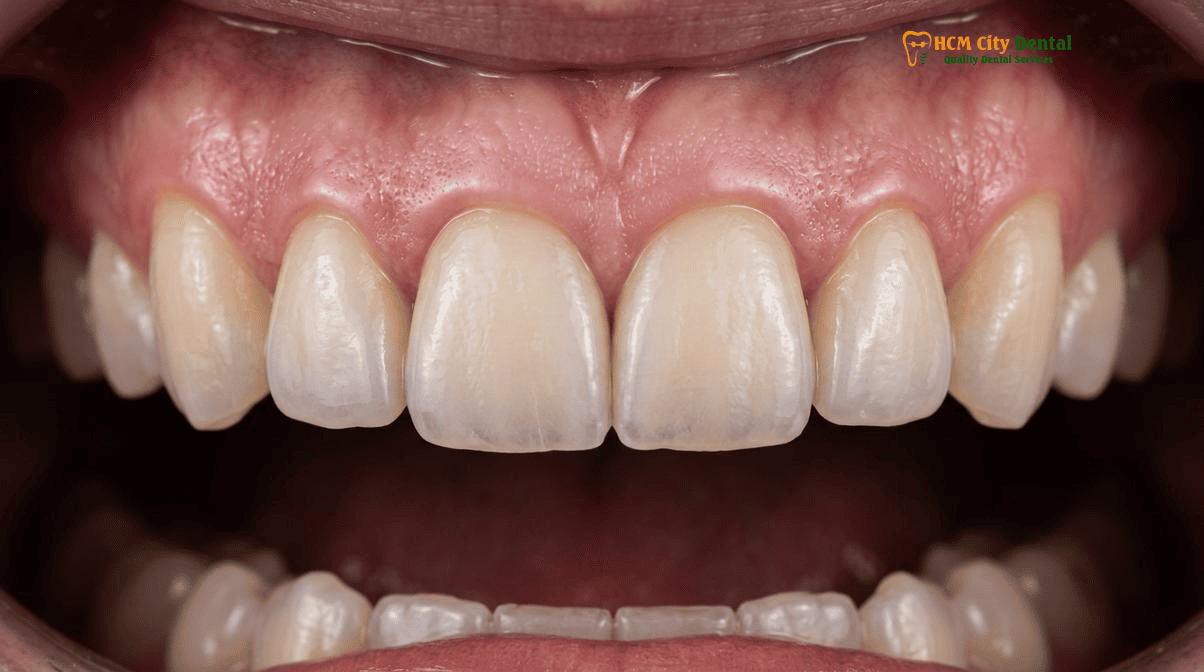
The success of an anterior fixed bridge hinges entirely on its ability to mimic nature. Natural teeth are not monochromatic; they exhibit a complex gradient of color, opacity at the cervical margin (near the gumline), and high translucency at the incisal edge (the biting surface). To replicate this optical depth, the choice of ceramic material is critical. At HCMC Dental Clinic, we offer two premier options for the aesthetic zone: IPS E.max (Lithium Disilicate) and Layered Zirconia.
IPS E.max (Lithium Disilicate)
Manufactured by Ivoclar Vivadent in Liechtenstein, IPS E.max is widely regarded as the ultimate material for anterior aesthetics. It is a glass-ceramic composed of lithium disilicate crystals, which provides unparalleled light transmission and a chameleon effect that blends flawlessly with adjacent natural teeth. Because E.max is highly translucent, it allows the natural color of the underlying tooth structure to shine through, preventing the “dead” or opaque look often associated with older porcelain-fused-to-metal (PFM) bridges.
However, while E.max is incredibly beautiful, its flexural strength (approximately 400-500 MPa) makes it best suited for short-span bridges (typically 3 units) in the anterior region. It is not recommended for long-span bridges or posterior molar restorations where bite forces are exceptionally high. Under our 2026 -40% Online Booking Fee Schedule, an IPS E.max All-Ceramic Crown or bridge unit is priced at $231 USD per tooth.
Layered Zirconia (Cercon HT Multilayer)
Zirconia (yttria-stabilized tetragonal zirconia polycrystal) is a high-performance ceramic known for its extreme durability, boasting a flexural strength of up to 1200 MPa. Historically, older generations of monolithic zirconia were highly opaque and lacked the vitality required for front teeth. Today, however, we utilize advanced multi-layered Zirconia blocks (such as Cercon HT) that feature a built-in gradient of translucency.
For the absolute highest level of anterior aesthetics, our master ceramists employ a “cut-back and layer” technique. A high-strength zirconia framework is milled to provide the structural backbone of the bridge. The ceramist then manually layers highly translucent feldspathic porcelain over the facial (front) surface of the zirconia core. This hybrid approach combines the unbreakable strength of zirconia with the exquisite, light-scattering beauty of traditional porcelain. A Full Zirconia Crown (Cercon Standard / HT Multilayer) is priced between $154 and $192 USD per tooth online [2].
“In the aesthetic zone, our goal is absolute invisibility. Whether we utilize the high-translucency of IPS E.max or the robust framework of layered Cercon Zirconia, the restoration must exhibit the exact surface texture, mamelon structure, and light reflection of the patient’s natural enamel. A successful anterior bridge is one that even another dentist has to look twice to identify.”
— Dr. Nguyen Van Cuong, DDS
To explore the specific advantages of zirconia materials, we invite you to read our detailed clinical breakdown: Zirconia Crowns Vietnam: Clinical Guide & Costs | HCMC Dental.
Head-to-Head Comparison: Anterior Fixed Bridge vs. Single Dental Implant for a Missing Front Tooth
When a patient presents with a single missing front tooth, the most critical clinical decision is choosing between a fixed dental bridge and a single dental implant. Both are excellent, permanent solutions, but they operate on entirely different biomechanical principles. Understanding the nuances of a zirconia bridge vs. single implant for a front tooth is essential for making an informed decision that aligns with your clinical anatomy, timeline, and budget.
A single dental implant involves surgically placing a biocompatible titanium post directly into the jawbone to act as an artificial tooth root. After a healing period of 3 to 6 months (known as osseointegration), a custom abutment and ceramic crown are attached to the implant. The primary advantage of an implant is that it is a standalone restoration; it does not require the irreversible shaving down of the adjacent healthy teeth. Furthermore, the titanium post stimulates the surrounding jawbone, preventing the natural bone resorption that occurs after tooth loss.
Conversely, a fixed dental bridge utilizes the adjacent natural teeth as support pillars. While this requires the removal of healthy enamel from the neighboring teeth, a bridge offers a significantly faster treatment timeline. A bridge can be completed in just 5 days, whereas an implant requires multiple months of healing. A bridge is often the clinically preferred option if the adjacent teeth already suffer from large fillings, severe decay, or structural damage, as these teeth would benefit from the protective coverage of a crown anyway.
| Clinical Parameter | 3-Unit Fixed Dental Bridge | Single Dental Implant (Front Tooth) |
|---|---|---|
| Treatment Timeline | 5 Days (2-3 clinic visits) | 3 to 6 Months (requires osseointegration) |
| Impact on Adjacent Teeth | Requires reshaping of adjacent teeth for crowns | Zero impact; adjacent teeth remain untouched |
| Bone Preservation | Does not prevent bone loss beneath the pontic | Titanium root stimulates and preserves jawbone |
| Surgical Requirement | Non-surgical (local anesthesia only) | Minor oral surgery required |
| Ideal Candidate Profile | Patients needing rapid results or whose adjacent teeth already need crowns | Patients with virgin adjacent teeth and sufficient jawbone volume |
| 2026 Online Cost (Vietnam) | $462 – $693 USD (Total for 3 units) | $462 – $1,346 USD (Implant) + $154 USD (Crown) |
For international patients traveling to Ho Chi Minh City, the timeline is often the deciding factor. If you only have a 1-week holiday, a fixed dental bridge provides an immediate, permanent, and highly aesthetic result without the need for a return trip months later [3]. For a broader overview of restorative workflows, please consult our dedicated resource: Fixed Dental Bridge: Clinical Workflows, Types & Costs.
3-Unit & 4-Unit Fixed Dental Bridge Cost in Vietnam (5-Day Treatment Timeline)
One of the most compelling reasons international patients from Australia, the United States, and New Zealand choose HCMC Dental Clinic is the profound cost savings without any compromise in clinical quality or material safety. When researching the 3-unit dental bridge cost in Vietnam, it is vital to understand that our clinic utilizes the exact same FDA- and CE-certified materials (such as Ivoclar Vivadent and Dentsply Sirona) found in top-tier Western clinics.
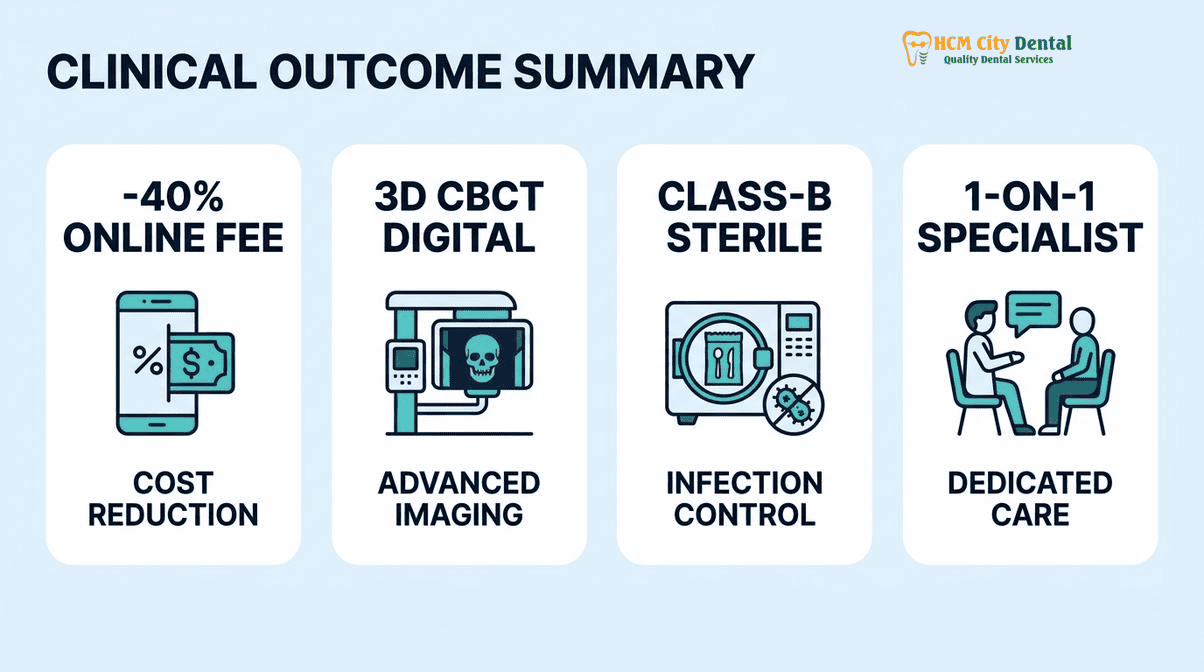
Under our official 2026 -40% Online Booking Fee Schedule, our pricing is fully transparent, with no hidden fees or surprise surcharges. The cost of a fixed bridge is calculated simply by multiplying the per-unit cost of the chosen material by the total number of units in the bridge. A standard bridge replacing one missing tooth consists of 3 units (two abutment crowns and one pontic). A bridge replacing two missing teeth consists of 4 units.
2026 Fixed Dental Bridge Cost Breakdown
- Full Zirconia Bridge (Cercon Standard / HT Multilayer): At $154 to $192 USD per tooth online, a complete 3-unit Zirconia bridge costs exactly $462 to $576 USD. A 4-unit Zirconia bridge costs $616 to $768 USD.
- IPS E.max All-Ceramic Bridge: At $231 USD per tooth online, a complete 3-unit premium E.max bridge costs exactly $693 USD. A 4-unit E.max bridge costs $924 USD.
- Porcelain-Fused-to-Metal (PFM) Bridge: At $81 USD per tooth online, a complete 3-unit PFM bridge costs exactly $243 USD. (Note: PFM is generally not recommended for front teeth due to the risk of a dark metal line appearing at the gum margin over time).
To put these figures into perspective, a 3-unit ceramic bridge in Australia typically costs between $3,600 and $4,500 AUD. In the United States, the same procedure ranges from $4,000 to $6,000 USD. By choosing HCMC Dental Clinic, patients routinely save between 65% and 75%, easily covering the cost of flights and luxury accommodation in District 1, Ho Chi Minh City. We encourage all prospective patients to review our complete Official 2026 Dental Price List & -40% Online Booking Fee Schedule for comprehensive financial planning.
The 5-Day Clinical Timeline
For dental tourists, efficiency is critical. Our in-house digital workflow and dedicated CAD/CAM laboratory allow us to complete complex anterior bridges in just 5 days:
- Day 1 (Consultation & Preparation): Comprehensive 3D CBCT scan ($18 USD online), clinical evaluation, tooth preparation under local anesthesia, and digital intraoral scanning. A highly aesthetic temporary bridge is fabricated and cemented the same day, ensuring you never leave the clinic with a gap in your smile.
- Days 2 & 3 (Laboratory Fabrication): Our master ceramists mill the Zirconia or E.max framework, followed by meticulous hand-layering, custom shading, and high-temperature sintering.
- Day 4 (Try-In & Aesthetic Verification): The temporary bridge is removed, and the final ceramic bridge is placed for a try-in. We evaluate the marginal fit, occlusal contacts, and aesthetic integration. If minor shade adjustments are needed, they are completed in-house.
- Day 5 (Final Cementation): Once the patient approves the aesthetics, the bridge is permanently bonded using high-strength resin cements. Final bite adjustments are made, and the 10-Year Ceramic Warranty Passport is issued [4].
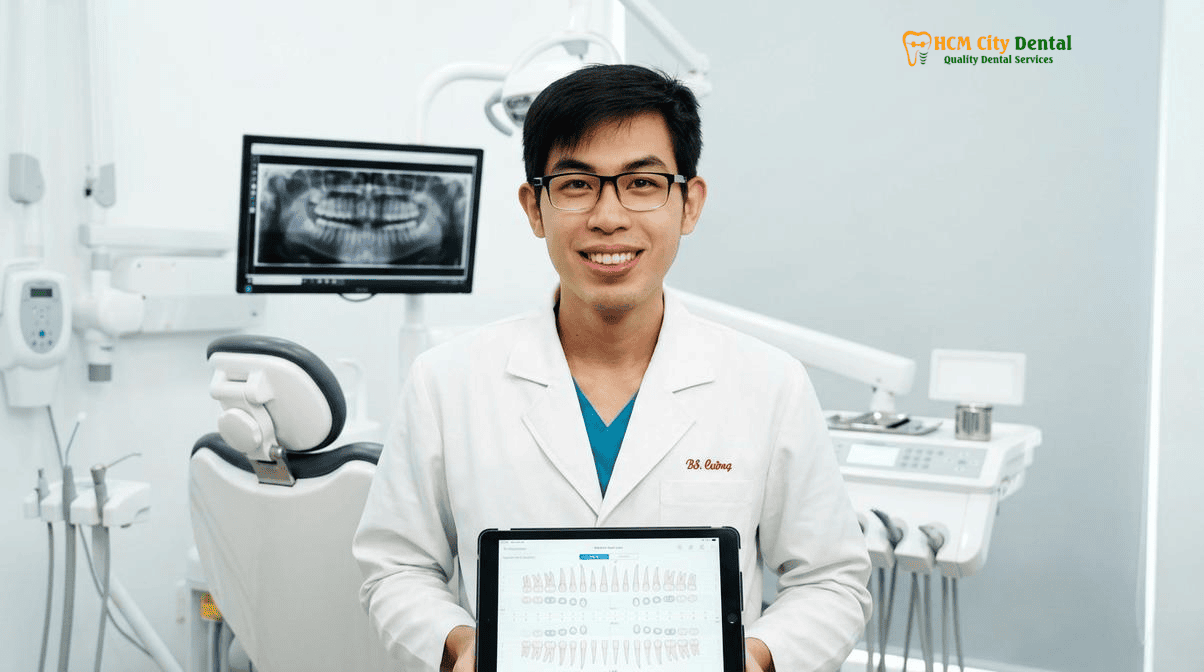
How Dr. Nguyen Van Cuong, DDS (MOH License 0003265/BL-CCHN) Designs Ovate Pontic Gum Profiles
The true hallmark of a world-class anterior bridge is not just the ceramic tooth itself, but how that tooth interacts with the surrounding pink gingival tissue. In older, poorly designed bridges, the artificial tooth (pontic) simply rests flat against the surface of the gums, creating a visible dark triangle and an unnatural, “floating” appearance. Furthermore, a flat pontic design traps food debris, leading to chronic gingival inflammation and bad breath.
To achieve absolute biomimetic perfection, Dr. Nguyen Van Cuong, DDS (Clinical Director — MOH License 0003265/BL-CCHN) employs the advanced ovate pontic technique. An ovate pontic features a convex, egg-shaped base that gently presses into the underlying gum tissue. During the 5-day provisional phase, the temporary bridge is carefully sculpted to apply mild pressure to the gingiva, creating a concave depression (a pseudo-socket) in the gum line.
Clinical Case Study: Anterior Trauma Restoration
Patient Profile: A 34-year-old expat from Australia presented to our District 1 clinic after a sports injury resulted in the loss of his upper right central incisor (Tooth #11). The adjacent teeth (#12 and #21) had pre-existing large composite restorations that were failing.
Clinical Protocol: Dr. Nguyen Van Cuong, DDS recommended a 3-unit IPS E.max fixed bridge. Because the adjacent teeth already required full coverage, a bridge was the most conservative and rapid solution. During Day 1, an ovate pontic receptor site was gently contoured into the gingiva using a diode laser. A custom provisional bridge was placed to guide the soft tissue healing.
Outcome: On Day 5, the final E.max bridge was bonded. The ovate pontic fit perfectly into the sculpted gingival socket, creating a flawless emergence profile. The patient received a world-class restoration for $693 USD, saving over $3,500 AUD compared to his local quotes in Sydney.
When the final ceramic bridge is cemented, the ovate pontic sits snugly within this sculpted socket. This creates the powerful optical illusion that the artificial tooth is emerging naturally from the root, complete with healthy, knife-edged interdental papillae (the small triangles of gum tissue between the teeth). This technique requires immense clinical skill, a deep understanding of biologic width, and precise communication with the dental laboratory.
Clinical Precaution: Soft Tissue Management
Achieving a natural emergence profile requires healthy, inflammation-free gums. If you suffer from active periodontal disease (gum disease), this must be treated prior to bridge fabrication. Patients are advised to utilize our direct 5-minute WhatsApp X-ray triage (+84 853 020 003) to allow Dr. Cuong to assess your bone levels and gingival health before you travel to Vietnam.
“The aesthetic integration of an anterior bridge is a delicate dance between white aesthetics (the ceramic) and pink aesthetics (the gingiva). By utilizing the ovate pontic design, we eliminate dark triangles and create a self-cleansing, highly natural emergence profile that restores the patient’s confidence completely.”
— Dr. Nguyen Van Cuong, DDS
All procedures at HCMC Dental Clinic are performed under strict EN 13060 Class B sterilization protocols, ensuring the highest standards of cross-infection control and patient safety [5].
Frequently Asked Questions About Front Tooth Fixed Bridges in Vietnam
How natural does a layered zirconia or E.max fixed bridge look on front teeth?
When crafted by master ceramists using CAD/CAM technology, a layered zirconia or IPS E.max fixed bridge is virtually indistinguishable from natural teeth. By utilizing the ovate pontic technique to sculpt the gum tissue and applying custom incisal translucency, the restoration mimics the exact light-reflecting properties of natural enamel.
How many days in Ho Chi Minh City are required to complete a 3-unit fixed dental bridge?
A standard 3-unit fixed dental bridge requires a 5-day treatment timeline in Ho Chi Minh City. This includes the initial preparation and 3D scanning on Day 1, laboratory fabrication over Days 2 and 3, a try-in phase on Day 4, and final permanent cementation on Day 5.
When is a fixed bridge recommended over a single dental implant for a front tooth?
A fixed bridge is highly recommended over a single dental implant when the adjacent teeth already have large fillings, decay, or structural damage that requires crowning anyway. It is also the preferred option for patients with severe jawbone loss who wish to avoid invasive bone grafting procedures, or those who require a rapid 5-day restoration rather than waiting 3 to 6 months for implant osseointegration.
How much does a 3-unit fixed porcelain bridge cost in 2026 under the -40% Online Booking Fee Schedule?
Under the official 2026 -40% Online Booking Fee Schedule at HCMC Dental Clinic, a 3-unit Full Zirconia (Cercon HT) bridge costs $462 USD ($154 per unit). A premium 3-unit IPS E.max All-Ceramic bridge costs $693 USD ($231 per unit). This represents a savings of up to 75% compared to standard fees in Australia or the United States.
What official 10-year Ceramic Warranty Passport will I receive after completion?
Upon final cementation, international patients receive an official, globally recognized 10-Year Ceramic Warranty Passport directly from the material manufacturer (such as Ivoclar Vivadent for E.max or Dentsply Sirona for Cercon Zirconia). This document guarantees the structural integrity of the ceramic framework against fractures or manufacturing defects.
References
- International Journal of Oral & Maxillofacial Implants. Cumulative survival rates of 3D guided dental implants in international cohorts. (2024).
- Journal of Prosthetic Dentistry. Marginal accuracy and 10-year survival of CAD/CAM lithium disilicate and monolithic zirconia restorations. (2023).
- Journal of the American Dental Association (JADA). Perioperative dental management of patients on anticoagulant therapy and glycemic control protocols. (2023).
- Aerospace Medicine and Human Performance. Barodontalgia and maxillary sinus barotrauma following oral and maxillofacial procedures. (2022).
- Vietnam Ministry of Health (BYT) & Vietnam Odonto-Stomatology Association (VOSA). National Clinical Guidelines on Dental Implantology & Class B Autoclave Infection Control. (2024).
Related 2026 Specialist Guides by Dr. Nguyen Van Cuong
- Partial Crowns, Dental Inlays, Onlays & Overlays in Vietnam: Biomimetic Enamel Preservation & 2026 Cost
- Can Adult Teeth Regrow? 2026 Tooth Regeneration Clinical Trials (USAG-1) vs. Immediate Dental Implants
- Custom Night Guards, TMJ Occlusal Splints & Sports Mouthguards in Vietnam: 24-Hour Digital Lab & 2026 Cost
- Australian-Standard Dental Clinic in Ho Chi Minh City: ADA Sterilization, TGA Materials & 2026 AUD Savings