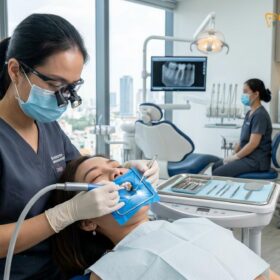
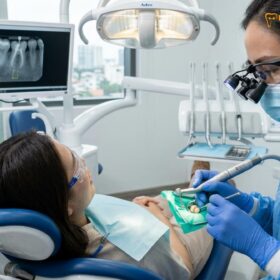
Navigating a travel insurance dental root canal claim requires a precise understanding of what constitutes a medical emergency versus elective dental care. Travel insurance typically covers emergency root canals only if the procedure is medically necessary for immediate pain relief or results from sudden accidental trauma during your trip. Routine endodontic care is excluded, making precise clinical documentation and pre-authorization essential for successful reimbursement.
Clinical Summary:
Filing a successful travel insurance dental root canal claim demands a clear distinction between planned dental tourism and unforeseen acute medical emergencies. Most international travel policies provide limited emergency dental coverage—often capped between $500 and $1,000—specifically designated for the sudden relief of severe pain or the treatment of accidental trauma to natural teeth. Successful financial reimbursement relies entirely on acquiring comprehensive clinical evidence at the time of service. This includes pre-operative periapical radiographs, detailed diagnostic reports confirming acute pathology, and itemized invoices utilizing correct international dental codes. Dr. Nguyen Van Cuong emphasizes that immediate communication with your insurance provider’s 24-hour assistance team before initiating irreversible endodontic therapy is a critical step to verify benefits and avoid unexpected claim denials.
Key Takeaways:
- Coverage is strictly limited to acute emergencies, such as sudden severe infection or physical trauma to natural teeth.
- Pre-existing conditions, including previously diagnosed asymptomatic decay or lost temporary fillings, are universally excluded.
- Pre-authorization from the insurer’s emergency assistance team is highly recommended before commencing treatment.
- Clinical evidence must include diagnostic X-rays, a formal medical report, and an itemized receipt with recognized dental codes.
- Permanent restorations, such as custom dental crowns placed after the root canal, are rarely covered by travel policies.
The Difference Between Routine Dental Travel and Travel Medical Emergencies
Routine dental travel involves planned, elective procedures, whereas travel medical emergencies are sudden, unforeseen events requiring immediate clinical intervention to alleviate severe pain or treat acute infection.
Understanding the strict parameters set by insurance providers is the first step in determining whether your root canal treatment will be covered while abroad. Travel insurance is fundamentally designed to protect travelers from unforeseen, catastrophic events. It is not a substitute for comprehensive health or dental insurance. Therefore, claims adjusters meticulously scrutinize dental claims to differentiate between a genuine, sudden medical crisis and elective dental tourism.
Routine dental travel, often referred to as dental tourism, involves a patient intentionally traveling to a destination like Ho Chi Minh City to undergo planned procedures. These might include replacing old restorations, addressing chronic but asymptomatic decay, or undergoing cosmetic enhancements. Even if a dentist discovers a necrotic pulp during a routine check-up that requires endodontic therapy, if the patient is not experiencing acute, unmanageable symptoms, the insurer will classify the treatment as elective and deny the claim. The pathology may be real, but the urgency does not meet the policy’s definition of an emergency[1].
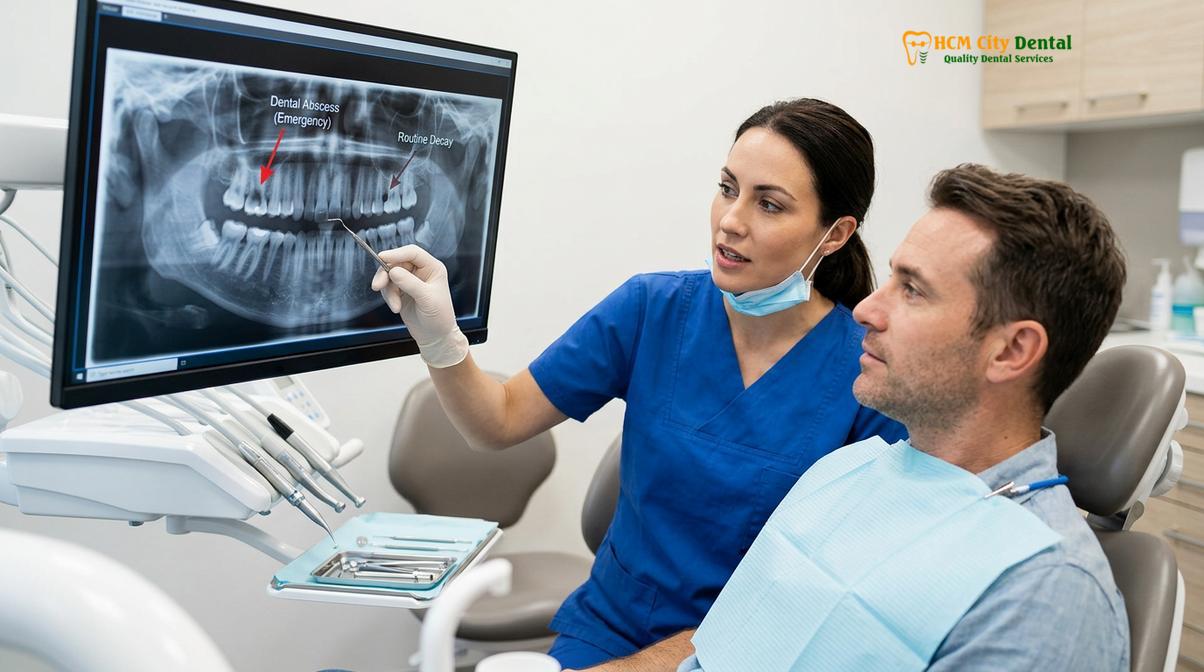
Conversely, a travel medical emergency is defined by its sudden onset and the immediate necessity for intervention. In the context of endodontics, this typically presents as acute irreversible pulpitis or an acute apical abscess. These conditions cause spontaneous, excruciating pain that cannot be managed with over-the-counter analgesics, often accompanied by facial swelling or fever. The primary objective of the emergency dental coverage is solely the relief of this acute pain and the stabilization of the patient’s condition so they can safely continue their trip or return home.
“Insurance companies evaluate dental claims based on the principle of immediate necessity. If the clinical notes indicate that the procedure could have been safely postponed until the patient returned to their home country, the claim for the root canal will almost certainly be denied, regardless of the severity of the underlying decay.”
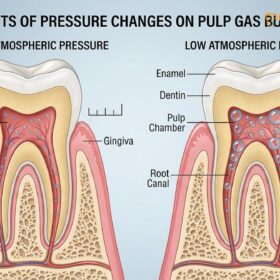
This distinction becomes particularly relevant when considering the physiological impacts of travel itself. A phenomenon known as barodontalgia can occur when changes in ambient pressure—such as during a flight or while scuba diving—cause trapped gases within a diseased tooth to expand, triggering sudden, agonizing pain[2]. A tooth that was entirely asymptomatic before departure can rapidly escalate into an acute emergency requiring immediate intervention upon landing. If you are concerned about flying after a root canal or experiencing pain during a flight, documenting the sudden onset of symptoms is crucial for your insurance claim.
Analyzing Travel Insurance: Accidental Injury vs. Sudden Acute Pain Relief
Travel policies categorize dental emergencies into accidental trauma (like a fractured tooth from a fall) and sudden acute pain relief (like an acute periapical abscess), each with distinct coverage limits and clinical criteria.
When reviewing your travel insurance policy, you will likely find that dental benefits are divided into two distinct categories: coverage for accidental injury and coverage for the sudden relief of pain. Understanding which category your situation falls into is vital, as the documentation requirements and financial sub-limits often differ significantly between the two.
Accidental Dental Injury: This category covers damage to sound, natural teeth caused by an external force. Examples include tripping on a cobblestone street and fracturing an incisor, or sustaining a blow to the face during a recreational activity. If the trauma results in a complicated crown fracture that exposes the dental pulp, an emergency root canal is clinically necessary to prevent infection and save the tooth. Insurers generally view accidental injuries favorably, provided the injury occurred during the covered trip and was not the result of an excluded activity (such as extreme sports or intoxication). The coverage limits for accidental injuries are sometimes higher, occasionally falling under the broader medical emergency limit rather than the strict dental sub-limit.
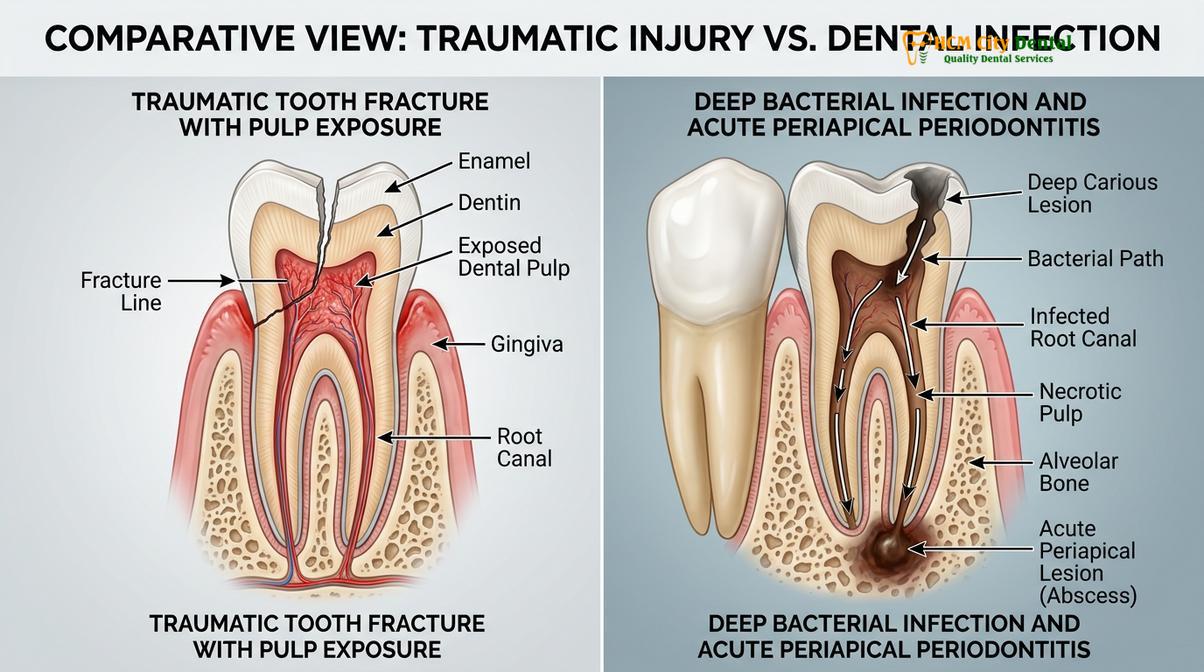
Sudden Acute Pain Relief: This category addresses internal dental pathologies, such as deep carious lesions that suddenly breach the pulp chamber, leading to acute pulpitis or an abscess. The defining characteristic here is the spontaneous onset of severe pain without an external traumatic event. Insurers are highly cautious with these claims due to the high likelihood of pre-existing conditions. The coverage is strictly limited to the minimum intervention required to stop the pain. Often, this means the policy will cover the extirpation of the pulp (the initial stage of a root canal) and a temporary filling, but may not cover the complete obturation of the root canal system if the initial step successfully alleviated the pain[3].
To clarify the differences, consider the following clinical and insurance distinctions:
| Criteria | Accidental Dental Injury | Sudden Acute Pain Relief |
|---|---|---|
| Triggering Event | External physical trauma (e.g., fall, impact). | Internal pathology (e.g., sudden infection, abscess). |
| Clinical Presentation | Fractured tooth, exposed pulp, luxation, avulsion. | Spontaneous throbbing pain, localized swelling, sensitivity to heat. |
| Primary Insurance Concern | Verifying the accident occurred during the trip. | Ruling out pre-existing decay or prior symptoms. |
| Typical Coverage Scope | Root canal, splinting, sometimes broader medical limits apply. | Strictly limited to pain relief (pulpectomy/temporary filling). |
| Common Sub-Limits | Often integrated with general medical (up to $10,000+). | Usually capped at a specific dental limit ($500 – $1,000). |
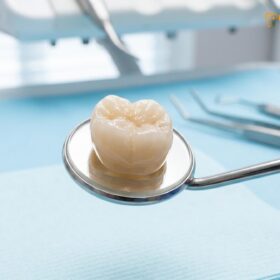
It is crucial to note that regardless of the category, travel insurance almost never covers the definitive restoration of the tooth. While you may urgently need a dental crown after a root canal to protect the fragile remaining tooth structure, insurers classify the crown as a permanent, non-emergency prosthetic. They expect you to return to your home country to complete the final restorative phase.
Step 1: Contacting Your Insurer for Pre-Authorization in Vietnam
Securing pre-authorization involves contacting your insurer’s 24-hour assistance line immediately upon experiencing symptoms to verify your emergency dental coverage limits and approved clinical workflows.
The moment you experience a dental emergency while traveling, your first instinct may be to rush to the nearest clinic. However, from an insurance perspective, your first action should be to contact your travel insurance provider’s 24-hour emergency assistance hotline. Failing to notify your insurer before receiving treatment is one of the most common reasons for claim denials.
When you call the assistance team, you initiate a formal record of the emergency. The triage coordinator will ask for details regarding your symptoms, the onset of the pain, and whether the issue is related to an accident. This conversation serves several critical purposes. First, it allows the insurer to verify your policy details and confirm that you have active emergency dental coverage. Second, the coordinator can clarify your specific sub-limits, ensuring you understand exactly how much financial assistance is available.

Furthermore, many international insurers have preferred provider networks. While you are generally free to choose any licensed practitioner, the assistance team might direct you to a vetted facility, such as HCMC Dental Clinic in Ho Chi Minh City, where the staff is experienced in handling international patients and providing the exact documentation required by foreign insurers. If you proceed without pre-authorization, the insurer may argue that you did not give them the opportunity to manage the care or control the costs.
Important Insurance Warning: Never assume that a verbal confirmation of “dental coverage” guarantees full reimbursement for a root canal. Always ask the representative specifically: “Does my policy cover endodontic therapy for the relief of acute pain, and what is the maximum monetary limit for this specific procedure?” Document the date, time, and the name of the representative you spoke with.
During this initial contact, ask the representative to email you a blank claim form and a list of required medical documents. Having this list in hand before you sit in the dental chair allows you to instruct the clinic staff on exactly what evidence needs to be gathered during your appointment. This proactive approach prevents the administrative nightmare of trying to obtain missing X-rays or translated reports after you have already returned to your home country.
Step 2: Collecting Essential Evidence (X-Rays, Treatment Reports, Receipts)
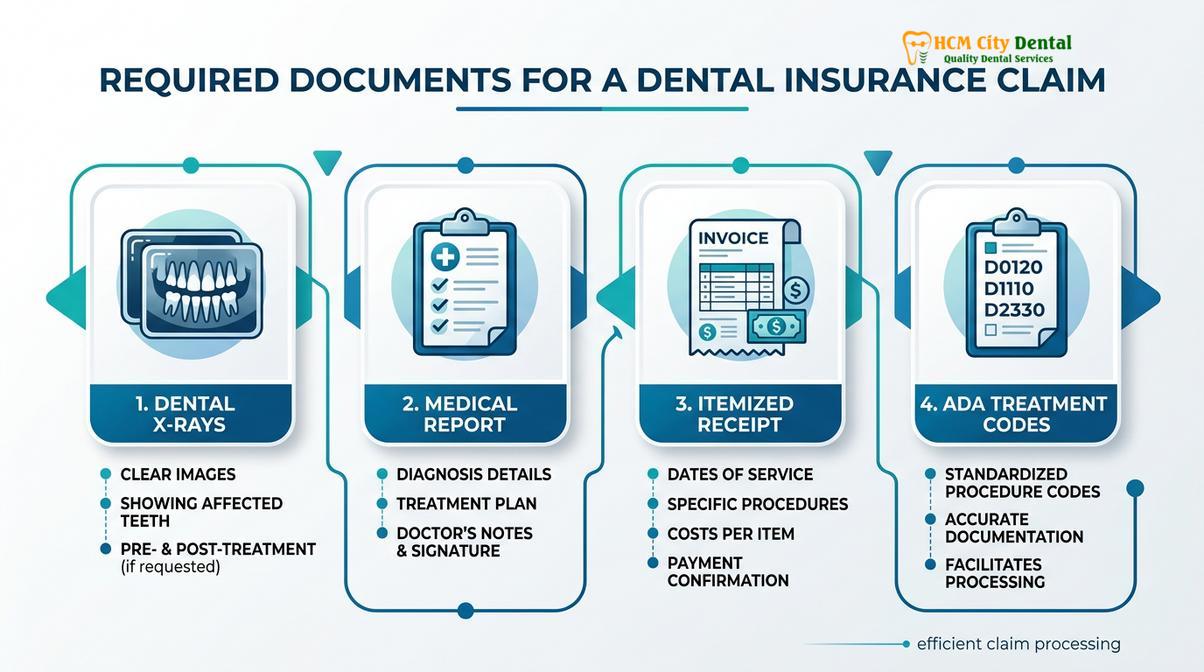
A successful claim requires robust clinical documentation, including pre- and post-operative radiographs, a detailed diagnostic report from the attending endodontist, and a comprehensive itemized invoice.
Insurance claims adjusters are not dentists; they rely entirely on the objective clinical evidence provided to them to determine the validity of a claim. If the documentation is vague, incomplete, or lacks diagnostic proof of an emergency, the claim will be rejected. Gathering this evidence at the time of treatment is paramount.
The cornerstone of any endodontic claim is radiographic evidence. You must obtain clear, high-resolution digital copies of your X-rays. A pre-operative periapical X-ray is mandatory; it provides visual proof of the pathology, such as a radiolucency at the apex of the root indicating an abscess, or a fracture line extending into the pulp chamber. Following the procedure, a post-operative X-ray is required to demonstrate that the root canal therapy was actually performed and completed to standard[4]. Without these images, the insurer has no proof that the treatment was medically necessary.
In addition to X-rays, you need a formal Medical/Dental Report signed by the treating dentist. This document must explicitly state the patient’s chief complaint (e.g., “Patient presented with severe, spontaneous, throbbing pain rated 9/10”), the clinical findings (e.g., “Tooth #36 exhibits no response to cold testing and severe pain on percussion”), and the definitive diagnosis (e.g., “Acute apical abscess with irreversible pulpitis”). Crucially, the report must contain a statement confirming the emergency nature of the visit, such as: “Immediate endodontic intervention was medically necessary for the relief of acute pain and to prevent systemic infection.”
Clinical Case Example: A tourist visiting Saigon experienced sudden, excruciating pain in a lower molar, rendering them unable to sleep or eat. They visited HCMC Dental Clinic, where Dr. Nguyen Van Cuong diagnosed acute irreversible pulpitis. Dr. Cuong provided the patient with a comprehensive dossier including pre-op X-rays, a signed medical report emphasizing the sudden onset of symptoms, and an itemized dental receipt Saigon. Because the documentation clearly proved the treatment was for immediate pain relief and not elective care, the patient’s travel insurance reimbursed the maximum allowable limit of $750 within two weeks.
Finally, the financial documentation must be impeccable. A simple credit card receipt is insufficient. You must request a detailed, itemized invoice. This document must list the clinic’s official details, the date of service, the specific tooth treated, and a line-by-line breakdown of the costs for the consultation, X-rays, anesthesia, and the root canal procedure itself. If you are comparing the root canal cost internationally, ensure the invoice clearly states the currency used (e.g., VND) so the insurer can apply the correct exchange rate on the date of service.
Correct Coding and Translation: Making Sure Documentation is Clear for Claims
Utilizing internationally recognized dental codes (such as ADA CDT codes or FDI notation) and providing certified English translations of clinical notes ensures claims adjusters can accurately process your reimbursement.
One of the most significant hurdles in processing international medical claims is the language barrier and the discrepancy in medical coding systems. If an insurance adjuster in the United States or Australia receives a handwritten clinical note in Vietnamese without standardized codes, the claim will be delayed indefinitely or denied due to a lack of clarity.
To ensure seamless processing, request that your dental provider use internationally recognized coding systems. For tooth numbering, the FDI World Dental Federation notation (e.g., Tooth 36 for the lower left first molar) or the Universal Numbering System (e.g., Tooth 19) should be clearly indicated. More importantly, the procedures themselves should be mapped to standardized codes, such as the American Dental Association (ADA) Current Dental Terminology (CDT) codes. For example, noting “D3220 – Therapeutic pulpotomy” or “D3330 – Endodontic therapy, molar tooth” provides unambiguous clarity to the claims adjuster regarding exactly what treatment was rendered.
“Standardized dental coding removes ambiguity. When an adjuster sees code D3310 alongside a diagnosis of acute pulpitis, they can immediately cross-reference it with the policy’s emergency dental benefits, drastically reducing the processing time of the claim.”
Furthermore, all documentation must be in English. If you are seeking treatment for a travel policy toothache HCMC, ensure the clinic can provide the medical report, the itemized invoice, and the receipt in English. Reputable clinics accustomed to treating expatriates and tourists will have bilingual staff and standardized English forms readily available. If the clinic can only provide documents in the local language, you will be responsible for obtaining and paying for a certified translation before submitting your claim, adding unnecessary time and expense to the process.
It is also vital to ensure that the terminology used in the translated documents aligns with the language in your insurance policy. Words matter. A report stating the treatment was for “decay removal” might be interpreted as routine care, whereas “emergency extirpation of necrotic pulp for acute pain relief” clearly aligns with the criteria for emergency coverage.
Common Pitfalls: Why Travel Insurers Deny Dental Emergency Claims
Claims are frequently denied due to lack of pre-authorization, treatment of pre-existing conditions, missing diagnostic evidence, or billing for non-covered permanent restorations like crowns.
Despite experiencing genuine pain and undergoing necessary treatment, many travelers find their dental claims denied due to strict policy exclusions and administrative missteps. Understanding these common pitfalls can help you navigate the process more effectively and set realistic expectations regarding your reimbursement.
The most frequent reason for denial is the “pre-existing condition” clause. Travel insurance is designed to cover the unexpected. If your dental records indicate that you had a known cavity, a lost filling, or experienced intermittent pain in the affected tooth prior to your departure date, the insurer will classify the emergency as a foreseeable exacerbation of a pre-existing issue. Even if the pain suddenly became unbearable during the trip, the underlying pathology was present before the policy took effect, rendering it ineligible for coverage[5].
Another major pitfall is the inclusion of permanent restorations in the claim. As previously discussed, the goal of emergency dental coverage is stabilization. Once the root canal is performed and the pain is eliminated, the emergency is considered resolved. Insurers will cover the cost of a temporary filling to seal the tooth. However, they will almost universally deny claims for permanent restorations. If you choose to proceed with a zirconia or Emax crown while still abroad, you must be prepared to pay for that portion of the treatment entirely out of pocket. The invoice must clearly separate the cost of the emergency root canal from the cost of the elective crown.
Finally, claims are routinely denied simply due to insufficient evidence. Missing pre-operative X-rays, vague medical reports that fail to mention “acute pain,” or submitting a credit card slip instead of an itemized invoice will trigger an automatic denial. The burden of proof lies entirely with the policyholder. Ensuring that every piece of documentation is collected, correctly coded, and translated before leaving the clinic is your best defense against a rejected claim.
When to See a Doctor
While navigating insurance is important, your primary concern should always be your health and safety. Dental infections can escalate rapidly, especially when traveling, and can lead to severe systemic complications if left untreated. You should seek immediate emergency dental care if you experience any of the following red-flag symptoms:
- Severe, Unrelenting Pain: Spontaneous throbbing pain that wakes you up at night and is not relieved by maximum doses of over-the-counter painkillers.
- Facial Swelling: Any visible swelling in your gums, cheek, jaw, or neck. This indicates that the infection has spread beyond the tooth and requires immediate antibiotic therapy and drainage.
- Fever and Malaise: A high temperature, chills, or a general feeling of illness accompanying a toothache suggests a systemic infection.
- Difficulty Swallowing or Breathing: This is a critical medical emergency (potential Ludwig’s angina) requiring immediate hospital intervention, as the swelling may compromise your airway.
- Traumatic Injury: If a tooth is knocked out (avulsed), fractured exposing the pink pulp tissue, or pushed out of alignment due to an accident.

Do not delay treatment while waiting for insurance approval if you are experiencing these severe symptoms. Contact your insurer’s emergency line while en route to the clinic, but prioritize receiving immediate clinical care to manage the infection and alleviate the pain. Following your treatment, adhering to a proper root canal recovery guide and knowing what to eat after the procedure will help ensure a smooth healing process for the remainder of your trip.
Frequently Asked Questions
Will travel insurance pay for a dental crown after a root canal?
Generally, no. Travel insurance typically only covers the emergency root canal therapy required to alleviate acute pain and the placement of a temporary or basic direct filling. Permanent restorations, such as custom dental crowns, are almost universally classified as non-emergency, elective procedures and are excluded from standard travel policies. You will likely need to cover the cost of the crown out of pocket or through your primary dental insurance upon returning home.
How do I prove my root canal treatment was an emergency to my insurer?
You must provide objective clinical evidence demonstrating acute pathology. This includes pre-operative periapical X-rays showing an infection or fracture, a formal diagnostic report from your endodontist stating the presence of severe pain or trauma, and clinical notes detailing the immediate necessity of the intervention. The documentation must clearly state that the treatment could not be safely delayed until your return home.
What details should be included on my dental invoice in Vietnam?
Your invoice must be highly detailed and translated into English. It should include the clinic’s official letterhead, the treating dentist’s credentials, the date of service, specific international dental codes (like ADA CDT codes) for each procedure performed, the tooth number treated, and a clear breakdown of all costs incurred. A simple credit card receipt is insufficient for claims processing.
Can I claim emergency dental coverage if my toothache started before my trip?
No, travel insurance strictly excludes pre-existing medical and dental conditions. If your dental records indicate that you sought treatment, received a diagnosis, or experienced symptoms for the specific tooth prior to your departure date, the insurer will deny the claim based on the pre-existing condition clause, even if the pain worsened significantly during your travels.
Does travel insurance cover root canals for primary (baby) teeth?
Yes, provided the treatment meets the criteria for an acute emergency. If a pediatric patient suffers sudden trauma or a severe acute infection in a primary tooth while traveling, emergency pulpal therapy (such as a pulpotomy or pulpectomy) or extraction to relieve pain is typically covered under the same conditions and documentation requirements as adult dentition.
References
- Journal of Endodontics. Management of acute endodontic emergencies and diagnostic protocols. (2021).
- International Dental Journal. Travel medicine, insurance policies, and dental emergencies abroad. (2020).
- American Association of Endodontists. Diagnostic terminology and clinical guidelines for pulpal disease. (2019).
- Journal of Travel Medicine. Barodontalgia and the exacerbation of pulpal pathology during flights. (2022).
- Clinical Oral Investigations. Radiographic interpretation and documentation in emergency endodontics. (2018).