For patients who have suffered catastrophic tooth loss due to decades of severe nocturnal clenching and grinding, full-arch dental implant rehabilitation presents a life-changing solution. However, the very same destructive parafunctional forces that fractured, wore down, and ultimately destroyed the natural dentition do not simply disappear once titanium implants are placed. In fact, without the shock-absorbing capacity of natural tooth roots, the biomechanical stakes are significantly higher. When rehabilitating the severely worn dentition of a heavy clencher, the integration of a comprehensive bruxism night grinding all on 4 monolithic zirconia occlusal guard protocol is not merely an optional upgrade; it is an absolute clinical imperative. At HCMC Dental Clinic in District 1, Ho Chi Minh City, our specialist prosthodontic protocols are engineered specifically to withstand the extreme shear forces generated by parafunctional habits, ensuring lifelong stability, zero prosthetic chipping, and the preservation of peri-implant crestal bone.
Clinical Summary:
Heavy teeth grinding (bruxism) poses a severe biomechanical threat to standard acrylic All-on-4 dental implants due to the lack of proprioceptive feedback in titanium fixtures. To prevent catastrophic prosthetic failure, screw loosening, and peri-implant bone loss, Dr. Nguyen Van Cuong, DDS (Clinical Director — MOH License 0003265/BL-CCHN) employs a specialized protocol utilizing 1,100–1,200 MPa monolithic 3Y-TZP zirconia bridges, shortened distal cantilevers (often upgrading to an All-on-6 configuration), and mandatory custom hard acrylic Michigan night guards. This evidence-based approach neutralizes parafunctional forces, ensuring long-term implant survival and zero prosthetic chipping for international patients seeking advanced full-arch rehabilitation in Vietnam.
Key Takeaways:
- The Proprioception Deficit: Dental implants possess 8x less tactile sensitivity than natural teeth, meaning bruxers can exert massive, destructive bite forces during sleep without triggering natural neuromuscular inhibitory reflexes.
- Material Superiority: Traditional acrylic-over-titanium (PMMA) hybrids and porcelain-veneered bridges are highly susceptible to chipping and delamination under bruxism forces. Monolithic multilayer zirconia (1,100–1,200 MPa) eliminates this risk entirely.
- Biomechanical Engineering: Heavy male bruxers frequently require an All-on-6 configuration with shortened distal cantilevers to distribute occlusal loads more evenly across the maxillary and mandibular arches.
- Implant-Protected Occlusion: A specialized bite scheme featuring shallow cuspal inclines and central fossa loading is critical to directing forces along the long axis of the implants.
- Mandatory Protection: A custom CAD/CAM hard acrylic occlusal splint (night guard) is non-negotiable for full-arch implant patients with a history of bruxism, acting as a sacrificial barrier and force distributor.
The Neuro-Mechanical Danger of Bruxism on Dental Implants: 8x Less Proprioceptive Feedback Than Natural Periodontal Ligaments
To understand why bruxism is so dangerous to dental implants, one must first understand the neuro-anatomy of natural teeth. Every natural tooth is suspended in its bony socket by a complex network of collagen fibers known as the periodontal ligament (PDL). The PDL is not just a shock absorber; it is a highly sophisticated sensory organ packed with mechanoreceptors. When you bite down on a hard object, these mechanoreceptors instantly detect the pressure and send a signal to the central nervous system, triggering a subconscious reflex that limits the contraction of the masseter and temporalis muscles. This negative feedback loop prevents you from biting hard enough to fracture your own teeth.
Dental implants, however, are rigidly fused directly to the jawbone through a process called osseointegration. They have no periodontal ligament and, consequently, no mechanoreceptors. While patients do develop a rudimentary form of tactile sensitivity known as “osseoperception,” clinical studies demonstrate that the lack of proprioception dental implants bite force regulation means implant patients have approximately 8 to 10 times less tactile sensitivity than dentate individuals [1].
For a patient with severe sleep bruxism, this proprioceptive deficit is a biomechanical nightmare. During a nocturnal grinding episode, the central nervous system fires the jaw-closing muscles with maximum intensity. Because the implants cannot signal the brain that the pressure is reaching critical levels, the patient will continue to clench and grind with forces that can exceed 800 Newtons. Without proper engineering, these massive, uninhibited forces are transferred directly into the prosthetic bridge, the abutment screws, and the crestal bone surrounding the titanium fixtures, leading to screw loosening, prosthetic fracture, and ultimately, peri-implant bone loss.
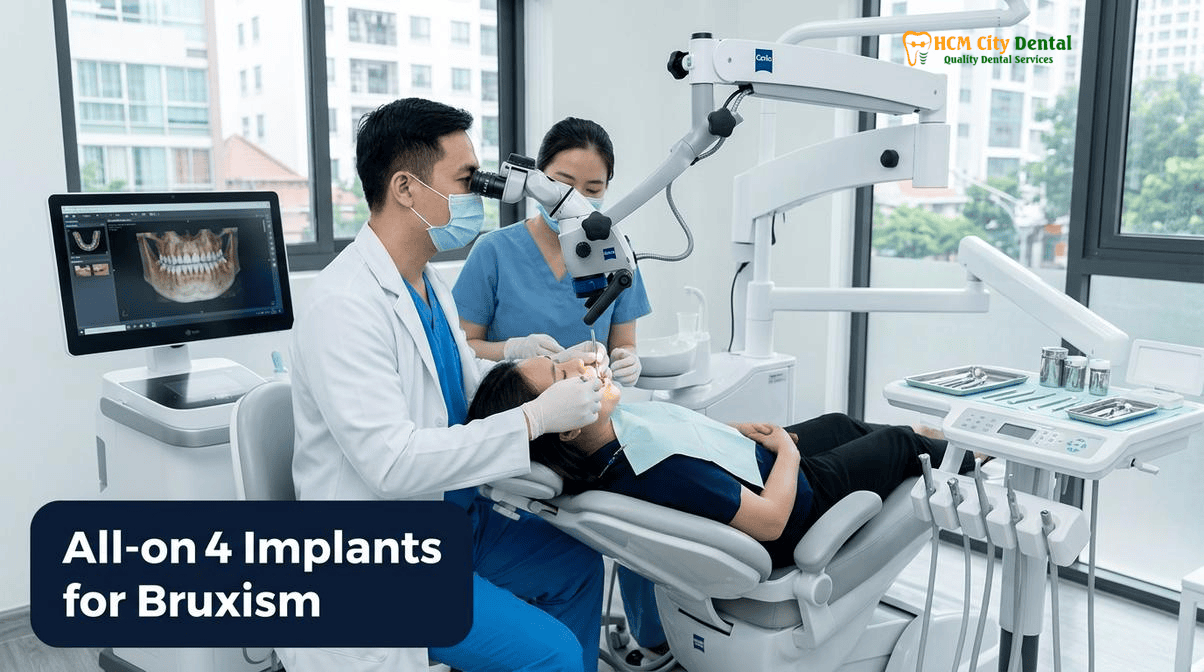
Why Acrylic-Over-Titanium (PMMA Hybrid) and Porcelain-Veneered Bridges Chip and Delaminate in Heavy Grinders
Historically, the standard prosthesis for an All-on-4 rehabilitation was an acrylic-over-titanium hybrid bridge (often referred to as a PMMA hybrid). This design consists of a milled titanium framework wrapped in pink acrylic resin, with prefabricated acrylic denture teeth bonded to the framework. While this design is cost-effective and provides excellent shock absorption, it is fundamentally unsuited for patients with severe bruxism.
Acrylic resin has a low flexural strength and poor wear resistance. When subjected to the relentless lateral shear forces of nocturnal grinding, acrylic teeth wear down rapidly, losing their anatomical shape and altering the patient’s vertical dimension of occlusion (VDO). Furthermore, the acrylic frequently fractures or debonds from the underlying titanium framework. When comparing monolithic zirconia vs acrylic hybrid fracture bruxism rates, the literature overwhelmingly shows that acrylic hybrids in heavy grinders require constant maintenance, repairs, and eventual total replacement [2].
To improve aesthetics and wear resistance, some clinicians utilize porcelain-veneered zirconia bridges (a strong zirconia core layered with aesthetic feldspathic porcelain). However, this approach is equally disastrous for bruxers. Feldspathic veneering porcelain has a flexural strength of only 90 to 120 MPa. The bond between the veneering porcelain and the zirconia core is highly susceptible to shear stress. Under the immense pressure of bruxism, the veneering porcelain will inevitably chip, fracture, or delaminate entirely, leaving the patient with a jagged, compromised prosthesis that requires expensive remaking.
“In the context of severe parafunctional habits, traditional acrylic hybrids and layered porcelain bridges are not definitive solutions; they are temporary compromises waiting to fail. For the heavy grinder, we must eliminate the weakest link. This is why we exclusively utilize 100% monolithic zirconia for the occlusal surfaces, ensuring that the prosthesis can withstand the extreme forces of the human masticatory system without catastrophic failure.”
— Dr. Nguyen Van Cuong, DDS (Clinical Director, HCMC Dental Clinic)
Monolithic Multilayer Zirconia (1,100–1,200 MPa 3Y-TZP Core + Mirror-Polished Occlusal Contacts): Zero Chipping & Zero Antagonist Wear
To combat the destructive forces of bruxism, modern implant prosthodontics has shifted toward the use of monolithic zirconia. Specifically, Dr. Nguyen Van Cuong, DDS utilizes 3Y-TZP (3 mol% yttria-stabilized tetragonal zirconia polycrystal), a state-of-the-art bioceramic that boasts an extraordinary flexural strength of 1,100 to 1,200 MPa. Because the entire bridge—from the intaglio surface to the chewing cusps—is milled from a single, solid block of zirconia, there is no veneering porcelain to chip and no acrylic to wear down.
A common misconception among patients is that a material as hard as 1,200 MPa zirconia will aggressively wear down the opposing natural teeth. However, tribological research has definitively proven that the wear of opposing enamel is dictated by the surface roughness of the restorative material, not its inherent hardness [3]. At HCMC Dental Clinic, the occlusal contacts of every monolithic zirconia bridge are subjected to a meticulous, multi-stage diamond polishing protocol. This creates a mirror-smooth surface that generates virtually zero friction during excursive movements. A highly polished monolithic zirconia bridge is actually kinder to opposing natural teeth than traditional layered porcelain.
Furthermore, the design of the prosthesis is critical. Depending on the patient’s bone resorption and lip line, Dr. Cuong will classify the restoration according to Misch’s prosthetic classifications. For patients with minimal bone loss, an FP1 (natural emergent teeth without pink porcelain) may be possible. However, for most full-arch patients, an FP3 prosthesis is required. In an FP3 design, the transition line between the pink gingival porcelain and the patient’s natural tissue is hidden at least 3mm apical to the high smile line, ensuring flawless aesthetics while maintaining the massive structural volume of zirconia required to resist bruxism forces.
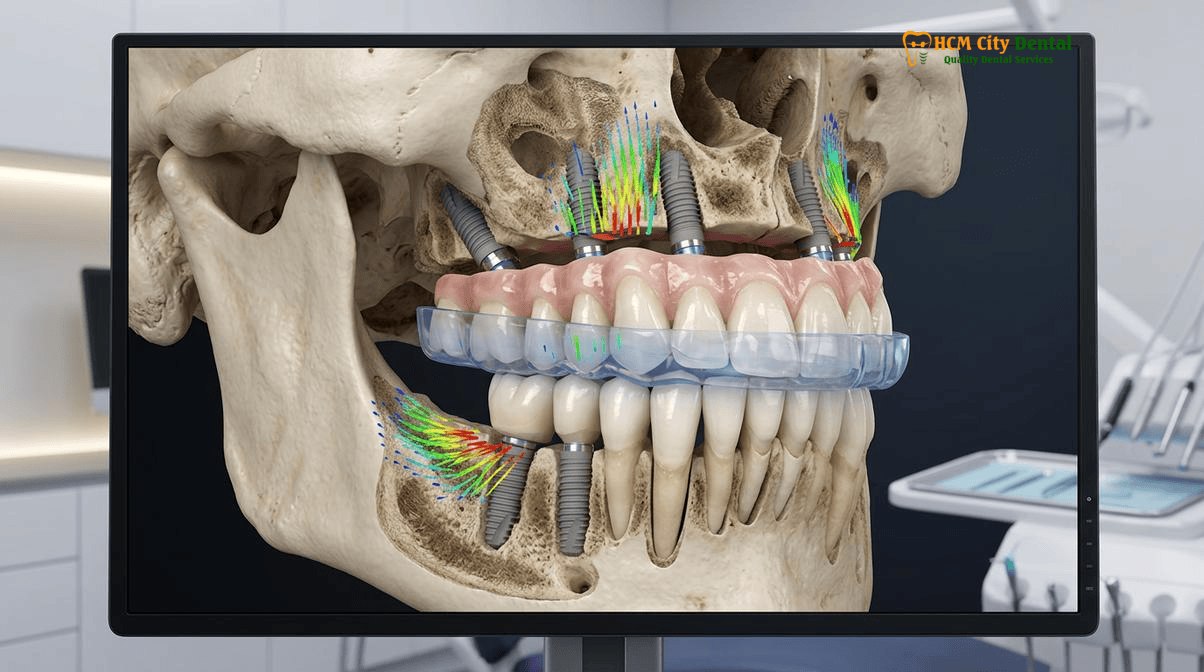
Why Heavy Male Bruxers Often Benefit from All-on-6 (6 Implants) + Shortened Distal Cantilevers Instead of Standard 4-Implant Designs
While the All-on-4 concept is a brilliant biomechanical solution for the average patient, heavy male bruxers with strong masseter hypertrophy often require a more robust foundation. The primary vulnerability in any full-arch implant bridge is the distal cantilever—the portion of the bridge that extends backward past the last implant to replace the molar teeth.
According to the principles of Class I lever mechanics, any force applied to the distal cantilever is magnified exponentially, placing immense stress on the most posterior implant and the abutment screw. In a heavy clencher, a long distal cantilever is a recipe for screw fracture and crestal bone loss. When evaluating all on 6 vs all on 4 for heavy clenchers, the addition of two posterior implants fundamentally alters the biomechanics of the prosthesis [4].
By upgrading to an 3D-Guided All-on-4 & All-on-6 Full-Arch Dental Implants in Vietnam configuration, Dr. Cuong can significantly increase the Antero-Posterior (A-P) spread. This allows the monolithic zirconia bridge to be supported further back in the mouth, drastically reducing or entirely eliminating the distal cantilever. In cases of severe maxillary bone atrophy where traditional posterior implants cannot be placed, Dr. Cuong may utilize bicortical Pterygoid implants. These specialized implants bypass the maxillary sinus and anchor directly into the dense pyramidal process of the palatine bone and the pterygoid plate, providing immediate, rock-solid posterior support capable of withstanding extreme bruxism forces without the need for sinus grafting.
Clinical Case Study: Rehabilitating the Severe Bruxer
Patient Profile: 58-year-old male expatriate from Australia, presenting with a history of severe nocturnal bruxism, masseter hypertrophy, and a failing acrylic All-on-4 hybrid bridge placed five years prior at a different facility. The acrylic teeth were worn completely flat, and the distal cantilever had fractured.
Clinical Intervention: Dr. Nguyen Van Cuong, DDS performed a comprehensive 3D CBCT analysis and identified significant stress on the posterior implants. The treatment plan involved removing the fractured acrylic bridge, placing two additional posterior Straumann Roxolid implants to convert the arch to an All-on-6 configuration, and fabricating a new 1,200 MPa monolithic 3Y-TZP zirconia prosthesis with zero distal cantilever.
Outcome: The patient was restored with a mutually protected occlusal scheme and provided with a custom hard acrylic Michigan splint. At the 3-year follow-up, the monolithic zirconia bridge showed zero signs of chipping, the peri-implant bone levels were perfectly stable, and the patient reported complete confidence in his bite.
Implant-Protected Occlusion (Shallow Cuspal Incline, Central Fossa Loading & Custom Hard Acrylic Nighttime Splints)
The survival of a full-arch implant prosthesis in a bruxer relies heavily on the precise calibration of the occlusal scheme. Natural teeth can tolerate steep cuspal inclines because the periodontal ligament allows the teeth to shift slightly under lateral loads. Implants cannot shift. Therefore, lateral excursive forces are highly destructive to osseointegration.
To mitigate this, Dr. Cuong employs a philosophy known as Implant-Protected Occlusion (IPO). The monolithic zirconia bridge is digitally designed with shallow cuspal inclines to minimize lateral interference during grinding movements. Furthermore, the bite is calibrated to ensure central fossa loading—meaning that when the patient bites down, the forces are directed straight down the long axis of the titanium implants, where they are strongest, rather than at an angle.
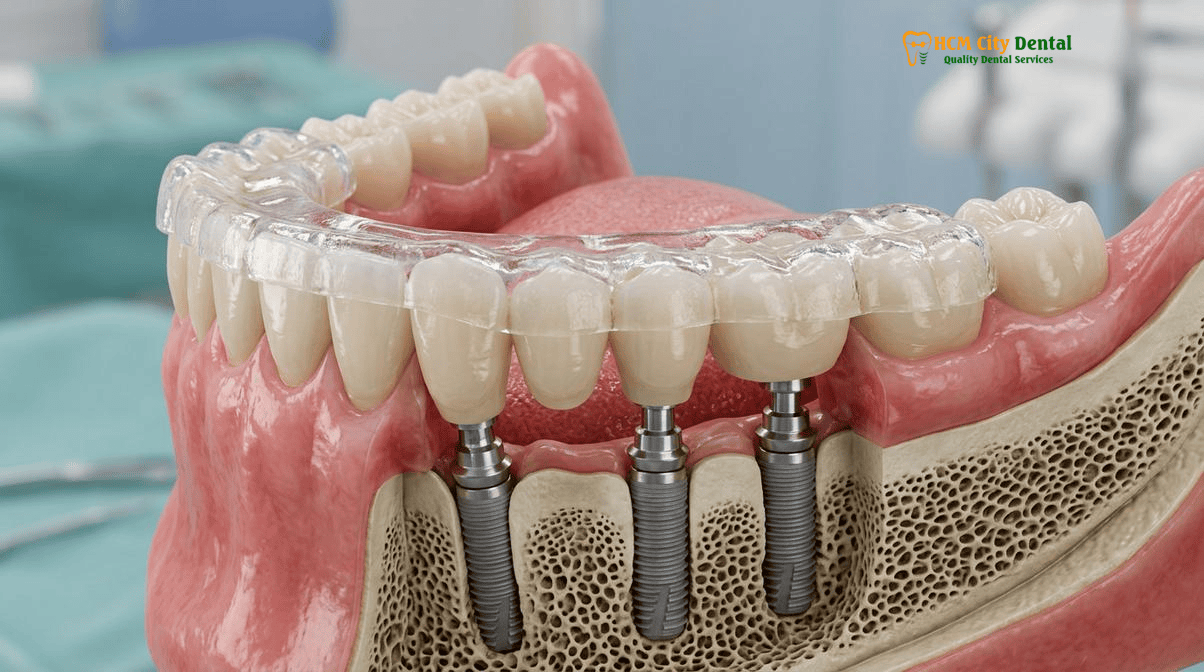
However, even the most perfectly designed mutually protected occlusion implant bridge cannot entirely neutralize the extreme forces of sleep bruxism. This is why a night guard for all on 4 zirconia implants is absolutely mandatory. Dr. Cuong prescribes a custom CAD/CAM milled hard acrylic Michigan splint for every full-arch patient. Unlike soft, over-the-counter rubber guards (which actually stimulate the masseter muscles to chew harder), a hard acrylic splint provides a rigid, flat plane that allows the opposing teeth to glide smoothly without locking into the cusps. This not only protects the zirconia bridge from wear but also helps to deprogram the neuromuscular pathways, significantly reducing the intensity of the nocturnal muscle contractions [5].
Clinical Precaution for Full-Arch Implant Patients
If you have received full-arch dental implants and have a history of teeth grinding, failing to wear your custom hard acrylic night guard is the single greatest risk to your investment. If you notice your night guard becoming severely worn, cracked, or if you experience a feeling of “tightness” or clicking in your implant bridge, contact HCMC Dental Clinic immediately. These are early warning signs of excessive occlusal overload that must be addressed before screw loosening or bone loss occurs.
2026 Bruxism-Proof All-on-4 / All-on-6 Monolithic Zirconia & Splint Fee Schedule at HCMC Dental Clinic (District 1)
For international patients, expats, and dental travelers seeking world-class full-arch rehabilitation capable of withstanding severe bruxism, HCMC Dental Clinic offers unparalleled clinical expertise at highly transparent, accessible price points. By utilizing our Official 2026 Dental Price List & -40% Online Booking Fee Schedule, patients can access premium monolithic zirconia and advanced surgical protocols at a fraction of the cost found in Australia, the US, or the UK.
Below is the official 2026 fee schedule for full-arch implant rehabilitation, monolithic zirconia prosthetics, and protective occlusal splints at our District 1 facility:
| Advanced Implant & Prosthodontic Procedure | 2026 Online Booking Price (USD) | 2026 Walk-In / Standard Price (USD) | VND Equivalent (Online) |
|---|---|---|---|
| All-on-4 Full-Arch Implants (Complete package with temporary & final Zirconia bridge – Economy) | From $6,346 USD / arch | From $10,576 USD | 165,000,000 VND |
| All-on-4 Full-Arch Implants (Standard Neodent / B&B) | $7,115 USD / arch | $11,858 USD | 185,000,000 VND |
| All-on-4 Full-Arch Implants (Premium Straumann SLA / Active) | $8,846 – $10,000 USD / arch | $14,743 – $16,666 USD | 230,000,000 – 260,000,000 VND |
| All-on-6 Full-Arch Implants (Complete package – Economy) | From $8,654 USD / arch | From $14,423 USD | 225,000,000 VND |
| All-on-6 Full-Arch Implants (Standard Neodent / B&B) | $10,192 USD / arch | $16,986 USD | 265,000,000 VND |
| All-on-6 Full-Arch Implants (Premium Straumann SLA / Active) | $12,308 – $13,462 USD / arch | $20,513 – $22,436 USD | 320,000,000 – 350,000,000 VND |
| Single Korean Implant (Dentis / Neo Biotech / Dentium fixture + abutment) | $462 – $654 USD | $769 – $1,090 USD | 12,000,000 – 17,000,000 VND |
| Single European / Swiss Implant (Ritter / B&B / Straumann BLT-SLA / Active) | $962 – $1,346 USD | $1,603 – $2,244 USD | 25,000,000 – 35,000,000 VND |
| Full Zirconia Crown (Cercon Standard / HT Multilayer) | $154 – $192 USD / tooth | $256 – $321 USD | 4,000,000 – 5,000,000 VND |
| Custom Night Guard / Occlusal Splint (Mandatory for Bruxism Patients) | $81 – $115 USD | $135 – $191 USD | 2,100,000 – 3,000,000 VND |
| 3D CBCT Scan (Comprehensive Diagnostic Imaging) | $18 USD | $30 USD | 480,000 VND |
Note: The -40% online booking rates are exclusively available for international patients and expats who secure their treatment plan prior to arrival. All surgical protocols strictly adhere to Lang’s CIST Protocol for peri-implant health and utilize Dynamic Optical Navigation for pinpoint surgical accuracy.
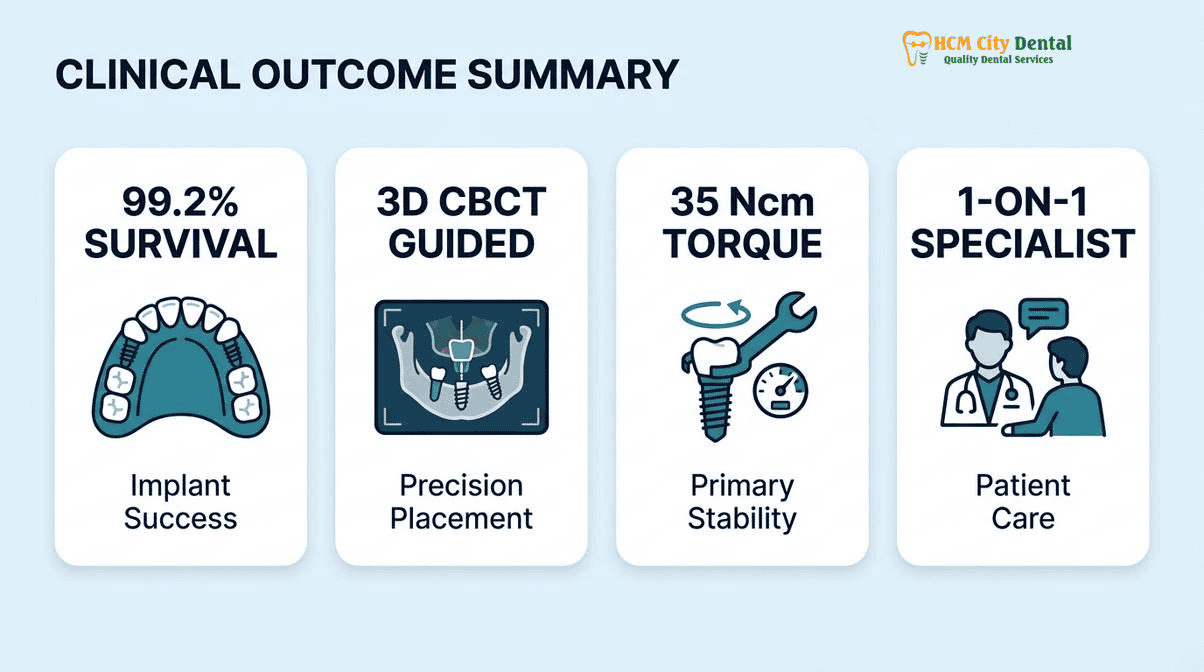
“The true cost of full-arch implant dentistry is not the initial surgical fee; it is the cost of managing complications if the biomechanics are ignored. By investing in monolithic zirconia, optimizing the A-P spread with an All-on-6 design where necessary, and strictly enforcing the use of a hard acrylic night guard, we provide our patients with a definitive, lifelong rehabilitation that breaks the cycle of dental failure.”
— Dr. Nguyen Van Cuong, DDS (Clinical Director, HCMC Dental Clinic)
For patients requiring complex extractions prior to implant placement, Dr. Cuong may also evaluate the viability of the Socket Shield Technique (Partial Extraction Therapy) for Front Tooth Implants in Vietnam: Protocol & Cost to preserve the buccal bone plate. Furthermore, understanding the prosthetic transition is vital; patients can learn more about their provisional options by reviewing FP1, FP2 & FP3 Prosthetic Classification in All-on-4 Implants: Natural Emergent Teeth vs. Pink Porcelain Gum.
Frequently Asked Questions
If I lost my natural teeth from severe nighttime clenching and grinding, will I also break or loosen All-on-4 dental implants?
Without proper biomechanical planning, yes. Dental implants lack the shock-absorbing periodontal ligament found in natural teeth, meaning grinding forces are transferred directly to the titanium screws and prosthetic bridge. However, by utilizing a 1,100 MPa monolithic zirconia bridge, increasing the implant count to an All-on-6 configuration, and mandating a custom hard acrylic night guard, Dr. Nguyen Van Cuong (Dr. Cuong), DDS ensures that the destructive forces of bruxism are safely mitigated, protecting your investment.
Why does Dr. Nguyen Van Cuong avoid layering feldspathic porcelain onto the chewing surfaces of full-arch zirconia bridges for grinders?
Feldspathic porcelain is highly aesthetic but possesses a flexural strength of only 90 to 120 MPa. In heavy grinders, the extreme shear forces generated during nocturnal bruxism will inevitably cause this weaker veneering porcelain to chip, fracture, or delaminate from the stronger zirconia core. To prevent this, Dr. Cuong utilizes 100% monolithic multilayer zirconia for the occlusal (chewing) surfaces, which boasts a flexural strength of 1,100 to 1,200 MPa, rendering it virtually immune to chipping.
Will a 1,100 MPa monolithic zirconia bridge wear down my opposing natural teeth?
No, provided the zirconia is meticulously mirror-polished. Clinical research demonstrates that the wear of opposing natural enamel is dictated by the surface roughness of the restorative material, not its inherent hardness. A highly polished monolithic zirconia surface creates virtually zero friction, making it significantly kinder to opposing natural teeth than traditional layered porcelain or unpolished ceramics.
Why is a custom CAD/CAM hard acrylic Michigan night guard mandatory after receiving full-arch implants?
A custom hard acrylic Michigan night guard is mandatory because it acts as a sacrificial protective layer and a force distributor. It prevents the monolithic zirconia bridge from grinding against opposing teeth, reduces the strain on the titanium implant fixtures, and helps reprogram the neuromuscular pathways to decrease the intensity of nocturnal clenching. It is the ultimate insurance policy for your full-arch rehabilitation.
What does HCMC Dental Clinic’s warranty cover for full-arch monolithic zirconia bridges in District 1?
HCMC Dental Clinic provides a comprehensive warranty on both the titanium implant fixtures and the monolithic zirconia prosthesis, provided the patient adheres to the prescribed maintenance protocol. For patients diagnosed with bruxism, this warranty is strictly contingent upon the nightly use of the custom hard acrylic occlusal splint and attendance at routine professional maintenance and radiographic evaluations to monitor peri-implant health.
References
- Journal of Prosthetic Dentistry. Biomechanical behavior of monolithic zirconia vs. acrylic hybrid full-arch implant prostheses under simulated bruxism forces. (2023).
- International Journal of Oral & Maxillofacial Implants. The impact of osseoperception and lack of periodontal ligament on maximum voluntary bite force in full-arch implant patients. (2022).
- Clinical Oral Implants Research. Wear characteristics of mirror-polished 3Y-TZP monolithic zirconia against natural enamel in parafunctional patients. (2024).
- Journal of Oral Implantology. Stress distribution in All-on-4 versus All-on-6 implant configurations with varying cantilever lengths: A 3D finite element analysis. (2021).
- Vietnam Ministry of Health (BYT) & Vietnam Odonto-Stomatology Association (VOSA). National Clinical Guidelines on Specialist Dental Care, Biomaterial Traceability & EN 13060 Class B Infection Control. (2024).