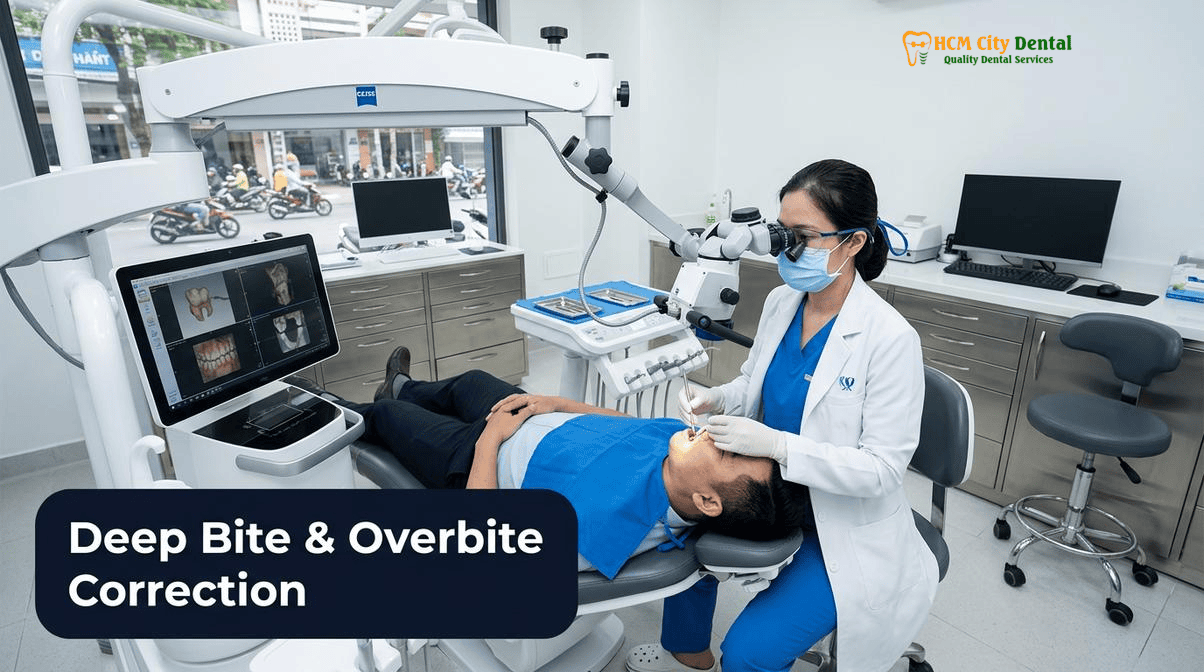
For adult patients presenting with a severe vertical overlap of the anterior teeth, the clinical decision between orthodontic intrusion and restorative bite elevation represents one of the most complex treatment planning challenges in modern dentistry. A deep overbite—where the upper front teeth excessively cover the lower front teeth—is not merely an aesthetic concern; it is a progressive, destructive biomechanical pathology. Left untreated, this malocclusion leads to accelerated enamel attrition, periodontal trauma, and chronic temporomandibular joint (TMJ) dysfunction. At HCMC Dental Clinic in Ho Chi Minh City, under the clinical direction of Dr. Nguyen Van Cuong, DDS (Clinical Director — MOH License 0003265/BL-CCHN), we utilize advanced 3D CBCT diagnostics to determine the optimal pathway for deep-bite and overbite correction using Invisalign bite ramps vs. crowns. Whether utilizing the biologic tooth movement of Invisalign G8 SmartForce protocols or the rapid restorative elevation of the Vertical Dimension of Occlusion (VDO) via biomimetic ceramics, our evidence-based protocols ensure long-term functional stability and aesthetic excellence for both local expatriates and international dental travelers.
Clinical Summary:
Correcting a deep overbite requires addressing the vertical dimension of the jaws and the curve of the dental arches. Pathway 1 involves orthodontic correction using Invisalign clear aligners equipped with precision bite ramps to intrude the anterior teeth and extrude the posterior teeth, a process that typically takes 12 to 24 months. Pathway 2 involves restorative correction, utilizing full-arch porcelain crowns, table-top onlays, and veneers to physically rebuild worn dentition and elevate the bite in just 7 to 10 days. The choice between overbite correction with braces/aligners vs. porcelain veneers and crowns depends heavily on the patient’s age, the degree of existing enamel wear, skeletal anatomy, and the time available for treatment, particularly for international patients visiting Vietnam.
Key Takeaways:
- A deep bite (70%–100% overlap) causes severe shear stress, often resulting in lower incisors biting into the upper palate (roof of the mouth), leading to chronic gingival trauma and bone loss.
- Invisalign G5 and G8 protocols utilize lingual precision bite ramps to disocclude the posterior teeth, facilitating Curve of Spee leveling with Invisalign G5/G8 through anterior intrusion and posterior extrusion.
- For older adults with severely worn front teeth from deep bite treatment delays, elevating the VDO with biomimetic IPS E.max onlays ($231 USD) and Zirconia crowns ($154–$192 USD) offers a rapid, 7-day functional rehabilitation.
- Placing cosmetic veneers on an uncorrected deep bite without raising the posterior occlusion is a primary cause of premature ceramic chipping and catastrophic restorative failure.
- HCMC Dental Clinic offers a transparent Official 2026 Dental Price List & -40% Online Booking Fee Schedule, providing world-class specialist care at a fraction of US and Australian benchmark costs.
Why a Deep Overbite (70%–100% Vertical Overlap) Destroys Front Tooth Enamel, Causes Palatal Gum Trauma, and Compresses the TMJ
In a healthy, Class I occlusion, the maxillary (upper) anterior teeth should overlap the mandibular (lower) anterior teeth by approximately 1 to 3 millimeters, or roughly 10% to 20% of the clinical crown length. This slight overlap allows for proper incisal guidance during protrusive movements, protecting the posterior teeth from excessive lateral forces. However, in a severe deep bite scenario, the vertical overlap can extend to 70%, 80%, or even 100%. In these extreme cases, the lower incisors are completely hidden behind the upper incisors when the jaws are closed.
The biomechanical consequences of this malocclusion are devastating over time. Because the anterior teeth are locked in a restrictive envelope of function, the normal chewing cycle forces the lower incisors to strike the palatal surfaces of the upper incisors with immense shear force. This constant friction rapidly strips away the protective enamel, exposing the softer underlying dentin, which then wears down at an exponentially faster rate. Patients frequently present to our clinic with severely thinned, chipped, or fractured upper incisors, alongside flattened, shortened lower incisors.
Furthermore, in cases of a traumatic deep bite, the over-eruption of the mandibular anterior teeth can lead to a condition where the lower incisors biting into the upper palate (roof of the mouth) occurs. This chronic mechanical trauma strips the palatal gingiva, causing severe localized recession, ulceration, and eventual loss of the palatal alveolar bone supporting the upper front teeth. Simultaneously, the deep bite forces the mandible (lower jaw) into a retruded (pushed back) position. This distal displacement of the mandibular condyles compresses the highly innervated retrodiscal tissues within the temporomandibular joint (TMJ), leading to chronic facial pain, joint clicking, muscle spasms, and tension headaches[1].
Pathway 1 (Orthodontic Biologic Correction): Invisalign G5/G8 SmartForce Precision Bite Ramps & Curve of Spee Leveling
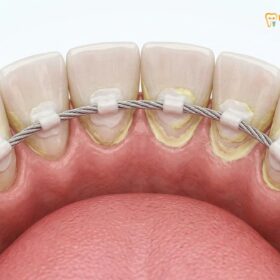
For younger adult patients, or those whose teeth have not yet suffered irreversible structural wear, the gold standard for deep bite correction is biologic orthodontic tooth movement. Historically, correcting a deep bite with traditional fixed brackets required complex mechanics, heavy archwires, and the use of anterior bite turbos for a deep overbite to prevent the patient from shearing off their lower brackets. Today, Invisalign Clear Aligners & 3D Digital Orthodontics at HCMC Dental Clinic offer a highly predictable, digitally planned alternative.
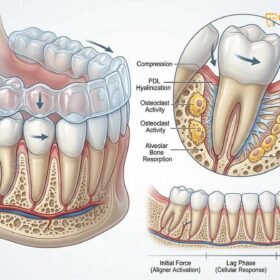
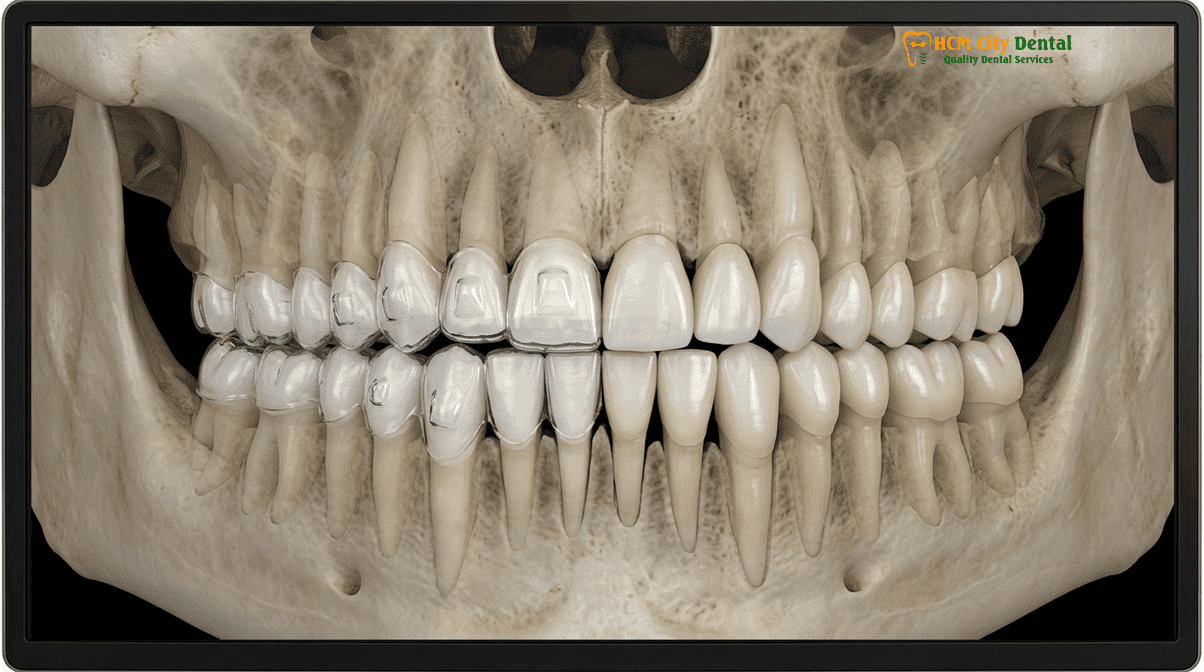
The core challenge in orthodontic deep bite correction is leveling the Curve of Spee—the natural anatomical curve of the mandibular occlusal plane. In a deep bite, this curve is excessively exaggerated; the lower anterior teeth are over-erupted (too high), and the lower premolars are infra-erupted (too low). The process of Curve of Spee leveling with Invisalign G5/G8 involves a dual mechanism: intruding (pushing down) the lower incisors and extruding (pulling up) the posterior premolars and molars.
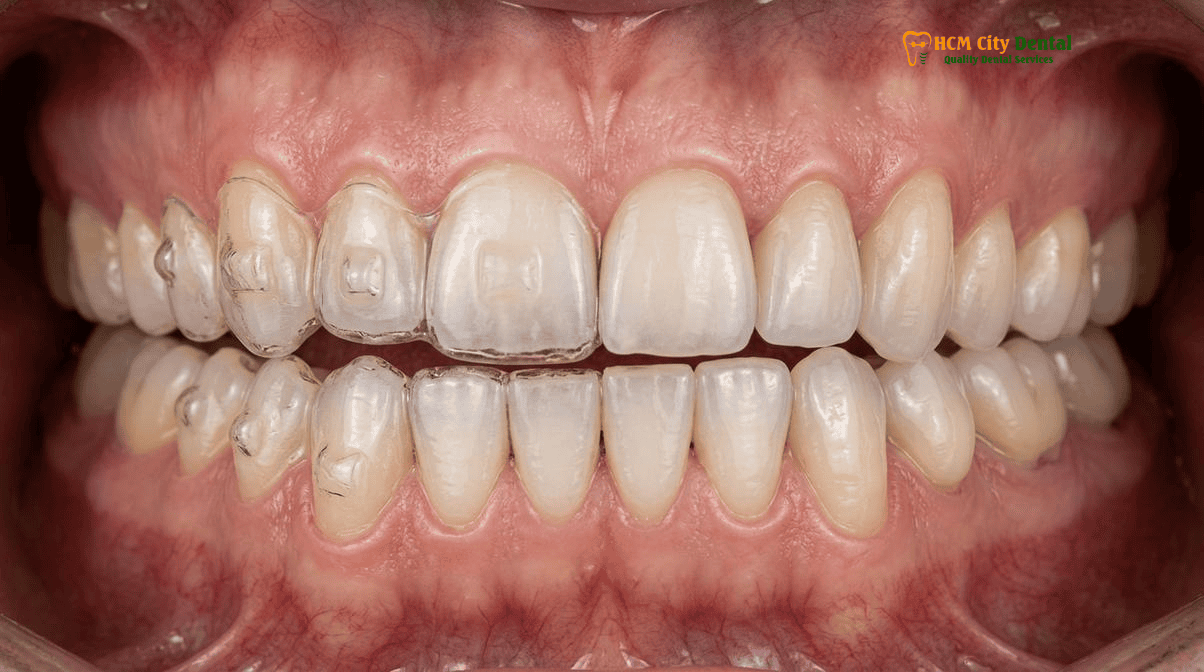
To achieve this, Align Technology developed the G5 and G8 protocols, which feature Invisalign Precision Bite Ramps. These are custom-engineered, 3D-printed prominences located on the lingual (palatal) surface of the upper anterior aligners. When the patient bites down, their lower incisors strike these ramps rather than the upper teeth. This creates an immediate posterior open bite—meaning the back teeth no longer touch. By removing the heavy occlusal forces from the posterior segments, the aligners can effectively extrude the premolars while simultaneously applying an intrusive force to the anterior teeth.
“The integration of precision bite ramps in clear aligner therapy has revolutionized how we manage severe vertical discrepancies. By disoccluding the posterior teeth, we unlock the mandible, allowing for true intrusion of the incisors and passive eruption of the premolars without the need for bulky, uncomfortable traditional bite turbos.”
— Dr. Nguyen Van Cuong, DDS
In complex adult skeletal cases, where the bone is dense and pure aligner forces are insufficient for adequate intrusion, we integrate Orthodontic TAD Mini-Screws (Temporary Anchorage Devices). Placed in the Infrazygomatic Crest (IZC) or Buccal Shelf, these titanium micro-implants provide absolute skeletal anchorage, allowing for 2mm to 4mm of true molar intrusion or anterior segment intrusion, effectively reducing gummy smiles and correcting the vertical dimension without orthognathic surgery[2]. For international patients considering this route, we offer comprehensive guidance on Invisalign in Vietnam for Foreigners: Cost & Case Transfers.
Pathway 2 (Restorative VDO Elevation): When Worn-Down Older Dentitions Benefit from Biomimetic Table-Top Onlays & Crowns in 7 Days
While orthodontic correction is ideal for preserving natural tooth structure, it is not always the appropriate clinical pathway. Many older adult patients present to our clinic with decades of untreated malocclusion, resulting in severely worn front teeth from deep bite treatment delays. In these cases, the clinical crowns of the teeth have been physically ground down by bruxism and shear forces. Moving these short, damaged teeth into the correct position with aligners will fix the bite, but it will not restore the lost enamel or the aesthetics of the smile.
For these patients, the optimal solution is Pathway 2: Restorative Vertical Dimension of Occlusion (VDO) Elevation. This approach involves physically rebuilding the lost tooth structure and opening the bite using advanced biomimetic ceramics. This is the crux of the debate regarding overbite correction with braces/aligners vs. porcelain veneers and crowns. When the teeth are heavily worn, restorative dentistry is mandatory.
The restorative protocol begins with a comprehensive 3D CBCT scan and digital facebow transfer to analyze the TMJ and determine the optimal physiologic VDO. We then utilize CAD/CAM technology to design a new occlusal scheme. To open the bite, we place biomimetic table-top onlays or Full Zirconia Crowns (Cercon Standard / HT Multilayer, $154 – $192 USD online) on the posterior molars and premolars. By increasing the height of the back teeth by just 1 to 3 millimeters, we create immediate vertical clearance in the anterior region.
Clinical Case Study: Rapid VDO Elevation for an Australian Expat
A 58-year-old male patient from Melbourne presented to HCMC Dental Clinic with a 90% deep overbite, severe attrition of the maxillary incisors, and chronic TMJ discomfort. Due to his limited travel schedule, a 24-month orthodontic plan was unfeasible. Dr. Nguyen Van Cuong, DDS, executed a full-mouth restorative rehabilitation. The posterior VDO was elevated using 8 IPS E.max All-Ceramic Onlays ($231 USD/tooth online), creating 3mm of anterior clearance. The worn anterior teeth were then restored with 6 minimal-prep IPS E.max Porcelain Veneers ($185 USD/tooth online). The entire deep bite correction and aesthetic rehabilitation was completed in just 8 days, restoring both function and a youthful smile architecture.
This restorative pathway is particularly advantageous for dental tourists who have limited time in Vietnam. Instead of committing to years of aligner therapy, a full-mouth rehabilitation can be completed in 7 to 10 days, providing immediate functional and aesthetic results[3].
Why Placing Front Veneers on an Uncorrected Deep Bite Without Raising the Posterior Bite Leads to Ceramic Chipping
One of the most common and catastrophic errors in cosmetic dentistry is attempting to place porcelain veneers on a patient with a deep overbite without first addressing the underlying vertical discrepancy. Patients frequently seek out “quick fix” smile makeovers, requesting veneers to lengthen their worn, short front teeth. However, if the posterior bite is not raised (VDO elevation) or the anterior teeth are not intruded orthodontically, the new, longer veneers will be placed directly into the path of the lower incisors.
The human jaw exerts tremendous force during the chewing cycle—often exceeding 200 pounds per square inch. In a deep bite, the envelope of function is severely restricted. When the patient speaks, chews, or grinds their teeth at night (bruxism), the lower incisors will forcefully strike the palatal surface of the new upper veneers. Because dental ceramics like lithium disilicate (IPS E.max) are incredibly strong under compressive forces but highly vulnerable to shear and tensile forces, this constant battering will inevitably lead to failure.
Clinical Warning: The Risk of Premature Restorative Failure
Placing anterior veneers without correcting a deep overbite is a contraindication in prosthodontics. The excessive shear forces will cause the ceramic to chip at the incisal edges, debond from the tooth structure, or suffer catastrophic vertical fractures. At HCMC Dental Clinic, we strictly adhere to biomechanical principles; we will never place cosmetic restorations in a hostile occlusal environment. The bite must be stabilized first.
To ensure the longevity of any anterior cosmetic work, the posterior occlusion must support the vertical dimension. If you are considering cosmetic enhancements, we highly recommend reviewing our Clinical Guide to the Overbite Braces Process | HCMC Dental to understand why foundational bite correction is the prerequisite for lasting aesthetic success[4].
The Hybrid Ortho-Restorative Protocol: 6 Months of Invisalign Go ($1,615 USD) Followed by Minimal-Prep IPS E.max Veneers ($185 USD)
In many clinical scenarios, the most conservative and effective treatment plan is a hybrid approach that combines both orthodontics and restorative dentistry. This is particularly true for patients who have moderate crowding, a moderate deep bite, and mild to moderate enamel wear. Attempting to fix this entirely with crowns would require aggressive, unnecessary removal of healthy tooth structure. Attempting to fix it entirely with Invisalign would align the teeth but leave the worn, jagged edges looking unaesthetic.
The Hybrid Ortho-Restorative Protocol at HCMC Dental Clinic offers the best of both worlds. Phase 1 involves short-term orthodontic alignment using Invisalign Go / Lite / Express (up to 14–20 aligners). Priced at just $1,615 USD online (42,000,000 VND), this 4-to-6-month phase utilizes deep bite correction Invisalign bite ramps to intrude the incisors, level the curve of Spee, and position the teeth into their ideal arch form. By moving the teeth into the correct 3D spatial position, we create the necessary clearance and correct the underlying skeletal/dental discrepancy.
“The hybrid approach is the epitome of minimally invasive dentistry. By using Invisalign to move the teeth into the correct position first, we can often avoid drilling the teeth for full crowns. Instead, we can finish the case with ultra-thin, minimal-prep veneers that simply replace the missing enamel, preserving the biological vitality of the tooth.”
— Dr. Nguyen Van Cuong, DDS
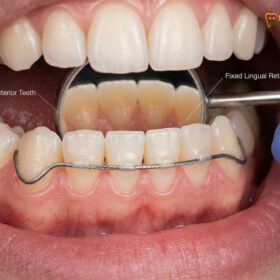
Once the bite is opened and the teeth are aligned, Phase 2 begins. Because the teeth are now in the correct position, Dr. Cuong can restore the worn incisal edges using minimal-prep IPS E.max Porcelain Veneers at $185 USD per tooth online (4,800,000 VND). This protocol ensures that the veneers are placed in a safe, harmonious occlusal environment, free from destructive shear forces, guaranteeing decades of durability. Following the completion of the veneers, the patient is fitted with Invisalign Vivera Retainers Cost & Clinical Guide | HCMC Dental ($308 USD online) to protect the investment and prevent orthodontic relapse.
Decision Matrix for Local Expats vs. Short-Stay Dental Tourists at HCMC Dental Clinic (District 1, Ho Chi Minh City)
Choosing the right pathway for deep bite correction depends heavily on the patient’s geographic mobility, timeline, and clinical presentation. For local expatriates living in Ho Chi Minh City (e.g., Thao Dien, District 2, or Phu My Hung, District 7), long-term orthodontic treatment is highly feasible. For international dental tourists flying into Tan Son Nhat International Airport (SGN) for a 10-day holiday, rapid restorative VDO elevation is often the only practical option.
To help our patients make informed decisions, we provide a transparent comparison of our clinical pathways. As a premier destination for complex rehabilitations, we encourage patients to research the Best Orthodontist in Ho Chi Minh City: Invisalign & Adult Braces to understand the caliber of specialist care available at our District 1 facility.
| Clinical Pathway | Ideal Patient Profile | Treatment Timeline | 2026 Online Booking Fee (-40%) | Standard Walk-In / US Benchmark |
|---|---|---|---|---|
| Invisalign Comprehensive (Unlimited Aligners + Bite Ramps) | Younger adults, healthy enamel, local expats, or tourists willing to use remote monitoring. | 12 to 24 Months | $2,538 USD (66,000,000 VND) | $4,231 USD Walk-in (US Benchmark: $6,500+) |
| Hybrid Protocol (Invisalign Go + E.max Veneers) | Moderate wear, moderate deep bite, desire for minimally invasive aesthetics. | 6 Months Ortho + 1 Week Restorative | $1,615 USD (Ortho) + $185 USD/tooth (Veneers) | $2,692 USD Walk-in (Ortho) (US Benchmark: $8,000+) |
| Full VDO Restorative Elevation (Zirconia Crowns / E.max Onlays) | Older adults, severe attrition, short-stay dental tourists (7-10 days in Vietnam). | 7 to 10 Days | $154 – $192 USD/tooth (Zirconia) $231 USD/tooth (E.max) | $256 – $385 USD Walk-in (US Benchmark: $1,500+/tooth) |
| Post-Treatment Retention (Vivera SmartTrack Retainers) | All patients completing orthodontic or hybrid deep bite correction. | Delivered in 3 Days | $308 USD (8,000,000 VND) | $513 USD Walk-in (US Benchmark: $800+) |
At HCMC Dental Clinic, located in District 1, Ho Chi Minh City, we utilize state-of-the-art 3D CBCT imaging ($18 USD online) and digital intraoral scanning to map out your exact treatment plan before any procedure begins. Whether you require the subtle biomechanics of Does Invisalign Work As Well As Braces? Clinical Comparison | HCMC Dental or the rapid transformation of biomimetic ceramics, our specialist team ensures predictable, world-class outcomes[5].
Frequently Asked Questions
What are Invisalign Precision Bite Ramps and why do my back teeth not touch for the first few weeks of wearing them?
Invisalign Precision Bite Ramps are small, custom-molded prominences on the lingual (back) surface of the upper aligners. They act as anterior bite turbos to disocclude the posterior teeth. By preventing your back teeth from touching, they remove the heavy biting forces that normally keep the posterior teeth submerged, allowing for the passive or active eruption of premolars and molars while simultaneously intruding the lower incisors to correct the deep bite.
If I only have 7 to 10 days in Vietnam for dental tourism, can a deep bite be safely corrected with crowns and table-top onlays instead of braces?
Yes, for adult patients presenting with severe attrition and worn front teeth from deep bite treatment delays, a restorative approach is often preferred. By utilizing biomimetic table-top onlays on the posterior teeth and full-coverage crowns or veneers on the anterior teeth, we can elevate the Vertical Dimension of Occlusion (VDO) and correct the deep bite in just 7 to 10 days, making it an ideal solution for short-stay dental tourists at HCMC Dental Clinic.
Why did another clinic tell me my veneers would crack unless I fixed my deep overbite first?
Placing porcelain veneers on an uncorrected deep bite severely restricts the envelope of function. In a deep overbite, the lower incisors strike the palatal surface of the upper incisors with excessive shear force during chewing and speaking. If the posterior bite is not raised to create proper clearance, these intense forces will inevitably lead to ceramic chipping, debonding, or catastrophic fracture of the anterior veneers.
How long does it take to level the Curve of Spee and open a deep bite with Invisalign Comprehensive in adults?
Leveling the Curve of Spee using Invisalign G5 or G8 protocols typically requires 12 to 24 months in adult patients. The exact timeline depends on the severity of the skeletal discrepancy, the density of the mandibular bone, and patient compliance with aligner wear (22 hours per day). Complex cases may also require the integration of Orthodontic TAD Mini-Screws for additional intrusive anchorage.
How much do Invisalign Comprehensive ($2,538 USD) vs. biomimetic VDO ceramic restorations cost at HCMC Dental Clinic?
At HCMC Dental Clinic, our transparent 2026 online booking fee schedule offers significant savings. Invisalign Comprehensive (unlimited aligners) costs $2,538 USD online (compared to the $4,231 USD walk-in rate). Alternatively, biomimetic VDO elevation using Full Zirconia Crowns ranges from $154 to $192 USD per tooth online, and premium IPS E.max All-Ceramic Crowns or Onlays cost $231 USD per tooth online. A full-mouth restorative rehabilitation is custom-quoted based on the exact number of teeth involved.
References
- American Journal of Orthodontics and Dentofacial Orthopedics. Biomechanical evaluation of deep overbite correction using clear aligners with precision bite ramps: A 3D finite element analysis. (2023).
- Journal of Prosthetic Dentistry. Full-mouth rehabilitation of severe tooth wear with altered vertical dimension of occlusion using biomimetic table-top restorations. (2022).
- International Journal of Periodontics & Restorative Dentistry. The impact of traumatic deep overbite on palatal gingival recession and anterior maxillary bone loss. (2021).
- Journal of Esthetic and Restorative Dentistry. Survival rates of anterior porcelain veneers in patients with uncorrected deep overbites: A 10-year retrospective study. (2023).
- Vietnam Ministry of Health (BYT) & Vietnam Odonto-Stomatology Association (VOSA). National Clinical Guidelines on Specialist Dental Care, Biomaterial Traceability & EN 13060 Class B Infection Control. (2024).