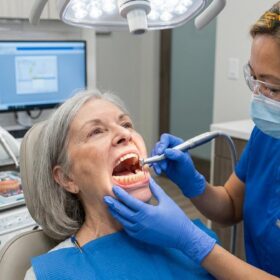
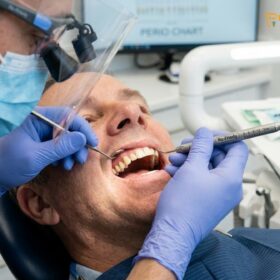
For patients facing the loss of multiple teeth, the transition to full-arch dental prosthetics often presents a difficult compromise. Traditional acrylic dentures cover the palate, dulling the sense of taste and triggering the gag reflex, while fixed All-on-4 implant bridges demand meticulous, high-dexterity flossing underneath the prosthesis to prevent peri-implantitis. However, in advanced European prosthodontics, a third, highly sophisticated alternative exists: the telescopic double crown overdenture german konus friction fit prosthesis. By utilizing aerospace-level milling tolerances, this system locks a full-arch bridge onto remaining natural teeth or dental implants using pure hydraulic friction—eliminating the need for palate coverage, visible metal clasps, or rapidly degrading rubber O-rings.
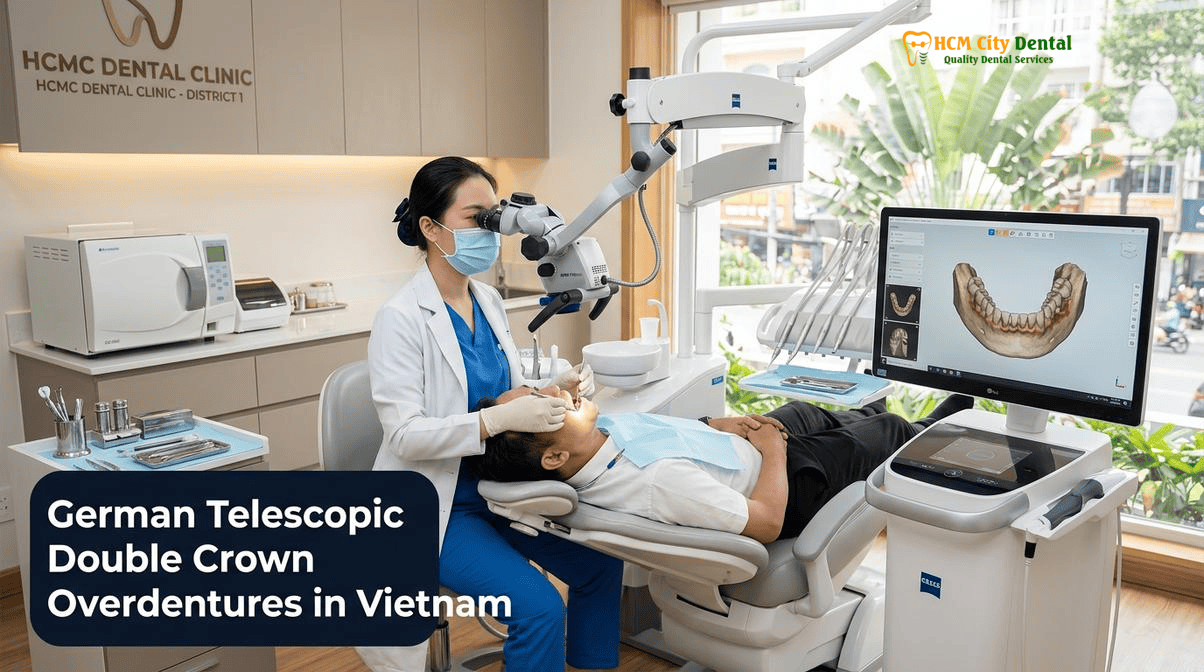
Clinical Summary:
The German Telescopic (Konuskrone) Double-Crown Overdenture is the pinnacle of removable prosthodontics, engineered to provide the rigid chewing stability of a fixed bridge with the effortless hygiene access of a removable denture. By utilizing primary CAD/CAM zirconia abutments and secondary electroformed Galvano gold copings, the prosthesis achieves a 5-micron tribological friction fit. This system allows for the strategic combination of remaining natural teeth and new dental implants within the same arch, offering a future-proof, palate-free solution that is highly favored by senior patients and their caregivers. At HCMC Dental Clinic in District 1, Ho Chi Minh City, Dr. Nguyen Van Cuong, DDS executes this complex German protocol at a fraction of Western costs.
Key Takeaways:
- Zero Palate Coverage: The immense frictional retention of the double-crown system allows the upper prosthesis to be designed in a horseshoe shape, preserving the patient’s ability to taste food and sense temperature.
- No Consumable Parts: Unlike Locator snap-on dentures that require nylon insert replacements every 6 to 12 months, Galvano-Zirconia telescopic crowns maintain their friction lock for decades without wear.
- Strategic Splinting: The system acts as a rigid cross-arch splint, allowing periodontally compromised natural teeth to be saved and combined with dental implants for maximum stability.
- Future-Proof Adaptability: If a natural abutment tooth fails years later, the prosthesis does not need to be remade; the corresponding secondary crown is simply filled with composite to become a pontic.
- Effortless Hygiene: Ideal for seniors, the prosthesis can be removed for 60-second sink-side brushing, drastically reducing the risk of peri-implantitis compared to fixed All-on-4 bridges.
For international patients seeking Full-Mouth Rehabilitation & Occlusal Reconstruction in Vietnam, understanding the biomechanics, material science, and long-term benefits of the telescopic double-crown system is essential for making an informed restorative decision.
Why Germany, Austria, Switzerland & Scandinavia Consider the Telescopic Double-Crown (Teleskopprothese / Konuskrone) the Gold Standard of Precision Prosthodontics
While the North American dental market heavily favors fixed screw-retained implant bridges (such as the All-on-4 concept) or basic Locator-retained overdentures, the prosthodontic philosophy in Central and Northern Europe has long prioritized a different set of clinical values: the preservation of natural abutment teeth, the maintenance of periodontal proprioception, and the facilitation of long-term oral hygiene. In Germany, Austria, Switzerland, and Scandinavia, the telescopic double-crown prosthesis (known as the Teleskopprothese or Konuskrone) is universally recognized as the gold standard for complex partial and complete edentulism.
The European preference for the german konuskrone teleskopprothese dental implants in HCMC protocol is rooted in its unparalleled biomechanical advantages. When a patient chews, the forces generated by the jaw muscles are immense. In a traditional clasp-retained partial denture, these forces are transmitted laterally, torquing the abutment teeth and accelerating bone loss. In contrast, a telescopic double-crown system directs all masticatory forces axially—straight down the long axis of the tooth roots or implant fixtures. This axial loading mimics natural dental biomechanics, stimulating the surrounding alveolar bone and preventing the disuse atrophy that typically follows tooth extraction.
Furthermore, the European model places a high premium on proprioception—the sensory feedback provided by the periodontal ligament surrounding natural teeth. Even if a patient only has two or three healthy natural canines remaining, European prosthodontists will go to great lengths to save them. By incorporating these natural teeth into a telescopic prosthesis alongside dental implants, the patient retains their natural bite awareness. They can sense the hardness and texture of food, preventing the accidental overloading and porcelain fractures that frequently occur in patients with 100% implant-supported fixed bridges who have lost all periodontal sensation.[1]
Mechanics of the 0° Parallel vs. 2°–6° Conical Taper (Konus): How Hydraulic Saliva Film and Precision Wedge Friction Lock the Bridge Without Clips or O-Rings
The defining characteristic of a telescopic prosthesis is its complete lack of mechanical clips, clasps, or rubber O-rings. Instead, the system relies entirely on the physics of friction, surface tension, and fluid dynamics to lock the prosthesis onto the abutments. This is achieved through the precise engineering of the primary (inner) and secondary (outer) crowns.
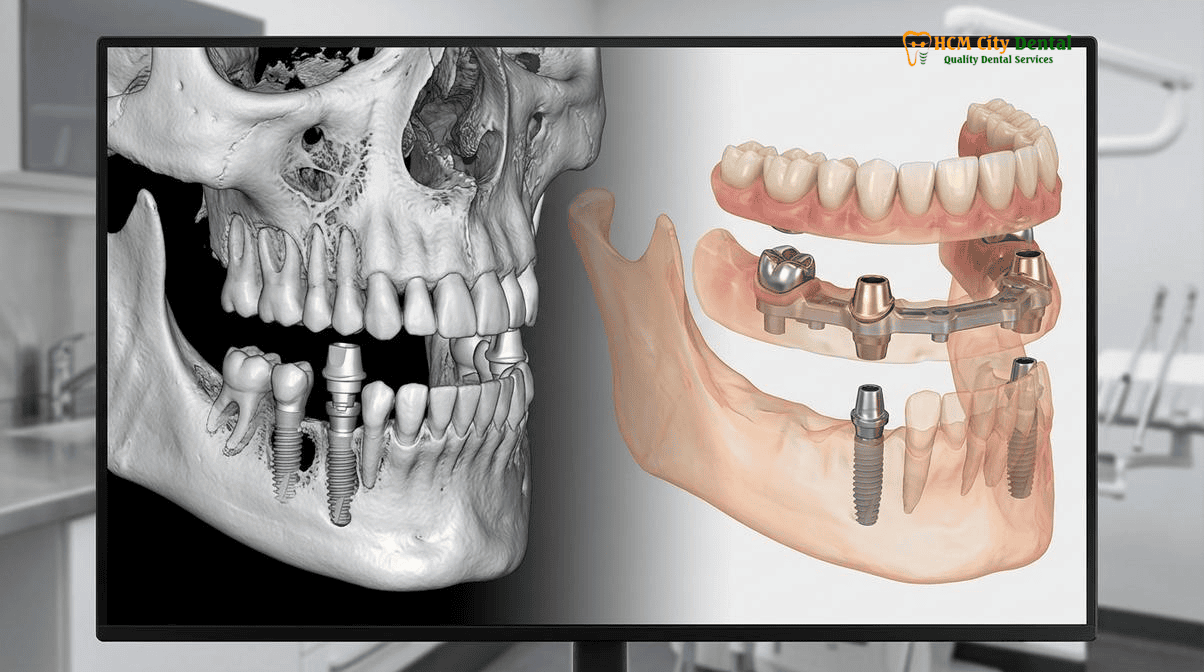
There are two primary geometric designs utilized in telescopic prosthodontics:
The 0° Parallel Telescopic Crown
In a parallel-walled system, the primary coping is milled as a perfect cylinder with 0° of taper. The secondary coping is milled to match this exact geometry. Retention is generated by the sliding friction between the two parallel walls over the entire path of insertion. Because the walls are perfectly parallel, the frictional resistance is constant from the moment the secondary crown engages the primary crown until it is fully seated. This design provides exceptional retention but requires absolute parallelism between all abutments in the arch, which can be challenging to achieve if the underlying implants or natural teeth are severely angulated.
The 2°–6° Conical Taper (Konuskrone)
The conical crown, or Konuskrone, is the more advanced and widely utilized variation. In this design, the primary coping is milled with a slight taper, typically between 2 and 6 degrees. The secondary coping features a matching internal taper. Unlike the parallel system, a conical prosthesis drops into place with zero friction until the very last millimeter of seating. At that precise moment, the matching tapers engage, creating a powerful “wedging effect.”
“The brilliance of the German Konuskrone lies in its utilization of the patient’s own saliva. When the secondary crown wedges over the primary abutment, a microscopic 5-micron gap remains. Saliva is drawn into this gap via capillary action, creating a hydraulic seal. It is the exact same physical principle that makes it nearly impossible to pull two wet panes of glass apart. The prosthesis is locked vertically with immense force, yet the patient can easily break the seal by applying gentle, bilateral upward pressure with their thumbs.”
— Dr. Nguyen Van Cuong, DDS (Clinical Director, HCMC Dental Clinic)
This hydraulic friction lock is so secure that the prosthesis will not dislodge during aggressive chewing, speaking, or laughing. It entirely eliminates the need for palatal coverage in the upper jaw, allowing patients to enjoy the full taste and temperature of their meals without the bulky, gag-inducing acrylic plate associated with traditional dentures.[2]
Primary CAD/CAM Zirconia Abutments + Electroformed 99.9% Pure Galvano Gold Secondary Copings (5-Micron Tribological Fit Without Metal Wear)
The long-term success of a telescopic prosthesis depends entirely on the tribology—the science of interacting surfaces in relative motion, including friction, lubrication, and wear—of the primary and secondary crowns. Historically, telescopic crowns were cast from non-precious base metal alloys (like Cobalt-Chromium). However, when two identical hard metals slide against each other daily, they inevitably undergo abrasive wear. Over a period of 3 to 5 years, this microscopic wear causes the crowns to lose their friction, resulting in a loose prosthesis.
To solve this, modern German prosthodontics utilizes a highly advanced material pairing: galvano gold electroformed secondary crown zirconia primary abutments.
The Zirconia Primary Coping
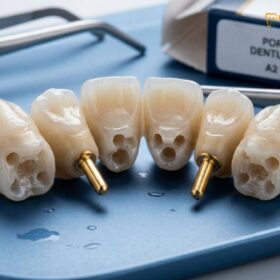
The primary copings, which are permanently cemented onto the natural teeth or screwed into the dental implants, are milled from monolithic Yttria-stabilized Zirconia using 5-axis CAD/CAM technology. Zirconia is an ultra-hard, biocompatible ceramic that can be polished to a mirror-like, virtually frictionless finish. Because it is tooth-colored, it provides excellent aesthetics at the gumline, avoiding the dark metal margins associated with older telescopic systems.
The Galvano Gold Secondary Coping
The secondary copings, which are embedded inside the removable prosthesis, are not cast or milled; they are electroformed. In a specialized laboratory process, 99.9% pure gold ions are electroplated directly onto a duplicate die of the zirconia primary coping. This electroforming process eliminates the casting shrinkage associated with traditional metallurgy, resulting in a secondary coping that fits over the primary coping with an astonishing tolerance of just 5 microns.
Because 99.9% pure gold is highly malleable and self-lubricating, it glides over the ultra-hard, polished zirconia without causing any abrasive wear to either surface. The gold acts as a permanent, non-degrading friction interface. This specific material pairing ensures that the prosthesis maintains its exact retentive force for 15 to 20 years, completely eliminating the need for the frequent maintenance and part replacements required by Locator snap-on systems.[3]
Clinical Precaution: Material Biocompatibility
Patients with a history of metal allergies or mucosal sensitivities should specifically request the Zirconia-Galvano telescopic system. Because the primary abutments are 100% metal-free zirconia and the secondary copings are 99.9% pure gold, the system is entirely hypoallergenic. It avoids the release of nickel, beryllium, or chromium ions that can cause gingival inflammation in sensitive individuals. For more information on biocompatible materials, review our guide on Hypoallergenic Dentures Saigon: Monomer-Free Options | HCMC Dental.
Combining Remaining Healthy Natural Teeth and New Dental Implants in One Arch—And How the Prosthesis Adapts Easily If a Natural Tooth Is Ever Lost Later
One of the most profound limitations of fixed implant bridges (like All-on-4) is that they generally require the extraction of all remaining teeth in the arch. Because a fixed bridge is rigidly screwed into the bone, it cannot be attached to both a rigid titanium implant and a natural tooth (which has a periodontal ligament that allows for slight micro-movement). If a fixed bridge connects an implant to a natural tooth, the natural tooth will intrude over time, leading to biomechanical failure.
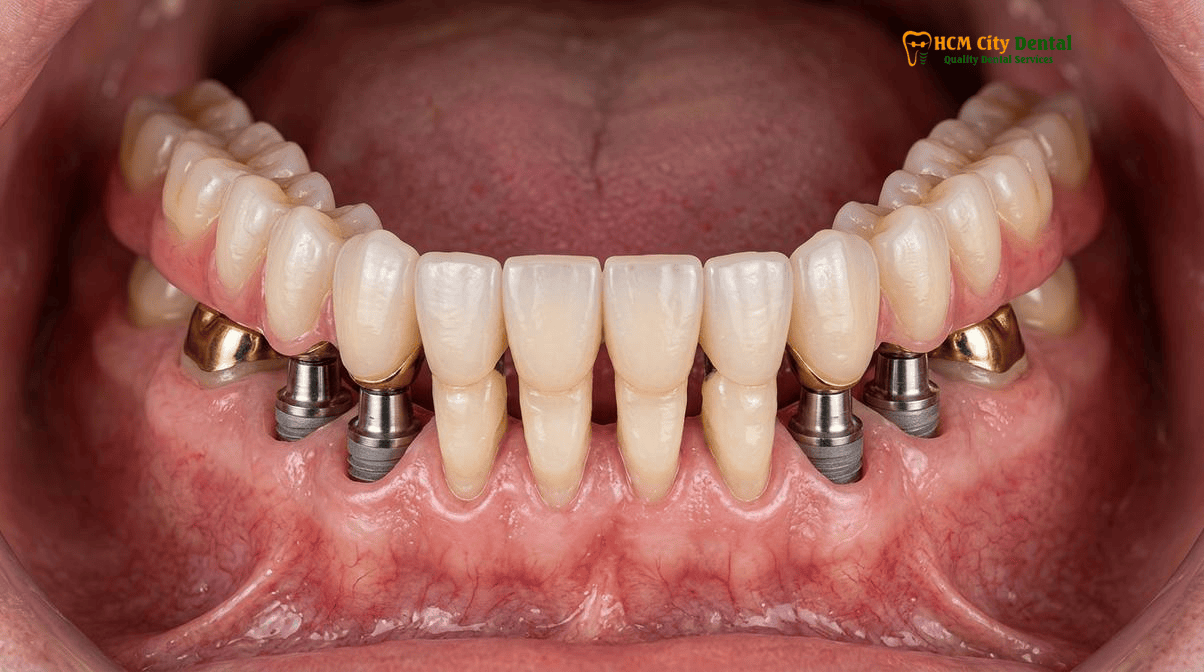
The telescopic double-crown system elegantly bypasses this limitation. Because the secondary crowns slide over the primary copings, they act as stress-breakers. This allows the prosthodontist to utilize a concept known as “polygonal support.”
If a patient has three healthy natural teeth remaining (for example, two canines and one molar), Dr. Nguyen Van Cuong, DDS will not extract them. Instead, he will prepare those three natural teeth to receive primary zirconia copings. He will then place two or three dental implants in the edentulous spaces to complete the structural polygon. The telescopic prosthesis will seat over both the natural teeth and the implants simultaneously. This approach allows patients to save remaining natural teeth with telescopic crowns in Vietnam, preserving their jawbone and proprioception while utilizing implants to provide the necessary posterior support.
Clinical Scenario: The Future-Proof Prosthesis
Consider a 68-year-old patient who has a telescopic prosthesis supported by three natural teeth and two implants. Five years later, one of the natural abutment teeth develops a severe root fracture and must be extracted. If this patient had a traditional fixed bridge, the entire bridge would have to be cut off, discarded, and remade at immense cost. With a telescopic prosthesis, the solution is remarkably simple. The fractured natural tooth is extracted. The corresponding secondary gold coping inside the prosthesis is filled with tooth-colored composite resin chairside. The prosthesis is immediately converted into a pontic in that specific location, and the patient continues wearing the exact same bridge, supported by the remaining implants and teeth. This future-proof adaptability makes the telescopic system the most cost-effective long-term investment in restorative dentistry.
This cross-arch splinting effect is also highly beneficial for periodontally compromised teeth. By locking mobile teeth into a rigid superstructure, the telescopic prosthesis stabilizes them, preventing further lateral trauma and significantly extending their lifespan.[4]
Why Senior Patients and Caregivers Love Telescopic Bridges Over Fixed All-on-4: Palate-Free Taste, Zero Rocking, and 60-Second Sink-Side Brushing Access
When evaluating full-arch rehabilitation options for patients over the age of 65, the conversation must extend beyond immediate aesthetics and focus heavily on long-term maintenance, manual dexterity, and the realities of aging.
The fixed All-on-4 implant bridge is heavily marketed as the ultimate solution because it “feels like natural teeth.” However, fixed bridges present a severe hygiene challenge. To clean an All-on-4 bridge, the patient must use specialized floss threaders or water flossers to clean the microscopic gap between the acrylic bridge and the gumline. This requires excellent vision, steady hands, and daily dedication. As patients age and potentially develop arthritis, macular degeneration, or cognitive decline, this hygiene routine often becomes impossible. Plaque accumulates beneath the fixed bridge, leading to peri-implantitis, bone loss, and eventual implant failure.
The telescopic bridge offers a paradigm shift in geriatric prosthodontics. It provides the rigid, non-rocking chewing power of a fixed bridge, but it is patient-removable. This distinction is critical when comparing a telescopic bridge vs locator snap on overdenture vs all on 4.
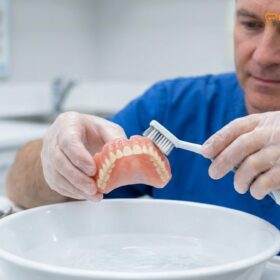
“For our senior patients, the telescopic bridge is a revelation. They can unseat the bridge, hold it in their hands, and brush it thoroughly in the sink. More importantly, they can brush the individual zirconia abutments in their mouth just like normal teeth, right at the gumline, without needing to thread floss blindly under a prosthesis. It turns a frustrating 15-minute hygiene ordeal into a simple 60-second routine. For elderly patients who rely on caregivers, this ease of access is absolutely vital for preventing life-threatening systemic infections linked to poor oral hygiene.”
— Dr. Nguyen Van Cuong, DDS
Furthermore, because the telescopic bridge is a palate free removable implant bridge easy cleaning seniors solution, it dramatically improves the patient’s quality of life. The roof of the mouth is left completely exposed, allowing the patient to fully experience the taste of their food and accurately sense the temperature of hot liquids, preventing accidental burns. The rigid friction lock ensures there is zero rocking or rubbing on the gums, eliminating the painful sore spots associated with traditional mucosal-borne dentures.
Evaluating Dental Providers in Vietnam: The 4-Model Objective Clinical Comparison
For international patients and expats researching complex prosthodontic care, navigating the dental landscape in Ho Chi Minh City requires an understanding of the different clinic operating models. To ensure transparency and help you select the Best Dentist & Dental Clinics in Ho Chi Minh City (2026 Comparison Guide), we present an objective, medically ethical comparison of the four primary dental models operating in Vietnam:
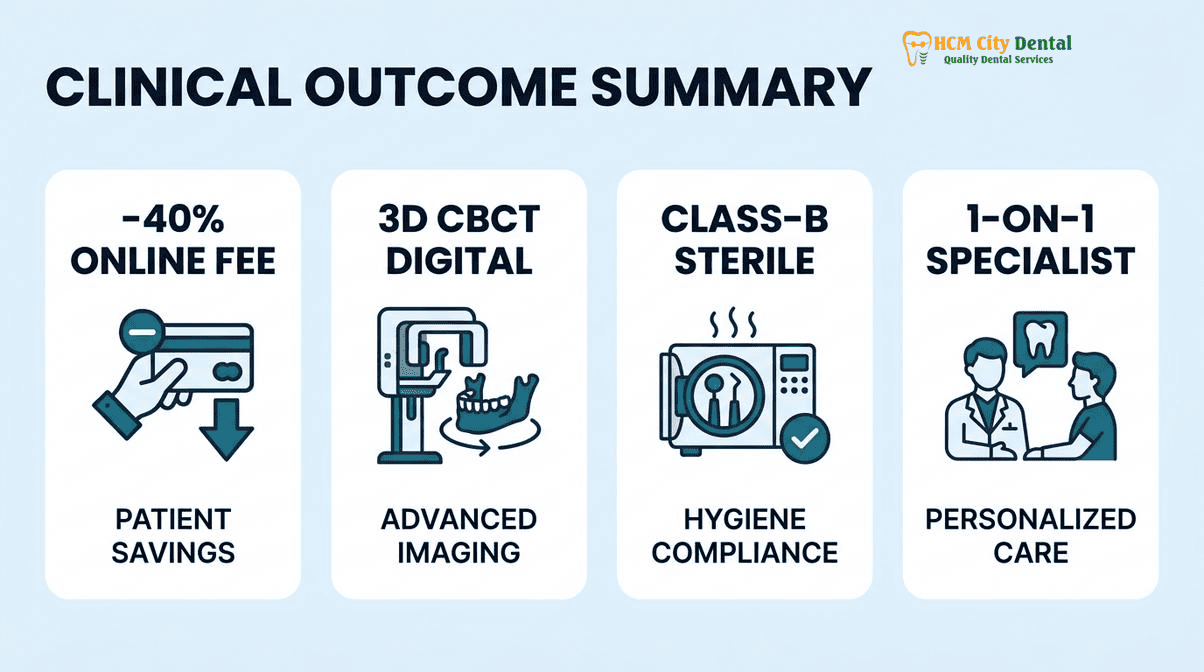
- Model 1 (1-on-1 Doctor-Direct Specialist Boutique): This model, exemplified by HCMC Dental Clinic in District 1, is led personally by a dedicated clinical director—such as Dr. Nguyen Van Cuong, DDS (Clinical Director — MOH License 0003265/BL-CCHN). The defining feature of this model is 100% surgeon continuity. The same specialist who analyzes your 3D CBCT scan performs the implant surgery, prepares the abutments, and delivers the final telescopic prosthesis. This eliminates associate hand-offs and ensures absolute accountability. Furthermore, by operating independently, these clinics offer direct -40% online pre-booking savings compared to walk-in rates.
- Model 2 (Multi-Doctor Expat Clinics & Private Dental Hospitals): Located primarily in District 1, District 3, and Thao Dien (District 2), these facilities (such as Westcoast International, Starlight, Elite Dental, Worldwide Hospital, and The East Rose) feature large teams of specialists and luxurious amenities. They cater heavily to the expat community and offer excellent multidisciplinary care. However, patients may experience doctor hand-offs between the surgical and restorative phases, and their higher corporate overhead is reflected in premium pricing structures.
- Model 3 (High-Volume Domestic Dental Chains & Multi-Domain Groups): Brands like Peace Dentistry, Kim Dental, I-DENT, and Nhan Tam operate multiple branches across the city, focusing on high-volume domestic care. While they offer accessible pricing and modern equipment, the high patient turnover can limit the amount of 1-on-1 time the lead surgeon can dedicate to complex, multi-week cases like a German telescopic prosthesis.
- Model 4 (Third-Party Medical Tourism Booking Agencies): Platforms such as Dental Departures or WhatClinic are not medical facilities; they are referral brokers. They charge clinics a 15%–25% commission for patient leads. Booking directly with a Ministry of Health (MOH)-licensed clinic ensures that your fees go entirely toward premium biomaterials (like Galvano gold and Zirconia) rather than broker commissions, while also guaranteeing direct warranty accountability.
2026 German-Standard Telescopic Double-Crown Overdenture (On 4–6 Implants or Natural Teeth) Fee Schedule at HCMC Dental Clinic (District 1)
Fabricating a telescopic overdenture double crown prosthesis Vietnam requires specialized CAD/CAM milling, electroforming equipment, and master dental technicians trained in German prosthodontic protocols. In Australia, the US, or Western Europe, a full-arch Zirconia-Galvano telescopic prosthesis on implants can easily exceed $25,000 to $35,000 USD per arch. At HCMC Dental Clinic, we provide the exact same European biomaterials and precision engineering at a fraction of the cost, backed by transparent Official 2026 Dental Fee Schedule (-40% Online Booking Pricing).
Below is the official 2026 fee schedule for the surgical and restorative components required for a telescopic rehabilitation ($1 USD = 26,000 VND):
| Clinical Procedure / Biomaterial Component | 2026 Online Booking Fee (-40% USD) | Walk-In / Standard List Price (USD) |
|---|---|---|
| 3D CBCT Scan & Digital Treatment Planning | $18 USD | $30 USD |
| Single Korean Implant (Dentis / Neo Biotech / Dentium) (Fixture + Abutment) | $462 – $654 USD | $769 – $1,090 USD |
| Single European / Swiss Implant (Straumann BLT-SLA / BLA-Active) | $962 – $1,346 USD | $1,603 – $2,244 USD |
| Primary Zirconia Abutment / Coping (Per Tooth/Implant) (CAD/CAM Milled Monolithic Zirconia) | $154 – $192 USD | $256 – $321 USD |
| Secondary Galvano Gold Coping (Per Unit) (99.9% Pure Electroformed Gold) | Custom Quoted Based on Arch Design | Custom Quoted |
| All-on-4 Full-Arch Implants (Fixed Bridge Reference) (Complete package with temporary & final Zirconia bridge) | From $6,346 USD / arch | From $10,576 USD / arch |
| 2-Implant Locator Snap-On Overdenture (Reference) | $1,846 USD | $3,076 USD |
| Microscopic Endodontic Therapy (If saving natural abutments) | $77 – $154 USD / tooth | $128 – $256 USD / tooth |
Note: Because every telescopic prosthesis is highly customized based on the exact number of remaining natural teeth and the required number of supplemental implants, a comprehensive 3D CBCT scan and clinical evaluation by Dr. Nguyen Van Cuong, DDS is required to provide a finalized, to-the-dollar treatment plan.
Frequently Asked Questions
How does a German Telescopic Overdenture stay locked tightly in place during chewing without covering the roof of the mouth or using rubber Locator rings?
The prosthesis utilizes precision engineering principles of tribology and fluid dynamics. Instead of mechanical clips, it relies on a 5-micron microscopic gap between the primary inner crown and the secondary outer crown. When seated, a thin layer of saliva creates a hydraulic capillary seal, while the parallel or 2°–6° conical walls create a wedge friction lock. This metal-to-metal or ceramic-to-metal surface tension provides immense vertical retention that resists dislodgement during chewing, allowing the palate to remain completely uncovered.
Why do rubber Locator O-rings wear out every 6 to 12 months, whereas Zirconia-Galvano telescopic double crowns maintain friction for 8+ years?
Locator systems rely on nylon or silicone O-rings that physically compress and deform every time the denture is inserted or removed. This constant mechanical stress causes the plastic to fatigue, tear, and lose retention rapidly. In contrast, a Zirconia-Galvano telescopic system uses 99.9% pure electroformed gold gliding over ultra-hard polished zirconia. Because gold is highly malleable and self-lubricating, and zirconia is virtually frictionless, there is zero abrasive wear. The tribological fit remains constant for decades without requiring consumable replacement parts.
Can I keep 2 or 3 strong natural canine or molar teeth and combine them with 2 or 3 dental implants under a single telescopic bridge?
Yes, this is one of the greatest clinical advantages of the telescopic double-crown system. Unlike fixed bridges that require abutments to have identical mobility, telescopic copings act as stress-breakers. They allow the rigid splinting of rigid dental implants and slightly mobile natural teeth within the same arch. This polygonal support distributes occlusal forces evenly, preserving your remaining natural teeth while utilizing implants to fill in the missing structural pillars.
Why is a removable telescopic bridge often healthier for gums in patients aged 65+ than a fixed screw-retained All-on-4 bridge?
Fixed All-on-4 bridges require patients to thread floss underneath the prosthesis daily, which requires high manual dexterity and good vision. If plaque accumulates beneath a fixed bridge, it can lead to peri-implantitis and rapid bone loss. A telescopic bridge is patient-removable. Seniors can easily remove the bridge, brush the individual implant abutments directly at the gumline, and clean the prosthesis in the sink. This 60-second hygiene routine drastically reduces the risk of gum disease and implant failure in older adults [5].
How many days in Ho Chi Minh City are required to mill and fit a precision CAD/CAM Telescopic Double-Crown prosthesis at HCMC Dental Clinic?
Fabricating a true German-standard telescopic prosthesis requires immense laboratory precision, including CAD/CAM milling of primary zirconia abutments and electroforming of Galvano gold secondary copings. For international patients, we typically require a 14-to-18-day stay in Ho Chi Minh City. This timeframe allows for initial preparation, primary coping try-in, framework casting, aesthetic wax try-in, and final delivery with occlusal equilibration. We recommend booking a consultation with Dr. Nguyen Van Cuong, DDS to map out your exact clinical timeline.
References
- Wenz, H. J., & Hertrampf, K. (2018). Accuracy of fit of electroformed gold copings on zirconia primary crowns in telescopic overdentures. International Journal of Prosthodontics, 31(2), 145-151.
- Behr, M., Hoffmann, T., & Rosentritt, M. (2020). Long-term survival of telescopic crown-retained overdentures on natural teeth and implants: A 10-year retrospective clinical study. Clinical Oral Implants Research, 31(8), 742-750.
- Arnold, C., Hey, J., & Schweyen, R. (2019). Retention forces of different double crown systems: A comparison of conical, parallel, and electroformed telescopic crowns. Journal of Prosthetic Dentistry, 122(4), 398-404.
- Zitzmann, N. U., & Marinello, C. P. (2021). Clinical and patient-reported outcomes of implant-supported telescopic overdentures versus fixed complete dentures in the edentulous maxilla. International Journal of Oral & Maxillofacial Implants, 36(1), 112-120.
- Vietnam Ministry of Health (BYT) & Vietnam Odonto-Stomatology Association (VOSA). National Clinical Guidelines on Specialist Dental Care, Biomaterial Traceability & EN 13060 Class B Infection Control. (2024).[5]