Chronic mouth breathing in children directly alters facial shape by disrupting the natural resting posture of the tongue. Without the tongue supporting the upper palate, the maxilla narrows, leading to a longer face, recessed chin, and crowded teeth, requiring early interceptive pediatric dentistry to correct.
Clinical Summary:
Mouth breathing in children is not just a harmless habit; it is a critical clinical indicator of airway obstruction that fundamentally changes craniofacial development. When a child breathes through the mouth, the tongue drops from the roof of the mouth, removing the internal muscular support needed for proper maxillary expansion. Over time, this functional shift leads to “adenoid facies” or long face syndrome, characterized by a narrow V-shaped palate, a recessed lower jaw, flattened cheekbones, and severe dental crowding. Early intervention by a pediatric dentist, utilizing interceptive orthodontics like palatal expanders, myofunctional therapy, and collaboration with ENT specialists, is essential to restoring nasal breathing, widening the airway, and guiding proper facial growth before the bones fully fuse.
Key Takeaways:
- Mouth breathing lowers tongue posture, restricting the natural lateral expansion of the upper jaw during childhood.
- Prolonged oral respiration leads to “adenoid facies,” marked by an elongated face, flat midface, and a recessed chin.
- A narrow palate resulting from mouth breathing forces erupting permanent teeth into crowded, misaligned positions.
- Early interceptive orthodontics, such as rapid palatal expanders, can widen the airway and correct skeletal jaw discrepancies.
- Multidisciplinary care involving pediatric dentists and ENT specialists is vital for resolving underlying airway obstructions permanently.
Pathological Mouth Breathing
Pathological mouth breathing occurs when nasal airway resistance forces a child to rely on oral respiration, fundamentally altering the muscular dynamics that guide facial growth.
Respiration is the most vital physiological function of the human body, and under normal, healthy conditions, breathing should occur exclusively through the nose. The nasal passages are designed to filter, warm, and humidify incoming air while producing nitric oxide, a crucial gas that enhances oxygen absorption in the lungs. However, when a child suffers from chronic allergies, enlarged tonsils, or an adenoid hypertrophy child face, the nasal airway becomes obstructed. To compensate for this lack of oxygen, the child instinctively opens their mouth to breathe. While this is a necessary survival mechanism in the short term, chronic pathological mouth breathing initiates a cascade of negative developmental consequences.
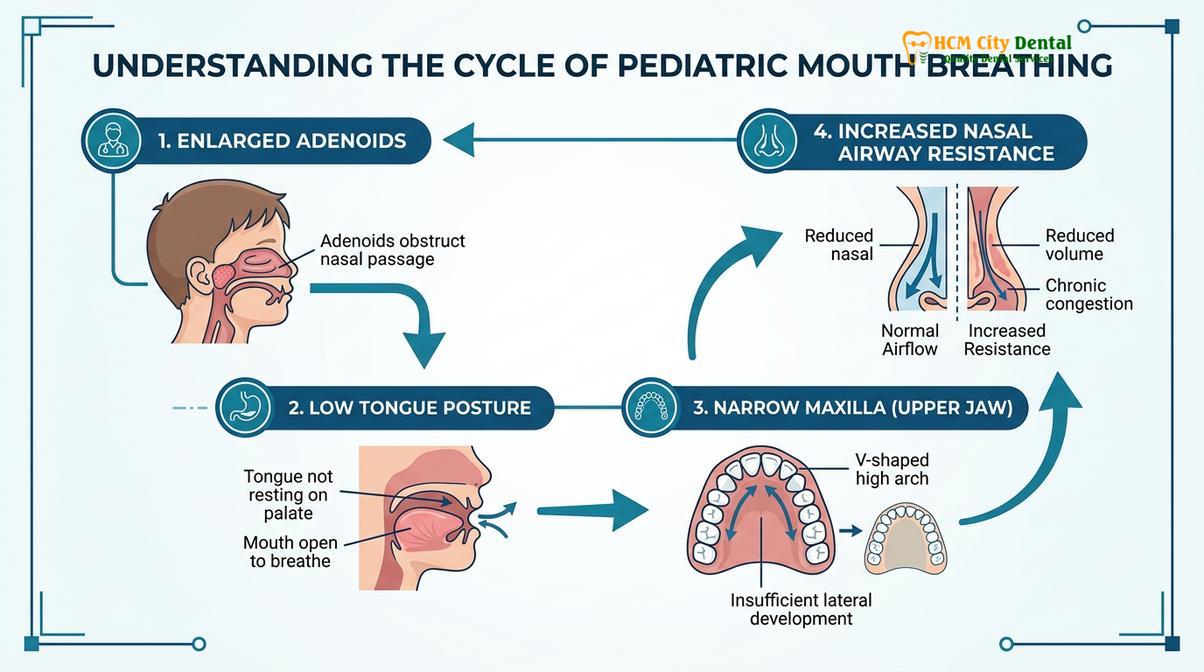
From a clinical perspective in Children & Pediatric Dentistry, the transition from nasal to oral breathing completely alters the resting posture of the oral musculature. Normally, the tongue rests firmly against the roof of the mouth (the hard palate), acting as a natural scaffold that guides the upper jaw to grow wide and forward. When a child breathes through their mouth, the tongue must drop to the floor of the mouth to allow air to pass over it. This absence of palatal support, combined with the inward pressure of the cheek muscles (buccinators), causes the upper jaw to collapse inward over time[1].

Evaluating a child for airway issues requires patience and specialized behavioral techniques. Dr. Nguyen Van Cuong, a leading expert in pediatric airway dentistry, emphasizes the importance of the “Tell-Show-Do” behavioral management technique when assessing young patients. By explaining the airway assessment in child-friendly terms (Tell), demonstrating the small dental mirror on their hand (Show), and proceeding only when the child is relaxed (Do), clinicians can accurately evaluate tonsil size, tongue posture, and palatal width without causing dental anxiety. Furthermore, chronic mouth breathing dries out the oral cavity, severely reducing saliva flow. Saliva is essential for neutralizing bacterial acids; without it, children are at a significantly higher risk for early childhood caries, often requiring interventions like fissure sealants or fluoride varnish applications to protect the vulnerable enamel.
“Adenoid Facies” Signs: Long Face, Recessed Chin
Children who chronically mouth-breathe often develop “adenoid facies,” a distinct craniofacial pattern characterized by an elongated face, flattened midface, and a retrognathic (recessed) mandible.
The concept that function dictates form is nowhere more evident than in the developing face of a child. The continuous open-mouth posture required for oral breathing forces the lower jaw (mandible) to hinge downward and backward. Because the upper and lower jaws are intricately connected through the temporomandibular joint and surrounding musculature, this downward rotation of the mandible pulls the entire facial structure with it. Over years of rapid childhood growth, this functional adaptation manifests as a specific set of physical characteristics historically referred to in medical literature as “adenoid facies.”
Parents and clinicians observing a child with long face syndrome mouth breathing will notice several distinct features. The face appears disproportionately long and narrow. The cheekbones (midface) often look flattened or underdeveloped because the upper jaw has not grown forward adequately. The lower jaw is recessed, creating a weak chin profile and often a convex facial appearance. Additionally, the lips become incompetent, meaning the upper and lower lips do not naturally seal together when the face is at rest, often appearing dry, rolled out, or chapped due to constant air exposure[2].
“The resting posture of the tongue and lips dictates the trajectory of craniofacial growth. When nasal obstruction forces the mouth open, the resulting downward and backward rotation of the mandible permanently alters the child’s facial aesthetics and airway volume if left uncorrected during the formative years.”
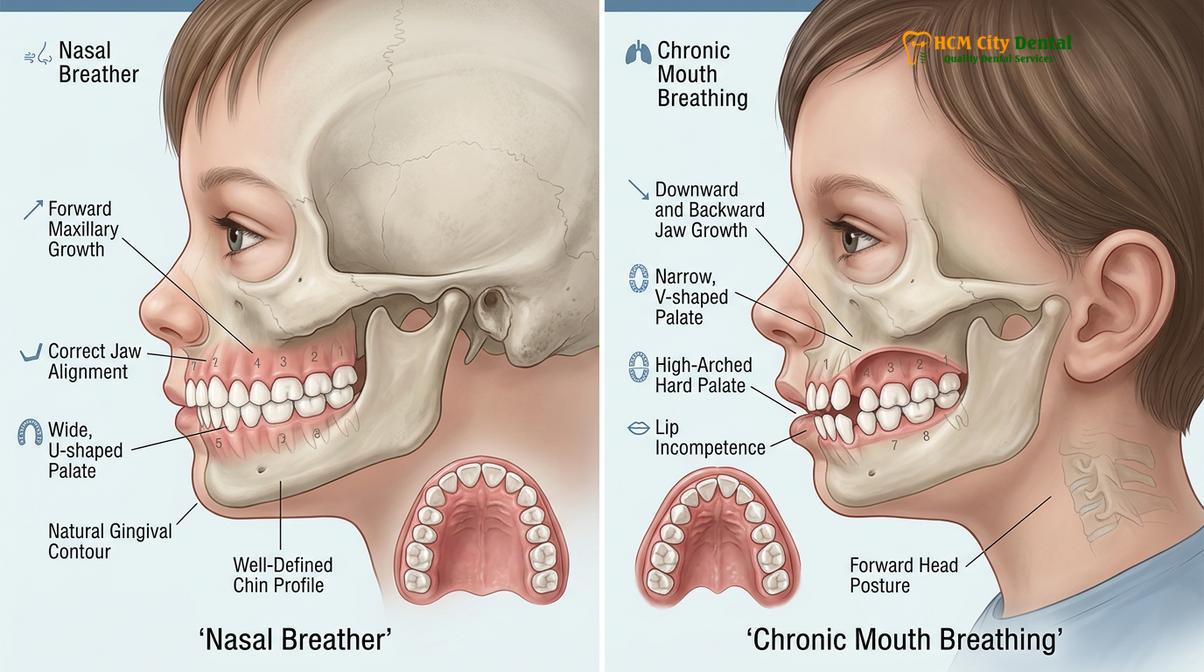
Cephalometric radiographic studies have consistently shown that children who are habitual mouth breathers exhibit a steeper mandibular plane angle and an increase in lower anterior facial height compared to their nasal-breathing peers. This skeletal discrepancy is not merely an aesthetic concern; it is a structural deformity that compromises the child’s airway. As the lower jaw grows backward rather than forward, it pushes the base of the tongue closer to the posterior pharyngeal wall, further narrowing the airway space and setting the stage for lifelong sleep-disordered breathing.
Link Between Mouth Breathing & Crowded Teeth
The absence of the tongue resting against the palate causes the upper jaw to develop in a narrow, V-shape, leaving insufficient arch space for erupting permanent teeth and causing severe crowding.
The relationship between respiratory function and dental alignment is profound. In a healthy nasal breather, the broad, U-shaped tongue rests against the palate, counterbalancing the inward forces of the cheek muscles. This equilibrium ensures that the maxillary arch grows wide enough to accommodate all the adult teeth. However, in a mouth breather, the tongue drops, and the unopposed cheek muscles squeeze the upper jaw inward. The result is a narrow, V-shaped maxillary arch with a high palatal vault.
Because the perimeter of the jaw bone is physically smaller, there is simply not enough room for the larger permanent teeth to erupt into their proper positions. This leads to severe dental crowding, overlapping incisors, and impacted canines. Furthermore, the narrow upper jaw often fails to overlap the lower jaw correctly, resulting in posterior crossbites—a condition where the upper teeth bite inside the lower teeth. To address these complex malocclusions, parents often seek braces for expat children, but without addressing the underlying mouth breathing habit, orthodontic relapse is highly likely[3].
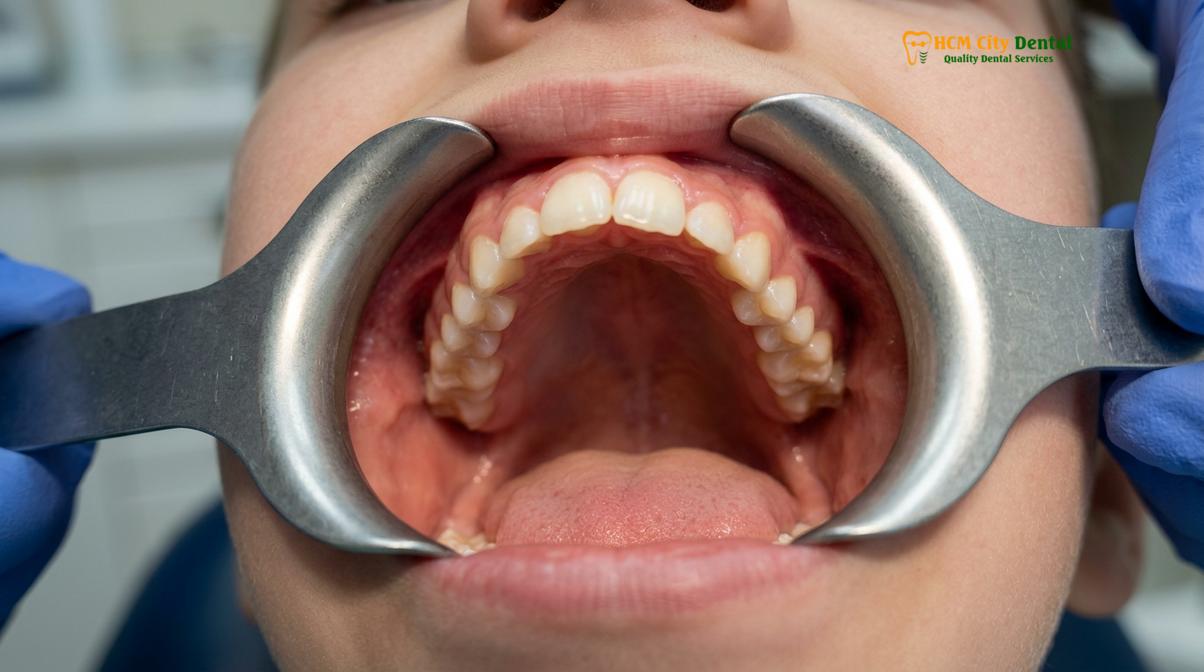
The table below highlights the clinical differences in dental and facial development between nasal breathers and chronic mouth breathers:
| Clinical Feature | Healthy Nasal Breather | Chronic Mouth Breather |
|---|---|---|
| Tongue Posture | Resting firmly against the hard palate | Resting low on the floor of the mouth |
| Maxillary Arch Shape | Broad, U-shaped arch | Narrow, V-shaped arch |
| Palatal Vault | Normal, shallow contour | High, deep palatal vault |
| Dental Alignment | Adequate space, straight teeth | Severe crowding, crossbites, overjets |
| Facial Profile | Forward growth, strong chin, defined cheekbones | Downward growth, recessed chin, flat midface |
In addition to structural crowding, the dry oral environment caused by mouth breathing accelerates tooth decay. When treating early childhood caries in these patients, pediatric dentists prioritize biocompatible materials. For baby teeth, Glass Ionomer Cement (GIC) fillings are often preferred over composite resins because GIC chemically bonds to the tooth, tolerates moisture better, and continuously releases fluoride to prevent recurrent decay. In cases of deep decay where drilling is not tolerated, Silver Diamine Fluoride (SDF) can be applied to arrest the cavity painlessly, though it leaves a localized dark stain on the decayed portion.
Narrow Palate and Nasal Airway Resistance
A narrow palate directly reduces the volume of the nasal cavity above it, creating a cycle of increased nasal airway resistance that perpetuates the mouth-breathing habit.
The anatomical relationship between the mouth and the nose is intimately connected: the roof of the mouth is simultaneously the floor of the nasal cavity. When mouth breathing causes the upper jaw (maxilla) to narrow and the palate to vault upward, it physically encroaches upon the nasal space. This structural narrowing decreases the volume of the nasal cavity, thereby increasing nasal airway resistance. According to the principles of fluid dynamics, even a small reduction in the radius of the airway exponentially increases the resistance to airflow.
This creates a vicious, self-perpetuating cycle. A child begins mouth breathing due to temporary nasal congestion or enlarged adenoids. The mouth breathing causes the palate to narrow. The narrow palate shrinks the nasal cavity, making it physically harder to breathe through the nose even after the initial congestion clears. Consequently, the child is locked into a mouth breather teeth alignment and respiratory pattern, unable to switch back to nasal breathing without clinical intervention[4].
Clinical Warning: Misdiagnosis of ADHD
Children with narrow palates and high nasal airway resistance often suffer from pediatric sleep apnea. The resulting sleep fragmentation causes daytime fatigue, hyperactivity, poor concentration, and behavioral issues. These symptoms are frequently misdiagnosed as Attention Deficit Hyperactivity Disorder (ADHD). Always have a pediatric dentist evaluate a child’s airway and jaw structure before concluding that behavioral issues are purely neurological.
Dr. Cuong notes that evaluating the transverse width of the maxilla is a critical component of every pediatric dental exam. If a child presents with a narrow palate, venous pooling under the eyes (allergic shiners), and a history of restless sleep, an immediate airway assessment is warranted. Expanding the palate not only creates room for the teeth but fundamentally increases the volume of the nasal cavity, reducing airway resistance and allowing the child to breathe normally through their nose again.
Clinical Interventions: Expanders & Airway ENT Referrals
Treating pediatric mouth breathing requires a multidisciplinary approach, utilizing rapid palatal expanders to widen the maxilla and ENT referrals to clear physical airway obstructions.
Addressing mouth breathing and its effects on facial shape requires proactive, early intervention. The goal of pediatric interceptive orthodontics is to guide the growth of the jawbones while they are still malleable, rather than waiting until the teenage years when the facial sutures have fused. This is often referred to as Phase 1 orthodontics, which focuses on orthopedic correction of the jaw rather than just moving teeth.
The primary tool for correcting a narrow maxilla is the Rapid Palatal Expander (RPE). This custom-made appliance is gently secured to the upper molars and features a small central screw. By turning the screw slightly each day, gentle pressure is applied to the mid-palatal suture, stimulating new bone growth and physically widening the upper jaw. This expansion not only creates space to resolve dental crowding but also dramatically increases the width of the nasal floor, instantly improving nasal airflow. Following expansion, myofunctional therapy is often prescribed. This involves a series of targeted exercises to strengthen the oral muscles, retrain the tongue to rest on the palate, and establish a permanent lip seal[5].
Clinical Case Review: HCMC Dental Clinic
A 7-year-old patient visited HCMC Dental Clinic in Ho Chi Minh City presenting with chronic snoring, a recessed chin, and severe upper crowding. Clinical examination revealed a narrow V-shaped palate and enlarged tonsils. The treatment workflow involved a referral to an ENT for adenotonsillectomy to clear the airway, followed by Phase 1 interceptive orthodontics using a palatal expander. Within 8 months, the patient’s nasal breathing was restored, sleep quality improved dramatically, and the lower jaw naturally postured forward, significantly improving the facial profile.
If premature loss of baby teeth has occurred due to decay, space maintainers (such as a fixed band-and-loop) are utilized to hold the arch length open, preventing further crowding. For children requiring restorative work, baby root canals (pulpotomies) and stainless steel or zirconia crowns are performed under strict behavioral management protocols to ensure comfort.
Understanding the financial investment in pediatric airway health is important for parents. According to the latest clinic fee schedule, the pricing structure for pediatric dental interventions is as follows:
- Kids Consultation & Diagnostic check-up: 300,000 to 500,000 VND (~$12 to $20 USD) (Walk-in: 500,000 to 800,000 VND).
- Fissure Sealant (per tooth): 400,000 to 600,000 VND (~$16 to $24 USD) (Walk-in: 700,000 to 1,000,000 VND).
- Fluoride Varnish Application: 300,000 to 500,000 VND (~$12 to $20 USD) (Walk-in: 500,000 to 800,000 VND).
- Pediatric Glass Ionomer Filling (GIC, fluoride-releasing): 400,000 to 600,000 VND (~$16 to $24 USD) (Walk-in: 700,000 to 1,000,000 VND).
- Pediatric Composite Filling: 500,000 to 800,000 VND (~$20 to $32 USD) (Walk-in: 800,000 to 1,300,000 VND).
- Baby Root Canal (Pulpotomy): 1,000,000 to 1,500,000 VND (~$40 to $60 USD) (Walk-in: 1,600,000 to 2,500,000 VND).
- Space Maintainer (fixed, band-and-loop): 2,000,000 to 3,000,000 VND (~$80 to $120 USD) (Walk-in: 3,300,000 to 5,000,000 VND).
- Custom Pediatric Sports Mouthguard: 1,500,000 to 2,500,000 VND (~$60 to $100 USD) (Walk-in: 2,500,000 to 3,500,000 VND).
Note: Patients booking in advance via WhatsApp can access the discounted rates (up to -40% off walk-in prices).
When to See a Doctor
Parents should monitor their child’s breathing habits closely, especially during sleep and periods of quiet concentration (like watching TV or reading). If you notice your child consistently keeping their mouth open, breathing audibly, snoring, or grinding their teeth at night, it is crucial to schedule a clinical evaluation. Other red flags include chronic dry lips, dark circles under the eyes, daytime lethargy, and a noticeably lengthening facial profile.
“Early detection is the cornerstone of pediatric airway dentistry. By identifying and treating mouth breathing before the age of 8, we can harness the child’s natural growth potential to correct skeletal discrepancies, avoiding the need for complex jaw surgeries or permanent tooth extractions in the future.”

The best age for a kid’s first orthodontic evaluation is age 7, as recommended by global dental associations. At this stage, the first permanent molars have erupted, establishing the back bite, and the pediatric dentist can accurately assess anterior-posterior and transverse jaw relationships. If you suspect your child is a mouth breather, seeking a comprehensive airway and orthodontic assessment at a specialized facility like HCMC Dental Clinic in Ho Chi Minh City can provide a clear, evidence-based roadmap to restore their nasal breathing and protect their facial development.
Frequently Asked Questions
Can mouth breathing change a child’s facial structure?
Yes, chronic mouth breathing can significantly alter a child’s facial structure. Because the tongue drops from the roof of the mouth to allow oral airflow, the upper jaw lacks internal support, leading to a narrow palate, an elongated lower face, flattened cheeks, and a recessed chin over time. This downward and backward growth trajectory permanently changes the aesthetic proportions of the face if not intercepted early.
How do dentists treat mouth breathing in children?
Dentists treat pediatric mouth breathing using a multidisciplinary approach that includes interceptive orthodontics and myofunctional therapy. We utilize rapid palatal expanders to widen the upper jaw and nasal airway, prescribe tongue posture exercises, and often collaborate with ENT specialists to remove physical obstructions like enlarged adenoids. This combined approach ensures both the structural space and the muscular habits are corrected.
What are the signs of pediatric mouth breathing?
The primary signs of pediatric mouth breathing include an open-mouth resting posture, audible breathing, snoring, and chronic dry or chapped lips. Clinically, parents may also notice dark circles under the eyes (allergic shiners), daytime fatigue, crowded teeth, and a progressively lengthening facial profile. Frequent throat clearing and a high, narrow palate observed during dental check-ups are also strong indicators.
At what age should mouth breathing be corrected?
Mouth breathing should be evaluated and corrected as early as possible, ideally between the ages of 4 and 7. During this critical window of craniofacial growth, the jawbones are highly malleable, allowing pediatric dentists to guide proper facial development and prevent permanent structural changes. Delaying treatment until the teenage years often requires more invasive orthodontic or surgical interventions.
Does mouth breathing cause cavities in baby teeth?
Yes, chronic mouth breathing significantly increases the risk of cavities in baby teeth. Continuous oral airflow dries out the mouth, reducing the protective flow of saliva that naturally washes away food particles and neutralizes bacterial acids, thereby accelerating early childhood caries and gum inflammation. Pediatric dentists often use fluoride-releasing Glass Ionomer Cements (GIC) or Silver Diamine Fluoride (SDF) to manage decay in these high-risk patients.
References
- American Journal of Orthodontics and Dentofacial Orthopedics. Primate experiments on oral respiration and facial growth. (1981).
- International Journal of Pediatric Otorhinolaryngology. Craniofacial morphology in children with adenoid hypertrophy. (1990).
- Journal of Clinical Pediatric Dentistry. The impact of mouth breathing on dentofacial development and malocclusion. (2004).
- American Academy of Pediatric Dentistry (AAPD). Guidelines on management of the developing dentition and occlusion. (2021).
- Journal of Dental Sleep Medicine. Pediatric sleep-disordered breathing and maxillary expansion. (2018).