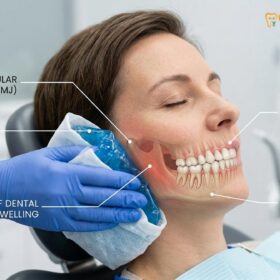
Experiencing dental trauma from a motorcycle accident in Vietnam requires immediate clinical triage to rule out severe head injuries, followed by urgent dental intervention to stabilize fractures or replant avulsed teeth. Prompt, evidence-based treatment significantly improves the prognosis for saving natural dentition and restoring facial aesthetics.
Clinical Summary:
Maxillofacial injuries are a frequent consequence of traffic collisions, particularly for riders using open-face helmets. The critical initial response dictates the success rate of treating a dental trauma motorcycle accident in Vietnam. Immediate first aid involves securing the airway, controlling hemorrhage, and preserving knocked-out teeth in a physiological medium like milk or Hank’s Balanced Salt Solution (HBSS). Clinical triage must first differentiate between life-threatening neurological trauma requiring a hospital emergency room and isolated dentoalveolar injuries suitable for an emergency dental clinic. Advanced reconstructive protocols—ranging from flexible wire composite splinting for luxated teeth to endodontic therapy and implantology—are essential for long-term functional and aesthetic rehabilitation. Proper documentation, including police reports and detailed medical imaging, is crucial for navigating travel insurance claims effectively.
Key Takeaways:
- Immediate hospital evaluation is required if there is loss of consciousness, amnesia, or suspected jaw fractures.
- Avulsed (knocked-out) teeth must be handled only by the crown and stored in milk or saliva, never in plain water.
- Replantation of an avulsed tooth within 30 to 60 minutes generally yields the highest success rate for periodontal ligament survival.
- Flexible splinting is considered the standard for stabilizing loosened teeth, allowing physiological movement to help prevent ankylosis.
- Comprehensive documentation, including clinical photographs and radiographs, is mandatory for processing international insurance claims.
Prevalence of Dental Injuries from Scooter Accidents
Maxillofacial and dental injuries are highly prevalent in scooter accidents due to the widespread use of open-face helmets, which leave the lower third of the face exposed to direct, high-velocity impact forces.
The bustling streets of Southeast Asia present unique navigational challenges, and traffic collisions remain a significant public health concern. When analyzing the epidemiology of maxillofacial trauma in motorcycle accidents[2], clinical data reveals a disproportionately high incidence of injuries affecting the lower third of the face. This vulnerability is primarily attributed to the prevalent use of half-helmets or open-face helmets. While these helmets provide crucial protection for the neurocranium against traumatic brain injury, they offer minimal structural shielding for the mandible, maxilla, and anterior dentition during a forward-trajectory collision.
During a sudden deceleration event, the rider’s forward momentum often results in direct impact between the facial structures and the road surface, handlebars, or other vehicles. The kinetic energy transferred during this impact is immense. According to the World Health Organization (WHO) Vietnam road traffic injuries and facial trauma statistics[4], the anterior teeth—specifically the maxillary central and lateral incisors—bear the brunt of the trauma, leading to a high frequency of fractures, luxations, and complete avulsions.
“The anterior maxilla is the most frequently injured region in maxillofacial trauma resulting from two-wheeled vehicle accidents. The lack of chin-bar protection in standard commuter helmets leaves the dentoalveolar complex highly vulnerable to direct blunt force trauma.”
Furthermore, the environmental factors of a road traffic accident introduce a high risk of contamination. A tooth injury from a scooter accident is rarely a clean fracture; it is typically accompanied by soft tissue lacerations embedded with asphalt, dirt, and debris. This necessitates meticulous debridement and prophylactic antibiotic protocols to help prevent secondary infections, such as facial cellulitis or osteomyelitis, which can severely complicate the reconstructive timeline.
First Aid Steps Immediately After an Accident
Immediate first aid involves securing the airway, controlling facial hemorrhage with sterile pressure, and preserving any knocked-out teeth in a physiological medium like milk to maintain cellular viability.
The moments immediately following a traffic collision are chaotic, but adhering to strict first aid protocols can mean the difference between saving and losing a natural tooth. The primary objective in any trauma scenario is the preservation of life, following standard resuscitation guidelines. Once life-threatening conditions are ruled out, attention must rapidly shift to managing the dentoalveolar trauma. Time is the most critical variable, particularly concerning the extraoral dry time of avulsed teeth.
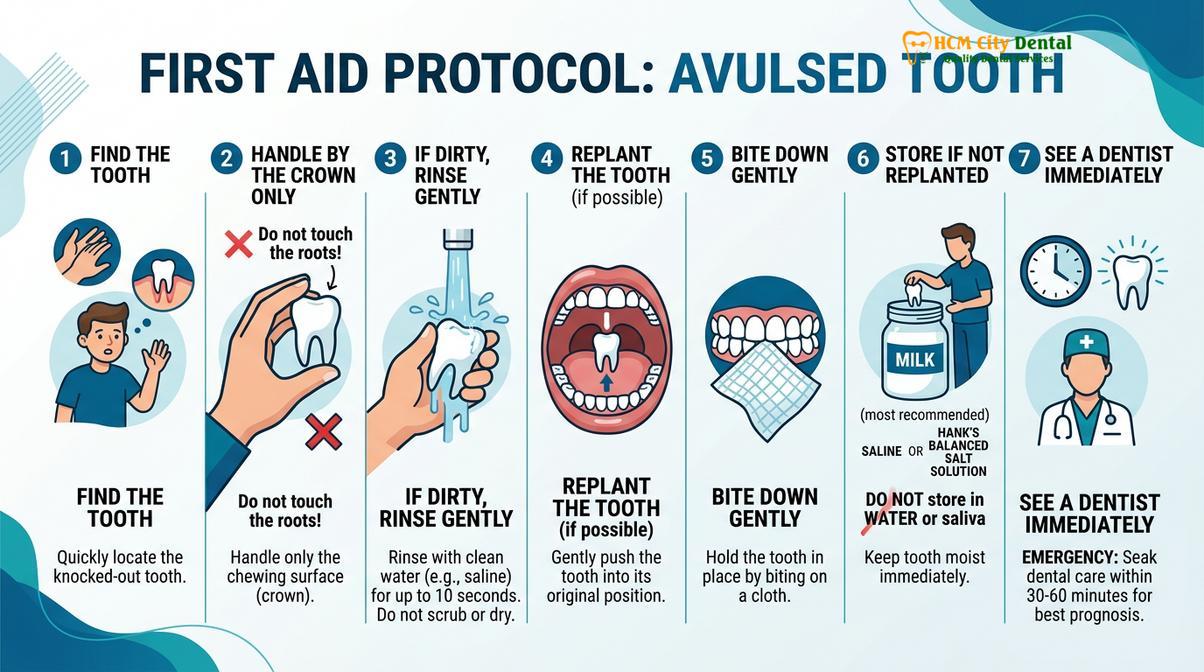
Critical Warning: Never scrub, wipe, or use soap on the root surface of a knocked-out tooth, even if it is covered in road debris. Doing so destroys the delicate periodontal ligament cells necessary for successful replantation. Rinse it gently with cold milk or saline for no more than 10 seconds.
If a tooth has been completely knocked out (avulsed), the periodontal ligament cells attached to the root surface begin to desiccate and die within minutes. To maximize the chances of successful replantation, the tooth must be located immediately. The International Association of Dental Traumatology (IADT) guidelines for the management of traumatic dental injuries[1] state that it is imperative to handle the tooth strictly by the clinical crown (the white enamel portion) and never by the root.
If the patient is conscious, calm, and cooperative, the best immediate action is to gently replant the tooth back into its socket and have the patient bite down on a clean handkerchief to hold it in place. If immediate replantation is not feasible due to the patient’s condition or severe alveolar damage, the tooth must be stored in a physiological medium. Hank’s Balanced Salt Solution (HBSS) is ideal, but cold whole milk is the most practical and accessible alternative at an accident scene. Milk has a compatible osmolality and pH that can help sustain cell viability during transport to a clinic.
Triage: Dental Emergency vs ER Hospital Visit
Patients must visit a hospital ER first if they experience loss of consciousness, severe facial lacerations, or suspected jaw fractures, whereas isolated tooth damage can be treated directly at an emergency dental clinic.
Proper triage is the cornerstone of trauma management. When a patient suffers a dental trauma motorcycle accident in Vietnam, bystanders and first responders must quickly differentiate between injuries that require immediate maxillofacial surgical intervention at a hospital and those that can be managed by a specialized facial trauma dentist. Misjudging the severity of head trauma can have severe consequences.
When to Seek Immediate Medical Attention at a Hospital: A hospital Emergency Room (ER) visit is absolutely mandatory if the patient exhibits any neurological red flags. These include any period of unconsciousness, no matter how brief; retrograde or anterograde amnesia; confusion; dizziness; nausea or vomiting; unequal pupil dilation; or clear fluid leaking from the ears or nose. Furthermore, if there is uncontrolled arterial bleeding, deep facial lacerations requiring complex multi-layer suturing, or signs of major skeletal fractures, the hospital is the only appropriate destination.
| Clinical Presentation | Primary Triage Destination | Immediate Action Required |
|---|---|---|
| Loss of consciousness, dizziness, amnesia | Hospital Emergency Room (ER) | Immobilize cervical spine, monitor airway, urgent CT scan. |
| Inability to close mouth, severe bite misalignment | Hospital ER / Maxillofacial Surgeon | Suspected Le Fort or mandibular fracture; requires rigid fixation. |
| Knocked-out tooth (Avulsion) with no head trauma | Emergency Dental Clinic | Store tooth in milk; seek dental replantation within 60 minutes. |
| Chipped, broken, or loosened teeth; minor lip cuts | Emergency Dental Clinic | Control bleeding with gauze; urgent dental splinting and evaluation. |
Signs of a severe jaw fracture include a sudden, drastic change in the dental occlusion (the way the upper and lower teeth fit together), trismus (inability to open the mouth), palpable step-deformities along the jawline, or sublingual hematoma (bruising under the tongue). These conditions often require rigid internal fixation using titanium plates and screws, a procedure performed by oral and maxillofacial surgeons in a hospital operating theater.
Conversely, if the patient is fully alert, oriented, and the trauma is strictly confined to the dentoalveolar complex—such as chipped enamel, fractured crowns, loosened teeth, or avulsions—proceeding directly to a well-equipped dental clinic is the most efficient route. Dental clinics possess the specific instruments, materials, and expertise required to save compromised teeth, which general hospital ERs often lack.
Common Types of Trauma: Fractures, Intrusion, and Avulsion
Scooter accidents typically result in complicated crown-root fractures, lateral luxation, intrusion into the alveolar bone, or complete avulsion, each requiring specific clinical protocols ranging from endodontic therapy to flexible splinting.
The biomechanics of a traffic collision produce a wide spectrum of dentoalveolar injuries. Understanding the clinical classification of these injuries is essential for determining the appropriate reconstructive pathway. Strict guidelines for managing these complex scenarios emphasize the preservation of vitality and the prevention of root resorption.
Crown and Root Fractures
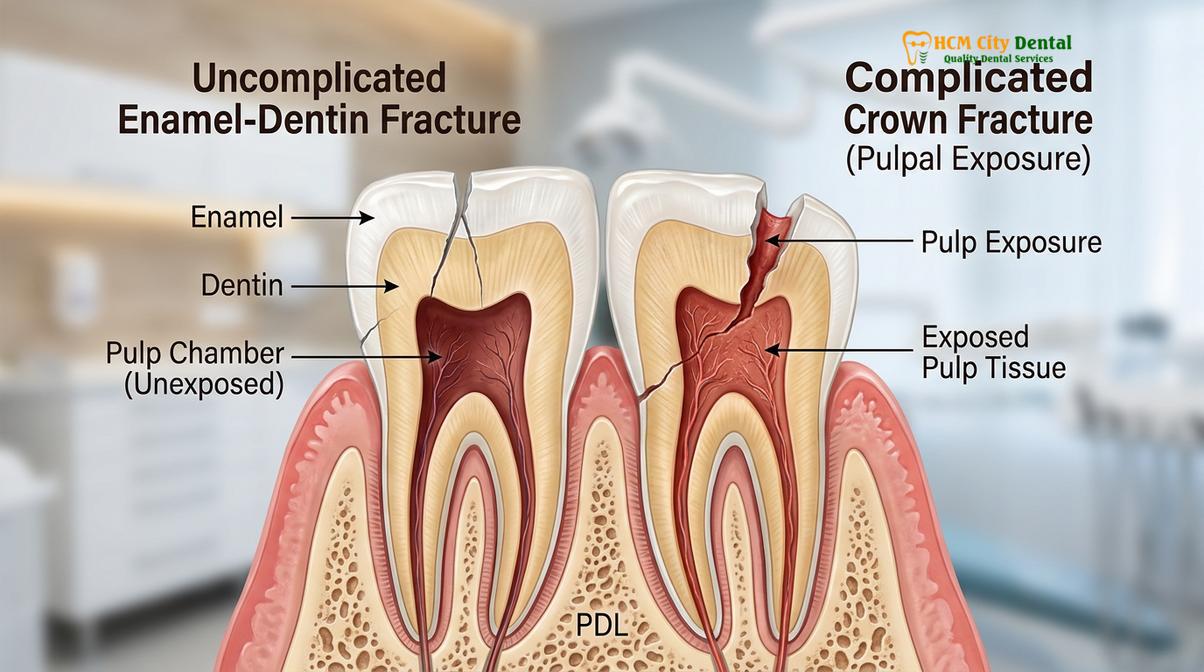
Fractures are categorized based on the tissues involved. An uncomplicated fracture involves only the enamel or enamel and dentin, without exposing the dental pulp. These are generally treated with immediate composite bonding to seal the dentinal tubules, helping to prevent bacterial ingress and thermal sensitivity. However, a complicated crown fracture involves the exposure of the pulp tissue. In a motorcycle accident, these fractures are often contaminated. Treatment requires immediate endodontic intervention—either a partial pulpotomy or a complete pulpectomy (root canal treatment), depending on the stage of root development and the time elapsed since the injury.
Crown-root fractures extend below the gingival margin and into the root structure. These are highly complex to manage. The American Association of Endodontists guidelines on the management of crown-root fractures and pulpal exposure[5] suggest that if the fracture line extends deep subgingivally, the tooth may require orthodontic extrusion or surgical crown lengthening to expose healthy tooth structure before a restoration can be placed. In severe vertical root fractures, the tooth is generally deemed unrestorable and requires extraction.
Luxation Injuries (Displacement)
Luxation injuries occur when the tooth is displaced from its normal anatomical position within the socket due to the impact force.
- Concussion and Subluxation: The tooth is tender to percussion and may be slightly mobile, but it is not displaced. Treatment involves occlusal adjustment to relieve biting pressure and a soft diet.
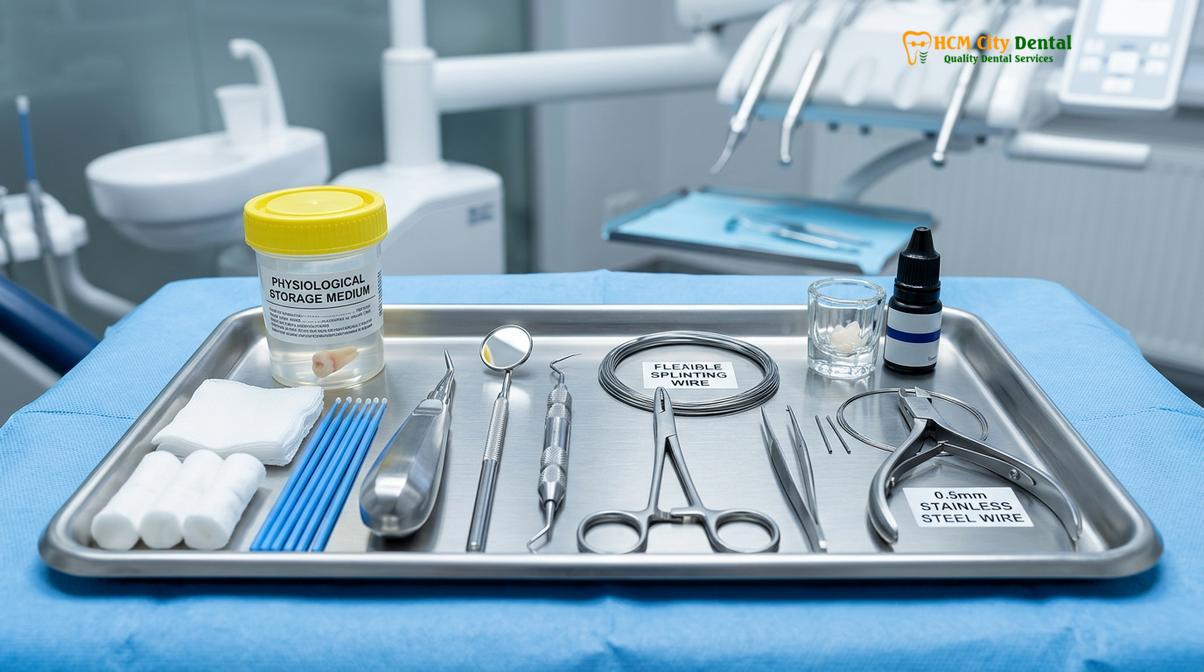
- Lateral Luxation: The tooth is pushed forward, backward, or sideways, often accompanied by a fracture of the alveolar bone socket wall. The tooth is usually locked firmly in its new, abnormal position. The clinician must administer local anesthesia, manually disengage the tooth from the bony lock, reposition it digitally, and stabilize it using specific splinting techniques for luxation and avulsion injuries[3].
- Intrusion: The tooth is driven deep into the jawbone, crushing the periodontal ligament and severing the neurovascular supply. This is one of the most severe forms of trauma. Treatment may involve allowing spontaneous re-eruption (in young patients), orthodontic extrusion, or surgical repositioning, followed by mandatory root canal therapy due to the high rate of pulpal necrosis.
Reconstructive Dental Options in HCMC
Comprehensive reconstruction involves a multidisciplinary approach, utilizing root canal therapy, composite bonding, ceramic crowns, or immediate implant placement to restore both function and aesthetics after severe trauma.
Once the initial emergency phase is managed and the dentoalveolar structures are stabilized, the focus shifts to comprehensive rehabilitation. The reconstructive journey following a severe dental trauma motorcycle accident in Vietnam can be extensive, requiring a multidisciplinary approach that encompasses endodontics, periodontics, and prosthodontics. The goal is not merely to fill gaps, but to restore the precise biomechanical function and natural aesthetics of the patient’s smile.
Dr. Nguyen Van Cuong, a leading specialist in restorative dentistry, emphasizes the importance of immediate and precise intervention. Dr. Cuong notes that the severity of a motorcycle dental injury often correlates directly with the speed of the collision and the angle of impact. His clinical approach prioritizes preserving natural tooth structure whenever possible through advanced microsurgical techniques, ensuring that traumatized tissues have the best possible environment to heal.
Clinical Case Example: A 28-year-old expat patient presented to HCMC Dental Clinic in Ho Chi Minh City following a low-speed scooter collision. The patient suffered a complicated crown fracture of the maxillary right central incisor and lateral luxation of the left central incisor. Immediate treatment involved repositioning and flexible splinting of the luxated tooth, followed by a partial pulpotomy on the fractured incisor to preserve pulp vitality. After a four-week healing period, the splint was removed, and the fractured tooth was beautifully restored using biomimetic composite layering, completely avoiding the need for a full-coverage crown.
“Successful management of dental trauma relies heavily on the patient’s immediate actions at the scene and the clinician’s adherence to evidence-based biological protocols. Preserving the natural root is always our primary objective.”
For teeth that have suffered pulpal necrosis due to trauma—a common sequela of severe luxation or avulsion—root canal therapy is required. In trauma cases, the canal is often medicated with calcium hydroxide for several weeks prior to final obturation. This highly alkaline paste helps to disinfect the canal space, arrest inflammatory root resorption, and promote the healing of periapical lesions. Once the root is stable, the tooth can be restored with a ceramic crown or veneer.
Navigating Police Reports and Insurance Claims
Securing proper documentation, including a local police report and detailed clinical records, is essential for successfully processing international travel insurance claims for emergency dental treatments.
Dealing with the aftermath of a traffic accident in a foreign country can be overwhelming, particularly when navigating the administrative requirements of international travel insurance. Most comprehensive travel insurance policies offer coverage for emergency dental trauma resulting from an accident. However, this coverage is almost always contingent upon strict adherence to local laws. Insurers typically require proof that the rider was legally operating the vehicle, which in Vietnam means possessing a valid international driving permit (IDP) endorsed for motorcycles and wearing a helmet at the time of the crash.
To facilitate a smooth claims process, it is highly recommended to obtain a police report at the scene or shortly after the incident. While this can be challenging due to language barriers, it serves as official documentation of the accident’s circumstances. Simultaneously, the clinical documentation provided by your dentist is equally critical. Ensure that the clinic provides a comprehensive medical report outlining the diagnosis, the specific trauma codes, and a detailed breakdown of the treatments rendered.
Pre-operative and post-operative radiographs, along with high-resolution clinical photographs, should be requested and kept in your records, as insurance adjusters frequently demand visual evidence of the trauma before approving reimbursement for complex reconstructive procedures. If you or a loved one has experienced a dental trauma motorcycle accident in Vietnam, contact HCMC Dental Clinic in Ho Chi Minh City immediately. Our dedicated trauma team is equipped with the advanced technology and clinical expertise necessary to stabilize your injuries, alleviate pain, and provide the comprehensive documentation needed for your Emergency Dental Care claims.
References
- International Association of Dental Traumatology (IADT). Guidelines for the management of traumatic dental injuries.
- Journal of Oral and Maxillofacial Surgery. Epidemiology of maxillofacial trauma in motorcycle accidents.
- Dental Traumatology. Splinting techniques for luxation and avulsion injuries.
- World Health Organization (WHO) Vietnam. Road traffic injuries and facial trauma statistics.
- American Association of Endodontists. Management of crown-root fractures and pulpal exposure.
Frequently Asked Questions
What should I do if I break my teeth in a scooter accident?
Immediately control bleeding with sterile gauze, locate any broken tooth fragments, and store them in milk or saline. Seek emergency dental care promptly to stabilize the fracture and help prevent pulpal infection.
Should I go to a hospital or a dentist first?
Go to a hospital ER first if you experience loss of consciousness, severe facial bleeding, dizziness, or suspect a jaw fracture. For isolated tooth damage without head trauma, visit an emergency dentist directly.
How much does facial dental reconstruction cost in Vietnam?
Costs vary widely based on the extent of the trauma. Simple splinting or composite bonding is generally more accessible, while complex reconstruction involving root canals, ceramic crowns, or dental implants requires a customized clinical estimate.
Will tourist insurance cover motorcycle accident dental injuries?
Many comprehensive travel insurance policies cover emergency dental trauma resulting from accidents, provided you were legally riding with a valid permit and wearing a helmet. Always review your specific policy exclusions.
How long does treatment take after dental trauma?
Initial emergency stabilization typically takes one to two hours. However, comprehensive rehabilitation, including endodontic therapy, implant integration, and final prosthetic placement, may require multiple visits spanning several months.