When comparing a custom vs store bought night guard, custom appliances offer precise fit and superior protection against bruxism, while store-bought options provide immediate, temporary relief at a lower initial cost. Choosing the right device depends on your grinding severity, jaw health, and long-term dental protection goals.
Clinical Summary:
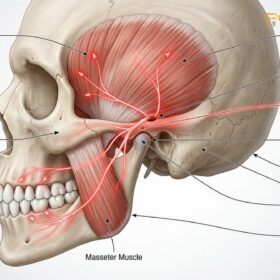
Bruxism (teeth grinding) and clenching exert immense pressure on the dentition and temporomandibular joints (TMJ). The debate between a custom vs store bought night guard centers on adaptation, material science, and occlusal dynamics. Custom night guards, fabricated from precise digital or physical impressions, provide an exact fit that distributes bite forces evenly, protecting enamel without triggering muscle hyperactivity. Conversely, an OTC mouth guard (including boil-and-bite varieties) relies on generic arch shapes and softer thermoplastic materials. While accessible, these generic options often lack posterior support, which can inadvertently increase masseter muscle activity and exacerbate joint pain. For chronic bruxism, dental professionals strongly advocate for custom-fabricated appliances to ensure airway patency, optimal comfort, and long-term structural integrity of the teeth.
Key Takeaways:
- Precision Fit: Custom guards match your exact dental anatomy, preventing the appliance from shifting during sleep.
- Material Quality: Professional guards use medical-grade acrylics (hard, soft, or dual-laminate) that resist heavy grinding forces.
- TMJ Safety: Store-bought guards can create uneven bite surfaces, potentially worsening jaw pain and muscle tension.
- Cost Efficiency: Despite a higher initial price, custom appliances last significantly longer, offering better long-term value.
- Airway Protection: The slim profile of a custom device ensures unobstructed breathing compared to bulky generic alternatives.
How Custom Guards Are Made
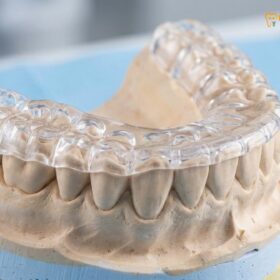
Custom night guards are meticulously fabricated in a dental laboratory using highly accurate digital scans or physical impressions of your unique dental anatomy.
The creation of a custom night guard is a highly controlled clinical process designed to yield an appliance that perfectly mimics the contours of your teeth. This precision is what fundamentally separates professional professional bruxism appliances from generic alternatives. The workflow begins with a comprehensive diagnostic evaluation. A dentist will examine your teeth for signs of attrition (wear), abfraction (notching at the gumline), and assess the health of your temporomandibular joint (TMJ) and surrounding musculature.
Once the need for a custom appliance is confirmed, the impression phase begins. Modern dental practices frequently utilize intraoral digital scanners. These sophisticated cameras capture thousands of images per second, stitching them together to create a flawless 3D model of your dental arches. This digital approach eliminates the discomfort of traditional gooey impression materials and provides a microscopic level of accuracy that is impossible to achieve with a store bought night guard. If traditional methods are used, high-quality polyvinyl siloxane (PVS) materials capture the exact morphology of every cusp and fissure.
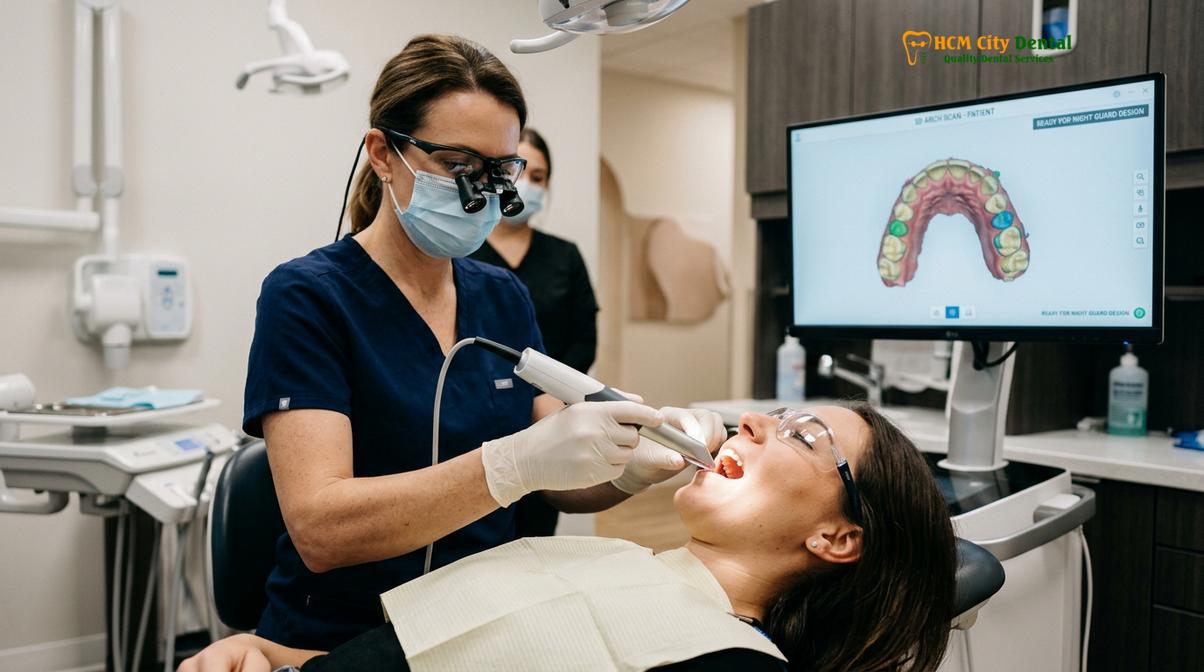
The data or physical molds are then sent to a specialized dental laboratory. Here, technicians fabricate the guard using medical-grade materials. Depending on the clinical diagnosis, the guard may be constructed from hard acrylic (Polymethyl methacrylate – PMMA) for severe grinders, a soft material for mild clenchers, or a dual-laminate material that features a hard, durable outer shell and a soft, comfortable inner lining. The laboratory also articulates the models to simulate your exact jaw movements, ensuring that the final product provides optimal canine guidance and posterior disclusion. [1]
The final step involves a fitting appointment. Dr. Nguyen Van Cuong emphasizes that a custom guard is not simply handed to the patient; it must be clinically adjusted. The dentist will use articulating paper to identify any premature contacts—spots where the teeth hit the guard too early or too hard. By carefully polishing and adjusting these areas, the dentist ensures that the bite forces are distributed evenly across the entire dental arch, minimizing stress on any single tooth or the jaw joint.
Store-Bought Types Explained
Over-the-counter mouth guards are mass-produced devices available in one-size-fits-all or boil-and-bite formats, designed for immediate but generalized use.
When exploring the custom vs store bought night guard dilemma, it is crucial to understand the variations within the over-the-counter (OTC) market. These appliances are readily available at pharmacies and sporting goods stores, offering an immediate, low-barrier entry to tooth protection. However, their mass-produced nature inherently limits their clinical efficacy.
The most basic type is the “stock” or one-size-fits-all guard. These are pre-formed U-shaped trays made from basic plastics or rubber. Because they make no attempt to adapt to the individual’s dental anatomy, they are notoriously bulky and rely entirely on the user clenching their teeth to keep the guard in place. This constant clenching defeats the purpose of a night guard, which is to relax the jaw musculature.
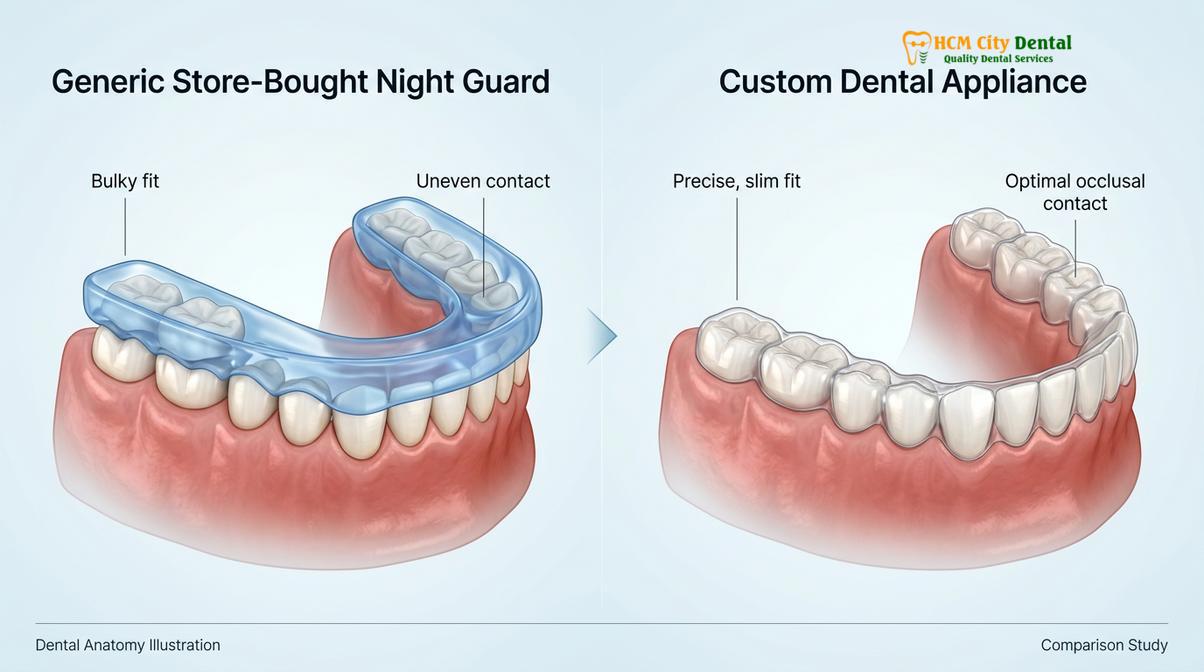
A more popular alternative is the boil and bite night guard. These devices are constructed from thermoplastic materials, typically ethylene-vinyl acetate (EVA). The user softens the guard in boiling water, allows it to cool slightly, and then bites into it while using their fingers and tongue to adapt the material around their teeth. While this provides a better fit than a stock guard, it still falls significantly short of clinical standards.
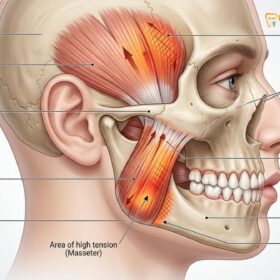
The primary issue with an OTC mouth guard is the lack of occlusal (bite) management. When a patient bites into the softened plastic, the material displaces unevenly. This often results in a guard that is too thin in the posterior (back) regions and too thick in the anterior (front) regions, or vice versa. Furthermore, the soft, rubbery texture of many store-bought guards can trigger a subconscious chewing reflex during sleep. Instead of relaxing, the masseter and temporalis muscles become hyperactive, treating the soft guard like a chew toy, which can exacerbate muscle fatigue and joint pain. [2]
Fit Precision Comparison
Custom guards offer microscopic adaptation to your teeth for secure retention, whereas store-bought options rely on generalized shapes that often shift during sleep.
The biomechanics of how an appliance fits over the dentition is a critical factor in its success. A custom night guard is designed with precise retention protocols. It snaps securely onto the teeth, utilizing the natural undercuts of the dental anatomy to stay firmly in place without requiring any conscious effort from the patient. This secure fit ensures that the guard remains in the correct position throughout all stages of sleep, including the rapid eye movement (REM) cycle, when bruxism episodes are often most intense.
In contrast, a store bought night guard suffers from poor marginal adaptation. Because the material is not formed under laboratory pressure or vacuum, micro-gaps exist between the guard and the teeth. These gaps allow saliva to pool, which can become a breeding ground for bacteria if the guard is not meticulously cleaned. More importantly, the lack of secure retention means the guard can easily dislodge during the night. A loose appliance is not only ineffective at protecting the teeth but can also pose a potential choking hazard if it falls to the back of the throat.
To clearly illustrate the differences, the following table outlines the core distinctions between the two options:
| Feature | Custom Night Guard | Store-Bought (OTC) Guard |
|---|---|---|
| Fit & Retention | Microscopic precision; snaps securely into place. | Loose or bulky; prone to shifting during sleep. |
| Material Quality | Medical-grade acrylics (hard, soft, dual-laminate). | Basic thermoplastics (EVA) or rubber. |
| Occlusal Balance | Professionally adjusted for even bite force distribution. | Uneven surface; can misalign the jaw. |
| Lifespan | Several years with proper maintenance. | A few weeks to a few months before degrading. |
| TMJ Impact | Relaxes musculature and decompresses the joint. | May trigger “chew toy” reflex and worsen pain. |
The precision of a custom appliance also extends to its thickness. Dental laboratories can fabricate guards that are incredibly thin yet highly durable, ensuring that the patient’s vertical dimension of occlusion (the distance between the upper and lower jaws) is not excessively altered. Over-the-counter options are universally thicker to compensate for their weaker materials, which forces the jaw into an unnatural, open posture that can strain the joint capsule.
Protection and Bite Balance
A professionally adjusted custom guard ensures even distribution of occlusal forces, protecting enamel and preventing temporomandibular joint strain.
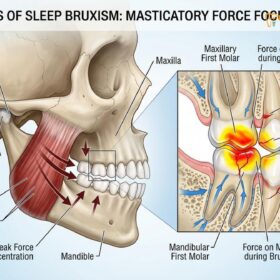
The primary function of any night guard is to act as a protective barrier between the upper and lower teeth, preventing the irreversible loss of enamel caused by grinding. However, true clinical protection goes beyond simply covering the teeth; it requires the establishment of occlusal equilibrium. When you close your jaw, the forces should be distributed evenly across all teeth. If one tooth hits the guard before the others (a premature contact), the proprioceptive nerve endings in the periodontal ligament send distress signals to the brain, which can trigger muscle spasms and jaw deflection.
A custom night guard is meticulously adjusted by a dentist to ensure that all teeth contact the appliance simultaneously and with equal intensity. Furthermore, the dentist will design the guard to provide “canine guidance.” This means that when you slide your jaw side to side (lateral excursion), only the canine teeth touch the guard, causing the back teeth to separate (disclude). This mechanism shuts down the heavy grinding muscles, significantly reducing the force exerted on the TMJ. [3]
“The goal of a therapeutic occlusal appliance is not just to shield the enamel, but to reprogram the neuromuscular pathways. An unbalanced guard can act as a wedge, driving the condyle out of its natural position and initiating a cascade of temporomandibular joint dysfunction.”
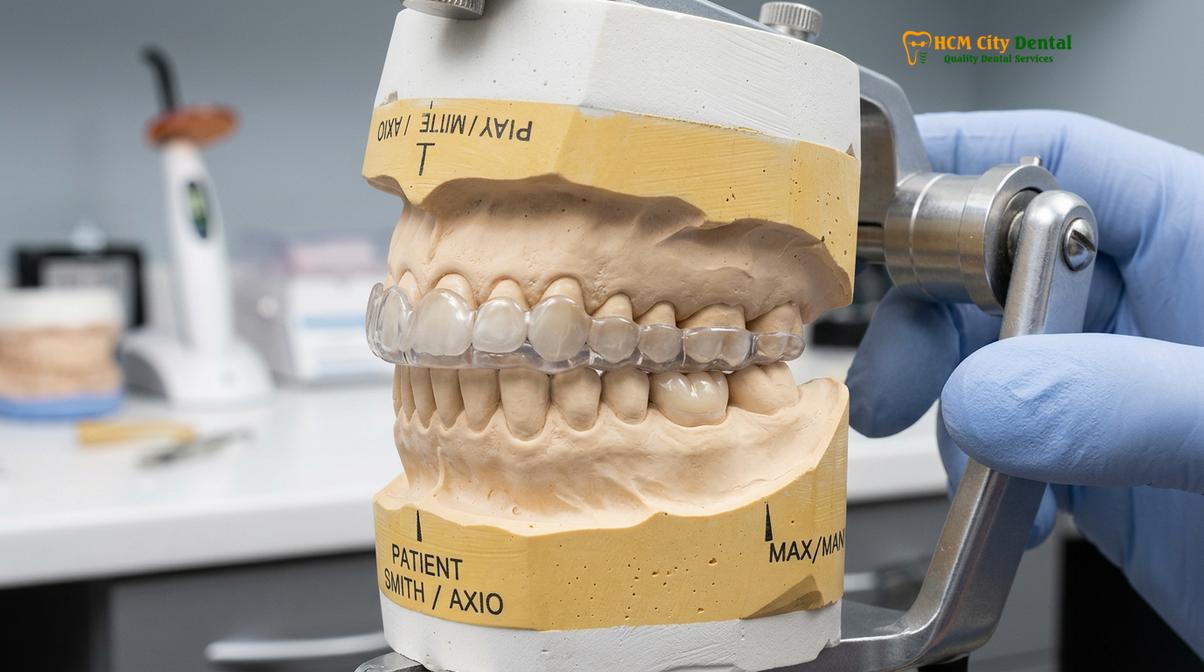
An OTC mouth guard cannot provide this level of sophisticated bite management. When a patient uses a boil and bite night guard, the resulting biting surface is entirely random, dictated by how hard they bit down while the plastic was soft. This frequently creates deep indentations that lock the teeth into a specific position. If the patient attempts to grind their teeth during sleep, the locked-in position resists the movement, transferring immense lateral stress directly to the teeth and the TMJ. This is why many patients who use generic guards report waking up with increased jaw soreness and tension headaches.
Comfort and Sleep Quality
Superior fit translates to minimal bulk, allowing for natural breathing, proper lip seal, and uninterrupted sleep cycles.
Patient compliance is the most critical factor in the success of bruxism treatment. If an appliance is uncomfortable, the patient will simply stop wearing it, leaving their teeth vulnerable to damage. Comfort is directly correlated with the bulk and fit of the device. Custom night guards are fabricated to be as unobtrusive as possible. They cover only the necessary dental structures and are tapered smoothly at the edges to prevent irritation to the tongue, cheeks, and gingival tissues.
Because a custom guard fits so intimately, it allows the patient to maintain a natural lip seal. This is vital for promoting nasal breathing during sleep. Conversely, the excessive bulk of a store bought night guard often forces the lips apart, leading to mouth breathing. Mouth breathing dries out the oral cavity, altering the pH balance and increasing the risk of dental caries and gingivitis. Furthermore, a bulky appliance can encroach on the airway space, potentially exacerbating snoring or mild obstructive sleep apnea (OSA) in susceptible individuals. [4]
Clinical Case Review: Transitioning to Custom Care
A patient visited HCMC Dental Clinic in Ho Chi Minh City complaining of chronic morning headaches and severe tooth sensitivity. For six months, the patient had been using a generic boil-and-bite guard. Clinical examination revealed that the bulky OTC guard was causing the jaw to rest in an unnatural, strained position, and the soft material was encouraging continuous clenching. Dr. Nguyen Van Cuong prescribed a custom-milled, dual-laminate night guard. Within two weeks of wearing the precisely balanced custom appliance, the patient reported a complete cessation of morning headaches and significantly improved sleep quality, demonstrating the profound impact of proper occlusal support.
The psychological aspect of sleep quality cannot be overstated. Constantly worrying about a loose guard falling out, or waking up multiple times due to discomfort, fragments the sleep architecture. A custom appliance provides peace of mind, allowing the patient to enter deep, restorative sleep phases without interruption.
Long-Term Cost Analysis
While custom appliances require a higher initial investment, their durability makes them significantly more cost-effective over time compared to frequent OTC replacements.
When evaluating a custom vs store bought night guard, the initial price tag is often the most significant deciding factor for patients. It is undeniable that a custom appliance, which involves clinical chair time, digital scanning, and skilled laboratory fabrication, carries a higher upfront cost than a mass-produced item pulled from a pharmacy shelf. However, viewing this solely as a short-term expense is a clinical miscalculation.
Store-bought guards are manufactured from softer, less durable plastics. For a moderate to severe grinder, these materials break down rapidly. It is not uncommon for a patient to chew through a generic guard in a matter of weeks or months. If a patient must purchase a new over-the-counter guard every two to three months, the cumulative cost over a few years quickly surpasses the price of a single custom appliance.
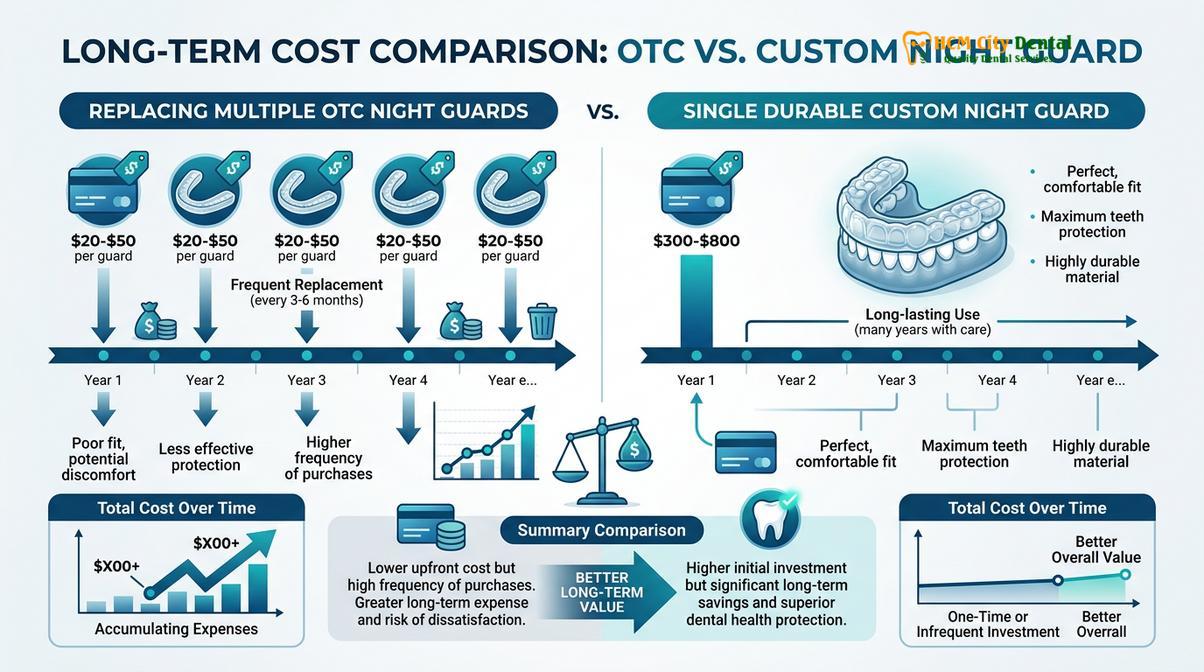
Custom night guards are fabricated from high-density, cross-linked acrylics designed to withstand the immense forces of the human bite. With proper daily cleaning and routine clinical adjustments, a custom guard can last for several years. [5]
More importantly, the true cost analysis must factor in the prevention of dental trauma. Bruxism is a destructive force. Without adequate protection, patients risk fracturing teeth, destroying expensive dental restorations (like crowns and veneers), and causing irreversible damage to the TMJ. The cost of a single root canal and crown to repair a fractured molar is exponentially higher than the investment in a premium custom night guard. Therefore, a professional appliance should be viewed as a highly effective insurance policy for your oral health.
When Store-Bought Is Acceptable
Generic guards can serve as a temporary diagnostic tool or short-term protection while awaiting a permanent custom appliance.
Despite the overwhelming clinical advantages of custom appliances, there are specific, limited scenarios where an OTC mouth guard may be deemed acceptable by dental professionals. It is important to categorize these devices as temporary solutions rather than long-term therapeutic tools.
One common scenario is during a transitional dental phase. If a patient is undergoing extensive restorative work, such as multiple crowns or active orthodontic treatment, their bite is constantly changing. Fabricating a custom guard during this period would be impractical, as it would quickly cease to fit. In these cases, a boil and bite night guard can provide temporary protection until the dental work is completed and the bite stabilizes.
Additionally, a store-bought guard can be used as a short-term diagnostic tool. If a patient is unsure whether they are actually grinding their teeth at night, wearing an inexpensive generic guard for a few nights can provide evidence. If the patient wakes up to find the plastic heavily scuffed or indented, it confirms the presence of bruxism, justifying the investment in a custom appliance.
Clinical Warning: TMJ Exacerbation
Never use a soft, store-bought night guard if you are currently experiencing acute jaw pain, clicking, or locking of the temporomandibular joint. The soft material can trigger increased muscle activity (the “chew toy” effect), and the uneven bite surface can force the jaw joint into a compromised position, potentially worsening TMJ disorders and causing severe, radiating facial pain.
Finally, for individuals who experience very rare, stress-induced clenching (perhaps only a few nights a year during high-stress events), a generic guard might suffice. However, for anyone experiencing regular bruxism, the transition to a custom device is clinically imperative.
When to See a Doctor
Persistent jaw pain, visible tooth wear, or chronic morning headaches require immediate clinical evaluation to prevent irreversible dental damage.
Recognizing the signs of destructive bruxism is crucial for timely intervention. Many patients are unaware they grind their teeth until a sleep partner points it out or a dentist notices the physical evidence during a routine exam. You should schedule a consultation if you frequently wake up with a dull, constant headache radiating from the temples, or if your jaw feels stiff and tired in the morning.
Visual signs include teeth that appear flattened, chipped, or fractured. You may also notice increased tooth sensitivity to hot and cold, as the protective enamel is worn away, exposing the sensitive underlying dentin. If you experience clicking, popping, or grating sounds when opening or closing your mouth, this indicates stress on the temporomandibular joint.
“Early intervention is the cornerstone of managing bruxism. Waiting until teeth are fractured or the jaw joint is severely compromised transforms a simple preventive measure into a complex, full-mouth rehabilitation.”

During a consultation at HCMC Dental Clinic, the clinical team will perform a thorough evaluation of your bite mechanics, muscle tension, and joint health. Based on these diagnostics, they can recommend the most appropriate intervention, ensuring that any appliance provided is tailored to your specific anatomical needs and bruxism severity. Do not rely on self-diagnosis or generic solutions if you are experiencing chronic pain or visible dental wear.
Frequently Asked Questions
Are custom night guards worth it?
Yes, custom night guards are highly worth the investment for chronic teeth grinders. They provide precise occlusal balance, superior durability, and optimal airway protection, ultimately preventing costly dental fractures and severe temporomandibular joint dysfunction over time. The exact fit ensures the appliance stays securely in place, offering uninterrupted sleep and reliable protection that generic alternatives simply cannot match.
How much does a custom night guard cost?
Currently, a custom night guard requires a higher initial investment than generic options, reflecting the clinical time, digital scanning, and laboratory fabrication involved. However, their extended lifespan often makes them more cost-effective annually than frequently replacing over-the-counter alternatives. When factoring in the prevention of expensive restorative dental work, such as crowns or implants needed to fix cracked teeth, the long-term value is substantial.
Can a store-bought guard worsen TMJ?
Yes, a poorly fitted store-bought guard can exacerbate TMJ disorders. Soft, bulky materials often trigger a “chew toy” reflex, increasing masseter muscle activity, while uneven bite surfaces can misalign the jaw and cause severe joint strain. If the appliance forces the condyle out of its natural resting position within the joint socket, it can lead to chronic inflammation, clicking, and restricted jaw movement.
How long do custom guards last vs OTC?
A professionally fabricated custom night guard typically lasts several years with proper care, depending on the severity of bruxism. In contrast, over-the-counter mouth guards degrade rapidly and usually require replacement every few months due to material breakdown. The high-density acrylics used in custom appliances are specifically engineered to withstand heavy occlusal forces without warping or tearing.
Where to get a custom night guard in Vietnam?
You can obtain a professionally fitted custom night guard at reputable dental centers like HCMC Dental Clinic in Ho Chi Minh City. A clinical evaluation ensures the appliance is tailored to your specific bite mechanics and bruxism severity. The process involves precise digital scanning and expert laboratory fabrication to deliver a device that offers maximum comfort and protection.
References
- Journal of Prosthetic Dentistry. Efficacy of stabilization splints for the management of patients with masticatory muscle pain. (2020).
- American Dental Association (ADA). Oral health topics: Bruxism and occlusal appliances. (2021).
- Journal of Oral Rehabilitation. The effect of soft and hard occlusal splints on sleep bruxism. (2019).
- International Journal of Prosthodontics. Biomechanical analysis of over-the-counter vs custom occlusal devices. (2022).
- Clinical Oral Investigations. Long-term cost-effectiveness of custom-made night guards in bruxism management. (2018).