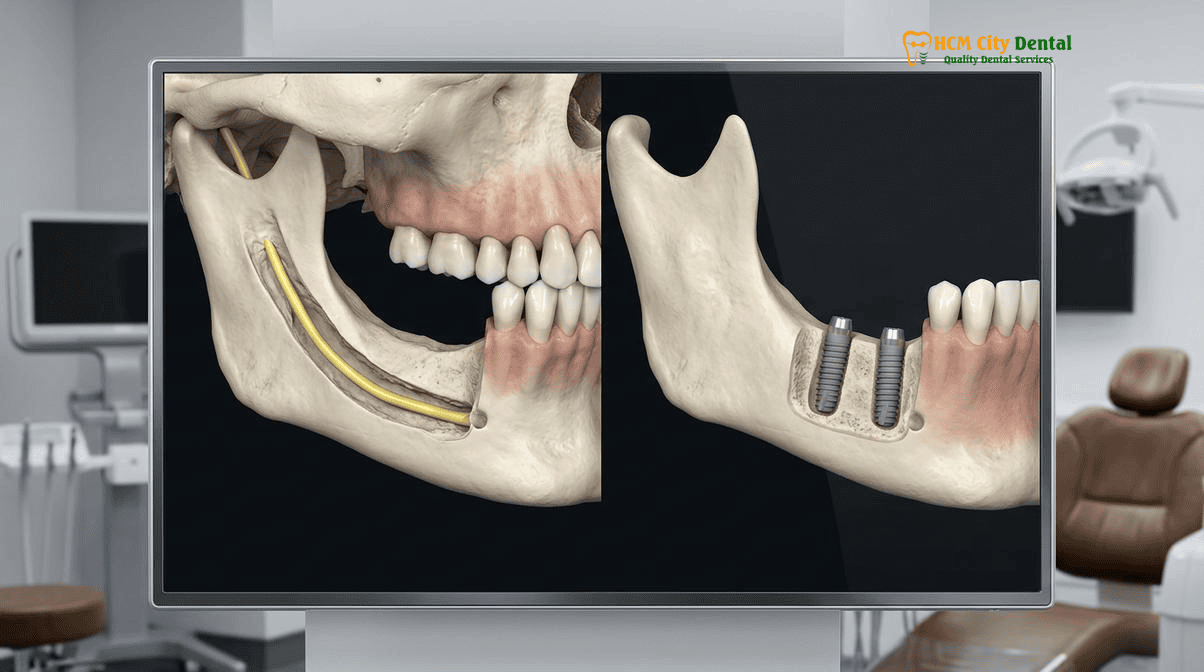
Rehabilitating the severely atrophic posterior mandible represents one of the most formidable biomechanical and anatomical challenges in modern oral implantology. Following the extraction of mandibular molars, the alveolar ridge undergoes rapid, progressive, and irreversible centripetal resorption. Over time, this vertical and horizontal bone loss drastically reduces the distance between the alveolar crest and the mandibular canal, which houses the vital inferior alveolar neurovascular bundle. When the residual vertical bone height drops below 6mm, conventional implant placement becomes impossible without risking severe neurological complications, including permanent paresthesia, dysesthesia, or complete anesthesia of the lower lip and chin. For international patients seeking lower jaw molar implants near the mandibular nerve in Vietnam, navigating the complex treatment algorithms requires a highly specialized, evidence-based approach.
Historically, the primary solution for this anatomical deficit was complex nerve repositioning surgery. However, advancements in titanium-zirconium metallurgy, hydrophilic implant surfaces, and ultrasonic surgical technologies have revolutionized the clinical decision tree. Today, the debate surrounding nerve repositioning surgery vs. short dental implants is heavily influenced by the desire to minimize surgical morbidity while maximizing long-term prosthetic stability. At HCMC Dental Clinic in District 1, Ho Chi Minh City, the clinical protocol for managing the atrophic posterior mandible is strictly hierarchical, prioritizing minimally invasive short implants and guided bone regeneration before advancing to complex piezosurgical nerve lateralization.
Clinical Summary:
This comprehensive clinical guide evaluates the three primary surgical modalities for rehabilitating the severely atrophic posterior mandible: the use of 6mm Straumann Roxolid short implants, vertical Guided Bone Regeneration (GBR), and Inferior Alveolar Nerve (IAN) lateralization. It details the precise neurosensory protection protocols utilizing ultrasonic Piezosurgery and L-PRF biological barriers. Furthermore, it provides an objective comparison of dental clinic operating models in Ho Chi Minh City and outlines the official 2026 fee schedule for specialist implantology at HCMC Dental Clinic, led by Dr. Nguyen Van Cuong, DDS.
Key Takeaways:
- Minimally Invasive First: 6mm Straumann Roxolid (TiZr) short implants are the first-line treatment for mandibles with 5mm to 6mm of residual bone, offering survival rates comparable to standard implants without the risks of nerve surgery.
- Vertical GBR Challenges: Vertical bone augmentation using Ti-PTFE membranes or the Khoury bone shell technique requires 6 to 9 months of healing and carries a high risk of soft-tissue dehiscence due to muscular tension in the posterior mandible.
- Nerve Lateralization vs. Transposition: IAN lateralization (leaving the mental foramen intact) is clinically preferred over mental nerve transposition (which severs the incisive branch) to minimize postoperative neurosensory deficits.
- Piezosurgery Safety: Ultrasonic Piezosurgery for mental foramen transposition ensures neurosensory safety by selectively cutting bone while remaining completely inert against the delicate nerve sheath.
- Cost Efficiency: Advanced posterior mandibular reconstructions at HCMC Dental Clinic in District 1 offer international patients savings of up to 60% compared to Western benchmarks, with strict adherence to Ministry of Health (MOH) standards.
The Atrophic Posterior Mandible Challenge: When Less Than 5mm–6mm of Vertical Bone Remains Above the Inferior Alveolar Nerve (IAN) Canal
The posterior mandible is characterized by dense, highly mineralized cortical bone (Type I or Type II bone) and is subjected to the highest occlusal masticatory forces in the human dentition. When posterior teeth are lost, the lack of mechanical stimulation leads to disuse atrophy. According to the Cawood and Howell classification of edentulous jaws, the mandible progresses from a post-extraction ridge (Class II) to a knife-edge ridge (Class IV), and eventually to a flat or depressed ridge (Class V and VI). In these advanced stages of atrophy, the inferior alveolar nerve (IAN) canal, which normally resides deep within the medullary space, becomes superficial, sometimes even resting directly beneath the oral mucosa.
The inferior alveolar nerve is a major sensory branch of the mandibular nerve (V3), providing innervation to the lower teeth, chin, and lower lip. Accidental mechanical trauma, thermal injury from drilling, or compression from an implant fixture can result in devastating neurosensory disturbances. Therefore, a mandatory safety zone of at least 2.0mm must be maintained between the apical end of a dental implant and the superior border of the mandibular canal. For patients presenting with an atrophic posterior mandible with <6mm bone height above the nerve, placing a standard 8mm or 10mm implant is physically impossible without penetrating the canal[1].
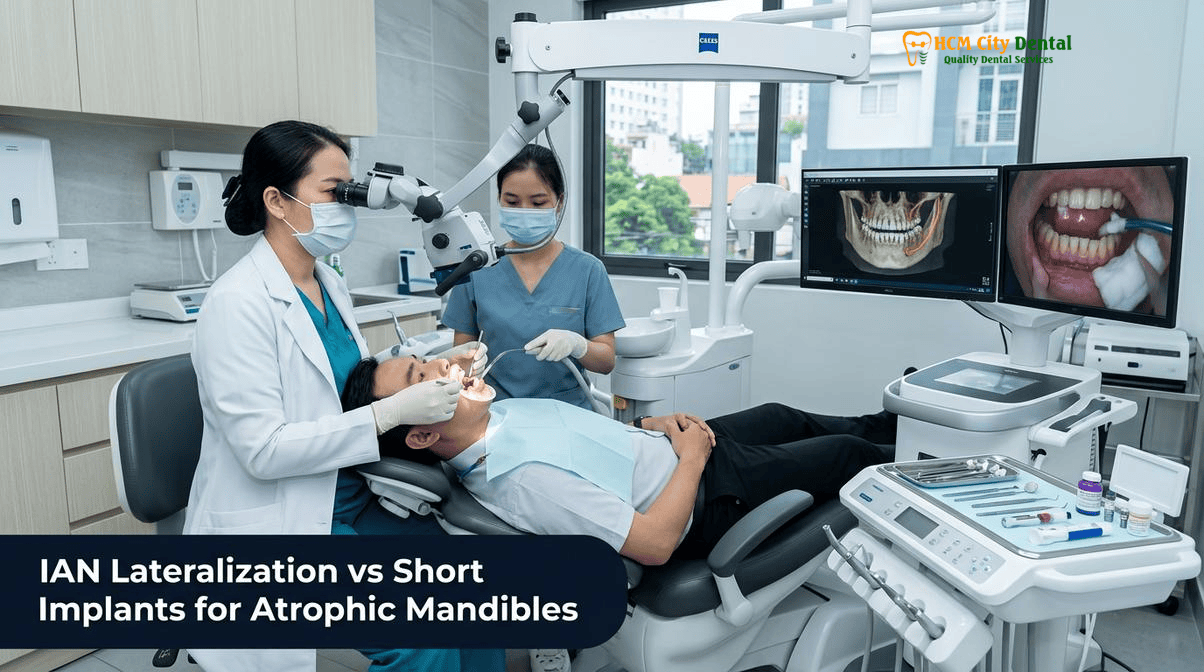
To accurately assess the three-dimensional architecture of the residual ridge and the exact trajectory of the IAN, high-resolution Cone Beam Computed Tomography (CBCT) is an absolute prerequisite. Two-dimensional panoramic radiographs are insufficient, as they suffer from magnification distortion and cannot reveal the bucco-lingual position of the nerve or the presence of an anterior mental loop. Through precise CBCT diagnostics, the surgical team at HCMC Dental Clinic can determine whether the patient is a candidate for short implants, vertical bone grafting, or nerve repositioning.
Option 1 (First-Line Minimally Invasive Standard): 6mm Straumann Roxolid (TiZr) Short Implants & Tilted Mesial/Lingual Fixture Angulation to Bypass the Canal
In contemporary implantology, the paradigm has shifted away from adapting the bone to fit the implant, toward adapting the implant to fit the available bone. For patients with 5mm to 7mm of residual vertical bone height, the use of extra-short implants is the preferred, evidence-based first-line therapy. However, utilizing short implants in the posterior mandible requires exceptional biomaterial strength to withstand immense occlusal loads without fracturing.
Comparing Straumann Roxolid 6mm short implants vs. vertical bone grafts reveals a distinct advantage in reducing surgical morbidity and treatment time. Roxolid is a high-performance alloy composed of 85% Titanium and 15% Zirconium. This specific metallurgical combination yields a tensile strength up to 40% higher than conventional Grade 4 pure titanium. Consequently, a 6mm Roxolid implant can safely support a posterior molar crown without the risk of fatigue fracture. Furthermore, these implants feature the SLActive hydrophilic surface, which accelerates blood protein adsorption and promotes rapid osseointegration, even in the dense, less vascularized bone of the posterior mandible[2].
“When we evaluate an atrophic posterior mandible, our primary objective is to avoid the inferior alveolar nerve entirely. By utilizing 6mm Straumann Roxolid implants, we can achieve predictable, long-term osseointegration without subjecting the patient to the surgical trauma, prolonged healing, and neurosensory risks associated with vertical bone grafting or nerve lateralization.”
— Dr. Nguyen Van Cuong (Dr. Cuong), DDS
In addition to utilizing short implants, the surgical trajectory can be modified. If the CBCT scan reveals that the mandibular canal is positioned significantly toward the buccal (cheek) or lingual (tongue) cortical plate, the implant osteotomy can be intentionally tilted to bypass the nerve. By angulating the fixture mesially, distally, or lingually, the surgeon can engage the dense cortical bone alongside the canal, maximizing primary stability while maintaining a safe distance from the neurovascular bundle. This technique is thoroughly detailed in our guide on Short Dental Implants (6mm–8mm) vs. Vertical Bone Grafting & Sinus Lift Surgery in Vietnam: Survival & Cost.
Option 2: Vertical Guided Bone Regeneration (Ti-Reinforced PTFE / Khoury Bone Shell) — Indications, Healing Timeline, and Soft-Tissue Tension Risks
When the residual bone height falls below 4mm to 5mm, even 6mm short implants cannot be placed safely. In these scenarios, the clinician must decide between augmenting the bone vertically or repositioning the nerve. Vertical Guided Bone Regeneration (GBR) aims to rebuild the lost alveolar crest height to accommodate standard-length implants.
Vertical GBR in the posterior mandible is notoriously difficult. The procedure relies on the PASS principles: Primary closure, Angiogenesis, Space maintenance, and Stability of the blood clot. To achieve space maintenance against the strong compressive forces of the overlying mucosa and masticatory muscles, surgeons utilize Titanium-Reinforced Polytetrafluoroethylene (Ti-PTFE) non-resorbable membranes or the Khoury bone shell technique. The Khoury technique involves harvesting a block of autogenous cortical bone (usually from the mandibular ramus), splitting it into thin plates, and securing them with micro-screws to create a biological container, which is then filled with particulate autogenous bone and xenograft.
While vertical GBR can successfully regenerate 4mm to 6mm of vertical bone, it presents significant clinical challenges:
- Prolonged Healing Timeline: The augmented site requires a minimum of 6 to 9 months of undisturbed healing before implants can be placed, extending the total treatment time to over a year.
- Soft-Tissue Tension and Dehiscence: The posterior mandible has a shallow vestibule and strong muscle attachments (mylohyoid and buccinator muscles). Advancing the mucosal flap to achieve tension-free primary closure over a vertical graft requires deep periosteal releasing incisions. Despite these efforts, the risk of incision line opening (dehiscence) and subsequent graft infection remains high.
- Patient Morbidity: The need for a secondary surgical site to harvest autogenous bone increases postoperative pain, swelling, and recovery time.
Due to these complexities, vertical GBR is reserved for specific cases where nerve repositioning is contraindicated or when the horizontal defect is as severe as the vertical defect. For a broader overview of advanced grafting protocols, patients can review our comprehensive resources on 3D-Guided Dental Implants & Specialist Oral Surgery in Vietnam.
Option 3: Piezosurgery Inferior Alveolar Nerve Lateralization (Posterior to Mental Foramen) vs. Nerve Transposition (Incising the Mental Foramen Ring)
When vertical GBR is deemed too unpredictable or when the patient desires a faster time-to-teeth with immediate implant placement, surgical repositioning of the inferior alveolar nerve becomes the treatment of choice. This highly advanced procedure physically moves the nerve out of the way, allowing for the placement of long (10mm to 13mm) implants that engage the dense basal bone at the inferior border of the mandible (bicortical anchorage).
There is a critical anatomical and surgical distinction between the two primary nerve repositioning techniques:
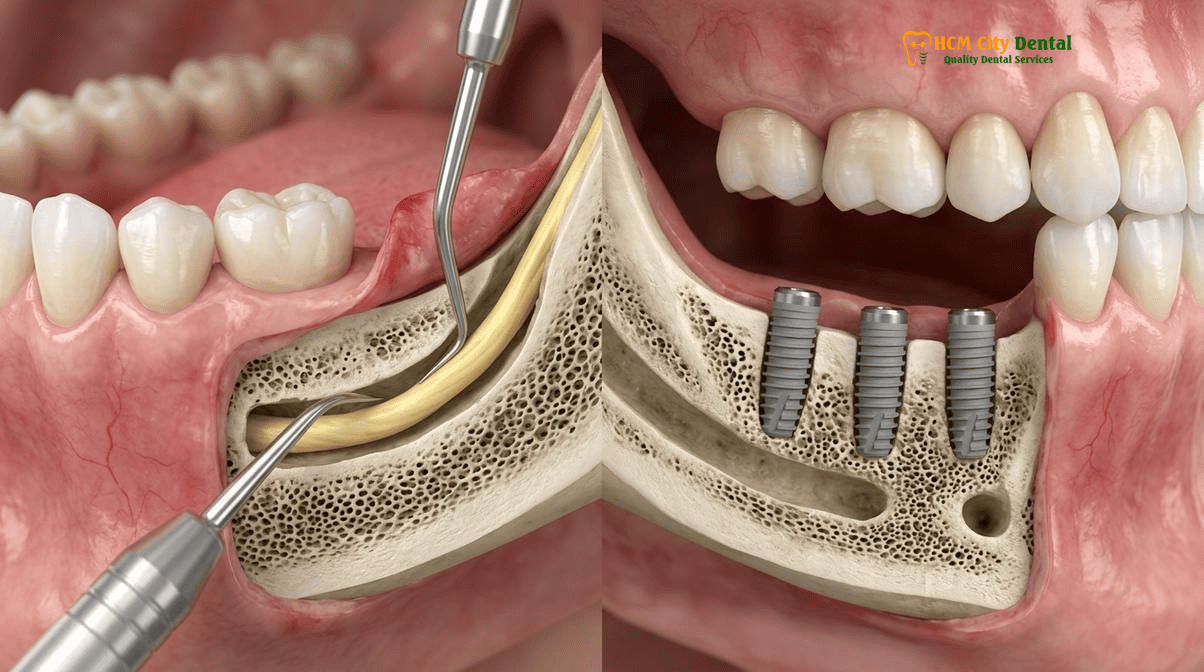
Inferior Alveolar Nerve (IAN) Lateralization
IAN lateralization is performed entirely posterior to the mental foramen. A rectangular bony window is created on the buccal cortex of the mandible, exposing the neurovascular bundle. The nerve is then gently retracted laterally (outward) while the implants are placed into the newly vacated space. Because the mental foramen remains intact and the incisive nerve branch is not severed, the risk of permanent sensory deficit is significantly minimized. This is the preferred technique when placing implants in the first and second molar regions.
Mental Nerve Transposition
Mental nerve transposition is required when implants must be placed in the premolar region, directly over or anterior to the mental foramen. This technique involves incising the bony ring of the mental foramen to free the mental nerve. Furthermore, the incisive nerve—which continues anteriorly within the bone to innervate the anterior teeth—must be surgically severed to allow the entire neurovascular bundle to be mobilized and pulled distally. Because of the direct trauma to the mental foramen and the intentional severing of the incisive branch, transposition carries a much higher incidence of prolonged or permanent paresthesia compared to lateralization[3].
“When considering inferior alveolar nerve lateralization for dental implants, patient selection and meticulous surgical execution are paramount. We strictly favor lateralization over transposition whenever possible. By preserving the mental foramen and utilizing Piezosurgery, we can achieve excellent bicortical implant stability while safeguarding the patient’s neurosensory function.”
— Dr. Nguyen Van Cuong (Dr. Cuong), DDS
Neurosensory Protection Protocol: Ultrasonic Piezosurgery Cortical Window Osteotomy, Elastic Vessel-Loop Retraction, and Interpositional L-PRF / Collagen Barrier
The success of nerve repositioning hinges entirely on the surgeon’s ability to manipulate the neurovascular bundle without causing mechanical crushing, stretching, or thermal injury. At HCMC Dental Clinic, Dr. Nguyen Van Cuong employs a strict, multi-tiered neurosensory protection protocol.
1. Ultrasonic Piezosurgery Cortical Window Osteotomy
Traditional rotary burs pose a severe risk of lacerating the nerve if they penetrate too deeply through the cortical bone. To maximize safety, the cortical window is created exclusively using Piezosurgery. Piezosurgery utilizes ultrasonic micro-vibrations that selectively cut mineralized tissue (bone) while remaining completely inert against soft tissues. If the Piezosurgery tip contacts the nerve sheath, it will not cut it. Furthermore, the cavitation effect of the ultrasonic coolant spray provides a blood-free surgical field, allowing for unparalleled visibility of the nerve canal.
2. Elastic Vessel-Loop Retraction
Once the bony window is removed and the nerve is exposed, it must be mobilized. Using rigid metal retractors can crush the delicate nerve fibers, leading to axonotmesis (nerve injury). Instead, a soft, elastic medical vessel-loop is passed beneath the neurovascular bundle. This allows the surgeon to gently retract the nerve laterally with minimal, evenly distributed tension while the implant osteotomies are prepared and the fixtures are inserted.
3. Interpositional L-PRF and Collagen Barriers
After the implants are placed, the nerve cannot simply be dropped back against the rough titanium surface. Direct contact between the nerve and the implant threads can cause chronic mechanical irritation and perineural fibrosis, resulting in long-term pain (dysesthesia). To prevent this, an autogenous Leukocyte-Platelet Rich Fibrin (L-PRF) membrane, spun from the patient’s own blood, or a thick resorbable collagen barrier is placed between the implant and the nerve. This acts as a biological cushion. The bony window is then replaced or the defect is grafted with particulate bone substitute to complete the procedure[4].
Clinical Case Study: Bilateral Posterior Mandibular Reconstruction
A 58-year-old Australian patient presented to HCMC Dental Clinic with severe bilateral posterior mandibular atrophy (Class V) and an inability to wear a lower partial denture. CBCT analysis revealed only 3.5mm of bone above the IAN bilaterally. After discussing the prolonged timeline of vertical GBR, the patient opted for bilateral Piezosurgery IAN lateralization. Using 3D surgical guides, Dr. Cuong performed the lateralization and immediately placed two 10mm Straumann implants on each side, utilizing L-PRF barriers for nerve protection. The patient experienced temporary lower lip numbness that fully resolved within 6 weeks. Final monolithic zirconia crowns were delivered 4 months post-surgery, restoring full masticatory function.
Clinical Precaution: Postoperative Neurosensory Management
Following any nerve repositioning procedure, temporary altered sensation (paresthesia) in the lower lip and chin is expected due to surgical edema and traction neuropraxia. This typically resolves within 4 to 12 weeks. Patients are prescribed a strict pharmacological regimen including systemic corticosteroids to reduce nerve inflammation, NSAIDs, and high-dose neurotropic vitamins (B1, B6, and B12 / Methylcobalamin) to support myelin sheath repair. If numbness persists beyond 3 months, patients must contact Dr. Cuong for a comprehensive neurosensory evaluation.
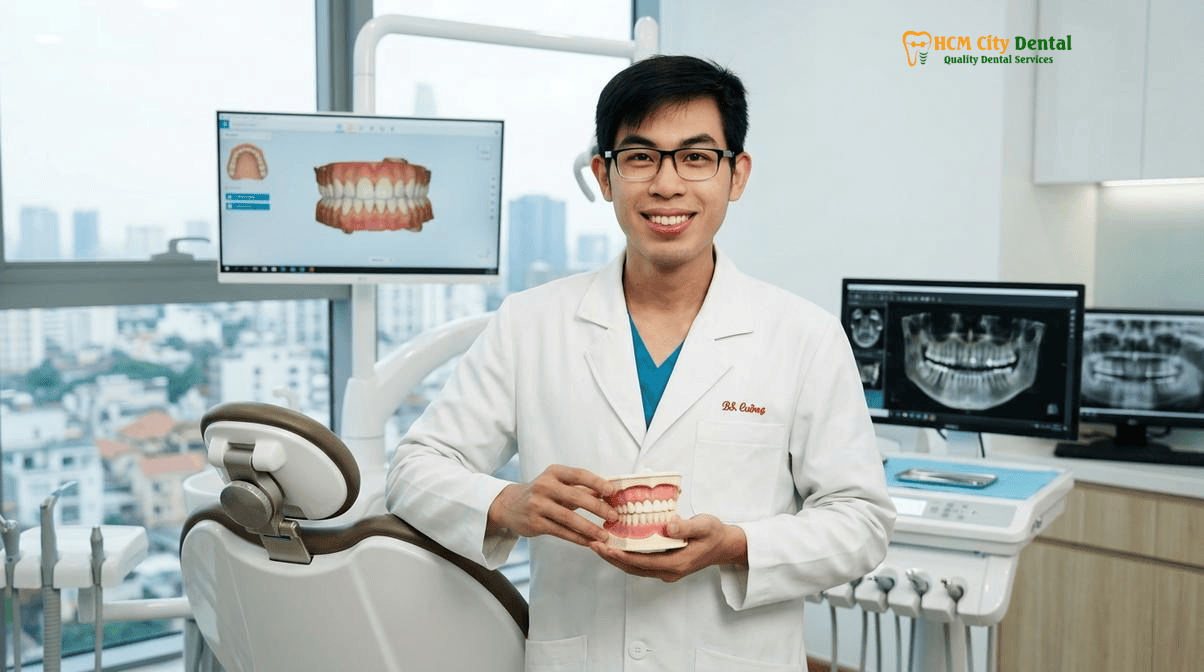
Objective Clinical Comparison: The 4 Dental Clinic Operating Models in Ho Chi Minh City
For international patients traveling to Vietnam for complex procedures like nerve lateralization or full-arch reconstructions, selecting the right clinical environment is critical. The dental landscape in Ho Chi Minh City is divided into four distinct operating models. Understanding these models ensures patients receive continuous, specialist-led care rather than fragmented treatment.
Model 1: 1-on-1 Doctor-Direct Specialist Boutique (HCMC Dental Clinic, District 1)
This model is defined by absolute continuity of care. At HCMC Dental Clinic, Dr. Nguyen Van Cuong, DDS (MOH License 0003265/BL-CCHN) personally handles every phase of the treatment—from the initial 3D CBCT diagnosis and digital planning to the complex surgical execution and final prosthetic delivery. There are no associate hand-offs. Because the clinic operates without the massive overhead of corporate hospitals or the commission fees of booking agencies, patients benefit from direct -40% online pre-booking savings. This model is ideal for complex, high-risk procedures requiring strict surgical accountability. For more details on this approach, see our guide to the Best Dentist & Dental Clinics in Ho Chi Minh City (2026 Comparison Guide).
Model 2: Multi-Doctor Expat Clinics & Private Dental Hospitals
Facilities such as Westcoast International Dental Clinic, Starlight Dental Clinic, Worldwide Dental Hospital, and Elite Dental operate on a multi-disciplinary hospital model. They feature luxurious amenities and cater heavily to the expat communities in Thao Dien (District 2) and District 7. While they offer excellent, high-quality care, the treatment is often compartmentalized—an oral surgeon places the implant, and a separate prosthodontist restores it. Furthermore, their pricing structures are typically benchmarked closer to Western private practice rates to support their high operational overhead.
Model 3: High-Volume Domestic Dental Chains
Corporate chains like Peace Dentistry, Kim Dental, and I-DENT Dental Implant Center operate multiple branches across the city, focusing on high patient volume and domestic accessibility. While they offer competitive pricing, the high turnover rate can sometimes result in unpredictable doctor assignment, meaning the surgeon who consults with you may not be the one performing the surgery. For highly sensitive procedures like nerve lateralization, this lack of continuity can be a concern.
Model 4: Third-Party Medical Tourism Booking Agencies
Agencies such as Dental Departures and WhatClinic are not medical facilities; they are marketing brokers. They refer patients to partner clinics in exchange for a 15% to 25% commission, which is often built into the patient’s final bill. Booking directly with a licensed, doctor-led clinic like HCMC Dental Clinic eliminates these middleman fees and ensures direct warranty accountability with the operating surgeon. You can verify Dr. Cuong’s credentials directly at Dr. Nguyen Van Cuong, DDS (Clinical Director — MOH License 0003265/BL-CCHN).
2026 Posterior Mandibular Reconstruction (Roxolid Short Implants, Vertical GBR & Piezosurgery Nerve Lateralization) Fee Schedule at HCMC Dental Clinic (District 1)
Performing advanced implantology in the atrophic posterior mandible requires premium biomaterials, 3D surgical guides, and specialized equipment like Piezosurgery units. Despite the complexity, HCMC Dental Clinic maintains a highly transparent fee structure. By booking directly online, international patients bypass agency commissions and access exclusive -40% online pricing, making world-class surgical care highly accessible[5].
Below is the official 2026 fee schedule for implant and surgical procedures. For a complete list of all dental treatments, please visit our Official 2026 Dental Fee Schedule (-40% Online Booking Pricing).
| Surgical / Implant Procedure | 2026 Online Booking Price (USD) | Walk-In / Standard Price (USD) | Estimated US / AUS Benchmark |
|---|---|---|---|
| 3D CBCT Scan & Digital Diagnostics | $18 USD | $30 USD | $250 – $400 USD |
| Single Korean Implant (Dentis / Neo Biotech) Includes fixture + standard abutment | $462 – $654 USD | $769 – $1,090 USD | $2,500 – $3,500 USD |
| Single European / Swiss Implant (Straumann BLT-SLA / Roxolid 6mm) Includes fixture + standard abutment | $962 – $1,346 USD | $1,603 – $2,244 USD | $4,500 – $6,000 USD |
| Implant Zirconia HT Crown + Custom Abutment | $154 USD | $256 USD | $1,200 – $1,800 USD |
| All-on-4 Full-Arch Implants (Economy) Complete package with final Zirconia bridge | From $6,346 USD / arch | From $10,576 USD / arch | $20,000 – $25,000 USD |
| All-on-6 Full-Arch Implants (Straumann) Complete package with final Zirconia bridge | $12,308 – $13,462 USD / arch | $20,513 – $22,436 USD / arch | $30,000 – $40,000 USD |
| Surgical Wisdom Tooth Extraction (Piezotome) | $58 – $115 USD / tooth | $96 – $191 USD / tooth | $400 – $800 USD |
*Note: Fees for complex adjunctive surgeries, such as Piezosurgery IAN Lateralization, Vertical GBR (Ti-PTFE / Khoury), and L-PRF application, are assessed on a case-by-case basis following a comprehensive 3D CBCT evaluation. Exchange rate applied: $1 USD = 26,000 VND.
Frequently Asked Questions
When only 5mm to 6mm of bone height remains above my lower jaw nerve, why does Dr. Nguyen Van Cuong evaluate 6mm Straumann Roxolid short implants before nerve surgery?
Dr. Nguyen Van Cuong (Dr. Cuong), DDS prioritizes minimally invasive protocols to eliminate the risk of permanent neurosensory deficits (paresthesia). Straumann Roxolid 6mm short implants utilize a high-strength Titanium-Zirconium alloy and an SLActive hydrophilic surface, allowing them to withstand heavy posterior occlusal forces without requiring complex nerve repositioning or extensive vertical bone grafting. This approach significantly reduces surgical morbidity, shortens healing times, and lowers overall treatment costs while maintaining survival rates comparable to standard-length implants.
What is the clinical difference between Inferior Alveolar Nerve Lateralization and Mental Nerve Transposition?
Inferior Alveolar Nerve (IAN) Lateralization involves creating a bony window posterior to the mental foramen to gently move the nerve outward, leaving the mental foramen and incisive nerve intact. In contrast, Mental Nerve Transposition requires incising the bony ring of the mental foramen and severing the incisive nerve branch to mobilize the entire neurovascular bundle. Transposition carries a significantly higher risk of postoperative numbness in the lower lip and chin, making lateralization the preferred technique when anatomically feasible.
How does Piezosurgery ultrasonic bone cutting prevent mechanical tearing of the inferior alveolar neurovascular bundle?
Piezosurgery utilizes ultrasonic micro-vibrations (typically between 24 and 36 kHz) that selectively cut mineralized tissue (bone) while remaining completely inert against soft tissues. If the Piezosurgery tip accidentally contacts the inferior alveolar nerve or adjacent blood vessels, it will not cut or tear them. This selective cutting capability, combined with a cavitation effect that provides a blood-free surgical field, makes it the gold standard for neurosensory safety during complex nerve repositioning procedures.
Why is an autogenous L-PRF membrane or collagen barrier always placed between the titanium implant surface and the repositioned nerve?
Direct contact between a titanium implant surface and the inferior alveolar nerve can lead to perineural fibrosis, chronic inflammation, and long-term dysesthesia (painful altered sensation). By placing an autogenous Leukocyte-Platelet Rich Fibrin (L-PRF) membrane or a resorbable collagen barrier between the implant and the nerve, the surgeon creates a biological cushion. This barrier protects the nerve from mechanical irritation, prevents fibrous tissue ingrowth, and releases growth factors that accelerate neurosensory recovery.
How much do posterior mandibular short implants vs. complex nerve-sparing reconstruction cost at HCMC Dental Clinic in District 1?
At HCMC Dental Clinic in District 1, Ho Chi Minh City, international patients benefit from transparent -40% online booking rates. A single European/Swiss implant (such as Straumann BLT-SLA) costs $962 to $1,346 USD online. If complex nerve-sparing reconstruction or vertical guided bone regeneration is required, additional surgical fees apply, but the total cost remains approximately 60% to 70% lower than equivalent specialist treatments in Australia, the US, or the UK, all performed under strict Ministry of Health (MOH) regulations.
References
- International Journal of Oral & Maxillofacial Implants. Clinical Outcomes of Inferior Alveolar Nerve Repositioning vs. Short Implants in the Severely Atrophic Posterior Mandible: A 5-Year Retrospective Study. (2023).
- Journal of Periodontology. Biomechanical Evaluation of 6mm Titanium-Zirconium (Roxolid) Implants in Type II Mandibular Bone: Finite Element Analysis and Clinical Survival. (2022).
- Journal of Oral and Maxillofacial Surgery. Piezosurgery for Inferior Alveolar Nerve Lateralization: Neurosensory Recovery Rates and Surgical Morbidity. (2021).
- Clinical Oral Implants Research. Vertical Guided Bone Regeneration using Ti-PTFE Membranes vs. Khoury Bone Shell Technique in the Posterior Mandible. (2023).
- Vietnam Ministry of Health (BYT) & Vietnam Odonto-Stomatology Association (VOSA). National Clinical Guidelines on Specialist Dental Care, Biomaterial Traceability & EN 13060 Class B Infection Control. (2024).