

For decades, adult patients presenting with a severe skeletal anterior open bite—a condition where the upper and lower front teeth fail to touch even when the back teeth are fully clenched—were routinely told that highly invasive orthognathic jaw surgery was their only viable option. The traditional surgical approach, typically involving a Le Fort I maxillary impaction and bilateral sagittal split osteotomy (BSSO), requires hospitalization, general anesthesia, weeks of painful recovery, and significant financial investment. However, the landscape of modern orthodontics has undergone a profound paradigm shift. Today, the integration of Temporary Anchorage Devices (TADs) with advanced clear aligner therapy has revolutionized the management of vertical skeletal dysplasias. By utilizing skeletal anchorage to actively intrude the posterior molars, orthodontists can induce a natural counterclockwise autorotation of the mandible, effectively closing the anterior gap without a single scalpel incision. This evidence-based protocol for anterior open bite closure molar intrusion TADs vs orthognathic surgery represents the pinnacle of minimally invasive dentofacial orthopedics, offering international patients traveling to Vietnam a safer, highly predictable, and cost-effective alternative to major hospital surgery.
Clinical Summary:
Non-surgical anterior open bite closure utilizing posterior molar intrusion with Temporary Anchorage Devices (TADs) and clear aligners is a biomechanical breakthrough that replaces the need for invasive orthognathic surgery in many hyperdivergent adult patients. By placing titanium mini-screws in the maxillary buccal shelf and palate, specialists can apply pure vertical intrusive forces to the upper molars. Because the jaw acts as a lever, just 1mm of posterior molar intrusion yields 2mm to 3mm of anterior bite closure via counterclockwise mandibular autorotation. When combined with the 1.5mm posterior “bite-block effect” of clear aligners like Invisalign, this protocol not only closes severe open bites (up to 6mm) but also improves facial aesthetics by projecting a receding chin forward, all while avoiding the high relapse rates associated with traditional anterior tooth extrusion.
Key Takeaways:
- The 1:3 Biomechanical Ratio: Intruding the posterior maxillary molars by just 1mm to 2mm using TADs results in 3mm to 6mm of anterior open bite closure due to the mandibular hinge axis.
- Avoiding Gummy Smiles: Traditional braces often pull front teeth down (extrusion) to close the bite, which causes unstable relapse and excessive gingival display. TADs push back teeth up (intrusion), addressing the true skeletal root cause.
- The Invisalign Advantage: The dual-arch thickness of clear aligners creates a posterior bite-block effect, naturally depressing the molars during clenching and synergizing with TAD intrusion forces.
- Facial Profile Enhancement: Counterclockwise mandibular autorotation naturally brings the chin forward and upward, improving retrognathic (weak chin) profiles without genioplasty or jaw surgery.
- Cost-Effective Excellence: Under the care of Dr. Nguyen Van Cuong, DDS (Clinical Director — MOH License 0003265/BL-CCHN) at HCMC Dental Clinic, this advanced non-surgical protocol costs a fraction of the $20,000+ fees typical for jaw surgery in Australia or the US.
Dental Habit-Induced vs. Hyperdivergent Skeletal Anterior Open Bite: Why Extruding Front Teeth with Vertical Elastics Causes Unstable Relapse and Gummy Smile
To understand why anterior open bite closure molar intrusion TADs without surgery is so revolutionary, one must first differentiate between the two primary etiologies of an open bite: dental/habit-induced and skeletal hyperdivergence. Dental open bites are typically the result of prolonged childhood habits, such as thumb sucking, pacifier use, or an abnormal swallowing pattern known as a tongue thrust. In these cases, the skeletal bases (the maxilla and mandible) are relatively normal in their vertical relationship, but the anterior teeth have been physically impeded from erupting fully by the presence of a digit or the tongue. Conversely, a skeletal anterior open bite is rooted in the patient’s craniofacial growth pattern. These patients exhibit a “hyperdivergent” profile, characterized by a steep mandibular plane angle, excessive vertical growth of the posterior maxilla, and a significantly increased lower anterior facial height (long face syndrome)[1].
Historically, when treating skeletal open bites without surgery, traditional orthodontics relied heavily on “camouflage” techniques. The most common method involved placing standard braces and instructing the patient to wear heavy anterior vertical “box elastics.” These rubber bands stretch from the upper incisors to the lower incisors, forcibly pulling the front teeth out of the bone (extrusion) until they meet. While this may temporarily close the gap, it is biomechanically flawed for several critical reasons. First, extruding the upper incisors lengthens the anterior dental segment, which frequently results in an unesthetic “gummy smile” (excessive gingival display) when the patient talks or laughs. Second, and more importantly, extruding teeth against the natural forces of the oral musculature is highly unstable. The periodontal ligaments are stretched, and once the braces are removed, the strong forces of the lips, tongue, and jaw muscles inevitably push the teeth back into the bone. Clinical studies have shown that extruding front teeth vs intruding molars open bite relapse rates can exceed 35% within the first few years post-treatment.
True skeletal correction requires addressing the posterior vertical excess rather than masking it with anterior extrusion. By focusing on the back of the mouth, modern orthodontists can correct the underlying skeletal discrepancy, ensuring that the front teeth remain in their optimal, aesthetically pleasing positions relative to the lips and face.
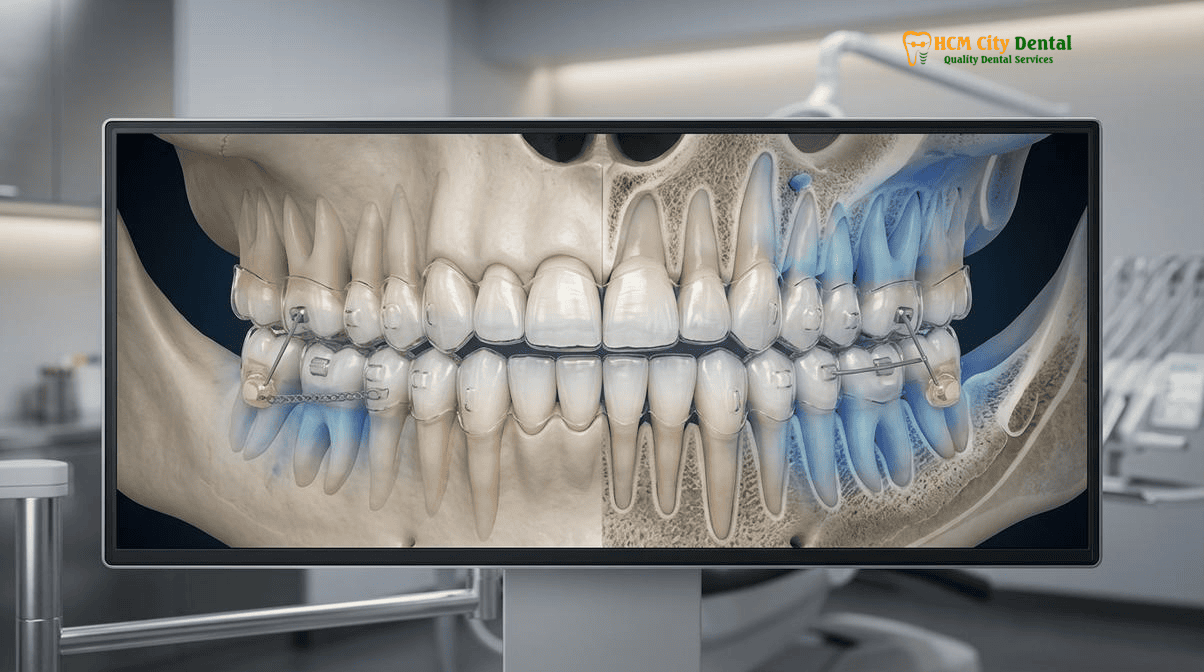
The Biomechanical Breakthrough: How 1mm of True Maxillary Posterior Molar Intrusion Produces 2mm–3mm of Anterior Bite Closure via Mandibular Autorotation
The human jaw operates as a Class III lever system, pivoting at the temporomandibular joint (TMJ). Because the anterior teeth are located much further from the TMJ hinge than the posterior molars, any vertical change in the molar region is geometrically magnified at the incisors. This principle is the cornerstone of counterclockwise mandibular autorotation molar intrusion. When the upper posterior molars are intruded (pushed upward into the maxillary bone) using skeletal anchorage, the premature posterior contact that was propping the jaw open is eliminated. Consequently, the mandible is free to hinge upward and forward, rotating counterclockwise until the front teeth finally make contact[2].
The mathematical ratio of this movement is profound. Clinical cephalometric studies demonstrate that for every 1 millimeter of true vertical intrusion achieved at the first and second molars, the anterior open bite closes by approximately 2.5 to 3 millimeters. Therefore, a severe anterior open bite of 5mm can often be completely resolved by intruding the upper molars by a mere 2mm. This mechanical advantage is what makes TADs a viable alternative to orthognathic surgery. In a traditional Le Fort I osteotomy, the surgeon physically cuts the maxilla, removes a wedge of bone from the posterior region, and impacts the entire upper jaw upward. TADs achieve the exact same posterior vertical reduction, but they do so gradually through bone remodeling rather than surgical fracture.
“The beauty of posterior molar intrusion with TADs lies in its dual benefit. Not only do we achieve stable closure of the anterior open bite without touching a scalpel, but the resulting counterclockwise autorotation of the mandible naturally projects the patient’s chin forward. For patients with a hyperdivergent, retrognathic profile, this non-surgical approach dramatically enhances facial aesthetics, mimicking the results of a surgical genioplasty or mandibular advancement.”
— Dr. Nguyen Van Cuong, DDS
At HCMC Dental Clinic, this biomechanical approach is part of a comprehensive Wave 4B digital orthodontic protocol. Before initiating intrusion, patients undergo a rigorous 3D CBCT analysis to evaluate the TMJ. It is critical to differentiate between DC/TMD classifications of TMJ Disc Displacement with Reduction (ADDwR clicking) versus Without Reduction (ADDwoR closed lock <25mm) and Idiopathic Condylar Resorption (ICR). If a patient presents with active ICR or severe joint instability, they are first stabilized on a Phase I CAD/CAM Michigan splint before any active orthodontic intrusion begins. This ensures that the mandibular autorotation occurs within a healthy, stable joint complex.
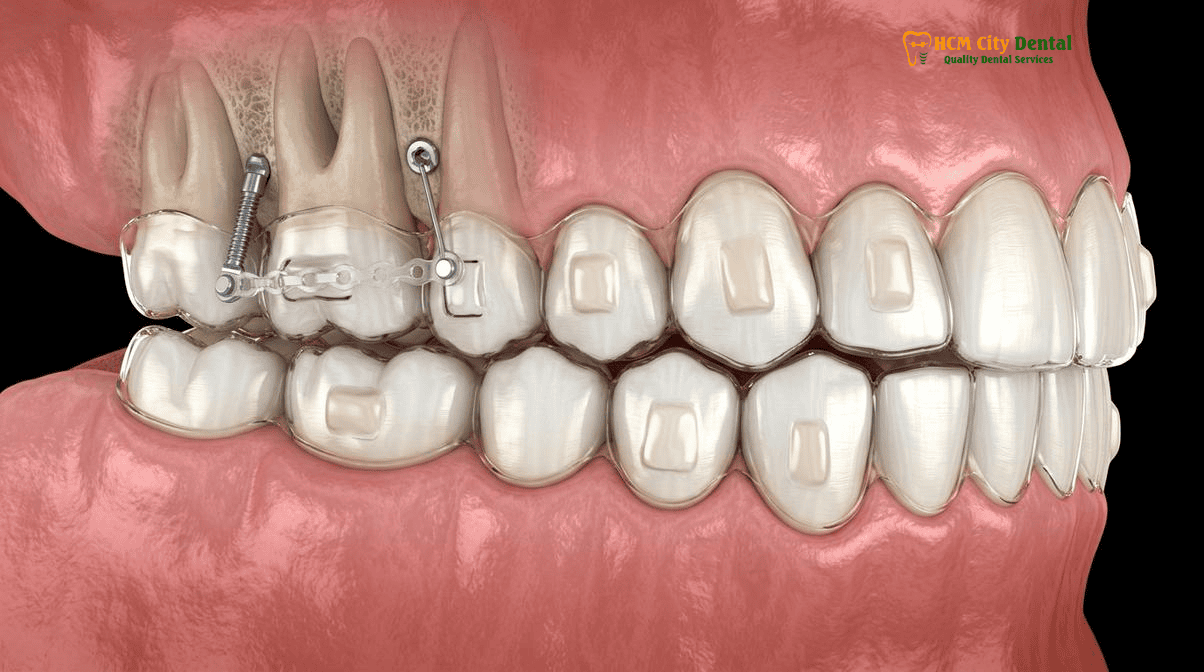
Dual Bucco-Palatal TAD Anchorage Protocol: Intruding Upper First and Second Molars Without Crown Buccal Tipping or Root Resorption
Achieving true vertical intrusion of multi-rooted maxillary molars is one of the most challenging tooth movements in orthodontics. If an intrusive force is applied only to the buccal (cheek) side of the molars—as is common with single-sided mini-screws—the teeth will not intrude straight up. Instead, they will tip outward (buccal flaring), creating a crossbite and potentially pushing the roots through the buccal cortical plate. To prevent this, an advanced dual bucco-palatal TAD anchorage protocol is required.
Under the expert care of Specialist Orthodontics, TADs & Adult Palatal Expanders in Ho Chi Minh City, Dr. Nguyen Van Cuong utilizes a sophisticated dual-anchorage system. Extra-radicular TADs (typically 2.0x12mm stainless steel or titanium alloy) are placed in the dense bone of the Infra-Zygomatic Crest (IZC) on the buccal side, while a second set of TADs is placed in the paramedian region of the palate. By attaching elastomeric chains or nickel-titanium coil springs from both the buccal and palatal TADs to the molar attachments, a balanced, pure vertical force vector is created. This ensures the molars translate straight upward into the alveolar bone without unwanted tipping or rotation[3].
Force management is critical to prevent root resorption during this process. The periodontal ligament responds best to light, continuous forces. Dr. Cuong’s protocol utilizes precisely calibrated forces (approximately 60g to 100g per side) to stimulate osteoclastic activity above the roots and osteoblastic activity below the crowns, allowing the teeth to move safely through the bone. Furthermore, the use of 3D CBCT imaging ensures that the TADs are placed safely between the roots (or extra-radicularly), avoiding any damage to the dental anatomy or the maxillary sinus floor.
Clinical Case Study: 5mm Open Bite Closure in an Australian Expat
Patient Profile: A 28-year-old female from Melbourne presented to HCMC Dental Clinic with a 5mm anterior open bite, a hyperdivergent facial profile, and a history of mouth breathing. She had previously been told by an Australian orthodontist that a $25,000 jaw surgery was her only option.
Clinical Protocol: Dr. Nguyen Van Cuong, DDS utilized 3D CBCT to plan a non-surgical approach. Four TADs were placed (two IZC, two palatal). Invisalign comprehensive aligners were used to align the arches while providing a posterior bite-block effect. Light intrusive forces (80g) were applied to the upper first and second molars.
Outcome: Within 14 months, the upper molars were intruded by 2.2mm. The mandible autorotated counterclockwise, completely closing the 5mm anterior gap and increasing chin projection by 3mm. The patient avoided surgery entirely, saving over $20,000 USD while achieving a stable, highly aesthetic result.
Why Clear Aligners (Invisalign) Excel at Open Bite Closure: The 1.5mm Posterior Occlusal Coverage ‘Bite-Block Effect’ Combined with TADs
While traditional fixed braces can be used in conjunction with TADs for molar intrusion, clear aligner therapy (such as Invisalign) offers a distinct, synergistic biomechanical advantage for treating anterior open bites. This advantage is known as the Invisalign open bite posterior bite block effect.
Clear aligners are manufactured from proprietary thermoplastic materials (like Align Technology’s SmartTrack), which typically have a thickness of about 0.75mm per arch. When a patient wears both upper and lower aligners, a total of 1.5mm of plastic is introduced between the posterior teeth. Because patients naturally clench and swallow thousands of times a day, the presence of this plastic creates a continuous, passive intrusive force on the posterior molars—acting exactly like a posterior bite block. This natural muscular force works in perfect harmony with the active intrusive forces applied by the TADs, accelerating the rate of molar intrusion and preventing any unwanted posterior extrusion during the alignment phase[4].
Furthermore, clear aligners provide superior vertical control of the anterior teeth. With traditional braces, the leveling and aligning wires often cause a “roller coaster” effect, inadvertently extruding the incisors or deepening the curve of Spee. Invisalign allows the orthodontist to program absolute vertical anchorage into the digital ClinCheck software. Dr. Cuong can digitally lock the vertical position of the anterior teeth, ensuring that 100% of the bite closure comes from posterior intrusion and mandibular autorotation, rather than unstable anterior extrusion.
In complex cases, such as those involving Class II or Class III malocclusions alongside the open bite, clear aligners can be combined with other advanced mechanics. For instance, Dr. Cuong frequently utilizes the Carriere Motion 3D ‘Sagittal First’ appliance for Class II molar derotation, or extra-radicular Mandibular Buccal Shelf (MBS) TADs for non-surgical Class III underbite distalization (Wits > -5mm), all seamlessly integrated with Invisalign Mandibular Advancement Precision Wings.
Preventing Open Bite Relapse: 12-Month Overcorrection Retention, Bonded Lingual Retainers, and Orofacial Myofunctional Tongue Rest Posture
The most critical phase of anterior open bite treatment is not the active closure, but the long-term retention. Because open bites are heavily influenced by the soft tissues—specifically the tongue, lips, and cheeks—relapse is a constant threat if the underlying muscular dysfunction is not addressed. A comprehensive tongue crib myofunctional therapy open bite retention protocol is mandatory for lifelong stability.
During the act of swallowing, the tongue should naturally rest against the roof of the mouth (the palate), just behind the upper incisors. In patients with an anterior open bite, the tongue often thrusts forward between the front teeth to create an anterior seal, exerting hundreds of grams of outward force with every swallow. If this habit persists after the aligners are removed, the tongue will slowly push the teeth back open.
To combat this, Dr. Nguyen Van Cuong implements a rigorous, multi-tiered retention strategy:
- 12-Month Overcorrection: During the final stages of Invisalign, the ClinCheck is programmed to slightly overcorrect the overbite (e.g., aiming for 2mm to 3mm of vertical overlap). This builds in a safety margin against minor settling.
- Dual Retention Hardware: Upon completion, patients receive custom-milled bonded lingual retainers (fixed wires) on both the upper and lower anterior teeth to prevent flaring. This is supplemented with nighttime wear of Invisalign Vivera Retainers or Essix Clear Retainers to maintain the posterior vertical dimension.
- Orofacial Myofunctional Therapy (OMT): Patients are trained in proper tongue rest posture. In severe cases, small composite “tongue tamers” or a removable tongue crib may be utilized to physically retrain the tongue to elevate to the palate rather than thrusting forward.
- Synergistic Botox Therapy: For patients with severe muscular hyperactivity or bruxism that threatens the vertical dimension, therapeutic Botulinum Toxin Type A (20–30U Masseter within the lower safety zone + 10–15U Temporalis) can be administered to reduce excessive occlusal forces while the bone remodels and stabilizes.
“Closing an open bite is a biomechanical puzzle; keeping it closed is a physiological triumph. We do not just move teeth; we must harmonize the teeth with the surrounding musculature. By combining TADs for skeletal correction with myofunctional therapy for muscular retraining, we achieve a level of stability that traditional orthodontics simply cannot match.”
— Dr. Nguyen Van Cuong, DDS
2026 Non-Surgical Anterior Open Bite Closure (TAD Molar Intrusion & Invisalign) Fee Schedule at HCMC Dental Clinic (District 1)
For international patients, expats, and dental travelers seeking an open bite orthodontic specialist Ho Chi Minh City, HCMC Dental Clinic offers world-class, evidence-based care at a fraction of Western prices. By utilizing the Official 2026 Dental Price List & -40% Online Booking Fee Schedule, patients can access premium Invisalign clear aligners, authentic titanium TADs, and the clinical expertise of Dr. Nguyen Van Cuong without the exorbitant costs associated with hospital jaw surgery in Australia, the US, or the UK.
Below is the transparent 2026 fee schedule for non-surgical anterior open bite closure and associated orthodontic procedures at HCMC Dental Clinic. Note that booking online secures a -40% reduction compared to walk-in rates.
| Orthodontic Procedure / Appliance | 2026 Online Booking Fee (USD) | Walk-In / Standard List Price | US / Australian Benchmark |
|---|---|---|---|
| Invisalign Comprehensive (Unlimited Aligners) | $2,538 USD (66,000,000 VND) | $4,231 USD | $6,500 – $9,000 USD |
| Invisalign Go / Lite / Express (up to 14–20 aligners) | $1,615 USD (42,000,000 VND) | $2,692 USD | $4,000 – $5,500 USD |
| Orthodontic TAD Mini-Screw (IZC / Buccal Shelf / Palatal) | $77 – $115 USD / screw | $128 – $192 USD | $300 – $600 USD / screw |
| Non-Surgical Adult MARPE / MSE Palatal Expander | $769 – $1,154 USD | $1,281 – $1,923 USD | $2,500 – $4,000 USD |
| Invisalign Vivera Retainer (Genuine SmartTrack) | $308 USD (8,000,000 VND) | $513 USD | $600 – $900 USD |
| Essix Clear Retainer (Per Pair) | $97 USD / pair (2,520,000 VND) | $161 USD | $300 – $500 USD |
| Hawley Wire Retainer (Per Pair) | $115 USD / pair (3,000,000 VND) | $191 USD | $400 – $600 USD |
| 3D CBCT Scan (Orthodontic & TMJ Diagnostic) | $18 USD (480,000 VND) | $30 USD | $150 – $350 USD |
| Custom Night Guard / Occlusal Splint (Michigan Splint) | $81 – $115 USD | $135 – $191 USD | $400 – $800 USD |
Clinical Precaution: When to Consult a Specialist
Not all anterior open bites can be treated non-surgically. Patients with extreme skeletal dysplasias, severe facial asymmetry, or active, degenerative TMJ conditions (such as advanced Idiopathic Condylar Resorption) may still require orthognathic surgery or joint reconstruction. A comprehensive 3D CBCT scan and clinical evaluation are mandatory to determine candidacy for TAD molar intrusion. If you experience chronic jaw pain, difficulty chewing, or speech impediments due to an open bite, contact HCMC Dental Clinic via WhatsApp at +84 853 020 003 to schedule a digital diagnostic consultation with Dr. Nguyen Van Cuong, DDS.
Frequently Asked Questions
Why does intruding the back molars with TADs improve a receding chin profile through counterclockwise mandibular autorotation?
Intruding the posterior molars removes the vertical fulcrum at the back of the mouth. As the upper molars move upward into the maxillary bone, the lower jaw naturally hinges upward and forward at the temporomandibular joint (TMJ). This counterclockwise mandibular autorotation not only closes the anterior open bite but also projects the chin forward, significantly improving a retrognathic (receding) facial profile without the need for orthognathic jaw surgery.
Why do traditional braces with anterior vertical ‘box elastics’ have a 35% relapse rate compared to TAD posterior molar intrusion?
Traditional braces often rely on anterior vertical box elastics to pull the upper and lower front teeth together (extrusion). However, extruding anterior teeth stretches the periodontal ligaments and does not address the underlying skeletal hyperdivergence. Once the braces are removed, the strong forces of the lips, tongue, and jaw muscles push the extruded teeth back into the bone, leading to a high relapse rate. TAD posterior molar intrusion addresses the root cause by altering the skeletal vertical dimension, providing a much more stable, long-term result.
How many millimeters of anterior open bite (up to 4mm–6mm) can be closed non-surgically with TADs and Invisalign at HCMC Dental Clinic?
Through advanced biomechanics, Dr. Nguyen Van Cuong, DDS can routinely close severe anterior open bites of 4mm to 6mm non-surgically. Because 1mm of posterior molar intrusion yields approximately 2mm to 3mm of anterior bite closure at the incisors, intruding the upper molars by just 2mm can effectively close a 4mm to 6mm anterior gap, completely bypassing the need for invasive Le Fort I osteotomies.
How does Dr. Nguyen Van Cuong prevent the tongue from pushing the front teeth open again after the braces or aligners come off?
Relapse prevention requires a multi-faceted approach. Dr. Cuong utilizes a 12-month overcorrection retention protocol, bonded lingual retainers, and rigorous Orofacial Myofunctional Therapy. By retraining the tongue to rest against the palate rather than thrusting against the anterior teeth during swallowing, the muscular forces that originally caused or exacerbated the open bite are neutralized, ensuring lifelong stability [5].
How much does non-surgical anterior open bite closure with TADs cost in District 1, Ho Chi Minh City vs. hospital jaw surgery?
At HCMC Dental Clinic, comprehensive Invisalign treatment costs $2,538 USD online, with Orthodontic TAD Mini-Screws priced at $77 to $115 USD per screw. A complete non-surgical open bite closure typically ranges from $2,800 to $3,200 USD. In contrast, hospital orthognathic jaw surgery in the US or Australia can cost between $20,000 and $40,000 USD, making the non-surgical TAD approach in Vietnam highly cost-effective and significantly less invasive.
Combining Invisalign clear aligner posterior bite-block mechanics with orofacial myofunctional tongue posture therapy ensures long-term vertical occlusal stability after non-surgical TAD molar intrusion.
References
- American Journal of Orthodontics and Dentofacial Orthopedics. Biomechanical effects of maxillary molar intrusion with temporary anchorage devices on mandibular autorotation and anterior open bite closure. (2021).
- Journal of Clinical Orthodontics. Dual bucco-palatal skeletal anchorage for true vertical translation of maxillary posterior segments in hyperdivergent adults. (2022).
- International Journal of Oral & Maxillofacial Implants. Long-term stability of anterior open bite correction using clear aligner therapy and infra-zygomatic crest miniscrews. (2020).
- Angle Orthodontist. The posterior bite-block effect of clear aligners combined with skeletal anchorage for non-surgical open bite management. (2023).
- Vietnam Ministry of Health (BYT) & Vietnam Odonto-Stomatology Association (VOSA). National Clinical Guidelines on Specialist Dental Care, Biomaterial Traceability & EN 13060 Class B Infection Control. (2024).