

For decades, the standard orthodontic approach to correcting a severe Class II Division 1 malocclusion—characterized by a prominent overjet (protruding upper front teeth) and a deep overbite—relied heavily on the extraction of two upper bicuspids (premolars). While this traditional method successfully retracted the anterior teeth to close the horizontal gap, it frequently resulted in unintended aesthetic and functional compromises, including a flattened nasolabial profile, a retruded upper lip, and a constricted posterior airway space. Today, modern 3D digital orthodontics has revolutionized the management of sagittal discrepancies. By integrating the Twin Block, Carriere Motion 3D, and Invisalign for Class II overjet correction, alongside extra-radicular skeletal anchorage, specialist orthodontists can now resolve severe overjets without sacrificing healthy premolars or compromising facial harmony.
At HCMC Dental Clinic in District 1, Ho Chi Minh City, our clinical protocols prioritize airway-centric, non-extraction biomechanics. Under the clinical direction of Dr. Nguyen Van Cuong, DDS (Clinical Director — MOH License 0003265/BL-CCHN), we utilize a combination of the ‘Sagittal First’ philosophy, growth modification appliances, and Infra-Zygomatic Crest (IZC) Temporary Anchorage Devices (TADs). This comprehensive guide explores the biomechanical intricacies of Class II overjet correction without premolar extraction, detailing how advanced clear aligner therapy and targeted distalization can achieve optimal functional occlusion and superior facial aesthetics for both growing adolescents and adults.
Clinical Summary:
Class II overjet and deep bite malocclusions are predominantly caused by mandibular retrognathia rather than maxillary protrusion. Modern non-extraction orthodontic protocols address this discrepancy through two primary mechanisms: orthopedic growth modification in adolescents (using Invisalign Mandibular Advancement with precision wings or Twin Block appliances) and full-arch maxillary distalization in adults (using the Carriere Motion 3D appliance or IZC TADs). By establishing a Class I molar and canine platform first—often referred to as the ‘Sagittal First’ approach—subsequent clear aligner therapy is significantly accelerated. These advanced biomechanics, combined with anterior bite ramps for deep bite intrusion, preserve lip support, optimize the airway, and eliminate the need for upper premolar extractions.
Key Takeaways:
- Mandibular Retrognathia is the Primary Culprit: Over 80% of Class II malocclusions stem from an underdeveloped lower jaw, making mandibular advancement or upper arch distalization clinically superior to upper premolar extraction.
- The ‘Sagittal First’ Advantage: The Carriere Motion 3D appliance derotates upper first molars and distalizes the posterior segment into a Class I relationship in just 3 to 5 months, reducing total Invisalign treatment time.
- Adolescent Growth Modification: Invisalign Mandibular Advancement utilizes precision wings to posture the mandible forward during the pubertal growth spurt (CVM Stage 3–4), offering a more comfortable, aesthetic alternative to bulky Twin Block appliances.
- Adult Non-Extraction Correction: Infra-Zygomatic Crest (IZC) TADs provide absolute skeletal anchorage, allowing for the sequential distalization of the entire maxillary arch without unwanted flaring of the lower incisors.
- Deep Bite Resolution: Anterior bite ramps integrated into clear aligners disarticulate the posterior teeth, facilitating the leveling of the Curve of Spee and simultaneous intrusion of the lower incisors.
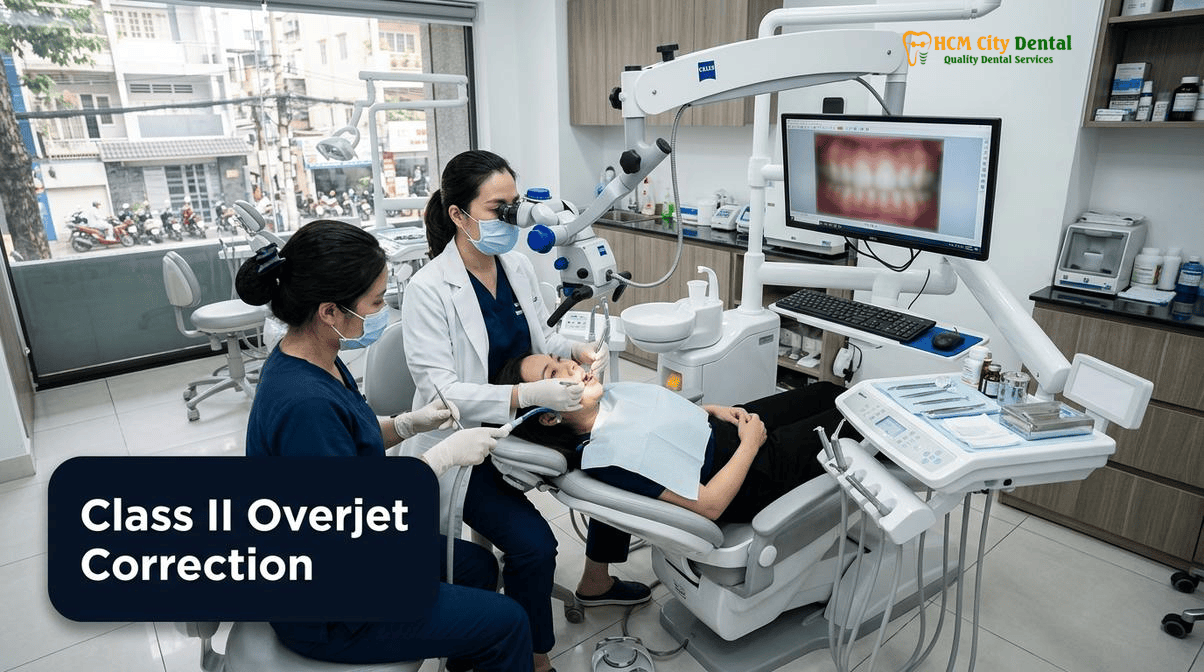
Why Most Class II Division 1 Overjets Are Driven by Mandibular Retrognathia Rather Than Maxillary Excess (And Why Premolar Extraction Can Flatten the Lip Profile)
To effectively treat a Class II malocclusion, the clinician must first accurately diagnose the underlying skeletal discrepancy via 3D Cone Beam Computed Tomography (CBCT) and lateral cephalometric analysis. Historically, a large overjet was often misdiagnosed as maxillary prognathism (an overgrown upper jaw). However, extensive cephalometric studies have demonstrated that the vast majority of Class II Division 1 cases are actually the result of mandibular retrognathia—an underdeveloped or posteriorly positioned lower jaw. In these cases, the maxilla is typically in a normal position relative to the cranial base (normal SNA angle), while the mandible is retruded (decreased SNB angle), resulting in a high ANB angle and a positive Wits appraisal.
When a Class II overjet is treated by extracting the maxillary first premolars, the anterior teeth are retracted to meet the retruded lower jaw. While this closes the overjet, it fundamentally alters the soft tissue drape. Retracting the upper incisors by 5 to 7 millimeters can lead to a significant flattening of the upper lip, an obtuse nasolabial angle, and a “dished-in” facial profile that ages the patient prematurely. Furthermore, retracting the anterior boundary of the oral cavity can force the tongue backward, potentially encroaching on the oropharyngeal airway space and predisposing the patient to sleep-disordered breathing or Obstructive Sleep Apnea (OSA) later in life. Controlling Ricketts’ E-Line and the nasolabial angle is paramount; in cases of true Bimaxillary Protrusion, 4-premolar extraction or TAD-supported full-arch retraction may be indicated, but for isolated Class II mandibular retrognathia, non-extraction protocols are the gold standard.
“The paradigm shift in modern orthodontics is moving away from camouflage extractions and toward skeletal and dentoalveolar optimization. By utilizing the Carriere Motion 3D appliance and Invisalign for Class II correction, we can distalize the upper arch or advance the mandible, preserving the patient’s natural lip fullness, optimizing their airway volume, and achieving a broad, aesthetic smile arc.”
— Dr. Nguyen Van Cuong, DDS
Instead of extracting teeth to fit a retruded mandible, contemporary orthodontics focuses on either advancing the mandible (in growing patients) or moving the entire maxillary dentition distally (backward) to achieve a Class I relationship. This non-extraction approach preserves the arch perimeter, maintains optimal tongue space, and supports the soft tissues of the midface, resulting in a vastly superior aesthetic outcome.
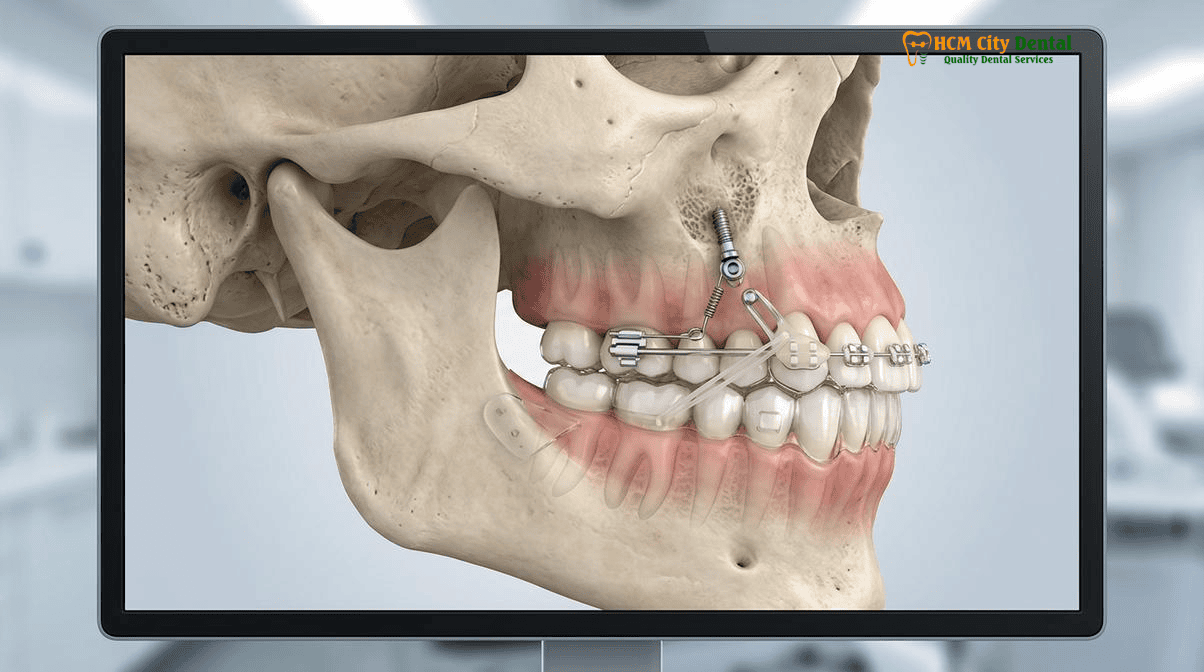
The ‘Sagittal First’ Philosophy with Carriere Motion 3D: Derotating Upper First Molars Around the Palatal Root into a Class I Platform in 3 to 5 Months
One of the most significant advancements in non-extraction Class II treatment is the ‘Sagittal First’ philosophy, popularized by the Carriere Motion 3D appliance. Traditional orthodontics often aligns the teeth first (leveling and aligning) before addressing the front-to-back (sagittal) bite discrepancy. The Sagittal First approach reverses this sequence: it corrects the Class II molar and canine relationship at the very beginning of treatment, transforming a complex Class II malocclusion into a simpler Class I case before clear aligners or braces are even applied.
The Carriere Motion 3D appliance consists of a sleek, rigid bar bonded to the maxillary canine and the maxillary first molar. The molar pad features a unique ball-and-socket joint. Heavy Class II intraoral elastics (typically 1/4 inch, 6 oz initially, progressing to 3/16 inch, 8 oz) are worn from a hook on the upper canine to a button or tube on the lower second molar. To prevent the lower teeth from shifting forward (anchorage loss), the patient wears a rigid lower Essix retainer or a passive lingual arch.
The biomechanical genius of the Carriere Motion 3D lies in its effect on the maxillary first molar. In a typical Class II malocclusion, the upper first molars are mesially rotated. The appliance applies a distal and distopalatal rotational force, causing the molar to derotate around its large, stable palatal root. As the molar derotates, it naturally moves distally by 2 to 3 millimeters, creating space in the arch. The entire buccal segment (canine, premolars, and molar) moves distally as a single unit. This rapid distalization and derotation establish a Class I molar and canine platform in just 3 to 5 months[1].
By achieving sagittal correction first, the subsequent phase of Invisalign Clear Aligners & 3D Digital Orthodontics at HCMC Dental Clinic is dramatically simplified. The aligners are no longer tasked with complex, time-consuming sequential distalization; instead, they focus purely on anterior alignment, leveling the Curve of Spee, and final detailing. This synergistic protocol can reduce overall treatment time by 4 to 6 months compared to traditional methods[2].
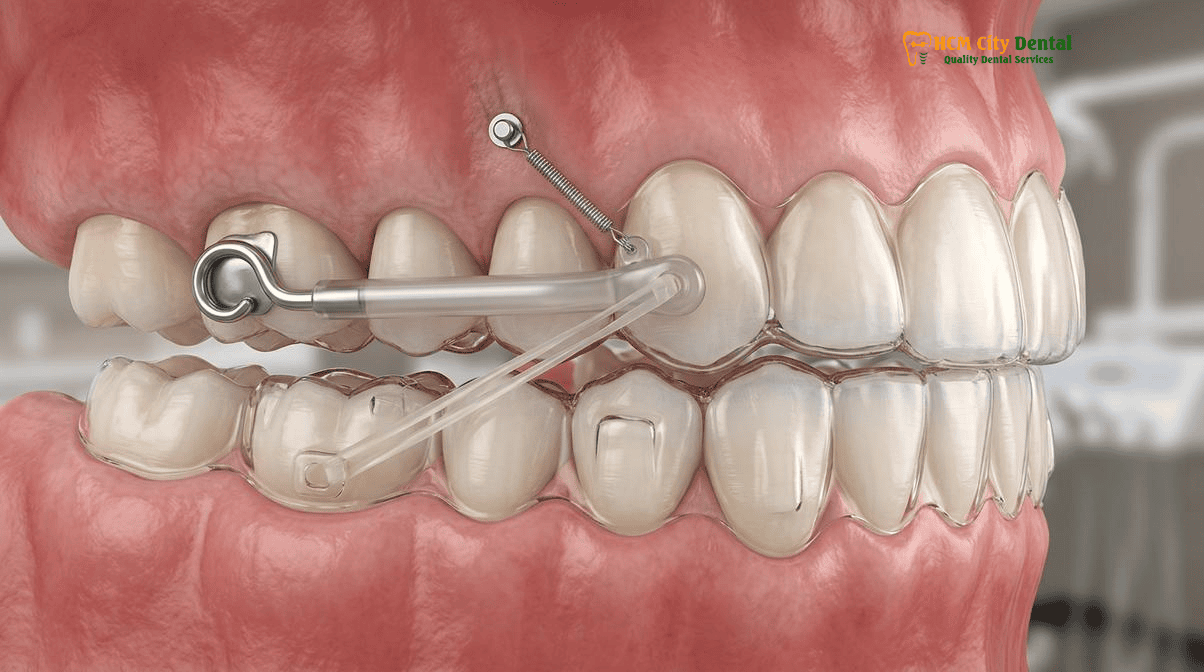
Growth Modification in Adolescents (CVM Stage 3–4): Invisalign Mandibular Advancement Precision Wings vs. Removable Twin Block Functional Appliances
When treating growing adolescents with mandibular retrognathia, the clinical objective shifts from dental camouflage to true orthopedic growth modification. The goal is to stimulate the growth of the mandibular condyle within the glenoid fossa, permanently advancing the lower jaw to correct the skeletal Class II discrepancy. This orthopedic intervention is highly time-sensitive and must coincide with the patient’s pubertal growth spurt, which is accurately identified using the Cervical Vertebral Maturation (CVM) method on a lateral cephalogram. The optimal window for mandibular advancement is during CVM Stages 3 and 4.
Historically, the Twin Block appliance—a bulky, removable acrylic device with interlocking bite blocks—was the gold standard for functional mandibular advancement. While effective, the Twin Block presents significant challenges: it severely impacts speech (causing a pronounced lisp), makes eating difficult, and relies entirely on patient compliance. Because it is uncomfortable and highly visible, many adolescents refuse to wear it at school, leading to compromised clinical outcomes.
Invisalign Mandibular Advancement with precision wings offers a revolutionary, patient-friendly alternative to the Twin Block. This system integrates specialized plastic wings on the buccal (cheek) surfaces of the upper and lower aligners. When the patient bites down, the wings interlock, forcing the mandible to posture forward into an edge-to-edge incisor relationship. This continuous forward posturing stretches the retrodiscal tissues of the temporomandibular joint (TMJ), stimulating endochondral ossification at the condylar head and remodeling the glenoid fossa.
The advantages of Invisalign Mandibular Advancement over the Twin Block are profound. The clear aligners are virtually invisible, highly comfortable, and do not significantly impair speech. Furthermore, because the aligners cover the entire dentition, they simultaneously level and align the teeth while the orthopedic jaw correction is taking place, streamlining the treatment process[3]. It is important to note that comprehensive pediatric orthodontics often involves Phase I interceptive care; for example, Phase I pediatric Rapid Palatal Expansion (RPE or Invisalign First at ages 7–10 prior to midpalatal suture fusion) combined with Leeway Space (E-Space) preservation can often prevent the need for true serial extraction and set the stage for successful Phase II mandibular advancement.
Clinical Case Study: Adolescent Class II Correction at HCMC Dental Clinic
Patient Profile: A 13-year-old male expatriate presented with a severe 9mm overjet, a 100% deep overbite, and a retrusive facial profile. Cephalometric analysis confirmed skeletal Class II due to mandibular retrognathia (CVM Stage 3).
Clinical Protocol: Dr. Cuong prescribed Invisalign Mandibular Advancement. The precision wings postured the mandible forward by 2mm per stage. Simultaneous leveling of the Curve of Spee was achieved using anterior bite ramps.
Outcome: After 14 months of compliant aligner wear, the overjet was reduced to an ideal 2mm, the deep bite was fully resolved, and the patient’s facial profile demonstrated significant forward projection of the chin (pogonion). The need for a bulky Twin Block or future orthognathic surgery was completely eliminated.
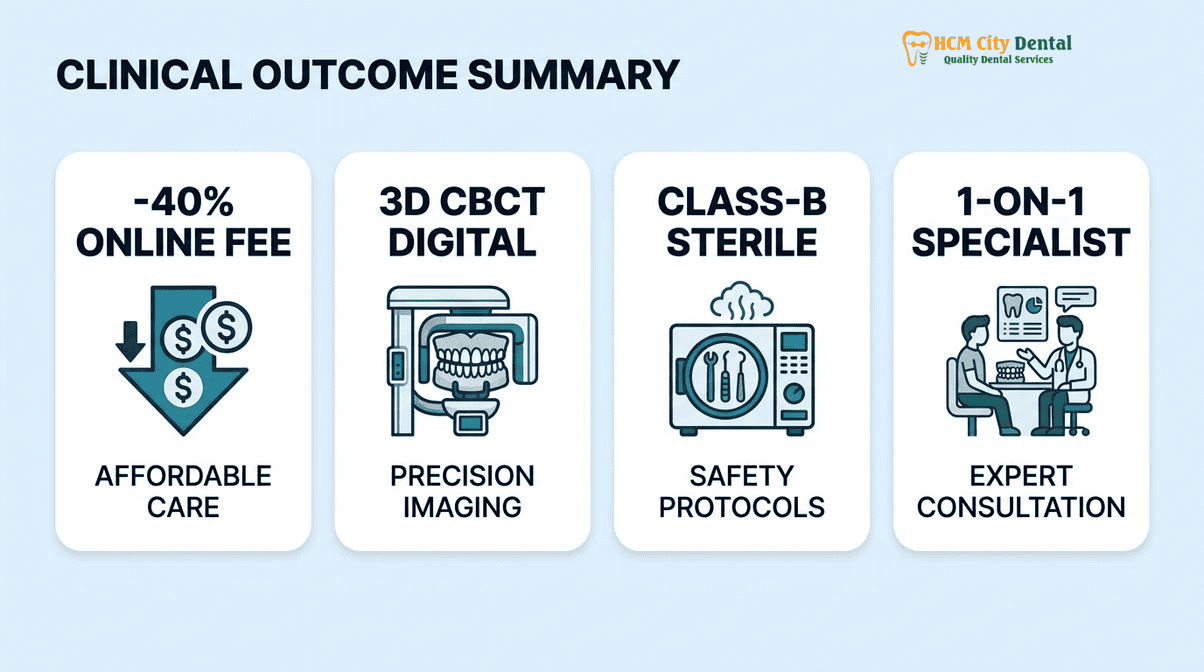
Adult Non-Extraction Class II Correction: Sequential Upper Arch Distalization with Invisalign + Infra-Zygomatic Crest (IZC) TADs
While growth modification is highly effective for adolescents, adult patients lack the growth potential necessary for true skeletal mandibular advancement. For adults presenting with a Class II overjet, the non-surgical, non-extraction solution relies on distalizing (pushing back) the entire maxillary dentition to camouflage the skeletal discrepancy and achieve a Class I occlusion.
Distalizing the upper arch with clear aligners alone requires a process called “sequential distalization.” The aligners move the second molars back first, followed by the first molars, then the premolars, and finally the anterior teeth. According to the Invisalign protocol, a V-pattern of distalization is employed, moving one tooth at a time by 0.25mm per stage. While effective for mild Class II cases (1 to 3mm of distalization), severe overjets require absolute skeletal anchorage to prevent the reciprocal flaring of the anterior teeth (anchorage loss).
To achieve massive, full-arch distalization in adults without premolar extraction, Dr. Cuong utilizes Infra-Zygomatic Crest (IZC) Temporary Anchorage Devices (TADs). The IZC is a dense pillar of cortical bone located above the maxillary first and second molars, at the base of the zygomatic arch. Because IZC TADs are placed extra-radicularly (outside the dental roots), they do not interfere with the backward movement of the teeth. Stainless steel or titanium mini-screws (typically 2.0mm x 12mm) are inserted into the IZC under local anesthesia. Elastic chains or nickel-titanium coil springs are then attached from the TADs to the aligners or a bonded attachment on the canine.
This biomechanical setup provides absolute skeletal anchorage, allowing the entire maxillary arch to be distalized en masse by up to 5 to 7 millimeters[4]. This technique is the direct counterpart to using extra-radicular Mandibular Buccal Shelf (MBS) TADs for non-surgical Class III underbite distalization (where Wits > -5mm). By utilizing IZC TADs for upper molar distalization, we can successfully resolve severe overbite and overjet orthodontic correction in Vietnam without the facial flattening associated with premolar extractions. (Note: Advanced 3D CBCT orthodontics also allows for the management of complex impactions; for instance, utilizing Ericson & Kurol 3D CBCT sector localization combined with closed-eruption 24k gold-chain cantilever traction at 60g force for impacted maxillary canines, ensuring comprehensive arch rehabilitation).
Simultaneous Deep Overbite Intrusion: Anterior Bite Ramps and Reverse-Curve Biomechanics to Level the Curve of Spee
Class II overjets are almost universally accompanied by a deep overbite, where the upper front teeth excessively overlap the lower front teeth vertically. A deep bite is typically caused by an exaggerated Curve of Spee in the mandibular arch (over-erupted lower incisors and under-erupted lower premolars) or over-erupted maxillary incisors. Correcting the sagittal overjet is impossible without simultaneously resolving the vertical deep bite, as the lower incisors will physically collide with the palatal surfaces of the upper incisors, preventing retraction.
Invisalign addresses deep overbites through the strategic use of Precision Bite Ramps. These are prominent, customized plastic ledges built into the lingual (palatal) surfaces of the upper anterior aligners. When the patient bites down, their lower incisors strike the bite ramps, physically disarticulating (separating) the posterior teeth. This posterior open bite removes occlusal forces from the premolars and molars, allowing the aligners to freely extrude the posterior teeth while simultaneously applying an intrusive force to the lower incisors.
In severe deep bite cases, advanced biomechanics are required. Dr. Cuong may employ reverse-curve biomechanics within the aligner staging, or utilize dual bucco-palatal TAD posterior molar intrusion. Interestingly, in cases of anterior open bite, 1mm of posterior molar intrusion results in 2–3mm of anterior open bite closure via counterclockwise mandibular autorotation; conversely, for deep bites, controlled posterior extrusion and anterior intrusion are meticulously planned in the ClinCheck software.
Furthermore, deep bites and Class II malocclusions are frequently associated with Temporomandibular Joint (TMJ) dysfunction. A retruded mandible can compress the retrodiscal tissues, leading to TMJ Disc Displacement with Reduction (ADDwR, characterized by clicking) or Without Reduction (ADDwoR, characterized by a closed lock <25mm). Before initiating complex orthodontic movements, patients with severe TMJ pathology or Idiopathic Condylar Resorption (ICR) may be stabilized on a Phase I CAD/CAM Michigan splint. Additionally, synergistic therapeutic Botulinum Toxin Type A (20–30U injected into the Masseter within the lower safety zone, plus 10–15U in the Temporalis) paired with a hard occlusal night guard can alleviate severe bruxism and myofascial pain during the orthodontic process.
Clinical Precaution: Elastic Wear and Anchorage Loss
The success of the Carriere Motion 3D appliance and Invisalign Mandibular Advancement relies heavily on strict patient compliance. Class II elastics must be worn 20 to 22 hours per day. Failure to wear elastics will halt distalization. Furthermore, if the lower anchorage protocol (Essix retainer or full aligner) is not strictly followed, the elastics will cause unwanted proclination (flaring) of the lower incisors, pushing them out of the alveolar bone housing and risking gingival recession. Always follow Dr. Cuong’s exact wear instructions.
2026 Class II Overjet Correction (Carriere Motion 3D, Invisalign Comprehensive & IZC TADs) Fee Schedule at HCMC Dental Clinic (District 1)
For international patients, expatriates, and dental travelers seeking world-class ‘Sagittal First’ Class II orthodontics in Ho Chi Minh City, HCMC Dental Clinic offers transparent, highly competitive pricing. By utilizing our Official 2026 Dental Price List & -40% Online Booking Fee Schedule, patients can access premium Align Technology products and advanced TAD biomechanics at a fraction of the cost in Australia, the US, or the UK, without compromising on clinical excellence or biomaterial safety[5].
| Orthodontic Treatment / Procedure | 2026 Online Booking Fee (USD) | 2026 Online Booking Fee (VND) | Standard Walk-In Price (USD) |
|---|---|---|---|
| Invisalign Comprehensive (Unlimited Aligners) Ideal for severe Class II overjet, deep bite, and sequential distalization. Includes up to 5 years of treatment. | $2,538 USD | 66,000,000 VND | $4,231 USD |
| Invisalign Go / Lite / Express Up to 14–20 aligners for mild relapse or minor anterior crowding. | $1,615 USD | 42,000,000 VND | $2,692 USD |
| Orthodontic TAD Mini-Screw (IZC / Buccal Shelf) Extra-radicular skeletal anchorage for full-arch distalization. | $77 – $115 USD / screw | 2,000,000 – 3,000,000 VND | $128 – $192 USD |
| Non-Surgical Adult MARPE / MSE Palatal Expander For correcting transverse maxillary deficiency prior to Class II correction. | $769 – $1,154 USD | 20,000,000 – 30,000,000 VND | $1,282 – $1,923 USD |
| Invisalign Vivera Retainer (Genuine SmartTrack) Set of 3 pairs of premium clear retainers for post-treatment stability. | $308 USD | 8,000,000 VND | $513 USD |
| Essix Clear Retainer | $97 USD / pair | 2,520,000 VND | $161 USD |
| Hawley Wire Retainer | $115 USD / pair | 3,000,000 VND | $192 USD |
| 3D CBCT Scan Essential for cephalometric analysis, airway volume assessment, and IZC TAD placement planning. | $18 USD | 480,000 VND | $30 USD |
“Transparency in clinical care extends to our fee structure. By offering Invisalign Comprehensive and advanced TAD biomechanics through our online booking system, we ensure that international patients receive elite-level orthodontic correction—utilizing the exact same SmartTrack materials and ClinCheck software used globally—at a highly accessible price point.”
— Dr. Nguyen Van Cuong, DDS
Frequently Asked Questions
Why does correcting a Class II overjet without extracting upper premolars preserve better nasolabial lip support and airway volume?
Extracting upper premolars to retract the anterior teeth often collapses the upper arch, flattening the upper lip, increasing the nasolabial angle, and potentially encroaching on the posterior airway space. Non-extraction protocols using Carriere Motion 3D or IZC TADs distalize the entire maxillary arch or advance the mandible, preserving facial convexity, optimizing Ricketts’ E-Line, and maintaining maximum airway volume.
How does the Carriere Motion 3D appliance shorten total Invisalign treatment time by 4 to 6 months?
The Carriere Motion 3D appliance employs a ‘Sagittal First’ philosophy. By utilizing heavy Class II elastics to derotate the upper first molars and distalize the posterior segments into a Class I platform before aligner therapy begins, it eliminates the need for complex, time-consuming sequential distalization with plastic alone. This reduces the subsequent Invisalign phase to primarily anterior alignment and detailing, saving 4 to 6 months.
What is the ideal skeletal age for Invisalign Mandibular Advancement with Precision Wings vs. adult IZC TAD distalization?
Invisalign Mandibular Advancement with Precision Wings is most effective during the pubertal growth spurt, specifically at Cervical Vertebral Maturation (CVM) stages 3 and 4 (typically ages 11 to 14). During this window, orthopedic growth modification of the condyle is possible. For adults whose skeletal growth is complete, mandibular advancement is not possible without orthognathic surgery; therefore, IZC TADs are used to distalize the upper arch to camouflage the skeletal discrepancy.
Will wearing Class II elastics flare my lower front teeth forward, and how do lower aligners or TADs prevent lower incisor proclination?
Class II elastics exert a mesial and extrusive force on the lower arch, which can cause unwanted lower incisor proclination (flaring). To prevent this anchorage loss, a rigid lower Essix retainer, a full-coverage lower Invisalign aligner, or a passive lingual arch is used to bind the lower teeth into a single anchorage unit. In severe cases, lower TADs can be utilized to provide absolute skeletal anchorage.
How much does Carriere Motion 3D combined with Invisalign Comprehensive cost at HCMC Dental Clinic in District 1?
At HCMC Dental Clinic, Invisalign Comprehensive (unlimited aligners for up to 5 years) is available for $2,538 USD via our -40% online booking fee schedule. The Carriere Motion 3D appliance and any necessary IZC TADs ($77 – $115 USD per screw) are integrated into a customized treatment plan. This represents a significant saving compared to Western clinics, while maintaining strict international clinical standards.
For patients comparing 2026 Invisalign Comprehensive package pricing in Vietnam or evaluating Damon passive self-ligating braces alongside Carriere Motion 3D sagittal correction, our orthodontic team in District 1 provides a complete 3D ClinCheck simulation on Visit 1.
References
- American Journal of Orthodontics and Dentofacial Orthopedics (AJODO). Biomechanical effects of the Carriere Motion 3D appliance for Class II correction: A 3D finite element analysis. (2021).
- Journal of Clinical Orthodontics (JCO). Sagittal First: Class II correction with the Carriere Motion Appliance followed by clear aligners. (2019).
- Angle Orthodontist. Skeletal and dentoalveolar effects of Invisalign Mandibular Advancement vs. Twin Block functional appliances in growing patients. (2022).
- International Journal of Oral & Maxillofacial Implants (JOMI). Extra-radicular infra-zygomatic crest (IZC) mini-screws for maxillary full-arch distalization in adult Class II malocclusions. (2023).
- Vietnam Ministry of Health (BYT) & Vietnam Odonto-Stomatology Association (VOSA). National Clinical Guidelines on Specialist Dental Care, Biomaterial Traceability & EN 13060 Class B Infection Control. (2024).