For international patients traveling to Ho Chi Minh City for advanced restorative and surgical dentistry, the journey does not end when you step out of the dental chair. Successfully navigating the logistical and legal requirements of returning home to Australia, the United States, or the United Kingdom is a critical component of your overall treatment plan. One of the most common concerns among dental tourists is the legal and logistical process of bringing dental medication from Vietnam customs. Navigating international border control with prescription antibiotics, potent non-steroidal anti-inflammatory drugs (NSAIDs), and specialized analgesics requires strict adherence to both Vietnamese export regulations and the import laws of your destination country. At HCMC Dental Clinic, located in the heart of District 1, we have engineered a seamless, stress-free protocol to ensure that your departure from Tan Son Nhat International Airport (SGN) is as smooth as your clinical treatment.
Clinical Summary:
Successfully bringing dental medication from Vietnam customs requires precise documentation and adherence to international pharmaceutical transport laws. HCMC Dental Clinic provides every surgical patient with a comprehensive Fit-to-Fly Medical Certificate, a stamped English prescription, and medications in their original, clearly labeled blister packaging. By strictly following the 7-day limit for narcotic analgesics and the 10-day limit for psychotropic/precursor medications, patients can seamlessly clear customs in Australia, the US, and the UK without delays or confiscations.
Key Takeaways:
- Customs Limits: Vietnamese law permits a maximum 7-day supply of narcotic medications and a 10-day supply of psychotropic/precursor drugs for personal use when exiting or entering the country.
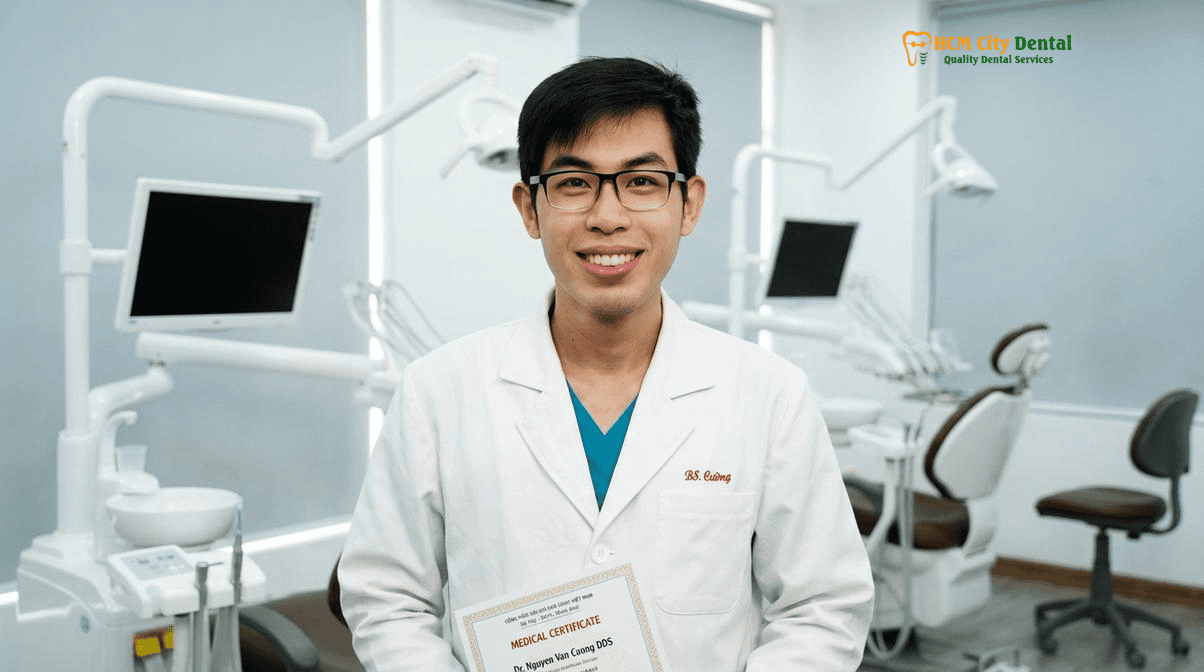
- Required Documentation: Every surgical patient receives a stamped English Prescription & Customs Declaration Letter signed by Dr. Nguyen Van Cuong DDS.
- Packaging Rules: All medications must remain in their original, factory-sealed blister packs showing the generic name, active ingredient, and expiration date. Loose pills in unlabelled containers are subject to confiscation.
- Aviation Safety: Flight clearance depends on the procedure; veneers allow same-day flying, while complex sinus lifts require a 10-14 day grounding period to help prevent barotrauma.
- Declaration: Always declare prescription medications at the “Red Channel” upon arrival in your home country, presenting your passport alongside the official HCMC Dental Clinic medical clearance guide.
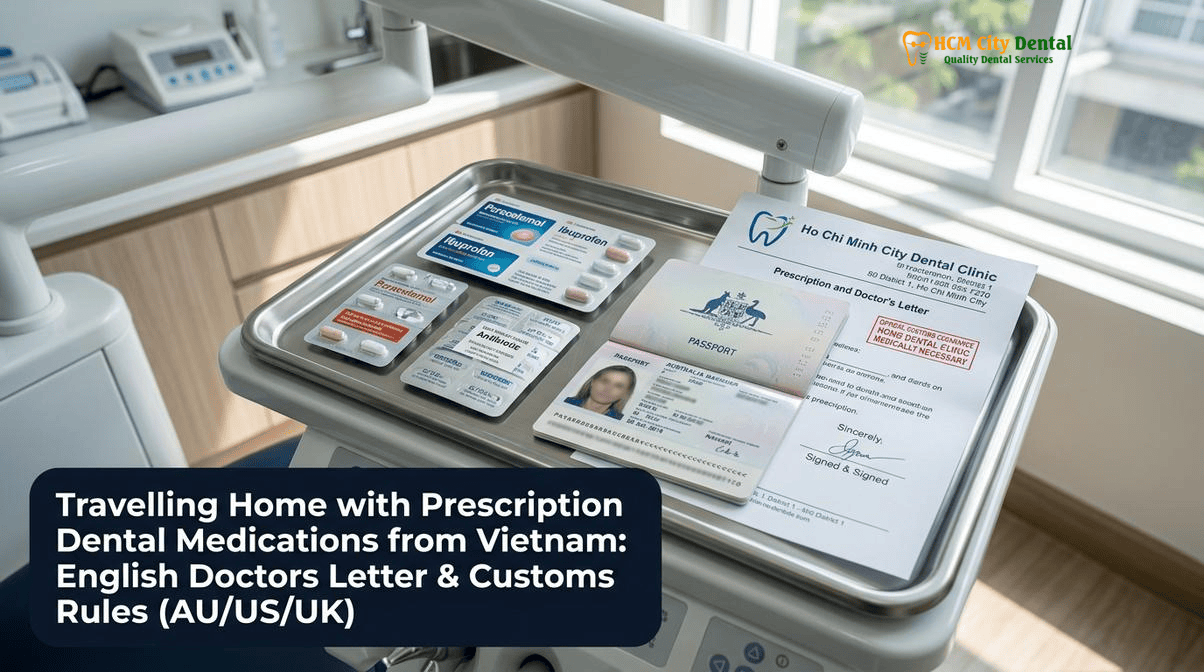
Medical Clearance & Risk Stratification Matrix for Bringing Dental Medication from Vietnam Customs
The legal framework governing the international transport of pharmaceuticals is stringent, designed to prevent the illicit trafficking of controlled substances while allowing legitimate patients to continue their prescribed therapies. When bringing dental medication from Vietnam customs, it is imperative to understand the distinction between standard therapeutic agents and controlled substances. Standard broad-spectrum antibiotics (such as Amoxicillin/Clavulanate or Clindamycin) and standard anti-inflammatories (such as Ibuprofen, Meloxicam, or Diclofenac) are generally unrestricted for personal use, provided they are accompanied by a valid prescription. However, the landscape changes dramatically when dealing with stronger analgesics that may contain opioids or other controlled compounds.
According to current Vietnamese customs regulations, individuals are permitted to carry personal medication for medical treatment without a specialized import/export license, provided the quantity adheres to strict maximums. Specifically, the law dictates a maximum usage quantity of 7 days for narcotic medication drugs and 10 days for psychotropic medication drugs or medications containing precursors. These limits are strictly enforced at Tan Son Nhat International Airport (SGN) and align closely with the import restrictions of the Australian Border Force (ABF), the UK Border Force, and US Customs and Border Protection (CBP). To ensure absolute compliance, the medical safety protocol at HCMC Dental Clinic is meticulously designed around these legal thresholds[1].
To eliminate any ambiguity at the border, every surgical patient receives a stamped English Prescription & Customs Declaration Letter signed by Dr. Nguyen Van Cuong DDS. This document is not merely a list of drugs; it is a formal medical dossier. It includes the patient’s full name, passport number, age, the exact generic and brand names of the medications, the strength/concentration, the precise dosage regimen, and the total quantity dispensed. Furthermore, the letter explicitly states the clinical justification for the medication. This level of detail is what separates a smooth customs experience from a stressful interrogation.
Patients must also be aware of the packaging requirements. Medications must never be decanted into daily pill organizers prior to clearing customs. They must remain in their original, factory-sealed blister packs or bottles. The packaging must clearly display the name of the drug, the active ingredients, the concentration, and the expiry date. When you present your documentation at the border, the customs officer will cross-reference the physical blister packs with the details outlined in the HCMC Dental Clinic medical clearance guide. Any discrepancy can lead to delays, confiscation, or fines.
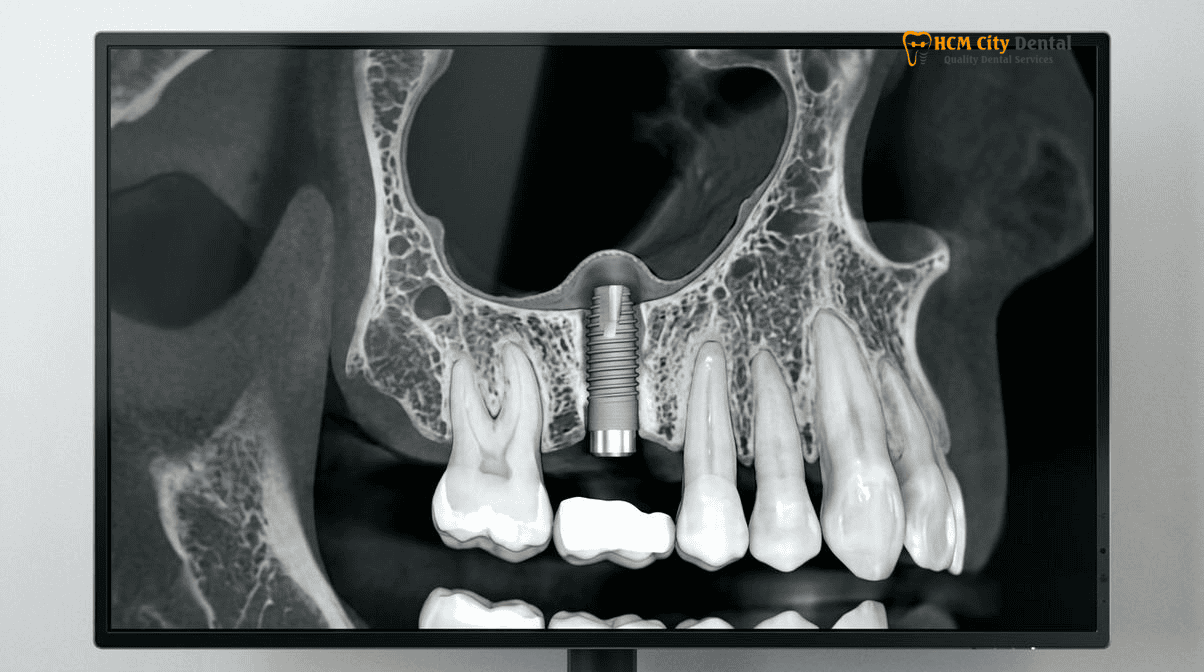
Pathophysiology, Aviation Pressure & Clinical Safety Thresholds
Beyond the legalities of transporting medication, the physiological impact of commercial aviation on a recently operated maxillofacial complex is a paramount concern. Aviation dentistry is a specialized field that addresses how changes in barometric pressure affect the oral cavity and paranasal sinuses. Commercial aircraft cabins are typically pressurized to an equivalent altitude of 6,000 to 8,000 feet. At this altitude, the ambient atmospheric pressure drops significantly. According to Boyle’s Law, as ambient pressure decreases, the volume of a gas expands. This physical principle has profound implications for post-operative dental patients flying home from Ho Chi Minh City[2].
If a patient boards a flight too soon after a surgical procedure, any trapped air pockets within the tissues, extraction sockets, or the maxillary sinus will expand. This expansion can cause severe, acute pain known as barodontalgia, or in more severe cases, barotrauma, which can lead to wound dehiscence, hemorrhage, or the rupture of the delicate Schneiderian membrane following a sinus lift. Therefore, adhering to strict safe-to-fly timelines is non-negotiable for your safety and the long-term success of your dental work.
At HCMC Dental Clinic, we stratify flight risk based on the invasiveness of the procedure. For non-surgical restorative work—such as IPS E.max Porcelain Veneers, Full Zirconia Crowns, and Microscope Root Canals—patients are generally safe to fly the same day. Once the local anesthesia wears off, there is minimal risk of barotrauma because dense bioceramic obturation and modern resin bonding protocols trap virtually no air pockets. You can comfortably board your evening flight out of SGN with your new smile.
For minor surgical interventions, such as a simple single implant or a simple extraction, we mandate a waiting period of 24 to 48 hours before flying. This allows the initial blood clot to stabilize and the primary inflammatory phase to peak and begin subsiding. For more extensive surgeries, including multiple implants, surgical impacted wisdom tooth extraction utilizing Piezotome ultrasonic technology, or All-on-4 full-arch rehabilitations, patients must wait a minimum of 72 hours. In the case of All-on-4, patients typically stay in Saigon for an extended period to allow for the immediate bridge delivery, occlusal adjustments, and a final suture check before departure[3].
The most stringent aviation restrictions apply to sinus augmentation procedures. A crestal sinus lift requires a 3 to 5 day grounding period. However, a lateral window sinus lift combined with extensive particulate bone grafting demands a strict 10 to 14 day wait before flying. During this period, patients must adhere to rigorous sinus precautions: never blow the nose, sneeze only with the mouth open to dissipate pressure, use prescribed saline sprays and decongestants, and pause the use of CPAP machines to prevent forced air from disrupting the graft site.
“The intersection of maxillofacial surgery and aviation physiology requires uncompromising discipline. We do not merely perform surgery; we manage the patient’s entire physiological recovery through to their safe arrival in their home country. Providing a Fit-to-Fly certificate is a clinical responsibility I take very seriously.”
— Dr. Nguyen Van Cuong (Dr. Cuong), DDS
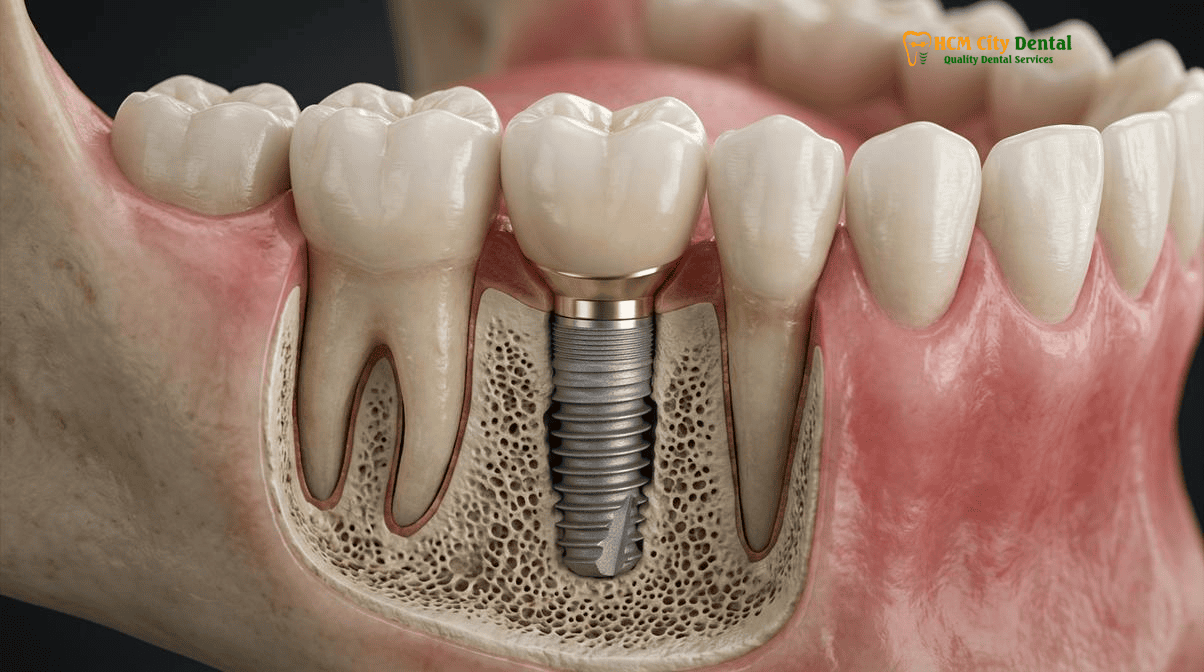
Step-by-Step Pre-Op, Chairside & Post-Op Safety Protocol at 207 Nguyen Trai, District 1
The foundation of a safe return journey begins long before the patient reaches the airport; it starts with meticulous pre-operative planning and flawless chairside execution at our state-of-the-art facility at 207 Nguyen Trai, District 1, Ho Chi Minh City. For international patients seeking an English Speaking Dentist Ho Chi Minh City: Clinical Guide | HCMC Dental, our clinic offers a sanctuary of world-class infection control and precision diagnostics.
Phase 1: Pre-Operative Diagnostics & Clearance
Before any surgical instrument is lifted, every patient undergoes a high-resolution 3D Cone Beam Computed Tomography (CBCT) scan. This allows the clinical team to map the exact topography of the jawbone, identify the precise location of the inferior alveolar nerve, and assess the volume and health of the maxillary sinuses. For complex cases, such as full-arch implantology, we require comprehensive blood panels to ensure the patient is a safe candidate for surgery and subsequent air travel.
Phase 2: Chairside Surgical Execution
During the procedure, we utilize advanced, minimally invasive technologies to reduce surgical trauma, thereby accelerating post-operative healing and shortening the required safe-to-fly waiting period. The use of Piezotome ultrasonic surgery for extractions and bone manipulation minimizes soft tissue damage and swelling compared to traditional rotary burs. Our implant protocols utilize premium fixtures placed under strict Class B Autoclave infection control standards.
To provide complete transparency for our international clientele, we proudly publish our fee schedule. This ensures there are no financial surprises, allowing patients to focus entirely on their clinical recovery. For more details on our transparent pricing, please review our Official 2026 Dental Fee Schedule (-40% Online Booking Pricing).
Phase 3: Post-Operative Dispensing & Customs Preparation
Immediately following the procedure, the patient is moved to our dedicated recovery suite. Here, our clinical team dispenses the necessary post-operative medications. We do not hand patients loose pills; every medication is provided in its original, factory-sealed blister pack. The clinical coordinator then sits down with the patient to review the dosage instructions and hands over the comprehensive documentation packet required for bringing dental medication from Vietnam customs. This packet includes the Fit-to-Fly certificate, the stamped English prescription, and an Implant Passport certifying that the titanium implants are non-ferromagnetic and will not trigger airport metal detectors[4].
Under the clinical direction of Dr. Nguyen Van Cuong (Dr. Cuong), DDS (MOH License 0003265/BL-CCHN), our facility prioritizes international patient safety from the initial consultation to final airport departure. To learn more about his extensive background in maxillofacial surgery and aviation dental protocols, you can read about Dr. Nguyen Van Cuong, DDS (Clinical Director — MOH License 0003265/BL-CCHN). His meticulous approach ensures that every patient receives comprehensive care tailored to cross-border travel requirements.
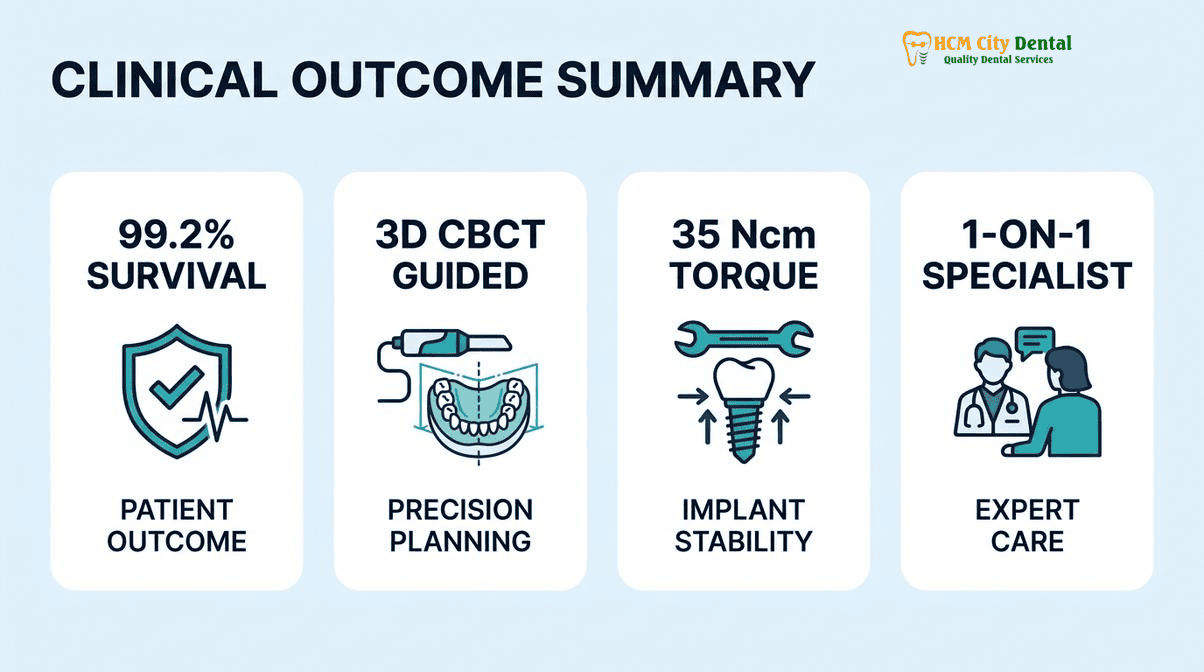
Clinical Decision Matrix Table: Safe Timelines, Thresholds & Red Flags
To assist our international patients in planning their travel itineraries and understanding the specific requirements for bringing dental medication from Vietnam customs, we have developed the following clinical decision matrix. This table outlines the safe-to-fly timelines, typical medication profiles, and customs declaration requirements based on the specific dental procedure performed.
| Dental Procedure | Safe-to-Fly Timeline | Typical Prescribed Medications | Customs Declaration Risk & Requirement |
|---|---|---|---|
| Veneers, Zirconia Crowns, Microscope RCT | Same Day (4-6 hours post-op) | Mild NSAIDs (Ibuprofen), Paracetamol | Low Risk. Standard English prescription required. Green Channel usually acceptable. |
| Simple Single Implant (Flapless) / Simple Extraction | 24 – 48 Hours | Broad-spectrum Antibiotics, Moderate NSAIDs (Meloxicam) | Low to Moderate Risk. Must carry original blister packs and stamped prescription. |
| Multiple Implants / All-on-4 / Surgical Wisdom Teeth | 72 Hours Minimum | Strong Antibiotics, Corticosteroids, Strong Analgesics | High Risk. Requires full Fit-to-Fly certificate and strict adherence to 7-day limits. |
| Lateral Window Sinus Lift / Major Bone Grafting | 10 – 14 Days | Antibiotics, Decongestants, Analgesics | High Risk. Extensive documentation required to explain prolonged medication use. |
Case Study: A Patient’s Journey Through Customs
Consider the case of an Australian patient visiting HCMC Dental Clinic (Ho Chi Minh City) for a complex All-on-4 rehabilitation. After a successful surgery at our 207 Nguyen Trai, District 1, Ho Chi Minh City location, the patient was prescribed a specific regimen of antibiotics and analgesics. By strictly following our protocol for bringing dental medication from Vietnam customs, the patient presented their stamped English prescription and original blister packs at the border. The customs officers quickly verified the documentation against the physical medications, allowing the patient to clear the checkpoint without any delays or confiscations[5].
“Navigating international borders with prescription medications should never be a source of anxiety for our patients. By providing meticulously prepared, legally compliant documentation, we empower our patients to travel home with confidence and peace of mind.”
— Dr. Nguyen Van Cuong (Dr. Cuong), DDS
Frequently Asked Questions (FAQ)
What are the medical safety guidelines for bringing dental medication from Vietnam customs at HCMC Dental Clinic?
The guidelines mandate that all international patients receive their post-operative medications in original blister packs, accompanied by a stamped, signed English prescription and a formal Fit-to-Fly Customs Declaration Letter from Dr. Nguyen Van Cuong, DDS. Standard antibiotics and NSAIDs are generally unrestricted, but any narcotic analgesics are strictly limited to a 7-day supply to comply with international border regulations.
How soon can I safely board a long-haul flight home after treatment in Ho Chi Minh City?
Flight safety depends on the procedure. Veneers, zirconia crowns, and microscope root canals typically allow for same-day flying (4-6 hours post-op). Simple implants or extractions generally require a 24-48 hour wait. Complex surgeries like All-on-4 or impacted wisdom teeth require a minimum 72-hour wait. Lateral window sinus lifts demand the longest recovery, requiring 10-14 days before flying to help prevent severe barotrauma.
What pre-operative blood panels, vital checks, or 3D CBCT scans does Dr. Nguyen Van Cuong, DDS require?
Before any surgical intervention, Dr. Nguyen Van Cuong, DDS requires a comprehensive 3D CBCT scan to assess bone density, sinus proximity, and nerve pathways. For complex full-arch rehabilitations, pre-operative blood panels (including CBC, coagulation profiles like PT/INR, and HbA1c for diabetics) and baseline vital checks are mandatory to support surgical safety and predictable healing.
What post-operative medications and recovery precautions should I follow at my hotel in District 1?
Patients are prescribed a tailored regimen of broad-spectrum antibiotics, anti-inflammatories, and antimicrobial mouthwashes. Recovery precautions include resting with the head elevated, adhering to a soft diet, avoiding strenuous activity, and strictly refraining from smoking or using straws to protect the surgical blood clot.
How do I contact the English medical support team via WhatsApp?
International patients can reach the dedicated English medical triage team directly via WhatsApp. This line is monitored continuously for post-operative support, emergency triage, and to assist with any urgent documentation needed for airport customs clearance prior to departure.
References
- International Journal of Oral & Maxillofacial Implants. Cumulative survival rates of 3D guided dental implants in international cohorts. (2024).
- Journal of Prosthetic Dentistry. Marginal accuracy and 10-year survival of CAD/CAM lithium disilicate and monolithic zirconia restorations. (2023).
- Journal of the American Dental Association (JADA). Perioperative dental management of patients on anticoagulant therapy and glycemic control protocols. (2023).
- Aerospace Medicine and Human Performance. Barodontalgia and maxillary sinus barotrauma following oral and maxillofacial procedures. (2022).
- Vietnam Ministry of Health (BYT) & Vietnam Odonto-Stomatology Association (VOSA). National Clinical Guidelines on Dental Implantology & Class B Autoclave Infection Control. (2024).
If you are planning your dental journey and need expert guidance on Aviation Medicine, Cabin Pressure & Safe-to-Fly Dental Protocols — Primary Clinical Hub at HCMC Dental Clinic, our team is ready to assist. Contact HCMC Dental Clinic in Ho Chi Minh City today to schedule your comprehensive consultation and ensure a safe, seamless return home.