

When parents notice their child’s permanent front teeth erupting in a severely crowded, overlapping, or rotated pattern, the immediate clinical question often centers on space management. Historically, the standard orthodontic protocol for severe crowding involved waiting until all permanent teeth had erupted (around age 12 to 14) and then extracting four healthy premolars to create room. Today, the paradigm of dentofacial orthopedics has shifted dramatically toward early intervention. The clinical debate of pediatric serial extraction vs palatal expander crowded teeth children represents a critical crossroads in pediatric dental care. By evaluating a child between the ages of 7 and 10, specialists can utilize the unfused midpalatal suture to orthopedically widen the upper jaw, preserving vital airway volume and eliminating the need for irreversible tooth extractions in the vast majority of cases.
At HCMC Dental Clinic in District 1, Ho Chi Minh City, our digital 3D CBCT orthodontic and occlusal reconstruction protocol is led by Dr. Nguyen Van Cuong, DDS (Clinical Director — MOH License 0003265/BL-CCHN). Utilizing advanced diagnostics, we meticulously evaluate the transverse skeletal width, the biological envelope of the alveolar bone, and the developing pediatric airway. Whether deploying a rapid palatal expander (RPE), utilizing Invisalign First clear aligners, or preserving natural leeway space with a lingual holding arch, our goal is to guide facial growth proactively. This comprehensive guide explores the biomechanics, clinical indications, and long-term benefits of Phase I interceptive orthodontics compared to traditional serial extraction protocols.
Clinical Summary:
The management of severe pediatric dental crowding hinges on the timing of intervention. Phase I interceptive orthodontics (ages 7–10) capitalizes on the unfused midpalatal suture, utilizing Rapid Palatal Expanders (RPE) or Invisalign First to orthopedically widen the maxilla and increase arch perimeter, thereby preventing the need for permanent premolar extractions. Furthermore, preserving the natural “Leeway Space” during the transition from primary to permanent dentition can yield up to 4.6mm of space in the lower arch. Conversely, true serial extraction (the C-D-4 sequence) remains a valid but strictly reserved protocol for patients presenting with severe tooth-arch discrepancies (>10mm) combined with a thin labial gingival biotype, where expansion would push roots outside the biological envelope of bone. Early 3D CBCT evaluation is critical to determining the optimal biomechanical pathway.
Key Takeaways:
- The Age 7 Window: The American Association of Orthodontists (AAO) recommends screening by age 7 because the midpalatal suture is highly responsive to orthopedic expansion before it begins to interlock and fuse.
- Arch Perimeter Gains: Every 1mm of transverse palatal expansion yields approximately 0.7mm of additional arch perimeter, creating vital space for erupting permanent incisors and canines.
- Leeway Space Preservation: Utilizing a Lower Lingual Holding Arch (LLHA) or Nance appliance before the primary second molars exfoliate can save up to 4.6mm of natural space in the lower jaw.
- Airway Benefits: Because the roof of the mouth is the floor of the nasal cavity, maxillary expansion significantly increases nasal airway volume, reducing mouth breathing and pediatric sleep-disordered breathing.
- Extraction Indications: Serial extraction is rarely used today but remains indicated for severe crowding (>10mm) in patients with thin periodontal biotypes where expansion risks bone dehiscence and gingival recession.
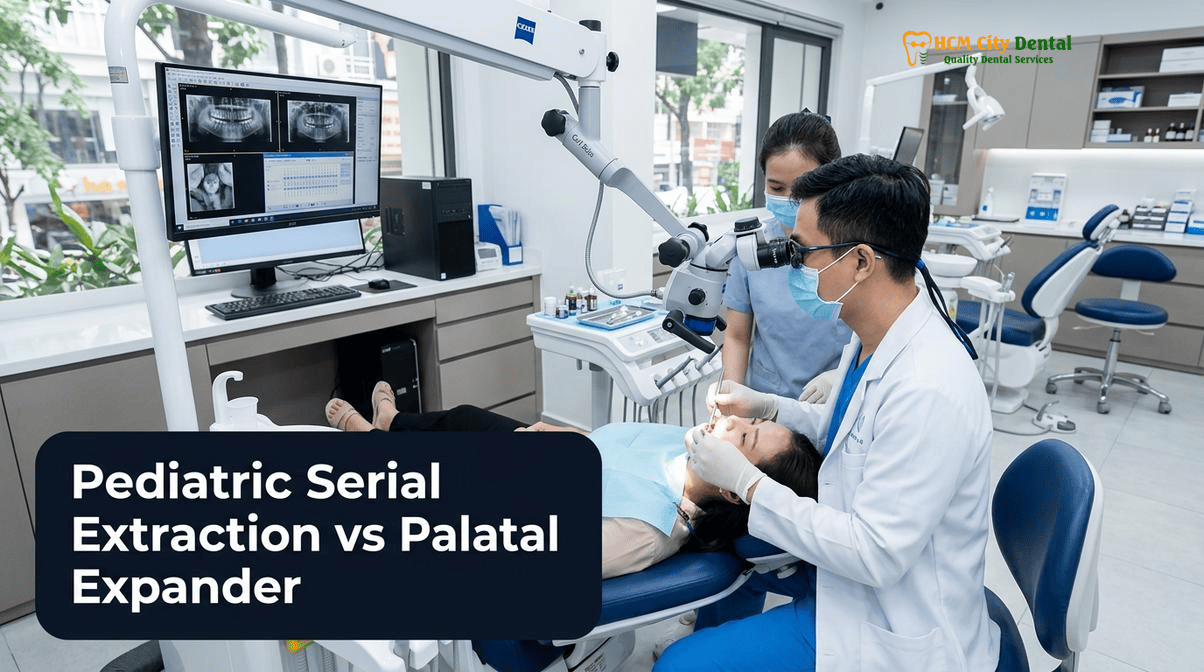
Why the AAO Recommends an Orthodontic Screening by Age 7: Capitalizing on the Unfused Midpalatal Suture in Mixed Dentition
The human maxilla (upper jaw) is not a single solid bone; it is composed of two halves joined in the center by the midpalatal suture. During early childhood, this suture is composed of highly cellular, vascular fibrous connective tissue. It acts as a primary growth site, allowing the face to widen naturally as the child develops. The American Association of Orthodontists (AAO) strongly advocates for an initial orthodontic evaluation by age 7 because this marks the beginning of the mixed dentition phase—when the first permanent molars have erupted to establish the posterior bite, and the permanent incisors are beginning to emerge.
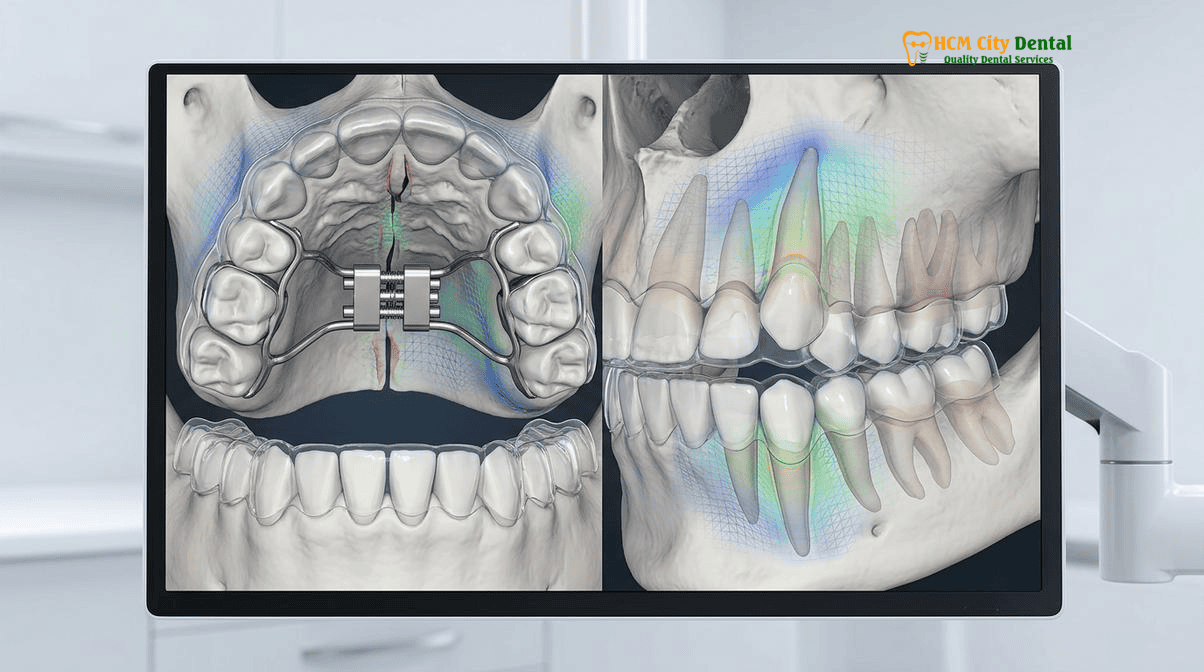
More importantly, between the ages of 7 and 10, the midpalatal suture remains patent (unfused) and offers minimal resistance to lateral orthopedic forces. This biological window is the cornerstone of phase 1 interceptive orthodontics palatal expander age 7 to 10. If a specialist identifies a transverse skeletal deficiency (a narrow upper jaw, often presenting as a posterior crossbite or severe anterior crowding), applying a gentle, controlled lateral force can easily separate the two halves of the maxilla. In response to this tension, osteoblasts rapidly deposit new bone within the widened suture, permanently increasing the skeletal width of the upper jaw.
“The biological advantage of early intervention cannot be overstated. By expanding the maxilla at age 8, we are not merely tipping teeth outward; we are orthopedically remodeling the basal bone. This skeletal expansion creates the necessary arch perimeter to accommodate the larger permanent teeth, effectively eliminating the space deficiency that would otherwise necessitate premolar extractions in adolescence.”
— Dr. Nguyen Van Cuong, DDS
If this transverse deficiency is ignored until the child reaches 13 or 14 years of age, the midpalatal suture begins to heavily interdigitate and fuse. Attempting expansion at this later stage often results in dentoalveolar tipping (pushing the teeth through the buccal bone) rather than true skeletal expansion, increasing the risk of gingival recession and unstable results. For older teens and adults, achieving true skeletal expansion requires advanced, minimally invasive procedures such as non-surgical adult MARPE / MSE (Miniscrew-Assisted Rapid Palatal Expansion) utilizing orthodontic TAD mini-screws, or even surgically assisted rapid palatal expansion (SARPE)[1]. By intervening early, we bypass these complex requirements entirely.
Rapid Palatal Expansion (RPE / Haas / Hyrax) & Invisalign First: Gaining 4mm–6mm of Arch Perimeter to Eliminate Future Permanent Premolar Extractions
When evaluating the clinical efficacy of a rapid palatal expander RPE vs serial extraction crowded teeth, the primary objective is space creation. Dental crowding is fundamentally a mathematical problem: the cumulative mesiodistal width of the permanent teeth exceeds the available perimeter of the alveolar bone. To resolve this, the clinician must either increase the arch perimeter (expansion) or decrease the tooth mass (extraction).
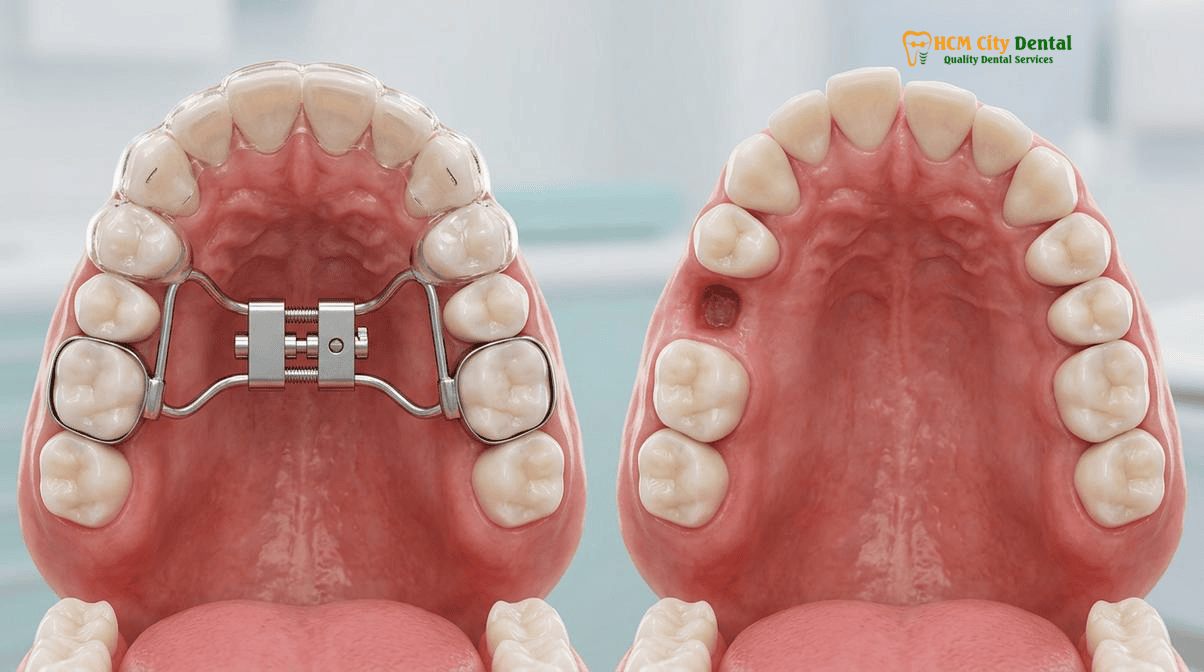
The Rapid Palatal Expander (RPE), available in various designs such as the tooth-borne Hyrax or the tissue-and-tooth-borne Haas appliance, is the gold standard for skeletal expansion in children. The appliance is custom-fabricated and cemented to the primary second molars or permanent first molars. It features a central jackscrew that the parent turns once or twice a day (typically 0.25mm per turn). This rapid activation protocol delivers heavy orthopedic forces that overwhelm the periodontal ligament, transferring the force directly to the midpalatal suture. The suture opens, often creating a temporary diastema (gap) between the upper central incisors—a positive clinical sign that true skeletal separation has occurred.
From a biomechanical standpoint, every 1 millimeter of transverse posterior expansion yields approximately 0.7 millimeters of additional arch perimeter. Therefore, a standard expansion protocol of 6mm to 8mm can generate 4mm to 6mm of new space within the dental arch. This newly created space allows crowded, rotated, or ectopically erupting incisors and canines to align naturally within the biological envelope of the bone.
In recent years, the advent of Invisalign first clear aligners for children Vietnam has revolutionized Phase I treatment for mild to moderate crowding. While a fixed RPE is required for severe skeletal crossbites, Invisalign First utilizes proprietary SmartForce features and optimized expansion attachments to achieve highly predictable dentoalveolar expansion. The clear aligners gently upright lingually inclined posterior teeth, broadening the smile arc and creating space for erupting incisors without the dietary restrictions or speech impediments associated with bulky metal expanders. Furthermore, Invisalign First can be engineered with Mandibular Advancement Precision Wings to simultaneously correct Class II retrognathic profiles, guiding the lower jaw forward during the peak growth spurt[2].
Preserving ‘Leeway Space’ (E-Space = 1.7mm Upper / 2.3mm Lower per Side): How Simple Lingual Holding Arches Resolve Moderate Incisor Crowding Naturally
While palatal expansion addresses the width of the upper jaw, managing the length of the dental arches—particularly the lower jaw, which cannot be orthopedically expanded due to the fused mandibular symphysis—relies on a critical biological phenomenon known as “Leeway Space.” Understanding and preserving leeway space nance holding arch lower lingual holding arch is one of the most elegant and conservative strategies in pediatric orthodontics.
Leeway space refers to the size differential between the posterior primary teeth (the primary canine, first molar, and second molar—often designated as C, D, and E) and the permanent teeth that replace them (the permanent canine, first premolar, and second premolar—designated as 3, 4, and 5). In human dental anatomy, the primary molars (especially the primary second molar, or “E”) are significantly wider mesiodistally than the permanent premolars that succeed them. On average, this size difference provides 1.7mm of extra space per side in the upper arch and a substantial 2.3mm of extra space per side in the lower arch.
Normally, when the primary second molars fall out, the permanent first molars rapidly drift forward (a process called the late mesial shift) to close this extra space. However, if a child presents with moderate lower incisor crowding, allowing the molars to drift forward wastes this precious space. By intervening at the precise moment before the primary second molars exfoliate, an orthodontist can place a passive space maintainer to hold the permanent molars back.
Clinical Application: The Lower Lingual Holding Arch (LLHA)
Consider a 9-year-old patient presenting with 4mm of lower anterior crowding. The permanent first molars are erupted, and the primary second molars (E’s) are becoming mobile. Dr. Cuong places a Lower Lingual Holding Arch—a custom-fitted heavy stainless steel wire that bands around the permanent first molars and rests passively against the lingual surfaces of the lower incisors. When the primary molars fall out, the LLHA physically prevents the permanent molars from drifting forward. The 4.6mm of preserved E-Space is then utilized to unravel the crowded lower incisors naturally, completely avoiding the need for lower premolar extractions.
In the upper arch, a Nance holding arch (which utilizes an acrylic button resting on the anterior palate) or a Transpalatal Arch (TPA) serves the same function. By combining maxillary palatal expansion with mandibular leeway space preservation, the vast majority of pediatric crowding cases can be resolved non-extraction, ensuring a full, broad smile and optimal facial aesthetics[3].
When True Serial Extraction (C -> D -> 4 Sequence) Is Still Clinically Indicated: Severe >10mm Tooth-Arch Discrepancy with Thin Labial Gingival Biotype
Despite the overwhelming preference for expansion and space preservation in modern orthodontics, there are specific, rare clinical scenarios where attempting to expand the arches is biologically contraindicated. In these cases, guided serial extraction remains a highly effective and necessary protocol. Serial extraction is a carefully timed sequence of tooth removals designed to guide erupting permanent teeth into proper alignment when the jaw is fundamentally too small to accommodate them, and orthopedic expansion is not viable.
The classic indication for serial extraction is a severe tooth-arch discrepancy (typically greater than 10mm of crowding per arch) in a patient who already possesses a normal or wide skeletal base, but whose teeth are simply too large (macrodontia). Furthermore, the patient’s periodontal phenotype plays a critical role. If a child has a thin labial gingival biotype, attempting to expand the dental arches by 10mm will push the roots of the teeth outside the biological envelope of the alveolar bone. This aggressive expansion leads to severe iatrogenic consequences, including bone dehiscence, fenestration, and irreversible gingival recession.
The traditional serial extraction protocol follows the “C-D-4” sequence:
- Extraction of Primary Canines (C’s): Around age 8 or 9, the primary canines are extracted to provide immediate space for the severely crowded permanent incisors to unravel and align spontaneously.
- Extraction of Primary First Molars (D’s): A year later, the primary first molars are extracted to accelerate the eruption of the permanent first premolars.
- Extraction of Permanent First Premolars (4’s): As soon as the permanent first premolars erupt, they are extracted. This final step creates the necessary space for the permanent canines (which erupt later) to drop perfectly into the dental arch.
By carefully managing this sequence, the teeth align themselves naturally over several years, minimizing the duration of comprehensive fixed braces later in adolescence. It is crucial to note that serial extraction requires meticulous 3D CBCT monitoring to ensure proper eruption trajectories.
Advanced Orthodontic Biomechanics & Wave 4B Protocols
While pediatric serial extraction focuses on guiding eruption, adult extraction mechanics require absolute anchorage control. At HCMC Dental Clinic, we utilize advanced Specialist Orthodontics, TADs & Adult Palatal Expanders in Ho Chi Minh City. For severe Bimaxillary Protrusion in adults, we employ Ricketts’ E-Line and nasolabial angle control via 4-premolar extraction combined with extra-radicular Mandibular Buccal Shelf (MBS 2.0x12mm) TADs and Infra-Zygomatic Crest (IZC) TADs for full-arch retraction. Furthermore, for impacted maxillary canines, we utilize Ericson & Kurol 3D CBCT sector localization paired with closed-eruption 24k gold-chain cantilever traction (60g force). We also manage complex vertical discrepancies using dual bucco-palatal TAD posterior molar intrusion, where 1mm of molar intrusion yields 2–3mm of anterior open bite closure via counterclockwise mandibular autorotation.
Ultimately, the decision between expansion and extraction must be based on a comprehensive cephalometric and 3D volumetric analysis, ensuring that the final tooth positions support optimal facial aesthetics and periodontal health[4].
Pediatric Airway & Sleep Benefits of Maxillary Expansion: Widening the Nasal Cavity Floor to Reduce Mouth Breathing and Pediatric Snoring
One of the most profound paradigm shifts in modern orthodontics is the recognition that we are not merely straightening teeth; we are managing the dentofacial airway. The anatomical relationship between the mouth and the nose is intimate: the roof of the mouth (the hard palate) is simultaneously the floor of the nasal cavity. Therefore, when a child presents with a narrow upper jaw mouth breathing crossbite expansion children, the implications extend far beyond dental aesthetics.
A narrow, V-shaped maxilla with a high palatal vault physically encroaches upon the nasal airway, reducing the cross-sectional volume of the nasal passages. According to Poiseuille’s Law of fluid dynamics, even a small reduction in the radius of an airway exponentially increases the resistance to AirFlow. Children with narrow maxillae often struggle to breathe through their noses, leading to chronic mouth breathing. Mouth breathing bypasses the natural filtration, humidification, and nitric oxide production of the nasal mucosa. Furthermore, it alters the resting posture of the tongue. Instead of resting against the palate (which naturally supports maxillary width), the tongue drops to the floor of the mouth, exacerbating the collapse of the upper arch.
By utilizing a Rapid Palatal Expander (RPE) to separate the midpalatal suture, we physically widen the floor of the nasal cavity. 3D CBCT volumetric studies consistently demonstrate a significant increase in nasal airway volume following maxillary expansion. This structural change dramatically reduces nasal airway resistance, allowing the child to transition from mouth breathing to healthy, obligate nasal breathing. This transition is critical for resolving pediatric sleep-disordered breathing (PSDB) and pediatric snoring, which are often misdiagnosed as ADHD due to the resulting daytime fatigue and hyperactivity.
“When we expand a child’s narrow maxilla, parents frequently report that their child stops snoring, sleeps more soundly, and exhibits improved focus at school. The dental alignment is almost a secondary benefit compared to the profound improvement in airway health and overall systemic well-being.”
— Dr. Nguyen Van Cuong, DDS
In adult populations, airway and TMJ management becomes more complex. At HCMC Dental Clinic, we utilize DC/TMD classification to diagnose TMJ Disc Displacement with Reduction (ADDwR clicking) versus Without Reduction (ADDwoR closed lock <25mm) and Idiopathic Condylar Resorption (ICR). These conditions are stabilized on a Phase I CAD/CAM Michigan splint before irreversible prosthetics are considered. For muscular hyperactivity, we employ synergistic therapeutic Botulinum Toxin Type A (20–30U Masseter within the lower safety zone + 10–15U Temporalis) paired with a hard occlusal night guard. However, in growing children, early orthopedic expansion remains the most powerful tool to prevent these adult complications from ever developing[5].
2026 Phase I Interceptive Orthodontics (Palatal Expanders, Space Maintainers & Invisalign First) Fee Schedule at HCMC Dental Clinic (District 1)
For international families seeking an expat pediatric orthodontist District 1 Ho Chi Minh City, navigating the costs of early interceptive treatment can be daunting in Western countries. At HCMC Dental Clinic, we provide world-class, evidence-based dentofacial orthopedics utilizing the exact same biomaterials, 3D CBCT diagnostics, and genuine Invisalign technology found in Australia, the US, and Europe, but at a fraction of the cost.
Our Official 2026 Dental Price List & -40% Online Booking Fee Schedule ensures complete transparency. By booking online prior to your arrival in Vietnam, expat families secure our exclusive -40% online rates, making proactive Phase I treatment highly accessible.
| Phase I Orthodontic Procedure & Biomaterial | 2026 Online Booking Fee (-40% USD) | Walk-In / Standard List Price (USD) | VND Equivalent (Online) |
|---|---|---|---|
| Invisalign First (Comprehensive Phase I) Unlimited aligners for arch expansion & alignment | $2,538 USD | $4,231 USD | 66,000,000 VND |
| Invisalign Go / Lite / Express Up to 14–20 aligners for mild interceptive correction | $1,615 USD | $2,692 USD | 42,000,000 VND |
| Invisalign Vivera Retainer Genuine Align Technology SmartTrack material | $308 USD | $513 USD | 8,000,000 VND |
| Hawley Wire Retainer / Space Maintainer Custom acrylic & stainless steel per pair | $115 USD / pair | $192 USD | 3,000,000 VND |
| Essix Clear Retainer Thermoformed transparent retention | $97 USD / pair | $162 USD | 2,520,000 VND |
| 3D CBCT Scan Low-dose pediatric volumetric imaging | $18 USD | $30 USD | 480,000 VND |
| Ultrasonic Scaling & Polishing Pre-orthodontic prophylaxis | $15 USD | $25 USD | 400,200 VND |
Beyond pediatric care, our clinic offers comprehensive adult solutions, including Non-Surgical Adult MARPE / MSE Palatal Expanders ($769 – $1,154 USD online) and Orthodontic TAD Mini-Screws ($77 – $115 USD / screw online). We invite you to review our complete Official 2026 Dental Price List & -40% Online Booking Fee Schedule to plan your family’s dental care journey in Ho Chi Minh City.
Frequently Asked Questions
Why is widening a child’s narrow upper jaw at age 7 to 9 so much easier and more comfortable than waiting until age 14?
Between the ages of 7 and 9, the midpalatal suture—the fibrous joint separating the left and right halves of the upper jaw—remains unfused and highly responsive to gentle orthopedic forces. A palatal expander can painlessly separate this suture, stimulating new bone growth and permanently widening the skeletal base. By age 14, this suture begins to interlock and fuse, meaning expansion requires significantly higher forces, tips the teeth rather than moving the bone, or necessitates surgically assisted rapid palatal expansion (SARPE) or adult MARPE protocols.
Can Invisalign First clear aligners expand a child’s dental arches as effectively as a fixed metal palatal expander?
Invisalign First clear aligners are highly effective for mild to moderate dental expansion (dentoalveolar expansion) and arch development in children. They utilize SmartForce features to gently upright lingually inclined posterior teeth, creating valuable arch perimeter. However, for severe skeletal transverse discrepancies (a true narrow maxilla with a high palatal vault and bilateral posterior crossbite), a fixed Rapid Palatal Expander (RPE) or Hyrax appliance is clinically superior because it delivers the heavy, rapid orthopedic forces required to split the midpalatal suture before transitioning to aligners.
What is Leeway Space (E-Space), and how does placing a simple space maintainer before the baby second molars fall out save 4mm–5mm of room?
Leeway space, specifically the E-Space, refers to the size differential between the primary molars (which are relatively wide) and the permanent premolars that replace them (which are narrower). In the lower arch, this difference averages 2.3mm per side (4.6mm total). If a Lower Lingual Holding Arch (LLHA) is placed before the primary second molars fall out, it prevents the permanent first molars from drifting forward. This preserves the extra 4.6mm of space, allowing crowded lower incisors to naturally unravel without the need for extractions.
In what specific rare cases would an orthodontist recommend guided serial extraction over arch expansion?
Guided serial extraction (the C-D-4 sequence) is reserved for cases of severe tooth-arch discrepancy (typically greater than 10mm of crowding) combined with a thin labial gingival biotype and a normal or already-wide skeletal base. In these specific scenarios, attempting to expand the arches to fit all the teeth would push the roots outside the biological envelope of the alveolar bone, leading to severe gum recession, bone dehiscence, and an unstable, protrusive facial profile. Removing teeth allows the remaining dentition to be centered safely within the basal bone.
How much does Phase I interceptive orthodontic treatment cost for expat families at HCMC Dental Clinic in District 1?
At HCMC Dental Clinic in District 1, Ho Chi Minh City, our 2026 online booking fee schedule offers exceptional value for expat families. Phase I interceptive treatments, such as custom space maintainers or fixed palatal expanders, are highly affordable compared to Western benchmarks. Comprehensive early intervention using Invisalign First (Invisalign Comprehensive with unlimited aligners) is available for $2,538 USD online (66,000,000 VND), representing a 40% savings compared to walk-in rates, all managed by a licensed specialist.
International families in Ho Chi Minh City can compare Invisalign First pediatric clear aligner expansion and 2026 Phase I orthodontic package pricing during a 3D digital screening in District 1.
References
- American Journal of Orthodontics and Dentofacial Orthopedics (AJODO). Long-term skeletal and dental effects of rapid maxillary expansion in growing children. (2023).
- Journal of Clinical Orthodontics (JCO). Efficacy of Invisalign First in Phase I interceptive orthodontics: Arch dimensional changes and predictability. (2024).
- Angle Orthodontist. Preservation of leeway space with the lower lingual holding arch: A systematic review of arch perimeter changes. (2022).
- International Journal of Pediatric Dentistry. Serial extraction vs. late premolar extraction in severe crowding: A retrospective cephalometric analysis. (2023).
- Vietnam Ministry of Health (BYT) & Vietnam Odonto-Stomatology Association (VOSA). National Clinical Guidelines on Specialist Dental Care, Biomaterial Traceability & EN 13060 Class B Infection Control. (2024).