For decades, adult patients facing severe malocclusions—such as a pronounced gummy smile, a severe anterior open bite, or a supra-erupted molar blocking a dental implant—were told that highly invasive orthognathic jaw surgery or destructive root canal therapies were their only options. Today, the landscape of adult orthodontics has been completely revolutionized by the introduction of orthodontic TADs (Temporary Anchorage Devices). By utilizing these micro-titanium implants, specialists can achieve absolute biomechanical anchorage, allowing for complex tooth movements that were previously considered biologically impossible with traditional braces alone. When combining advanced clear aligner therapy with orthodontic TADs (mini-screws) for gummy smile and molar intrusion protocols, patients can now achieve surgical-level results through minimally invasive, non-surgical means.
At HCMC Dental Clinic, located in the heart of District 1, Ho Chi Minh City, our clinical team leverages state-of-the-art 3D CBCT imaging and evidence-based biomechanics to deliver world-class orthodontic care. Whether you are an expatriate living in Thao Dien or a dental traveler seeking an Specialist Orthodontics, TADs & Adult Palatal Expanders in Ho Chi Minh City, understanding the profound capabilities of TADs is the first step toward a functional, aesthetic, and conservative smile transformation.
Clinical Summary:
Orthodontic Temporary Anchorage Devices (TADs) are biocompatible titanium mini-screws temporarily placed into the jawbone to provide absolute anchorage for complex tooth movements. At HCMC Dental Clinic, Dr. Nguyen Van Cuong, DDS, utilizes 3D CBCT-guided TADs to non-surgically correct gummy smiles (Vertical Maxillary Excess), close anterior open bites via molar intrusion, and push supra-erupted molars back into the bone to create space for dental implants. This minimally invasive, 5-minute chairside procedure eliminates the need for invasive LeFort I jaw surgery or destructive root canal therapies, offering international patients a highly predictable, cost-effective, and biologically conservative treatment pathway in Vietnam.
Key Takeaways:
- Absolute Anchorage: TADs bypass Newton’s third law of motion in orthodontics, allowing targeted teeth to move without causing unwanted shifting of adjacent anchor teeth.
- Non-Surgical Gummy Smile Correction: Anterior TADs can intrude the maxillary dentoalveolar complex by 2mm–4mm, effectively reducing gingival display without orthognathic surgery.
- Pre-Implant Molar Intrusion: A supra-erupted upper molar can be pushed back into the jawbone using TADs, preserving the tooth’s vitality and creating space for a lower implant.
- Painless 5-Minute Procedure: Placement is performed under local anesthesia, is virtually painless, and the screws are easily removed once treatment is complete.
- Transparent Pricing: HCMC Dental Clinic offers TAD placement at just $77 – $115 USD per screw online, a fraction of the cost compared to clinics in Australia or the United States.
What Are Orthodontic TADs (Temporary Anchorage Devices) and How Do They Replace Headgear and Orthognathic Jaw Surgery?
To understand the revolutionary impact of Temporary Anchorage Devices (TADs), one must first understand the fundamental limitation of traditional orthodontics: anchorage. According to Newton’s third law of motion, for every action, there is an equal and opposite reaction. When a traditional orthodontic wire pulls a protruding front tooth backward, it simultaneously pulls the back molar forward. If the orthodontist wants to move the front teeth without moving the back teeth, they need “anchorage.” Historically, this required cumbersome extra-oral appliances like headgear, which relied on the back of the neck or the skull to resist unwanted tooth movement, or highly invasive orthognathic jaw surgery to physically reposition the skeletal bones.
Orthodontic TADs have rendered these outdated methods largely obsolete. A TAD is a miniature screw—typically 1.5mm to 2.0mm in diameter and 6mm to 12mm in length—machined from medical-grade titanium alloy or stainless steel. Unlike traditional dental implants that are designed to permanently fuse with the bone (osseointegration), TADs are designed for temporary mechanical retention. They are placed directly into the alveolar bone or extra-alveolar sites (such as the palate, the Infrazygomatic Crest, or the Mandibular Buccal Shelf) to serve as an immovable anchor point. [1]
Because the TAD is anchored in solid bone, it does not move when orthodontic force is applied. This concept, known as “absolute anchorage,” allows the orthodontist to apply continuous, targeted force to specific teeth—or entire segments of teeth—without any reciprocal movement of the adjacent dentition. This biomechanical advantage is the key to executing complex movements such as intruding a supraerupted molar before dental implant procedures, full-arch distalization, and non-surgical anterior open-bite closure using TADs protocols.
Indication 1 (Pre-Implant Molar Intrusion): Pushing a Supra-Erupted Upper Molar Back Up 2mm–4mm to Create Space for a Lower Implant
One of the most frequent and frustrating clinical scenarios encountered in restorative dentistry is the supra-erupted molar. When a patient loses a lower first or second molar and delays replacing it with a dental implant, the opposing upper molar loses its chewing partner. Over time, the body’s natural physiological response causes the upper molar to over-erupt (drop down) into the empty space below. By the time the patient is ready for a lower implant, there is no longer enough vertical clearance to place a functional implant crown.
Historically, the traditional dental approach to this problem was highly destructive. The dentist would have to aggressively shave down the healthy upper molar to create space. Because this aggressive shaving often exposed the nerve of the tooth, the patient would be forced to undergo elective root canal therapy, followed by a core buildup and a full porcelain crown. This approach sacrifices a perfectly healthy tooth simply to accommodate a prosthesis below it.
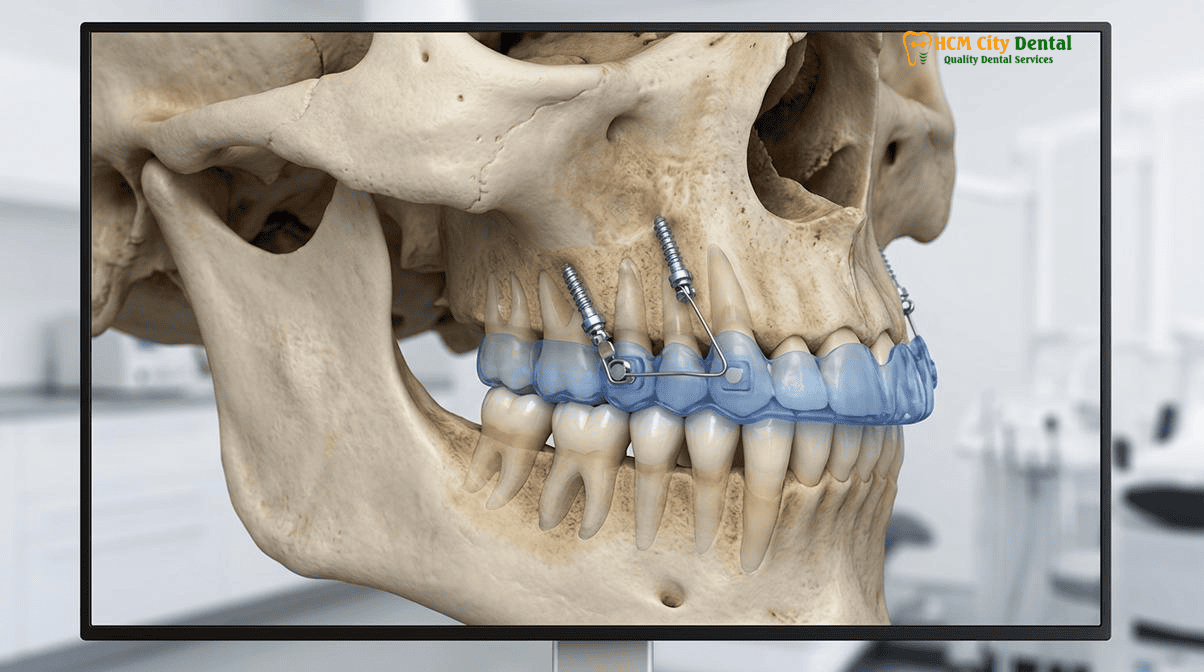
Today, the standard of care at HCMC Dental Clinic utilizes molar intrusion temporary anchorage devices. By placing one TAD on the buccal (cheek) side of the upper molar and another TAD on the palatal (roof of the mouth) side, we create a dual-anchorage system. An elastomeric chain or a nickel-titanium (NiTi) coil spring is stretched from the TADs to attachments on the molar. This applies a gentle, continuous upward force (typically 150g to 200g). [2]
Over a period of 4 to 6 months, this biological force stimulates osteoclastic activity above the tooth roots, allowing the entire molar to slowly intrude (move back up into the jawbone) by 2mm to 4mm. This creates the necessary vertical space for the lower implant while preserving the vitality, nerve, and natural crown of the upper molar. This procedure is frequently combined with partial braces or clear aligners to ensure the tooth remains perfectly upright during the intrusion process.
Clinical Case Study: Pre-Implant Molar Intrusion
A 42-year-old Australian expatriate presented to HCMC Dental Clinic seeking a lower right dental implant to replace a tooth lost five years prior. Clinical examination and 3D CBCT imaging revealed that the opposing upper right first molar had supra-erupted by 3.5mm, completely obliterating the restorative space. Instead of accepting a treatment plan from another clinic that involved a root canal and crown on the healthy upper tooth, the patient opted for Dr. Cuong’s biological approach. Two orthodontic TADs were placed under local anesthesia. Using light NiTi coil springs, the upper molar was successfully intruded by 3.5mm over 5 months. The patient then received a premium Straumann BLT-SLA implant in the lower jaw, preserving the upper tooth entirely and saving thousands of dollars in unnecessary restorative costs.
Indication 2 (Non-Surgical Gummy Smile & Vertical Maxillary Excess): Anterior Intrusion + Laser Crown Lengthening vs. LeFort I Surgery
A “gummy smile”—clinically defined as displaying more than 3mm of gingival tissue upon smiling—can be a significant source of aesthetic insecurity for many adult patients. The etiology of a gummy smile is multifactorial. It can be caused by a hyperactive upper lip muscle, altered passive eruption (where the gums have not naturally receded to expose the full anatomical crown of the teeth), or Vertical Maxillary Excess (VME), a skeletal condition where the upper jaw bone has grown too far downward.
For patients with severe VME, the traditional gold standard of treatment was LeFort I orthognathic surgery. This highly invasive hospital procedure involves surgically fracturing the upper jaw, removing a wedge of bone, impacting the maxilla upward, and securing it with titanium plates and screws. While effective, it carries significant risks, a long and painful recovery period, and exorbitant costs.
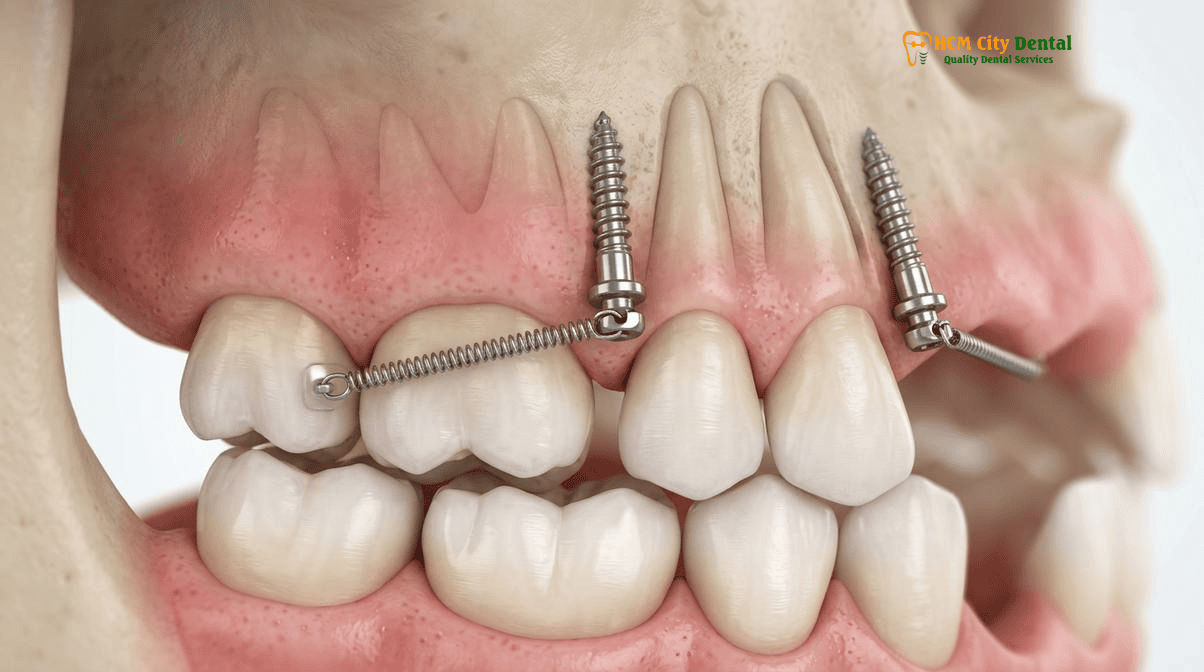
The advent of orthodontic TADs has provided a powerful, non-surgical alternative for mild to moderate VME. By placing TADs high in the anterior maxillary bone (above the roots of the upper incisors), the orthodontist can apply a direct upward force to the front teeth. This biomechanical setup intrudes the entire anterior dentoalveolar complex, physically moving the teeth and the surrounding bone upward by 2mm to 4mm. [3]
“The ability to intrude the anterior maxilla using TADs has fundamentally changed how we approach aesthetic smile design. We can now offer patients a profound reduction in gingival display without the trauma, downtime, and risks associated with orthognathic jaw surgery. It is a triumph of modern biomechanics.”
— Dr. Nguyen Van Cuong, DDS (Clinical Director — MOH License 0003265/BL-CCHN)
To maximize the aesthetic outcome, this anterior intrusion is frequently combined with a diode laser gingivectomy (laser crown lengthening). Once the teeth have been intruded to their optimal skeletal position, the laser is used to gently sculpt the gum line, removing excess tissue and exposing the beautiful, natural proportions of the enamel. This dual approach—skeletal intrusion via TADs and soft tissue contouring via laser—can effectively reduce a gummy smile by up to 5mm to 6mm, delivering a life-changing aesthetic result.
Indication 3 (Anterior Open Bite Closure & Distalization): Infrazygomatic Crest (IZC) and Mandibular Buccal Shelf Titanium/SS Screws
An anterior open bite—where the back teeth touch but the front teeth remain apart—is one of the most challenging malocclusions to treat in adult orthodontics. It severely impairs the patient’s ability to bite into food, affects speech, and often leads to excessive wear on the posterior teeth. Traditional mechanics often struggle to close an open bite because extruding (pulling down) the front teeth is highly unstable and prone to relapse.
The most stable and biomechanically sound method to close an anterior open bite is to intrude the posterior teeth (the molars). By pushing the upper and lower molars into the bone, the mandible (lower jaw) is allowed to auto-rotate counter-clockwise, naturally closing the gap between the front teeth. To achieve this massive posterior intrusion, specialists utilize extra-alveolar TADs placed in dense anatomical safe zones: the Infrazygomatic Crest (IZC) in the upper jaw and the Mandibular Buccal Shelf in the lower jaw.
Because these extra-alveolar sites are located outside the immediate root zones of the teeth, they allow for the placement of longer, thicker stainless steel or titanium screws (often 2.0mm x 12mm). These robust anchors can withstand heavy orthodontic forces, enabling the clinician to intrude and distalize (push back) the entire dental arch simultaneously. [4]
At HCMC Dental Clinic, this advanced TAD biomechanics is frequently integrated with clear aligner therapy. For example, when using Invisalign in Vietnam for Foreigners: Cost & Case Transfers, we utilize Invisalign G5/G8 SmartForce Precision Bite Ramps in conjunction with IZC and Buccal Shelf TADs. The aligners provide precise control over the tipping and torque of the teeth, while the TADs provide the absolute anchorage required to intrude the molars and close the open bite seamlessly and invisibly.
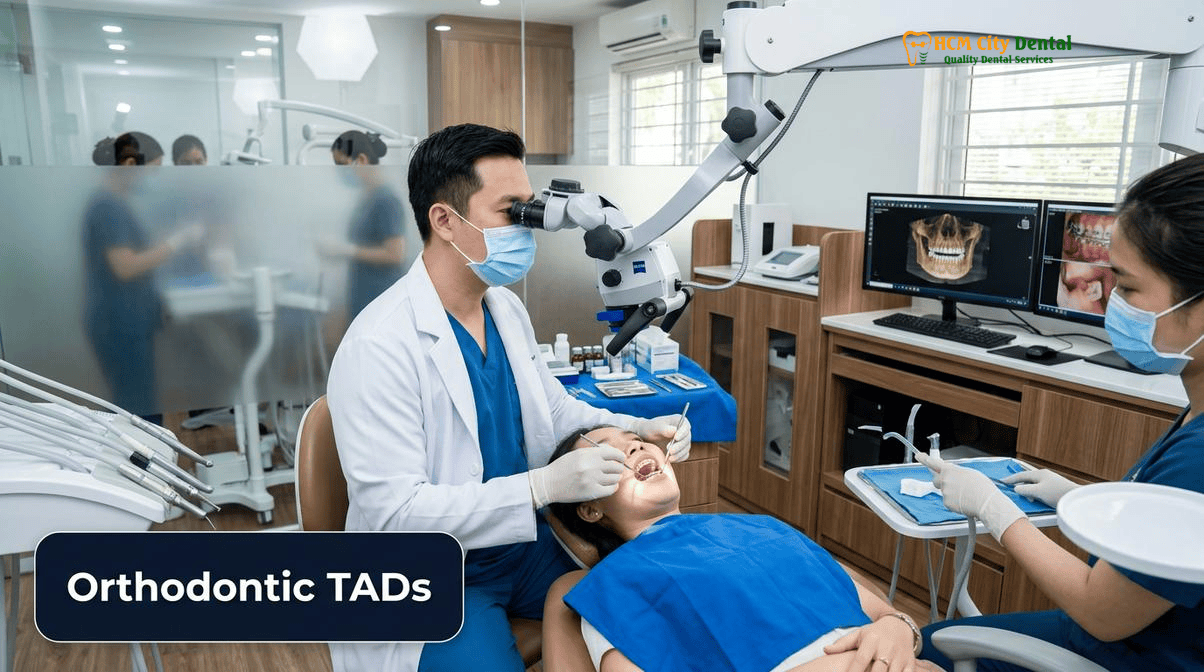
5-Minute Painless Chairside Placement Under Topical/Local Anesthesia and 3D CBCT Root-Proximity Safety Mapping
Despite the profound clinical benefits of TADs, many patients experience anxiety at the thought of having a “screw” placed into their jawbone. It is crucial to understand that the placement of an orthodontic mini-screw is a remarkably simple, minimally invasive, and virtually painless procedure that takes less than 5 minutes per site.
The safety and precision of the procedure begin with digital diagnostics. At HCMC Dental Clinic, every TAD placement is preceded by a high-resolution 3D CBCT (Cone Beam Computed Tomography) scan. This allows Dr. Cuong to visualize the exact position of the tooth roots, the density of the cortical bone, and the location of vital structures such as the maxillary sinus and the inferior alveolar nerve. By mapping the “safe zones” in 3D, the risk of root damage is virtually eliminated.
The clinical protocol is straightforward:
- Anesthesia: The alveolar bone itself has no pain receptors; only the overlying gingiva (gum tissue) can feel pain. We apply a high-strength topical anesthetic gel to the mucosa, followed by a micro-dose of local anesthetic (Lidocaine or Articaine) to completely numb the soft tissue.
- Placement: Using a specialized manual driver, the self-drilling titanium TAD is gently rotated through the gum tissue and into the cortical bone. Because the screw is self-drilling, there is no need to cut a flap of gum tissue or use a surgical drill. The patient feels a sensation of pressure, but absolutely no sharp pain.
- Activation: Once the TAD is stable, the orthodontic force (via elastics or springs) can be applied immediately.
- Removal: When the orthodontic movement is complete, the TAD is simply unscrewed. This often requires only topical anesthesia, and the tiny pinhole in the gum heals completely within 24 to 48 hours without the need for sutures.
Clinical Precaution: TAD Loosening and Oral Hygiene
While TADs have a high success rate (typically 85% to 90%), approximately 10% of mini-screws may become loose during treatment. This is usually due to localized inflammation (peri-implantitis) caused by plaque accumulation around the head of the screw. Patients must maintain meticulous oral hygiene, brushing gently around the TAD and using an antimicrobial mouthwash (such as Chlorhexidine) as directed. If a TAD becomes mobile or causes persistent discomfort, contact HCMC Dental Clinic immediately. The loose TAD can be painlessly removed, the site allowed to heal, and a new TAD placed in an adjacent safe zone.
2026 Orthodontic TADs, Invisalign & Braces Fee Schedule at HCMC Dental Clinic (District 1, Ho Chi Minh City)
For international patients, expatriates, and dental travelers, the cost of advanced adult orthodontics in countries like Australia, the United States, or the UK can be prohibitively expensive. A comprehensive treatment plan involving TADs, clear aligners, and pre-implant molar intrusion can easily exceed $10,000 to $15,000 USD in Western clinics.
By choosing HCMC Dental Clinic, patients gain access to world-class, evidence-based orthodontic care at a fraction of the cost. Our Official 2026 Dental Price List & -40% Online Booking Fee Schedule ensures complete transparency, with no hidden fees. We utilize the exact same premium biomaterials—such as genuine Align Technology Invisalign systems, medical-grade titanium TADs, and Straumann dental implants—as top-tier clinics globally.
“We believe that advanced biomechanics and absolute anchorage should be accessible to everyone. By maintaining a transparent, online-first fee schedule, we empower our international patients to plan their complex orthodontic and implant rehabilitations with absolute financial certainty.”
— Dr. Nguyen Van Cuong, DDS
Below is a detailed breakdown of our 2026 fee schedule for advanced orthodontics, TADs, and related restorative procedures. Please note that the -40% Online Booking Pricing is exclusively available to patients who secure their consultation via our digital platform prior to arrival.
| Clinical Procedure / Biomaterial | 2026 Online Booking Price (USD) | Walk-In / Standard Price (USD) | Estimated US / AUS Benchmark (USD) |
|---|---|---|---|
| Orthodontic TAD Mini-Screw (IZC / Buccal Shelf) | $77 – $115 / screw | $128 – $192 | $300 – $600 |
| Invisalign Go / Lite / Express (up to 14–20 aligners) | $1,615 | $2,692 | $3,500 – $5,000 |
| Invisalign Comprehensive (Unlimited aligners) | $2,538 | $4,231 | $6,000 – $8,500 |
| Non-Surgical Adult MARPE / MSE Palatal Expander | $769 – $1,154 | $1,282 – $1,923 | $2,500 – $4,000 |
| Invisalign Vivera Retainer (Genuine SmartTrack) | $308 | $513 | $600 – $900 |
| Single Korean Implant (Dentis / Neo Biotech / Dentium) | $462 – $654 | $769 – $1,090 | $2,500 – $3,500 |
| Single European / Swiss Implant (Straumann BLT-SLA) | $962 – $1,346 | $1,603 – $2,244 | $4,000 – $5,500 |
| Implant Zirconia HT Crown + Custom Abutment | $154 | $256 | $1,200 – $1,800 |
| 3D CBCT Scan (Diagnostic Imaging) | $18 | $30 | $150 – $300 |
When planning your treatment, it is essential to consider the comprehensive nature of the care provided. For patients undergoing complex movements, we highly recommend reviewing our guide on Hidden Costs Orthodontics Vietnam: Clinical Fee Guide | HCMC Dental to understand how our all-inclusive pricing model protects you from unexpected expenses.
Frequently Asked Questions
My upper molar dropped down into the gap of a missing lower tooth—can 2 orthodontic TADs push it back up without shaving it for a root canal and crown?
Yes. This is one of the most common and highly successful indications for orthodontic TADs. By placing one mini-screw on the buccal (cheek) side and one on the palatal (roof of the mouth) side, we can apply a continuous, light intrusive force (usually via an elastomeric chain or NiTi coil spring). This biomechanical setup can intrude a supra-erupted molar by 2mm to 4mm over a period of 4 to 6 months, creating the necessary vertical restorative space for a lower dental implant without requiring destructive root canal therapy or aggressive crown reduction.
Is placing and removing an orthodontic mini-screw (TAD) painful?
No. The placement of an orthodontic TAD is a minimally invasive, 5-minute chairside procedure. Because the alveolar bone itself lacks pain receptors, only the surface gum tissue needs to be numbed. We use a strong topical anesthetic gel followed by a few drops of local anesthetic (Lidocaine or Articaine). Patients feel a slight pressure during insertion, but zero sharp pain. Removal is even simpler, often requiring only topical anesthesia, and the tiny pinhole in the gum heals completely within 24 to 48 hours.
How many millimeters of gummy smile reduction can anterior TAD intrusion achieve when combined with laser gum contouring?
When utilizing anterior orthodontic TADs for maxillary intrusion, we can typically achieve 2mm to 4mm of true skeletal/dentoalveolar intrusion. If the patient also has altered passive eruption (excess gum tissue covering the anatomical crowns), we can combine the TAD intrusion with a diode laser gingivectomy (crown lengthening). This combined approach can safely reduce a gummy smile by up to 5mm to 6mm, completely transforming the smile line without the need for invasive LeFort I orthognathic jaw surgery.
Why do around 10% of orthodontic mini-screws loosen, and how easily are they repositioned?
Unlike traditional dental implants, orthodontic TADs are designed for temporary mechanical retention, not permanent osseointegration. Factors such as bone density, root proximity, inflammation of the surrounding gum tissue (peri-implantitis due to poor brushing), or excessive orthodontic force can cause a screw to loosen. If a TAD becomes mobile, it is simply unscrewed painlessly, the site is allowed to heal for a few weeks, and a new TAD is placed in an adjacent safe zone guided by a 3D CBCT scan [5].
Can orthodontic TADs be used invisibly alongside Invisalign clear aligners?
Absolutely. The integration of TADs with clear aligner therapy is a cornerstone of modern adult orthodontics. TADs can be placed in discreet locations, such as the Infrazygomatic Crest (IZC) or the palate, and connected to the aligners using precision cutouts and discrete elastics. This allows for complex movements—such as full-arch distalization, severe open bite closure, or molar intrusion—while maintaining the aesthetic and hygienic benefits of the Invisalign system.
References
- Kuroda, S., et al. (2007). Clinical orthodontic treatment of gummy smile with vertical maxillary excess using miniscrew anchorage. American Journal of Orthodontics and Dentofacial Orthopedics.
- Park, Y. C., et al. (2003). Intrusion of posterior teeth using mini-screw implants. American Journal of Orthodontics and Dentofacial Orthopedics.
- Sugawara, J., et al. (2006). Treatment and posttreatment dentoalveolar changes following intrusion of mandibular molars with application of a skeletal anchorage system (SAS) for open bite correction. International Journal of Adult Orthodontics and Orthognathic Surgery.
- Almeida, M. R. (2019). Biomechanics of extra-alveolar mini-implants (IZC and buccal shelf). Dental Press Journal of Orthodontics.
- Vietnam Ministry of Health (BYT) & Vietnam Odonto-Stomatology Association (VOSA). National Clinical Guidelines on Specialist Dental Care, Biomaterial Traceability & EN 13060 Class B Infection Control. (2024). [5]